You're standing at the counter after a wreck, looking at a repair estimate and a low insurance offer, and something feels off. The car is a Toyota, Honda, Nissan, or Subaru, maybe built in Ohio, Kentucky, Tennessee, or Japan, and the adjuster is talking as if all Japanese-brand cars get treated the same. They don't.
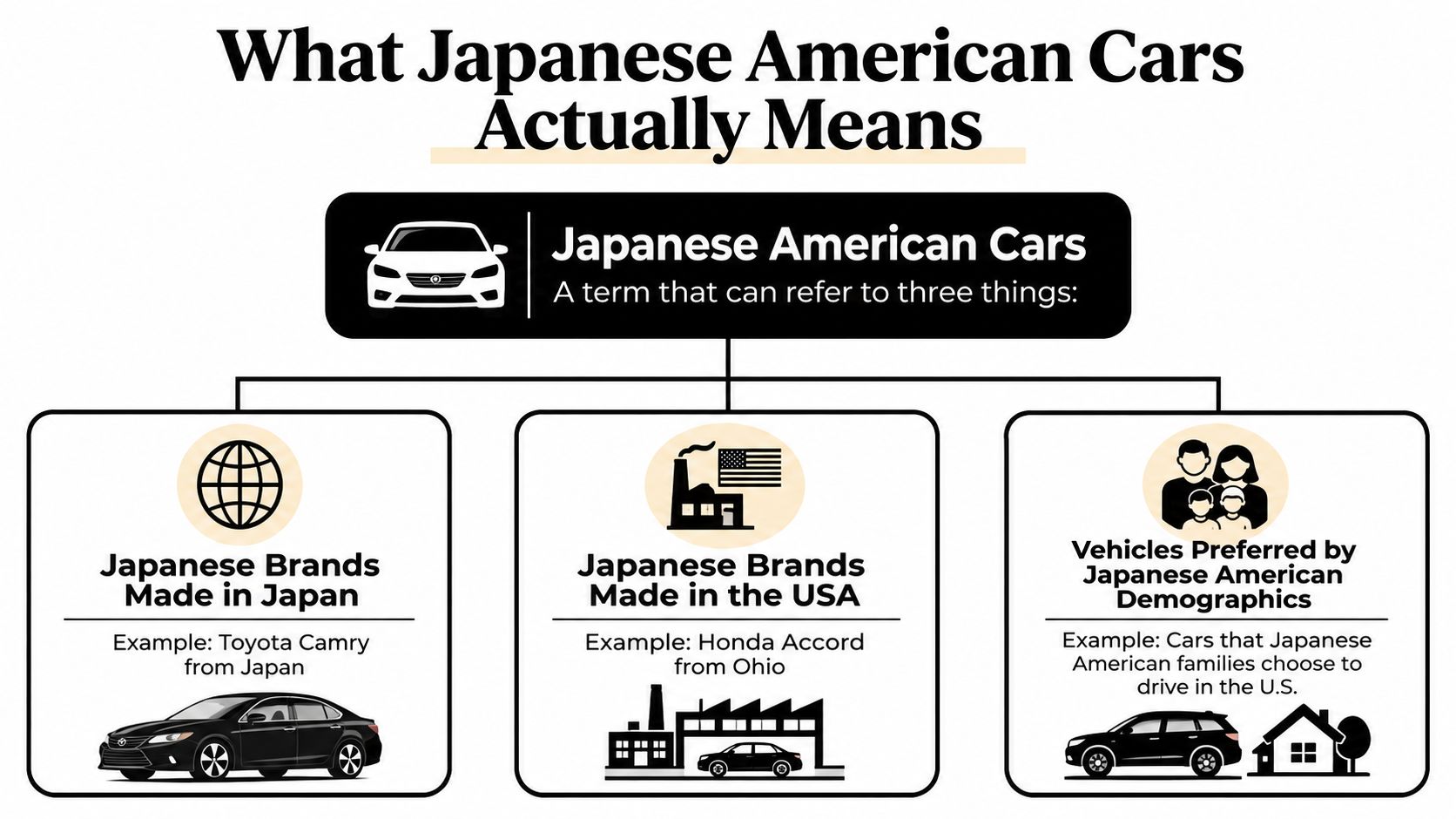
Japanese American cars means different things depending on who's asking. For one buyer, it means a Japanese-brand vehicle assembled in the United States, like a Camry, Accord, or CR-V built here and sold here as part of the domestic market. For someone else, it means the longer cultural story of Japanese American people in design, racing, repair, and customization. For accident claims, the only meaning that really matters is the one on the VIN, the title, the build sheet, and the comparable sales set.
If your claim involves diminished value, the first mistake is easy to make, and expensive to fix. An insurer can't appraise your car correctly if it starts from the wrong identity. A U.S.-built Toyota and a Japan-built Toyota may share a badge, but they don't always draw the same comparable sales, and that difference can matter once the accident is on the record.
What Japanese American Cars Actually Means
You can hear the phrase Japanese American cars three different ways, and only one of them belongs in an appraisal file. If your car was built in the United States, that's a domestic-assembly question, not a cultural question. If you're talking about the Japanese American community's role in car culture, that's a history question. If you're arguing with an insurer over resale loss, it's a documentation question.
Start with the build, not the badge
The badge tells you the brand. The build location tells you a lot more about how an adjuster should handle the file. A Camry assembled in Kentucky is treated differently in the market than a similar model imported from Japan if the comparable-sale pool, buyer perception, and repair-network familiarity differ. That's why smart claimants look at the VIN and the title first, not the marketing.
Practical rule: Don't let an adjuster collapse every Japanese-brand vehicle into the same bucket. The badge is only the beginning.
The cultural side matters too, but mostly because it explains why online searches for this phrase often miss the mark. Recent coverage of the Cruising J-Town project frames Japanese American automotive history as a broader story of design, racing, mechanics, and customization, not just imports or street tuning, and it points to more than 100 objects, photos, home movies, memorabilia, concept designs, and classic cars in the record of that history (Discover Nikkei coverage of Cruising J-Town). That's a useful reminder, but it won't decide your insurance payout.
What matters in a claim
If you're filing for diminished value, focus on three questions. First, where was the car built. Second, how did the accident affect its marketability. Third, what kind of buyer now sees the car as less desirable. Those questions control the settlement conversation far more than the broad label attached to the brand.
A good claim file answers those questions cleanly. A sloppy one lets the insurer pick the easiest classification and run with it. That's how people lose standing before the negotiation even starts.
The Rise of Japanese Brand Cars in America
A Japanese-brand car in the U.S. market earned its place through reliability, sensible engineering, and years of buyer trust. That history matters in a diminished-value claim because the market still treats these cars with specific expectations. A Camry, Civic, or Supra built in Tennessee or Ohio does not get appraised the same way as a comparable foreign-built model, even before you get to the repair file.
By 1976, Japanese-brand U.S. sales had already tripled since 1970 to more than 1 million units and an 8% market share, and by 1980 they reached 21% share (American Compass). Those numbers show how quickly buyers accepted the brands, and that acceptance still shapes how adjusters think about marketability after a loss.
The turning point came fast
In 1980, Japanese automakers also surpassed U.S. automakers in total automobile production for the first time, producing about 7 million vehicles versus 6.4 million in the United States. That shift ended the old outsider label and put Japanese brands at the center of the U.S. auto market.
The U.S. response changed the industry structure. In 1981, Japanese imports totaled 1,855,913 cars, which made up 80.0% of imported-car sales in the U.S. The Voluntary Export Restraints that followed capped Japanese exports to the U.S. at 1.68 million units in 1981 after 1.82 million the year before (CRS report).
Why that matters to appraisers
That history changed where the cars were built. Japanese-brand automakers did not stay purely foreign. They built a durable U.S. manufacturing base, and that base later grew to $53.3 billion in cumulative manufacturing investment since the early 1980s and support 1.6 million U.S. jobs. For a closer look at how that shift shows up in the market, the overview at Japanese car brands in America is useful, but the appraisal point is simpler, a U.S.-assembled Japanese-brand car often belongs in the domestic comparable set, not the imported one.
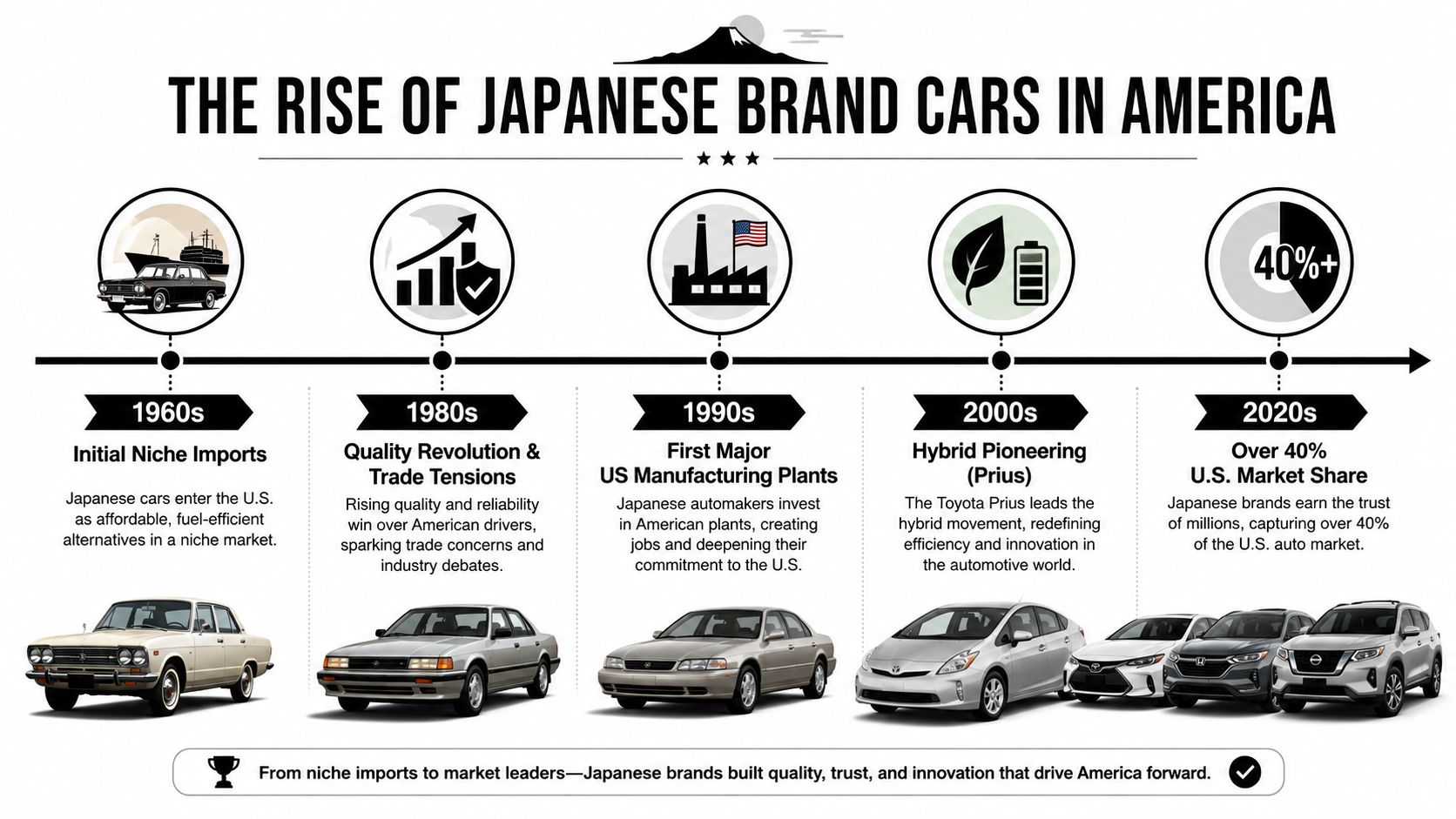
The point is plain. Japanese-brand vehicles are woven into the U.S. market, and appraisers should treat them that way when they compare post-loss value.
Engineering Traits That Shape Resale Value
Some Japanese performance cars hold value differently because they were engineered differently from the start. A compact turbo engine, low curb weight, and rear-wheel drive create a strong power-to-weight ratio, and that combination attracts buyers who care about balance, track use, and drift potential. That matters after a crash. The same traits that make the car desirable can also make repairs easier to spot, which affects the appraised loss.
Why the platform matters
The Nissan Silvia S13, S14, and S15 line is a clean example. In export trim, the SR20DET 2.0-liter turbo I4 is widely documented at about 247 hp and 203 lb-ft, with weight around 2,700 lb (MotorTrend). That setup puts the car in a very different valuation bracket than a heavier coupe with a broader buyer base. The pool is smaller, but the buyers are more exacting, so accident history can hit harder at claims time.
Japanese sports-car engineering also tends to favor high-rpm naturally aspirated engines or twin-turbo powertrains rather than sheer displacement. The Toyota 86/GR86 platform uses a 2.0 to 2.4-liter horizontally opposed four-cylinder with direct and port injection and a 12.5:1 compression ratio, making 197 to 228 hp at 7,000 rpm depending on generation, while the current Nissan Z uses a 3.0-liter twin-turbo V6 rated at 400 hp and 350 lb-ft (Car and Driver). Those layouts reward proper cooling, careful tuning, and repair records that show what was replaced and how it was put back together.
Appraiser's rule: High-output Japanese cars often lose more negotiating power when repairs are sloppy, undocumented, or built around tuned parts. The market notices.
What helps, what hurts
A stock, well-kept car usually gives you cleaner comparables than a modified one. A documented intercooler, oil-cooling setup, or quality suspension package can help preserve performance credibility, but only if the paperwork is tight. If the car has mixed parts, missing invoices, or unknown tuning, the carrier can argue the pre-loss value was already less stable.
The same engineering traits that make these cars fun also make them more sensitive in appraisal. Light weight, turbo response, and enthusiast demand can support a stronger diminished-value claim after an accident, but only if you prove the car was desirable before the crash. A claims file that shows careful maintenance, correct parts, and consistent build history gives the owner a better position than a stack of vague repair notes.
For a claims-focused look at how that documentation fits into the process, see this JDM vehicle appraisal guide.
How Origin Affects VINs, Titles, and Insurance Valuation
The first thing I check on any Japanese-brand claim is where the car was built. The badge doesn't settle that question. The VIN, title, and build data do.
Read the file like an appraiser
The first character of the VIN tells you the country or region of origin. That matters because a U.S.-assembled Toyota or Honda usually belongs in a different comparable-sale pool than an imported version of the same model. If the insurer uses the wrong origin, the valuation can drift downward before you even get to diminished value.
Title branding matters too. If the car already had prior damage, salvage branding, or an undisclosed history entry, the new accident doesn't land on a clean slate. Each prior issue narrows the buyer pool and can amplify the post-loss loss in value. That's one reason I never accept a carrier valuation until I've checked the title history and the origin code.
For a more detailed claims-focused breakdown, this JDM vehicle appraisal guide is a useful companion to the VIN and title review process.
Common Japanese-brand models and their U.S. assembly plants
| Brand | Model Examples | Primary U.S. Assembly Plant | VIN Country Code |
|---|---|---|---|
| Toyota | Camry, Corolla, RAV4 | Kentucky, Mississippi, Texas, Indiana | Varies by build location |
| Honda | Accord, Civic, CR-V | Ohio, Alabama, Indiana | Varies by build location |
| Nissan | Altima, Pathfinder, Rogue | Tennessee, Mississippi | Varies by build location |
| Subaru | Ascent, Legacy, Outback | Indiana | Varies by build location |
| Mazda | CX-50 | Alabama | Varies by build location |
What to verify before you argue value
- Assembly location: Confirm the plant from the VIN and build sheet, not the salesman's memory.
- Title status: Check for prior branding, because it changes the market baseline.
- Option content: Trim, drivetrain, and factory equipment can change comparables more than the badge does.
- Repair history: Previous damage can shrink the fair market value before the current loss ever happened.
If an insurer classifies your car as imported when it was built here, challenge it immediately. That mistake is one of the easiest to catch and one of the most expensive to let slide.
How Diminished Value Is Calculated on These Vehicles
Diminished value is the gap between what the car was worth before the crash and what the market will pay after a proper repair. That sounds simple, but the details change fast when you're dealing with Japanese-brand vehicles, especially performance trims, newer models, and cars with a strong reputation for reliability or resale strength. The insurer's first offer often treats every car like generic transportation. The market doesn't.
The formula is only the beginning
A carrier may lean on a formula approach, but the settlement still depends on the vehicle's desirability, origin, trim, prior condition, and the quality of the repair documentation. A mass-market Corolla does not behave the same way as a GR Supra or a modified WRX. Even when the damage is repaired correctly, the buyer psychology is different.
A clean, late-model sedan usually has a broad comparable set, so the loss can stay modest. A high-demand coupe or enthusiast car can show a much more noticeable spread because fewer buyers are willing to overlook an accident history. That's where an insurer's software usually undercounts the damage.
Three claim patterns I see over and over
Practical rule: The rarer the trim and the narrower the buyer pool, the harder it is for a carrier to justify a weak diminished-value offer.
- Mass-market sedan: The appraisal leans heavily on ordinary commuter comparables. The carrier often argues the accident history doesn't matter much, but that ignores buyer caution in the used market.
- Mid-trim SUV: Factory equipment, condition, and repair quality matter more than the badge. A clean repair can soften the hit, but only if the paperwork is strong.
- Performance coupe: Enthusiast demand changes the math. Buyers expect sharper condition standards, so a crash record can suppress value more than the carrier admits.
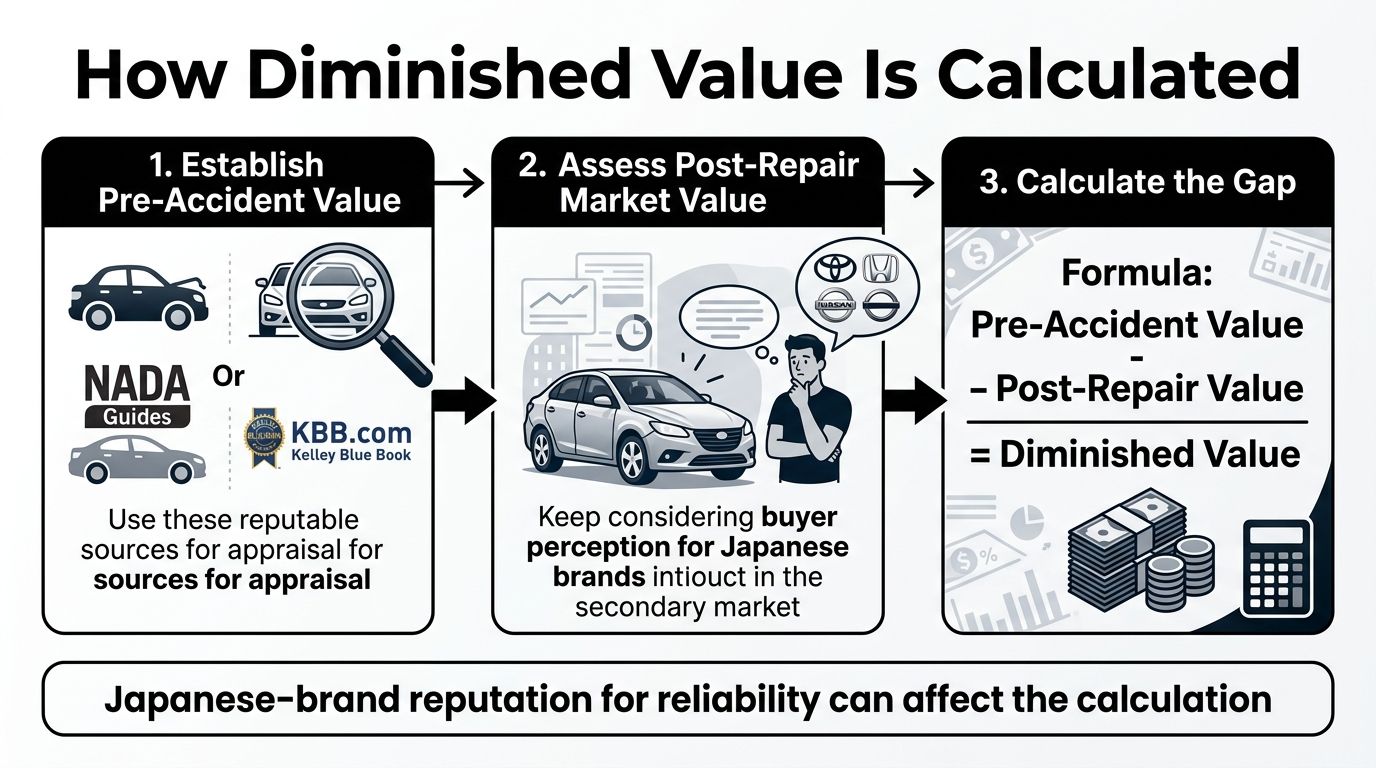
Japanese-brand reliability can support resale, but it doesn't erase diminished value after a loss. In some cases, that reputation just means the car was worth more before the crash, so the gap is bigger afterward. The wrong move is letting the carrier treat “reliable” as “unharmed.”
A proper claim uses the pre-accident market, the post-repair condition, and the buyer's real reaction to an accident record. That's the only math that matters.
Documentation Steps That Maximize Your Settlement
A strong diminished-value claim lives or dies on paperwork. I've seen good claims underpaid because the owner skipped photos, lost repair records, or accepted a vague shop invoice that didn't prove what was replaced. Insurers love missing records because missing records make low offers look reasonable.
Build the file in the right order
Start with pre-loss photos if you have them, especially shots that show paint condition, wheel condition, and any upgrades. Then gather the police report, repair estimate, final invoice, and any parts list that shows OEM versus aftermarket components. If the car was modified or maintained carefully, add oil-change logs, alignment sheets, and prior inspection records.
Keep the file boring and complete. Boring files win arguments.
A good workflow also includes comparable sales data and a post-repair inspection from someone who isn't tied to the carrier. If you're dealing with a family vehicle and need a broader claim checklist, the insurance claim guide for families is a practical reference for organizing the early steps without getting lost in jargon.
What the Appraisal Clause actually does
If the carrier won't move, the Appraisal Clause can force a structured valuation process. You name an appraiser, they name one, and if those two disagree, an umpire can resolve the gap. That process matters because it shifts the conversation away from the insurer's preferred software and toward a market-based review.
The clause isn't magic. You still need documentation, comparable sales, and a clear argument for why the first offer is wrong. But it gives you a position of strength the carrier often doesn't want to face.
A quick claim checklist
- Take pre-accident photos: Timestamped shots help establish condition.
- File the police report: It anchors the loss date and fault context.
- Get multiple repair estimates: The range can expose hidden issues.
- Hire an independent appraiser: Independent review reduces software bias.
- Gather comparable sales: Real market data beats vague insurance math.
Do this the same week the car leaves the shop. Waiting only gives the insurer more room to say the loss is old news.
When an Independent Appraiser Changes the Outcome
A carrier appraiser works inside a system built to save the company money. An independent appraiser works to establish what the market says your car lost. That difference matters most on Japanese-brand vehicles that have strong trim differentiation, a narrow buyer pool, or unusual equipment.
Where the gap gets widest
A recent model-year Toyota, Honda, Nissan, or Subaru with a clean history often has a sharper pre-loss value than the insurer wants to admit. A performance trim like a GR86 or Nissan Z can widen that gap further, because buyers in that segment care about accident history, repair quality, and originality. Modified or collector-grade cars are even tougher, because carrier software tends to underweight equipment, condition, and enthusiast demand.
An independent report usually lays out the build, origin, condition, comparable sales, and repair history in plain English. That makes it useful in negotiation and in an appraisal-clause dispute. It also stops the carrier from hiding behind a one-line valuation number that never explains itself.
For a deeper look at how the process works, see the independent car appraiser guide.
When to hire one without hesitation
- Your car is a performance model: The market reacts more strongly to damage history.
- Your car was built in the U.S. but branded Japanese: Origin and comparable selection can shift the number.
- The offer looks generic: If the insurer ignored trim, options, or condition, the report is weak.
- The repair involved special parts: The more unusual the equipment, the more likely the carrier missed something.
The plain advice is this. If the settlement feels like it was built from a template instead of a real market analysis, push back. A good independent appraisal doesn't create value out of thin air. It forces the insurer to acknowledge value that was there before the crash and still matters after the repair.
If your Japanese-brand car was hit and the offer feels thin, get the claim looked at before you sign anything. Total Loss Northwest handles diminished value and total loss appraisals with the kind of market-based review insurers don't like to see, and they can help you challenge a low settlement with a real report. Visit Total Loss Northwest if you want a second opinion that treats your car like an actual market asset, not a line item.