You walk up to the car, press the button, hear the click, pull the handle, and nothing happens. Or the key turns halfway and stops. Or the inside handle moves, but the door stays shut. That kind of lock stuck on car door problem feels minor right up until you're late, carrying groceries, or trying to get a child seat out of the back.
Most of the time, the cause is ordinary wear. A stuck or jammed car door lock is often a mechanical symptom of wear, and with the average age of light vehicles in the U.S. reaching 12.5 years in 2024 according to this vehicle age reference, more owners are dealing with aging latch and lock hardware. The mistake is treating every stuck lock like a nuisance you should overpower with more force.
Sometimes that works against you. A sticky latch may respond to cleaning and lubrication. A failed actuator may need replacement. A door that started sticking after a collision, flood exposure, or theft attempt is different. In an appraisal setting, that “simple” door issue can point to hidden damage inside the door shell, latch area, wiring, or hinge side structure.
That distinction matters. If you force the lock and tear up the evidence, you can make diagnosis harder and claims messier. The right move depends on what caused the lock to stick in the first place.
That Dreaded Click and a Door That Stays Shut
A common version goes like this. The remote disengages the locks on the other doors, the lights flash, and one door still refuses to open. From outside, the handle feels normal but disconnected. From inside, the lock knob moves, yet the latch won't release. Owners often assume the key cylinder is bad or the outside handle broke.
Sometimes they're right. Often they're not.
On older vehicles, repeated use wears down the small moving parts inside the door. The actuator, linkage rods, clips, and latch assembly all cycle over and over for years. One worn clip or one sticky latch jaw can leave the door shut even when the central locking system seems to be doing its job. That's why a lock stuck on car door complaint usually needs a diagnosis before it needs parts.
What this can mean in real life
A front door that won't open from the outside may be an annoyance. A rear door that won't open at all is a safety problem. A driver's door that jams after a side impact is something else entirely.
Practical rule: If the problem appeared gradually, wear is more likely. If it appeared right after an impact or intrusion, treat it as damage until proven otherwise.
As an appraiser, I pay attention to timing. If a client says, “The lock was fine before the crash,” I don't write that off. Door hardware is tied to alignment, structure, and electronics inside the door. A jammed lock can be the first visible symptom of a larger repair issue.
Don't decide too early
Before you spray anything, pry anything, or book the first shop you find, pause long enough to answer one question. Did this door start acting up on its own over time, or did it start after some event?
That answer changes everything. It affects the repair path, the kind of technician you need, and whether the door should be preserved for inspection instead of forced open.
How to Diagnose Why Your Car Door Lock Is Stuck
Diagnosis saves money. It also keeps you from breaking trim, bending rods, or replacing the wrong part. Modern vehicles increasingly rely on electronic locking systems, and over 90% of new vehicles feature remote or power locking according to this electronic locking overview. That means a stuck lock can come from an actuator, wiring issue, sensor fault, or door module problem, not just a worn key cylinder.
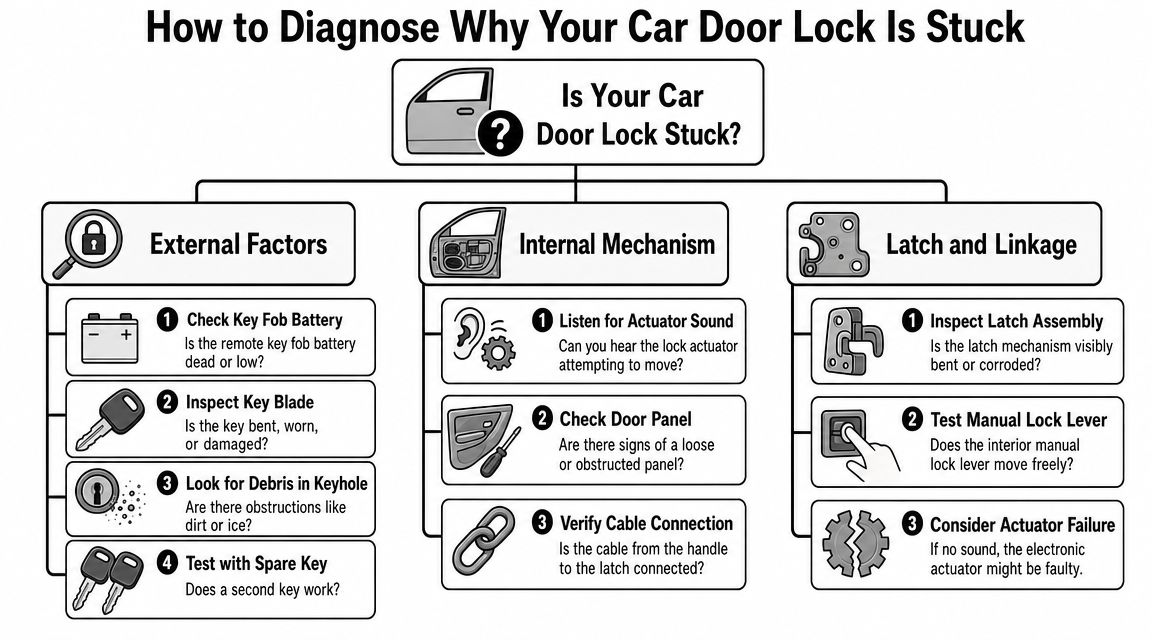
Start with the simplest split
First, determine whether the failure is mechanical, electrical, or alignment-related.
Ask these questions:
- Does the lock fail with both the remote and the key? If yes, the issue may be inside the door rather than in the key itself.
- Does it open from inside but not outside? That points toward linkage, cable, handle, or clip trouble.
- Do you hear a whirring or clicking sound inside the door? That can mean the actuator is trying to move but isn't moving the latch.
- Does the manual lock lever feel stiff or blocked? That suggests binding in the latch or linkage.
- Did the problem begin after body damage or a hard slam? Then alignment moves much higher on the list.
A practical flow you can follow
Use this sequence before removing anything:
Test every entry method
Try the remote, the physical key if equipped, the inside lock control, and both door handles.Compare that door to the others
If one door is the only problem, think local fault. If multiple doors are involved, think power, fuse, module, or programming issue.Listen closely
Have someone activate the lock while you stand near the affected door. Sound without movement often means the mechanism is jammed. No sound at all can point toward the actuator or electrical control side.Look at door fit
Uneven panel gaps, rubbing marks near the striker, or a door that needs an extra push to close can indicate misalignment.Decide whether this is a lock issue or a latch issue
A lot of owners say “the lock is stuck” when the latch is the actual problem.
| Symptom | Potential Cause | Next Step |
|---|---|---|
| Remote works on other doors but not this one | Local actuator, latch, linkage, or wiring fault | Listen for actuator sound and inspect inside-door access points |
| Door opens from inside only | Exterior handle linkage, cable, or clip issue | Inspect handle-to-latch connection |
| Key turns but nothing releases | Internal latch failure or disconnected rod | Check latch movement before replacing cylinder |
| Lock button moves but door stays shut | Jammed latch or misalignment | Inspect striker and latch relationship |
| Door became hard to close before it stopped opening | Striker or hinge alignment issue | Check fit and adjust carefully if appropriate |
When parts knowledge actually helps
If you're trying to understand how lock parts differ before you authorize a repair, this Blade Auto Keys lock replacement info is useful because it separates cylinder and lock replacement issues from broader door hardware failures.
If the key, remote, and inside switch all give the same bad result on one door, stop assuming the cylinder is the problem.
That one observation keeps people from paying for key work when the fault is buried in the door.
Safe DIY Fixes for Common Mechanical Jams
A stuck lock can be a simple latch problem. It can also be the first visible sign that the door is no longer sitting where it should. Before touching tools, decide whether you are trying to free a sticky mechanism or force damaged parts back into place. Those are very different jobs, and I treat them differently when a vehicle may later be inspected for repair quality, diminished value, or total loss.
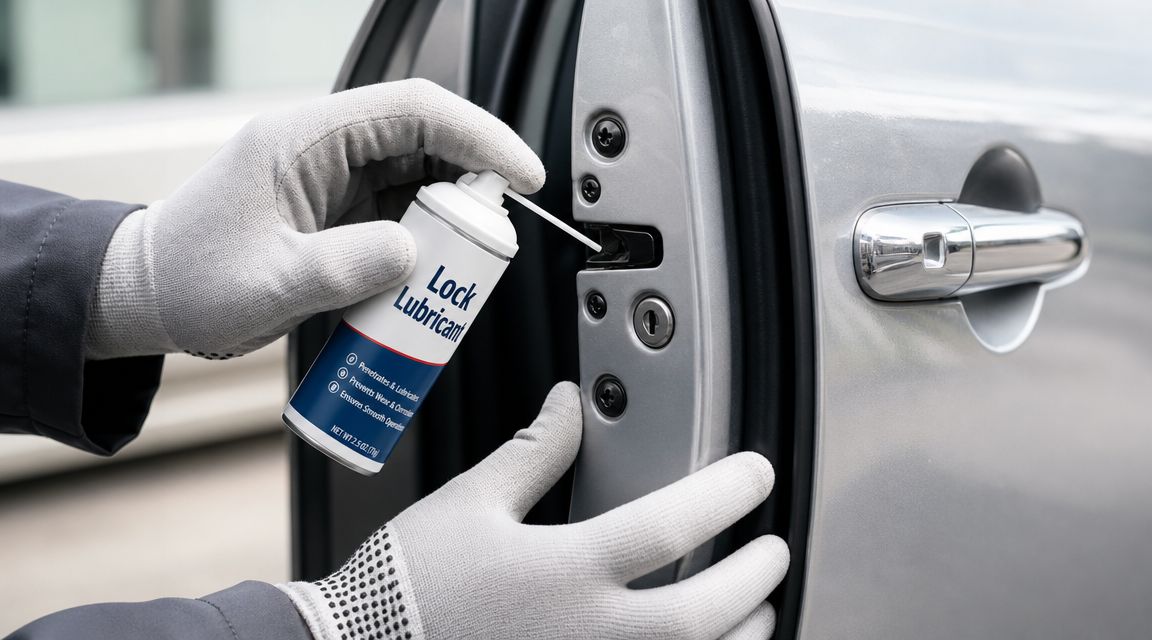
Start with the fixes that free minor contamination or a light bind without changing the evidence. If the vehicle was hit recently, photographed for a claim, or has visible door-gap changes, document the condition first. Good photos and notes often matter as much as the repair attempt, especially if you are already working through the steps to take after a car accident.
Fixes that are worth trying
Use light pressure and stop when resistance increases. A latch that frees with gentle help was sticking. A latch that fights back usually has a bent, broken, or loaded component behind it.
Lubricate the latch itself
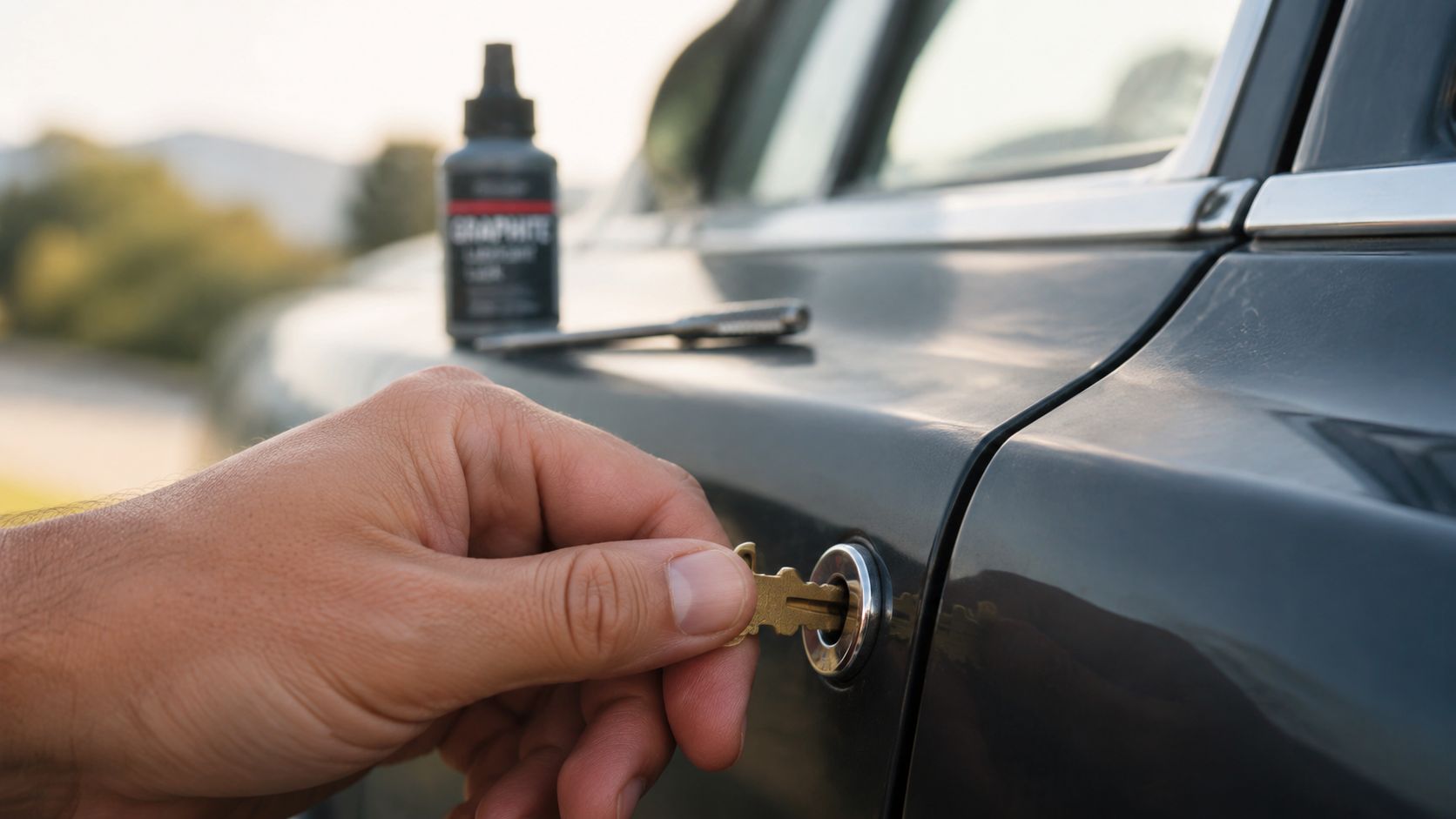
Spray a small amount of silicone lubricant or a light penetrating product into the latch opening, not just the key cylinder. Cycle the inside lock, outside handle, and inside handle gently. Wipe off excess so it does not attract grit.Check whether the latch is already in the closed position
This happens more often than drivers expect. With the door open, compare the stuck door's latch to a working door. If the latch jaw is closed, use a screwdriver or similar tool to rotate it back only while the handle is held in the open position. Keep fingers clear.Relieve pressure on the latch while someone works the lock
A light push inward on the door, or slight pull on the handle while another person operates the key fob or interior switch, can release a latch that is binding against the striker.Look at the striker and latch alignment
If the rear edge of the door sits proud, drops when opened, or needs a shove to catch, the latch may be under side load. In that case, more force usually makes the condition worse.
A careful striker adjustment
Only make this adjustment when the vehicle has no crash history tied to the problem and the door fit issue is minor and obvious. Mark the striker's original outline with tape or a paint marker. Then loosen it slightly and shift it in very small increments before retightening. General service guidance from Family Handyman's car door adjustment overview is consistent with what works in the field. Tiny changes matter here.
If one small correction improves closing effort and lock operation, you likely found a basic alignment issue. If the door suddenly fits worse, sits unevenly, or still will not release cleanly, return the striker to its marked position and stop.
What not to do
Bad DIY attempts create expensive appraisals.
- Do not force the key into a binding cylinder. Broken key extraction is a separate repair.
- Do not pry the door frame or glass channel from outside. That can bend the shell, mark trim, and complicate a claim.
- Do not keep slamming the door to "free it up." Repeated impact can damage the latch, striker, hinge, or window frame.
- Do not flood the inside of the door with spray if electronics, switches, or wiring may be nearby.
If gaining entry is the primary concern and you are trying to avoid cosmetic damage, this professional damage-free car entry guide shows what low-risk entry methods are supposed to look like.
Here's a useful visual on the kind of gentle latch work that can help when corrosion or sticking is the issue:
When DIY has done enough
A healthy latch usually shows some response to cleaning, lubrication, or pressure relief right away. No change after those steps points away from a simple jam and toward internal failure, bent hardware, or door-structure movement.
That distinction matters. Once a lock problem overlaps with accident damage, forced entry, flood exposure, or visible misalignment, every extra DIY attempt risks hiding the original condition or adding new damage that muddies the repair record. At that point, the smart move is to stop, document what you found, and let the next inspection start from clean facts.
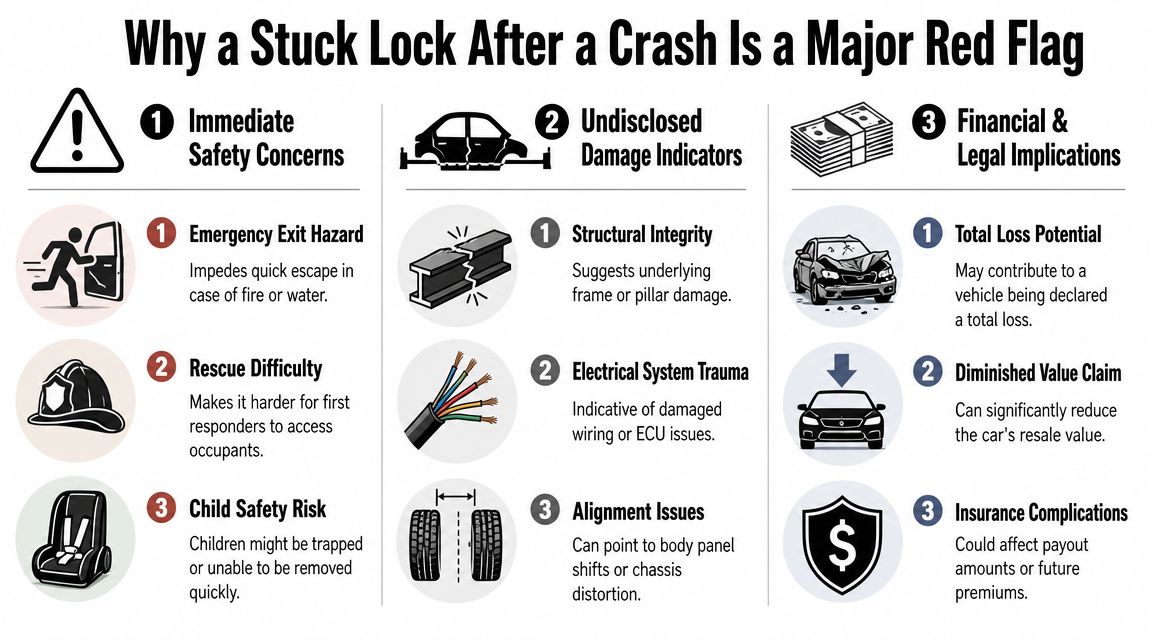
Why a Stuck Lock After a Crash Is a Major Red Flag
You get the car back after a side hit, press the fob, hear the click, and one door still refuses to open. That is not a minor annoyance. It is a post-loss symptom that can point to hidden structural or electrical damage inside the door.
Door latches, hinges, and retention systems are part of the vehicle's safety design, and crash damage can affect far more than the outer panel. NHTSA's occupant protection standards for side door strength and door retention exist because door performance in a crash matters to both protection and exit function. A lock that jams after impact can trace back to a shifted door shell, latch misalignment, damaged wiring in the door, or deformation around the hinge and striker areas, as reflected in NHTSA's Federal Motor Vehicle Safety Standards overview.
Why appraisers pay attention to this
In appraisal work, a stuck lock after a collision often helps confirm the actual repair scope. A door can look acceptable from six feet away and still have latch mounting movement, shell distortion, hinge shift, or damage to the door harness. On newer vehicles, that matters even more because the same door may house wiring for windows, mirrors, latch sensors, side airbags, or blind-spot components.
That affects three parts of the claim:
Safety and access
A door that will not open or latch correctly can interfere with occupant exit and post-crash inspection.Repair scope
What starts as a lock complaint may expand into alignment checks, latch replacement, harness inspection, sensor calibration, or shell repair.Vehicle value
Hidden side damage can change both the final invoice and how the market views the vehicle after repair, which matters in diminished value and total loss discussions.
Why preserving the condition matters
A jammed lock can be evidence of how the impact traveled through the door. If someone forces it open before the car is inspected, that original condition becomes harder to separate from later damage. From an appraiser's standpoint, that can muddy causation. From an owner's standpoint, it can create avoidable disputes about what the crash caused and what happened afterward.
Preserve what the vehicle is showing you.
Document these points before repair:
- Take close photos of the latch area, striker area, panel gaps, hinge area, and any paint rub or metal witness marks
- Record a short video showing the remote response, interior lock switch response, and handle movement
- Write down timing such as whether the door failed immediately after the accident or after the first shop visit
- Note the feel of the handle, lock knob, and door fit, including looseness, stiffness, sag, or scraping
If the claim is still being opened or reviewed, this steps after a car accident checklist helps preserve the broader record while the damage pattern is still fresh.
The line between a lock problem and a crash problem
A pre-accident sticky latch is one thing. A lock that starts binding after a side impact, theft attempt, or flood exposure is a different category. In that situation, the smart approach is to protect the evidence, note the symptoms, and let the right shop inspect the door as a system, not just as a latch.
That distinction can affect repair quality, claim handling, and value.
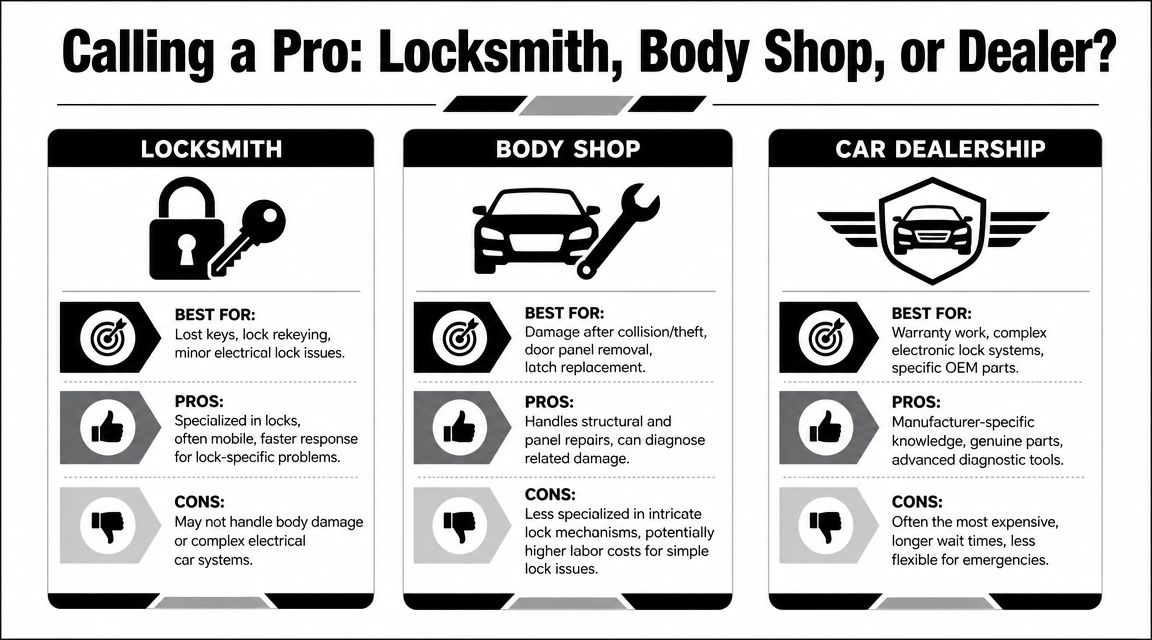
Calling a Pro, Locksmith, Body Shop, or Dealer?
Once DIY stops making sense, the right professional depends on the fault. People waste time when they call the cheapest option instead of the right one. A key specialist is not the same thing as a collision technician, and neither one is automatically the best choice for a modern electronic door module.
A simple door-latch problem may be repairable in roughly 30 minutes to 2 hours of labor, while a failed internal latch mechanism or actuator typically needs replacement rather than adjustment, according to this door latch labor benchmark.
When a locksmith is the best call
A locksmith is usually the right choice when the problem centers on keys, cylinders, or entry.
Good fit:
- Broken key in the lock
- Worn key blade
- Cylinder won't turn
- Lockout with no collision history
- Some minor lock-specific electrical issues
Weak fit:
- Door won't latch correctly
- Door is visibly misaligned
- Problem began after an accident
When a body shop makes more sense
A body shop is the better call when the lock stuck on car door complaint is really about door fit, latch mounting, or damage. If the door edge rubs, panel gaps changed, or the vehicle has side damage history, that's body-shop territory.
Look for a body shop if:
- The door became hard to close first
- The latch and striker don't line up cleanly
- The lock jam followed a side impact or theft attempt
- Interior panel removal is needed and the door won't open normally
A lock that failed after an impact is rarely just a lock problem.
When the dealer earns the higher bill
A dealer is often the right place for vehicle-specific electronics, especially when the door module, actuator logic, scanning, or OEM-only parts are involved. The dealer also makes sense for warranty work or newer vehicles with integrated access systems.
That doesn't mean the dealer should be first by default. If the door is bent, they may still send you to a body shop after charging diagnostic time.
A quick comparison
| Pro | Best use case | Where they struggle |
|---|---|---|
| Locksmith | Key, cylinder, lockout, basic lock hardware | Alignment, collision damage, deeper body issues |
| Body shop | Door alignment, latch mounts, impact-related door faults | Key programming, some vehicle-specific electronic coding |
| Dealer | Module diagnostics, OEM electronics, warranty concerns | Cost, wait time, and non-electronic body corrections |
If the dispute has already shifted from repair to value, especially after collision damage, an independent car appraisal services review can help determine whether the visible lock issue is part of a larger loss picture rather than a standalone repair ticket.
Simple Habits to Prevent Future Lock Problems
Door locks don't fail all at once. Most give warnings first. The trick is noticing them while the repair is still simple.
Small maintenance goes a long way
Lubricate moving hardware periodically
Light service on latch points and related moving parts helps keep contamination and corrosion from taking over.Pay attention to how the door closes
If the door suddenly needs more effort, don't ignore it. That's often the early clue before a latch or alignment complaint turns into a stuck door.Watch for slow or weak lock action
A lock that sounds strained or moves inconsistently deserves attention before it quits.
Avoid creating your own problem
Don't use the door as a lever
Leaning on a half-latched door or slamming it against resistance can make alignment worse.Keep the weather seals and latch area clean
Dirt, old grease, and moisture all work against smooth latch operation.Treat one bad symptom as enough reason to inspect
If one door acts differently from the others, that's the time to check it.
Most lock problems are cheaper and cleaner to address before the door stops opening.
FAQ About Stuck Locks and Insurance Claims
Should I force a stuck door lock after an accident?
No. After a crash, a jammed lock can point to a shifted latch, a bent door shell, damage around the striker, or a fault in the door electronics. If you pry on it, slam the door, or keep cycling the switch, you can turn a clean damage trail into a mixed repair record. That makes it harder to show what the impact caused versus what happened later.
Leave it as found if possible. Take photos, record a short video of the key fob, lock switch, inside handle, and outside handle, and note whether the door was working properly before the loss.
Can a stuck door lock be part of an insurance claim?
Yes, if the problem started with a covered event such as a collision or attempted theft. The issue is causation.
From an appraisal standpoint, insurers usually want a clear link between the loss and the lock failure. If the door has fresh misalignment, impact marks, new warning lights, broken trim, or glass and weatherstrip disturbance, that helps show the lock problem is part of the same event instead of age-related wear.
What should I document before repair?
Document function and fit.
Photograph the panel gaps, latch area, striker, door edge, rocker area, and any scrape marks or paint transfer. Record video showing what each control does and does not do. Save the repair estimate, tow receipt, and any shop notes that mention door alignment, intrusion damage, latch replacement, or scan results. Those details matter later if there is a dispute over scope or value.
Can a stuck lock affect diminished value?
It can, especially when the repair involves more than a simple latch replacement. Buyers notice door operation. Appraisers do too. A door that binds, closes differently, or needed structural correction raises questions about repair quality and hidden damage, even after the vehicle is back on the road.
If you are dealing with that issue, this guide to diminished value on a car explains how post-repair problems can affect a claim.
Can this contribute to a total loss decision?
Sometimes. The lock itself rarely totals a vehicle. The concern is what the stuck lock reveals.
If the door intrusion beam, hinge pillar, side structure, wiring, airbag components, or ADAS hardware were also affected, repair cost and repair complexity can climb fast. On lower-value vehicles, that broader damage picture can push the file closer to a total loss threshold.
If a stuck door lock showed up after an accident and the insurer is treating it like a minor annoyance, Total Loss Northwest can help you make the value case the right way. They handle diminished value and total loss appraisals for vehicle owners who need an independent, supportable assessment instead of a weak settlement number.