You pull the door shut, expect that clean metal click, and instead get a dead thud. You try again. Same sound. Maybe you slam it harder. Maybe you lean your shoulder into it while traffic passes and your stress spikes. If you're reading this because my car door won't close is your problem right now, you're not overreacting. A door that won't latch is a safety issue first, and sometimes a much bigger repair and insurance issue than it looks like at the curb.
I've seen this from both sides. Sometimes it's simple. A latch got stuck in the closed position. Dirt, ice, or a weak return spring is keeping the mechanism from grabbing the striker. Other times the door problem showed up right after a parking lot hit, a wind-caught door, or a “minor” collision that bent a hinge just enough to start a chain reaction. The door won't close, the gaps look off, and suddenly you're not dealing with a nuisance. You're dealing with possible structural damage, repair costs, and a vehicle that may be worth less even after it's fixed.
That's the part most drivers don't get told soon enough. The immediate job is to secure the car and get home safely. The next job is figuring out whether this is a latch problem, an alignment problem, or accident damage hiding in plain sight. And if the issue started after a crash, the paperwork matters almost as much as the repair.
That Awful Thud When Your Car Door Should Click
The sound tells you a lot.
A healthy car door closes with one motion and one result. The latch rotates around the striker, grabs it, and holds. When that doesn't happen, the door rebounds or just sits there loose against the weatherstrip. Drivers describe it the same way every day. “It shuts, but it doesn't stay shut.” “I have to hold it while driving.” “It worked before the accident.” “It only started after the cold snap.”
That last detail matters more than people think. Some failures are purely mechanical wear. Others trace back to known latch issues across the industry. Ford Motor Company, for example, has recalled nearly 4 million vehicles for faulty door latches, including models like the Focus, Escape, and F-150, where parts could break or freeze and prevent secure closure, as noted by The Lyon Firm's door latch defect summary.
Practical rule: If the door won't latch, don't talk yourself into “it'll probably be fine for one trip.” Treat it like a safety fault until proven otherwise.
I've also seen owners burn hours chasing the wrong fix because they focus only on the latch. They spray lubricant, push harder, or blame the weather, when the actual problem is that the door opening changed shape after impact. The latch may be fine. The geometry isn't.
That's why the first question isn't “How do I fix it?” It's “Did this start after an accident, a hard shove, a wind gust, or obvious wear?” The answer changes everything, from the tool you reach for to how you handle the insurance claim.
Immediate Safety Checks and Securing Your Vehicle
If the door pops open, won't stay closed, or needs your hand to keep it in place, stop dealing with it in traffic. Your first job is to get yourself out of danger.

Pull over before you troubleshoot
Get off the road as soon as it's safe. Use your hazard lights. Park on level ground if you can, because a sloped shoulder makes a sagging or partly latched door harder to judge.
Then do three basic things in order:
- Turn the vehicle off and stabilize it. Put it in park, set the parking brake, and keep passengers away from the problem door if you're near moving traffic.
- Check whether the door is partially latched. A partly caught latch can let go unexpectedly if you hit a bump.
- Decide whether the car can be moved at all. If the door swings open freely or can't be secured, towing is often the safer choice.
Look for simple obstructions first
A surprising number of roadside “door won't close” calls come down to something getting in the way.
Check these before touching tools:
- Seat belt trapped in the opening. The belt can bunch near the latch side and stop the door from reaching the striker.
- Loose clothing or bags. Hoodie strings, tote straps, and floor mat corners get pinched more often than you'd expect.
- Debris on the sill or latch area. Mud, gravel, or hardened ice can stop full closure.
- Weatherstrip folded over. A twisted rubber seal can create enough resistance to mimic a latch problem.
If you're not sure what else to inspect before driving again, a basic car safety inspection checklist is a useful way to slow down and verify the rest of the vehicle before you make another trip.
Do a fast visual check
Stand a few feet back and compare the problem door to the one on the other side.
Look for:
- Uneven panel gaps around the top or rear edge
- A door sitting low at the latch end
- Fresh scrape marks on the striker or latch
- Wrinkled metal or chipped paint near hinges or the door edge
If the door changed position after impact, forcing it shut can turn a repairable alignment issue into torn metal, broken trim, or damaged glass.
If anything looks bent, the best move is usually to stop. Secure what you can, document it, and get the vehicle transported instead of trying to muscle the door into submission.
Troubleshooting Common Mechanical Failures
A door that looks straight but still will not latch usually points to the hardware inside the door, not the body opening. That distinction matters. Mechanical faults are often cheaper to fix than collision damage, but repeated slamming can turn a simple latch problem into bent hardware, broken trim, and a messier repair file if you later need to explain the incident to an insurer.

Reset a latch that's stuck in the closed position
This is one of the most common roadside fixes.
Open the door and look at the latch on the trailing edge. If the claw is already rotated shut, the door has nothing to catch on the striker, so it bounces back instead of clicking closed.
Use a flat screwdriver or the shaft of a key carefully:
- Hold the exterior handle open, or have someone pull it
- Rotate the latch claw back to the open position
- Release the handle and make sure the latch stays reset
If it resets once and then sticks again, treat that as a warning sign. Dirt, worn internals, or a failing spring can let you close the door once and strand you again an hour later.
Clean a dirty, corroded, or frozen latch
Grime, old grease, and moisture make latch parts drag instead of snapping cleanly into place. In cold weather, that same moisture can freeze the mechanism half-closed.
Start simple. Wipe the latch area with a rag, use a cleaner that will not leave residue, then apply a light lubricant meant for latches. The order matters. Lubricant over packed dirt just makes grinding paste.
What helps and what doesn't
| Approach | Good use | Bad use |
|---|---|---|
| Brake cleaner or parts cleaner | Removing grime before lubrication | Soaking interior trim or painted surfaces |
| Light latch lubricant | Freeing sticky movement after cleaning | Flooding the mechanism without cleaning first |
| Hot water in freezing weather | Almost never worth it | Can refreeze and make the problem worse |
If the latch is frozen, get the car into a garage or warm it with safe, controlled heat. Improvised fixes often create water intrusion, electrical issues, or a worse freeze later that day.
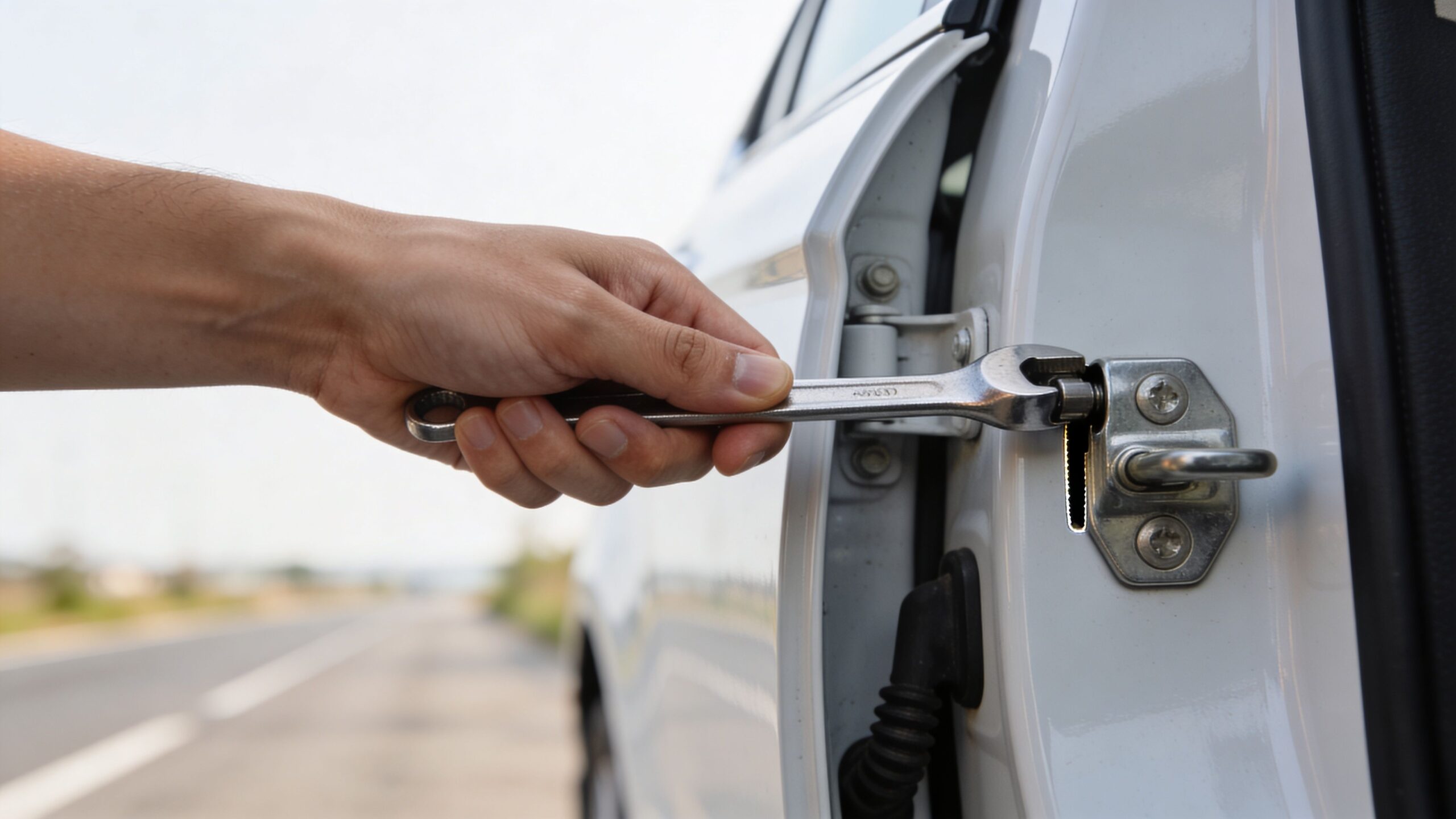
Inspect the striker and minor alignment
The striker is the metal loop on the body that the latch grabs. If it is loose, scarred, or slightly out of position, the latch can hit high, low, or sideways and refuse to engage.
Check for:
- Fresh rub marks on the striker
- Loose fasteners
- Metal contact marks above or below the striker
- A latch that hits the striker edge instead of centering on it
Small striker adjustments can solve a real problem. They can also hide a bigger one for a few days and make the final diagnosis harder. If you touch it, mark the original position first with tape or a paint marker so you can return to baseline.
Check handles, rods, and cables
A door can fail to latch even when the latch itself is still usable. I see this when the release handle does not return fully, a rod clip breaks inside the door, or a cable binds and keeps the mechanism partially open.
A few signs point that way:
- The handle feels loose or does not spring back like the others
- You hear movement inside the door with little or no latch action
- The lock started acting oddly at the same time as the latch problem
If you need a broader checklist for separating one symptom from another, this guide on how to diagnose common problems with your car is a practical companion.
Do not keep slamming the door to force a latch to catch. That can crack trim clips, bend the striker, and create damage that did not exist when the problem started.
Know when the latch itself has failed
Sometimes the latch assembly is worn out or broken inside. Springs weaken, plastic retainers crack, and internal pawls stop holding reliably. Cleaning will not fix that.
If the door only works when the handle is held in a certain position, if the latch will not stay reset, or if the failure came on suddenly with no visible alignment change, replacement is usually the cleaner answer. Check for open recalls before paying out of pocket. Many door latch problems have shown up across large model groups, and recall coverage can save you from spending money on a known defect.
Keep records while you sort it out. Photos of the latch position, notes on when the failure started, and repair invoices can help if the issue turns out to be tied to a recent impact or claim. If there was any chance this started after a crash, even a light one, review these steps to take after a car accident before repairs muddy the timeline.
When a Minor Accident Is the Real Culprit
A door that stopped latching after a "small" hit deserves more attention than most drivers give it. In appraisal work, this is one of the clearest signs that the force of the impact may have traveled beyond the visible dent, and that matters both for repair planning and for what the vehicle is worth after the claim is settled.
That's because a door has very little tolerance for being out of position. The latch, striker, hinges, and door opening all have to meet in the same path every time. A slight shift in the hinge area, striker location, or pillar can leave you with a door that looks close enough but will not click shut.

The impact may not be where the problem shows up
I see this after all kinds of low-speed incidents. A parking lot sideswipe. A front-corner bump that tweaks the opening. A door thrown wide by wind. A light crash where the owner is focused on the fender and does not realize the body line around the door changed too.
The dent you can see is not always the part that stops the door from closing. The concern is what moved behind it. Hinge mounting points can shift. A striker can get knocked out of alignment. In some cases, the door shell is fine and the opening itself is no longer square.
What separates a simple repair from a body-alignment problem
These signs usually push the diagnosis away from a latch issue and toward collision damage:
| Symptom | What it often suggests |
|---|---|
| Rear edge sits proud | Hinge movement or door shell distortion |
| Top corner hits first | Sagging door or an altered opening |
| Need to lift the door to close it | Worn hinges, bent hinges, or shifted mounting points |
| Fresh paint cracking near hinge area | Metal movement under stress |
| Window frame doesn't match roofline | Structural misalignment around the opening |
One clue by itself does not prove structural damage. A pattern does. If the door gap changed right after an accident, the latch started missing the striker, and the door now needs extra force or a lift to close, that is body-shop territory.
Why this matters for your insurance claim
Insurance estimates often start with the obvious panel damage. The harder part is getting paid for what the hit changed underneath. A non-closing door can mean additional measuring, hinge replacement, opening alignment, weld-point inspection, or pulls on the body structure before the door will fit correctly again.
That affects more than the repair bill. Once a vehicle has documented door opening or pillar alignment work, its post-repair market value can take a hit, especially on newer vehicles or cleaner pre-loss examples. I have seen claims start as a simple door adjustment and end with a larger repair scope, a better supplement, and a stronger diminished value argument because the door problem exposed hidden collision damage.
Document it early. Take photos of the panel gaps, striker, hinges, and the way the door sits when it fails to latch. Record a short video showing the closing attempt without slamming it. If the accident just happened, follow these steps to take after a car accident before repairs and teardown make the original condition harder to prove.
A door that will not close after an accident is often the clue that the impact affected more than the outer panel.
Drivers are often told it is "just alignment." Sometimes that is true. Sometimes "just alignment" means the opening has to be measured, pulled, and documented properly. That difference matters in the shop, and it matters again when you review whether the insurer's number reflects the loss.
Temporary Fixes and Knowing When to Call a Pro
Temporary fixes have one purpose. They help you move the vehicle a short distance more safely than leaving it unsecured. They are not repairs, and they don't erase the need for a real inspection.

What a temporary fix is for
If the door almost closes but won't stay latched, you may be able to secure it long enough to get off the roadside or reach a nearby shop. Keep the trip short and slow. Avoid passengers in that seating position.
Common temporary methods include:
- Ratchet strap through the cabin. This is the most secure improvised option if you can route it without damaging trim or blocking the driver.
- Heavy-duty tape. Useful for keeping a nearly closed door from fluttering, not for restraining a door that wants to swing open.
- Bungee cords. Better than nothing in a true emergency, but weaker and less predictable than a strap.
What I'd choose roadside
| Option | Best use | Main downside |
|---|---|---|
| Ratchet strap | Short trip to a shop | Can interfere with seating and interior panels |
| Heavy-duty tape | Door already seated, needs backup hold | Weak in rain, dirt, or cold |
| Bungee cord | Very short emergency repositioning | Stretch and hook failure risk |
Do not use a temporary restraint for normal driving, freeway driving, or carrying a child next to that door.
When your DIY effort should stop
There is a point where more tinkering costs you money.
Stop and call a mechanic or body shop if:
- The door has visible sag
- The latch resets but still won't catch
- The glass frame looks twisted
- You have to lift, slam, or hip-check the door
- The problem started after any collision
That's also the point when an independent appraisal may matter if the claim starts heading toward a low settlement. If the damage appears more serious than the initial estimate suggests, finding an independent auto appraiser near me can help you understand the financial side before you accept the insurer's number.
What the professional repair may involve
A shop fix can range from simple to extensive.
A basic mechanical repair might mean replacing the latch, handle assembly, or internal linkage. A body repair may involve hinge replacement, striker alignment, measuring the opening, and correcting metal movement before anything closes correctly again.
In the U.S. Northwest, hinge replacement on high-value or collector vehicles can run $1,500-$3,000 per door, according to the data summarized by AutoZone's article on why a car door won't close.
Here's a useful visual example of the kinds of latch and closure issues technicians work through in the shop:
The trade-off most drivers miss
A temporary fix protects you for the next few miles. A proper repair protects the car's function, safety, and value.
Those are different goals. If your only focus is “How do I get the door shut today,” you can miss the bigger loss. A poor alignment repair may leave wind noise, water leaks, uneven wear, or evidence of prior damage that hurts resale later. That's why the right answer is often slower, more expensive, and worth it.
Protecting Your Car's Value After a Door Incident
Once the immediate danger is handled, switch hats. Stop thinking only like a driver and start thinking like someone building a file.
If the door problem followed an accident, your photos and notes may become the difference between a routine repair claim and a fight over diminished value or a total loss decision. Before any repair starts, photograph the door open and closed, the latch area, the striker, the hinges, the panel gaps, and any point where paint is cracked or metal is wrinkled. Video helps too, especially if it shows the failed close attempt and any need to lift or force the door.
Why documentation matters financially
A door that won't close can be evidence of more than a broken part. It can support the argument that the opening shifted, the hinge area moved, or the structure took load in the crash.
That matters because a repaired vehicle can still lose market value after an accident. Buyers notice prior body work. They notice poor gaps even faster. If the repair estimate starts growing, the insurer may also decide the vehicle is uneconomical to repair and push toward a total loss based on their valuation.
When the numbers start affecting the claim
The same AutoZone-based summary notes that, in the U.S. Northwest, high-value and collector vehicle owners can face $1,500-$3,000 per door for hinge replacement, and independent appraisers invoking the Appraisal Clause can achieve 20-50% higher settlements by using market-backed reports that challenge insurer software, as referenced in this explanation of post-accident car value.
That doesn't mean every door claim turns into a major dispute. It means enough of them do that you shouldn't hand over the valuation question to a software estimate and assume it's fair.
Document first. Repair second. Negotiate third. Reversing that order weakens your position.
What to keep in your file
Keep it simple and organized:
- Photos before repair from multiple angles
- A short written timeline of when the door stopped closing
- Shop estimates and supplements
- Tow bills and storage records
- Any note that the issue began after impact
- Recall check results if your model has latch history
If you're not at fault, especially with a newer, custom, or collector vehicle, don't assume the insurance company's first offer accounts for the market effect of this damage. A bad latch is a repair. A bent opening is a valuation event.
If your door issue started after an accident and the insurance numbers don't look right, Total Loss Northwest helps drivers in Oregon and Washington challenge lowball total loss and diminished value settlements with certified independent appraisals. When a non-closing door points to bigger damage, they use real market data and the Appraisal Clause to fight for what your vehicle is worth.