You've just dealt with the crash, the tow, the body shop conversation, and the first call from the adjuster. Then the valuation arrives. It treats your performance car like a generic used vehicle with average condition, average history, and no market nuance.
That's where most owners realize the fight is starting.
If your car had rare factory options, documented maintenance, enthusiast-grade modifications, unusually clean condition, or strong regional demand, a low insurance offer isn't just frustrating. It's often built on a valuation method that was never designed to capture what your car was worth. A proper performance car appraisal gives you a market-based report you can use to challenge that number with evidence instead of opinion.
The Lowball Offer After the Accident
The usual call goes like this. The insurer says the car is a total loss, or they acknowledge diminished value after repairs, and then they present a number with a tone that suggests the matter is basically settled. The owner looks at the offer, looks at the car they spent years maintaining, and knows something is off.
That reaction is often correct.
A performance car gets undervalued in predictable ways. The insurer's system may miss a rare trim. It may flatten condition differences that matter a lot in enthusiast markets. It may ignore the difference between generic aftermarket parts and quality modifications that were professionally installed and documented. It may also lean on broad market data that doesn't reflect what comparable cars are selling for in your region.
Why this hits performance cars harder
With a standard commuter vehicle, a rough pricing model can land close enough. With a performance car, small details move value. Brake package, transmission, wheel condition, tire brand, service intervals, paint quality, interior wear, factory aero, accident history, even whether the car still presents like an enthusiast-owned example. Those things matter because buyers pay for them.
When an insurer sends a low offer, they're usually not responding to your memories of the car. They're responding to whatever the software recognized. That's a very different exercise.
Practical rule: If the valuation doesn't specifically account for your car's condition, history, options, and comparable enthusiast-market sales, don't treat it as final.
What changes the conversation
An independent appraisal changes the posture of the dispute. You're no longer saying, “I think my car is worth more.” You're saying, “Here is a documented valuation based on inspection, records, and market evidence.”
That matters in total loss claims and in diminished value claims after repairs. It matters even more when the insurer keeps repeating that their number is based on “market value” but can't show a convincing path from the raw data to the final figure.
In Oregon and Washington, that report can become more than negotiation support. In the right claim, it becomes the document that helps trigger a formal appraisal dispute process under the policy.
What a Performance Car Appraisal Actually Is
A performance car appraisal isn't a book value printout. It isn't a quick estimate from generic pricing software. It's a vehicle-specific valuation report built to stand up when the other side pushes back.
That distinction matters most when the car falls outside ordinary pricing patterns. Modified cars, collector-oriented trims, limited-production variants, and enthusiast-maintained examples often don't fit cleanly inside mass-market valuation tools. Dealer-side appraisal commentary has highlighted the gap clearly: owners want a way to prove adjustments for high-performance and specialty vehicles with defensible evidence, not just accept a generic number from valuation software, as discussed in dealer appraisal principles for the current market.
What a real appraisal includes
A legitimate report ties value to facts about your specific car. That usually means:
- Identity and ownership records that confirm what the car is and how it's titled.
- Condition documentation covering exterior, interior, mechanical presentation, and signs of prior damage or exceptional care.
- Modification review that separates value-neutral changes from upgrades buyers in this market may care about.
- Market support from comparable vehicles, not random listings that only vaguely resemble yours.
- Reasoned adjustments that explain why your car should sit above or below those comparables.
A generic tool tends to collapse differences. A proper appraisal does the opposite. It isolates them.
Why book value often fails
Book-based systems are built for scale and speed. Insurance carriers like that because they can process claims consistently. The problem is that consistency can still be wrong for your car.
A clean, low-volume performance model with records, factory options, and enthusiast ownership history may share a VIN family with rougher examples that drag down the average. The software sees category. The appraiser has to see market reality.
If you need a benchmark for what a formal independent report looks like in practice, this overview of a vehicle appraisal process shows the type of evidence-based approach that's useful in an actual dispute.
A good appraisal doesn't ask the insurer for sympathy. It removes excuses.
The real job of the appraiser
The appraiser's job isn't to “get a higher number.” It's to produce a value conclusion that can survive scrutiny. That means the report has to be coherent, documented, and consistent. In adversarial claims, especially after a low total loss offer, that consistency matters as much as the number itself.
Key Factors That Determine Your Cars True Value
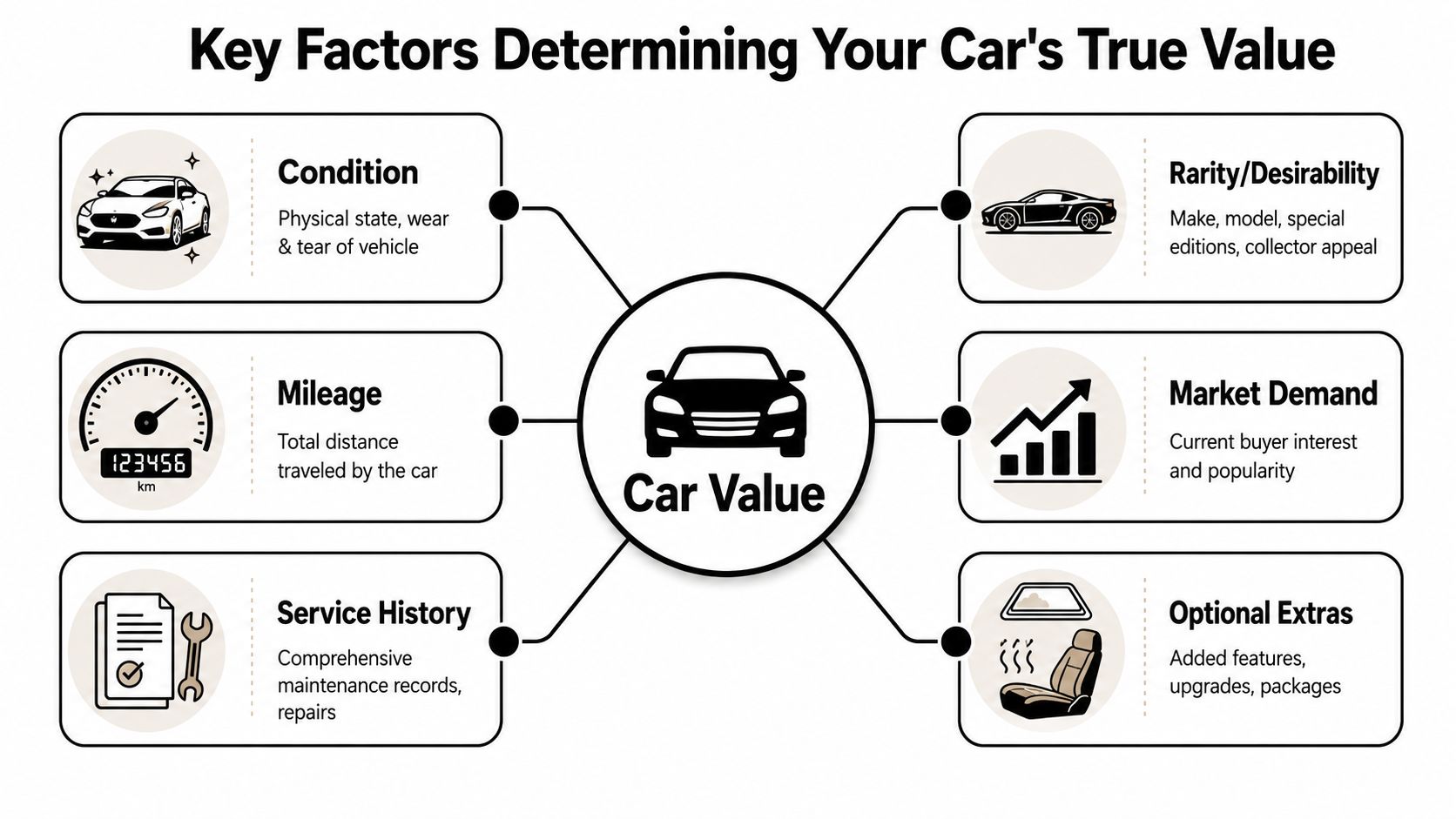
The value of a performance car lives in the details insurers often compress into broad categories. If you want to challenge a low offer, you need to understand which details impact the number and which ones owners tend to overestimate.
Condition is more than clean paint
A performance car can photograph well and still appraise below expectations. Panel fit, underbody condition, wheel rash, brake wear, fluid condition, seat bolster wear, prior paintwork quality, and evidence of hard use all matter. So does whether the car presents as carefully owned or merely detailed for sale.
Paint condition deserves special attention. If your car had protective film, corrected paint, or unusually well-preserved finishes before the loss, document it. Owners who need help organizing that part of the record often benefit from understanding vehicle paint protection because surface preservation can affect how an appraiser distinguishes ordinary wear from above-market condition.
Documentation separates claims from proof
For performance cars, service history can move value from “good example” to “preferred example.” Buyers pay for records because records reduce uncertainty. The same logic helps in an insurance dispute.
Useful documents include:
- Maintenance invoices showing routine service was done on time and by credible shops
- Modification receipts that identify brand, installation quality, and supporting parts
- Pre-loss photos that show condition before the accident
- Ownership records that help establish mileage progression and care
- Build sheets or option lists for trims where factory equipment changes market appeal
Rarity, trim, and buyer demand
Not all performance cars are rare in the same way. Some are rare because few were built. Others are desirable because buyers strongly prefer a specific engine, gearbox, color, package, or model year. A proper appraisal has to sort out whether the feature is market-relevant or just personally meaningful.
That's why comparable selection matters so much. The strongest comps aren't merely the same model. They're the same market type.
This is a data problem, not a vibes problem
Modern appraisal quality is increasingly measured by how close the valuation lands to real sale outcomes. One industry example says its vehicle appraisal system is 34% more accurate than competitors, with only a 4% average standard deviation from final auction sale prices, and that it can appraise 98% of all vehicles, according to Cars Commerce vehicle appraisal accuracy data. For a specialty or performance car, that matters because small condition and spec differences can create meaningful pricing error if the valuation method is too broad.
Here's the practical takeaway. The stronger the VIN-specific condition analysis and live market support, the harder it is for the insurer to hide behind a generic average.
For a clearer view of what insurers mean when they say “market value,” this guide to fair market value in vehicle claims is worth reviewing before you challenge an offer.
| Factor | Why it matters in a claim | Common insurer miss |
|---|---|---|
| Condition | Separates excellent examples from average market stock | Treating all “clean” cars as equivalent |
| Service history | Reduces buyer risk and supports premium positioning | Ignoring records unless pushed |
| Modifications | Can support value when documented and market-relevant | Treating all mods as zero-value or negative |
| Factory options | Buyers often pay up for the right package or transmission | Missing trim-level nuance |
| Regional comps | Enthusiast markets vary by geography | Using weak or mismatched comparables |
| Presentation before loss | Pre-accident photos can prove above-average condition | Assuming average prior condition |
The Appraisal Process from Start to Finish
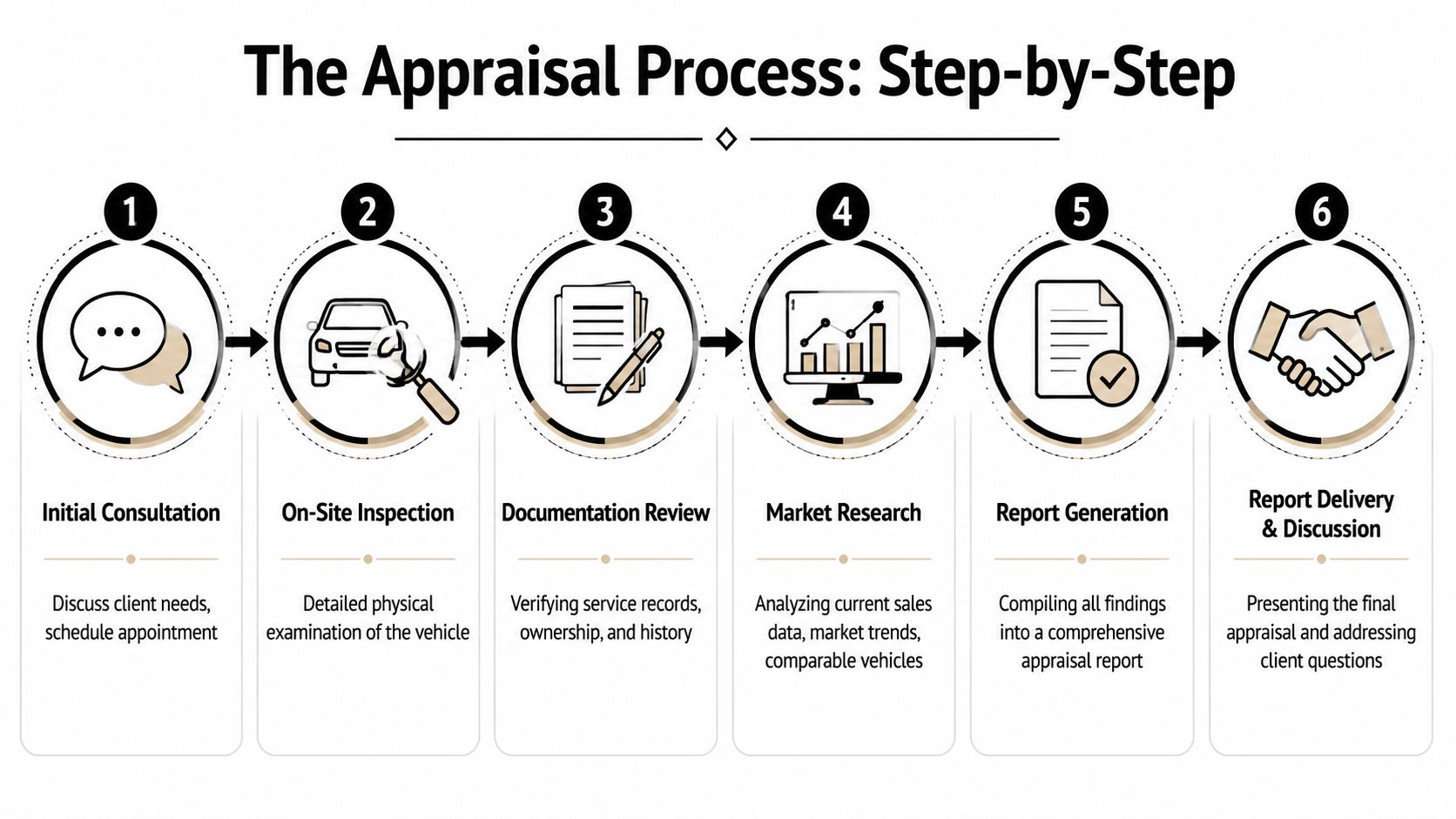
Most owners feel better once they see that appraisal is a structured process, not a vague expert opinion. A solid report is built in layers. Inspection first. Documentation next. Market analysis after that. Then the written valuation.
Step one through three
The first phase is fact gathering.
Initial intake
The appraiser identifies the claim type, the dispute point, and the vehicle configuration. At this stage, the owner should provide the insurance valuation, photos, service records, receipts, and any information about options or modifications that could affect market position.Physical inspection
A rigorous performance-car appraisal starts with a measured-condition inspection and a short road test because value adjustments depend on observable items like panel alignment, undercarriage condition, fluid state, braking response, and handling behavior. Formal workflows commonly pair that inspection with 3–5 region-matched comparable sales, as described in this explanation of vehicle appraisal workflows.Record review
The appraiser checks title history, ownership documents, service paperwork, and modification records. The review process filters out unsupported owner claims, allowing documented facts to remain.
Step four through six
After inspection, the file work begins.
Market research
The appraiser looks for comps that match the car in the ways that matter. Same model isn't enough. Transmission, trim, mileage range, accident history, condition level, major options, and regional relevance all affect whether a comparable is useful or just convenient.
Adjustments and reconciliation
Each comp has to be adjusted carefully. If one comparable has higher mileage but better options, and another has lower mileage but prior damage, the report has to explain how those differences affect the final conclusion. Experienced appraisers earn their keep through navigating these complexities.
The best report is the one that an insurer can't dismiss as arbitrary.
Final report delivery
A good appraisal report is readable, not just thorough. It should show the path from raw vehicle facts to final value. If the insurer challenges it, the owner or attorney should be able to point to the evidence without guessing what the appraiser meant.
What owners should do before the inspection
You can make the appraisal stronger by organizing the file before the appraiser ever sees the car.
- Collect records early so receipts, service logs, and photos don't disappear into old emails and glovebox folders.
- List every factory option you can verify. Don't rely on memory if you can get a build sheet or supporting paperwork.
- Separate valuable modifications from cosmetic noise. Brand, install quality, and documentation matter more than the fact that a part exists.
- Save the insurer's valuation report because the weaknesses in that report often shape the strongest rebuttal.
If you're in an active claim, timing matters. The cleanest disputes are usually the ones where the appraisal starts before the insurer's assumptions harden into a take-it-or-leave-it number.
Using Your Appraisal to Negotiate a Fair Settlement
Once you have the report, the job changes. You are no longer collecting evidence. You are using it.
In insurance disputes, especially with total losses and diminished value claims, the appraisal isn't just informational. It provides significant influence. The insurer may still resist, but now they have to answer a documented valuation instead of an upset owner on the phone.

What gives the report authority
A standard appraisal is built from a structured review of title and registration, maintenance history, exterior and interior condition, modifications, mileage, age, ownership history, engine condition, and test-drive findings, together with market data such as recent retail transactions, available supply, current demand, and reconditioning cost, as explained in this discussion of consistent dealership appraisal process. That structure is why the report carries weight in negotiation. It shows method.
That matters when the insurer says their software already accounted for “the market.” Sometimes it did. Sometimes it didn't. Your appraiser's report gives you a basis to force that question.
How to present it
Keep the communication tight and written when possible. You want a documented paper trail.
Use this sequence:
- Submit the appraisal formally with a short cover email stating that you dispute the insurer's valuation and are requesting reassessment based on the enclosed independent report.
- Identify the major errors in the carrier's number. Bad comps, missed options, ignored condition, unsupported adjustments, or failure to account for the actual pre-loss market.
- Ask for a written response to the appraisal's specific findings, not a generic restatement of the original offer.
- Keep your own timeline of every response, delay, and revised figure.
The Appraisal Clause in Oregon and Washington
For many policyholders, the most important phrase in the policy is the Appraisal Clause, sometimes called the right to appraisal. The wording varies by carrier, but the basic idea is similar. If you and the insurer disagree on the amount of loss, each side can select an appraiser, and the dispute moves into a defined valuation process instead of endless circular arguing.
In Oregon and Washington, this can be a powerful tool because it shifts the fight away from the insurer's internal valuation software and into a more formal evidence-driven process. That doesn't mean every claim should immediately go there. Sometimes a strong independent report is enough to move the offer. But when the adjuster won't engage with the evidence, invoking the clause can change the balance.
Don't argue feelings with an adjuster. Argue comparables, condition evidence, and policy rights.
One option for owners in that situation is working with a firm that specifically handles independent auto valuations and appraisal-clause disputes in those states, such as Total Loss Northwest, which provides total loss and diminished value appraisals in Oregon and Washington.
What not to do
Don't pad your claim with weak upgrades. Don't insist every modification adds value. Don't send ten pages of forum screenshots and call it market proof. And don't assume the first supervisor review is the final answer.
Insurance negotiations reward organized evidence. They also reward persistence.
Real-World Examples of Appraisal Victories
Owners usually understand the concept quickly once they see how the dispute works in practice. The problem here is that specific settlement numbers need to be documented if they're going to be published responsibly. Without verified claim figures, it's better to show how these cases typically unfold than to invent dramatic examples.
What these cases usually look like
A modified Subaru, a rare-spec BMW, a carefully maintained Porsche, or a specialty truck all run into the same issue. The insurer starts with broad market data. The owner responds with a targeted appraisal showing condition, options, records, and stronger comparables. Then one of two things happens: the insurer revises the number in negotiation, or the dispute moves toward the appraisal process under the policy.
The table below shows the framework you should expect to analyze in your own file.
| Vehicle Type | Insurer's Initial Offer | Independent Appraisal Value | Final Settlement Amount | Value Increase |
|---|---|---|---|---|
| Modified performance sedan | Review insurer's written valuation for missed modifications, weak comps, and average-condition assumptions | Independent report should document parts, install quality, and market relevance | Settlement may change after rebuttal or appraisal-clause process | Compare final result against the original offer |
| Rare factory-spec coupe | Initial offer often misses option-level desirability and regional demand | Appraisal should focus on exact trim, transmission, color, and condition-matched comps | Final number depends on how the insurer responds to documented evidence | Measure the gap created by better comparable selection |
| Collector-oriented sports car | Generic software may flatten condition and provenance | Independent value should lean heavily on records, ownership history, and presentation | Outcome may require formal dispute if the carrier resists specialist-market evidence | Increase reflects whether the insurer accepts a specialty-market view |
| Repaired late-model enthusiast car with diminished value claim | Carrier may argue repairs restored the vehicle sufficiently | Appraisal should show market stigma and post-repair value impact | Settlement often turns on report quality and insurer willingness to negotiate | Increase is the difference between no recognition and documented diminished value |
How to read a result the right way
A stronger settlement doesn't prove the owner was “lucky.” It usually means the first number was weak and the challenge was organized. The appraisal matters because it gives the dispute structure.
What separates successful files from stalled ones is usually simple:
- The owner documented the car before the loss
- The appraiser used market-relevant comparables
- The challenge focused on provable errors
- The policyholder or representative kept pressure on the process
That's what an appraisal victory usually looks like in practice. Less drama. More documentation.
How to Choose a Certified Independent Appraiser
The wrong appraiser can hurt your claim almost as much as a weak insurer valuation. If the report is sloppy, unsupported, or written by someone who doesn't understand specialty vehicles, the carrier will attack the process instead of addressing the number.
What to look for
Start with competence, not marketing.
A useful appraiser should have:
- Experience with performance and specialty vehicles because enthusiast markets don't behave like ordinary used-car inventory
- A documented inspection process that includes condition review, records analysis, and comparable selection
- Knowledge of Oregon and Washington claim practice if your dispute is in those states, especially when the Appraisal Clause may come into play
- A report style built for scrutiny rather than a short letter with a conclusion and no support
If you're comparing providers, this overview of an independent car appraiser gives a practical benchmark for the kind of role the appraiser should play in a disputed loss.
Why process matters more than personality
Vehicle valuation works best when it's disciplined and market-backed. Dealer performance guidance treats a used-to-new retail ratio of 1.25:1 as a marker of a strong used-vehicle operation, and the larger lesson for claim disputes is that acquisition and pricing discipline depend on real appraisal quality, not rough estimates, according to Cox Automotive used-car KPI guidance. That same principle applies to your claim. If small pricing errors matter to a dealer, they also matter to you when the insurer is trying to settle your loss.
Red flags that should stop you
A few warning signs come up often.
- Guaranteed value promises. No serious appraiser should promise a number before inspecting the car and reviewing the market.
- No interest in records. If they don't ask for service history, receipts, photos, and the insurer's report, they're not building a strong file.
- Generic comparable sets. If the sample cars aren't closely matched, the report may not hold.
- No understanding of dispute procedure. In appraisal-clause work, process errors can waste time and weaken their position.
Hire the appraiser who can explain the method, defend the comparables, and stay credible when the insurer pushes back.
A good independent appraiser won't tell you only what you want to hear. They'll tell you what they can prove.
If you're in Oregon or Washington and your insurer's valuation doesn't reflect your car's real market position, Total Loss Northwest provides certified independent appraisals for total loss and diminished value disputes, including appraisal-clause matters. If you already have an offer in hand, gather the valuation report, your records, and your pre-loss photos first. That gives your appraiser the best chance to challenge the number with evidence.