You open an email from the insurance company, download the attachment, and stare at a report that looks official enough to decide your money but vague enough to make you doubt your own reading. It mentions value, condition, comparables, adjustments, and settlement logic, yet none of it feels written for a normal driver.
That confusion makes sense. Most search results for a property appraisal report example show residential real estate forms, not the kind of report you need after a crash. If your dispute is about a damaged car, a diminished value claim, or a total loss offer, a house appraisal template won't help much.
Why Your Appraisal Report Is So Confusing
The phrase property appraisal is commonly associated with real estate. Search online and you'll usually land on mortgage-related forms, lender checklists, and articles about buying a house. That creates a problem for drivers because a vehicle is also property, but the dispute is completely different.
The gap is real. Content around this topic heavily centers on residential forms like URAR and static checklists, while leaving out the report logic that matters in insurance disputes, including diminished value analysis, market adjustments for damaged vehicles, and Appraisal Clause language, as noted in the personal property appraisal report checklist discussion from the Appraisers Association material.
A stressed driver often gets handed something that sounds final:
The insurer's number may look polished, but polished isn't the same as well supported.
That matters because two documents can look similar on the surface while doing very different jobs. A lender's appraisal tries to support a loan decision on a house. A vehicle appraisal for an insurance dispute tries to prove what your car was worth before the loss, or how much value it lost after the repair.
Why internet examples feel irrelevant
Most generic examples miss the points drivers care about:
- What changed after the accident: Not just whether the car was repaired, but how accident history affects market perception.
- How comparables were chosen: A clean-title, never-damaged listing isn't automatically comparable to a repaired vehicle with history.
- What the final number means: Is it a repair estimate, an insurer settlement estimate, or an independent opinion of value?
If you've been reading and thinking, "None of this matches my claim," you're probably right. The useful question isn't just, "What does an appraisal report look like?" It's, "What does a credible vehicle appraisal report include when money is on the line?"
Understanding the Standard Real Estate Appraisal Report
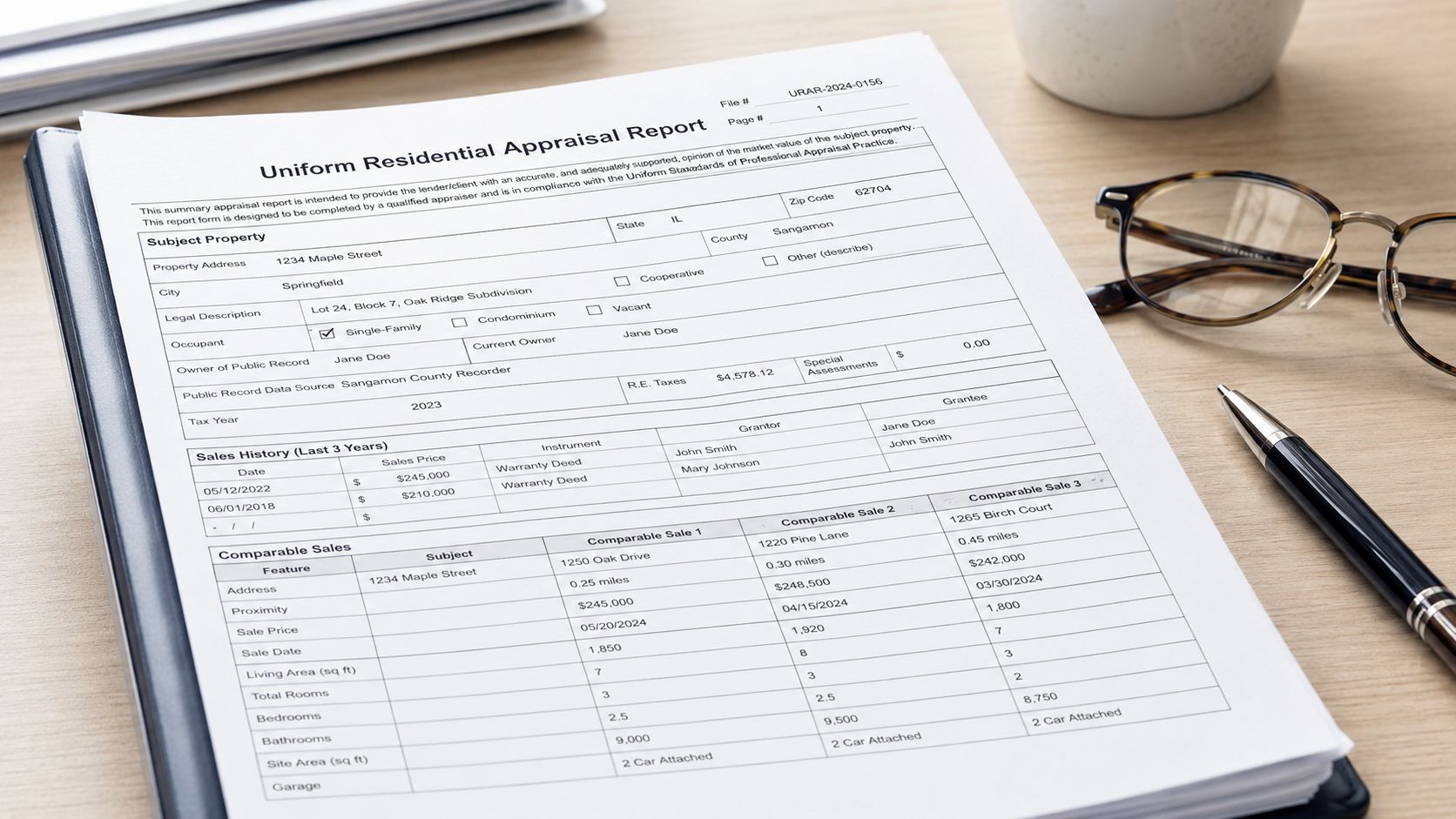
A common property appraisal report example encountered is the Uniform Residential Appraisal Report, often called URAR or Form 1004. That document is the standard residential appraisal format many lenders and appraisers use in mortgage work.
A URAR is built around three valuation approaches: Sales Comparison, Cost, and Income, and the final fair market value opinion must be documented with a specific date and signature for USPAP compliance, according to this explanation of appraisal report structure.
What the URAR is trying to do
Think of the URAR as a house's financial blueprint. It doesn't just say, "This home seems worth X." It shows how an appraiser got there using recognized methods.
The report commonly documents:
- A property overview: Year built, ownership type, living area, and material details such as roofing and siding.
- Comparable sales analysis: The appraiser compares the subject property to similar sold homes and applies line-item adjustments.
- A signed value conclusion: The opinion of value is tied to a specific effective date.
If you want a broader primer on common valuation methods before looking at any report, PropLab's valuation guide gives a helpful overview of how appraisers think through value in different settings.
The three approaches in plain English
Here is the short version.
- Sales Comparison Approach: The appraiser studies similar sold properties and adjusts for differences such as square footage, room count, or amenities.
- Cost Approach: The appraiser estimates what it would cost to replace or reproduce the improvements, subtracts depreciation, then adds land value.
- Income Approach: This approach is more relevant when a property produces income.
For residential work, the sales comparison approach is typically the dominant one. If you need a plain-language definition of the value target itself, this explanation of fair market value is a useful companion.
Why this matters to a vehicle owner
A real estate appraisal report is rigorous, but it's rigorous for a different problem. Houses don't carry accident-history stigma the way vehicles do. A URAR also depends on features like neighborhood analysis, building sketches, and gross living area. None of that answers the question you care about after a crash: what did this specific vehicle lose in value, or what was it worth right before it was totaled?
Real Estate vs Auto Appraisals A Critical Comparison
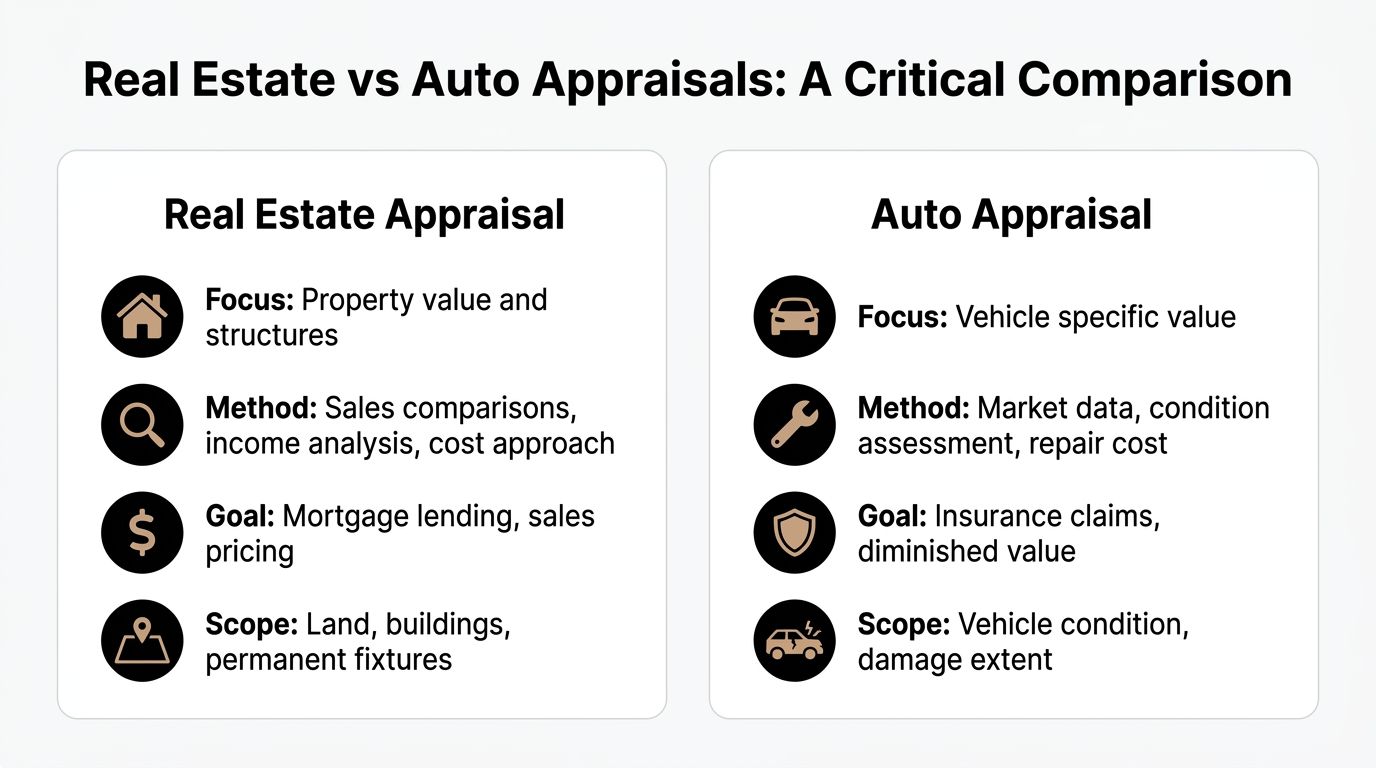
A house appraisal and an auto appraisal both use evidence, comparables, and adjustments. That's where the similarity ends.
A standard URAR requires interior and exterior inspection, neighborhood analysis, street-level inspection of comparable sales, and exhibits such as a street map, exterior building sketch, and calculated gross living area, as described in Fannie Mae's residential appraisal requirements. A vehicle report doesn't need a street map or building sketch. It needs market evidence that matches the condition, damage history, trim, options, and loss scenario of the car.
Side by side differences
| Factor | Real Estate Appraisal (URAR) | Auto Appraisal (Diminished Value/Total Loss) |
|---|---|---|
| Purpose | Support lending, sale, or refinance decisions | Support an insurance claim or dispute |
| Subject | Land, structure, permanent improvements | A specific vehicle with a specific history |
| Core question | What is the property worth in the market | What was the vehicle worth before loss, or how much value did it lose after repair |
| Comparables | Similar homes, often sold properties | Similar vehicles, with closer attention to trim, mileage, condition, and accident history |
| Adjustments | Features like living area, rooms, amenities | Condition, options, mileage, prior damage, repair quality, market stigma |
| End use | Loan underwriting and collateral review | Negotiation, settlement support, Appraisal Clause disputes |
Why car comparables are harder
A vehicle comparable isn't just "same make and model." It has to be close in the ways buyers react to. A repaired vehicle with an accident history doesn't compete in the market the same way a clean-history vehicle does.
That is why a serious vehicle appraiser doesn't stop at broad category matching. The report has to explain why one listing or sale belongs in the analysis and why another doesn't. If you're reviewing examples of this kind of work, a focused vehicle appraisal overview helps show what to expect from an auto-specific report.
A credible auto appraisal reads less like a form and more like a chain of reasoning.
The phrase that confuses many drivers
Inherent diminished value means the market may pay less for a repaired vehicle because the accident stays in its history. Even if the shop did solid work, many buyers still discount a car once they see prior damage in a report.
That idea doesn't fit neatly into a house appraisal template. It's one of the main reasons a generic property appraisal example leads drivers in the wrong direction.
Anatomy of a Diminished Value Report Example
A good diminished value report tells a story. Not a dramatic story. A valuation story.
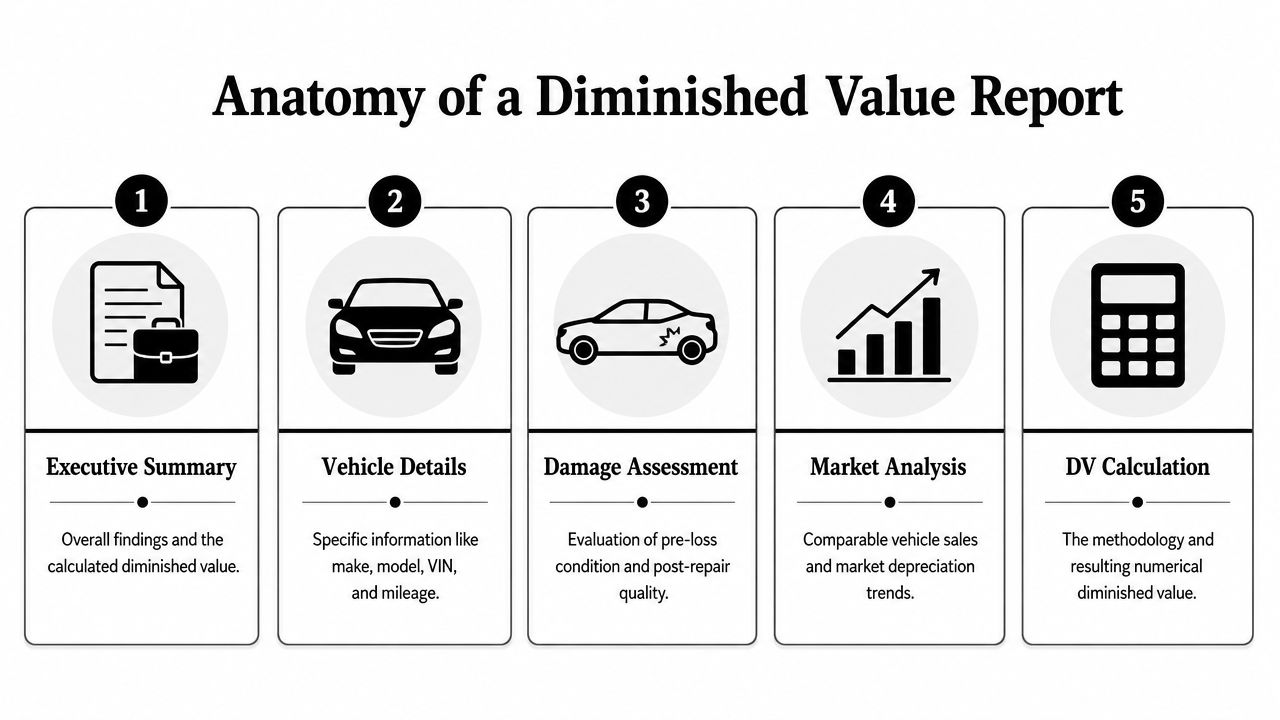
It starts with the vehicle before the collision, shows what happened, evaluates the repairs, studies the market, and then reaches an opinion about how much resale value the vehicle lost because of that history.
The opening pages
The first part of the report usually identifies the assignment clearly. Within this section, you should expect to see the vehicle details, claim details, and the purpose of the appraisal.
Typical elements include:
- Vehicle identification: Year, make, model, VIN, trim, and mileage
- Claim context: Date of loss, carrier, and claim reference information
- Scope of work: What the appraiser reviewed, inspected, or relied on
If any of that is muddy, the rest of the report gets weaker fast. A diminished value opinion only works if everyone is talking about the exact same vehicle and the same loss event.
Pre-loss condition matters more than many drivers realize
Insurers often act as if every used vehicle starts from the same baseline. It doesn't. A car with strong prior condition, desirable options, and no meaningful pre-loss defects may face a different market reaction than one that already had visible wear or prior issues.
A report should describe pre-loss condition in ordinary language. That doesn't mean hype. It means usable observations. Clean paint, worn interior, aftermarket parts, prior damage indicators, and maintenance history can all matter.
For commercial or work vehicles, maintenance records can help support condition arguments. If a vehicle was maintained on a scheduled basis, outside documentation can strengthen the report narrative. For fleets, resources on hgv maintenace can help owners understand what recordkeeping looks like when condition needs to be documented consistently.
Practical rule: If the report skips pre-loss condition and jumps straight to a final number, you should ask how the appraiser established the starting point.
Repair and damage analysis
At this juncture, the report should slow down and get specific. The appraiser isn't just asking whether the car got fixed. The appraiser is asking what kind of damage occurred and how that damage affects marketability after repair.
Look for discussion of:
- Damage location: Front, side, rear, or multiple impact areas
- Type of damage: Cosmetic panels versus more serious structural or mechanical concerns
- Repair outcome: Whether the documentation suggests complete repair, visible issues, or market-sensitive repair history
A serious report also distinguishes between repair cost and value loss. Those are not the same thing. A vehicle can be repaired correctly and still carry reduced market appeal.
Market analysis and final diminished value opinion
This is the heart of the report. The appraiser studies comparable vehicles and market behavior to support the conclusion that accident history changes what buyers will pay.
You want to see reasoning like this:
Similar vehicles without accident history set the cleaner market baseline. Comparable vehicles with damage history, or market reactions to repaired history, show the discount buyers apply.
The final section should connect the evidence to the number. Even when the report uses charts, listings, or dealer observations, the important part is the narrative logic. Can a reader follow the path from clean vehicle value, to damaged history effect, to the final diminished value conclusion?
If yes, the report is doing its job.
Decoding a Total Loss Report Example
A total loss report works backward from the settlement dispute. The question isn't how much value the accident shaved off after repairs. The question is what the vehicle was worth immediately before the loss.
That sounds simple until you read an insurer's valuation and realize the comparables may be weak, the options list may be incomplete, or the condition assumptions may be too low.
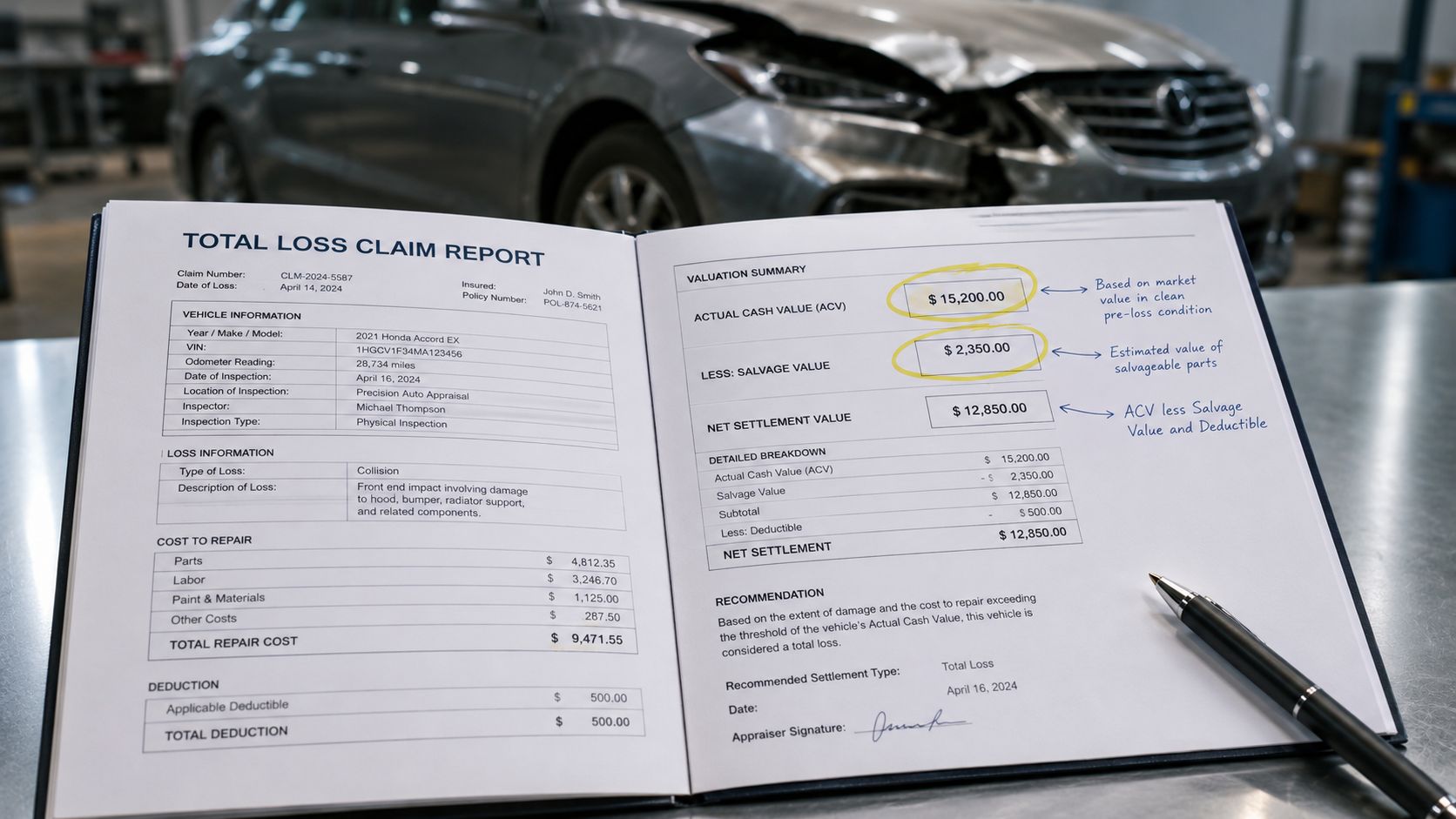
The first question is always pre-loss value
A total loss appraiser begins with the vehicle as it existed right before the incident. That includes trim, equipment, mileage, condition, title status, and market area. If any of those are wrong, the settlement can drift away from fair value.
This is one reason independent reports often read more carefully than software printouts. The appraiser is supposed to verify the subject vehicle rather than assume a generic version of it.
How total loss logic resembles appraisal discipline
Real estate offers a useful analogy here. In the Cost Approach of a URAR, the appraiser estimates replacement or reproduction cost, subtracts depreciation from physical deterioration or functional obsolescence, and adds land value, according to this explanation of the cost approach in appraisal reports. Auto valuation isn't the same method, but the lesson is similar. A supportable value opinion requires a visible method, not just a final output.
For cars, that means the report should show how the appraiser handled condition, equipment, and market data instead of hiding the logic inside a software result.
What to inspect in the comparable vehicles
A weak total loss report often uses poor comparables. A stronger one screens them more carefully.
Check whether the report accounts for:
- Trim and equipment differences: Leather, technology packages, drivetrain, premium audio, or factory upgrades
- Mileage relationship: Whether the comp is meaningfully higher or lower in use
- Condition quality: Interior wear, exterior defects, prior accident history, and retail readiness
- Market relevance: Whether the comp is similar enough to influence a buyer's decision
A total loss report should also explain adjustments in human language. If a comp has inferior equipment, the reader should understand why that matters. If a comp has visible flaws, the report should not pretend it competes equally with a better-kept subject vehicle.
Here is a helpful visual example of how these disputes are discussed in practice:
The conclusion section is where the report earns trust
In real estate, the final pages often reconcile multiple strands of analysis into one value conclusion. A solid total loss report should do the same in spirit. It should explain why certain comparables deserved more weight, why others deserved less, and why the final figure best represents the vehicle's actual cash value before the loss.
If you can't tell why the final number won over the alternatives, the report hasn't finished its job.
That final reconciliation provides you with an advantage in a dispute. It turns a complaint into an evidence-backed valuation position.
How to Use Your Appraisal Report to Win Your Claim
A report sitting in your inbox doesn't change anything by itself. It becomes useful when you use it as a negotiation document.
The strongest appraisals do something many insurer summaries don't. They show their reasoning. In real estate sales comparison work, appraisers document adjusted unit sale prices, sometimes in a range such as $16.43/SF to $17.49/SF, then reconcile those indications into a rounded final market value, such as $1,184,832 rounded to $1,180,000, while also stating the premise of value and arriving at a single reconciled opinion, as described in this URAR discussion of reconciliation and sales comparison reporting. Your vehicle report should create the same kind of confidence. Not the same metrics, but the same transparency.
How to present the report
Don't send it with a one-line note saying, "Please see attached."
Do this instead:
- State the dispute clearly: Say whether the disagreement involves diminished value, total loss actual cash value, or both.
- Identify the report as independent evidence: Tell the adjuster the report provides a documented opinion based on market analysis and vehicle-specific facts.
- Ask for written review: Request a written response to the report's conclusions, not just a revised verbal offer.
- Keep your communication organized: Save emails, PDFs, claim notes, and any response that accepts or rejects the report's reasoning.
When the Appraisal Clause matters
If the insurer refuses to move, your policy may contain an appraisal provision, often called the Appraisal Clause or Right to Appraisal. That process can shift the dispute away from the insurer's internal number and toward independent valuation.
This overview of the insurance appraisal clause explains the concept in plain language. Read your own policy wording carefully because the exact procedure can vary.
What to say to the adjuster
You don't need to sound like a lawyer. You need to sound organized.
Useful phrasing looks like this:
- When sending the report: "Please review the attached independent appraisal report and respond in writing to its market findings and valuation conclusion."
- When disputing weak comps: "The report identifies vehicle-specific differences that affect comparability, including condition and equipment."
- When invoking policy rights: "If we can't resolve the valuation disagreement through review of the independent appraisal, I intend to pursue the appraisal process available under the policy."
Keep the discussion on evidence. The more the adjuster talks in generalities, the more you should return to the report's specific findings.
Common mistakes that weaken your position
- Arguing from frustration alone: Being upset is understandable, but it doesn't replace documentation.
- Relying only on repair bills: Repair cost and value loss are separate issues.
- Accepting the insurer's labels: If they call something a "market valuation," ask what market data, what adjustments, and what condition assumptions support it.
A good appraisal report gives you a map. Your job is to make the insurer respond to the map, not steer you back into vague talking points.
Taking Control of Your Insurance Settlement
Once you understand what a real appraisal report does, the document stops feeling mysterious. You can spot the difference between a generic form and a report built for your actual dispute. You can also see why a residential property appraisal report example doesn't answer the questions that matter after a vehicle accident.
For a diminished value claim, the key issue is how accident history changed what buyers will pay. For a total loss claim, the key issue is what the vehicle was worth right before the loss. In both cases, the report needs clear identification, supportable comparables, visible adjustments, and a final conclusion that a reader can follow.
That gives you something more useful than a number. It gives you a position. When the insurer knows you have a coherent, evidence-based appraisal, the conversation changes. You are no longer asking them to be generous. You are asking them to answer the valuation case in front of them.
If you need help turning a confusing insurance valuation into a clear, defensible claim, Total Loss Northwest provides independent diminished value and total loss auto appraisals for drivers dealing with low settlement offers. Their work is built for negotiation, with reports designed to support fair market value arguments and Appraisal Clause disputes.