You already know the feeling. The insurer sends a settlement figure, it looks neat on paper, and it still doesn't cover the roof, the water damage, the contents loss, or the vehicle you were told was a total loss at a value that feels absurd. At that point, the problem isn't just the number. It's that the claim has turned into a negotiation, and the insurer is the side writing the first draft.
That's where public adjuster services come in for property claims. They're not a magic fix, and they're not the right tool for every dispute. But when a loss is disputed, under-documented, or buried in policy language, a public adjuster can alter the balance of power in the room. If the issue is a low vehicle total-loss figure instead of a homeowner's property claim, the smarter move is often a valuation expert, not a public adjuster. A good starting point for anyone already stuck in that fight is to look at Antioch auto body shop options if you're trying to understand repair path versus total-loss economics after a crash, then decide whether the problem is coverage, valuation, or both.
If you suspect the insurer is acting in bad faith, it helps to understand the pattern before you respond. A clear overview of common tactics is available in this guide on bad faith insurance practices, and the same rule applies whether the dispute is a storm claim or a vehicle valuation fight. The first step is knowing which kind of professional best fits the dispute.
When Your Insurance Settlement Feels Too Low
You open the settlement letter after a storm, or you get the total-loss offer after the accident, and the number looks like it came from a different case entirely. The roof still leaks. The contents still aren't inventoried. The vehicle market didn't suddenly get cheaper just because the insurer's software said so. That gap between what happened and what they're willing to pay is where policyholders start looking for outside help.
The claim is not a verdict
Insurance claims get treated like final decisions far too often. They're not. They're negotiations shaped by documentation, valuation methods, policy language, and who has the stronger file on the desk. In property claims, that's exactly why a public adjuster exists, they step in to document the loss, translate the policy, and push back on an incomplete estimate. In auto total-loss disputes, the better tool is often a certified independent appraiser, because the dispute is usually about value methodology, not a broad property-loss file.
Practical rule: if the fight is about roof scope, contents, or hidden water damage, think property claim. If the fight is about what your car was worth the day before the loss, think valuation dispute.
The frustration is real, but the wrong hire is expensive. A public adjuster can help when the insurer is undervaluing a first-party property claim. They usually can't fix a bad total-loss number on a vehicle by using the wrong framework. That's why the choice of expert matters before you sign anything or let the clock run.
If you're already comparing settlement paths, the question isn't “Who can get me more money?” It's “Who is built to solve this exact problem?” That answer determines whether you need public adjuster services, an appraisal process, or a direct challenge to the insurer's valuation.
Public Adjusters vs Company Adjusters vs Independent Appraisers
The confusion starts because everyone in the claims world uses the word adjuster, but they don't serve the same side. A company adjuster works for the insurer. A public adjuster works for the policyholder on property claims. An independent appraiser handles valuation disputes, especially in auto total-loss and diminished-value fights, where the issue is the number on the vehicle, not the scope of a building loss.
The cleanest way to separate them
| Claims Professional | Who They Represent | Claim Types | How They're Paid | Best For |
|---|---|---|---|---|
| Company Adjuster | The insurer | Property and auto claims handled for the carrier | Paid by the insurer | Initial carrier evaluation and settlement offers |
| Public Adjuster | The policyholder | Property claims, including homeowners, commercial property, and HOA losses | Usually contingency-based, subject to state rules | Disputed property losses, under-documentation, and coverage translation |
| Independent Appraiser | The vehicle owner or claimant in a valuation dispute | Auto total loss and diminished-value claims | Usually flat fee or agreed fee arrangement | Market-value disputes and appraisal-clause claims |
The distinction matters because the process changes with the dispute. A public adjuster inspects the damage, reviews policy language, documents the loss, prepares the proof of loss, and negotiates with the insurer. An independent appraiser on an auto claim is trying to remove the insurer's valuation software from the equation and replace it with a defensible market-value report. Those are not the same job.
If your claim is a property loss and the scope is messy, a public adjuster makes sense. If the problem is a vehicle valuation, the appraisal clause is usually the cleaner path, and you can review how that process works in detail through the insurance appraisal clause overview. Hiring the wrong professional doesn't just waste money, it sends your claim down the wrong lane.
A company adjuster is there to close the file for the carrier. A public adjuster is there to build the insured's file. An appraiser is there to settle value.
Financial Impact of Hiring a Public Adjuster
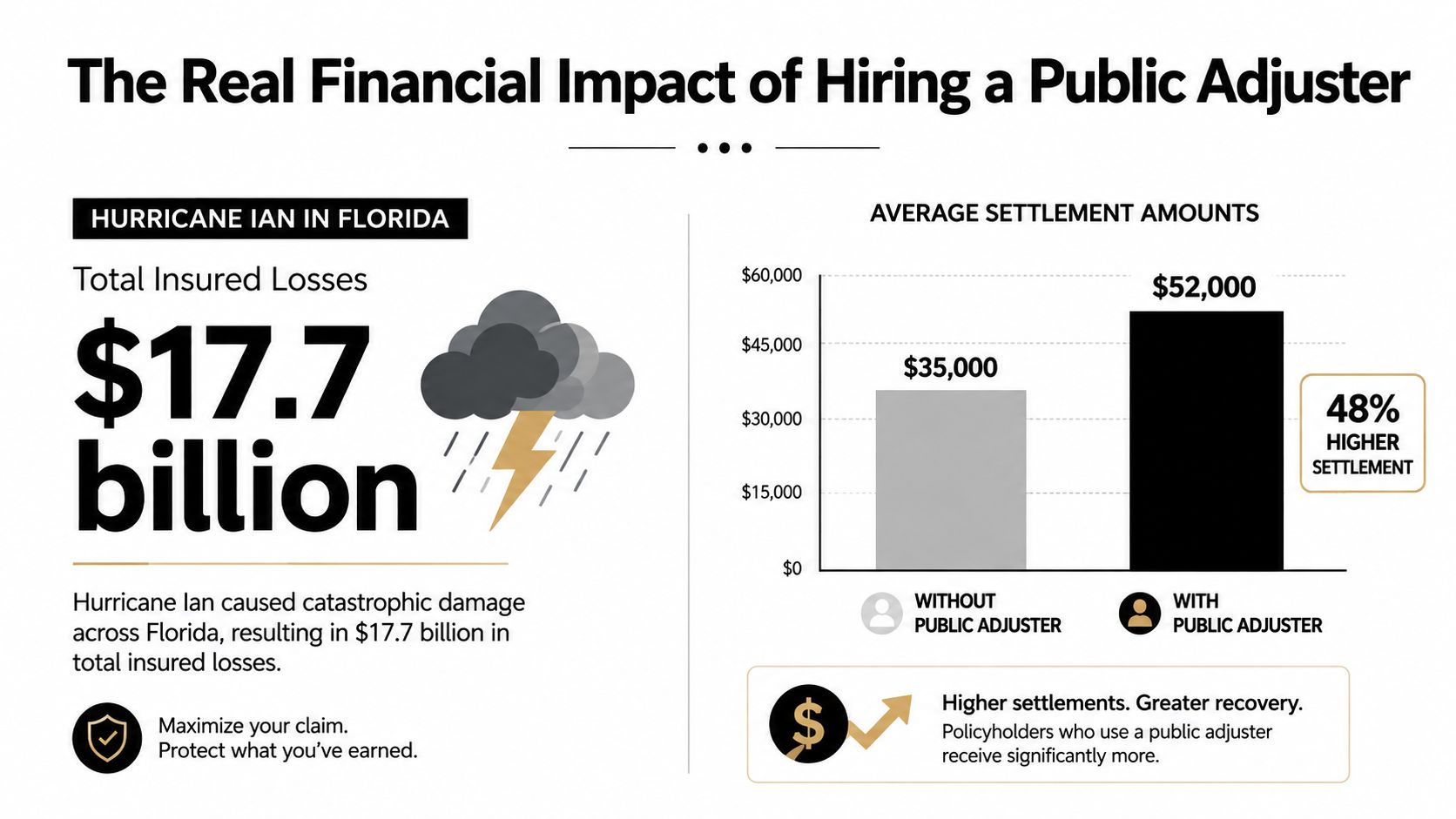
The clearest reason to use public adjuster services is the settlement math. In Florida, analysts reviewing Citizens Property Insurance Corporation claims from 2008 to 2009 found that public adjusters represented policyholders in 26% of non-catastrophe claims and 39% of catastrophe claims. The settlements were materially higher, with non-catastrophe claims averaging $9,379 with a public adjuster versus $1,391 without one, a 574% difference, and catastrophe claims averaging $17,187 versus $2,029, a 747% difference. That analysis is discussed in the source linked from the verified data, How effective are public adjusters.
What those numbers mean
Those outcomes do not mean every claim belongs with a public adjuster. They show where the service earns its fee, in disputed, document-heavy property claims where the insurer's first pass missed scope or undervalued the file. That is very different from a clean, ordinary claim where the offer is already fair and the only task is getting the check issued.
The market also explains why these services stay in demand. The claims-adjusting workforce is large and regulated, with 293,780 claims adjusters, examiners, and investigators in May 2023, and wages that place this work in a professional, fee-sensitive environment, according to the Bureau of Labor Statistics occupation data. When claims volume spikes after major storms, the stakes rise with it. Texas recorded more than 250,000 property insurance claims after Hurricane Beryl in July 2024, and Winter Storm Uri generated roughly $10 billion in insured losses and about half a million claims statewide in February 2021, also noted in the same BLS-linked source summary.
Use a public adjuster when the claim has these traits:
- Complex scope: hidden damage, contents losses, or multiple repair categories.
- Documentation problems: missing estimates, weak inventories, or bad line-item support.
- Coverage disputes: the insurer says the policy doesn't apply, or applies less than you claim.
- High-loss pressure: catastrophe claims, layered losses, or a file that needs constant follow-up.
If none of that describes your claim, the fee may not justify the lift. Public adjusters pay off when the claim is messy enough that a stronger file changes the outcome.
How the Public Adjuster Process Works From Start to Finish
A good public adjuster does not start by arguing. They start by building the file. That means a site inspection, damage photos, measurements, contents review, policy analysis, and a clean theory of loss before the insurer gets the first full version of the claim.
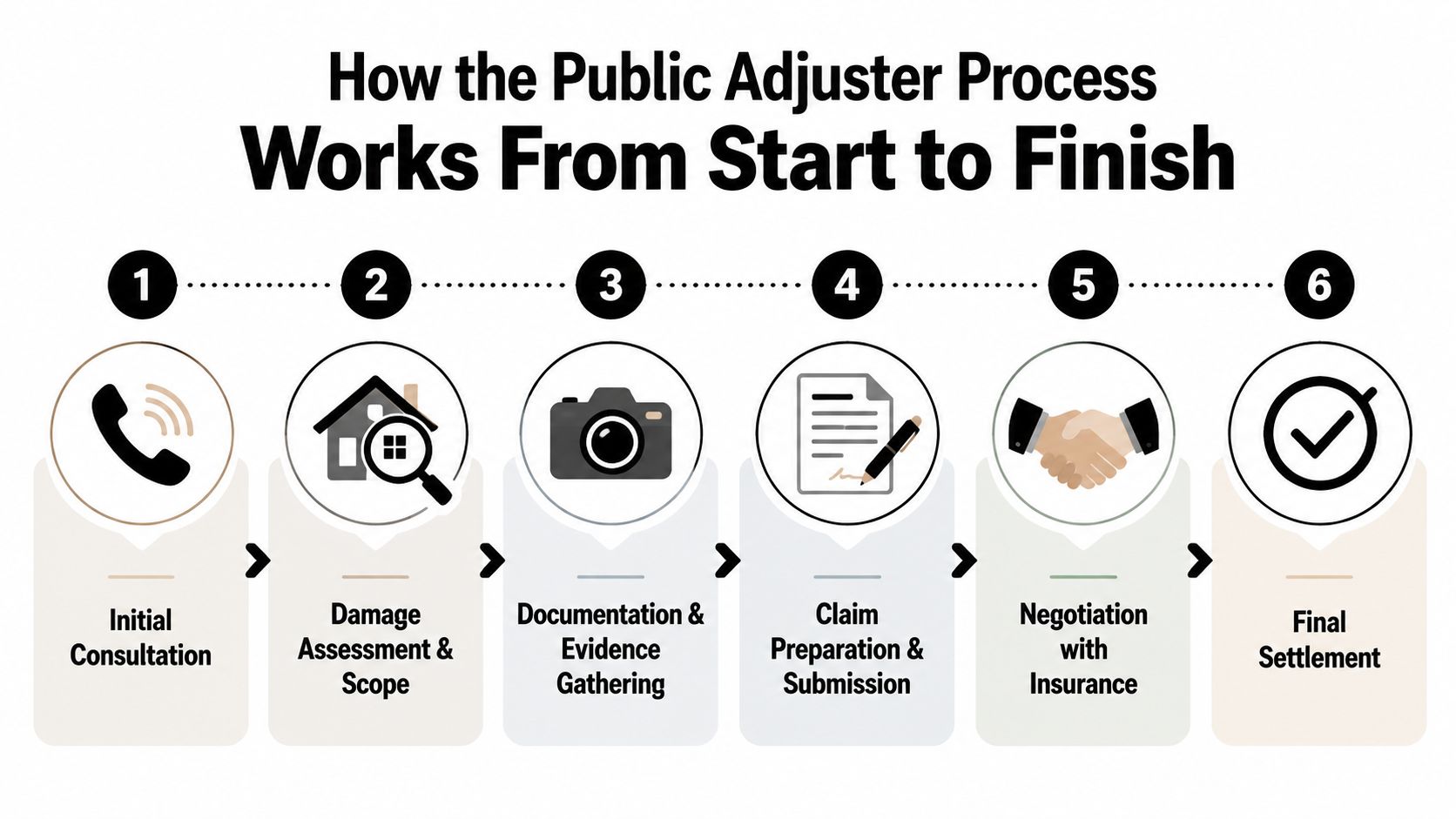
From first call to proof of loss
The workflow usually starts with initial retention, where you explain what happened and the adjuster decides whether the claim fits their lane. Next comes policy review, because the value of the claim depends on what the contract covers, not what the homeowner or business owner assumes it covers. After that, the adjuster documents the damage, photographs the loss, and builds the estimate.
The critical piece is the proof of loss. That package should include line-item repair costs, contents inventories, and coverage triggers so the insurer has a formal claim file to evaluate. If those details are weak at the start, the recoverable loss can be underestimated even when the damage itself is obvious.
The process continues through submission, negotiation, and escalation if talks stall. Appraisal or mediation may come into play when the numbers don't move. A solid public adjuster keeps the file disciplined, because insurers respond better to organized evidence than to frustration.
If you want a broader view of how claim fights are framed by consumers, the insurance claim dispute guide is worth reading before you try to reopen a closed file. The rule is simple. Document first, argue second.
Here's the official process in plain language:
- Initial Consultation. Decide whether the loss fits a public-adjuster model.
- Damage Assessment and Scope. Inspect the damage and map the full loss.
- Documentation and Evidence Gathering. Build photos, inventories, and repair support.
- Claim Preparation and Submission. Package the file for insurer review.
- Negotiation With Insurance. Push back on missing scope or low valuation.
- Final Settlement. Resolve the file or move to the next dispute step.
If the early documentation is sloppy, the final number usually suffers. That's not a theory, it's how claims files get underpaid.
Understanding Public Adjuster Fee Structures and Net Recovery
Public adjusters usually work on contingency, which means they get paid from the recovery instead of by the hour. That sounds simple until you run the math. The fee is generally calculated on the total settlement amount, not just the extra money they convince the insurer to pay.
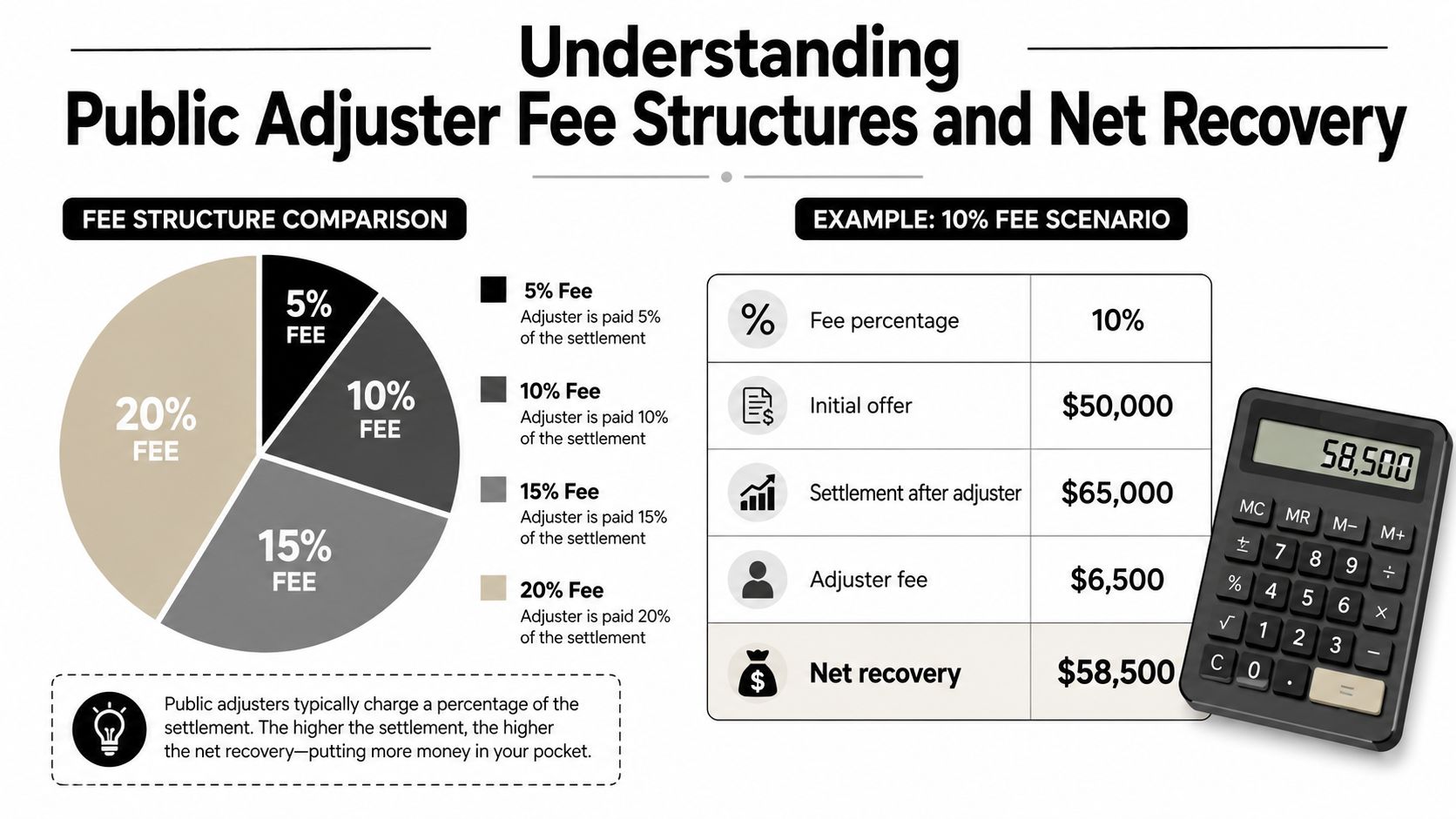
Fee caps change by state
The Insurance Information Institute explanation of public adjusters notes that fees can be up to 15% of the settlement in some cases. Texas caps public adjuster fees at 10% of the amount the insurer pays on the claim, while Florida allows up to 20% in normal years and 10% in declared-emergency years, per the verified data. California guidance says fees commonly range from 2% to 25% or more depending on claim size and complexity, again from the verified data summary.
The fee math matters because a bigger settlement isn't automatically a better net result. If the claim goes from a weak offer to a stronger one, the fee is applied to the full settlement amount. That's why policyholders need to compare net recovery, not just gross recovery.
Here's the simple way to test it. If an insurer offers $50,000 and the adjuster later secures $65,000 with a 10% fee, the fee is $6,500, leaving $58,500 net. That's better than the original offer, but only because the uplift exceeded the fee. If the uplift is small, the math can get thin fast.
If you're used to attorney fee talk in other disputes, think of it as comparable to a contingency model in a DUI defense fee guide like the Ticket Shield, PLLC fee overview. The structure is different, but the decision rule is the same, compare the expected gain against the cost before you sign.
A good public adjuster fee should come with one thing in writing, the percentage, the state cap, and whether it applies to the whole settlement or only to a disputed increment. If they won't spell that out, walk away.
When a Public Adjuster Is the Wrong Choice for Your Claim
Public adjusters are built for property claims. That includes homeowners, commercial property, and HOA losses. They're useful when the problem is damage scope, policy interpretation, documentation, or an insurer that's undervaluing the loss. They are not the right first call for most auto total-loss or diminished-value disputes.
Auto valuation needs a different tool
A vehicle total-loss dispute is usually about valuation methodology. The carrier says the car was worth one number. You know the market says something else. That is an appraisal problem, not a property-claims file. The better path is usually the appraisal clause, an independent appraisal, and a report that challenges the insurer's valuation assumptions directly.
That's the lane Total Loss Northwest works in, using certified independent appraisals for total loss and diminished value claims across Oregon and Washington State, with diminished value support in all 50 states. That kind of service is designed to attack the insurer's valuation software and build a market-based number instead. A public adjuster can't substitute for that when the dispute is about vehicle value rather than property loss.
The same distinction saves time on smaller disputes. If your claim is a basic fender-bender with an ordinary repair estimate, hiring a public adjuster is probably a detour. If your policy issue is really the vehicle's pre-loss value, the appraisal clause is the cleaner path. The right expert depends on the claim type, not on how angry you feel about the offer.
Wrong expert, wrong battlefield. Property loss needs claim-building. Vehicle value needs valuation evidence.
How to Vet and Hire the Right Claims Professional
Start with license verification, not sales talk. For a public adjuster, check your state insurance department, review the complaint history, and read the contract before you sign anything. A clean pitch doesn't matter if the fee terms are fuzzy or the cancellation clause traps you.
Questions that cut through the fluff
Ask whether they've handled your exact type of loss, not just “property claims” in general. Fire, water, hail, commercial loss, condo association loss, and catastrophe work all demand different documentation habits. For an auto valuation dispute, ask for certification credentials, appraisal-clause experience, and sample report structure, because you need someone who can defend market value in a formal negotiation.
A good legitimacy check is to treat the hire like any other professional service. The Recepta.ai legitimacy guide is a useful reminder to verify the business before you trust the pitch. That means looking past glossy promises and asking for proof.
Watch for these red flags:
- Upfront pressure: they want a signature before you've reviewed the contract.
- Guaranteed outcomes: no honest claims pro can promise a specific settlement.
- Vague fees: they won't say whether the percentage applies to the whole recovery.
- No recent references: they can't point to real work on similar losses.
If you're hiring for a vehicle dispute instead of a property claim, ask directly whether the person can support total-loss or diminished-value valuation work. If not, stop there. A professional who fits the claim type is worth more than one who claims to handle everything.
Total Loss Northwest handles total loss and diminished value disputes with certified independent appraisals, appraisal-clause support, and market-based reports built for negotiation. If your claim is a vehicle value fight, not a property loss, visit Total Loss Northwest and see whether your dispute belongs in the appraisal process instead of the public-adjuster lane.