The call usually sounds calm. The effect on you isn't.
Your insurer says the vehicle is a total loss, gives you a value that feels too low, and starts talking like the next step is obvious. It isn't. You're suddenly dealing with money, title paperwork, repair decisions, and the risk of making a bad choice too early.
Many find themselves pushed straight into the DMV side of the salvage title process. That's backwards. The first fight is financial. If you accept a weak total loss settlement, every decision after that gets worse. If you lock in a fair settlement first, you keep control.
Your Car Is Totaled Now What
That “total loss” label doesn't mean your car is undrivable junk. It means the insurer decided the claim crossed the line where paying to repair it no longer makes financial sense under the rules they're applying.
In plain English, Actual Cash Value (ACV) is what the insurer says your vehicle was worth right before the crash. A salvage title is the title brand that usually follows once the vehicle is treated as a total loss under state law and insurance procedure. If you want a simple primer on the label itself, read this explanation of what a salvage title means.

What total loss actually means
In the U.S., the trigger is often tied to repair cost versus pre-damage value. Iowa uses 70% of fair market value, and other state and industry references commonly cite about 75% as the point where a vehicle is branded salvage and treated as a total loss under the legal process, according to Iowa DOT salvage vehicle guidance.
That matters for one reason. This is a financial threshold, not a moral judgment about whether the car is “fixable.”
A car can start, drive, and still be a total loss. Another car can look awful and still not cross the threshold. The insurer is doing a math problem first.
A totaled car is often a paperwork event before it's a mechanical one.
The two paths in front of you
Once the insurer flags the vehicle as a total loss, you usually face two choices:
- Surrender the vehicle: You take the settlement, sign over the vehicle, and let the insurer handle the branded-title side.
- Keep the vehicle: You retain ownership, accept a reduced payout because you're keeping the damaged car, and then deal with the salvage title process yourself.
Both options can work. What doesn't work is deciding based on stress.
Use this quick gut-check:
| Question | If yes | If no |
|---|---|---|
| Do you want the least hassle possible? | Surrender is usually cleaner | Keeping it may still work |
| Do you know the car's real market value? | Negotiate first | Stop and document value |
| Do you have repair access or specialized knowledge? | Keeping it may make sense | Surrender becomes stronger |
Your first move is simple. Don't sign the title away until the settlement amount is final and fair. The insurer wants speed. You need bargaining power.
Negotiating Your Total Loss Settlement
The insurer's first number is usually an opening position, not a verdict. Treat it that way.
Adjusters lean on valuation systems and internal workflows designed to close files fast. That doesn't mean the offer reflects your car's real pre-loss value. If the options are wrong, the condition is graded harshly, or the comparables are weak, your settlement drops before you've even started.

Settle the money before you trigger the salvage headache
Most owners become ensnared by prematurely asking DMV questions before resolving the payout issue.
That sequence hurts you. As noted in New Jersey salvage guidance, the timing around branding, ownership paperwork, and insurer handling can affect what happens after a total loss. The actual consumer issue isn't “what is a salvage title?” It's what happens to your payout, lien, and future resale if you keep the car.
Practical rule: Resolve the claim value first. Then decide whether keeping the vehicle still makes sense.
If you're in the middle of this fight, this guide on negotiating a total loss settlement is worth reading before you agree to anything.
What to push back on
Don't call the offer unfair in general terms. Be specific.
Bring evidence that changes the valuation file:
- Comparable listings: Find same-generation vehicles with similar trim, mileage range, and equipment.
- Service history: Maintenance won't turn an average car into a collector car, but it can support condition.
- Options and packages: If the report missed factory or major added equipment, the number may be low.
- Pre-loss condition photos: Clean body, interior, wheels, and glass matter when condition adjustments are being made.
Then ask for the full valuation report. Read every line. Wrong trim. Missing package. Incorrect mileage band. Prior unrelated condition assumptions. These are the errors that cost you money.
When to invoke the appraisal clause
If the insurer won't move and your policy includes an appraisal clause, that's often your strongest tool. It lets each side hire an appraiser to determine value under the contract process instead of leaving the number entirely in the insurer's hands.
That's not the same thing as arguing with the adjuster for another week. It changes the battlefield.
One option in that situation is a third-party appraiser such as Total Loss Northwest, which provides total loss appraisals and can invoke the appraisal clause on behalf of vehicle owners under applicable policies. The point isn't who sounds more confident on the phone. The point is whose valuation is documented, supportable, and tied to the actual market.
Don't make these mistakes
- Signing too early: Once you sign title documents and release paperwork, your bargaining position often diminishes.
- Negotiating from memory: “I know what my car was worth” won't beat a valuation file.
- Focusing only on repairability: The settlement amount and the keep-or-surrender decision are separate issues.
- Letting the insurer rush you: Fast closure helps them more than it helps you.
A better settlement gives you better choices. That's the whole game.
Deciding to Keep or Surrender Your Vehicle
Once the settlement number is where it should be, the main decision gets easier. Now you can look at the car without the insurer's lowball offer distorting everything.
The basic math is simple:
Final settlement amount – insurer's buy-back or retention value = your cash payout if you keep the damaged vehicle
That's the number that matters. Not your attachment to the car. Not the adjuster's opinion. Not the repair shop's optimism.
When keeping the car makes sense
Keeping it can be smart if the vehicle has value that doesn't show up cleanly in a standard insurance valuation.
That often applies to:
- Collector or enthusiast cars: The owner may understand the market better than the insurer does.
- Customized vehicles: Some modifications don't get recognized properly in the initial value assessment.
- Primarily cosmetic damage cases: If the damage looks dramatic but the structure and key systems are manageable, owner-retain can pencil out.
- You have trusted repair access: If you know exactly who will repair it and how documentation will be handled, the risk drops.
If you'd buy your own damaged car back at that number, keeping it deserves a hard look.
When surrendering is the better move
Sometimes the clean break is the right move. I'd tell a client to surrender the vehicle if the damage is messy, the title process will be a burden, or the future use case doesn't justify the work.
Watch for these red flags:
| Situation | Better choice | Why |
|---|---|---|
| Heavy structural damage | Surrender | Repair and documentation can become a long grind |
| You need a replacement fast | Surrender | Time has a cost |
| You don't want inspection risk | Surrender | A failed rebuild path leaves you stuck |
| Low-value daily driver | Usually surrender | The paperwork burden often outweighs the upside |
Ask yourself three blunt questions
Do I want a project or a vehicle
If you retain a totaled car, you're taking on a project. That means repair oversight, receipts, title steps, inspection scheduling, and likely insurance shopping later.
Will I still want this car after it's branded rebuilt
A rebuilt title follows the car. If that fact bothers you now, it won't bother you less later.
Am I choosing this because it's smart or because I'm upset
A lot of owners keep a totaled car because the insurer irritated them. That's an emotional reaction to a financial problem. Don't mix the two.
The Path to a Rebuilt Title Repair and Documentation
If you're keeping the vehicle, the salvage title process becomes a paperwork discipline problem. The repair itself matters, of course. But the file you build matters almost as much.
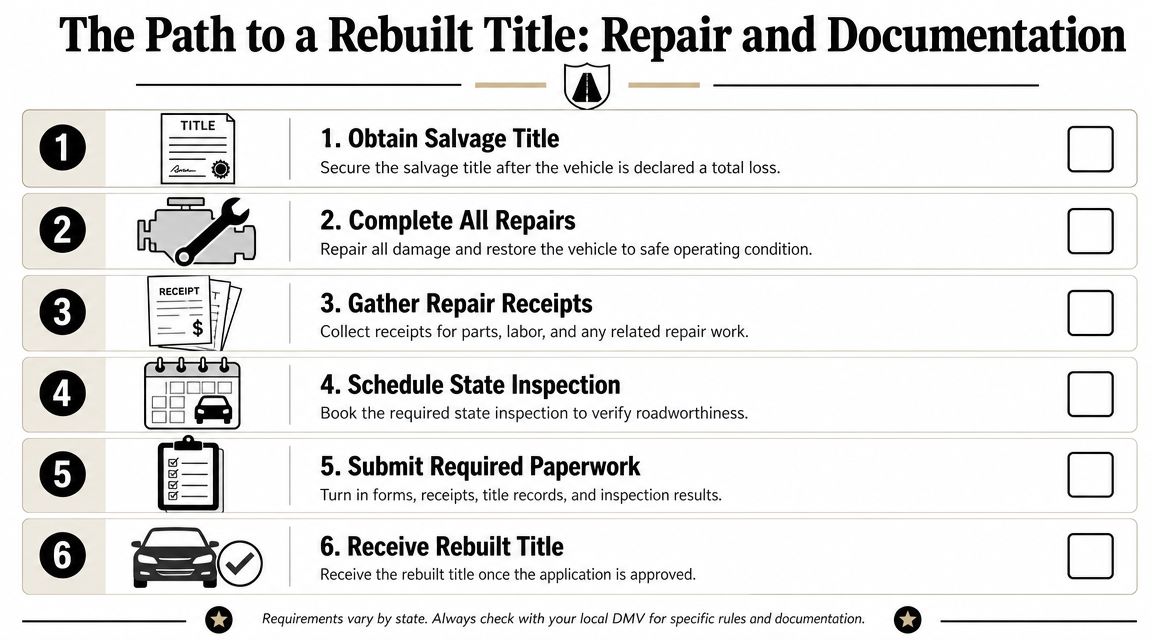
A salvage-to-rebuilt conversion is usually a documentation-heavy, inspection-gated workflow. One example is New York, which requires Form MV-83SAL and a fee of $200 or $205 depending on ownership documentation, as described in this overview of the New York rebuilt title application process. The bigger lesson is the important one. Missing VIN-linked receipts, omitted pre-repair photos, or inconsistent ownership records can sink the application even when the car is mechanically repaired.
Build your file before the wrench work gets ahead of you
Most owners do this backward. They repair first, then try to recreate the record later.
Don't.
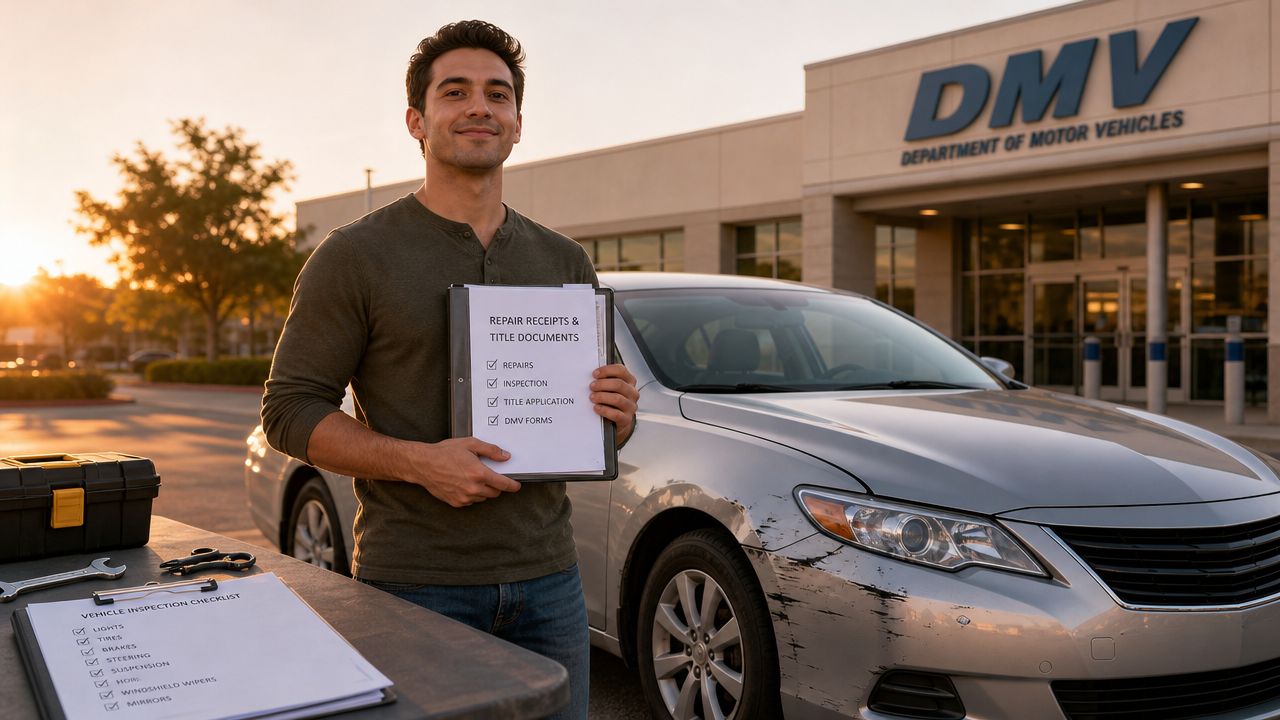
Start a dedicated binder or digital folder and keep these items organized from day one:
Repairs fix the car. Documentation proves the car is the one you own, the parts were acquired legitimately, and the rebuild followed the rules.
- Title and ownership documents: Keep copies of everything you receive from the insurer and state.
- Before photos: Take clear shots of all damage before repairs begin.
- During-repair photos: Show what was replaced and what was repaired.
- Itemized receipts: Major components should be traceable, especially if a part carries its own VIN or identifying number.
- Labor invoices: If a shop does any part of the work, keep the final invoice and supporting notes.
For larger vehicles or specialty units, using a qualified repair facility matters even more because documentation quality can make or break the file. If you're dealing with a motorhome or similar unit, this overview of professional RV collision damage repair is a useful benchmark for the kind of process and recordkeeping serious collision work should involve.
Here's a practical walkthrough of how owners think through rebuilding after a total loss:
Follow the sequence, not your impatience
The cleanest path usually looks like this:
Get the correct branded title status handled first
Don't assume you can jump straight to “rebuilt.” States want the salvage phase recognized before the rebuilt phase is considered.Complete repairs fully
Half-finished work wastes inspection appointments. Finish the vehicle before you ask the state to review it.Match every major repair to paper
If an inspector can point to a replaced component and you can't produce the related receipt, you've created your own problem.Prepare state-specific forms carefully
Wrong fields, missing signatures, or ownership mismatches create avoidable delays.
The common failure points
Sloppy receipts
A receipt that doesn't identify the part well enough may not help you much.
Missing photos
If you can't show what the vehicle looked like before and during repair, you make the inspector's job harder. Harder jobs often become rejected jobs.
Ownership gaps
If the paperwork trail from insurer to owner to repaired vehicle isn't clean, expect trouble.
The people reviewing these files aren't there to admire your bodywork. They're there to verify the vehicle's identity, parts trail, and legal path back toward registration.
Passing the Rebuilt Vehicle Inspection
This is the stage people misunderstand most. Many owners show up expecting a broad roadworthiness review. In practice, the rebuilt inspection often exists first to prevent fraud, confirm identity, and match the repaired vehicle to the paperwork.

Minnesota says the inspection used to clear salvage status is not a safety inspection. Its purpose is to deter fraud and verify identity and documentation. Iowa also requires owners to bring the salvage title, an affidavit of repairs, and receipts or invoices for rebuild parts to inspection, according to Minnesota salvage vehicle process guidance.
That distinction matters. If you show up with a mechanically decent car but weak paperwork, you can still fail.
What inspectors tend to focus on
Inspectors usually care about consistency.
They want the VIN on the vehicle to match the title. They want major repaired or replaced parts to line up with invoices. They want the story told by your documents to match the physical vehicle in front of them.
Inspector red flags
- Unexplained parts swaps: Especially where identifying numbers should exist
- Messy paperwork: Loose receipts, incomplete forms, missing signatures
- Repairs that don't match your photos: If the file says one thing and the car shows another, expect questions
- Inaccessible VIN areas: Don't make basic verification harder than it needs to be
Bring a clean binder, not a glovebox full of folded receipts.
How to prepare for inspection day
A little discipline here saves repeat trips.
| What to do | Why it helps |
|---|---|
| Organize documents in order | The inspector can verify faster |
| Clean the vehicle | VIN tags and repaired areas are easier to review |
| Bring originals and copies | You don't want a missing paper to kill the visit |
| Be ready to explain repairs plainly | Confused answers create suspicion |
What owners get wrong
They overprepare for a mechanic's test and underprepare for an identity-and-paper trail test.
That's why I tell clients to think like an auditor. If someone who's never seen your car before had to confirm what happened, where the parts came from, and whether the vehicle in front of them is the same one on the paperwork, could they do it quickly?
If the answer is no, fix that before the appointment.
Life With a Rebuilt Title Insurance and Resale
A rebuilt title gets you back on the road, but it doesn't return the car to a clean-history vehicle. That's the long-term reality, and you're better off facing it directly.
Insurance can take more work. Some carriers are cautious with rebuilt vehicles, and some owners find they need to call around more than they expected. The fix is persistence and documentation. When you can show the title progression, repair records, photos, and inspection result clearly, the conversation gets easier.
Insurance gets easier when your file is clean
Call insurers with your paperwork ready, not with a vague story.
Have these at hand:
- Rebuilt title documents
- Inspection paperwork
- Photo record of repairs
- Receipts and shop invoices
- Any independent valuation support you used during the claim
The cleaner your file, the less the vehicle looks like an unknown risk.
Resale depends on honesty and proof
If you sell the car later, disclose the rebuilt brand clearly. That isn't just smart. It protects you.
A rebuilt-title car is harder to sell when the seller gets defensive. It becomes easier to sell when the seller is organized. Buyers don't just want reassurance. They want evidence.
Don't argue that the title brand doesn't matter. Show why this particular rebuilt car deserves confidence.
A documentation binder becomes your sales tool. It proves the sequence from loss, to repair, to inspection, to legal road use. That gives a serious buyer something concrete to review instead of just your word.
Price expectations and market context
You also need to be realistic. A rebuilt-title car sits in a different category from a clean-title equivalent. If you expect clean-title money, you'll waste your time.
That said, broader used-vehicle conditions can still affect how buyers think about repaired cars. If you want context for how outside market pressure changes buyer behavior, this piece on understanding current car market chaos is a useful reminder that people don't shop in a vacuum.
And if you're dealing with the value hit after damage history, this guide to diminished value after an accident helps frame why title history and claim history continue to matter even after repairs are complete.
Owning a rebuilt-title vehicle can still make financial sense. But only if you made the right decision at the start, negotiated the total loss properly, and treated the salvage title process like a legal and financial project instead of just a repair job.
If your insurer has declared your vehicle a total loss and the number doesn't make sense, Total Loss Northwest can help you challenge the valuation through an independent appraisal and appraisal clause process where applicable. That gives you a stronger footing before you decide whether to surrender the vehicle or keep it and enter the salvage title process yourself.