The crash is over. Your car is in a yard or at a body shop. Your phone lights up, and the adjuster says the words nobody wants to hear: “We're declaring it a total loss.”
Most drivers hear that and think the decision is final. It isn't. It's the beginning of a negotiation over what your vehicle was worth, what hidden damage matters, and whether the insurer is using a shortcut valuation that leaves money on the table.
That matters because this isn't a tiny corner of the economy. The U.S. automotive collision repair market was valued at USD 36.66 billion in 2023 according to Grand View Research's collision repair market analysis. When that much money is moving through claims, repairs, parts, storage, labor, and salvage, insurers don't casually overpay. They control costs. Your job is to make sure they don't control your claim by default.
If you're dealing with total collision repair issues right now, stop thinking like a customer and start thinking like an owner protecting an asset. That shift changes everything.
The Phone Call No Car Owner Wants to Get
You've already had a rough week.
Maybe the other driver ran a light. Maybe somebody hit your parked car. Maybe your vehicle looked repairable from the outside, and you assumed the shop would write an estimate, replace a few panels, and move on. Then the insurer calls and says your car is totaled.
That call hits hard because it creates three problems at once. You lose transportation, you get pushed into a settlement process you didn't ask for, and you're expected to make decisions fast while you're still dealing with the accident itself.
Why that call feels so disorienting
The insurer speaks in claim language. You're thinking in real life language.
They talk about valuation reports, ACV, salvage, comparable vehicles, and thresholds. You're thinking about your commute, your car loan, your child's car seat, your aftermarket wheels, your recent maintenance, and the fact that your vehicle was in better condition than a generic book value suggests.
Practical rule: A total loss declaration is not a courtesy update. It's the point where the insurer starts trying to close the file.
That's why I tell clients the same thing every time. Slow down. Don't argue emotionally. Don't accept anything verbally. Get the paperwork.
The mistake most owners make in the first 24 hours
They assume the insurance company already “did the math correctly.”
Sometimes the adjuster is reasonable. Sometimes the report is sloppy. Sometimes the comparable vehicles are weak. Sometimes options are missing. Sometimes the condition rating is too low. And with modern vehicles, the biggest miss often isn't visible body damage. It's the way technology, safety systems, and repair standards affect value after a serious collision.
If your car had radar sensors, cameras, lane-keep features, adaptive cruise, blind-spot systems, or other driver-assistance hardware, you're not dealing with an old-school fender bender claim. You're dealing with a machine that depends on precise repair procedures and electronic calibration.
What to do before you say yes to anything
Start with these basics:
- Ask for the valuation report: You want the full report, not a summary over the phone.
- Ask where the vehicle is located: Storage charges and access matter.
- Remove personal items: Don't leave chargers, paperwork, garage remotes, or toll tags in the car.
- Keep every document: Estimate sheets, tow bills, photos, receipts, and emails all matter later.
The insurer's first number is a position, not a verdict.
That's the mindset you need for the rest of this process.
The Critical Fork Repair or Total Loss
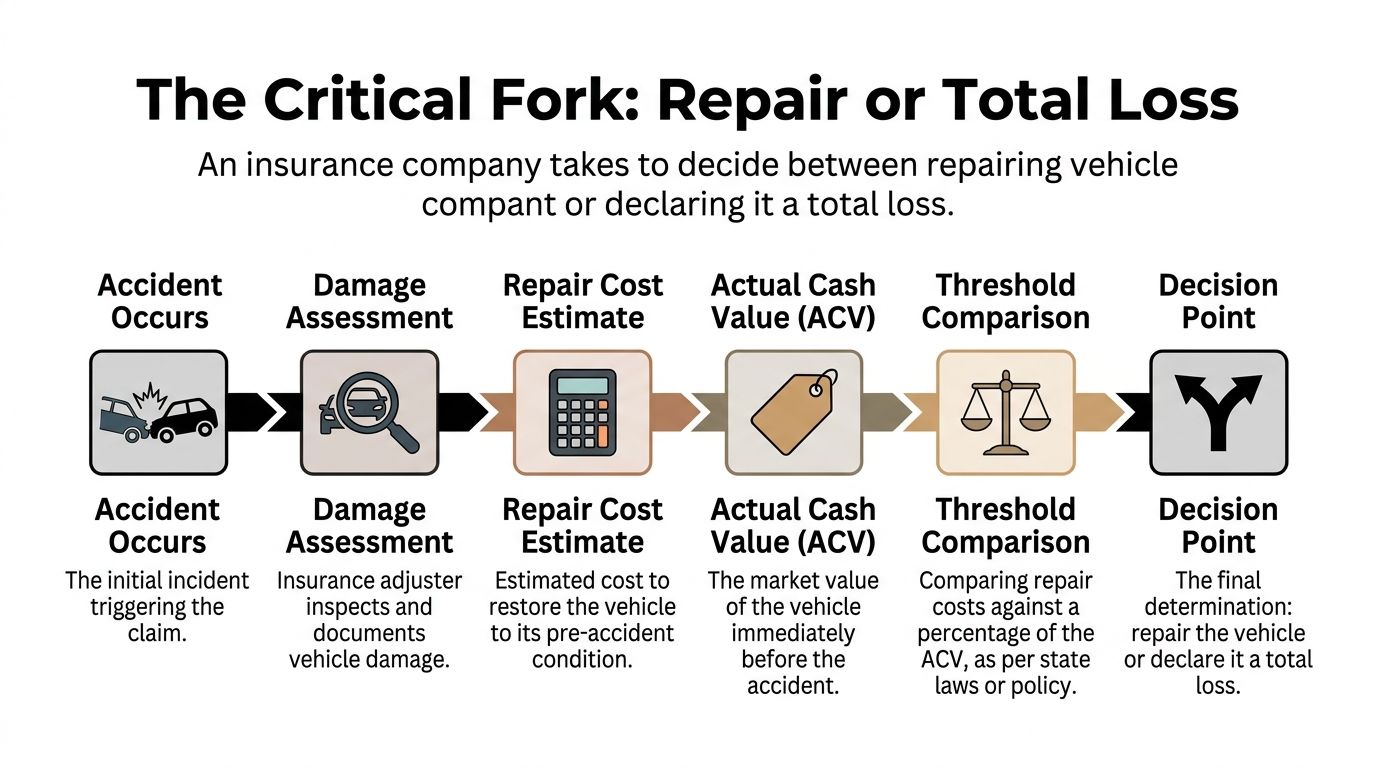
Insurers don't decide between repair and total loss based on sentiment. They decide based on cost.
A vehicle is generally treated as a total loss when the estimated repair cost exceeds a percentage of the car's pre-loss value, often 70 to 80 percent, according to Auto Body News on total loss processing and documentation. That estimate isn't supposed to be a quick glance. It requires full disassembly to uncover hidden damage before the final decision can be made.
What the insurer is really comparing
Consider a damaged appliance in your house. If fixing it costs close to what the appliance was worth before it broke, replacing it becomes the cheaper option.
With cars, the insurer looks at the vehicle's actual cash value, often called ACV. That's the market value of your vehicle immediately before the crash. It is not what you paid for it, what you still owe, or what it would cost to buy a nicer replacement.
Then they compare that value to the projected repair cost. If the repair path gets too expensive, they move to total loss.
Why the estimate can swing hard after teardown
Visible damage is only the start.
Once the shop disassembles the vehicle, hidden structural damage, sensor mounting damage, suspension issues, wiring problems, and calibration needs can push the estimate much higher. On modern vehicles, that's common. A bumper isn't just a bumper anymore. It may house radar units, brackets, harnesses, and components that affect safety systems.
That's one reason the choice between repair parts matters so much. If you're trying to understand the tradeoffs involved in choosing between OEM and aftermarket components, learn that before you agree with the insurer's assumptions about repair cost and quality.
The fork in the road isn't always obvious
Some owners want the car repaired no matter what. Others want the fastest payout possible. Both reactions can backfire.
Use this framework:
- If the insurer says repair is possible: Ask whether the estimate includes full teardown findings, structural measurement, and ADAS work.
- If the insurer says total loss: Ask how they established ACV and whether every option, package, and condition factor was included.
- If you're considering keeping the car: Read about whether you can fix a totaled car before you commit to owner retention.
Hidden damage changes claims. Once the vehicle is opened up, the “repairable” car from day one can become a total loss on day three.
That's why total collision repair decisions should never be based on a casual first estimate.
Your Action Plan After a Total Loss Declaration
More drivers are getting this call now. As of 2025, total loss frequency has climbed to nearly 23% of claims, driven by rising repair costs and an aging vehicle fleet, according to this collision repair trends report. So if this happened to you, you're not dealing with some rare edge case. You're dealing with a claim type insurers process constantly.
That's good news and bad news. Good because there's a process. Bad because they move through that process fast, and speed usually benefits them more than you.
Your first moves
Handle the basics first. Don't overcomplicate it.
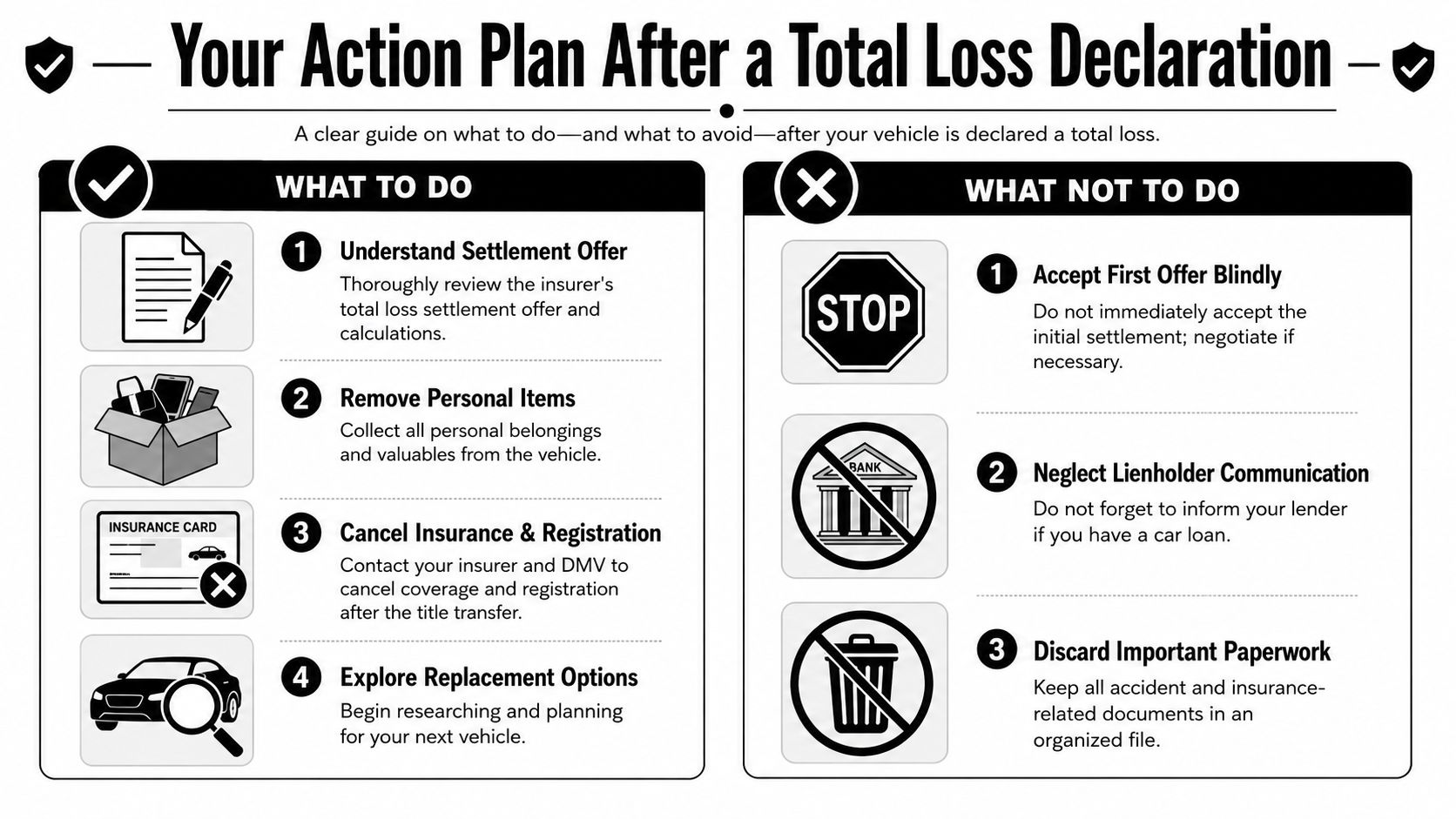
Request the valuation report immediately
You need the full breakdown of how the insurer arrived at its number.Get your property out of the vehicle
Check the glove box, center console, trunk, door pockets, and any hidden storage areas.Preserve evidence
Save photos of the vehicle before the loss if you have them. Save maintenance receipts, tire invoices, recent service records, and proof of upgrades.
What to gather before you respond
The strongest rebuttal is organized, not emotional.
- Maintenance records: Show consistent care and condition.
- Recent receipts: New tires, battery, brakes, suspension work, or factory-option repairs can matter.
- Vehicle details: Trim level, packages, mileage, interior condition, and added equipment.
- Local comparable listings: Look for vehicles that match yours in configuration and market.
What not to do
In such instances, owners hurt themselves.
- Don't accept the first offer blindly: Review the valuation line by line.
- Don't sign a release too early: Once you sign away rights, your negotiating position quickly weakens.
- Don't stop talking to your lender: If there's a loan, the payoff affects what reaches you.
- Don't throw away claim paperwork: Keep one organized file, digital or paper.
If you can't explain how the insurer reached the number, you're not ready to accept it.
A simple file system that works
Create one folder with these categories:
| File Type | What to Save |
|---|---|
| Claim documents | Adjuster emails, claim number, valuation report |
| Vehicle proof | Photos, window sticker if available, service records |
| Financial records | Loan payoff info, receipts, registration |
| Market evidence | Comparable listings, dealer quotes, notes from calls |
That file becomes your advantage. Without it, you're arguing from memory.
How to Negotiate a Fair Settlement
The adjuster calls, reads a number off a report, and makes it sound settled.
It is not settled.
A total loss valuation is only as good as the inputs behind it, and insurers know exactly which inputs push the payout down. If you want a fair number, stop reacting to the dollar amount and start attacking the report.
How insurers cut the value
They rarely slash value in one obvious move. They trim it in small places that look technical enough to pass without a fight.
Common problems include comparable vehicles pulled from weaker markets, missing trim or package details, low condition ratings, and option lists that ignore equipment your vehicle had. On newer vehicles, the undervaluation gets worse when advanced driver assistance features are treated like basic equipment instead of high-cost, high-value systems. A car with surround-view cameras, radar-based cruise control, lane-keeping hardware, or parking assist is not equivalent to a stripped version of the same model.
That difference matters. Modern vehicles carry expensive safety technology, and insurers often value them like yesterday's cars.
How to respond without wasting time
Do not argue in general terms. Mark up the valuation line by line.
Send a short written dispute that does four things:
- Identify factual errors: Wrong trim, mileage, drivetrain, packages, options, prior condition, or local market area.
- Challenge weak comparables: Remove listings with mismatched equipment, accident history, excessive distance, or unrealistic asking prices.
- Add proof of your vehicle's real configuration: Window sticker, build sheet, service records, receipts, and clear photos.
- Ask for a revised valuation in writing: Force the insurer to answer the specific errors, not dodge them on the phone.
Keep the tone professional. Keep the pressure on.
If the insurer cannot defend each comp and each adjustment, the number is not reliable.
The clause that gives you real leverage
If the adjuster keeps repeating the same offer, check your policy for the Appraisal Clause.
That provision can let you hire your own appraiser and force a value dispute out of the usual adjuster back-and-forth. For many owners, that is the first point in the claim where the process becomes evidence-driven instead of script-driven. If you need an outside valuation, independent total loss negotiation support through the appraisal process can help document what the insurer missed.
Use that option when the gap is meaningful. Do not wait until frustration makes you sloppy.
The hidden money owners miss on newer cars
A total loss negotiation is not always just about pre-loss market value. With late-model vehicles, the settlement discussion often ignores what advanced safety systems contribute to value and what damage to those systems signals to the market.
Buyers, dealers, and appraisers do not treat a previously wrecked ADAS-equipped vehicle the same way they treat an older car with basic repair history. Camera mounts, radar brackets, sensor placement, calibration records, and OEM repair procedures affect confidence and resale. If your valuation report treats those features as background noise, push back. A detailed diminished value appraisal can uncover losses that a standard body shop estimate never touches.
That point gets missed constantly, and it costs owners real money.
Bring in help when the facts are on your side
Get an appraiser involved if the insurer ignores obvious errors, uses poor comparables, or treats a well-equipped vehicle like an average one. Do the same if your car is rare, unusually clean, heavily optioned, or loaded with driver-assistance hardware that was never properly reflected in the valuation.
At that stage, another phone call with the adjuster is usually a waste of time. Evidence wins. Expertise speeds it up.
Uncovering Hidden Value with a DV Claim
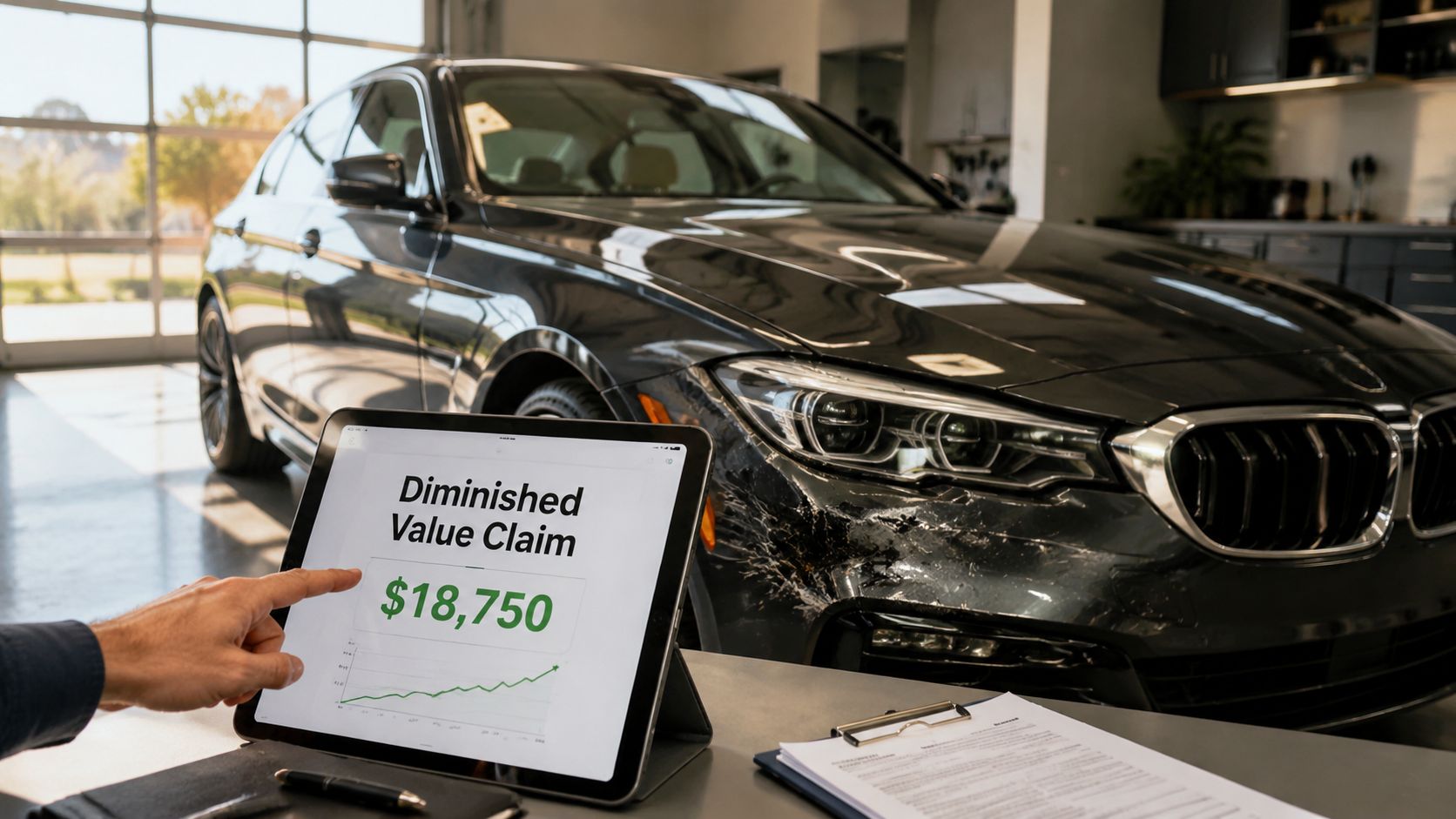
After the repair, your car may look right and still be worth less. That drop in market value is diminished value, or DV, and insurers count on owners missing it.
Far too many claims get reduced to sheet metal, paint, and labor hours. That approach falls apart on newer vehicles packed with cameras, radar sensors, parking hardware, and calibration requirements. A late-model car with accident history and questionable ADAS work does not trade like a clean equivalent. Buyers know it. Dealers know it. You should price the claim accordingly.
The ADAS problem most claims miss
The part owners and even many shops overlook is simple. Modern collision damage can hurt value even when the visible repair looks acceptable.
According to this analysis of collision repair rights and diminished value, 10% to 15% of ADAS-equipped vehicles suffer calibration issues post-repair if non-OEM procedures are used. That should get your attention. Lane departure warning, adaptive cruise, forward collision warning, blind-spot monitoring, and parking assistance all depend on precise placement, mounting, and calibration. If a radar bracket is slightly off or a camera was not recalibrated to OEM procedure, the car carries more risk and less market appeal.
That value loss is real, and insurers rarely volunteer it.
What you should demand after repair
If your vehicle was repaired instead of totaled, get the paperwork and read it.
- Post-repair scan documentation: Proof that fault codes and system status were checked.
- ADAS calibration verification report: A printed record, not a verbal assurance.
- OEM procedure compliance records: Especially if the vehicle has a driver-assistance package.
- Clear invoice language: The repair order should show exactly what was done.
If the shop cannot produce calibration proof, treat the repair as incomplete until someone documents it properly.
A proper total collision repair outcome on a modern vehicle includes more than straight panels. Structural work must return the vehicle to factory tolerances, and ADAS systems need post-repair calibration and electronic scanning. Car-O-Liner's overview of collision repair notes that structural realignment should be verified within ±1.5mm and followed by final electronic diagnostics and calibration work in line with OEM standards.
Here's a short walkthrough that helps explain the valuation side of that problem:
Why this matters even more on newer vehicles
The newer and more optioned the vehicle, the more expensive it gets to ignore this issue. Luxury models, EVs, hybrids, and upper-trim family vehicles often carry safety and convenience packages that materially affect resale value. Once those systems are involved in a loss, the market asks harder questions. Were OEM procedures followed? Were sensors replaced or reused? Was calibration documented? Can a future buyer trust the system?
A detailed diminished value appraisal can identify losses that a standard body shop estimate never addresses. If you are dealing with a newer vehicle and trying to sort out whether repair, value loss, or salvage makes financial sense, review your options after a car is declared totaled before you sign anything.
Deciding What to Do with Your Totaled Car
Once the settlement number is resolved, you still have one more decision to make. What happens to the vehicle itself?
Most owners choose the simple route. They sign the title over and let the insurer take the vehicle. The other route is owner retention, sometimes called keeping or buying back the salvage. That option can work, but only if you understand the downside before you commit.
Two paths, very different consequences
If you surrender the vehicle, the insurer pays the agreed settlement and takes possession. That usually means fewer headaches, less paperwork, and no future involvement with the damaged car.
If you keep it, the insurer deducts the salvage value from the settlement and you retain the vehicle. That sounds attractive when the car still runs or has sentimental value. But a salvage title can create registration issues, insurance complications, financing problems, and resale headaches.
Options for Your Totaled Vehicle
| Option | What Happens | Pros | Cons |
|---|---|---|---|
| Surrender to insurer | You transfer title and the insurer takes the vehicle | Cleaner exit, less paperwork, no need to manage salvage or repairs | You lose any chance to retain parts or rebuild the car |
| Keep the salvage | Insurer deducts salvage value and you keep the vehicle | Useful if you want to rebuild, part out, or keep a specialty vehicle | Salvage title complications, harder insurance placement, reduced resale value |
When keeping the salvage makes sense
It can make sense if the car is a collector vehicle, if you have access to qualified repair resources, or if the value to you is higher than the resale market would suggest.
For most daily drivers, though, owner retention creates more trouble than people expect. Before you decide, review a practical guide on what to do with a totalled car and think through registration, title branding, insurability, and your real end goal. If your plan is vague, keeping the salvage is usually a bad decision.
Frequently Asked Questions About Total Loss
How long does a total loss claim take?
It depends on the insurer, the condition of the vehicle, title access, lienholder involvement, and whether the value is disputed. A straightforward claim can move quickly. A disputed valuation takes longer. If the insurer is rushing you, that's their timeline, not yours.
Can I keep my personalized plates?
Often, yes, but the process depends on your state's vehicle agency rules. Ask before the vehicle leaves your control, and confirm what paperwork you need to transfer or retain the plates.
What if I still owe money on the loan?
Your lender gets paid first from the settlement if there's an active lien. If the settlement is less than the loan payoff, you may owe the difference unless you have gap coverage. Call the lender early. Don't wait for the insurer to handle that conversation for you.
Will my insurance rates go up?
They can. Whether they do depends on fault, your carrier, your policy history, and state rules. Ask your insurer directly, but don't let fear about future premiums push you into accepting a weak settlement now.
Can I challenge the offer if the car is already declared a total loss?
Yes. The total loss decision and the settlement amount are related, but they are not the same argument. You can still challenge the valuation, the comparable vehicles used, and the final payout figure.
If you're being lowballed on a total loss or you suspect the insurer's valuation misses the actual value of your vehicle, Total Loss Northwest offers independent total loss and diminished value appraisals for drivers who need documentation strong enough to use in negotiation. That kind of outside valuation can be the difference between closing a frustrating claim quickly and closing it fairly.