You open the claim email expecting a number that will let you replace your car and move on. Instead, you get a settlement figure that feels detached from reality. The options package isn't there. The local market doesn't seem to matter. The condition of the vehicle before the crash has been flattened into a few generic adjustments.
That's the moment a lot of drivers search for “total loss appraisal near me.” They're not looking for theory. They want to know whether the insurer's number is final, who can challenge it, and what to do next without making the claim worse.
The most important point is simple. A total loss offer is often the insurer's opening position, not the last word. If your policy includes an Appraisal Clause, you may have a formal path to force a fair valuation using independent appraisers and, if needed, an umpire. For drivers in Washington and Oregon, that right can change the entire claim.
Why Your Insurer's Total Loss Offer Is Just a Starting Point
Most drivers assume the insurer has already “done the math” and the number must be correct. In practice, that first valuation is often built from software-driven reports and broad market inputs. Those systems can miss trim details, factory options, recent replacements, and local pricing differences that matter when you're trying to buy the same vehicle again.
That problem gets worse because total loss rules vary by state. Many states use a threshold approach, and 70% is the most widely used threshold, while other states use a formula that also includes salvage value, as explained in The Zebra's guide to total loss calculations. Two vehicles with similar damage can be handled differently depending on where the loss happened and how the carrier applies the rule.
What the insurer's number often misses
When I review a total loss file, I'm not looking only at the final offer. I'm looking at how the number was built.
Common problems include:
- Missing options: Leather, technology packages, towing equipment, premium wheels, and trim upgrades are often undervalued when the valuation isn't built from a proper VIN decode.
- Weak comparables: Cars outside your immediate market can pull the number down, especially if the report leans on vehicles that don't reflect your area.
- Condition shortcuts: A generic deduction for prior condition can reduce value even when the vehicle was well-kept.
- Maintenance blind spots: New tires, major services, and documented upkeep usually support value, but they don't always make it into the insurer's report.
The carrier's valuation report is evidence. It is not a verdict.
An independent appraisal gives you a structured way to challenge that report with market-backed analysis. If you want a plain-language explanation of how insurers frame actual cash value, this breakdown of auto insurance actual cash value is a useful starting point.
When a low offer becomes a bigger problem
A low valuation isn't always bad faith by itself. Sometimes it's a weak process. Sometimes it's an adjuster relying too heavily on a vendor report. But when an insurer ignores clear evidence, delays, or refuses to engage fairly, the issue can become more serious. If you're trying to understand that line, Porter Law Group explains bad faith insurance in a practical way.
Your power comes from process. Not anger. Not long phone calls. Not repeating that the offer feels unfair. A proper appraisal challenge replaces opinion with documentation and puts the insurer in a framework it has to answer.
Finding a Certified Total Loss Appraiser Near You
The phrase “near me” matters, but physical distance is only part of the decision. In a total loss dispute, the appraiser needs to know your local market, read the policy correctly, and build a valuation the insurer has to take seriously under the Appraisal Clause.

That matters even more in Washington and Oregon. A usable appraisal is not just a price opinion. It is a claim document tied to policy procedure. The appraiser should be able to identify the exact trim and factory options from the VIN, select defensible comparable vehicles from the right market area, explain every adjustment, and work within the appraisal process if the carrier refuses to revise its number.
The credentials that matter
Look for an appraiser who is USPAP-compliant and has real experience with insurance appraisal disputes. Valuation work in total loss claims depends on documentation, market selection, policy language, and claim procedure. Those are separate skills from repair estimating or vehicle sales.
In practice, I look for a method, not a title alone. The appraiser should be able to explain how they confirm equipment, how they choose comparable sales or listings, how recent those vehicles need to be, and how they handle insurer pushback. If they cannot walk you through that process clearly, the report often ends up too thin to carry weight.
Local judgment still matters. Seattle-area values can differ from Spokane, Vancouver, Portland, Bend, or smaller rural markets. An appraiser who knows the Pacific Northwest can usually spot when the carrier pulled comparables from the wrong area or used vehicles that are a poor trim, mileage, or condition match.
Questions to ask before you hire anyone
Keep the screening simple and direct.
- Ask about Appraisal Clause experience: Have they handled total loss disputes where the policyholder formally invoked appraisal?
- Ask how they select comparables: You want market-based support, not a recycled guidebook number.
- Ask whether they decode the VIN: Exact equipment and trim affect value.
- Ask what documents they review: A solid answer includes the insurer's valuation report, policy language, photos, title or registration, and service records.
- Ask how the final report is written: The report should show the comparables, adjustments, and reasoning in a format the insurer can evaluate.
If you want a practical starting point, this guide to finding an independent auto appraiser near me explains what to look for before you sign anything.
A quick visual overview can help before you make calls:
Red flags that waste time
Vague answers are the first warning sign. If an appraiser cannot explain how they support value, respond to insurer objections, or participate in the appraisal process, you may be paying for a document that does not move the claim.
Be careful with anyone who promises a number before reviewing the file. A credible appraiser will want the carrier's valuation report, your policy, the loss paperwork, and photos before discussing likely value. That is how careful appraisal work is done.
A total loss appraiser earns the fee by producing a defensible valuation and helping the policyholder use the process correctly.
Gathering Your Documents and Photos for the Appraisal
A strong appraisal file starts before the appraiser writes a single adjustment. The cleaner your documentation, the harder it is for the insurer to lean on assumptions.
Treat this like building evidence, not paperwork.
What to gather first
Start with the documents that show ownership, coverage, and the insurer's position.
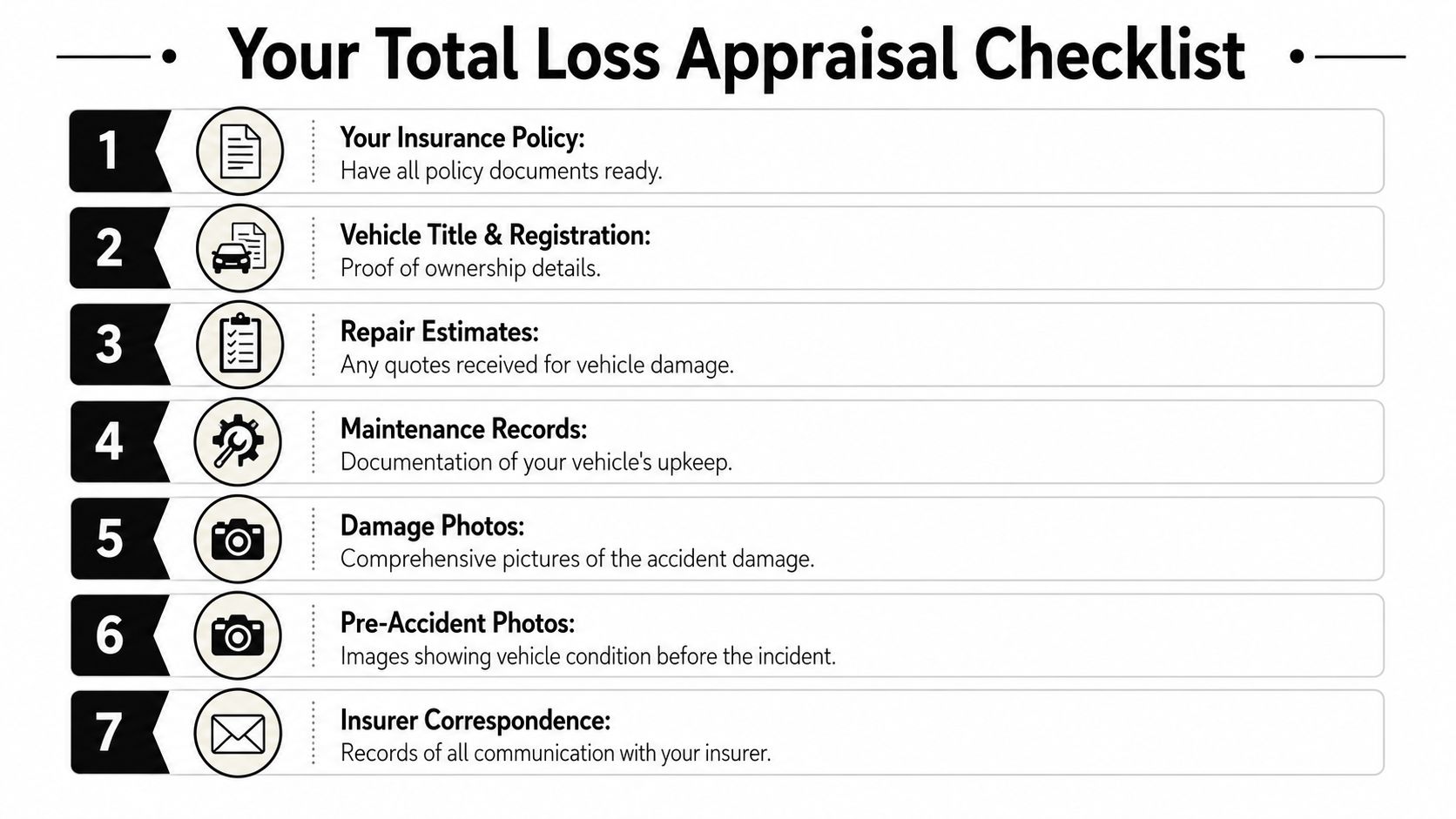
- Your insurance policy: The appraiser needs to verify whether the Appraisal Clause applies and how the policy phrases it.
- Title and registration: These confirm ownership and help match the vehicle details correctly.
- The insurer's valuation report: Errors often show up in this document. Missing options, weak comps, and unexplained condition deductions usually appear here first.
- Repair estimates or total loss notice: These help establish how the claim reached total loss status.
If you're still sorting out the broader claim after the crash, this guide on steps after a car accident helps organize the timeline.
Records that often add value
Drivers tend to underestimate what supports market value. Keep anything that shows the vehicle was better than “average.”
- Maintenance records: Oil service history, major interval services, brake work, suspension work, and dealer records matter.
- Receipts for recent parts: Tires, batteries, brakes, and major mechanical replacements help show the vehicle was maintained.
- Upgrade receipts: Factory-authorized or high-quality additions can matter if they're relevant to market value.
- Pre-loss photos: These are useful when the insurer applies a broad condition deduction without proof.
Practical rule: If it would help a buyer understand why your car was worth more than a generic listing, keep it.
Photos your appraiser actually needs
Don't just send crash photos from the scene. Send a full condition set if you have access to the vehicle or older images on your phone.
Take or locate:
- Front three-quarter and rear three-quarter views
- Both side profiles
- Interior photos of seats, dash, console, and infotainment
- Odometer and VIN label
- Wheel and tire close-ups
- Damage photos from multiple angles
- Any clear pre-accident images showing paint, body, and interior condition
The goal isn't volume. It's coverage. A clean photo set lets the appraiser defend condition, verify options, and explain why the insurer's deductions don't fit your vehicle.
The Independent Appraisal Process and Timeline
After you retain an independent appraiser, the claim shifts into a formal procedure under your policy. That change matters, especially in Washington and Oregon, because the appraisal clause gives you a defined way to challenge a low total loss offer instead of waiting for the carrier to reconsider on its own timeline.

How the process usually unfolds
The first step is a coverage and policy review. Your appraiser checks whether your policy's appraisal clause applies to this first-party total loss dispute and confirms how notice should be given. Small wording differences in the policy can affect timing, who selects the umpire, and how the final amount is issued.
Next comes vehicle verification. The VIN, trim level, drivetrain, factory packages, mileage, and condition evidence all need to be nailed down before anyone argues value. If the insurer missed options or treated a well-kept vehicle as average, that gets addressed here.
Then the appraiser builds the valuation report. That usually means selecting appropriate local or regional comparable vehicles, adjusting for mileage, condition, equipment, and market differences, and writing the report in a way the carrier's appraiser has to answer point by point. Presentation matters. A thin number with no method rarely changes a claim.
Once the report is ready, the appraisal clause is formally invoked in writing. From there, each side names an appraiser, the reports are exchanged, and the two appraisers try to reach an agreed value. If they cannot, an umpire is selected to decide the remaining gap. In practice, many disputes resolve before the umpire has to make the final call.
What the timeline looks like in real life
Most owners want a hard deadline. Insurance claims rarely work that cleanly.
A straightforward file can move quickly if the policy language is clear, the documents are complete, and the insurer responds on schedule. A disputed file takes longer when the carrier delays naming its appraiser, argues over comparable vehicles, or pushes back on condition adjustments. The process is structured, but it is still handled by people, and people create delays.
From your side, the timeline usually breaks into three phases:
- Review and setup. The appraiser reviews the policy, insurer valuation, and vehicle details, then prepares the formal demand.
- Valuation exchange. Both sides compare reports, challenge weak comps, and defend their adjustments.
- Resolution. The appraisers either agree on value or submit the dispute to an umpire for a binding decision on the amount of loss.
That structure gives you control. You are no longer relying on repeated calls to the adjuster or informal requests that go nowhere.
Where claims tend to stall
In my experience, delays usually come from preventable problems in the file, not from the clause itself.
Common sticking points include:
- The carrier used bad comps from the wrong market, wrong trim, or wrong condition bracket.
- Options were missed or misread when the insurer decoded the VIN or described the vehicle.
- The policyholder accepted the offer too early or signed paperwork that narrowed the dispute.
- The appraiser knows valuation but not procedure and fails to invoke the clause correctly or answer the insurer's objections in writing.
There are also judgment calls that affect value but do not always show up neatly in a pricing tool. Recent tires, exceptional interior condition, dealer service history, and even presentation can influence market reaction. If you are replacing a vehicle and trying to protect its resale position beforehand, improving trade-in value through detailing can support cleaner condition evidence and better buyer comparisons.
A well-built appraisal file does one thing very effectively. It forces the discussion back to policy rights, market evidence, and written methodology. That is how owners in Washington and Oregon stop arguing in circles and start pressing for a fair total loss settlement.
Calculating the Cost and Value of a Total Loss Appraisal
A driver in Washington or Oregon gets a total loss offer, looks at the number, and immediately has to make a hard call. Do you spend more money to challenge it, or do you accept a settlement that may be too low and try to move on?
The best way to answer that is with a simple economic calculation.
What you are paying for
Independent appraisal companies typically charge $399-$500 for an all-encompassing total loss valuation report, according to DV Check's overview of total loss appraisals. That fee generally covers a market-supported valuation built from comparable vehicle research, option verification, and a written report you can use in a dispute.
In practical terms, you are paying for three things:
- A supportable value conclusion
- A written explanation of how that value was reached
- A formal position the insurer must answer once the appraisal clause is invoked
That last point matters. If your policy includes an appraisal clause, the report is not just informational. It becomes part of the process that can force the carrier to address the value dispute on the record.
When the fee makes financial sense
Some claims do not justify the expense. If the insurer used local comparables, got the trim and options right, and described condition fairly, the upside may be limited.
Other claims are different. I see the fee make sense most often when the carrier missed equipment, pulled comparables from the wrong market, ignored documented condition, or valued a higher-line trim like a base model. In those cases, the dispute is not about squeezing out a small gain. It is about correcting a flawed starting number before it turns into a permanent settlement.
Here is a practical way to evaluate it:
| Situation | Likely value of an appraisal |
|---|---|
| Options missing, comps look weak, condition seems understated | Often worth pursuing |
| Specialty, luxury, or highly optioned vehicle | Often worth pursuing |
| Everyday driver with a detailed and fair insurer report | May be less compelling |
| You already accepted payment | Harder to fix |
Condition evidence also has value outside a total loss claim. If you are replacing the vehicle and expect to sell or trade another one soon, improving trade-in value through detailing can help you document visible condition more clearly and support a better price.
Measure the decision by net recovery
The critical question is not the appraisal fee by itself. The question is what happens to your net position if the original valuation stays in place.
A low total loss number can leave you short when you try to replace the vehicle, cover taxes and fees, or deal with a loan balance. A good appraisal does not manufacture value. It documents value the insurer may have missed and gives you a structured way to press that issue under the policy.
That is how I advise clients to look at it. If the likely correction is large enough to justify the fee and if the appraisal clause gives you a clear path to challenge the number, the cost is often reasonable. If the carrier's report is already solid, paying for another opinion may not change the outcome enough to matter.
Final Steps for Washington and Oregon Drivers
Your insurer can decide the vehicle is a total loss and still undervalue it. Those are two separate decisions.
For Washington and Oregon drivers, that distinction matters. In both states, the total loss threshold is often discussed as being around 75%, as explained in Christensen & Hymas's discussion of total loss valuation issues. That threshold helps explain why the carrier classified the vehicle as a total loss. It does not answer the harder question, which is whether the valuation report reflects your vehicle's actual market value in your local market.
That is usually where the actual dispute begins.
The mistakes that show up most in WA and OR claims
I see the same problems repeatedly in Pacific Northwest total loss files. Carriers often pull comparables from too wide a radius, miss factory options, or apply condition adjustments that do not match the photos and service history. In Washington and Oregon, those errors matter because values can shift from one metro area to the next, and from one trim package to another, faster than many desk valuations account for.
The source above also points to recurring valuation problems that fit what shows up in these claims:
- Non-local comparables can pull the number down sharply
- Inflated salvage values can skew the carrier's math
- Omitted options can leave real value out of the report
- Correcting those issues can materially change the settlement
For a policyholder trying to replace a vehicle, those are practical losses, not technical ones.
Your action list if you're disputing the offer
Handle this in order.
Read the valuation report line by line
Confirm the trim, drivetrain, mileage, package codes, factory options, prior condition, and the location of each comparable vehicle.Organize your proof
Gather photos, maintenance records, purchase documents, recent repair invoices, and anything else that supports condition and equipment.Find the Appraisal Clause in your policy
Look for language giving either party the right to demand appraisal on a first-party physical damage claim. That clause is the pressure point. It lets you force a formal value dispute process instead of staying stuck in back-and-forth adjuster emails.Hire an appraiser who works clause disputes
The appraiser should know Washington and Oregon market conditions and know how to document value in a form the carrier has to address.Act before you close out the claim
Once payment is accepted without a clear reservation of the dispute, the file becomes harder to reopen and your position usually weakens.
Strong total loss disputes are usually built before the insurer's first number becomes the accepted number in the file.
Steps that tend to produce results
Effective strategies include using targeted pressure with specific comparables, VIN-based option verification, clear written adjustments, and a clean paper trail showing exactly why the carrier's report falls short. If the policy allows appraisal, invoke the clause in writing and do it clearly. Keep every communication professional and dated.
That approach changes the conversation. It moves the dispute away from opinion and toward documented market support.
If you searched “total loss appraisal near me,” you are probably past the stage where a generic explanation helps. At that point, the practical question is whether your policy gives you the right to force an appraisal and whether your evidence is strong enough to support a higher number. For many Washington and Oregon drivers, the Appraisal Clause is the clearest path to a fairer settlement.