A total loss car appraisal is your secret weapon against a low settlement offer from the insurance company. It’s an independent, expert valuation of what your vehicle was actually worth right before it was wrecked. Think of it as a second opinion—not from just anyone, but from a certified professional whose only job is to determine your car’s true market value.
This appraisal becomes your most powerful tool to get the money you're rightfully owed, ensuring you can actually replace your vehicle, not just accept the insurer's lowball number.
What a Total Loss Car Appraisal Means for You
When the insurance adjuster tells you your car is a "total loss," it's not a personal judgment on your beloved vehicle. It's just business. Their internal calculations simply show that fixing it costs more than what they think it's worth.
This valuation, however, often leads to a settlement offer that leaves you feeling short-changed and wondering how you'll ever afford a similar car. That's precisely where a total loss car appraisal steps in to change the entire dynamic.
The insurer’s offer is based on their own internal software, which is designed to find the cheapest comparable vehicles out there to keep their payout low. An independent appraisal, on the other hand, is a real-world market analysis conducted by an expert who represents your best interests.
Shifting the Power Dynamic
Getting your own appraisal report puts you back in the driver's seat. It provides a detailed, evidence-backed document that shows your car's actual cash value (ACV) just before the accident. This empowers you in a few key ways:
- It Establishes True Market Value: Appraisers don't just pull numbers from a database. They dig into your local market to find real vehicles for sale that are genuinely comparable to yours.
- It Accounts for the Details: Did you just put on new tires? Have a premium sound system? Keep it in pristine, garage-kept condition? Independent appraisers factor in all the unique upgrades and meticulous care that insurance software ignores.
- It Gives You Real Leverage: A professional appraisal report isn't just an opinion; it's documented proof. This gives you the ammunition you need to go back to the insurer and negotiate a much fairer settlement.
This process is about more than just a number—it’s about fairness and control. You're no longer just accepting what you're told. Instead, you're presenting a well-researched case for what you're owed. Understanding this, along with other parts of the process like transferring your vehicle title to the insurance company, is the first step toward getting the payout you deserve.
The table below breaks down exactly why an independent appraisal provides a more realistic and fair valuation than what your insurer initially offers.
Insurer's Offer vs Independent Appraisal Key Differences
| Valuation Factor | Insurer's Typical Approach | Independent Appraiser's Approach |
|---|---|---|
| Data Source | Proprietary software (e.g., CCC, Mitchell) that often uses dealer wholesale or auction data. | Real-time, local market listings from dealerships and private sellers. |
| Vehicle Condition | Uses broad, generic condition ratings (e.g., "average," "clean") that rarely reflect reality. | Conducts a detailed inspection (or uses comprehensive photos) and applies specific, evidence-based condition adjustments. |
| Upgrades & Options | Often misses or undervalues aftermarket parts, rare packages, and recent maintenance. | Actively documents and assigns value to all unique features, upgrades, and major recent repairs. |
| Comparables | May pull "comps" from a wide geographic area or use vehicles that are a poor match. | Focuses on finding the closest possible comparable vehicles within the same local market. |
| Primary Goal | Minimize the company's financial payout while closing the claim quickly. | Determine the true, fair market replacement cost for the policyholder. |
As you can see, the methods are worlds apart. One is designed for speed and cost-savings for the company, while the other is focused entirely on accuracy for you.
The core purpose of a total loss appraisal is to level the playing field. It replaces the insurer's biased software valuation with a fair, market-driven assessment based on verifiable data.
Ultimately, getting your own total loss car appraisal isn't about picking a fight; it's about making sure you're treated fairly. You can learn more about how a professional can help you get a fair and accurate settlement for your vehicle at https://totallossnw.com/total-loss-appraisal/.
Why Insurers Are Totaling More Cars Than Ever
If it feels like cars are being declared a total loss after fender-benders you'd expect to see fixed, you’re not wrong. We're in the middle of a perfect storm of economic shifts and new technology that has completely rewritten the math for insurance companies.
The line between a "repairable" car and a "totaled" one has gotten razor-thin. It’s not just about how bad the crash looks anymore. It all boils down to a cold, hard calculation: do the repair costs get too close to the car's current market value?
Once the cost to fix your car hits a certain percentage of its actual cash value (ACV)—usually around 75-80%—the insurance company will almost always cut a check and write it off. Today, several powerful forces are shoving more and more cars over that tipping point. Getting a handle on these trends is the first step to understanding why an independent total loss car appraisal has become so essential.
The Soaring Cost of Modern Repairs
Just think about what a new car is made of. It's not just steel, rubber, and glass. Your vehicle is basically a supercomputer on wheels, loaded with complex tech that is incredibly expensive to fix.
Even a minor collision can damage sensitive systems, sending what used to be a simple repair bill into the stratosphere.
- Advanced Driver-Assistance Systems (ADAS): Those cameras in your bumper, sensors in your mirrors, and radar units hidden behind the grille are now standard fare. A simple bumper replacement isn't so simple anymore; it now involves costly and precise recalibration of all those systems.
- Complex Materials: Car manufacturers now rely on a cocktail of high-strength steel, aluminum, and even carbon fiber to make cars safer and more efficient. These materials can’t be fixed by just any body shop—they require specialized tools and training, which jacks up labor rates.
- LED Lighting and Electronics: A single cracked headlight assembly on a modern vehicle can run into the thousands of dollars. Just a decade ago, you might have paid a couple hundred bucks for the same repair.
The Other Side of the Equation
While repair costs have been shooting for the moon, the value of used cars has started to come back down to earth. After the massive spike during the pandemic, prices are softening. This creates a painful financial squeeze.
You have rising repair bills on one side and falling vehicle values on the other. This combination means a collision that would have been a straightforward repair a few years ago can now easily push your car past the insurer's total-loss threshold.
Recent industry data shows the average repair cost climbed to $4,451 by mid-2023, with newer cars costing an average of $5,211 to fix. Globally, some insurers are reporting that over 30% of their claims are now total losses, often for accidents that don’t look catastrophic at all. You can read more about these auto industry trends and how they're affecting claims.
This new reality changes everything about your insurance claim. The fight isn't about the damage anymore—it's about the valuation of your car.
This is exactly why the insurer's initial valuation is the single most important number in your claim. If they can justify a low value for your car, it makes it that much easier to call it a total loss and offer a settlement that saves them money but leaves you without enough to replace what you lost.
How to Find the Flaws in Your Insurer's Valuation Report
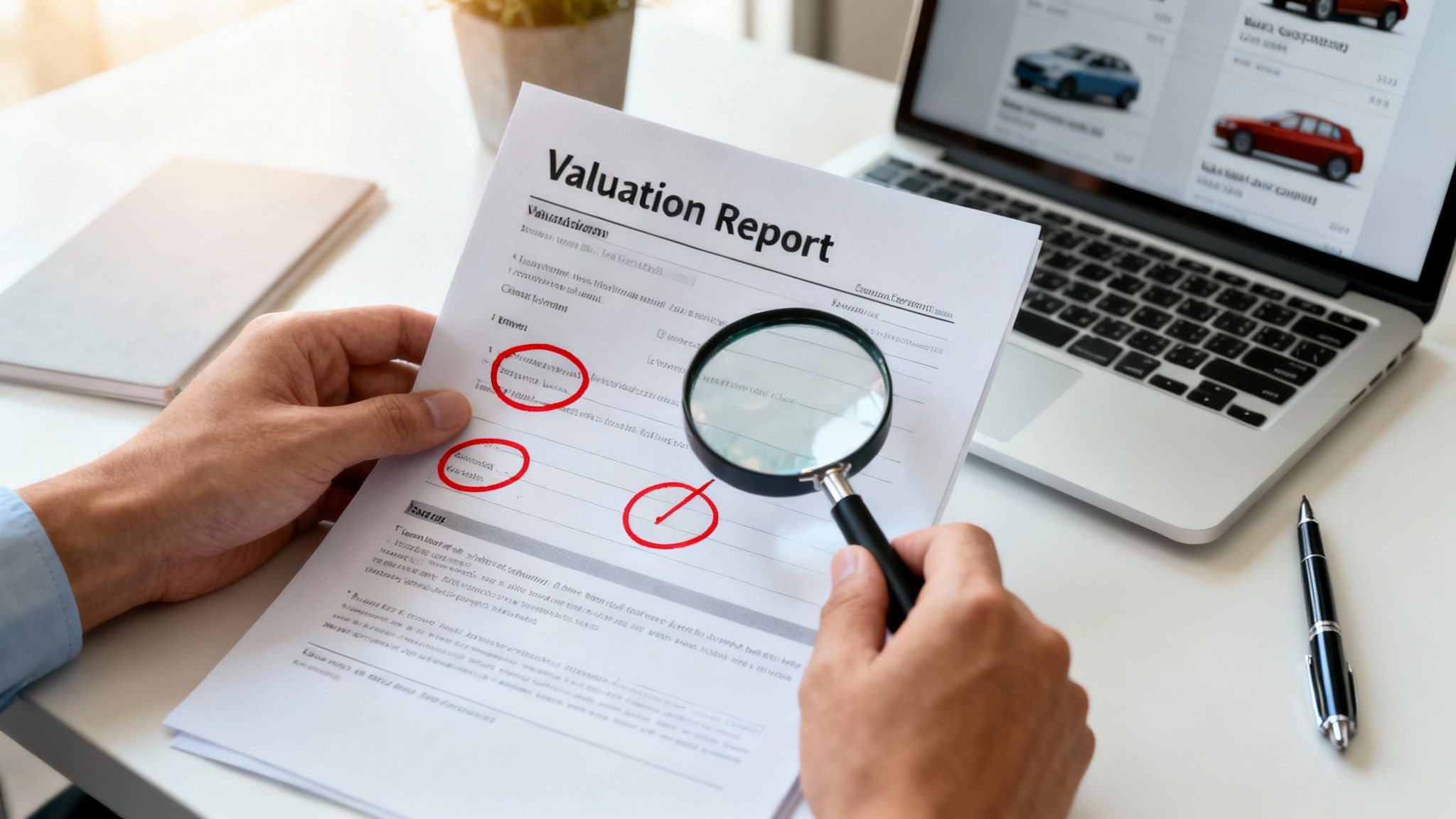
When your insurance company presents their settlement offer, it comes with a detailed valuation report. This document, often spit out by software like CCC ONE or Mitchell, is meant to look official and non-negotiable. But in my experience, these reports are often packed with flaws that just so happen to lower your car's value.
Your very first step should be to ask for a complete copy of that report. Don't just look at the final number—you need to see exactly how they did the math. Picking this document apart is your single best shot at finding the leverage you need to fight back against a lowball offer.
Think of yourself as an auditor. Insurance companies are dealing with a massive volume of claims, and their systems are built for efficiency, not accuracy. Small mistakes, omissions, and unfair assumptions are incredibly common, and they almost always work in the insurer's favor.
Scrutinizing the Comparable Vehicles
At the heart of any valuation report is a list of "comparable" vehicles, or "comps." This is the foundation of their entire calculation, and it’s where most of the biggest mistakes are made. The software often grabs cars that are poor matches, which drags down the average value significantly.
Here are the red flags to look for right away:
- Geographic Mismatches: Are the comps from dealerships hundreds of miles away or in another state entirely? A car’s value is tied to its local market.
- Trim Level and Option Discrepancies: This is a big one. They might compare your fully-loaded Limited model to a stripped-down base model. Make sure the comps have the same engine, premium packages, and features as your car.
- Poor Condition: The report might use comps with way more miles or in rough shape without making a fair adjustment to compensate.
A common tactic is to use comps from wholesale auctions or distant, lower-cost markets. These are not true "replacement vehicles" available to you as a retail customer and are an unfair basis for valuation.
Uncovering Unfair Adjustments and Omissions
Beyond bad comps, the report will be full of "adjustments" that chip away at your car's value. An adjuster who has never even seen your car might slap a generic "average" condition rating on it, completely ignoring the fact that you kept it in pristine shape.
This is where you start building your case. Go through the report line by line and check everything.
Your Valuation Report Checklist:
- Condition Adjustments: Did they dock you for "previous damage" that never existed or for what amounts to normal wear and tear? A -$500 deduction for a tiny scuff is often an easy point to win back.
- Missing Upgrades: Does the report actually list your premium sound system, the brand-new tires you just bought, or that factory tow package? Insurers constantly overlook both factory options and aftermarket additions that add real value.
- Incorrect Mileage: It sounds simple, but make sure they got the mileage right. A typo can make your car seem older and less valuable than it was.
Finding these flaws is the first step in a successful total loss car appraisal dispute. Every error you document becomes a piece of evidence, helping you build a powerful argument that their offer simply doesn't reflect what your vehicle was truly worth.
How an Independent Appraiser Calculates True Market Value
While your insurance company relies on automated software to spit out a quick number, an independent appraiser’s process is far more hands-on and detailed. Think of it like the difference between a fast-food burger and a meal from a gourmet chef. One is mass-produced for speed and efficiency, while the other is carefully crafted with quality ingredients to get the perfect result.
The whole point of a total loss car appraisal is to build a rock-solid, evidence-based case for what it would actually cost to replace your car. It’s an investigation, not just a quick calculation, focused on your specific local market right before the accident happened.
A Deep Dive into the Local Market
The first thing a good appraiser does is a deep dive into your local market. They aren't just pulling from some giant national database; they are actively hunting for comparable cars that were for sale or recently sold right in your area. This is a huge deal, because a car’s value can swing wildly from one city to the next.
The appraiser is looking for vehicles that are a true apples-to-apples match, focusing on things like:
- Identical Trim and Packages: They make sure the comparable cars have the same engine, transmission, and those desirable factory options that insurers almost always overlook.
- Similar Mileage and Condition: The search is narrowed down to cars with mileage and a pre-accident condition that genuinely mirrors your own vehicle.
- Recent Sales Data: They prioritize what cars actually sold for, not just the inflated asking prices you see on dealer lots.
This hyper-local, detail-obsessed approach makes sure the final number reflects what it would really cost you to go out and buy a similar car today.
An independent appraiser builds their valuation from the ground up using real-world market evidence. Insurers, on the other hand, often start with a generic value and work backward with deductions—a process that almost always benefits them, not you.
Accounting for the Details Insurers Ignore
This is where a professional appraiser really earns their keep. They meticulously document and assign value to all the little things that made your car special—and worth more than a generic entry in a database. This means a thorough review of your vehicle’s entire history and condition.
To back up their valuation, an appraiser will look at maintenance records and even objective data about your car's ongoing health. Pristine condition, a brand-new transmission, tasteful aftermarket upgrades, and even high enthusiast demand for your specific model are all factored into the final number.
Some vehicles, especially popular performance cars, are just more likely to be declared a total loss. When one in seven accidents for certain models ends this way, having an appraiser who gets the true market value is critical. For example, models like the Ford Mustang, Dodge Challenger, and Subaru WRX often see total loss rates hovering around 14%. An expert knows how to make sure the unique demand for these cars is reflected in the appraisal, which can mean thousands more in your pocket.
By putting all this detailed analysis together with a deep knowledge of your local market, the appraiser produces a comprehensive and defensible report. This isn't just an opinion; it's a professional valuation that gives you the solid leverage you need to negotiate effectively.
If you need this kind of expert analysis, you can learn more about a specialized vehicle appraisal at https://totallossnw.com/vehicle-appraisal/.
Using Your Policy's Appraisal Clause to Your Advantage
Buried deep within the fine print of every auto insurance policy is a powerful tool most drivers have never heard of: the Appraisal Clause. This isn't just a bunch of legal jargon; it's your contractual right to a fair and impartial process when you and your insurer are at a standstill over your car's value.
Think of it as a built-in tie-breaker. When you invoke the appraisal clause, you're essentially telling the insurance company that their take-it-or-leave-it offer isn't the end of the story. It forces the conversation to move beyond their internal software and into a structured negotiation based on real-world evidence.
How the Appraisal Clause Works
Invoking this clause is your ultimate trump card in a total loss car appraisal dispute. It kicks off a formal process where both you and the insurer bring in certified professionals to argue the case, shifting the focus from a frustrating disagreement to a methodical valuation.
Here’s how it usually unfolds, step by step:
- Give Formal Written Notice: You have to officially inform your insurance company in writing that you are invoking the appraisal clause. A phone call won't cut it; this needs to be a formal declaration.
- Hire Your Appraiser: This is where you bring in your own expert—a competent, independent appraiser who will build a detailed valuation report for your vehicle based on its specific condition and actual market data.
- The Insurer Hires Their Appraiser: Once you've hired your expert, your insurance company is obligated to hire its own appraiser to do the same.
- The Negotiation: The two appraisers get together to hash out a fair settlement value. Because they're both professionals, the goal is to land on a number that the evidence supports.
- The Umpire Steps In: If the two appraisers can't come to an agreement, they jointly select a neutral third party, known as an umpire. The umpire examines both reports and makes a final, binding decision.
A certified appraiser doesn't just pull a number out of thin air. They follow a rigorous process to build their valuation.
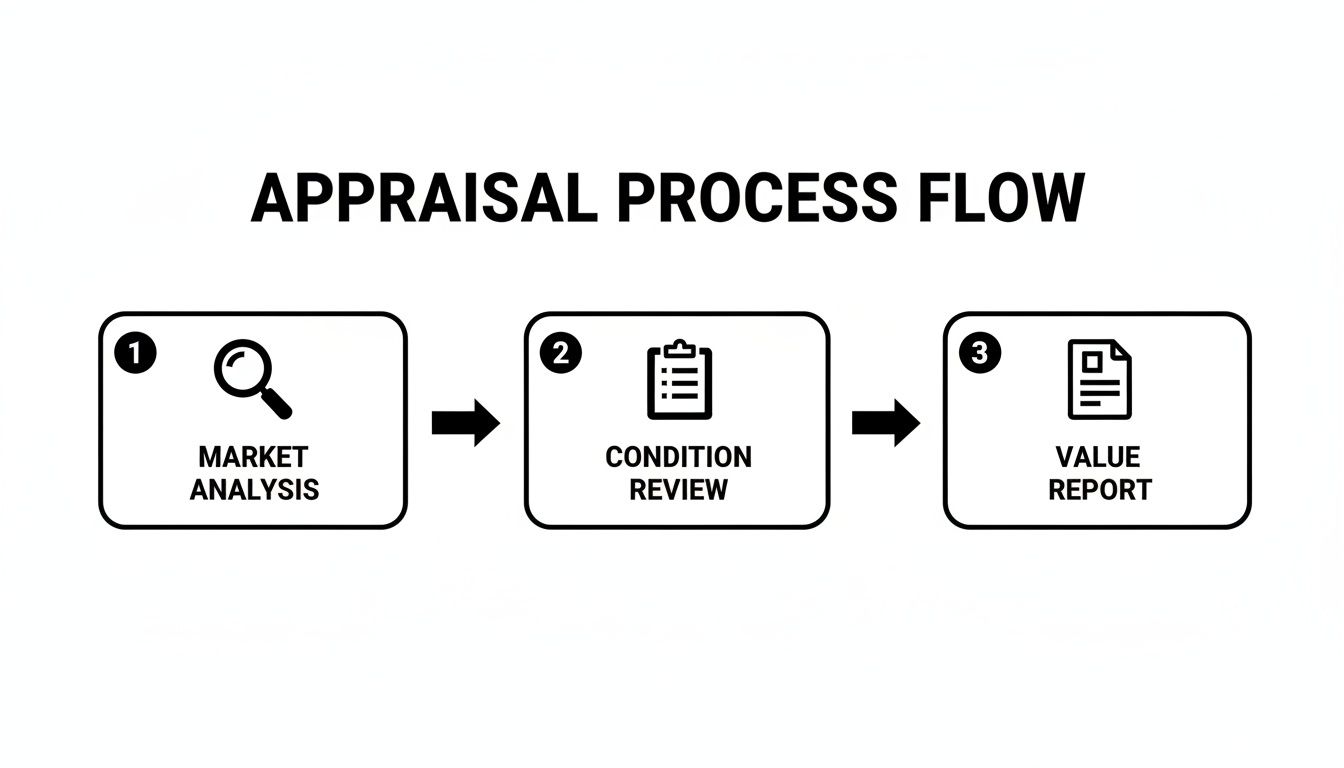
Each of these steps is designed to build a solid case for your car's true value, using verifiable data instead of the generic outputs from the insurer's software.
The appraisal clause is your contractual right to level the playing field. It ensures the final settlement is based on credible evidence and professional analysis, not just the insurer's initial low offer.
This process is a genuine game-changer. It transforms a frustrating argument into a formal, binding procedure where professional assessments replace subjective opinions. You can find out more about the specifics of using the insurance appraisal clause to your advantage and see how it works in the real world. By understanding and using this powerful tool, you can make sure the final number truly reflects your vehicle's actual cash value—getting you the money you need to get back on the road.
Your Total Loss Appraisal Questions Answered
Dealing with a total loss claim can feel like trying to navigate a foreign country without a map. It's filled with confusing jargon and tight deadlines, all while you're still reeling from the accident itself. The last thing you need is more confusion.
This section is designed to cut through the noise. We'll tackle the most common questions people have, giving you clear, straightforward answers so you can feel confident in your next steps.
How Long Does a Total Loss Settlement Take?
This is usually the first question on everyone's mind: "When do I get paid?" There's no single magic number, but the process generally takes a few weeks. However, several things can either speed it up or slow it down considerably.
Here’s a rough breakdown of what you can expect:
- Initial Assessment (A few days to a week): Right after the accident, the insurance company sends someone to inspect your vehicle and officially decide if it's a total loss.
- Valuation and Offer (Another week): Once it's declared totaled, the insurer crunches the numbers and sends you their settlement offer.
- Negotiation (Varies greatly): This is the biggest wild card. If you accept their first offer, things move fast. But if you dispute it and hire your own appraiser, this stage can add several weeks while the two sides work towards an agreement.
- Final Payout (A few days): As soon as you agree on a number, it usually only takes a few business days to process the final paperwork and cut the check.
A simple, undisputed claim might be wrapped up in two to three weeks. But if you need to invoke the appraisal clause and fight for a better offer, it could easily stretch out for a month or more.
What If I Still Owe Money on My Car?
This is a really common and incredibly stressful scenario. If your car is totaled but you still have a loan, the settlement check isn't going to come to you first. Instead, the insurance company is legally required to pay your lender.
Let’s say the final settlement for your car is $15,000, but you still owe the bank $17,000. The insurer will send the full $15,000 directly to your lender. That still leaves you on the hook for the remaining $2,000, which you'll have to pay out of pocket. This is what's known as being "upside down" or having negative equity.
Key Takeaway: This is precisely what Guaranteed Asset Protection (GAP) insurance is for. If you have it, it will cover that $2,000 gap between the car's value and your loan balance, saving you from a nasty financial surprise.
Can I Keep My Totaled Car?
In most states, the answer is yes. You have the option to keep your vehicle after it's been declared a total loss, a process known as "owner retention." But it's not as simple as just taking the car home, and you need to know what you’re getting into.
If you decide to keep it, the insurance company will subtract the car's salvage value from your settlement check. The salvage value is what they would have gotten for it by selling the wreck at auction.
For instance, if your car's settlement value is $10,000 and its salvage value is $1,500, you’d get a check for $8,500 and the car would be yours.
Just be aware, the vehicle will be given a "salvage title." This means it's not legal to drive on public roads until it's been properly repaired and passed a strict state inspection to earn a "rebuilt" title. It can be a long and expensive journey.
Why Is an Independent Appraisal So Important Now?
The chances of your car being totaled in an accident are higher today than ever before. It’s not just a rare occurrence anymore; it’s a significant portion of all auto claims, which has a huge effect on how payouts are determined.
Industry data from early 2025 revealed that a staggering 22.6% of all auto losses in the U.S. were declared total losses. Think about that. For drivers with cars that are seven years or older, the odds of an accident resulting in a total loss are now roughly 1 in 4. This trend is being fueled by falling used-vehicle values and the simple fact that cars on the road are getting older.
This is exactly why getting an accurate, independent total loss car appraisal is so critical if you feel the insurer’s offer is a lowball. Discover more insights about these crash course trends to see the data for yourself.
At Total Loss Northwest, we specialize in fighting for the true value of your vehicle. If you’re facing a lowball settlement offer in Oregon or Washington, our certified appraisers can provide the detailed, evidence-backed report you need to secure a fair payout. Don’t leave money on the table—contact us for a professional appraisal at https://totallossnw.com.