You get the call. The adjuster says your car is a total loss on vehicle claim, they've “run the numbers,” and an offer is coming. You're still dealing with the accident, trying to get to work, and now you're supposed to make a fast decision about a car you may have owned for years.
It's often assumed the hard part is over once the insurer declares the vehicle totaled. It isn't. That's when the value fight starts.
A total loss decision is not the same thing as a fair settlement. Those are two separate issues. The insurer has decided what it wants to do with the car. You still have to decide whether their valuation is accurate, whether their comparables make sense, and whether you're about to leave money on the table by signing too soon.
My Car Was Declared a Total Loss Now What
The first reaction is usually a mix of anger and confusion. The car may still look fixable. It may even run. But the insurer says it's totaled and starts talking like the next step is obvious.
It isn't obvious.
In insurer-reported crashes, total loss frequency reached 22.8% in 2025, up from 22.1% in 2024, which means nearly one in four crashed vehicles is being declared a total loss according to Carscoops coverage of CCC crash data. This is happening more often because repairs are expensive and modern vehicles are packed with costly systems.

That matters for one reason. If this happened to you, you're not in some rare edge case. You're in a very common insurance workflow, and insurers handle these claims fast. Fast is good for them. Fast is often bad for you.
Treat the first offer like an opening bid
When the adjuster says, “We've determined the vehicle is a total loss,” many owners hear, “The number is final.” It usually isn't. The total loss declaration and the vehicle value are connected, but they are not the same argument.
Your next move should be simple:
- Pause the process: Don't accept the first number over the phone.
- Get the report: Ask for the written valuation and settlement breakdown.
- Start reviewing facts: Year, trim, mileage, options, condition, and local comps all matter.
- Keep your bargaining power: Don't sign title paperwork until you understand the valuation.
Practical rule: A total loss notice is the start of negotiation, not the end of it.
If you're in that exact moment right now, this guide on what to do when my car is totaled is worth reading alongside the steps below.
What Total Loss Really Means for Your Vehicle
“Totaled” doesn't always mean destroyed. It usually means the insurer believes repairing the vehicle doesn't make economic sense under the rules that apply to the claim.
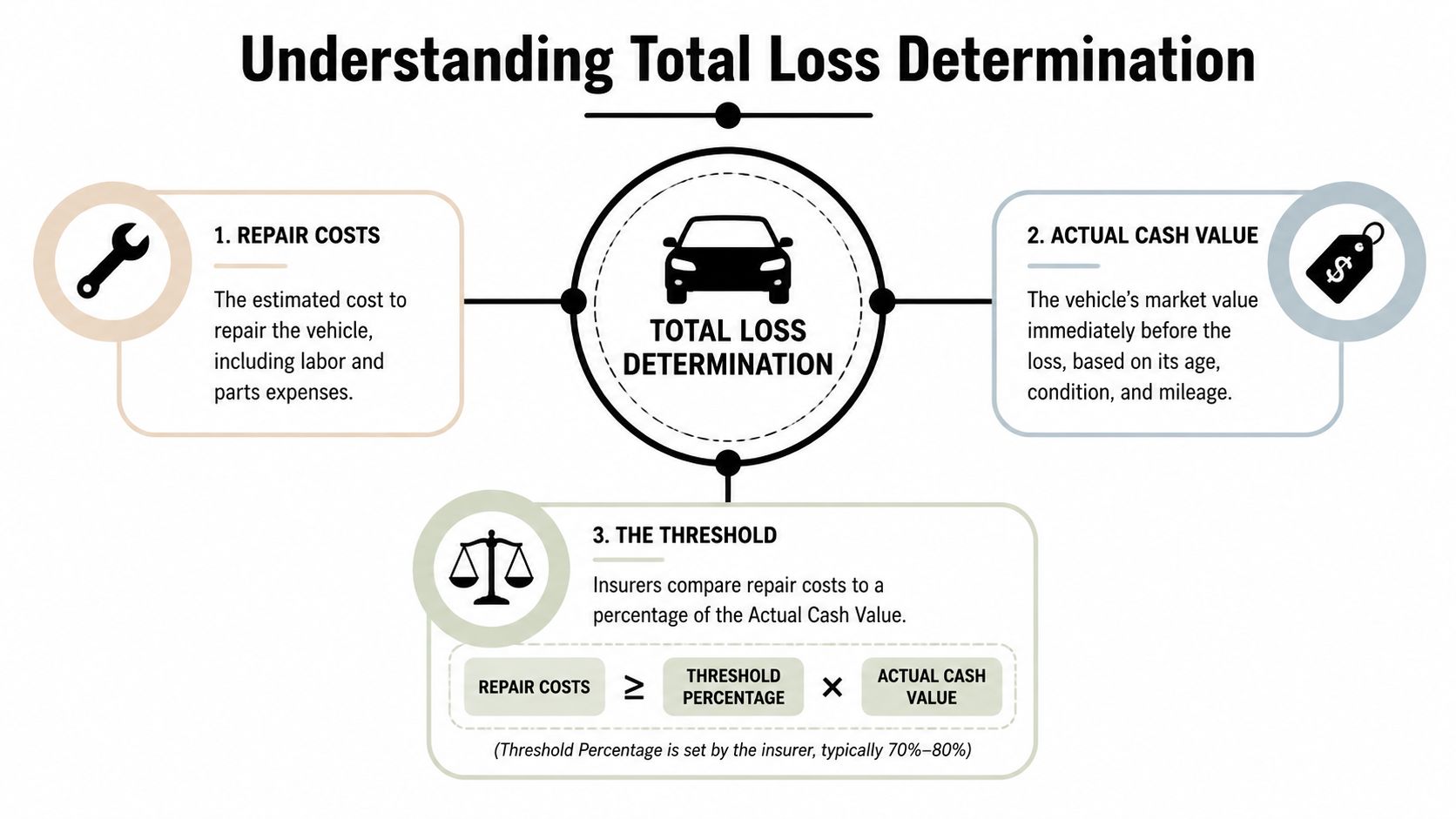
Imagine a scale. One side represents the vehicle's value immediately preceding the accident. The opposite side reflects the total repair costs, which are occasionally paired with the salvage value. When the weight of these expenses becomes excessive, the insurance provider designates the vehicle as a total loss.
The two methods that drive the decision
States mainly use one of two methods. According to Total Loss Northwest's state threshold guide, insurers generally apply either a Fixed Percentage Threshold (FPT) or a Total Loss Formula (TLF). Under FPT, repairs exceeding a percentage of the vehicle's value can trigger a total loss. Under TLF, the vehicle is totaled if Repair Cost + Salvage Value is greater than or equal to Actual Cash Value. Washington uses the TLF method.
Here's the plain-English version:
| Method | What it asks |
|---|---|
| FPT | Are repairs above the state's allowed percentage of the car's value? |
| TLF | Do repair cost and salvage value together meet or exceed the car's value? |
This is why a car that looks repairable can still be totaled. Cosmetic damage can hide expensive structural work, electronic calibration, sensor replacement, or labor that pushes the claim over the threshold.
The three numbers you must understand
The whole fight comes down to three terms.
- Actual Cash Value means the vehicle's pre-loss market value.
- Repair Cost means the estimated cost to restore the vehicle.
- Salvage Value means what the damaged vehicle is worth in its unrepaired state.
If any one of those numbers is wrong, the whole decision can tilt the wrong way.
A total loss decision isn't just about damage. It's about math, and bad math produces bad settlements.
For Oregon and Washington drivers, this matters even more because formula-driven total loss decisions can swing sharply based on valuation details that most owners never see unless they ask.
How Insurers Determine Your Car's Value And Why It's Often Wrong
Most owners get shortchanged at this stage. This occurs not because of their own mistakes, but because they assume the value provided by the insurer is neutral.
It usually isn't.
The settlement is built around Actual Cash Value, and that number is only as good as the inputs behind it. According to Better Collision's explanation of total loss valuation, ACV is often undervalued by 15-35% without an independent appraisal. The same source notes that insurer formulas often use conservative condition adjustments and mileage deductions while failing to reflect local market premiums that real sales data can show.
Where lowball valuations usually come from
Insurers commonly rely on valuation platforms and preset adjustment logic. That sounds clean and objective. In practice, it often produces a number that looks precise while missing actual market conditions.
Watch for these problems:
- Wrong condition grading: A well-kept vehicle gets treated like an average one.
- Weak comparables: The report uses vehicles with different trims, options, or condition.
- Bad geography: The valuation pulls comps from markets that don't reflect what your car would sell for locally.
- Missing upgrades: New tires, premium packages, and documented improvements are ignored or discounted.
- Mileage penalties without context: High mileage gets punished, but strong condition and local demand don't get proper weight.
Why local market reality matters
A total loss on vehicle claim should reflect what your car was worth where you live, not what a software system spits out from a broad database.
That's especially obvious with specialty vehicles, trucks, clean older cars, and anything with unusual demand in your region. The same problem shows up in other vehicle categories too. If you're comparing value logic across vehicle types, this guide on understanding Utah RV insurance is a useful parallel because RV insurance decisions also turn on vehicle type, risk profile, and valuation assumptions that owners often overlook.
If the insurer's comps wouldn't persuade a real buyer in your local market, they shouldn't control your settlement.
A good place to start is learning how an insurance company values a car so you can audit the report instead of just reacting to the offer.
My advice as an appraiser
Never argue “I loved my car, so it's worth more.” That goes nowhere.
Argue facts. Wrong trim. Wrong mileage. Wrong market. Missing options. Missing maintenance. Unsupported condition deductions. If you challenge the report like evidence, not emotion, your position gets stronger fast.
Your Step-by-Step Action Plan After a Total Loss Decision
You need a plan, not another vague suggestion to “work with your adjuster.” Adjusters work for the insurer. Your job is to protect your claim.

Step one, stop the autopilot
Do not accept the number on the first call. Do not sign title transfer paperwork just because someone says it will “keep things moving.” Speed helps the carrier close the file. It does nothing for your bargaining position.
Ask for everything in writing. You want the valuation report, the comparable vehicle list, the repair estimate, and any deductions they applied.
Step two, build your file before you argue
Most owners complain before they collect evidence. That's backwards.
Pull together the documents that prove value:
- Maintenance records: Show the vehicle was cared for, not neglected.
- Upgrade receipts: Tires, wheels, suspension work, audio, trim packages, and recent repairs can matter.
- Photos from before the loss: These help challenge unfair condition deductions.
- Purchase records and option details: Make sure the trim and packages are right.
- Local listings: Find vehicles that match yours in your market.
Step three, audit the valuation line by line
Don't just look at the final offer. Read the report like an examiner.
Check these items carefully:
| Item to review | What goes wrong |
|---|---|
| Year and trim | Base model used instead of higher trim |
| Mileage | Incorrect odometer figure |
| Options | Leather, tech packages, tow packages, or other features omitted |
| Condition | Blanket deductions with little support |
| Comps | Vehicles outside your market or not truly comparable |
One bad adjustment can drag the whole number down. Several bad adjustments almost guarantee it.
Step four, invoke the Appraisal Clause
This is the move too many people miss. If your policy includes an Appraisal Clause, you can usually force a formal value dispute process instead of begging the insurer to reconsider.
That matters because the Appraisal Clause shifts the fight away from internal insurer software and toward independent valuation. Each side selects an appraiser. If the two appraisers disagree, an umpire can decide.
What to say: “I dispute the insurer's valuation and I am invoking the Appraisal Clause under the policy.”
Keep it short. Keep it in writing.
A quick overview can help if you want to hear the process explained plainly:
Step five, don't negotiate against yourself
Once you've invoked appraisal or formally disputed value, stop making random concessions. Don't say, “I'd probably take a little more.” Don't float compromise numbers before the evidence is organized.
Use a cleaner approach:
- State that you dispute the valuation.
- Identify specific errors in writing.
- Provide support for your position.
- Require a corrected valuation or proceed through appraisal.
This process feels slower. It usually ends better.
The Power of an Independent Appraisal and Diminished Value
An independent appraisal changes the quality of the conversation. Instead of arguing with an adjuster's opinion, you're presenting a documented market value backed by vehicle-specific evidence.
That matters because total loss claims are common and expensive. Approximately 1% of insured vehicles in the United States, or about 2 million vehicles annually, are declared a total loss, and average payouts now exceed $16,000, according to SimpleDecider's summary of total loss frequency and payouts. When that much money is at stake, guessing is a bad strategy.
What an independent appraiser does differently
A proper appraiser doesn't just reprint database outputs. They review the vehicle itself, the configuration, the condition, the market, and the comparables with an eye toward what would hold up if challenged.
That usually includes:
- Market-matched comparables: Vehicles that resemble yours.
- Option verification: Trim, packages, features, and relevant upgrades.
- Condition support: Documentation that pushes back on blanket deductions.
- Local relevance: A value tied to your market, not a generic average.
One factual option for Oregon and Washington owners is Total Loss Northwest's diminished value support, which focuses on independent appraisals and Appraisal Clause disputes rather than insurer valuation software.
Don't ignore diminished value
Not every damaged vehicle becomes a total loss. If your car is repaired instead, you may still have a diminished value claim because accident history can reduce resale value even after repairs.
That's important for late-model vehicles, luxury vehicles, and anything buyers scrutinize hard. The same appraiser who can challenge a low ACV on a total loss claim can often document post-repair value loss too.
The insurer's job is to close the claim. Your job is to make sure the value is right before that happens.
Navigating Salvage Titles and Rules in Oregon and Washington
A salvage title changes the future of the vehicle. It tells later buyers, lenders, and insurers that the car was declared a total loss. That doesn't automatically make the vehicle worthless, but it does affect registration, insurability, resale, and repair decisions.
If you accept the total loss settlement, you usually face two broad choices. You can let the insurer take the vehicle, or you can keep it and accept a reduced payout because the salvage has value.
Keeping the car is not a casual decision
Owners often want to keep a totaled vehicle because it still drives or because the damage looks manageable. Sometimes that makes sense. Often it doesn't.
Before you retain salvage, ask yourself:
- Can you repair it properly: Not cheaply. Properly.
- Can you live with a branded title: Future sale value usually changes.
- Can you insure and register it afterward: Rules and underwriting can become more difficult.
- Are you accounting for hidden damage: Especially structural and electronic issues.
Why Washington drivers need to watch the formula
A lot of online guides are vague on local rules. That's a problem. According to Total Loss Appraisals' discussion of state-specific gaps, there's a real information gap for Oregon and Washington drivers, and Washington uses the Total Loss Formula, where Repair Cost + Salvage Value must be greater than or equal to ACV. That makes accurate ACV and salvage value especially important.
In plain terms, if either of those numbers is wrong, the outcome can change.
For Oregon drivers, the practical takeaway is similar even when articles online fail to spell out local details clearly. Don't assume a national carrier is applying logic in a way that matches your interests. Ask how they valued the vehicle. Ask how they valued the salvage. Ask for the math in writing.
Frequently Asked Questions About Total Loss Claims
Can I keep and repair my totaled car
Yes, in many cases you can keep it. But don't treat that like a win until you've looked at the numbers and the title consequences.
If you keep the vehicle, the insurer typically reduces your payout to account for salvage. Then you take on the burden of repairs, inspections, title branding, and future resale headaches. That works best for owners who understand the vehicle well and have a realistic repair plan.
What if I still owe money on the loan
The lender usually gets paid first from the settlement. If the payoff is less than the settlement amount, you receive the difference. If the payoff is higher, you may still owe money after the car is gone.
That's where GAP coverage can matter. It can help with the difference between what the vehicle is worth and what you still owe. Review your loan documents and your insurance paperwork before assuming the settlement check is all coming to you.
Does fault change my right to challenge the value
No. Fault may affect which carrier pays and whether a deductible applies, but it does not erase your right to dispute a bad valuation.
If the car's ACV is wrong, it's wrong whether the claim is first-party or third-party. The valuation evidence is still the valuation evidence.
What if salvage value is wrong
This gets overlooked all the time. According to 1800LionLaw's explanation of total loss threshold issues, a hidden issue in total loss claims is the insurer's salvage valuation. A low salvage valuation makes the Repair Cost + Salvage Value total lower, which can make it harder to reach the ACV threshold and can prevent a total loss declaration on a badly damaged vehicle.
That means salvage value is not just a side issue. It can affect whether the insurer totals the car at all.
What happens if the appraisers disagree
Then the umpire process matters. Under a typical Appraisal Clause setup, each side picks an appraiser. If they can't agree, they submit the dispute to a neutral umpire.
That's one reason it's worth doing the process correctly from the start. A sloppy appraisal doesn't get stronger when a third person reviews it.
If you're dealing with a low offer, disputed ACV, or a confusing total loss on vehicle claim in Oregon or Washington, Total Loss Northwest provides independent appraisals for total loss and diminished value disputes. If the insurer's number doesn't make sense, get the valuation reviewed before you sign anything.