You were hit days ago. Your car is in the shop, or sitting in a yard waiting on a total loss decision, and the insurance company is acting like your transportation problem is a side issue. They offer a tiny rental that doesn't fit your life. Or they stop paying the moment they call the vehicle a total loss, even though you still can't replace it.
That's where most drivers get boxed in.
They hear “rental coverage” and assume that's the whole story. It isn't. If another driver caused the crash, you may have a loss of use claim. That's not the same thing as the cheap rental allowance an adjuster keeps talking about. It's a separate legal concept, and if you don't understand it, you'll probably accept less than you're owed.
If you've been asking what is loss of use, the short answer is this: it's compensation for being deprived of your vehicle. Not just reimbursement for whatever bargain rental the insurer wants to approve. Not just a courtesy payment. Compensation for the value of what you lost when your car was taken out of service.
Your Accident Was Days Ago Why Are You Still Waiting
A common post-crash pattern goes like this. The other driver is clearly at fault. You report the claim. You expect the insurer to move quickly. Instead, you get delay, a limited rental offer, or silence.

Maybe you drive an SUV because you haul kids, tools, or equipment. The adjuster offers an economy car and acts like that solves the problem. Maybe your vehicle is a pickup and they offer a compact sedan. Maybe they declare your car a total loss, tell you a check is coming, and cut off rental help before that money puts you back on the road.
That gap is where people get hurt financially.
You still have to get to work. You still have to pick people up, carry gear, make appointments, and keep life moving. Insurance companies know that. They also know many drivers are stressed enough to take whatever is offered just to end the hassle.
You don't lose your right to fair payment just because the insurer moved the claim into a different category.
The problem isn't only the delay
The deeper issue is that insurers often steer the conversation toward their coverage language instead of your legal damages. That shift helps them. It doesn't help you.
When an adjuster keeps repeating “rental reimbursement,” they may be talking about a narrow benefit with limits. If the other driver caused the crash, your actual claim may be broader than that.
What loss of use is really for
Loss of use exists for this exact situation. It addresses the value of being without your vehicle while it's being repaired, evaluated, or replaced. It matters when the offered rental is inadequate. It matters when no rental is provided. It matters when the insurer drags its feet.
If you've been sidelined after a crash and the insurer is acting like transportation is your problem, start treating loss of use as a real claim item. Because it is.
Loss of Use Is Not What Your Insurance Company Calls It
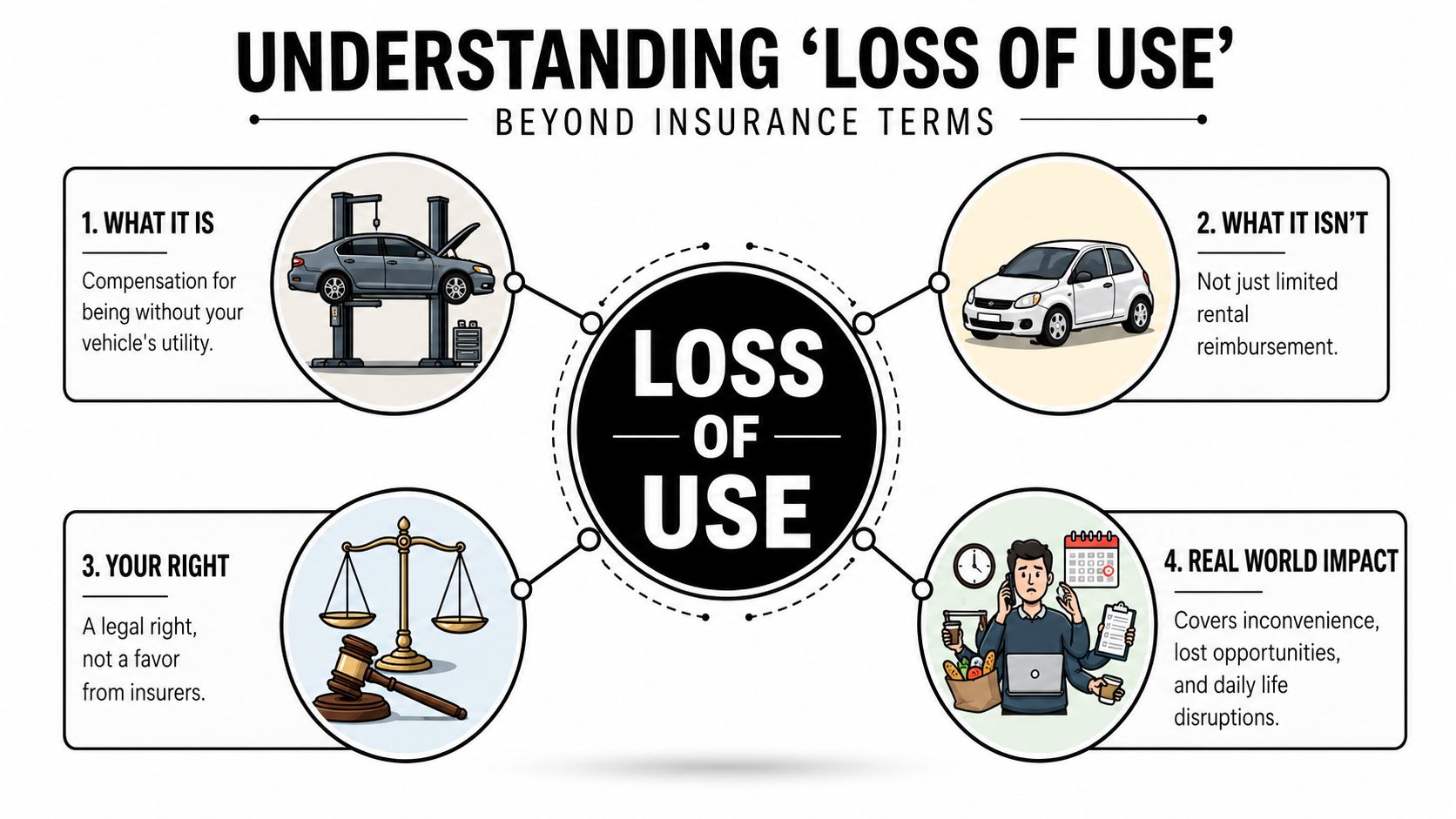
Most adjusters use language that sounds practical but shrinks the claim. They say “we can put you in a rental” or “your policy allows this amount.” That frames the issue as a benefit the company controls. Loss of use is different. It's based on the fact that you were deprived of your vehicle.
The legal idea that matters
In auto claims and tort law, loss of use is measured by the daily market rental value of a comparable vehicle for the reasonable repair period, not by what the owner spent renting one, according to legal analysis of loss of use damages. That point matters more than most drivers realize.
If you borrowed your sister's car for free, you may still have a claim. If you worked from home and didn't rent anything, you may still have a claim. If you couldn't afford the rental the insurer should have covered, that doesn't erase the loss.
The law focuses on the loss of your right to use your own vehicle.
A simple way to think about it
Think of a hotel room you paid for. If the room becomes unusable, the hotel doesn't get to say, “You didn't sleep in another room, so you suffered no loss.” The loss happened when the room you had the right to use became unavailable.
Your car works the same way. Ownership includes the right to use it, or not use it, whenever you choose. When someone else's negligence takes that away, compensation should be based on the market value of that lost use.
Practical rule: Don't let an adjuster reduce your claim to what you happened to spend out of pocket. The proper measure is the rental value of a comparable vehicle during the reasonable loss period.
Comparable means comparable
Insurers get slippery when they often price your loss as if any vehicle will do. That's wrong. A comparable vehicle should reflect the type of vehicle you lost use of.
If you drove a luxury SUV, the benchmark is not a bargain compact. If you drove a truck, the benchmark is not the cheapest four-door sedan on the lot. The standard is a similar vehicle, not the insurer's cheapest option.
That's why understanding what is loss of use changes the whole conversation. You stop asking, “What will they give me?” and start asking, “What is the fair rental value of what I lost?”
Loss of Use vs Rental Reimbursement vs Diminished Value
Three different claims. Three different rules. If you let an adjuster blend them together, you will leave money on the table.
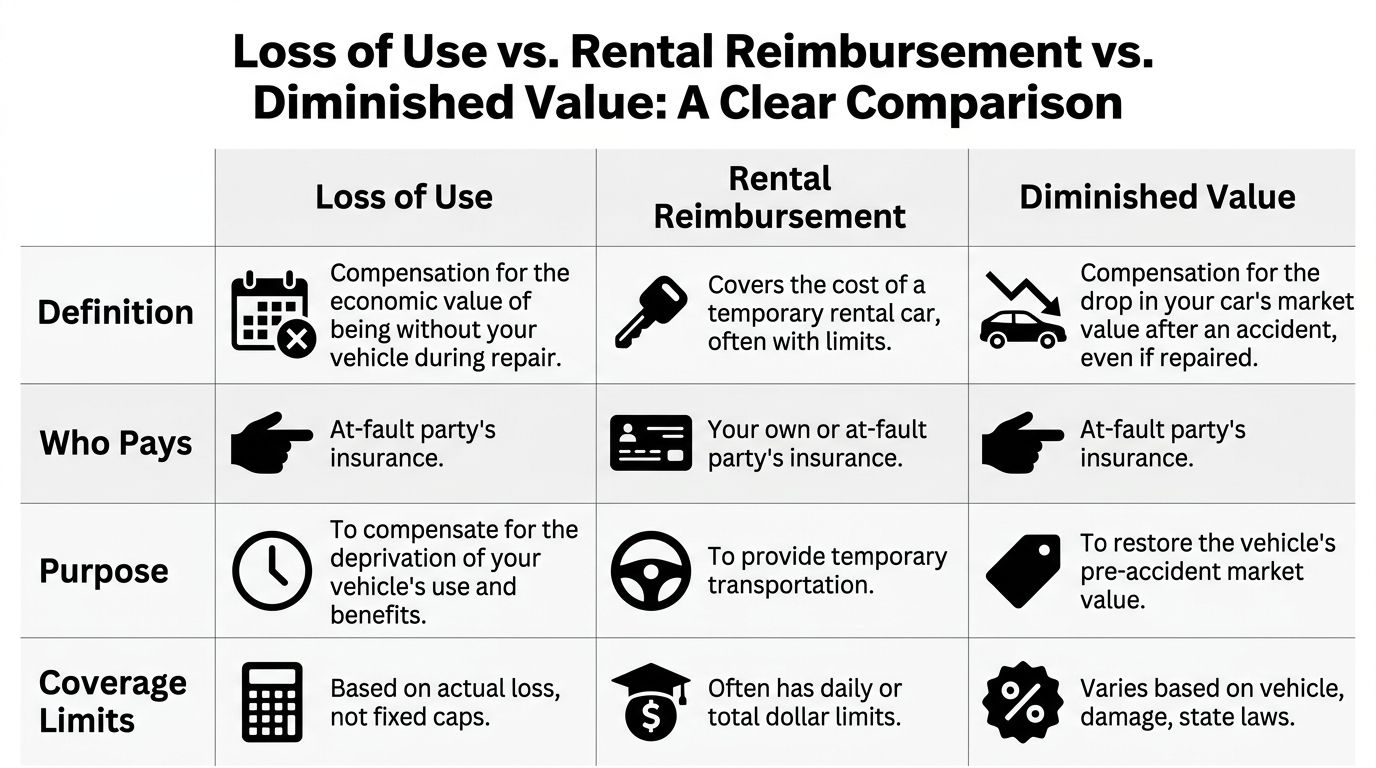
The biggest point drivers miss is this: rental reimbursement is a small policy benefit on your own coverage, while loss of use is a damages claim against the at-fault party. Those are not measured the same way, and they should not be paid the same way.
| Claim type | What it covers | Who usually pays | When it applies | Main trap |
|---|---|---|---|---|
| Loss of use | The value of being deprived of your vehicle | Usually the at-fault party's insurer | During repairs and often during the replacement delay after a total loss | Adjuster tries to limit it to a rental policy cap |
| Rental reimbursement | A temporary transportation benefit under your policy | Your own insurer if you bought the coverage | After a covered claim | Low daily caps and short time limits |
| Diminished value | The drop in resale value after repairs | Usually the at-fault party's insurer | After the vehicle is repaired | Driver never makes the claim |
Rental reimbursement is limited by your policy
Rental reimbursement exists because you paid for it. It is optional coverage on many policies, and the limits are set by contract, not by the actual value of what you lost. The Insurance Information Institute explains that rental reimbursement usually pays up to a stated daily amount and up to a stated maximum time limit, depending on the coverage you selected and your insurer's rules, as described in its overview of rental reimbursement coverage.
That benefit can help, but it is often too small. A policy might only cover a basic rental class, or it might run out before you are back on the road. If your vehicle was totaled, the gap can get worse. You may be waiting on the value payment, title paperwork, financing, or a replacement vehicle while the rental benefit has already stopped.
For a practical breakdown of that policy issue, read this guide on rental car coverage after an accident.
Loss of use is the larger legal claim people overlook
Loss of use is not an add-on benefit. It is part of the damages caused by the crash. That matters most in total loss cases, where insurers love to act like the claim ends the day they declare your car a total.
It does not.
If the other driver caused the crash, your loss of use claim can extend through a reasonable replacement period. That period is often longer than your rental reimbursement coverage. This is the payment gap that catches drivers by surprise. They hear, "we only allow 30 days" or "your rental coverage is exhausted," and they assume the discussion is over. It is not over if you are making a third-party claim against the at-fault driver.
That is the distinction you need to press. Policy cap on your own rental coverage. Market-based damages claim against the other side.
Diminished value covers a different loss
Diminished value has nothing to do with transportation. It addresses the reduced market value of a repaired vehicle with an accident history.
A repairable claim can have both losses at the same time. You can be owed loss of use for the period you were without the car, and diminished value for the permanent reduction in what that repaired car is worth. Keep them separate in writing. Separate proof. Separate dollar amounts. Separate demand.
If the crash also caused injury, this expert guide for personal injury settlements gives a useful overview of how injury compensation fits alongside property damage claims.
This explainer adds a quick visual breakdown before you negotiate:
How Insurers Calculate and Undervalue Your Claim
Your car is sitting at the shop, or already declared a total loss, and the adjuster acts like your transportation problem should fit neatly inside their spreadsheet. That is how good claims get cut down.
Insurers usually start with two inputs: the daily rental value and the number of days they agree to pay. They keep the offer low by shrinking one or both.
Where the lowball starts
First, they price the wrong vehicle.
A pickup gets valued like a compact car. A three-row SUV gets treated like basic sedan transportation. A higher-trim vehicle gets matched to the cheapest thing with four wheels. That is not a small error. Daily rate drives the whole claim.
Next, they cut the time period. On repairable vehicles, carriers often use shop estimates and labor-time assumptions to argue for a shorter out-of-service period than what happened in real life. They ignore parts delays, supplement approvals, shop backlog, and insurer-caused waiting time. If your car was unavailable, those days matter.
Then they blur claim types on purpose. They talk to you as if your loss of use claim is the same as rental reimbursement under your own policy. It is not. Rental reimbursement is a limited coverage benefit. A third-party loss of use claim is a damages claim against the at-fault driver, based on the reasonable rental value of a comparable vehicle. This discussion of loss of use versus rental reimbursement lays out that distinction clearly.
If the other driver caused the crash, do not let their insurer price your claim using your policy limits, their internal cap, or the cheapest rental category they can find.
The total loss gap is where insurers save money
This is the part drivers miss, and insurers count on that.
Once a vehicle is totaled, many carriers try to stop paying for loss of use as soon as they make an offer or say the file is "ready to settle." That date is convenient for them. It is often worthless to you. You still need time to receive payment, clear a loan payoff, dispute a bad valuation, transfer title, and find a replacement vehicle you can buy.
That gap gets worse when the total loss offer is too low. If the insurer undervalues your vehicle, they are not just shorting the car. They are extending the period you are stuck without comparable transportation. Review how they priced the vehicle before you accept the cutoff date. This guide on how an insurance company values a car is a good place to start.
If you are dealing with injury and property damage at the same time, this expert guide for personal injury settlements explains how claim timing and settlement pressure can cause losses to get missed.
What to challenge first
Before you argue about the final number, check the foundation of the offer.
- Vehicle match: Did they use a rental class that matches what you drove?
- Loss period: Did they end the claim based on their internal deadline instead of the date your transportation loss reasonably ended?
- Delay blame: Are they ignoring shop delays, parts delays, or insurer-caused slowdowns?
- Claim type: Are they treating a liability claim like optional rental coverage under your own policy?
If those inputs are wrong, the offer is wrong. Start there.
A Step-by-Step Guide to Making Your Loss of Use Claim
Loss of use claims are won with documentation, not outrage. Being angry is understandable. It won't move an adjuster. A file built with dates, rental comparisons, and clean records will.
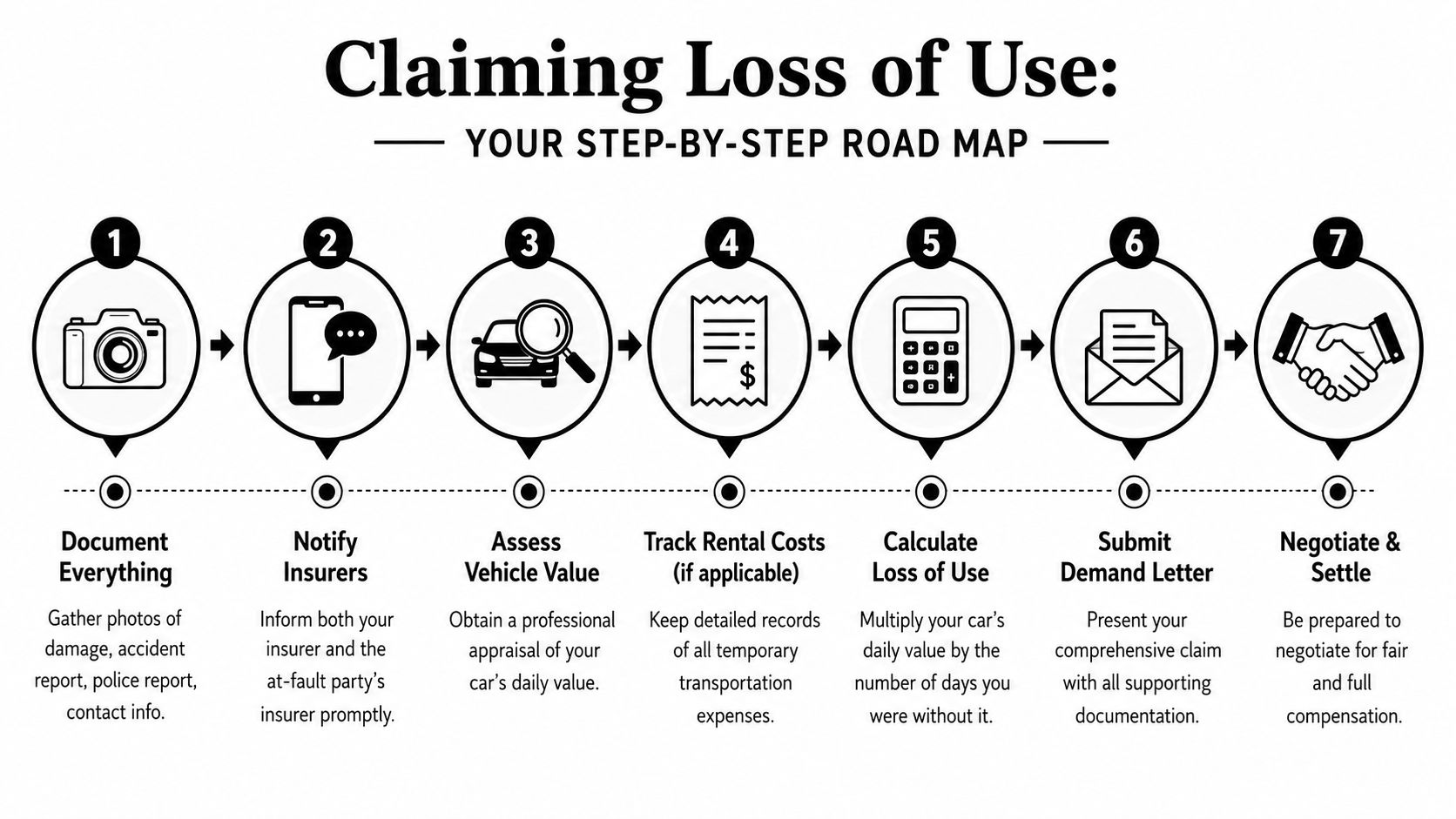
Start building the file immediately
Use a dedicated folder on your phone and email from day one. Save every estimate, text, voicemail summary, tow invoice, and shop update. If the insurer later claims the delay was your fault, your timeline becomes your defense.
Here's the checklist I'd use:
- Get the claim basics locked down. Save the claim number, adjuster name, body shop name, and all decision dates.
- Photograph the vehicle and damage. Take wide shots and close-ups.
- Save the repair estimate or total loss notice. These documents anchor the timeline.
- Keep a communication log. Date, time, who you spoke with, and what they said.
- Track when the car became unusable and when it was returned, or when payment put you in position to replace it.
Prove comparable rental value
At this point, most drivers get lazy, and the insurer counts on that.
Don't just say, “I needed a similar vehicle.” Gather current rate screenshots or written quotes from major rental companies for vehicles comparable to yours in your local market. If your vehicle is unusual, document the closest available equivalent and why it's the closest match.
Focus on the actual use profile of your car. Seating, cargo space, drivetrain, class, and utility all matter.
Gather your own market evidence before the adjuster anchors the claim with a low daily rate. Once that number gets into the file, everything becomes a fight.
Handle total loss claims differently
Most articles stop at repair scenarios. That's not enough. In total loss cases, insurers often end rental assistance before the driver can get back into a replacement vehicle. As noted in this explanation of total loss loss-of-use gaps, that gap period can itself support a loss of use claim.
That means you should document:
- Settlement timing: When the offer was made, when paperwork was completed, and when funds were available.
- Replacement delay reasons: Lien payoff delay, title issues, valuation dispute, or realistic replacement search time.
- Transportation impact: Out-of-pocket rentals, ride costs, borrowed vehicle arrangements, or inability to replace immediately.
Put the demand in writing
Once your timeline and rental evidence are together, send a written demand. Keep it plain:
- Identify the at-fault claim
- State the dates of loss of use
- State the comparable vehicle class
- Attach your rental market support
- Explain any total loss gap
- Ask for written confirmation of payment position
Short beats dramatic. Precise beats emotional.
Fighting a Denial or Lowball Offer in Oregon and Washington
If you're in Oregon or Washington, don't assume a denial means the insurer is right. It often means the insurer thinks you won't push back. Adjusters deny, delay, and minimize claims every day because many drivers won't challenge them in writing.
You should.
The language that gets attention
When an offer is too low, send a formal response that does three things. It identifies the legal basis of the claim, states the factual timeline, and disputes the insurer's unsupported rate or cutoff date.
A simple structure works:
I am seeking payment for loss of use caused by your insured's negligence. Your current position appears to rely on rental reimbursement limitations rather than the reasonable rental value of a comparable vehicle for the actual period of deprivation. Please provide the basis for your daily rate, the vehicle class used, and the date on which you contend my loss of use ended.
That forces the adjuster to explain the number instead of repeating it.
What to include with the dispute
Your written challenge should attach the documents that matter most:
- Rental market support: Screenshots or quotes for comparable vehicles in your area
- Timeline proof: Shop updates, total loss notices, payment dates, and communication log
- Vehicle-specific facts: Why your vehicle class matters and why a generic substitute is not comparable
If the insurer flatly denies the claim or keeps moving the goalposts, this guide on steps to appeal a claim denial gives a solid framework for escalating the dispute cleanly.
Oregon and Washington drivers need leverage, not arguments
In both states, the practical problem is the same. The insurer controls the first number and hopes it becomes the final number. You need evidence strong enough to break that pattern.
That's especially true when the total loss value itself is disputed. A bad vehicle valuation creates a transportation delay. Then the carrier tries to deny responsibility for the delay it helped create.
If the claim is stalling and you need state-specific help navigating the dispute process, this resource for local insurance dispute help in Oregon and Washington is a useful next step.
When an independent appraiser changes the fight
There's a point where more phone calls won't help. If the insurer is leaning on internal valuation software, refusing to justify comparables, or using the wrong vehicle class, you need independent evidence with weight behind it.
That matters most in high-value, collector, custom, and disputed total loss cases. Once the file includes a credible outside valuation or appraisal position, the insurer has to answer substance with substance.
Don't argue in circles. Build the record, challenge the bad assumptions, and escalate with evidence.
Frequently Asked Questions About Loss of Use
Can I still claim loss of use if I never rented a car
Yes.
A loss of use claim is based on what it would reasonably cost to rent a comparable vehicle during the time you were deprived of yours. It is not limited to what you spent out of pocket. If you borrowed a family car, took rides from coworkers, or went without, the at fault driver's insurer may still owe for that loss.
Courts in many states have recognized that point, including cases collected by the Legal Information Institute and state court decisions holding that loss of use damages can be recovered without proof that a substitute vehicle was rented.
How does loss of use work when my car is a total loss
Consequently, drivers get shortchanged.
Your own policy may offer rental reimbursement, but that coverage usually has a daily cap, a short time limit, or both. A legal loss of use claim against the at fault party is different. It is not automatically limited by the small rental benefit listed on your declarations page.
In a total loss, the fight is usually about timing. The insurer wants to stop paying as soon as it declares the car totaled. You should focus on the gap between the crash date and the date you had a fair payment available to go replace the vehicle. If the carrier delayed the valuation, disputed the amount, or made funds unavailable, that gap matters.
What's the single most important evidence for a strong claim
Documented market rental rates for a comparable vehicle.
Get local quotes. Match the class of vehicle as closely as possible. Save screenshots, rate sheets, and emails. If you drove a truck, SUV, luxury car, or van, do not let the insurer price your claim as if any compact rental will do.
The stronger your rental comparables, the harder it is for an adjuster to push a generic, low daily rate.
If your insurer is lowballing a total loss or ignoring the actual loss of use value tied to your vehicle, Total Loss Northwest can help you challenge the numbers with independent appraisal support. They specialize in total loss and diminished value appraisals in Oregon and Washington, especially when the insurer's valuation software doesn't reflect the actual market.