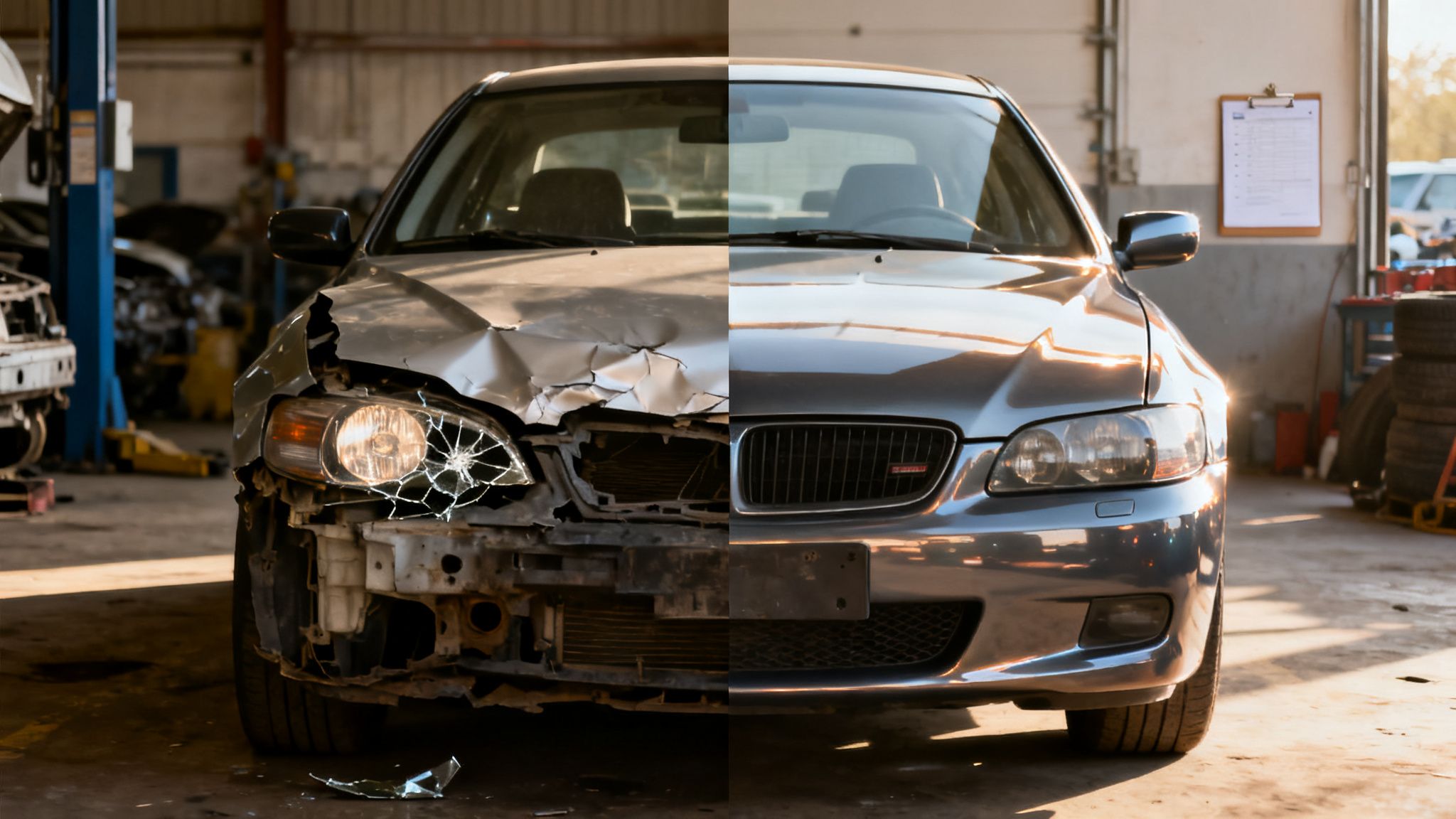
So, what exactly is a salvage title? Think of it as a permanent brand on a vehicle's history, a red flag letting everyone know it was once declared a total loss by an insurance company.
This happens when the cost to fix the car after an accident or other major event (like a flood or fire) gets too high. Instead of paying for repairs, the insurer decides it's more practical to just pay out the vehicle's value and write it off.
What a Salvage Title Really Means
Imagine a house that's been badly damaged in a fire. It gets a "condemned" notice, meaning it's not safe to live in as-is. A salvage title works the same way for a car. The vehicle has suffered enough damage that it's no longer considered street-legal or safe to drive in its current state.
This isn't a random decision. Insurers use a specific formula. They compare the estimated repair costs to the car's pre-accident value, known as its Actual Cash Value (ACV). When the repairs hit a certain percentage of that value, the car is totaled.
Here in the Pacific Northwest, both Oregon and Washington set that threshold at 80%. If a car is worth $10,000 and needs $8,000 in repairs, it's officially a total loss.
Why Do We Even Have Salvage Titles?
The whole point of the salvage title system is to protect you, the consumer. It's a built-in warning system.
This brand prevents someone from patching up a badly wrecked car on the cheap and selling it to an unsuspecting buyer who thinks they're getting a great deal. It forces transparency by documenting the vehicle's severe damage history for all future owners to see.
A salvage title isn't just a piece of paper; it's a permanent financial footnote on a vehicle's history report. It tells a story of significant damage and dramatically alters how buyers, lenders, and insurance companies perceive its worth and safety.
What Happens After a Car Is Branded 'Salvage'?
Once a vehicle gets a salvage title, it's at a crossroads. The owner can sell it to a scrapyard for parts, or they can take on the challenge of repairing it.
But even if it's perfectly repaired, it can never go back to having a "clean" title. The best it can achieve is a rebuilt title. This requires passing a strict state inspection to prove it's roadworthy again.
To fully get why this matters, it helps to understand what makes a car totaled in the first place. A rebuilt title gets the car back on the road, but that salvage history never disappears—and it will always affect the vehicle's value.
To make these distinctions clearer, let's break down the three main title types you'll encounter.
Salvage vs Clean vs Rebuilt Title At a Glance
This table gives you a quick snapshot of how each title status compares, helping you understand the key differences in an instant.
| Title Status | Definition | Can It Be Driven Legally? | Insurance Impact | Resale Value |
|---|---|---|---|---|
| Clean | The vehicle has no history of being declared a total loss. | Yes | Standard coverage available | Highest value |
| Salvage | The vehicle has been declared a total loss by an insurer due to damage. | No, not on public roads | Cannot be insured for road use | Very low; sold for parts/scrap |
| Rebuilt | A salvage vehicle that has been repaired and passed a state inspection. | Yes | Difficult to insure; often liability-only | Significantly lower than a clean title |
As you can see, a title's brand has a huge impact on a vehicle's usability, insurability, and—most importantly—its value.
The Journey to a Salvage Title: Unpacking the Total Loss Process
A car doesn’t get a salvage title just because it looks like a wreck; it gets one because of a calculator. The journey from a reliable daily driver to a vehicle branded 'salvage' isn't about the car's condition as much as it is a cold, hard financial decision made by the insurance company. It's a numbers game, plain and simple, where the cost to fix the car goes head-to-head with what it was worth right before the accident.
Let’s walk through a real-world scenario. Imagine you’re driving your well-maintained car, which you know is worth about $15,000. Out of nowhere, another driver runs a red light, and bam—a major collision. Thankfully, you're okay, but your car definitely isn't. This is the moment the clock starts ticking on a potential total loss declaration.
First things first, you file a claim. Your insurance company sends out an adjuster whose entire job is to figure out the financial damage. They'll go over your vehicle with a fine-tooth comb, noting every dent, scrape, and broken part, from the crumpled bumper right down to the bent frame.
This detailed inspection turns into a comprehensive repair estimate. The body shop comes back with a quote of $12,500 to get everything back to pre-accident condition, covering parts, labor, and paint. Now the two most important numbers are on the table: the car's Actual Cash Value (ACV) of $15,000 and the repair estimate of $12,500.
The Total Loss Threshold
This is where state law steps in. Most states have what’s called a Total Loss Threshold (TLT), which is a specific percentage that tells an insurer when they must declare a vehicle a total loss. Think of it as a clear line in the sand that prevents arbitrary decisions.
Here's how it works:
- The Formula: The insurer divides the repair cost by the vehicle's ACV.
- The Comparison: If that percentage hits or exceeds the state’s TLT, the car is officially totaled. End of story.
In our local area, both Oregon and Washington set the TLT at 80%. So in our example, the math is $12,500 / $15,000 = 83.3%. Since 83.3% is over the 80% threshold, your insurance company is legally obligated to declare your car a total loss.
Once the repair costs cross that state-mandated line, the conversation is no longer about fixing your car. It becomes a purely financial transaction. The insurer will pay you the ACV (less your deductible), take ownership of the vehicle, and apply for a salvage title from the DMV.
This simple chart breaks down the three main stages of what just happened.
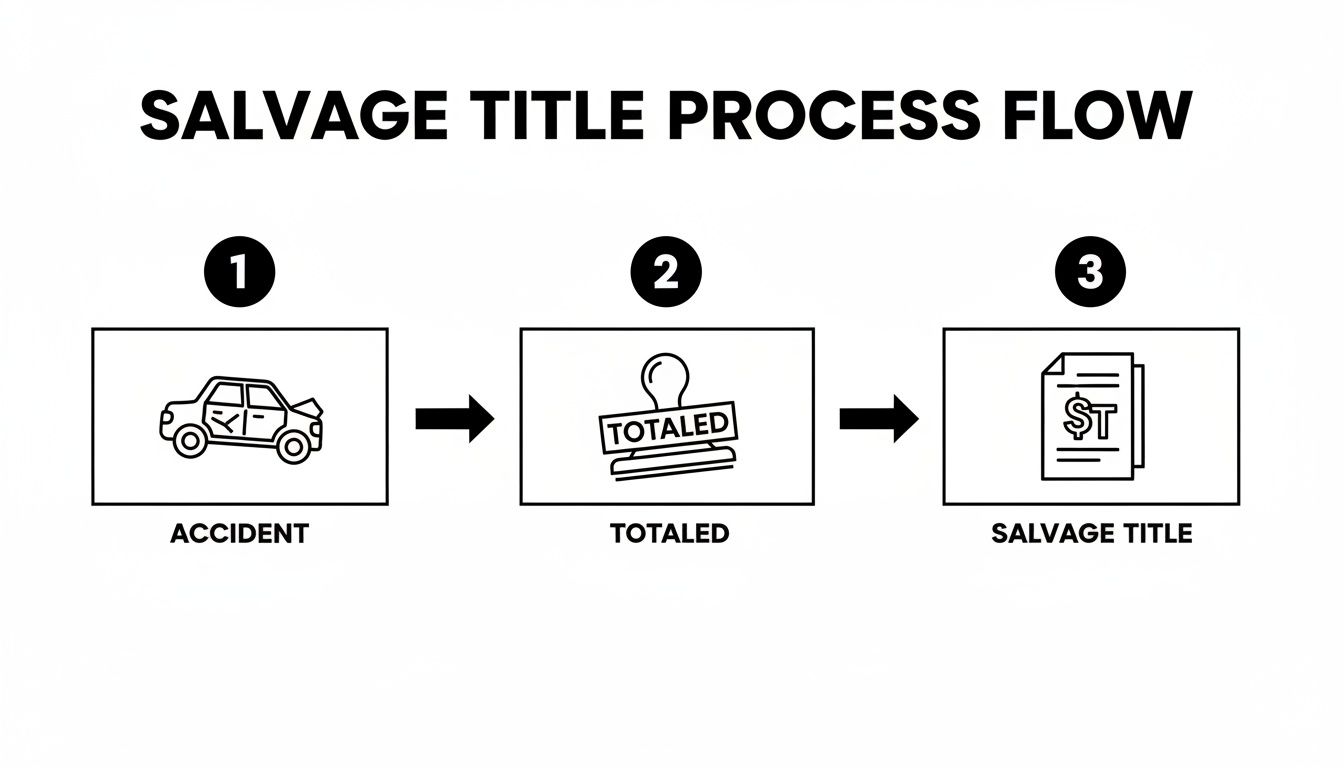
As you can see, it's a straightforward progression: the accident kicks things off, the insurer's math leads to the "totaled" stamp, and the process ends with the DMV issuing a salvage title.
Behind the Insurer's Calculation
It’s important to realize that the body shop estimate isn’t the only number the insurer is looking at. They're also thinking about other potential costs, like paying for your rental car while the repairs are being done or the risk of finding more hidden damage once the mechanics start tearing the car apart.
They also have a trick up their sleeve: they know they can get some of their money back by selling your damaged car at a salvage auction. An adjuster might figure your wrecked car could fetch $3,000 from a rebuilder. This potential recovery makes totaling the car an even better deal for them.
From their perspective, the internal math looks something like this:
- Cost to Repair: Pay the shop $12,500.
- Cost to Total: Pay you the $15,000 ACV, then get $3,000 back from the salvage auction. Their net cost is $12,000.
In this case, totaling the car saves the insurance company $500, so it’s the obvious business decision. Once they make that call, the paperwork is filed, and your car's clean title is gone forever, replaced by a salvage title that permanently alters its history and value.
The Financial Aftermath of a Salvage Title
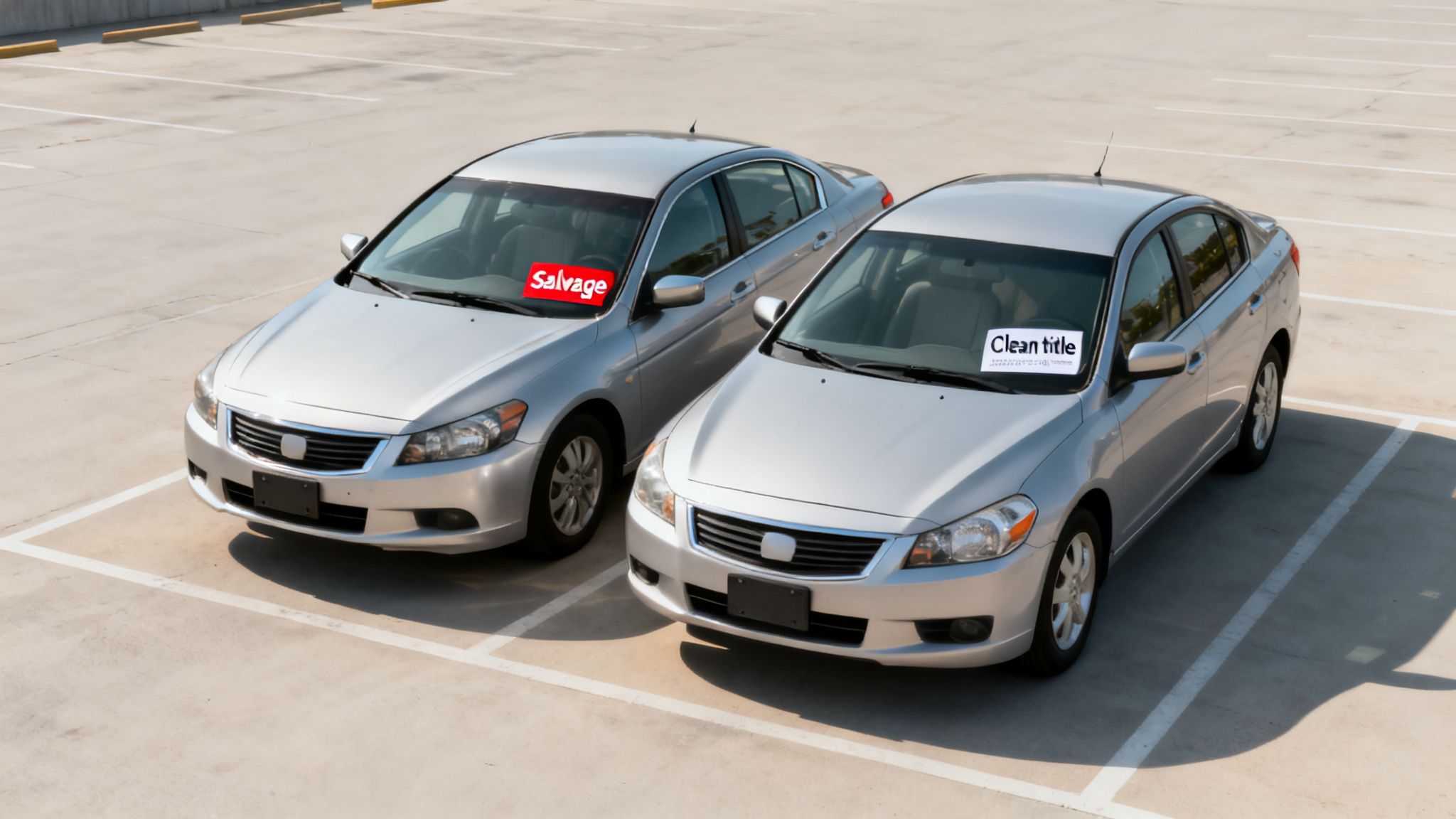
The moment an insurance company declares your vehicle a total loss, its financial future is changed forever. A salvage title isn't just a technicality; it’s a brand that immediately craters your car's value. This is, without a doubt, the biggest and most lasting consequence you’ll face. It hits everything from the car’s market price to your ability to even get it insured.
Even if you pour money into repairs and successfully get a "rebuilt" title, the financial damage is done. That salvage history is permanently tied to the vehicle's VIN, like a permanent red flag for anyone who looks it up—buyers, banks, and insurance agents alike. It creates a lingering cloud of doubt about the car's real condition and reliability.
How Much Value Does a Salvage Title Erase?
We’re not talking about a small dent in value. The financial hit is massive. A vehicle with a rebuilt title is instantly worth a fraction of an identical car with a clean history. The exact number can vary, but the drop-off is always steep.
A car with a salvage history—even after it's been perfectly repaired and issued a rebuilt title—typically loses 20% to 50% of its market value. This huge drop is all about the perceived risk tied to its traumatic past.
So, why such a dramatic plunge? It really boils down to a few key fears that buyers and lenders share:
- Safety Concerns: People are rightfully worried about hidden frame damage or compromised safety systems that even a thorough inspection might not catch.
- Insurance Hurdles: It's tough to get full coverage on a rebuilt car, which makes it a less attractive and harder-to-finance purchase for the next owner.
- Financing Difficulties: Many banks and credit unions simply will not write a loan for a vehicle with a branded title. This dramatically shrinks your pool of potential buyers.
This financial blow is especially painful for owners of classic, custom, or heavily modified cars. The thousands you invested in that engine swap or vintage restoration often get ignored in a standard total loss valuation, which makes fighting for a fair settlement absolutely critical. You can get a rough idea of the impact by using a diminished value claim calculator to see the potential loss.
The Insurance Nightmare
On top of the immediate hit to its value, just trying to insure a rebuilt vehicle can be a major headache. While state laws usually require insurers to offer you basic liability coverage, getting collision and comprehensive—what most people call "full coverage"—is a completely different ballgame.
Most major insurance companies want nothing to do with providing full coverage for a rebuilt car. They see it as a high-risk gamble with an unknown repair history and a much higher chance of future claims. The few that will offer it are almost certain to charge you far higher premiums than they would for the same car with a clean title, making it more expensive to own month after month.
A Growing Market Trend
The whole issue of what is a salvage title has become a much bigger deal recently as the car market has gone wild. With used car prices soaring and accident rates on the rise, more vehicles are being totaled out for what might seem like pretty moderate damage. As repair costs climb past the total loss thresholds in states like Washington, we're seeing more dealers selling rebuilt salvage cars to meet the demand for cheaper vehicles. You can read more about the rise of salvage car sales on TheDrive.com.
All of this just highlights how important it is to push back against an insurer's initial lowball offer. Their number is designed to protect their bottom line, not your investment. Once you understand the serious financial consequences of a salvage title, you're in a much stronger position to fight for the true, pre-accident value of your vehicle and protect yourself financially.
From Salvage to Roadworthy: The Rebuilt Title Process
A salvage title might feel like a death sentence for a car, but it’s really more of a temporary holding pattern. Think of it as a vehicle in limbo—it can’t be legally driven or registered as-is, but it’s not destined for the scrap heap just yet. With the right care and attention, it can be resurrected. This comeback story, however, requires officially changing its title from salvage to rebuilt, a journey that’s heavily regulated by the state to ensure the car is genuinely safe to be back on the road.
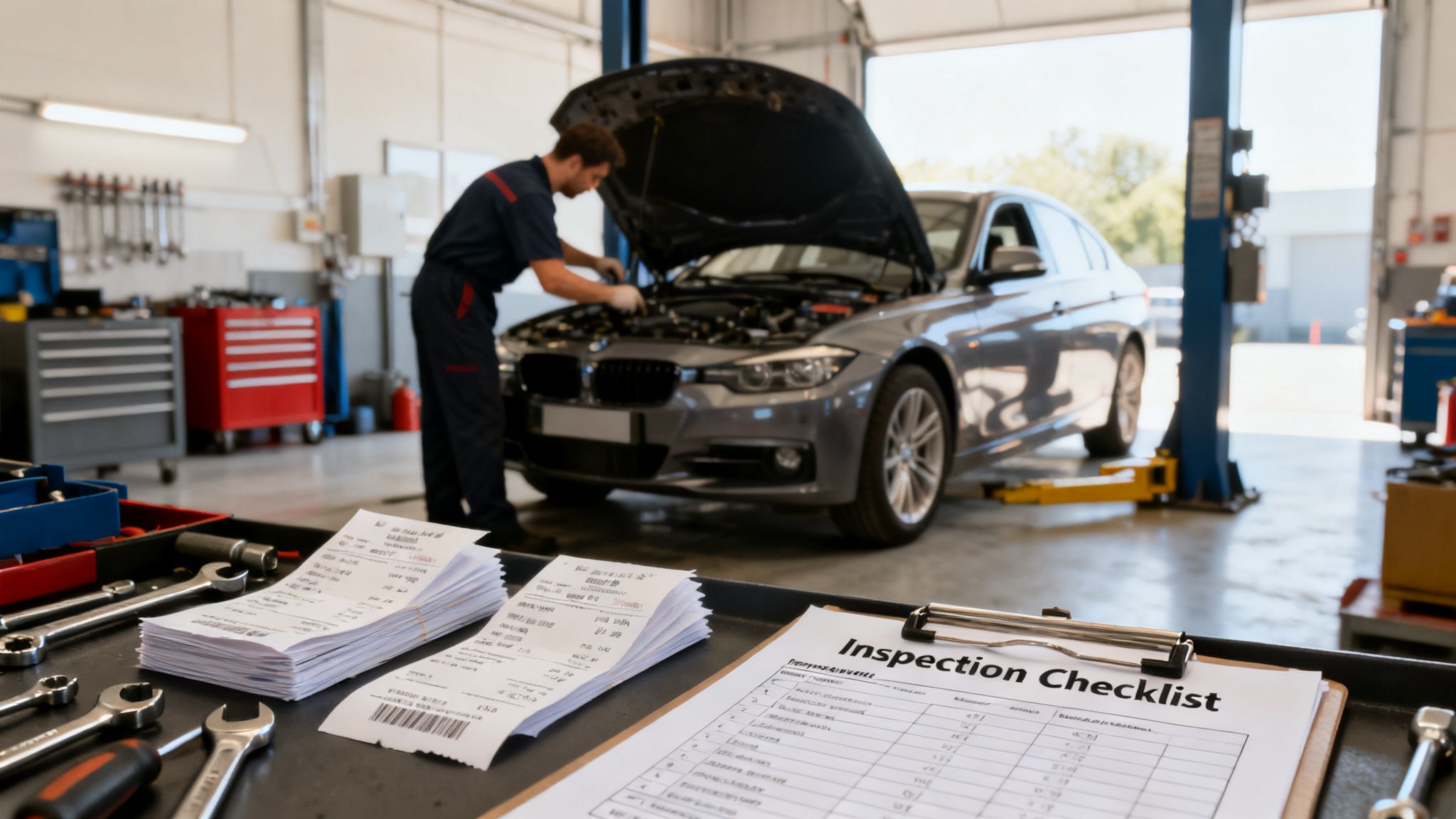
To pull this off, you have to treat the entire project like a professional restoration, even if you’re a pro DIY mechanic. The goal isn’t just to make the car look good and run right; it's to build an ironclad paper trail proving every single repair was done by the book with legitimate parts. This is no time to grab parts from a junkyard without a receipt.
Step One: The Professional Repairs
First things first: the physical repairs. Every bit of damage that led the insurance company to declare the car a total loss has to be fixed. This goes far beyond just buffing out dents and repainting a fender. We're talking about critical structural and mechanical systems.
For instance, if the frame was bent, it needs to be put on a proper frame machine and straightened back to factory specifications. If the airbags went off, they must be replaced with new, fully functional units—not just bypassed or removed. Every repair has to meet, and ideally exceed, all safety standards.
Step Two: The Documentation Trail
As the repairs move forward, your paperwork becomes just as crucial as your tools. You need to keep a meticulous record of every part, every receipt, and every hour of labor. In essence, you're building a legal case to prove your car is roadworthy.
Your evidence file should be airtight and include:
- The Original Repair Estimate: That first document from the insurer that detailed all the initial damage.
- Receipts for All Parts: Every single invoice for both new and used parts. These receipts need to clearly list the part and, for major components, the VIN of the vehicle they came from.
- Labor Invoices: If you paid a shop to do the work, get detailed invoices that break down exactly what they did.
- Photo Evidence: Snap plenty of "before" pictures of the damage. Then, document the repair process at key stages and take detailed "after" shots.
This documentation is absolutely non-negotiable. When you go for your inspection, the state examiner will be cross-referencing your receipts with the physical parts on the car. They're making sure you didn't use stolen components and that the work was done to a high standard.
Step Three: The State Inspection
With the car fully repaired and your binder of documents in hand, you've reached the final hurdle: the state-mandated rebuilt vehicle inspection. This is a whole different ballgame from your standard safety or emissions test. It's a highly detailed examination performed by a specialist from a state agency, like the Washington State Patrol or the Oregon DMV.
The inspector will go over the quality of the repairs with a fine-toothed comb, verify that all safety systems are working correctly, and run the VINs on your receipts against the parts on the vehicle. They are laser-focused on spotting shoddy workmanship or stolen parts.
If you pass, the state officially rebrands the title as rebuilt. This new title is your green light to get the car registered, insured, and legally back on the road.
It’s a demanding process, no doubt, but getting a rebuilt title gives a vehicle a second chance after being declared a total loss. Understanding these steps is just as important as understanding the total loss vehicle appraisal that started this whole journey in the first place.
How to Fight a Total Loss Settlement and Win
When your insurance company declares your car a total loss, it can feel like the final word. They hand you a settlement offer, and the expectation is that you’ll just sign the paperwork and move on.
But here’s the single most important thing you need to remember: never accept the first offer. That initial number isn't a final decision; it's the starting point for a negotiation.
This isn’t about your insurer being malicious—it’s just business. Their first valuation is almost always spit out by third-party software that scrapes data from all over. The problem? That data often includes banged-up auction vehicles or cars in poor condition, which drags down the average value and gives them a lowball number that helps their bottom line, not yours.
Your Secret Weapon: The Appraisal Clause
Buried in the fine print of most auto insurance policies is a powerful tool you probably didn't even know you had: the Appraisal Clause. This provision gives you the legal right to dispute the insurance company's valuation of your vehicle.
Invoking this clause essentially takes the decision away from the insurance adjuster and their biased software. It kicks off a formal process where both you and your insurer hire your own certified, independent appraisers to determine the vehicle's true Actual Cash Value (ACV). It completely levels the playing field.
Think of the Appraisal Clause as your right to a second opinion. If a doctor gave you a serious diagnosis, you’d seek another expert's view, right? The same logic applies here—you are not obligated to accept your insurer's financial diagnosis of your vehicle's worth.
Your Action Plan: What to Do Before You Sign Anything
Before you even think about accepting a settlement, you need to gather your own evidence and build a solid case for your car’s true value. Time is critical, so you need to start immediately.
Here is your step-by-step playbook:
- Do Not Sign Over Your Title: Once you sign that title, it's game over. Hold onto it until you are 100% satisfied with the final settlement amount.
- Demand the Insurer's Valuation Report: Ask them for a complete copy of the report they used to come up with their offer. This document is your roadmap to finding their mistakes.
- Scrutinize Their Report for Errors: Go through that report with a fine-tooth comb. Look for mistakes in your car's trim level, mileage, options, and its overall condition rating. Are the "comparable" vehicles they used really similar to yours? Are they even from your local market? Every inaccuracy you find is leverage.
- Gather Your Own Proof of Value: This is where you prove your car was better than average. Dig up maintenance logs, receipts for recent work (like new tires or a battery), and any invoices for upgrades you installed.
It's crucial to know your options, especially if your insurance company denied your total loss claim or just won’t budge from a lowball offer.
Invoking the Clause and Hiring a Pro
Once you have your evidence ready, the next step is to formally invoke the Appraisal Clause in writing. This official notification signals to the insurance company that you're serious and not backing down.
At this point, the single most effective action you can take is to hire your own certified, independent appraiser.
An independent appraiser works for you, not the insurance company. They'll conduct a thorough, hands-on inspection of your vehicle and write a detailed report based on its specific condition, features, and the current local market. That report becomes your ultimate negotiating tool, providing unbiased, expert proof of what your vehicle was truly worth moments before the accident.
The concept of a salvage title came from insurance reforms in the 1970s to fight fraud, but the salvage market has since exploded into a massive industry. Online salvage auctions are seeing annual growth of 15-17%, with totaled cars making up over 61% of the revenue. This just goes to show how routine the total loss process has become for insurers—and why fighting for every dollar you're owed is more important than ever.
Answering Your Questions About Salvage Titles
The world of salvage and rebuilt titles can be a confusing place, full of jargon that leaves you with more questions than answers. It's completely normal to feel a bit lost—the details really matter when you're talking about a car's value, safety, and ability to get insured.
Let's cut through the noise and tackle some of the most common questions head-on. My goal here is to give you clear, straightforward answers so you can make a smart decision, whether you're buying, selling, or fighting a total loss claim.
Can I Get Full Coverage Insurance on a Rebuilt Title Car?
Almost never. You should go into this assuming the answer is no. While you can usually get the state-required minimum liability coverage without much trouble, getting comprehensive and collision—what we call "full coverage"—is another story entirely.
Most major insurance carriers simply won't touch a rebuilt vehicle for full coverage. They view its previous life as a total loss as an unknown, unacceptable risk. The few smaller companies that might offer it will likely charge you a painfully high premium for the privilege. My advice? Get insurance quotes before you even think about buying a car with a rebuilt title to avoid a nasty surprise.
Is Buying a Rebuilt Car Ever a Good Idea?
It can be, but it's a path for the extremely cautious and well-informed buyer—not for the faint of heart. If you can find a car where the damage was purely cosmetic (think a bad hailstorm) and you have rock-solid proof the repairs were done by a top-notch professional, you might snag a good deal.
But this road is full of potholes. Before you even consider making an offer, you absolutely must pay for a thorough pre-purchase inspection from an independent, trusted mechanic. Their job is to be your skeptic, hunting for hidden frame damage, mismatched paint, or shoddy safety system repairs that could turn your bargain into a money pit—or worse, an unsafe vehicle. Always be ready for a significantly lower resale value and those insurance hurdles we just talked about.
A rebuilt title car can look like a steal on paper, but the initial savings can get wiped out in a hurry by surprise repair bills, sky-high insurance, and a massive hit in value when it's time to sell. For most people, the risks just aren't worth the reward.
How Can I Check if a Car Has a Salvage History?
Never, ever rely on what the seller tells you. The only person you can trust on this is yourself, armed with good data. The best way to get the real story is to run a comprehensive vehicle history report using the car's Vehicle Identification Number (VIN).
Services like CARFAX or AutoCheck dig into a vehicle's past and will flag any title "brands" like salvage, rebuilt, flood, or fire damage. You can often use a reliable VIN decoder to start your research and confirm a vehicle's history. This isn't an optional step; it's a must-do before buying any used car.
What Is the Difference Between a Salvage Title and a Junk Title?
Think of them as two different levels of a car being "totaled," one with a possible future and one without.
- Salvage Title: This is a temporary brand. It means the car was declared a total loss but has the potential to be repaired. If it passes a strict state inspection after being fixed, it can be re-registered with a "rebuilt" title and legally driven again.
- Junk Title: This is the end of the road. A junk title is given to a vehicle that's considered non-repairable. It can never be legally driven on public roads again and is destined to be sold for parts or scrap metal.
If your insurance company has declared your vehicle a total loss and their settlement offer seems way off, don't just accept it. At Total Loss Northwest, we fight for the true value of your vehicle. Our certified, independent appraisals give you the leverage and proof you need to get a fair settlement. Visit us at https://totallossnw.com to see how we can help.