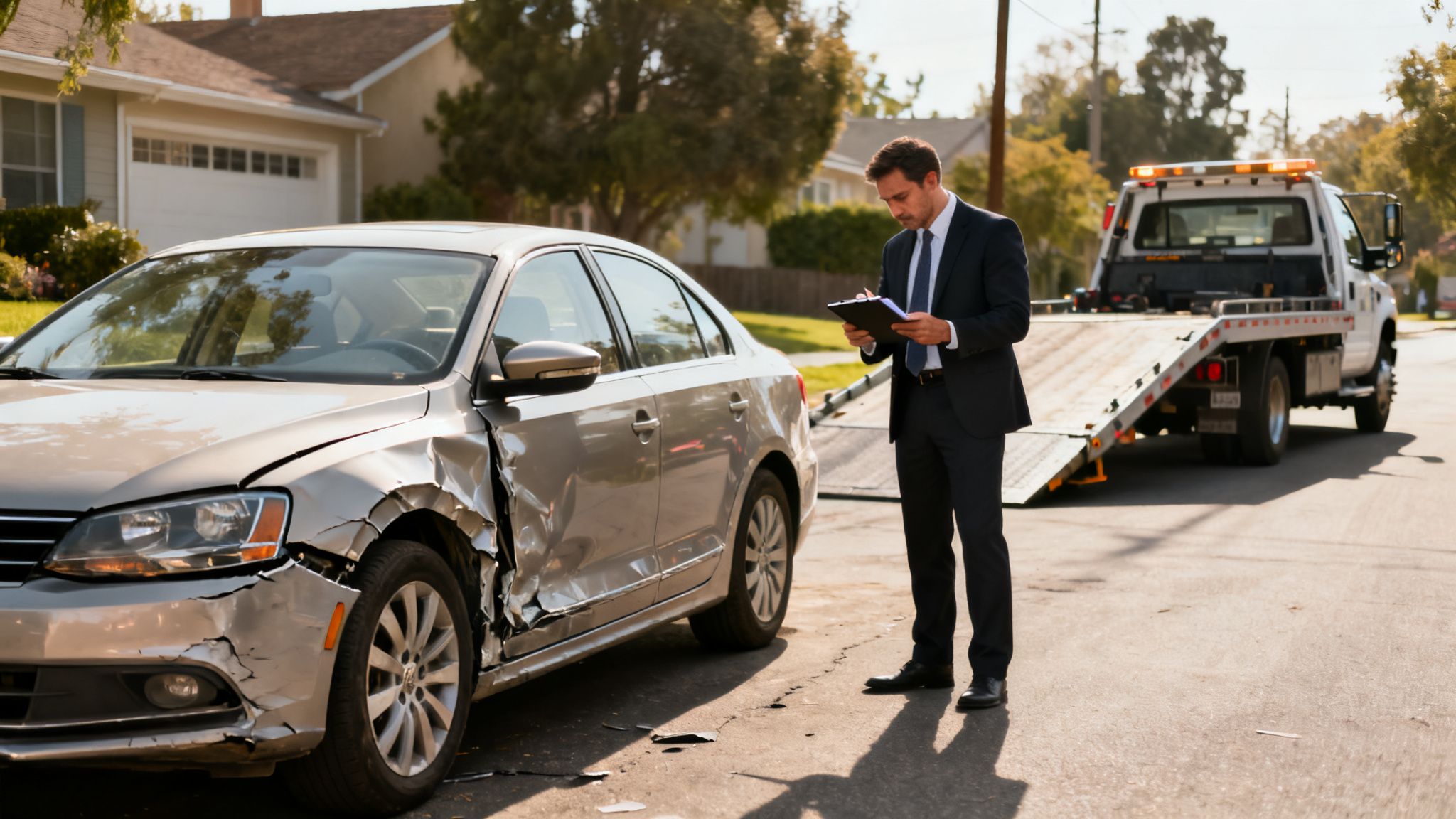
No one wants to hear the words "total loss" after a car accident. But what does it actually mean? Put simply, an insurance company declares your car a total loss when fixing it would cost more than what the car was worth right before the crash.
This isn't an emotional decision about your car's reliability or sentimental value. It's a straightforward financial calculation: repair costs versus the vehicle's actual worth.
The Moment of Truth: When Your Car Is Totaled
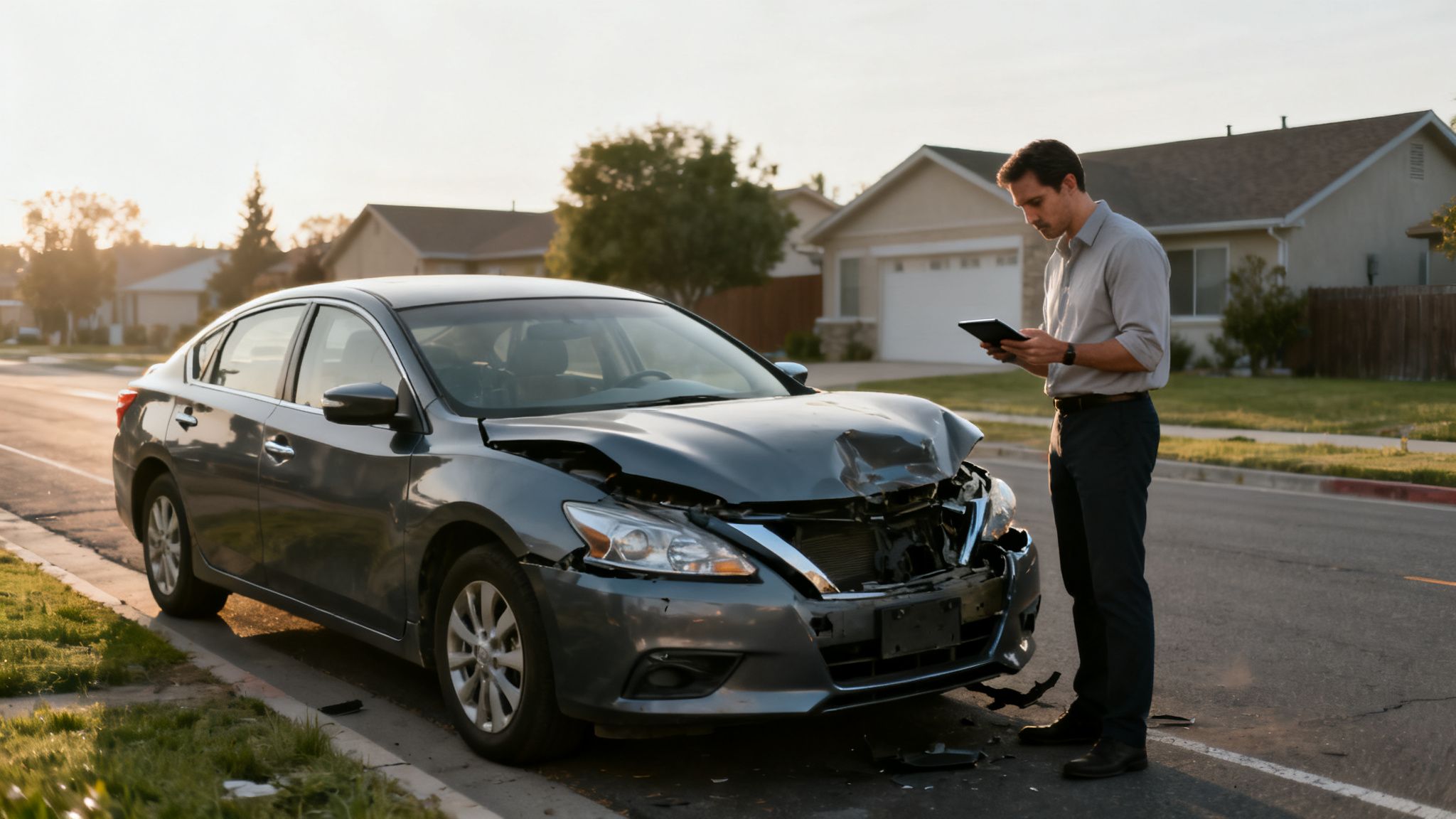
Think of it like this: if you have an old watch that’s worth $100, you probably wouldn't spend $120 to fix it. It just doesn't make financial sense. Insurers apply the same logic to your vehicle. They run a cost-benefit analysis to see if a repair is economically viable or if it’s time to cut their losses and pay you out.
This evaluation is the first major step in determining whether you'll get a check to cover repairs or a settlement for your car's value.
Understanding the Financial Tipping Point
The entire total loss decision comes down to a number called the Actual Cash Value (ACV). This is the fair market value of your specific car—its make, model, year, mileage, and condition—one second before the accident happened. It’s not what you paid for the car, and it's definitely not what you still owe on your loan.
An insurer "totals" a car when the estimated repair bill hits a certain percentage of that ACV. This threshold changes depending on the state, but the trend is clear: more cars are being totaled now than ever before.
Through April 2025, a staggering 22.6% of all collision claims in the U.S. ended in a total loss. What's driving this? A big part of the story is that over 70% of these totaled vehicles were seven years or older. With lower values, it doesn't take much for repair costs to tip the scales. You can find more details on these auto claim trends in the crash course report from CCC Intelligent Solutions.
Key Factors in the Total Loss Decision
So, what exactly goes into this calculation? It’s not just one number. Several moving parts come together to push a vehicle past the point of economical repair. Getting a handle on these is your first step toward ensuring you get a fair deal, because the insurer's first offer is just that—an offer.
To help you get a quick overview, this table breaks down the main components.
Quick Guide to Total Loss Factors
| Key Factor | What It Means for Your Claim |
|---|---|
| Estimated Repair Costs | This is the total bill for parts, labor, paint, and any specialized work needed for modern safety systems. It's often higher than you'd expect. |
| Actual Cash Value (ACV) | The pre-accident market value of your vehicle. This is the most common point of negotiation, as insurers often undervalue it. |
| Salvage Value | The amount the insurer can get by selling your wrecked car at auction for parts or scrap. This value is subtracted from their payout to you. |
| State Regulations | Specific laws, like those in Oregon and Washington, set the exact percentage (the "total loss threshold") that triggers a total loss declaration. |
Each of these elements plays a critical role in the final decision.
Understanding these core components is crucial, especially in states like Oregon and Washington with their own specific rules. The most important thing to remember is that you have the right to question and challenge the insurance company’s numbers to secure a fair settlement.
Decoding the Total Loss Formula
When an insurance company looks at your wrecked car, they aren't seeing the road trips or the memories. They're seeing a math problem. The decision to fix your car or "total it out" comes down to a straightforward, often frustrating, financial calculation.
It’s all about comparing two key numbers: what it would cost to fix the damage versus what the car was worth a moment before the crash. When the repair bill starts creeping too close to the car's value, the insurer will almost always choose to write it off. Understanding how they get these numbers is your first step toward getting a fair shake.
The Two Sides of the Total Loss Equation
Every total loss decision hinges on how two critical values stack up against each other. If you know what they are and how they're calculated, you'll be in a much better position to question a lowball settlement.
Actual Cash Value (ACV): Think of this as the "for sale" price of your car one second before the accident. It’s not what you paid for it, and it’s not what a brand-new one costs. The ACV is what a buyer in your local area would have realistically paid for your specific car—taking into account its year, make, model, mileage, options, and, most importantly, its pre-accident condition.
Estimated Repair Costs: This is the full, itemized bill to return your car to the way it was before the collision. It covers everything—parts, labor, paint, and any complex recalibrations needed for modern safety features.
The adjuster’s job is to put these two numbers side-by-side. If the repair costs get too high relative to the ACV, it’s game over for your car. For a more detailed breakdown of how these numbers interact, our guide on calculating a total loss vehicle goes even deeper.
Why Your Car’s ACV Is More Than Just a Number
The ACV is the single most important—and most frequently disputed—part of this formula. Insurers don't just guess; they use third-party software to generate an initial ACV report. These systems pull sales data for similar cars, but they have a major blind spot: they can't see your car.
An automated report doesn't know about the pristine interior you worked so hard to maintain, the brand-new set of premium tires you just installed, or the major engine service you recently paid for. It relies on averages and assumptions, which often leads to an initial offer that falls short of your car's true market value. That's why it's so important to know what's in their report and what isn't; learning how to approach decoding your CCC ONE Market Valuation Report is a critical skill.
Always treat the insurer’s first ACV figure as a starting point for discussion, not the final number.
The Soaring Cost of Repairs
On the other side of the equation, repair costs have gone through the roof. Today's cars are rolling computers, and fixing them is no longer a simple nuts-and-bolts job. A seemingly minor fender bender can easily damage a whole network of sensors, cameras, and radar units that run the car's advanced safety systems.
- Expensive Electronics: A single modern headlight assembly can cost over $1,500, and a bumper packed with parking sensors can quickly run into the thousands.
- Specialized Labor: Repairing a car is one thing, but recalibrating its Advanced Driver-Assistance Systems (ADAS) requires special tools and highly trained technicians, adding a hefty sum to the labor bill.
- Supply Chain Headaches: Delays and shortages for specific parts can inflate costs and drag out repair times, making a quick fix a thing of the past.
This surge in repair costs means that cars are being totaled out with less and less visible damage. The financial tipping point is just reached much sooner than it was a decade ago.
How State Laws in Oregon and Washington Define a Total Loss
When an insurance company decides to total your car, they aren't just making a judgment call based on their own internal policies. The final decision is actually dictated by state law, and the rules can be surprisingly different from one place to the next.
This is especially true here in the Pacific Northwest. Oregon and Washington have their own distinct regulations, and as a driver, understanding them is one of the most powerful tools you have. These laws create a legal backstop, preventing insurers from patching up a dangerously damaged vehicle just to save a buck.
The Total Loss Threshold Explained
Most states, including Oregon, use what’s called a Total Loss Threshold (TLT). Think of it as a clear, mathematical line in the sand set by lawmakers.
If the estimated cost to fix your car hits a certain percentage of its pre-accident value—its Actual Cash Value (ACV)—the insurance company is legally required to declare it a total loss. No ifs, ands, or buts.
In Oregon, that magic number is 80%. So, if your car was worth $20,000 before the crash, and the body shop says repairs will cost $16,000 or more, your car is officially a total loss under state law. It's a straightforward rule designed to take unsafe vehicles off the road for good.
This simple decision tree lays out the basic financial choice an insurer faces.
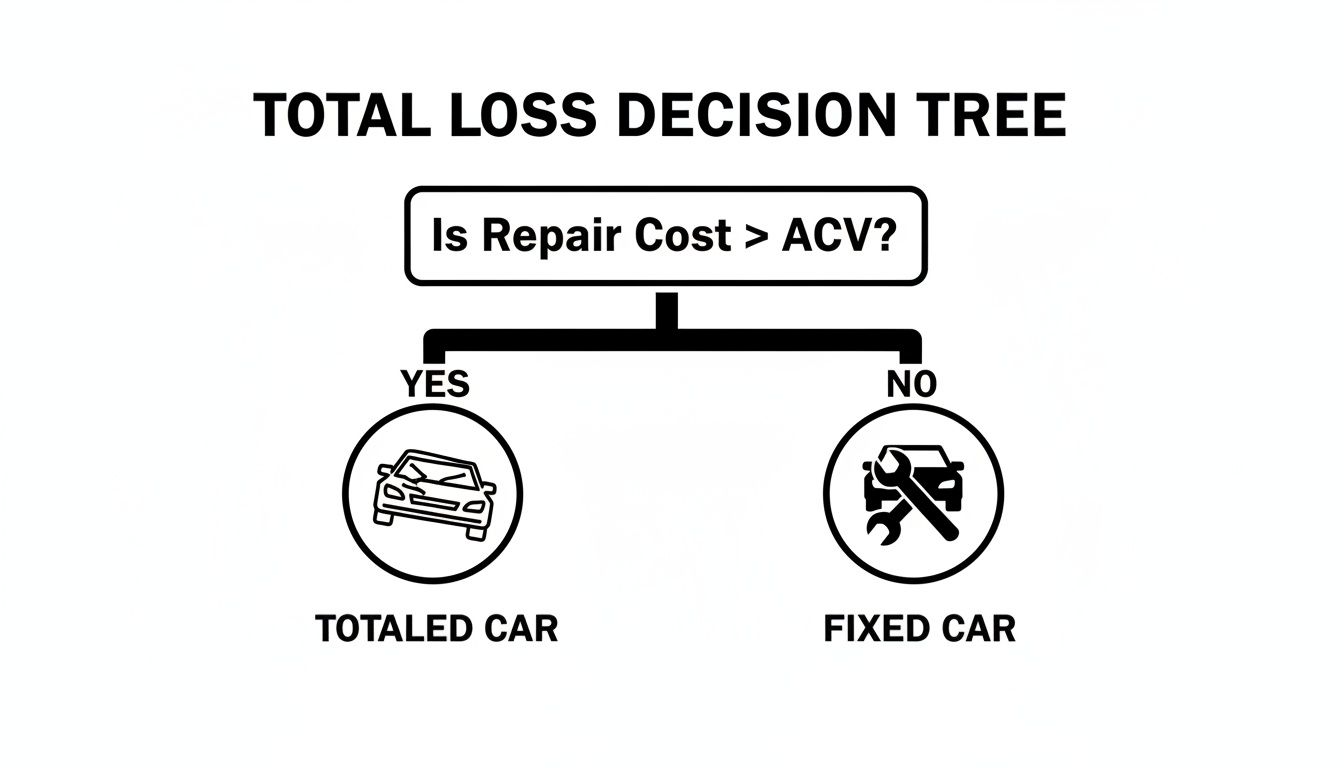
When you get right down to it, the whole process boils down to one simple question: do the repairs cost more than the car is worth?
Washington's Total Loss Formula
Washington, on the other hand, does things a little differently. Instead of a simple percentage, the state uses a Total Loss Formula (TLF). It has a few more moving parts, but its purpose is the same: to identify cars that just don't make financial sense to repair.
The formula looks like this: Repair Cost + Salvage Value > Actual Cash Value
Let’s walk through a real-world example to see how it works:
- Your car’s pre-accident ACV is $15,000.
- The shop estimates the Repair Cost at $11,000.
- The insurer figures they can sell the wreck to a salvage yard for $5,000 (its Salvage Value).
Now, just plug those numbers into Washington's formula: $11,000 (Repairs) + $5,000 (Salvage) = $16,000.
Since that $16,000 total is greater than the car’s $15,000 ACV, it must be declared a total loss in Washington. You can get an even more detailed breakdown in our guide to the total loss process in Washington.
Why These State Laws Matter to You
Knowing whether your state uses a threshold or a formula isn't just trivia—it's leverage. It gives you the power to hold your insurance company accountable. If an adjuster is pushing to repair a car that you feel is totaled, you can point directly to the law.
An insurer cannot choose to repair a vehicle that legally meets the state's definition of a total loss. These regulations are not suggestions; they are legal requirements designed for consumer protection.
At the end of the day, these laws protect you. They ensure that an insurer’s financial decision doesn't put a structurally compromised car back on the highway, promoting safety and transparency for everyone.
Seeing the Numbers in a Real-World Example
Theories and formulas are great, but nothing makes sense like seeing real dollars on the line. Let's walk through a common scenario to show you exactly why an insurance company’s first offer is just a starting point, not the final word.
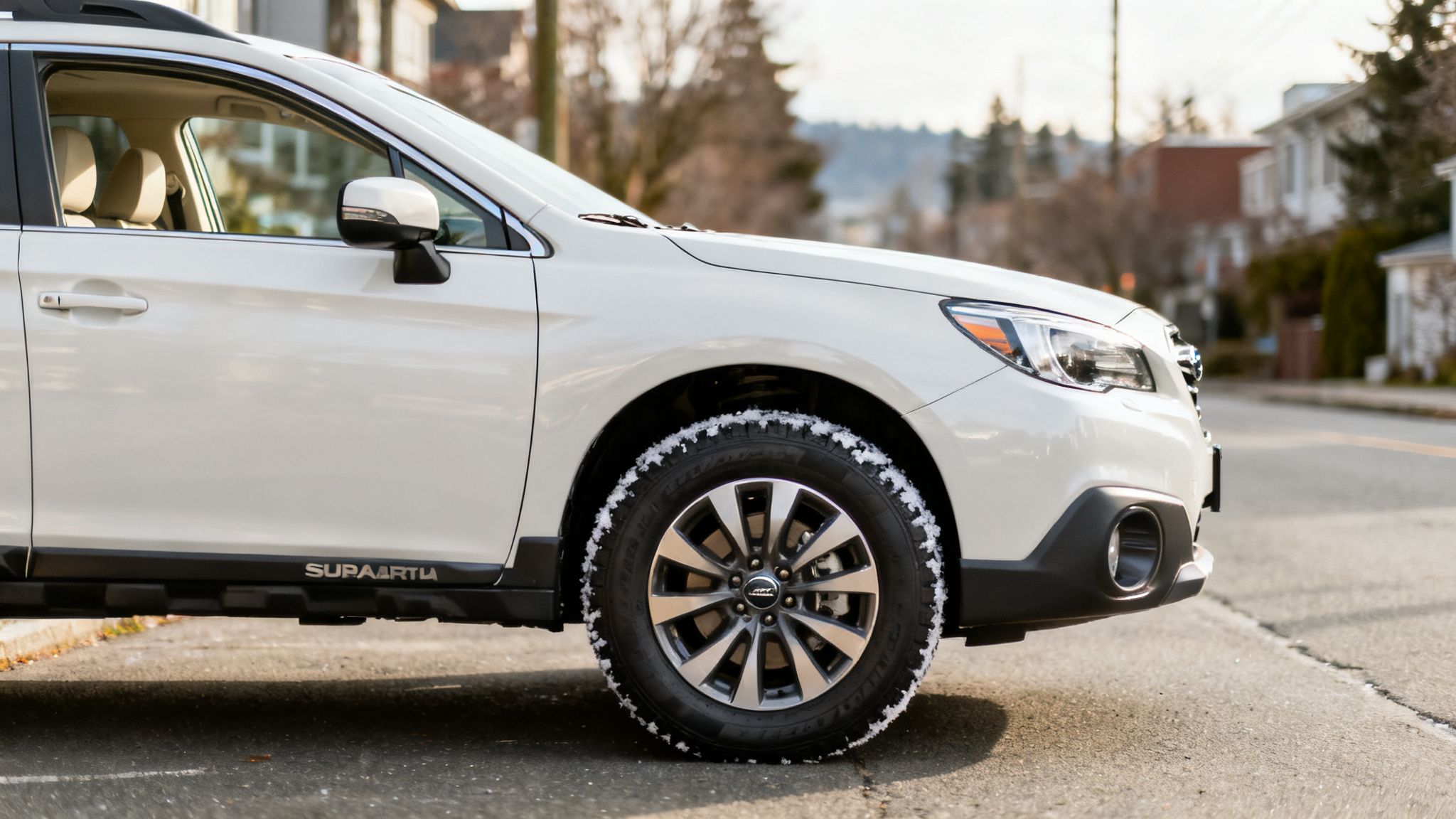
Let's meet Sarah, a driver from Seattle. Her meticulously cared-for 2018 Subaru Outback—the perfect ride for Pacific Northwest adventures—was in a bad collision. The damage was severe, and her insurance company’s adjuster immediately started the total-loss process.
The Insurer's Initial Offer
A few days later, Sarah got the insurer’s valuation report. It stated the Actual Cash Value (ACV) of her Outback was $18,500. The number felt like a punch to the gut. She knew what she’d invested in her car and what it would take to buy another one just like it.
The problem? The insurer’s report was generated by software that used a generic profile for a 2018 Outback. It relied on standard depreciation tables and regional auction sales, completely ignoring the details that made Sarah’s car special. It was an assessment of an Outback, not her Outback.
This is happening more and more. With complex vehicle technology, repair costs are soaring, and in the U.S., over 30% of claims now end up as total losses. As one industry report from Solera points out, this trend forces insurers to lean on automated valuation tools that often spit out lowball offers, especially for well-maintained vehicles.
The Independent Appraiser's Investigation
Feeling short-changed, Sarah hired a certified independent appraiser for a second opinion. This is where the story takes a turn.
The appraiser didn’t just plug numbers into a computer; they went out and looked at the car. The process was thorough, methodical, and based on hard evidence:
- Documenting Upgrades: The appraiser photographed and documented the $1,200 set of brand-new, all-weather tires Sarah had put on just two months before the crash.
- Recording Recent Maintenance: He took note of the receipt for a $1,500 timing belt replacement—a major service that adds significant value and extends the car's life.
- Assessing True Condition: The report detailed the vehicle’s immaculate interior and exterior, rating its condition far above the "average" assumed by the insurer's software.
The core difference is simple: The insurer’s software values a car based on what a computer model says it should be worth. An independent appraiser values a car based on what it actually is.
Instead of using old auction data, the appraiser pulled real-time sales listings for comparable Subaru Outbacks from dealerships across Washington and Oregon. This gave him a true, local market value for what it would actually cost Sarah to replace her exact car today.
A Tale of Two Valuations
The difference in approach created a huge difference in value. The independent appraiser built a case from the ground up, proving a much higher market value for Sarah’s specific Outback.
This table shows just how different an insurer's initial offer can be from a valuation conducted by a certified, independent professional who is working for you.
Insurer vs. Independent Appraiser Valuation
| Valuation Component | Insurance Company Value | Independent Appraiser Value | Financial Impact |
|---|---|---|---|
| Base Vehicle Value | $18,500 | $21,000 | +$2,500 |
| Condition Adjustment | Included (Standard) | +$750 (Excellent) | +$750 |
| New All-Weather Tires | Not Accounted For | +$800 (Pro-rated) | +$800 |
| Recent Timing Belt Service | Not Accounted For | +$1,000 (Added Value) | +$1,000 |
| Final ACV | $18,500 | $23,550 | +$5,050 |
By presenting this detailed, evidence-backed appraisal report to her insurance company, Sarah successfully negotiated a final settlement of $23,550.
That’s over $5,000 more than the initial offer—money she absolutely needed to buy a comparable replacement. Sarah's story is a perfect example of why you should never just accept the first number the insurance company gives you.
Know Your Rights After a Total Loss Declaration

The moment the insurance company officially declares your vehicle a total loss, the ball is back in your court. But to play the game well, you need to know the rules. Think of this as your playbook for what comes next—a rundown of the fundamental rights you have as a policyholder.
The most important thing to burn into your memory is that their first settlement offer is just that: an offer. You have zero obligation to accept it, and you absolutely have the right to question their math and push back with your own proof.
You Have the Right to Dispute the ACV
The entire total loss settlement hinges on one figure: the Actual Cash Value (ACV). Unsurprisingly, this is also where most of the fights happen. Insurers often generate their initial ACV using automated software that can easily undervalue your car by overlooking its unique condition, recent upgrades, or local market demand.
You have every right to challenge their valuation. Your first move should be to comb through their valuation report and start gathering your own evidence. This isn’t complicated. You’ll want things like:
- Maintenance Records: Proof of regular oil changes, tire rotations, and other service shows your car was cared for, not neglected.
- Receipts for Upgrades: Did you just drop a grand on new tires or replace the transmission? That’s real, tangible value their software almost certainly missed.
- Market Research: Find a handful of comparable vehicles for sale in your immediate area to paint a picture of what it would actually cost to replace your car.
With this documentation in hand, you can go back to the adjuster with a well-supported counter-offer. If you want a more detailed game plan, our guide on how to negotiate your total loss settlement breaks it down step-by-step.
The Option to Keep Your Car
It might sound strange, but you often have the choice to keep your vehicle even after it's been totaled. This can be a smart move if the damage is mostly cosmetic, or if you're handy with a wrench and can tackle the repairs yourself for far less than a commercial body shop.
If you go this route, the insurance company pays you the ACV minus the car’s salvage value. That salvage value is simply what the insurer would have gotten for your wrecked car at a scrap auction. After you get your check, the car is yours to keep, but it comes with a major string attached.
The state will issue your vehicle a "salvage title." This title is a permanent brand, letting everyone know the car was once declared a total loss, which can make it a real headache to insure or resell later. To get it back on the road legally, you'll need to complete all the repairs and pass a tough state safety inspection to get a "rebuilt" title.
Invoking Your Policy's Appraisal Clause
So what happens if you and the insurer are still miles apart on the car's value and negotiations have hit a brick wall? Buried in the fine print of most auto policies is an incredibly powerful tool for consumers: the Appraisal Clause.
Think of the clause as your contractual right to a fair second opinion. It’s a formal, structured process for settling disagreements over value, taking the final decision out of the insurance company's hands.
The Appraisal Clause allows both you and the insurer to hire your own certified, independent appraiser. These two experts then work to agree on a fair value. If they can’t reach an agreement, they select a neutral third appraiser, called an umpire, who makes the final, binding decision.
Invoking this clause isn't an aggressive or hostile tactic; it's a standard procedure built right into your policy to guarantee a fair outcome. It replaces the insurer’s lowball-prone software with the expert judgment of professionals who evaluate your car based on its actual condition and the real-world local market. When talks stall, it is the single most effective way to get the settlement you truly deserve.
Common Questions About Total Loss Claims
Dealing with the fallout from a serious car accident is stressful enough. But when the insurance company tells you your car is a "total loss," a whole new wave of questions and worries can hit you all at once. It’s a confusing process, but understanding how it works is the first step toward taking back control.
Let's walk through some of the most common questions we hear from drivers in this exact situation.
Can I Keep My Car if It’s Declared a Total Loss?
Believe it or not, yes. In almost every case, you have the right to keep your car, a process known as “owner retention.”
If you go this route, the insurance company will pay you the car’s Actual Cash Value (ACV), but they’ll subtract its salvage value. That salvage value is simply what they would have gotten for it by selling the wrecked vehicle to a salvage yard or at auction.
Sounds simple, but here’s the catch: the car will be given a salvage title. This is a permanent brand on its history that tells everyone it was once considered totaled. To get it back on the road legally, you'll have to jump through some hoops:
- Complete all the necessary repairs to bring it up to state safety standards.
- Pass a specific, often rigorous, state inspection for rebuilt vehicles.
- Apply for a new "rebuilt" title.
Even after all that, you'll likely find that insuring a rebuilt vehicle is more expensive and difficult, and its resale value will have taken a massive hit.
What Happens if I Still Owe Money on My Car Loan?
This is where things can get really tricky for a lot of people. If you have an outstanding loan, your lender is first in line for the insurance payout. The check goes to them, not you.
If the settlement is more than what you owe, the lender gets paid off, and you get to keep the rest. But if the insurance settlement is less than your loan balance—a situation often called being "upside-down"—you're still on the hook for the difference. You’ll have to pay that remaining balance out of pocket.
This is precisely why GAP (Guaranteed Asset Protection) insurance exists. GAP coverage is designed to cover the "gap" between what your car is worth and what you still owe on the loan. Without it, you could find yourself making payments on a car that's already been hauled away to a junkyard.
How Does an Independent Appraisal Actually Increase My Settlement?
An independent appraisal isn't just a second opinion; it's a completely different approach to valuation. The insurance company relies on software that spits out a generic value for a vehicle like yours. An independent appraiser, on the other hand, determines the value of your car.
It’s a hands-on, detailed process. A certified appraiser will physically inspect your vehicle (or photos of it, pre-accident) to document its actual condition, mileage, and all its features and options. They look for things the software misses, like recent major repairs or valuable upgrades you've made.
Most importantly, they don't rely on a generic database. They dig into real-time sales data for truly comparable vehicles in your local market to build a report based on reality. When you invoke your policy's Appraisal Clause with that report, you force the insurer to negotiate based on what it would actually cost you to buy a replacement car today, not some automated number. This often leads to a much higher, and fairer, settlement.
Do Custom Parts or Recent Repairs Affect the Car’s Value?
They absolutely should, but the insurance company isn't going to give you credit for them automatically. Their software has no way of knowing about the new transmission you put in last year, the custom wheels you added, or that high-end stereo system you invested in. It's up to you to prove it.
This is why keeping good records is so crucial. Dig up every receipt and invoice for those upgrades and present them to the adjuster and your appraiser. A good independent appraiser knows exactly how to factor the depreciated value of these items into the total ACV, making sure you get compensated for the money you put into the car.
People also frequently wonder if their car is automatically totaled if the airbags deploy. While deployed airbags often indicate a severe impact, it doesn't guarantee a total loss designation. For a closer look at this, the guide If Airbags Deploy, Is Your Car Totaled in California? offers some great context on how adjusters weigh that and other factors.
If you're in Oregon or Washington and staring down a lowball total loss offer, you don't have to just take it. At Total Loss Northwest, our certified appraisers fight to get you the true market value for your vehicle. We invoke the Appraisal Clause on your behalf to ensure a fair and accurate settlement. Contact us today for a free consultation at https://totallossnw.com.