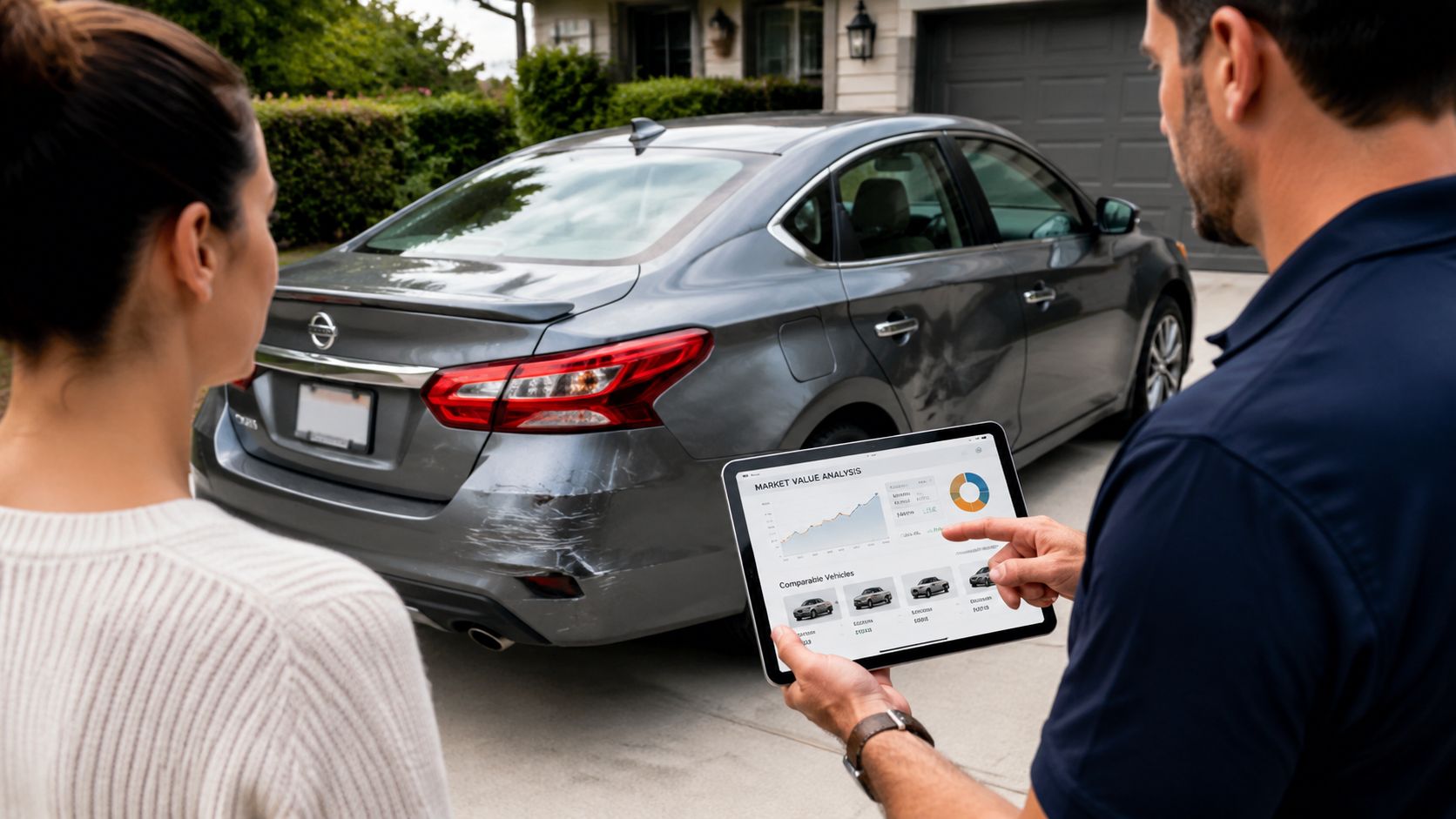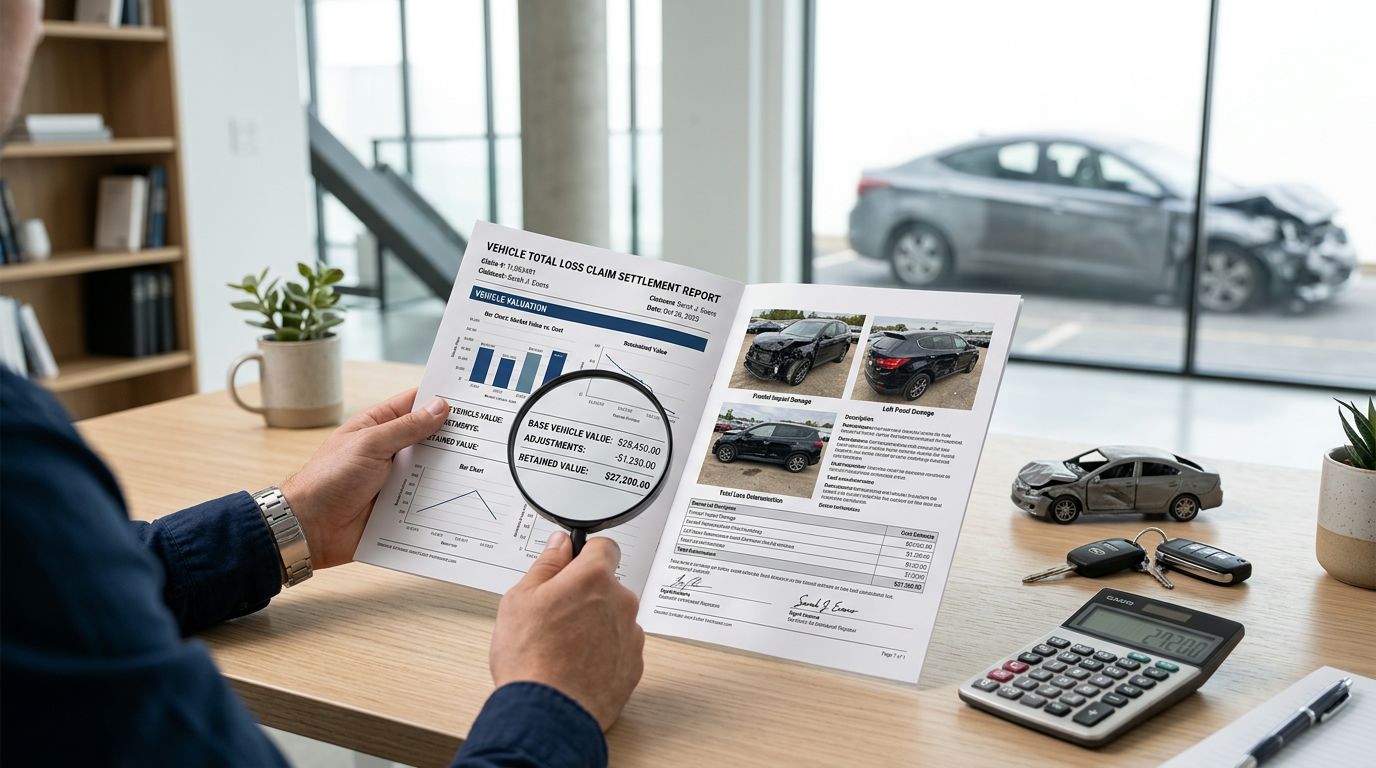
When your car gets wrecked, the insurance company has to decide: fix it or "total it"? That decision isn't just a judgment call; it's based on a specific rule called the total loss threshold, and it's different in every state.
This threshold is the magic number, usually a percentage, that compares the cost to repair your car against its actual cash value (ACV) right before the accident. Getting a handle on your state's specific rule is the first, most important step you can take to make sure you get a fair shake from your insurance company.
What Is a Total Loss Threshold and Why It Matters
At its core, the total loss threshold is the tipping point. It's the point where the law says it no longer makes financial sense to repair a vehicle, legally forcing the insurer to declare it a total loss and write you a check.
This single rule has a huge impact on your wallet. If the damage estimate sails past that threshold, you get paid the car's pre-accident value. But if it falls just shy, you could end up with a vehicle that's been through the wringer with massive repairs, which can seriously tank its resale value down the road. You can get a much clearer picture of the entire process by learning more about what makes a car totalled.
Generally, states follow one of two main systems to figure this out:
- Fixed Percentage Threshold: This is the most common approach. A state sets a specific percentage, like 75%. If the repair estimate is more than 75% of the car's ACV, it’s automatically deemed a total loss. Simple as that.
- Total Loss Formula (TLF): A handful of states use a slightly more complex calculation. Here, if the Cost of Repairs + the car's expected Salvage Value is equal to or greater than its ACV, it's totaled.
Knowing which system your state uses is critical. It's the key to understanding your claim and gives you the power to advocate for yourself effectively.
A Quick Reference Guide For All 50 States
When your car is damaged, one of the first questions you'll have is whether it can be repaired or if it’s a total loss. The answer isn't always straightforward and often comes down to where you live. Each state sets its own rules, and those regulations can make a huge difference in the outcome of your insurance claim.
The thresholds for declaring a vehicle a total loss vary wildly across the country, ranging from as low as 60% of the vehicle's pre-accident value to as high as 100%. For instance, Oklahoma has the lowest threshold in the nation at just 60%, which means vehicles there are declared a total loss more readily. At the other end of the spectrum, states like Colorado and Texas require repair costs to meet or exceed 100% of the car's value. The most common standard, adopted by about 15 states, is a 75% threshold.
You can get a better sense of how states stack up by checking out a comprehensive state-by-state total loss guide.
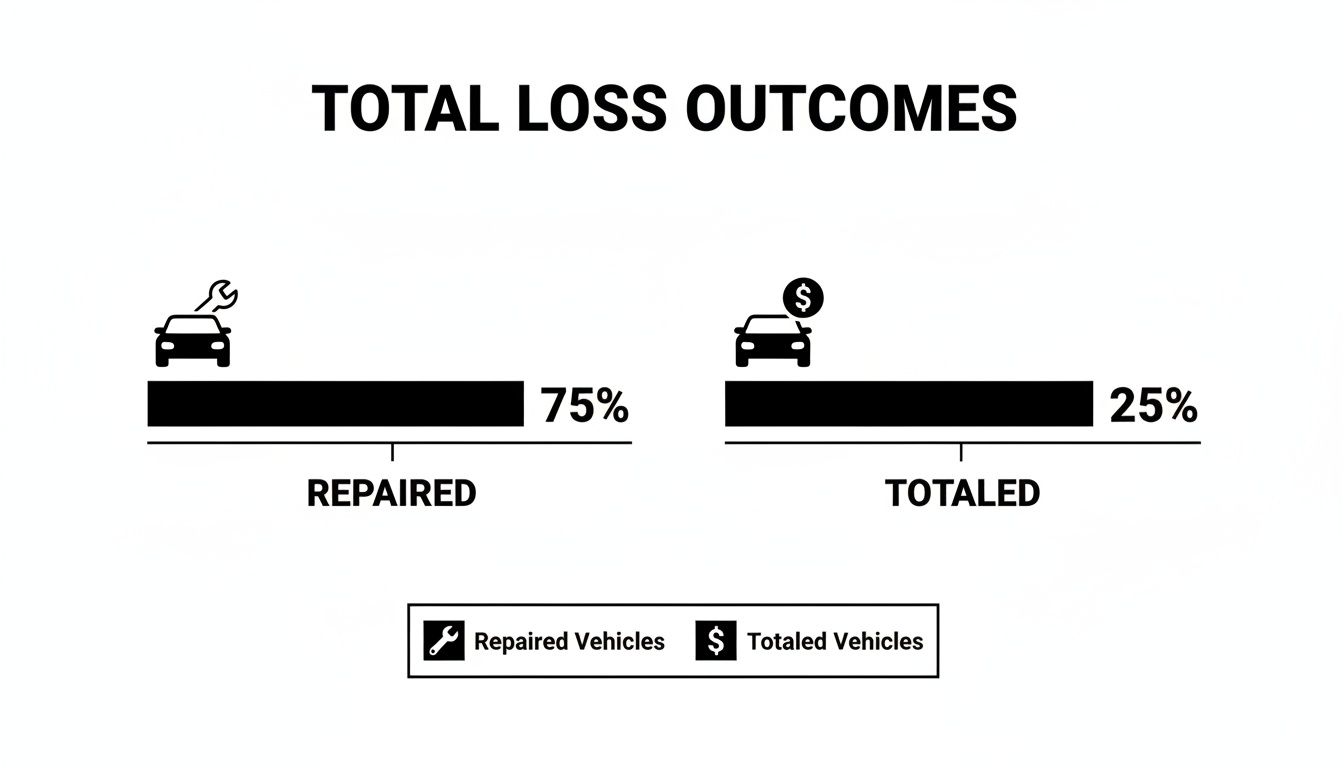
As you can see, while a total loss feels like a common scenario, most vehicles involved in claims end up being repaired.
How To Use The State Threshold Table
In the table below, you can quickly find your state's specific rule. You'll see one of two approaches: a simple percentage of the car's Actual Cash Value (ACV) or a more complex Total Loss Formula (TLF). This is your first step to understanding what to expect from your insurer.
Let's look at a practical example. Imagine your car was worth $15,000 before the accident.
- In a state like Kentucky, which uses a 75% threshold, your car would be declared a total loss if the repair estimate exceeds $11,250.
- But in a TLF state like Washington, the adjuster does a different calculation: Cost of Repairs + Salvage Value ≥ ACV. The outcome is less about a fixed percentage and more about the car's potential scrap value.
Here's a crucial point to remember: while an insurer must total a vehicle if it meets the state's minimum threshold, they often have the discretion to total it even if the costs are slightly lower. If they run the numbers and find that totaling the car is more economical than repairing it, they can make that call.
Total Loss Threshold by State Quick Lookup Table
Find your state's specific total loss rule at a glance. This table outlines whether your state uses a fixed percentage or a Total Loss Formula (TLF).
| State | Threshold Type | Threshold Value / Rule |
|---|---|---|
| Alabama | Percentage | 75% of Actual Cash Value (ACV) |
| Alaska | Percentage | 80% of ACV |
| Arizona | Total Loss Formula | Cost of Repairs + Salvage Value ≥ ACV |
| Arkansas | Percentage | 70% of ACV |
| California | Total Loss Formula | Cost of Repairs + Salvage Value ≥ ACV |
| Colorado | Percentage | 100% of ACV |
| Connecticut | Percentage | 75% of ACV |
| Delaware | Percentage | 75% of ACV |
| Florida | Percentage | 80% of ACV |
| Georgia | Percentage | 75% of ACV |
| Hawaii | Percentage | 75% of ACV |
| Idaho | Percentage | 75% of ACV |
| Illinois | Total Loss Formula | Cost of Repairs + Salvage Value ≥ ACV |
| Indiana | Percentage | 70% of ACV |
| Iowa | Percentage | 70% of ACV |
| Kansas | Percentage | 75% of ACV |
| Kentucky | Percentage | 75% of ACV |
| Louisiana | Percentage | 75% of ACV |
| Maine | Percentage | 75% of ACV |
| Maryland | Percentage | 75% of ACV |
| Massachusetts | Total Loss Formula | Cost of Repairs + Salvage Value ≥ ACV |
| Michigan | Percentage | 75% of ACV |
| Minnesota | Percentage | 80% of ACV |
| Mississippi | Percentage | 75% of ACV |
| Missouri | Percentage | 80% of ACV |
| Montana | Percentage | 75% of ACV |
| Nebraska | Percentage | 75% of ACV |
| Nevada | Percentage | 65% of ACV |
| New Hampshire | Percentage | 75% of ACV |
| New Jersey | Total Loss Formula | Cost of Repairs + Salvage Value ≥ ACV |
| New Mexico | Total Loss Formula | Cost of Repairs + Salvage Value ≥ ACV |
| New York | Percentage | 75% of ACV |
| North Carolina | Percentage | 75% of ACV |
| North Dakota | Percentage | 75% of ACV |
| Ohio | Total Loss Formula | Cost of Repairs + Salvage Value ≥ ACV |
| Oklahoma | Percentage | 60% of ACV |
| Oregon | Percentage | 80% of ACV |
| Pennsylvania | Percentage | 70% of ACV |
| Rhode Island | Percentage | 75% of ACV |
| South Carolina | Percentage | 75% of ACV |
| South Dakota | Percentage | 75% of ACV |
| Tennessee | Percentage | 75% of ACV |
| Texas | Percentage | 100% of ACV |
| Utah | Percentage | 70% of ACV |
| Vermont | Total Loss Formula | Cost of Repairs + Salvage Value ≥ ACV |
| Virginia | Percentage | 75% of ACV |
| Washington | Total Loss Formula | Cost of Repairs + Salvage Value ≥ ACV |
| West Virginia | Percentage | 75% of ACV |
| Wisconsin | Percentage | 70% of ACV |
| Wyoming | Percentage | 75% of ACV |
Use this table as your starting point. Knowing your state's rule is the first step in navigating the claims process and ensuring you get a fair settlement.
Percentage Thresholds vs. The Total Loss Formula: What's the Difference?
When your car is badly damaged, the insurance company has to decide if it's a "total loss." To do this, they don't just guess. States have specific rules, and they generally fall into one of two camps: a simple percentage threshold or a more complex calculation called the Total Loss Formula (TLF).
Knowing which method your state uses is critical because it directly impacts whether you'll be getting a check for your car's value or getting it repaired.
Fixed Percentage Thresholds
The most common approach is the fixed percentage threshold. It’s pretty straightforward. The state sets a specific percentage, and if the cost to repair your car exceeds that percentage of its Actual Cash Value (ACV), it's automatically deemed a total loss.
Let's say your car's ACV is $10,000, and your state has a 75% threshold. If the body shop estimates repairs at $7,501 or more, the insurance company has no choice—they must declare it a total loss. It's a simple, clear-cut rule.
The Total Loss Formula Explained
Other states use the Total Loss Formula (TLF), which gives insurers a bit more wiggle room. This method isn't just about repair costs; it also brings the car's potential scrap or salvage value into the equation.
The formula works like this:
- (Cost of Repairs + Salvage Value) ≥ Actual Cash Value
If the sum of the repairs and what the wrecked car could be sold for is equal to or greater than its pre-accident value, it’s a goner.
Here’s how that plays out. Imagine that same $10,000 car. The repairs might only be $6,000, which would be well under a 75% threshold. But, if the insurer knows they can sell the wreck at a salvage auction for $4,500, the math changes: $6,000 (repairs) + $4,500 (salvage) = $10,500.
Because that $10,500 total is more than the car's $10,000 ACV, it’s still considered a total loss. This is why a car can sometimes be totaled even when the damage doesn't look that severe.
You might be surprised to learn that this formula is used in about half of the states, including populous ones like California, Illinois, and Washington. It gives insurance companies flexibility by looking at the complete financial picture, not just the repair bill. For a full breakdown, you can check out this total loss threshold data by state.
How Insurers Calculate Your Vehicle's Actual Cash Value

The entire total loss equation balances on a single, crucial figure: your vehicle’s Actual Cash Value (ACV). It’s easy to get this confused with what you paid for the car or what you might still owe on a loan, but ACV is something different. It represents what your specific car was worth on the open market just moments before the accident happened.
Getting the ACV right is absolutely critical. The state's total loss threshold is a percentage applied directly to this value. If an insurer’s valuation is off by even a few hundred dollars, it can be the difference between getting a check for your totaled car or being stuck with repairing a vehicle that should have been written off.
Key Factors That Determine ACV
So, how does an adjuster arrive at this number? They don't just pull it out of thin air. Instead, they compile a report based on a specific set of data points for your car.
- Make, Model, and Year: This is the starting point for any valuation.
- Mileage: Generally, the fewer miles on the odometer, the higher the value.
- Pre-Accident Condition: This covers everything from the paint and interior to the engine's mechanical health. Dings, scratches, or wear and tear will be factored in.
- Trim Level and Options: A fully loaded model with a premium package is worth more than the base model.
- Local Market Sales: The adjuster will pull data on what similar vehicles have recently sold for in your immediate area.
The insurance company plugs all this information into valuation software to generate an ACV report. But here’s the problem: these reports are often just a first draft, and not a very good one.
Be warned: The third-party valuation systems that insurance companies use are notorious for producing lowball offers. They often rely on outdated sales data or pull "comparable" vehicles that aren't truly comparable, resulting in an ACV that doesn't reflect your car's real-world value.
This is exactly why you should always treat their first offer as a starting point for negotiation, not the final word. A low ACV directly skews the total loss threshold by state calculation and could keep your car from being rightfully declared a total loss. To better prepare yourself, it's a good idea to learn more about what the actual cash value of your car truly means and how to fight for a fair number.
Always remember, you have the right to challenge their valuation. You can and should present your own evidence to get the settlement you deserve.
How to Dispute an Unfair Insurance Valuation
When an insurance adjuster gives you a lowball Actual Cash Value (ACV) for your car, it’s easy to feel like you have to accept it. But their first number is just that—an offer. You absolutely have the right to challenge a valuation that you feel is unfair, whether it’s keeping your car from being totaled or just not giving you enough to buy a similar replacement.
Fighting back successfully comes down to having a clear, evidence-based strategy. Don't go in with emotions; go in with facts.
Building Your Counter-Offer
The very first thing you should do is formally ask the insurance company for a complete copy of their valuation report. This is the document that supposedly backs up their offer, and it will list the "comparable" vehicles they used to land on their number. Go through it with a fine-tooth comb. Look for mistakes like incorrect trim levels, wrong mileage, or comps from way outside your local market, which don't reflect your area's values.
Once you see how they got their number, you can start building your own case. Your whole goal is to prove what your vehicle was actually worth right before the accident, using solid proof. It's not enough to just say their offer is too low; you have to show them why.
Here’s how to get your counter-offer ready:
- Find Your Own Comps: Search for recent online listings and sales of cars that are a dead ringer for yours. I'm talking same make, model, year, trim, and similar condition, all within your local area.
- Document Everything: Make a detailed list of every factory option, aftermarket upgrade, and recent major maintenance. Did you just put on new tires? Have a recent major service done? Those things add real value the insurer's automated system probably overlooked.
- Present Your Case: Put all of your evidence together in a professional letter or email. Calmly and politely state that you are rejecting their initial offer and present your own valuation, backing it up with all the research you've gathered.
If your total loss claim gets shot down or you just can't get them to budge on an unjust valuation, knowing what to do when insurance denies your claim is critical. The process can feel like an uphill battle, but being prepared makes a world of difference.
Invoking the Appraisal Clause
What if you've presented all your facts and the adjuster still won't play ball? Buried in your policy documents is a powerful tool most people don't know about: the Appraisal Clause. This provision gives you the right to hire your own certified, independent appraiser to give an unbiased valuation of your vehicle.
Getting an independent appraisal is your best leverage. It takes the insurer's biased software out of the equation and replaces it with a detailed, market-based report from a neutral expert. This turns the negotiation from an argument of opinions into a discussion based on verifiable facts.
When you invoke this clause, your appraiser and the insurance company's appraiser will try to reach an agreement. If they still can't see eye to eye, they bring in a neutral, third-party "umpire" who makes a final, binding decision. This process forces the insurance company to deal with a true market valuation, and it often leads to a much fairer settlement for you.
Navigating Claims for Custom and High-Value Vehicles

When you're dealing with a classic car, a custom build, or a high-value exotic, the standard insurance playbook just doesn't apply. The automated software adjusters use to determine a car's value is built for mass-produced vehicles, not your meticulously restored muscle car or a ride with thousands in aftermarket parts. This mismatch almost always results in an unfairly low Actual Cash Value (ACV) offer.
That lowball valuation creates a serious problem when it comes to the total loss threshold by state. If the insurance company undervalues your car from the start, it may not be declared a total loss even with catastrophic damage. For these unique vehicles, you have to take a different path to prove what your car was really worth before the accident.
Proving Your Vehicle's Unique Value
Forget about standard KBB values—they're irrelevant here. You need to build a rock-solid case that shows the true, pre-accident market value of your specific car. Without detailed, undeniable proof, the insurer will just fall back on their flawed process, and that could cost you a fortune.
To get a fair valuation, you need to gather documentation that tells the story of your car and what makes it special. Think like you're preparing a case for court.
- Detailed Modification Receipts: Every single receipt for parts, paint, engine work, or custom upholstery is a piece of evidence.
- Restoration Photo Log: A picture is worth a thousand words, and a photo album detailing a ground-up restoration is proof of the quality and expense you put in.
- Professional Show Records: Has your car won awards or been recognized at shows? This helps establish its pedigree and exceptional condition.
The most powerful tool you have for a special interest vehicle claim is an independent appraisal. A certified appraiser provides an objective, market-based valuation that forces the insurance company to look past its own inadequate software.
This professional report is the cornerstone of your entire claim. For anyone who owns a unique car, getting a professional exotic and custom car appraisal isn't a luxury—it's essential for protecting your investment. An expert valuation gives you the leverage you need to negotiate a settlement that truly reflects what your car was worth.
Common Questions About Total Loss Claims
When your car is totaled, the process can feel overwhelming and bring up a lot of questions you wouldn't encounter with a simple fender-bender. Let's clear up some of the most common issues drivers face.
Can I Keep My Car If It's Declared a Total Loss?
Yes, you almost always have the right to keep your car, even after it's been totaled. This is called an “owner-retained salvage,” and it's a pretty straightforward process.
Your insurance company will calculate the vehicle’s Actual Cash Value (ACV) and then subtract the amount they would have received for it at a salvage auction. You get a check for the difference, and the car is yours. Just remember, it will be handed back with a “salvage title,” meaning you can't legally drive it until it passes state-required inspections and is retitled as a “rebuilt” vehicle.
What Happens If the Body Shop Finds More Damage During Repairs?
This is an incredibly common situation. A technician starts taking things apart and discovers hidden damage that wasn't visible in the initial estimate. When this happens, the shop files what's called a “supplemental claim” with your insurer to cover the extra parts and labor.
If that new, higher repair cost pushes the total damage past your state's total loss threshold, the game changes. The insurance company must then stop the repair process, declare the car a total loss, and pay you out according to your policy.
Does How Much I Owe on My Car Loan Affect Anything?
Absolutely not. The amount of your auto loan has zero influence on the insurance company's decision. Their calculation is purely a matter of dollars and cents.
They only look at two things: the cost of repairs versus the car's pre-accident value. The final decision is dictated by the total loss threshold by state, not by your loan balance.
Important Takeaway: If the insurer's settlement offer is less than what you still owe on your loan, you're on the hook for the difference. This is exactly what GAP (Guaranteed Asset Protection) insurance is for—it's designed to cover that financial "gap" and is a lifesaver for anyone financing a car.
If you're in Washington or Oregon and feel the insurance company is giving you a lowball offer on your totaled car or diminished value claim, don't just accept it. Total Loss Northwest provides certified, independent auto appraisals that hold insurers accountable. Visit us online to get the fair settlement you deserve.