You’ve been in an accident, your car is totaled, and the insurance company’s settlement offer lands in your inbox. It feels… low. Way too low. This is the exact moment an independent auto insurance appraiser becomes the most important person on your team.
Think of them as a seasoned expert fighting in your corner, armed with data and experience to get you what your vehicle was actually worth.
What an Auto Insurance Appraiser Does for You

An independent appraiser is your professional counter-argument to the insurer's lowball offer. It’s a simple matter of whose interests are being represented.
The insurance company's adjuster works to protect the company's bottom line, which often means minimizing payouts. Your independent appraiser, on the other hand, works exclusively for you. Their only job is to determine the factual, evidence-backed fair market value of your vehicle before the accident.
You wouldn't let the person buying your house be the only one to appraise it, right? The same logic applies to your car. An independent appraisal makes sure the settlement reflects reality, not just an insurance company's profit margin.
The Two Main Battlegrounds
Auto insurance appraisers are your champions in two primary types of claims. Each requires specialized expertise to recover money you're rightfully owed:
- Total Loss Claims: This is when your vehicle is declared "totaled." Your appraiser builds a rock-solid case to prove its true pre-accident market value, directly challenging the often-understated figure the insurer's software spits out.
- Diminished Value Claims: Even after perfect repairs, a car with an accident on its record is worth less than an identical one without that history. A diminished value claim is how you recover that loss in resale value, and an appraiser provides the critical evidence needed to prove how much value was lost.
Let's say you're a driver in Oregon or Washington, and your car is totaled. The insurance offer comes in 20% below what similar cars are actually selling for. This is precisely where auto insurance appraisers at Total Loss Northwest step in to invoke your policy’s Appraisal Clause.
The need for this expertise is growing. The global auto insurance market was a massive $923.4 billion in 2023 and is projected to hit $2,274.8 billion by 2032. As the industry grows, so does the importance of having an expert on your side. You can read more about this expanding market and what it means for consumers like you.
An independent appraiser levels the playing field. They replace the insurer's biased valuation with an objective, market-based assessment, giving you the leverage to demand a fair settlement.
Essentially, they move the conversation away from the insurance company's internal formulas and into a neutral space governed by real-world data and expert analysis. By hiring one, you aren’t just asking for more money; you're enforcing your right to be made whole after a loss.
Tucked away in the dense legal language of your auto insurance policy is a powerful tool most people don't even know exists. It's called the Appraisal Clause, and it's your contractual right to formally challenge the insurance company’s lowball offer for your vehicle.
Think of it as the built-in referee you've been paying for with every premium. When you're at a standstill with your insurer over the value of your totaled car, this clause provides a clear path forward, breaking the frustrating cycle of phone calls and emails that go nowhere.
Invoking the Appraisal Clause immediately shifts the power dynamic. It pulls the decision-making process away from the insurance company's internal adjusters and their profit-focused software. Instead, it places the valuation in the hands of qualified, independent experts who rely on hard market data and evidence, not algorithms.
How the Appraisal Clause Works
The process itself is surprisingly straightforward and designed to ensure a fair outcome for both sides. Once you officially invoke the clause, a specific sequence of events kicks in, effectively leveling the playing field.
Here’s how it typically unfolds:
- You Hire Your Appraiser: Your first move is to find and hire a certified, independent auto insurance appraiser to represent you. Their sole job is to perform a detailed, unbiased evaluation of your vehicle's condition before the accident and determine its true market value.
- The Insurer Hires Their Appraiser: In response, the insurance company will hire its own appraiser to do the same. This sets the stage for a professional, one-on-one negotiation.
- The Appraisers Negotiate: The two experts will present their valuation reports and all the supporting documentation to each other. They'll then work to negotiate and agree on a final, fair value for your car.
- The Umpire Steps In (If Needed): If the two appraisers can't come to an agreement, they mutually select a neutral third party, known as an umpire. The umpire reviews the reports from both appraisers and makes the final, binding decision on the vehicle's value.
This isn't just some clever negotiation trick; it's a formal process laid out in the contract you have with your insurer. It’s your right to use it when you're confident their offer just isn't right.
By invoking the Appraisal Clause, you transform the settlement process from a one-sided declaration by the insurer into a balanced negotiation between experts. It's the most effective way to ensure the final number reflects your car's actual worth.
Why It Is Your Strongest Tool
Simply accepting the first offer from an insurer can leave thousands of dollars on the table. In our experience, many initial offers come in 15-30% below a vehicle's actual market value. The Appraisal Clause is your best weapon to fight back without having to hire a lawyer and get tangled up in a long, expensive lawsuit. For a closer look at the details, you can learn more about the insurance appraisal clause and how it empowers you as a policyholder.
It forces the insurance company to justify its number with real facts and figures, not just their internal metrics. A good appraiser comes to the table armed with comparable sales data, detailed condition reports, and proof of any upgrades or unique features that added value to your vehicle. This evidence-based approach is infinitely more effective than just arguing with an adjuster that their offer feels too low.
At the end of the day, it's about making sure you get what you're owed so you can get back on the road. The Appraisal Clause is the key to making that happen.
When to Hire an Independent Auto Appraiser
Knowing when to bring in a professional can make or break your insurance claim. You always hope for a smooth, fair process, but certain red flags should tell you it’s time to get an expert in your corner. Recognizing these signals is the difference between a lowball offer and getting what your car was actually worth.
When you hit one of these roadblocks, acting fast is key. It stops the insurance company from steamrolling the process and puts you back in control. Let's walk through the most common situations where hiring an independent appraiser isn't just a good idea—it's essential.
The Total Loss Offer Is Shockingly Low
This is, by far, the most common reason people call us. The insurance company sends you a settlement offer for your totaled car, and the number just feels wrong. It's way below what you see similar cars selling for online and at local dealerships. This isn't a mistake. Their valuation software is often programmed to cherry-pick the cheapest, sometimes irrelevant, "comparable" vehicles to save them money.
If your own research shows a gap of a few thousand dollars or more, don't waste your breath arguing with the adjuster. An independent auto insurance appraiser builds a case for you. We compile a detailed, evidence-based report using real, local market data to prove your car's true value, forcing them to deal with facts instead of their flawed numbers.
You Own a Unique or Modified Vehicle
The automated valuation tools insurance companies use are completely lost when it comes to non-standard vehicles. If your car or truck fits any of these descriptions, an independent appraisal is a must:
- Classic or Collector Cars: Their value hinges on rarity, condition, originality, and history—things a computer algorithm simply can't grasp.
- Customized or Modified Vehicles: Did you spend a small fortune on a lift kit, a custom stereo, or performance upgrades? An appraiser documents every single modification, using receipts and market data to ensure that value is added to your settlement.
- Rare or Limited-Edition Models: For cars with a small but passionate following, an expert knows where to find the right comparables to establish a true market value.
We recently helped a truck owner who had $15,000 in aftermarket upgrades that the insurance company's report completely ignored. An independent appraisal meticulously documented each part, adding that full value back into his final settlement.
You Have a Diminished Value Claim
Even after flawless repairs, your vehicle is now branded with an accident history. That stigma permanently lowers its resale value, a very real financial loss known as Diminished Value. Getting the insurance company to pay for this loss is nearly impossible without a formal report from an appraiser who specializes in these claims.
Insurers almost always push back hard on diminished value. But studies consistently show a vehicle’s resale value can drop by 10-30% on average after a significant collision. Despite this, insurance companies are notorious for underpaying or outright denying these claims. Owners of high-end vehicles, in particular, can recover 15-25% more in diminished value with a professional appraisal than they ever could on their own. You can read more research about the auto insurance market to see how these industry trends play out.
The Adjuster Is Unresponsive or Dismissive
Sometimes, the biggest red flag is the person you're dealing with. If the insurance adjuster is ignoring your emails, refusing to negotiate, or brushing off your evidence without a valid reason, you need backup.
An independent appraiser steps in and speaks their language. We present a formal, professional case that they can't simply ignore. This intervention often breaks the stalemate and forces the insurer to take your claim seriously. When the conversation stalls, an expert gets it moving again.
The Auto Appraisal Process from Start to Finish
Dealing with a total loss or diminished value claim can be a real headache. It often feels like you're lost in a maze of paperwork and lowball offers. But the auto appraisal process itself is surprisingly straightforward when you know the steps. Think of it as a clear roadmap that takes you from confusion to a fair settlement.
The moment you hire a professional, you're no longer just arguing—you're building a powerful, evidence-based case for your vehicle's real value. Every step is designed to get you the money you're rightfully owed.
This flowchart shows the most common reasons people like you decide it's time to call in an expert.

As you can see, a shockingly low offer from the insurance company, owning a unique or custom vehicle, or facing a big drop in resale value are all classic triggers for hiring an independent appraiser.
Step 1: Your First Call and Invoking the Appraisal Clause
It all starts with a simple, free consultation. You'll talk with a certified appraiser about your situation—the insurance company's offer, what makes your car special, and the details of your claim. We'll look over their initial paperwork and tell you straight up if you have a good case.
If you decide to move forward, the first official step is a big one: invoking the Appraisal Clause in your insurance policy. This is your contractual right. You'll send a formal letter (usually certified mail) to your insurer, letting them know you're disputing their number. That single letter completely changes the game.
Step 2: Digging into the Details: Inspection and Market Research
With the clause invoked, your appraiser rolls up their sleeves and gets to work. This is where the real investigation begins, and it’s the foundation for everything that follows.
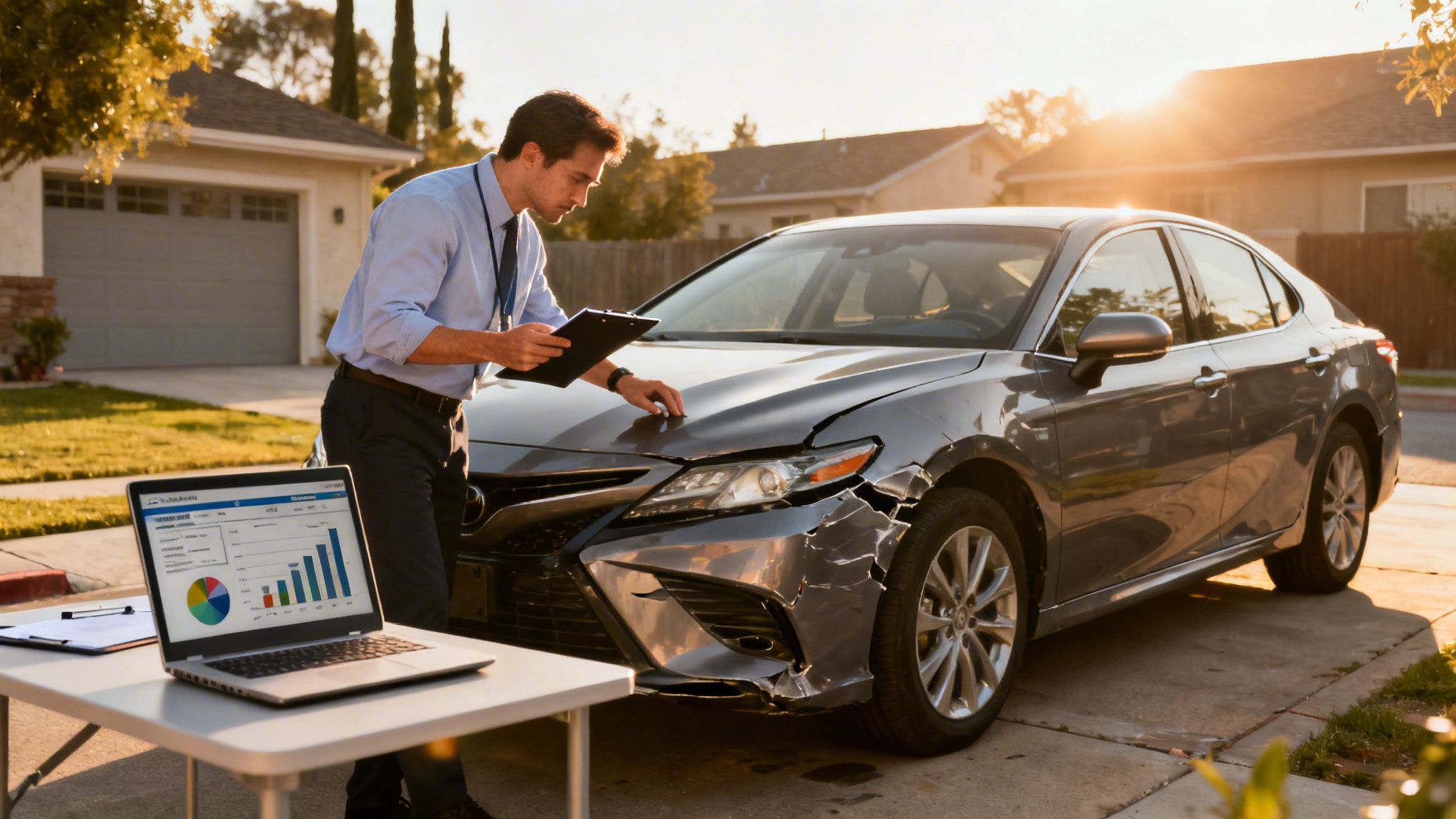
- A Deep-Dive Inspection: Your appraiser will perform a meticulous inspection of your vehicle (either in person or through detailed photos) to document its pre-accident condition. They're looking for everything—upgrades, special features, custom modifications, and proof of excellent maintenance.
- Real-World Market Research: This is where true expertise makes all the difference. Your appraiser hits the streets (digitally, of course) to find actual comparable vehicles for sale in your local area. We're talking the same make, model, year, and trim, with similar mileage and condition. Unlike the software insurance companies use, a human expert knows how to spot and toss out irrelevant listings like salvage titles or neglected rust buckets.
This research phase is all about building an undeniable case with cold, hard facts that systematically dismantle the insurer’s lowball offer.
Step 3: Building the Case: The Appraisal Report
Once all the evidence is gathered, your appraiser crafts a comprehensive valuation report. This isn't just a number scribbled on a piece of paper; it's a detailed, professional document built to stand up to intense scrutiny from the insurance company.
A professional appraisal report is your ultimate leverage. It methodically picks apart the insurance company's low offer by replacing their bad data with solid, real-world market evidence.
A powerful report will always include:
- A detailed breakdown of your vehicle’s condition, options, and any aftermarket parts.
- A list of truly comparable vehicles currently for sale in your market, complete with links and photos.
- An adjustment analysis explaining how your vehicle's specific features and condition stack up against the comps.
- A final, clearly stated Fair Market Value backed by all the collected proof.
This report, which we can typically complete in 5-7 business days, is then sent directly to the insurance company and their assigned appraiser.
Step 4: The Negotiation and Final Agreement
With reports in hand, the two appraisers get down to business. Your appraiser acts as your champion, presenting the evidence from their report and poking holes in the insurer's flimsy valuation. The objective is simple: get both sides to agree on a fair number.
Most of the time, a well-researched, professionally written report from an experienced auto insurance appraiser is all it takes to bring the insurance company to the table with a much better settlement offer. But what if they still won't budge?
If the two appraisers reach a stalemate, the process has a built-in tiebreaker: a neutral umpire. The umpire is a third-party expert who reviews both reports, hears both sides, and makes a final, binding decision. This ensures your claim is settled based on facts, not the insurance company’s bottom line.
To get an even closer look at how this all plays out, check out our in-depth guide on how a professional auto insurance appraisal can get you the best possible outcome.
Getting a handle on the timeline can also help set your expectations. While every case is a bit different, the process generally follows a predictable schedule.
Typical Auto Appraisal Timeline
Here’s a look at what you can generally expect, from the day you hire an appraiser to the day you get your final settlement.
| Phase | Action Required | Estimated Timeline |
|---|---|---|
| Phase 1: Initiation | Client consultation, sign agreement, invoke appraisal clause with insurer. | 1-3 Business Days |
| Phase 2: Investigation | Appraiser inspects vehicle and conducts in-depth market research for comparables. | 3-5 Business Days |
| Phase 3: Reporting | Appraiser compiles all data into a comprehensive report and submits it to the insurer. | 5-7 Business Days |
| Phase 4: Negotiation | Appraisers from both sides negotiate a settlement value. | 7-14 Business Days |
| Phase 5: Resolution | Insurer processes the agreed-upon settlement; payment is issued to the client. | 5-10 Business Days |
This timeline shows that from start to finish, the entire process is designed to be efficient. The goal is to move your claim forward with purpose and get it resolved correctly and without unnecessary delays.
How to Prepare for Your Vehicle Appraisal

A successful appraisal comes down to solid evidence. While your independent auto insurance appraiser brings the expertise, you bring the critical ammunition. Think of yourself as the most important member of your own claim team.
By gathering the right documents, you're not just helping out; you're arming your appraiser with everything they need to build an undeniable case for your car’s actual pre-accident value. This is how you turn a decent argument into an airtight one.
Building Your Evidence File
Your appraiser’s job is to see what the insurance company’s generic software can’t—the real story of your vehicle. The more proof you can provide of its condition, diligent maintenance, and unique features, the stronger your position becomes. Every receipt and photo helps paint a complete and accurate picture that a computer-generated report will always miss.
Start pulling these key items together:
- Service and Maintenance Records: These documents are your number one defense against the insurer's claims of "average wear and tear." A history of consistent oil changes, tire rotations, and following the scheduled maintenance proves your vehicle was well-cared-for, and that directly impacts its value.
- Receipts for Recent Upgrades: Did you drop a grand on new tires a month before the accident? What about a new battery or major engine work? Any receipts for parts or labor in the last 1-2 years can add serious money to the valuation.
- Original Window Sticker: If you have it, the original Monroney sticker is a goldmine. It lists every single factory-installed option and package, ensuring no valuable features get overlooked by the insurance company.
- Pre-Accident Photos: A picture is worth a thousand words, and in this case, it might be worth thousands of dollars. Photos showing your car looking sharp before the collision—clean, no damage, well-maintained—are incredibly powerful visual proof.
When it comes to proving meticulous care, the little details matter. Even demonstrating you invested in high-quality car paint protection like a ceramic coating can help build the narrative that your vehicle was in superior condition, influencing its final valuation.
Documenting Special Features and Modifications
Standard valuation tools are notoriously bad at accounting for anything outside of factory specs. This is where your personal documentation can make a huge financial difference, especially if you drive a modified, custom, or enthusiast vehicle.
You need to be ready to provide proof for anything that makes your car stand out from the crowd.
A detailed folder with receipts isn't just paperwork. It's a direct counter-argument to the insurer's attempt to treat your vehicle like every other basic model on the road. It proves your car was better.
Compile a list and find receipts for any of the following:
- Aftermarket Wheels and Tires: Custom wheels add both aesthetic and monetary value.
- Performance Upgrades: Document any engine modifications, custom exhaust systems, or suspension upgrades.
- Custom Audio or Visual Systems: High-end stereos, speakers, and infotainment systems are all valuable additions.
- Special Packages: Proof of rare trim levels, appearance packages, or limited-edition features is absolutely essential.
By getting this information organized ahead of time, you give your appraiser the tools they need to dismantle the insurer's lowball offer and fight for the settlement you actually deserve. You aren't just a bystander in this process; you're taking control of it.
Understanding Your Rights in Oregon and Washington
When you're dealing with an insurance claim, where you live matters. A lot. The rules of the game and the protections you have can change dramatically just by crossing a state line, which is why knowing your specific rights in Oregon and Washington is so crucial. Think of it as your home-field advantage in a settlement dispute.
An auto insurance appraiser who lives and breathes the Pacific Northwest market understands the local quirks that national valuation software completely misses. For instance, trucks and SUVs are always in high demand around here. They just hold their value better than in other parts of the country. That's a detail that can make a huge difference in your settlement, but it's often overlooked by a one-size-fits-all valuation report.
Washington State Specifics
If you're in Washington, you have some clear, powerful rights when it comes to diminished value. State law gives you the green light to file what's called a "third-party" diminished value claim.
What does that mean? If someone else hits your car and it's their fault, you can go after their insurance company to pay for the drop in your car's resale value, even after it's been perfectly repaired.
Knowing your state-specific rights transforms you from a passive recipient of an offer into an informed advocate for your own claim. In the Pacific Northwest, this includes understanding local market trends and legal precedents.
This is a fantastic consumer protection that isn't available everywhere. It provides a direct path to getting the full compensation you deserve. You can find out more about how we tackle these claims in our guide on diminished value for your auto.
Oregon's Fair Settlement Rules
Oregon also has your back with strong rules, especially when your car is declared a total loss. The state's administrative code is very clear: an insurer's offer has to be fair and based on comparable vehicles available right here in your local market.
They can't get away with cherry-picking cheaper cars from hundreds of miles away just to lowball you.
On top of that, an Oregon insurer is required to show you their work—they must give you a detailed breakdown of how they calculated their offer. This transparency is exactly what a good appraiser needs to poke holes in their report and challenge any bad data or unfair comparisons.
It’s a tough field, and good, independent appraisers are becoming harder to find. There are only about 13,600 appraisers in the entire country, and that number is expected to drop by 2.2% by 2032. At the same time, claim data reveals that a staggering 70% of total loss disputes happen because the initial offer was 15-30% too low. Invoking the Appraisal Clause can put an average of $5,000-$20,000 back in your pocket on higher-value vehicles. You can dig into more car insurance market trends on Grand View Research. An expert with local knowledge is your best bet to avoid becoming another statistic.
Got Questions? We’ve Got Answers.
Even with a roadmap of the appraisal process, it’s completely normal to have a few questions still bouncing around in your head. Getting straight answers is the best way to feel confident about moving forward and taking back control of your insurance claim.
Let’s tackle some of the most common questions we hear from drivers every single day.
How Much Does an Independent Appraiser Cost?
This is usually the first thing people want to know, and for good reason. The cost for a professional appraisal isn't set in stone, but most independent appraisers charge a flat fee for their work. You can typically expect this to be anywhere from a few hundred to several hundred dollars, depending on how complex your vehicle's valuation is.
It’s helpful to think of this not as an expense, but as an investment in a fair outcome. For example, if an insurer’s offer is $4,000 short of what your car is actually worth, spending $500 on an appraisal that gets you that full amount is a huge win. Always ask for a clear fee schedule right from the start so there are no surprises down the road.
Can I Use the Appraisal Clause if the Accident Was My Fault?
Yes, you absolutely can. The Appraisal Clause is a feature of your insurance policy, and it exists specifically to settle disagreements over value between you and your insurer. Who caused the accident has nothing to do with it.
If you’re filing a claim for a total loss under your own collision coverage, you have every right to invoke the clause if you don't agree with their valuation. Fault simply determines which insurance company pays the bill, not your right to get a fair settlement from your own provider.
Your right to dispute your vehicle's value is built right into your policy. It’s there for you whether you're claiming on your own collision coverage or against the at-fault driver's insurance.
What if the Insurance Company Ignores My Appraiser?
They can't. Once you officially invoke the Appraisal Clause in writing, your insurance company is contractually bound to play ball. They are legally required to participate and hire their own appraiser.
If you run into an adjuster who is dragging their feet or trying to ignore the request, your appraiser will know exactly how to handle it. A persistent refusal by the insurer to follow the rules of your policy can be considered "bad faith," which is a serious issue that can land them in hot water legally and financially.
How Long Does This Whole Thing Take?
While every claim has its own quirks, the appraisal process is built for efficiency. We're usually talking about a matter of weeks, not months, from the moment you hire an appraiser to when you get your final check.
Here's a rough timeline:
- Report Building: It typically takes your appraiser about 5-7 business days to do the inspection, dig into the market data, and write their comprehensive report.
- Negotiation Phase: Once the reports are exchanged, the back-and-forth between the two appraisers usually takes another 7 to 14 business days.
- Getting Paid: After they reach an agreement, it takes the insurance company about 5-10 business days to cut the check.
This whole framework is designed to keep your claim moving forward and prevent the long, frustrating delays that can happen when you're just stuck arguing with an adjuster.
Don't let an insurance company tell you what your car is worth. If you’re in Oregon or Washington and staring at a lowball offer for your totaled car or diminished value, Total Loss Northwest is ready to step in. Our certified appraisers have the deep expertise needed to build a rock-solid case for your vehicle's true value.
Get a free consultation today and find out how much your claim is really worth.