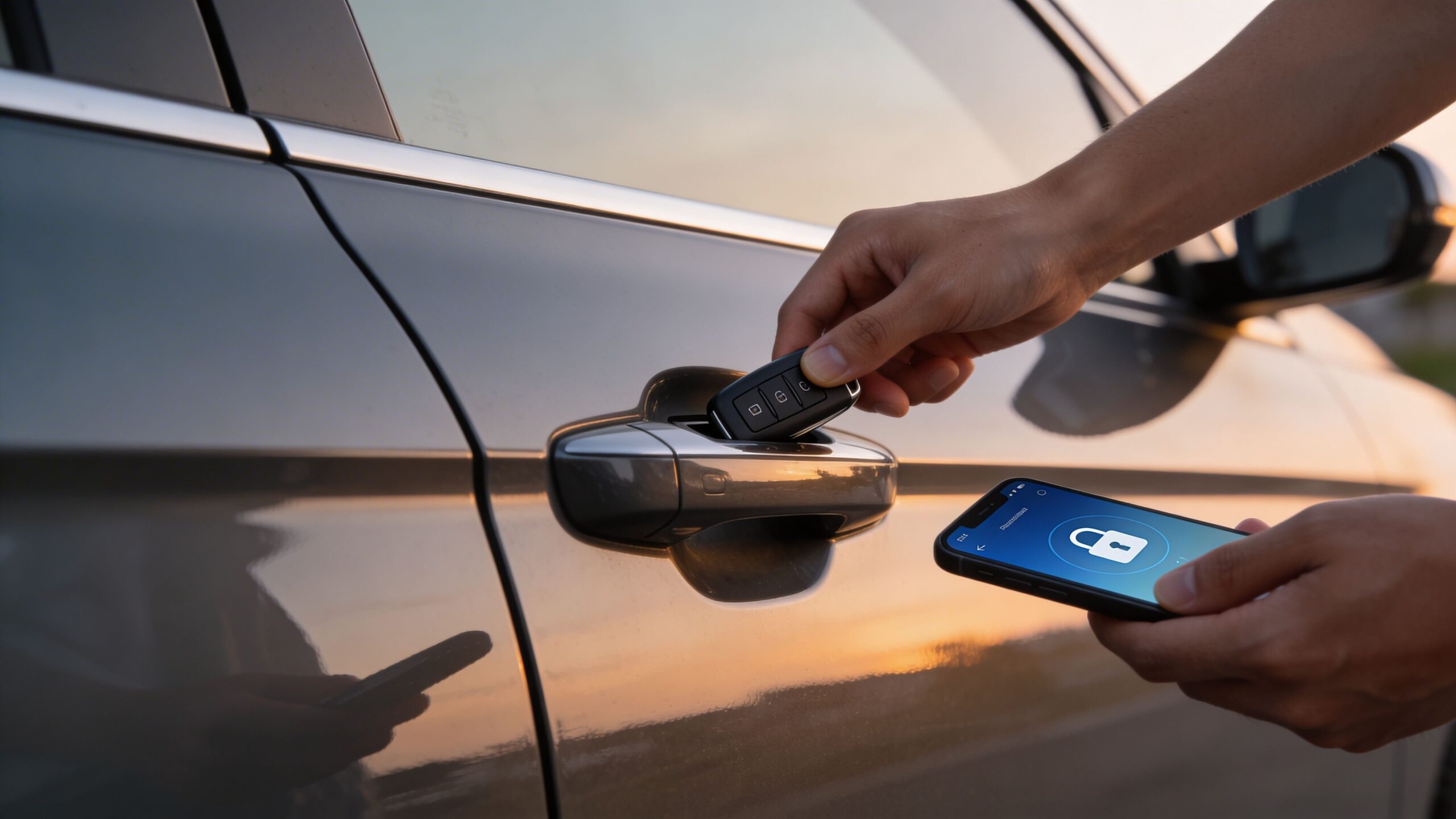
You park, grab your bag, hit the fob, and start walking. Then the doubt kicks in. Did it lock, or did you only think it did?
That small moment matters more than most drivers realize. A locked vehicle is harder to steal from, harder to tamper with, and easier to defend in an insurance claim if something else goes wrong later. After a collision, that matters even more. A vehicle that’s left unsecured can pick up new damage, lose personal property, or develop claim disputes that had nothing to do with the original crash.
I look at this from the appraisal side. Security isn’t just a convenience issue. It affects condition, documentation, and how cleanly you can separate accident damage from later theft or tampering. If you want a fair valuation, especially after a not-at-fault loss, simple habits like how you lock car doors carry more weight than people expect.
Why You Must Lock Car Doors Every Single Time
A lot of drivers treat locking as optional when they’re only stepping away for a minute. That’s a mistake.
50% of all car thefts occur from vehicles left unsecured, and theft claims rise 10% above monthly averages in darker months, according to Driving Monitor’s summary of theft risk from unlocked cars. Most of these incidents aren’t elaborate break-ins. Someone finds an easy target and takes advantage of it.
That’s the basic security reason. The insurance reason is just as important.
If your vehicle has already been in a collision, every extra problem after that crash makes the claim harder to sort out. A theft from a car not properly secured can muddy the timeline. A door left unsecured can lead to interior damage, missing personal items, or questions about when certain damage happened. Those disputes create friction right where you want clarity.
Locking protects condition, not just contents
Drivers often think about a phone, wallet, laptop, or tools left inside. Those matter. But the larger issue is the vehicle’s overall integrity.
When a car stays secure, you preserve:
- The interior condition that supports a cleaner valuation
- The damage timeline by reducing the chance of later tampering
- Your documentation position if the insurer starts separating covered loss from later events
- Your own bargaining power when discussing repair quality, diminished value, or total loss numbers
Practical rule: If you’re far enough away that you can’t immediately touch the handle and confirm the lock, you’re too far away to assume it worked.
That habit becomes even more important if the car is sitting in a tow yard, body shop lot, apartment garage, hotel parking lot, or on the street after a breakdown.
Good security habits also support claim discipline
Locking your doors won’t fix a bad valuation. But it does help eliminate avoidable complications. That’s one reason drivers should understand what comprehensive auto insurance covers before a theft or break-in ever happens.
A locked vehicle tells a cleaner story. You took ordinary steps to protect it. You reduced preventable exposure. You preserved the condition as best you could. In claims work, that kind of consistency helps.
Mastering Everyday Locking Methods
Most drivers use the same locking method every day without thinking about whether it’s the best one in that moment. That’s fine when everything works normally. It’s not fine when the fob battery is weak, the signal is blocked, or the car has already suffered damage.

Manual key lock
This is still the fallback method I trust most when electronics are acting up.
You insert the physical key, turn the cylinder, and lock the door directly. It’s slower than a fob, but it doesn’t depend on app connectivity, a healthy key fob battery, or good radio conditions. If your vehicle battery is weak or the remote has become unreliable, the mechanical key gives you a direct answer.
Use it when:
- The fob response is inconsistent
- The car battery is low
- You’re troubleshooting whether the problem is electronic or mechanical
- You want direct confirmation at the door
One caution: if the key feels rough, sticky, or sloppy in the cylinder, don’t force it. A worn key or damaged cylinder can turn a small issue into a lockout.
Interior lock button or switch
This is the method many people use when they’re already seated. Press the interior lock switch before driving or before someone exits the vehicle.
It’s simple, but it has a limitation. Locking from inside doesn’t confirm what will happen once all doors close. On some vehicles, one door that isn’t fully latched can interrupt the expected locking behavior. After any door repair, window work, or body work, I’d pay closer attention here.
A good routine is:
- Press the interior lock button.
- Watch the lock indicators.
- Close the final door firmly.
- Check for any warning message or unexpected disengagement of the locks.
Key fob remote
This is the everyday standard for most drivers. Press lock, listen for the chirp or clunk, watch for flash confirmation, and move on.
That convenience is exactly why it gets exploited. In remote keyless entry systems, criminals can use RF jamming attacks on the 433 MHz or 315 MHz bands to block the lock signal. Research cited by USENIX reports these attacks succeed in 90% to 100% of attempts if the owner doesn’t physically verify the door is locked, and that physical verification is missed in 85% of cases in field testing, as described in the USENIX paper on remote keyless entry vulnerabilities.
That sounds technical, but the practical lesson is simple. You hit lock, but the car may never receive it.
Don’t trust the button press. Trust the result.
If you use a fob, the best routine is to press lock, pause, and touch the handle once. That one extra movement closes a big gap.
Touch sensor and proximity systems
Modern keyless systems make it easy to lock car doors by touching the exterior handle or walking away with the fob in your pocket. They’re convenient, but convenience can make drivers less observant.
These systems work best when you stay aware of three things:
- Your fob location: If the car doesn’t detect it properly, the lock command may not complete.
- The final door or hatch: A partly open hatch can interrupt the lock cycle.
- Feedback: Look for mirror fold, marker flash, horn chirp, or the sound of actuators moving.
If your vehicle supports walk-away lock, test it in a safe setting before relying on it in public. Some owners assume it’s active when it isn’t.
Smartphone app locking
App-based locking is useful when you can’t remember whether you locked up, or when the vehicle is parked out of sight but still within cellular reach.
It’s also useful after a crash, when you may be separated from the car and need to confirm status remotely. The limitation is that app systems depend on account access, phone battery, data service, and the vehicle’s own connection.
Use app locking for convenience, but don’t let it replace old-fashioned confirmation when you’re standing beside the vehicle.
What works best in real life
Here’s the short version:
| Method | Best use | Main risk |
|---|---|---|
| Physical key | Dead battery, direct confirmation, troubleshooting | Worn key or cylinder can bind |
| Interior switch | Immediate in-cabin security | Doesn’t always confirm final closed-door status |
| Key fob | Daily convenience | Signal blocking or false confidence |
| Touch sensor | Hands-full entry and exit | Easy to assume it worked without checking |
| App | Remote status and backup control | Depends on phone and network access |
The best method isn’t one tool. It’s a habit. Use the method your car supports, then verify that the lock engaged.
Leveraging Auto-Lock and Child Safety Locks
Factory lock features do a lot of quiet work. Most owners never check the settings after they buy the car, and many don’t revisit them after software updates, battery replacement, or a repair. That’s a missed opportunity.

Auto-lock settings worth checking
Many vehicles let you customize when they lock car doors automatically. The names vary by brand, but the functions are familiar.
Look for settings such as:
- Lock on drive
- Lock when shifting out of park
- Walk-away auto-lock
- Relock after initial disengagement if no door opens
- Driver door disengages only on first press
These options usually sit in the infotainment settings, instrument cluster menu, or body control settings if accessed through dealer-level software.
A few practical observations matter here. Walk-away lock is convenient in daily use, but drivers tend to overtrust it. Lock on drive is useful for occupant security, but it doesn’t help when the vehicle is parked. Relock-after-disengagement can save you if you accidentally activate the access function, but it won’t help if a door is opened and then left unsecured.
Set it once, then test it
Don’t assume a menu setting means the feature is operating correctly.
Do a simple check in your driveway or parking area:
- Activate the setting.
- Exit the vehicle the way you normally would.
- Wait for the expected lock event.
- Confirm with the handle.
- Repeat with the hatch and rear doors.
That test matters after any battery disconnect, collision repair, or body module issue. A feature can be enabled in software and still behave differently in practice.
A lock feature only counts if it works on the actual vehicle in its current condition.
Child safety locks
Child safety locks are different from ordinary lock controls. Their job isn’t theft prevention. Their job is to stop a rear door from being opened from the inside.
That’s useful when:
- A child rides in the back seat
- A passenger may pull the handle at the wrong time
- You want one-direction control over rear door use
On many vehicles, the child lock is a small manual lever on the edge of the rear door. On others, it’s an electronic setting controlled from the driver area.
If you activate it manually, open the rear door and look near the latch area. You’ll usually see a small switch position marked for lock status. Engage it, close the door, and test from inside before assuming it’s set correctly.
When these settings matter after repairs
After collision work, check every passive locking feature again. Door alignment, latch adjustment, and electrical repairs can change how the system behaves. A rear door that closes a little differently may still appear normal while failing to behave normally.
That’s why I treat these features as part of post-repair verification, not just family convenience settings.
Troubleshooting Common Car Lock Problems
When a lock starts acting up, start with the simplest cause and work inward. The immediate thought is often “the actuator is dead” or “the whole lock is broken.” Sometimes that’s true. Often it isn’t.

Start with the fob and the easiest checks
If the remote won’t lock the doors, begin outside the door panel.
Try this sequence:
- Use a second fob if you have one: If one works and the other doesn’t, the problem is likely in the fob.
- Replace the fob battery: Weak batteries often cause short range, delayed response, or inconsistent locking.
- Stand closer to the vehicle: This helps separate a low-power signal problem from a vehicle-side issue.
- Use the interior switch: If the cabin switch works, the fault may be remote-related rather than mechanical.
If none of that changes anything, use the physical key if your vehicle has one. That tells you whether the lock cylinder still operates the latch.
If the lock is stiff or stuck
A manual lock that feels gritty or hard to turn may have dirt, wear, corrosion, or internal damage. In coastal and wet regions, corrosion is a common source of trouble.
Professionals diagnose mechanical failures by checking pawl wear within a 0.5 to 1 mm maximum tolerance, spring fatigue, and corrosion. The same source says corrosion causes 30% to 40% of lockouts in coastal regions like Oregon and Washington, and 25% of locks fail mandatory federal strength tests after an accident, according to this breakdown of common car door lock problems.
Practical steps that are usually safe:
- Check for obvious door misalignment: If the door sits high, low, or tight after a bump or repair, the latch may be under load.
- Try the lock gently with the door open: If it behaves differently open versus closed, alignment may be part of the issue.
- Avoid forcing the key or knob: Forced operation can turn a serviceable lock into a broken one.
If you’re already locked out, it’s better to use a careful method than improvise with wedges and coat hangers. A good primer on how to safely get into a locked car can help you avoid bending trim, damaging weather seals, or scratching the glass.
Listen before you disassemble
The sound of the system tells you a lot.
If you press lock and hear a faint click inside one door but nothing moves, the actuator may be trying and failing. If one door is not secured while the others cycle normally, focus on that door’s actuator, latch, or harness rather than the entire system. If nothing happens anywhere, check fuses, the body control side, or the main power path first.
This video gives a useful visual overview of lock troubleshooting basics:
When to stop doing it yourself
There’s a clear point where DIY stops making sense.
Stop and call a professional if:
- The door has collision damage
- The lock works only intermittently
- The key won’t turn and feels jammed
- The inside and outside handles behave differently
- The window, mirror, or speaker wiring also acts up
Those grouped symptoms often point to wiring damage in the door jamb, latch damage inside the shell, or structural misalignment that needs proper adjustment.
If a lock problem started after an accident, treat it as collision-related until proven otherwise.
That approach protects both the vehicle and your paperwork.
Post-Accident Protocol to Lock Car Doors and Protect Value
After a crash, the immediate focus is often on obvious body damage, tow arrangements, and the other driver’s insurance. That’s understandable. But the vehicle is often at its most vulnerable in the hours right after impact.

A bent door, weak latch, dead battery, or confused body electronics can leave the car unsecured even when you think it’s locked. That matters for theft risk, but it also matters for value. Data cited for Washington and Oregon says 15% of vehicle thefts stem from unverified remote locking, often resulting in total loss payouts 22% below market value, as described in this video discussion of unverified remote locking and claim impact.
The first checks at the scene
If it’s safe to approach the vehicle, verify security before it leaves your sight.
Use this quick protocol:
- Test each affected door by hand. Don’t assume the central lock worked.
- Remove valuables and sensitive documents. Registration, garage remotes, work gear, and personal electronics should come out.
- Photograph the door positions and latch condition. Get clear photos before towing.
- Note any warning messages or electrical issues. If the lock switch acts strangely, record it.
- Tell the tow operator if a door won’t secure. Make it part of the handoff.
That last point matters. If the vehicle can’t be locked, the storage risk changes immediately.
If a door won’t lock after impact
A damaged door may not latch properly, or it may latch but fail to stay secure. Treat those as different problems.
If the latch won’t hold, the car needs secured transport and a clear notation in the tow or intake record. If the latch holds but the electronic lock won’t engage, the car may still be vulnerable in a lot or yard where people assume it’s protected.
Document both the physical condition and the lock condition. Those are not the same thing.
Why this affects the claim
From an appraisal standpoint, the cleanest claim is one where the vehicle’s condition stayed stable after the collision. Once theft, water intrusion, missing property, or lot tampering enters the picture, the insurer has more room to separate losses and question value.
That’s why your post-crash process should include security, not just safety and insurance exchange. If you need a broader checklist, these steps after car accident are worth reviewing while the details are still fresh.
What to document before the car disappears into the system
Tow yards, salvage lots, and repair facilities move fast. Your records should move faster.
Create a short evidence set:
- Photos of all doors closed
- Photos of any door that won’t align or latch
- A short video showing lock behavior
- A note of whether the fob, app, or interior switch worked
- A written timeline of when you last confirmed the car was secured
The better your documentation, the easier it is to separate collision damage from later interference.
That separation has real value. It gives less room for confusion, less room for lowball reasoning, and a better foundation if the settlement starts heading in the wrong direction.
Frequently Asked Questions About Car Door Locks
Can I upgrade an older car with newer locks
Usually, yes. The key question is whether you should.
Older vehicles can often take alarm systems, actuators, remote entry kits, or updated cylinders. But retrofit work only helps if the installation is clean and the door hardware is still sound. On a collector or specialty vehicle, I’d be cautious about modifications that hurt originality, wiring quality, or door panel condition.
If value matters, keep records of what was installed and who did the work.
Does a broken door lock affect an appraisal
Yes, it can.
A broken lock can signal collision-related structural issues, latch weakness, electrical faults, or unresolved security problems. It also raises practical questions about theft exposure and overall condition. In an appraisal, the lock issue isn’t just “one small part.” It can support a broader conclusion that the vehicle’s condition, usability, or market appeal took a hit.
If you’re unsure what that process looks like, this overview of what is an appraisal for a car is a good starting point.
What’s the difference between older lock designs and modern ones
The short version is precision and resistance.
A key milestone came in 1935, when GM introduced the sidebar lock. The bigger shift came by 1966, when pin tumbler locks became the widespread standard and sharply reduced common vulnerabilities, according to this history of car lock evolution and the move to pin tumbler systems.
Modern electronic systems built on that mechanical foundation. They added convenience, but also added failure points that older purely mechanical systems didn’t have.
If my remote says the car is locked, is that enough
No.
Remote confirmation is useful, but not infallible. Electronics can misread the situation, and damaged doors can create false confidence after a crash. If the vehicle matters, verify physically when you can.
That’s especially important in the first days after an accident, when door alignment and latch performance may have changed.
What should I do first after an accident if I’m worried about security and value
Start with safety, then secure the vehicle, then document everything.
If you want a broader legal and practical checklist, these general steps to take after a car accident are useful alongside your insurance and repair process. Once the immediate situation is under control, confirm whether each door closes, latches, and locks properly. That gives you a cleaner record and fewer surprises later.
If your insurer is undervaluing a total loss or diminished value claim after an accident, Total Loss Northwest helps drivers in Oregon and Washington fight for a fair number with independent appraisals built on real market value, not insurer-biased software.