The call usually goes the same way. The adjuster sounds calm, maybe even friendly, and then drops the number. Your vehicle is a total loss. Their settlement offer is “based on market data.” You look at it once, then again, because it won't buy a comparable replacement unless you downgrade, settle, or pay out of pocket for their mistake.
That's the moment many claimants lose their advantage. They argue on the phone, send angry emails, and hope a supervisor will suddenly become fair. That usually goes nowhere. If you want to fight a lowball offer, you need a record, a strategy, and pressure that matters.
An insurance commissioner complaint can help. But by itself, it's not a magic wand. The strongest complaint is the one backed by a clean paper trail and an independent appraisal report that gives the regulator something concrete to review instead of just “my word against theirs.”
Your First Step After a Lowball Settlement Offer
You're not overreacting if the offer feels wrong. Lowball settlements are part of a much bigger pattern. Claims handling issues made up 65.2% of all complaints filed with state insurance commissioners in 2024, and unsatisfactory settlement offers accounted for 12.2% of those claims-related grievances, according to Claims Journal's coverage of NAIC complaint data.

Stop arguing by phone
When the offer lands low, your first instinct is usually to explain why it's unfair. Don't waste your best points in a phone fight. Adjusters document calls their way. You need to document the claim your way.
Start with three moves:
- Ask for the valuation report: Get the insurer's total loss valuation, comparable vehicles, condition adjustments, mileage adjustments, and any deductions in writing.
- Pause verbal negotiation: Keep future communication in email when possible so dates, promises, and explanations don't disappear.
- Create one claim file: Put every letter, email, photo, estimate, and note in one folder. Paper beats memory every time.
Know what the commissioner can do
Your state's insurance department exists to review consumer complaints and enforce insurance rules. That matters. If an insurer dragged its feet, ignored evidence, misapplied policy language, or relied on a weak valuation process, a regulator can put that conduct under a microscope.
But don't confuse oversight with valuation. The commissioner's office isn't there to become your personal appraiser. If you file an insurance commissioner complaint without independent evidence of value, you're just handing over a grievance. If you file one with a detailed appraisal and a clean timeline, you're handing over a case.
The complaint is leverage. The appraisal is proof.
Your job in the first 48 hours
Do not chase emotion. Build position.
Write down the accident date, the date the insurer inspected the vehicle, the date they declared it a total loss, the date you received the offer, and every communication since. Then compare their valuation to actual comparable vehicles in your market and any independent valuation evidence you can obtain.
If you remember one thing, remember this. Your first step after a lowball settlement offer is not to complain. It's to prepare a complaint that can survive scrutiny.
Building Your Case Before You File
Complaints are often filed too early. They're mad, they know the offer is bad, and they want the state to fix it. That's backwards. You win this kind of fight before the complaint is ever submitted.
Build a case file, not a pile of papers
A regulator needs a clean story supported by documents. That means every piece of evidence must answer one of three questions: what the policy says, what the insurer did, and why the valuation is wrong.
Here's the checklist I'd use.
| Document | Why You Need It |
|---|---|
| Policy declarations page | Identifies the policy, coverage, and insured vehicle. |
| Full policy wording | Lets you cite the insurer's own contract language when you describe the dispute. |
| Claim number and adjuster contact info | Ties every document to the exact claim and decision-maker. |
| Total loss offer letter | Shows the amount offered and the insurer's written position. |
| Valuation report | Reveals the comparable vehicles, adjustments, condition ratings, and methodology used. |
| Photos of your vehicle before the loss | Helps prove pre-loss condition, options, upgrades, and overall market appeal. |
| Photos after the loss | Confirms the severity of damage and supports the total loss timeline. |
| Repair estimate or damage assessment | Gives context for how the claim developed and when the insurer moved to total loss. |
| Maintenance and service records | Supports condition, care, and recent work that may affect value. |
| Receipts for options, upgrades, or custom equipment | Helps document value that generic software often misses. |
| Comparable vehicle listings | Shows what similar vehicles are actually being offered for in your market. |
| All emails and letters with the insurer | Creates a paper trail of delays, explanations, and contradictions. |
| Call log | Records who said what, and when, especially if the insurer changed positions. |
| Independent appraisal report | Gives the regulator third-party evidence of fair market value. |
| Demand letter or rebuttal letter | Shows you gave the insurer a fair chance to correct the problem before filing. |
The independent appraisal changes the fight
This is the part most consumers skip, and it's the part that gives the complaint teeth. A strong appraisal report moves the dispute away from “I think your offer is low” and into “here is a documented valuation prepared independently, with market support.”
That matters because state insurance commissioners typically can't adjudicate a dispute or force a specific settlement amount, but complaint pattern-tracking led to fines against 12 major auto insurers in 2025-2026 for systemic delays and valuation issues, as noted in this discussion of regulatory enforcement trends. Regulators act best when you show a pattern problem or a process problem. A thin valuation, ignored comparables, missing options, or unexplained deductions can all become process problems.
What good evidence looks like
Use evidence that's organized, labeled, and easy to follow.
- Chronology first: Put events in order by date. Regulators read faster when they can track the file from loss to offer.
- Policy language second: Quote the relevant wording exactly if you're referring to valuation, duties, or claim handling obligations.
- Valuation proof third: Attach the insurer's report next to your independent appraisal so the discrepancy is visible.
Practical rule: If a stranger can't understand your complaint packet in five minutes, it's not ready.
Don't file while key evidence is missing
If you don't yet have the insurer's valuation report, ask for it. If your vehicle had unusual features, collector status, custom work, or exceptional condition, document that before filing. If the insurer keeps talking in generalities, make them commit in writing.
A rushed insurance commissioner complaint often reads like frustration. A prepared one reads like evidence.
How to Write a Complaint That Regulators Read
Most complaints fail on writing, not just facts. The person reviewing your file doesn't need drama. They need a timeline, a clear issue, and a specific request.

Write like a witness, not a wounded customer
A weak complaint sounds like this: “My insurance company is scamming me, nobody cares, and the adjuster is impossible.” That may be how you feel. It's useless on paper.
A strong complaint does four things:
States the claim plainly
Identify the loss, the vehicle, the claim number, and the settlement dispute.Uses a date-by-date timeline
Regulators look for process failures. Dates expose them.Points to documents
Every important statement should tie to an attachment.Asks for a defined outcome
Don't say “please help.” Say what you want reviewed.
If you need help shaping your written position before you file, study examples of a strong insurance demand letter for a disputed claim. The same discipline applies to a complaint. Facts first. Evidence attached. No rambling.
Use this structure
I tell clients to keep the core narrative tight:
- Opening paragraph: Identify the claim and the dispute.
- Timeline bullets: Show what happened in order.
- Valuation dispute paragraph: Explain why the offer is unsupported.
- Requested action: Ask the department to review the insurer's handling and valuation process.
I am filing this complaint regarding my total loss claim for my vehicle after the insurer presented a settlement offer that does not reflect fair market value. The insurer declared the vehicle a total loss, provided a valuation report, and offered a settlement that I dispute based on documented market evidence and an independent appraisal attached to this complaint.
On [date], the loss occurred. On [date], the insurer inspected the vehicle. On [date], the insurer declared the vehicle a total loss. On [date], I received the insurer's valuation and settlement offer. I requested clarification and supporting documentation regarding comparable vehicles, condition adjustments, and valuation methodology.
The attached independent appraisal identifies material issues with the insurer's valuation, including unsupported or inadequate market support for the settlement figure. I am requesting that the Department review whether the insurer handled this claim fairly, evaluated the vehicle using an appropriate valuation process, and complied with applicable claims handling standards.
Keep it readable
Short paragraphs win. Bullet points win. Attachments with filenames that make sense win.
A complaint reviewer should be able to scan your timeline and know exactly where the insurer's process went off track. If they have to dig through emotional language to find the issue, you've made their job harder and your position weaker.
A quick walkthrough can help before you submit:
The Official Process for Filing Your Complaint
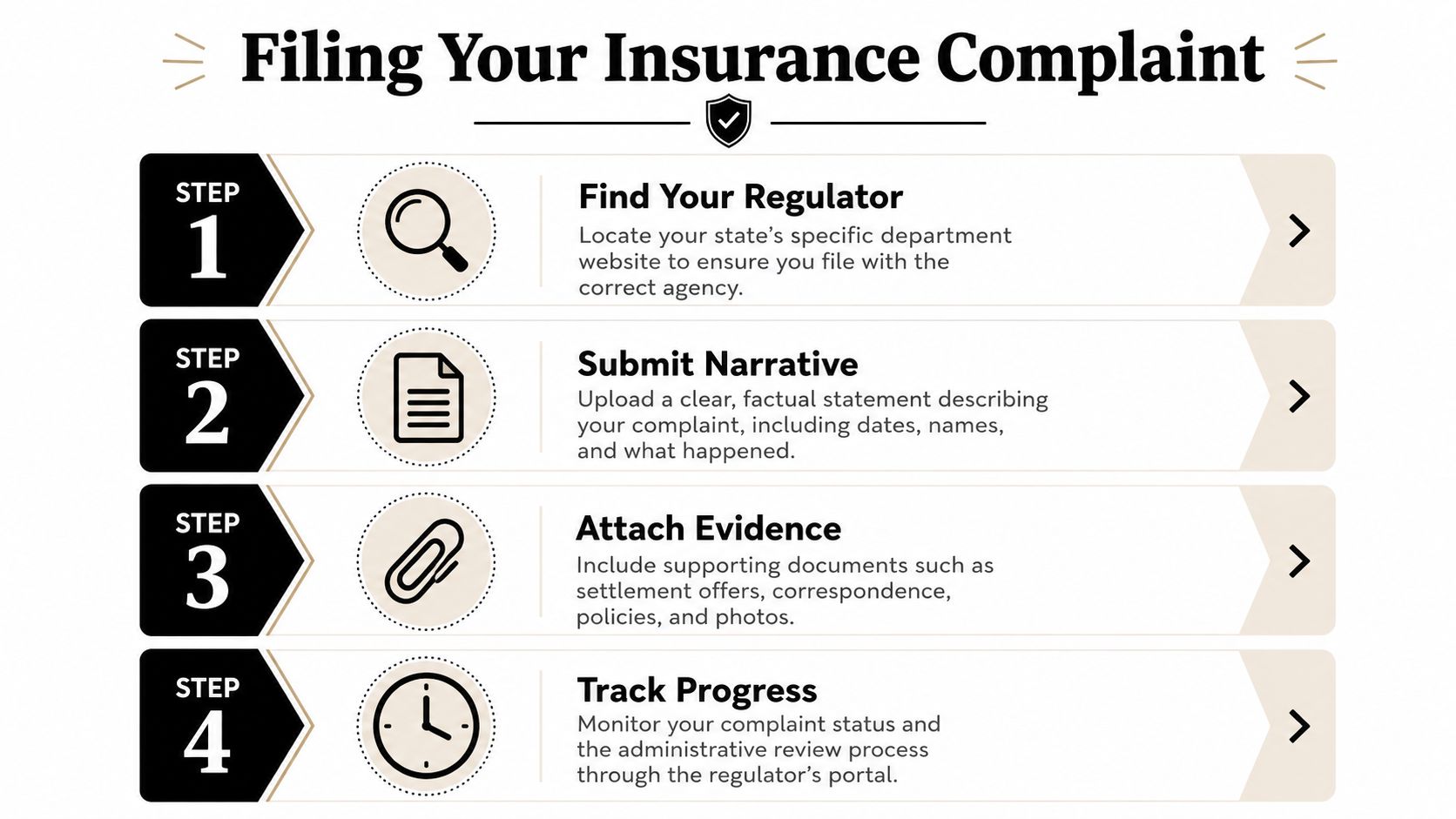
Filing the complaint itself is the easy part. The hard part is resisting the urge to overcomplicate it. Most departments of insurance want the same core items: your contact information, policy number, insurer name, claim number, summary of the dispute, and attachments.
Use the online portal if your state offers one
Online submission is usually the best option because it creates a timestamp, generates a case number, and preserves your attachments in one place. Search for your state's department of insurance or insurance commissioner complaint portal and verify you're on the official government site before uploading anything.
What to put in each part of the form
Don't overfill the form. Use the narrative box to summarize, then attach the actual evidence.
- Consumer information: Enter your legal name, address, phone, and email exactly as they appear on the policy or claim records.
- Insurer information: Use the full company name, not just the brand name on the app.
- Claim details: Include claim number, date of loss, vehicle year, make, and model.
- Complaint summary: Paste in your short factual narrative. Save long explanations for attachments if needed.
- Requested resolution: Ask for review of the insurer's claim handling and valuation process, and note the attached independent appraisal if applicable.
If you need to file by mail or fax
Some people still prefer paper, especially when the complaint packet is large. That's fine. Send a cover letter, your narrative, and clearly labeled exhibits in order. If a state accepts faxed submissions or supporting documents and you want a cleaner delivery trail than a walk-in copy shop, one practical option is to send legal filings via FaxZen.
Label attachments like exhibits. “Exhibit A, insurer valuation report” is easier to follow than “scan0004.pdf.”
Typical timing
You should expect administrative steps, not instant pressure. In Texas, the Department of Insurance acknowledges a complaint within 5 days, gives the insurer 25 business days to respond, and the average full process takes 30-40 days, according to this Texas complaint filing guide.
That timeline is useful even if you're not in Texas because it teaches the right expectation. A state complaint process moves like a file review, not an emergency negotiation. File carefully, then track it like a case.
What to Expect After You Click "Submit"
Once you file, the emotional part needs to stop. Patience then becomes part of your strategy. You'll usually get an acknowledgment and a case number first. Save both.
The three outcomes you're most likely to see
Most insurance commissioner complaint files move into one of these lanes:
| Likely outcome | What it usually means |
|---|---|
| The insurer re-evaluates the claim | The company wants to quiet the complaint or correct a weak file before the regulator digs deeper. |
| The insurer defends the original offer | You'll receive a written response that explains their valuation and handling position. |
| The department facilitates communication | The regulator asks questions, relays responses, and presses for clarification rather than ordering a settlement amount. |
None of that is glamorous. All of it matters. The complaint forces the insurer to answer in writing inside a regulatory setting instead of brushing you off in a call queue.
Documentation changes the odds
Preparation pays off. Nationally, complaints with complete documentation, including independent appraisals, succeed 78% of the time, compared to 42% for complaints without that support. Citing specific timeline violations can lead to insurer concessions in up to 90% of cases, according to NAIC complaint guidance summarized here.
That tells you exactly where influence comes from. Not outrage. Not volume. Not sending the same email five times. Influence comes from a file that proves what happened and when it happened.
What you should do while the file is pending
Don't go passive once the complaint is open.
- Watch deadlines: If the insurer responds, read the response against your documents, not against your memory.
- Correct the record fast: If they misstate facts, answer with exhibits and dates.
- Preserve every update: Add each regulator email and insurer response to the same case file.
If the carrier is also denying other parts of the claim or refusing to engage reasonably, it may help to review a broader roadmap for what to do when insurance denies a claim. Many of the same pressure points apply.
A complaint is often the first time an insurer has to defend its file in writing to someone outside the claim team.
Don't confuse movement with resolution
You may get a better explanation and still not get a fair number. That's common. A written response from the insurer can be useful even when it's disappointing because it locks them into a position. Once they've committed to that position on the record, weak assumptions become easier to attack through appraisal, mediation, or litigation if needed.
That's why the best complaint filers don't just wait for the department to save them. They use the complaint process to build pressure, expose bad handling, and create a cleaner path to the next move.
Beyond the Complaint and the Appraisal Clause and Next Steps
A complaint is pressure. The appraisal clause is often the mechanism that moves the value dispute out of the adjuster's hands.
Why the complaint alone usually isn't enough
This is the blunt truth. Only 22% of auto claim complaints result in direct insurer adjustments without additional pressure, based on this discussion of complaint outcomes and regulator limits. That doesn't mean filing was a mistake. It means you should treat the complaint as one tool, not the whole toolbox.

The appraisal clause is a contractual right
If your policy includes an appraisal clause, use it when the dispute is about value. Don't ask the adjuster if they'd “be willing” to consider it. Read the policy. If the clause applies, invoke it properly and in writing.
Appraisal changes the battlefield:
- It shifts the dispute from internal software to independent valuation work
- It narrows the issue to value instead of letting the insurer hide behind vague explanations
- It creates a formal process with appraisers rather than endless adjuster debate
If you're dealing with a total loss or diminished value fight, learn how the insurance appraisal clause works in practice. That process is often more effective than trying to persuade a claims desk to voluntarily fix its own number.
When to run both tracks
The smartest approach is often parallel pressure.
File the insurance commissioner complaint when the insurer's handling is the problem. Invoke appraisal when valuation is the problem. In many cases, both are true. The complaint documents delay, poor explanations, ignored evidence, or unfair process. The appraisal tackles the dollar amount directly.
Use the complaint to create accountability. Use appraisal to resolve value.
Other escalation options
If appraisal isn't available or the insurer creates a different kind of dispute, you may also consider:
- Mediation: Useful when both sides are still talking but need structure.
- Small claims court: Sometimes practical for simpler, lower-stakes disputes.
- Attorney review: Worth considering if bad faith conduct, major delays, or serious coverage issues are involved.
But for a straight lowball total loss fight, appraisal is usually the cleanest path because it attacks the exact issue in dispute. Value.
Frequently Asked Questions
| Question | Answer |
|---|---|
| Should I file a complaint as soon as I get a low offer? | Not immediately. First get the valuation report, gather your records, and organize the timeline. A rushed complaint is weaker than a prepared one. |
| Can the insurance commissioner force the insurer to pay my number? | Usually no. Regulators review conduct and compliance. They can press the insurer, demand a response, and track patterns, but they typically don't set the settlement amount for you. |
| What makes an insurance commissioner complaint stronger? | A short factual narrative, complete attachments, and independent valuation support. The cleaner the file, the easier it is for a regulator to spot bad handling. |
| Should I mention my emotions in the complaint? | Keep emotion out of the narrative. Facts, dates, policy language, and documents carry more weight than frustration. |
| What if the insurer already denied my objections? | File the complaint if the handling was unfair, but don't stop there. Look at the appraisal clause and other escalation options that target the valuation dispute directly. |
| Is an independent appraisal still useful if I already filed? | Yes. You can often supplement your complaint file with additional documents. The stronger your evidence, the more useful the complaint becomes. |
| Do I need an attorney to file? | Usually no. Many vehicle owners file on their own. The key is organization and evidence, not legal jargon. |
| What should I ask the department to do? | Ask for review of the insurer's claim handling and valuation process, and point to the attachments that show the problem. Keep the request specific and professional. |
If your insurer declared your vehicle a total loss and the offer doesn't match the actual market, don't let their software decide what you're owed. Total Loss Northwest provides independent total loss and diminished value appraisals, and can help invoke the appraisal clause so the dispute moves out of the adjuster's hands and into a process built around actual vehicle value.