You've just had an accident. The tow truck is gone, your insurer is suddenly very “helpful,” and your phone is full of mixed advice. One person says use the shop your insurance company recommends. Another says go to the dealership. A local body shop says they're certified and can handle everything.
That decision isn't just about getting your car back on the road. It affects safety, resale value, diminished value, and in some cases even the advantage you have in a total loss fight. A clean-looking repair and a correct repair are not the same thing.
Most drivers don't learn that until it costs them money.
Why Your Choice of Repair Shop Matters More Than Ever
Right after a collision, people focus on the visible damage. Bent fender. Broken headlamp. Scraped bumper. That's normal. But the bigger risk usually sits underneath the parts you can see. Structure, sensors, weld points, mounting locations, calibration issues. Those details decide whether the vehicle is restored properly or just made to look normal again.
That's why the shop matters so much. You're not buying paint. You're buying a repair record that may follow the vehicle for the rest of its life.
The repair industry is massive, which is part of the problem. In the United States alone, the auto repair industry generated $77.4 billion in revenue in 2022, and independent shops accounted for 72% of industry revenue in 2023, according to U.S. auto repair industry figures compiled here. In a system that large, shops compete hard for insurer referrals, customer volume, and cycle time. That doesn't automatically mean bad repairs. It does mean you can't assume every recommendation serves your interests.
The repair decision is also a value decision
If your car is newer, higher-end, collector-grade, or even well kept, the quality of the repair can affect what buyers, dealers, and appraisers think later. Even if the work looks good from ten feet away, poor documentation, improper procedures, and visible shortcuts can hurt what the car is worth after an accident.
If you want a grounded explanation of that financial side, read this breakdown of what your car may be worth after an accident. It's the part many drivers miss until they try to sell, trade, or settle a claim.
Practical rule: Choose the shop as if you'll have to defend that repair in front of a future buyer, appraiser, or insurance adjuster. Because you might.
What you're really deciding
You're deciding whether the vehicle will be repaired with documented discipline or with shortcuts hidden behind fresh paint.
Ask yourself which outcome provides more advantage later:
- A documented repair file with scans, measurements, and OEM procedure use.
- A vague invoice that says the car was repaired and refinished.
- A shop chosen for your vehicle and its repair needs.
- A shop chosen for insurer convenience and speed.
That's the fork in the road. The word certified matters because it can point to training, equipment, process control, and accountability. But only if you know who granted the certification and what it means.
Decoding the World of Auto Repair Certifications
Hearing “certified” often leads to the assumption that it means one thing. It doesn't. In collision repair, that label can point to very different standards, and some of them protect your car better than others.
Here's the hierarchy I use when I talk to vehicle owners.
OEM certification usually carries the most weight
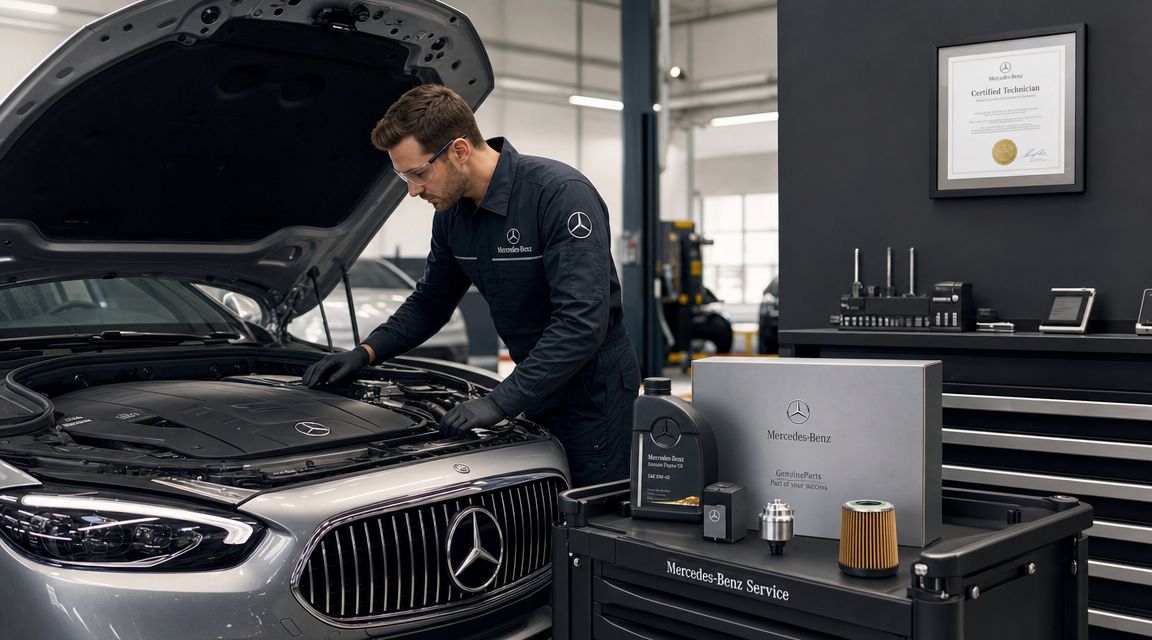
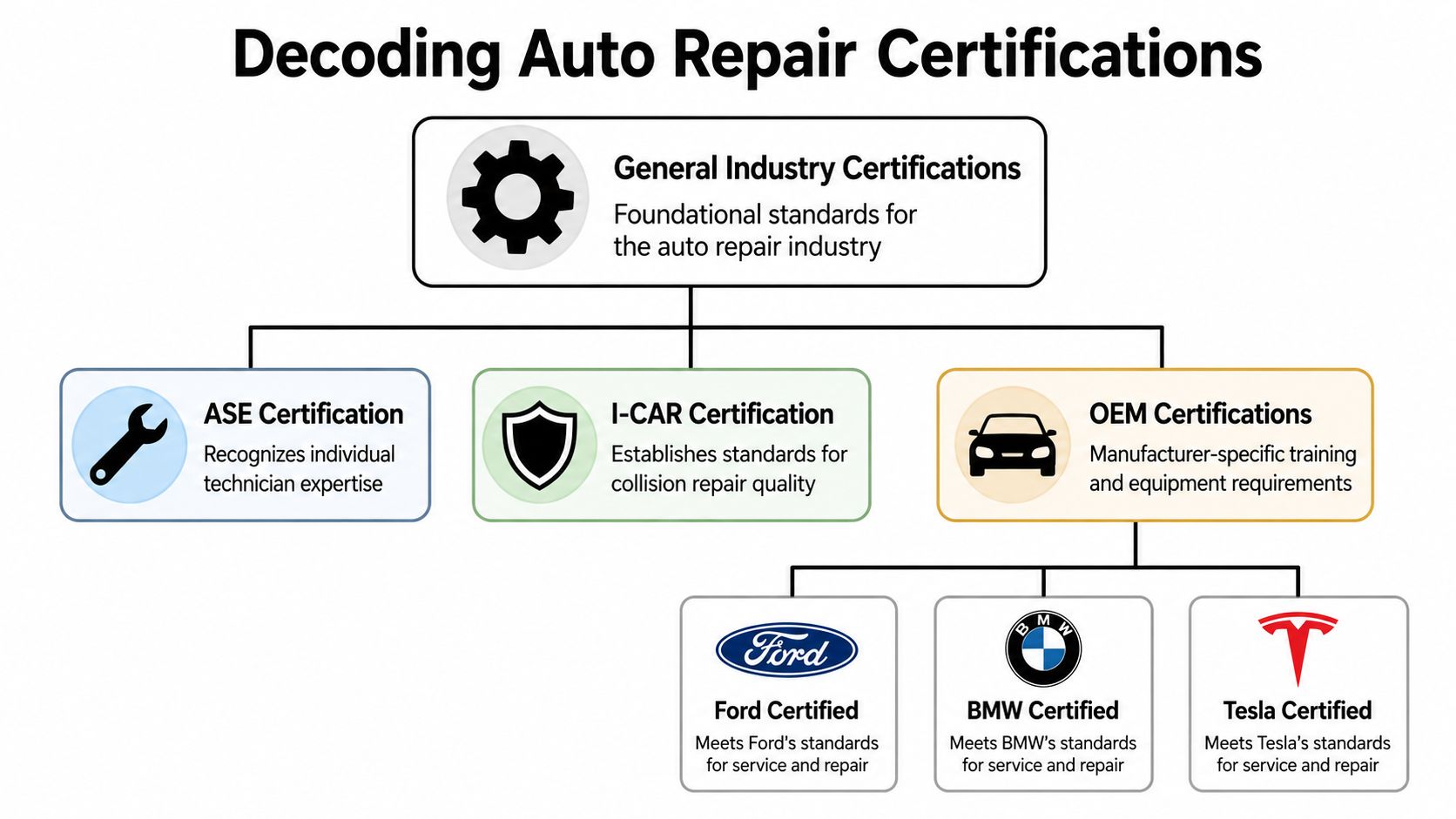
If a shop is certified by your vehicle's manufacturer, that generally means the automaker expects that shop to meet brand-specific requirements for training, tools, repair procedures, and equipment. That's the closest thing to a gold standard for collision repair on late-model vehicles with complex materials and electronics.
For owners of brands with advanced driver-assistance systems, mixed-material construction, or strict repair bulletins, this matters a lot. The question isn't whether a general body shop can straighten metal and repaint panels. The question is whether that shop is qualified to restore your specific vehicle the way the manufacturer says it must be repaired.
Technician credentials and shop credentials are different
A shop can have good technicians without having strong shop-level controls. It can also advertise certifications that belong to one person, not the entire operation.
That distinction matters even more because the labor market is tight. The push for certification reflects broader industry pressure. The U.S. Bureau of Labor Statistics projects 2% employment growth for automotive body and glass repairers from 2024 to 2034, with about 16,000 openings per year on average, and industry reporting noted that 31% of general auto repair shops cited technician shortages as their biggest challenge, as summarized in the BLS occupational outlook and related industry reporting. When experienced people leave and new people enter, credentials and process standards become more important, not less.
A simple way to think about the main labels
| Certification type | What it usually tells you | Who it primarily serves |
|---|---|---|
| OEM certification | The shop has brand-specific requirements tied to a manufacturer | Your vehicle's repair standards |
| ASE | Individual technicians have passed recognized skill-based testing | Technician competence |
| I-CAR | The shop or technicians have collision-repair training focus | Repair training and education |
| Insurer network or DRP | The shop has a working relationship with an insurance company | Claim handling efficiency and insurer workflow |
That last category is where many consumers get confused.
“Certified” can mean insurer-approved, not manufacturer-approved
An insurer-recommended shop may be perfectly capable. But a direct repair relationship is not the same thing as OEM certification. Don't blur those together.
If a shop says it's certified, your next sentence should be, “Certified by whom?”
That one question cuts through a lot of marketing.
Here's what I tell clients to verify before they get impressed by logos on a website:
- Brand-specific approval: Ask whether the shop is certified for your exact make, not just “foreign” or “domestic” vehicles.
- Current status: Certifications expire, change, and get updated.
- Technician depth: One trained person in the building isn't the same as a trained production staff.
- Repair scope: A shop may be strong in mechanical work but weaker in structural collision work.
Bad information often starts with a true statement that's incomplete. “We're certified” might be technically accurate. It still may not answer the question you need answered.
The Real-World Benefits of Certified Repairs
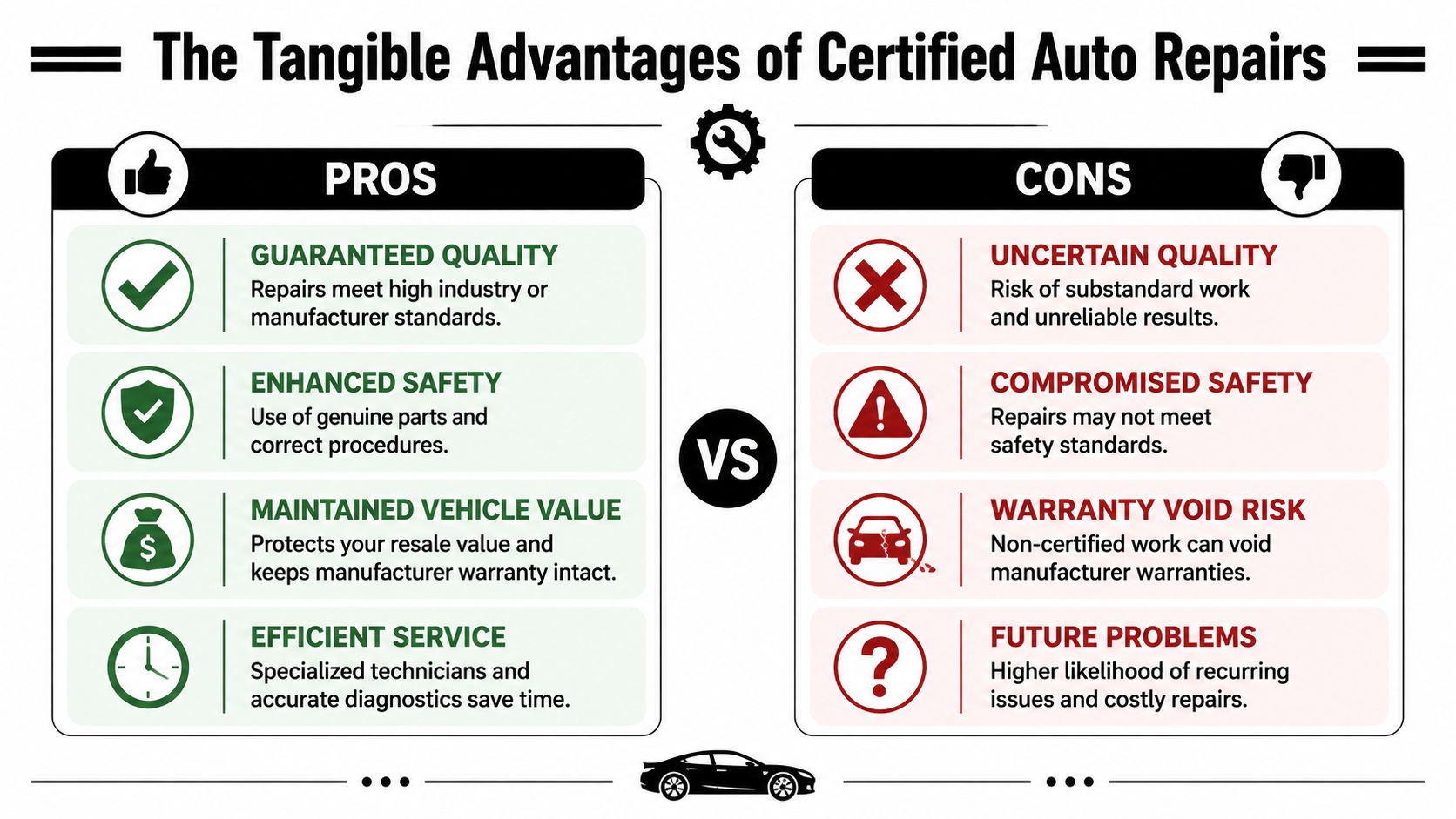
A proper collision repair is a technical process, not a cosmetic service. The reason certified repair shops matter is that good shops don't guess. They follow documented procedures, use the right equipment, and verify the result.
That's what protects both safety and value.
The paperwork behind a good repair is part of the repair
Certified collision repair shops are typically required to use OEM repair procedures tied to the vehicle's VIN, then verify the repair with pre-scan, post-scan, and dimensional measurement documentation, according to this explanation of collision repair compliance workflows. That process is built to catch hidden damage and restore ADAS and other electronic systems to factory specification.
That sentence may sound technical, but the takeaway is simple. A shop shouldn't just clear a code and send you home. It should prove the vehicle was inspected, measured, repaired, and checked.
What that means on the ground
When a certified shop handles a collision repair correctly, you'll usually see discipline in areas like these:
- VIN-based procedures: The shop pulls repair instructions for your exact vehicle configuration, not a generic estimate template.
- Pre-repair scanning: Electronic systems are checked before teardown so hidden faults aren't missed.
- Dimensional measurement: Structural points are measured to confirm the body and frame are back where they belong.
- Post-repair scanning and calibration: Safety systems, sensors, and related electronics are verified after reassembly.
That matters because modern vehicles depend on more than visible alignment. Bumpers carry sensors. Windshields can affect camera systems. A slightly wrong mounting point can create problems that don't show up until later.
A clean panel gap doesn't prove a safe repair. Documentation does.
Why this affects diminished value
Diminished value isn't just about the fact that a car was in an accident. It's also about how confidently the market can trust the repair. Buyers, appraisers, and dealers notice when records are thin or when a vehicle shows signs of rough workmanship.
The financial difference often comes down to questions like these:
- Was the repair done using the manufacturer's procedures?
- Are there scan records?
- Is there measurement documentation?
- Did the shop use proper structural methods?
- Does the final repair inspire confidence or raise suspicion?
A sloppy repair can increase the stigma attached to the accident history. A disciplined repair can limit the damage, even though it usually won't erase it.
Appearance is the lowest bar
Many people judge body work by paint match and finish quality. That's understandable, but it's not enough. A vehicle can look excellent and still carry unrepaired structural issues, incomplete calibration work, or weak documentation.
If your claim later turns into a diminished value dispute or a total loss valuation fight, the strength of the repair file matters. Certified repairs don't guarantee a perfect outcome, but they give you much better footing when someone asks whether the car was repaired the right way.
How to Find and Verify a True Certified Shop
Start with skepticism. That's not cynicism. It's basic self-protection.
The phrase certified repair shop gets thrown around loosely. Some shops are OEM-certified. Some have respected technician training. Some are using “certified” as soft marketing language because they're in an insurer network or have a credential that doesn't say much about collision quality on your vehicle.
Where to begin your search
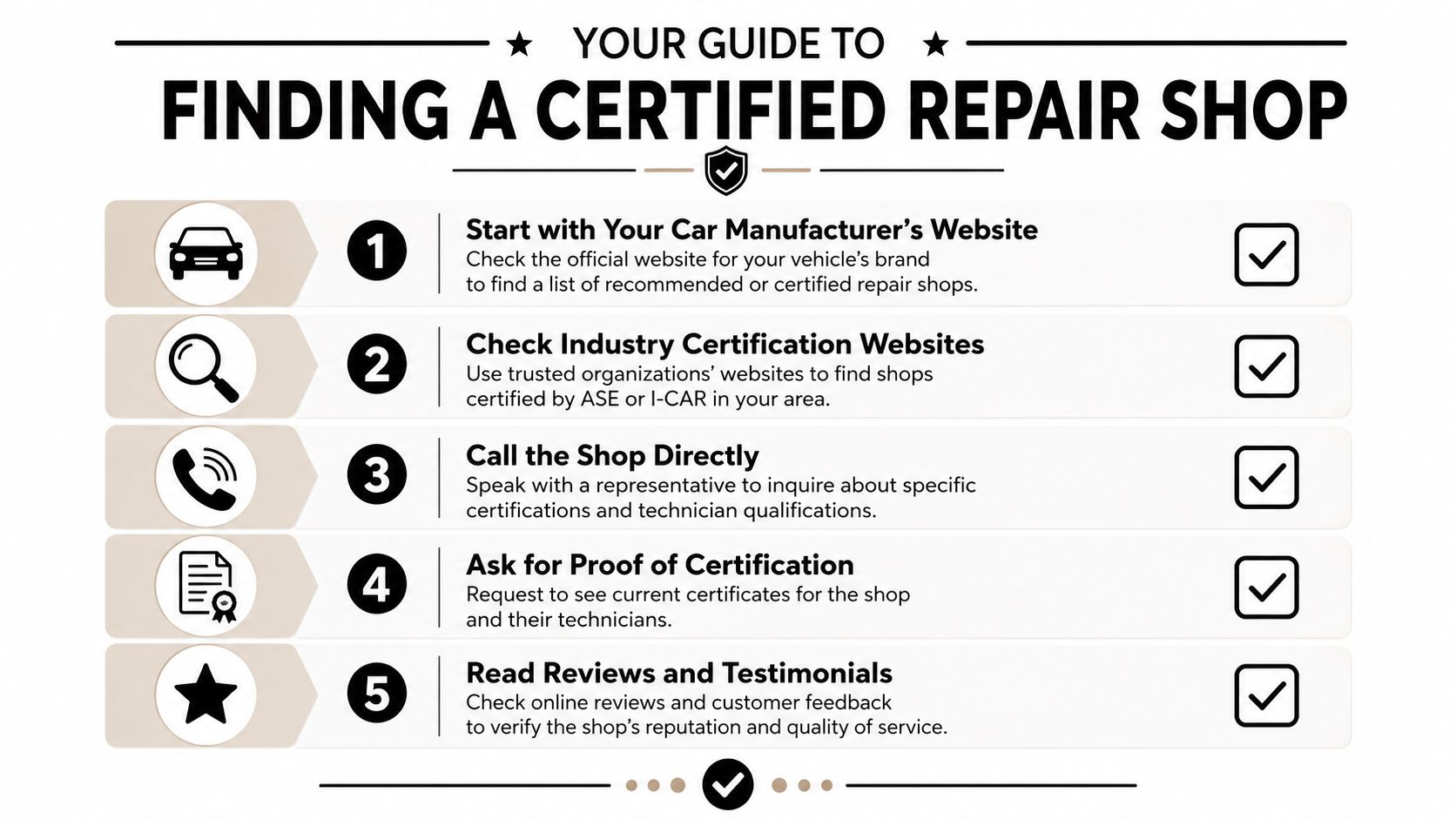
The best first stop is usually your vehicle manufacturer's official shop locator or collision-program page. If the automaker certifies collision facilities for your brand, that list is more useful than a generic search result.
After that, check broader industry directories and then call the shop directly. Don't rely on a badge on the homepage.
Public-facing shop finders and network listings can still leave out the key detail: who is doing the certifying, what standards are being audited, and whether that label reflects OEM-level repair requirements or something looser. That's the central caution raised in this discussion of how repair-shop certification labels can be misleading.
Questions that separate real qualifications from marketing
Use this checklist when you call or visit:
Ask who issued the certification
If the answer is vague, keep pushing. Manufacturer? Training organization? Insurance network?Ask whether the certification applies to your exact make
“We work on those all the time” isn't the same as make-specific authorization.Ask how they handle scanning and calibration
If the answer sounds casual, that's a warning sign.Ask whether they follow OEM repair procedures for your VIN
You want a yes, not a sales pitch.Ask what parts policy they use
Especially on structural and safety-related repairs.
Here's a quick visual overview before you start calling shops:
What to ask for in writing
You don't need to act like a lawyer. You do need to ask for proof.
- Current certificates: Not old plaques, not verbal assurances.
- Repair-process explanation: How they document scans, measurements, and calibrations.
- Parts policy: OEM, aftermarket, used, or a mix.
- Sublet disclosure: Whether calibrations or specialty work get sent elsewhere.
Ask this exactly: “Can you show me your current certification for my vehicle make and explain what procedures you use to document the repair?”
A solid shop won't get defensive. It will answer cleanly.
One more thing that matters
Pay attention to how the estimator talks. If the conversation is mostly about speed, insurer approvals, and getting you in and out fast, slow down. If the conversation is about procedures, documentation, and proper repair planning, you're usually in better hands.
Navigating Insurance Pressure and Your Right to Choose
Insurance companies often present their preferred shop list as a convenience. Sometimes it is. Sometimes it's also a shortcut into a claim process built around insurer priorities.
That's where drivers get trapped.
You report the loss. The adjuster says they can “help” by sending you to one of their approved shops. The language sounds neutral. It isn't always neutral. A shop in a direct repair relationship may be balancing your repair needs against the insurer's expectations for cost control, cycle time, supplement handling, and administrative compliance.
What your interests are versus what the insurer wants
Your goal is straightforward. You want the vehicle repaired correctly, documented thoroughly, and preserved as well as possible from a safety and value standpoint.
The insurer has a different goal. It wants to resolve the claim efficiently and control payout. Those goals can overlap, but they are not identical.
That conflict matters most on repairs involving structure, welds, replacement methods, electronics, and calibration. A key technical difference in stronger repair environments is equipment and process control. Certified shops are expected to have the right frame-measurement tools and factory-approved welding methods to restore structural dimensions within tight tolerances, as described in this overview of equipment and process standards in certified collision repair. A network focused first on cost and speed may not prioritize that standard the same way.
Why this affects claim leverage later
When a repair is cut short or documented poorly, the damage doesn't end when you pick up the car.
It can show up later in several ways:
- Diminished value gets harder to support because the repair history looks weaker.
- Resale discussions get uglier when buyers or dealers spot signs of rough work.
- Supplement disputes become murkier because the file doesn't clearly show what was required.
- Total loss arguments become harder if condition and repair quality become contested issues.
That's why I tell people not to treat repair choice as a convenience issue. It's a financial strategy issue.
Yes, you usually have the right to choose
In most states, you're not required to use the insurer's preferred shop. The insurer can recommend. That doesn't mean you have to accept the recommendation.
If an adjuster starts leaning on you, get educated before you answer. This guide on how to negotiate with an insurance adjuster gives a practical framework for handling that pressure without getting pushed into a bad decision.
You don't owe the insurance company blind trust. You owe yourself a repair decision you can defend later.
How to respond when you feel pushed
Keep it simple and calm.
Say something like this:
- “I'm exercising my right to choose the repair facility.”
- “I want the shop that's best qualified for my vehicle.”
- “Please send all claim communications and estimate information so I can review them.”
You don't need to argue about motives. You just need to stay in control.
The bottom line on DRP pressure
Insurer network shops aren't automatically bad. Some do very good work. The mistake is assuming the insurer's recommendation equals the best choice for your vehicle's value.
It might. It might not.
Your job is to verify whether that shop serves the repair first or the claim system first. If you don't answer that question early, you may pay for it later in lost value, weaker documentation, and less negotiating power.
Protecting Your Investment After the Repair Is Done
The repair isn't the end of the story. It's the start of the valuation story.
Even when the work is excellent, the vehicle now carries accident history. That alone can lower market value. For many owners, especially those with newer, premium, collector, or carefully maintained vehicles, that lost value deserves attention. If you want a fuller explanation of that issue, review this guide to diminished value on a car.
What to keep after the shop visit
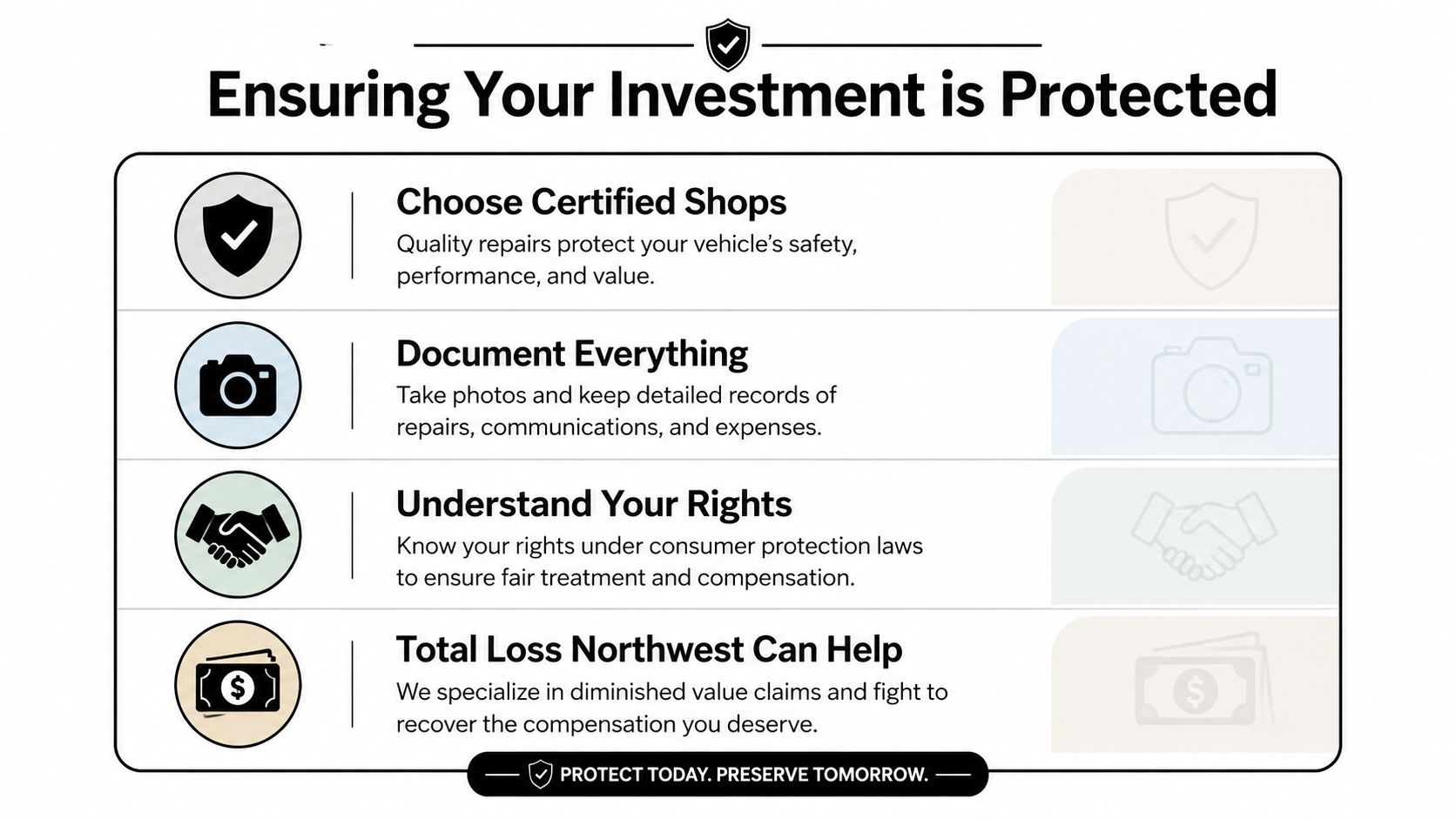
Hold onto every document tied to the repair. That includes estimates, final invoices, parts invoices if available, scan reports, calibration records, alignment records, and photos.
You should also keep a clear record of the actual damage involved. If you're not sure how collision categories are commonly described, this reference on common vehicle damage types is useful for understanding the terminology that can show up in inspections, auction histories, and valuation discussions.
Why independent appraisal matters
Insurance companies often value losses with internal systems and assumptions that don't fully reflect your vehicle's real market position. That becomes a serious problem when they lowball a total loss settlement or brush off a diminished value claim.
An independent appraiser gives you something different. Evidence. Market-based analysis. A defensible valuation. If the policy includes an appraisal clause, that process can shift the dispute out of the insurer's internal lane and into a more balanced one.
Bottom line: A certified repair protects the vehicle. An independent appraisal protects the money tied to it.
If your car was repaired after an accident, don't stop at “it looks good.” Ask what the repair documentation shows, what the accident history did to value, and whether the insurer's numbers hold up under scrutiny.
If your insurer is undervaluing your total loss claim or ignoring your actual diminished value after a collision, Total Loss Northwest can help. They specialize in independent auto appraisals for Oregon and Washington owners and provide diminished value support in all 50 states. Their work is built for one purpose: replacing insurer-biased numbers with real market value evidence that holds up in negotiations.