Your car is back from the body shop. The paint matches. The panels line up. It drives fine.
But when you think about selling or trading it in, you already know the problem. A vehicle with an accident history usually doesn't bring the same money as an identical vehicle with a clean history. That loss is what a lot of Georgia drivers are trying to estimate when they search for a GA diminished value calculator.
A calculator can help, but only if you understand what it's doing. In Georgia, the number most insurers use doesn't come from a real buyer, a dealer offer, or a comparison of similar accident-history vehicles. It usually comes from a formula. If you treat that result as the truth, you may leave money on the table before the claim negotiation even starts.
What Diminished Value Means for Your Car in Georgia
You pick up the car after repairs, look it over, and it seems right. The panels fit. The paint matches. Then the accident shows up on a history report, and the market treats your vehicle differently from that point on.
In Georgia, that drop in resale value after proper repairs is called diminished value. In a third-party claim, the issue is not whether the shop fixed the car. The issue is whether the vehicle is now worth less because it carries an accident history. If you are pursuing a Georgia diminished value claim, that distinction controls the entire negotiation.
What buyers actually care about
Real buyers and dealers do not stop at "repaired." They look at the severity of the loss, the parts replaced, any structural involvement, airbag deployment, paintwork, and what shows up on Carfax or AutoCheck. A vehicle can be repaired correctly and still bring less at trade-in or private sale because the next buyer sees added risk.
That difference is most significant when the vehicle had strong pre-loss condition, lower mileage, and solid demand before the crash. Late-model vehicles usually feel this more sharply because buyers have more clean-history alternatives.
Practical rule: Repairs restore use. They rarely restore full market value.
Why claims turn into disputes
Owners usually assume diminished value is a market question. Insurers often handle it like a formula question. That is the gap.
From an appraisal standpoint, diminished value is not abstract. It shows up in dealer bids, reduced buyer interest, and smaller offers once the accident history is disclosed. The standard Georgia calculator insurers rely on often starts from a capped number instead of asking what comparable accident-history vehicles sell for in the local market.
That is why a calculator can be useful and still be misleading. It may show the insurer's starting position, but it does not automatically show your actual loss. If you know that early, you can build the claim around evidence instead of accepting the first low number as if it came from the market.
Decoding the Insurance Company's 17c Formula
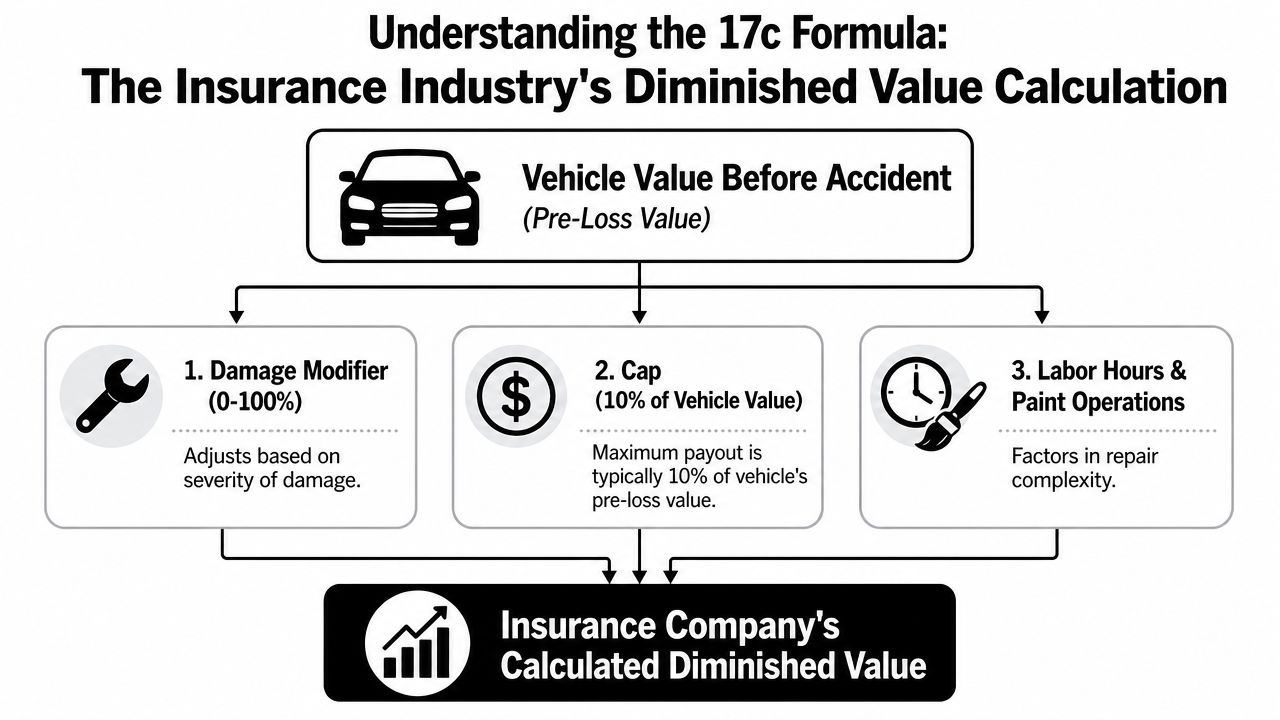
The standard Georgia insurance calculation is commonly known as the 17c formula. Many adjusters use it as the default starting point for diminished value claims, and that matters because the structure of the formula cuts the claim down in stages.
The formula starts with a cap
Georgia insurers apply a 10% cap to the vehicle's pre-accident market value, then multiply that figure by a damage severity multiplier and a mileage multiplier. The mileage multiplier is 0.00 if the vehicle has more than 100,000 miles, according to this Georgia 17c explanation.
That means the insurer doesn't begin by asking what the market took away from your vehicle. It begins by imposing a ceiling.
For a higher-value vehicle, that cap can be the first major problem. It limits the discussion before anyone reviews local resale behavior, dealer resistance, or buyer stigma attached to accident history.
Then each multiplier reduces the claim
The next step is the damage multiplier. In practice, arguments often start here. Adjusters often classify the repair severity in a way that holds the number down. Even when repairs involved meaningful impact to the vehicle's desirability, the formula converts that into a narrow multiplier.
Then comes mileage. Older or higher-mile vehicles already face resistance from insurers on diminished value. The mileage multiplier gives them another built-in reason to reduce the figure, even when the accident history still affects resale.
A practical way to think about the 17c method is this:
- Step one limits the ceiling before market value is considered.
- Step two narrows the claim based on the insurer's view of damage severity.
- Step three cuts further if mileage is high.
- Final result favors uniformity, not a true market measurement.
If you want a broader overview of claim strategy, this guide on a Georgia diminished value claim process helps frame where the formula fits into the larger dispute.
The 17c formula gives insurers a repeatable number. It does not give owners a market-tested value.
Why that matters in negotiation
Once an adjuster has a formula result on paper, many claimants assume the burden shifts to the insurer to justify it. In reality, the burden often shifts to you to disprove it.
That's why understanding the 17c formula matters. Not because it gives you the final answer, but because it reveals the exact mechanism the insurer will likely use to produce an offer that feels lower than common sense suggests.
Calculating a Baseline Diminished Value Estimate
A Georgia diminished value calculator is useful for one reason. It shows you the number an insurer is likely trying to defend.
That matters because claimants often treat the calculator output as if it reflects the actual market reaction to an accident history. It usually does not. It reflects a formula. If you can run that formula yourself, you can check whether the carrier used a fair starting value, whether the damage was understated, and whether the mileage adjustment was used to push the number down further.
Step one through step three
Start with the vehicle's pre-accident market value. Insurers often pull that figure from a pricing guide or internal valuation system. If that starting number is low, every later step stays low too.
Next, apply the 10% cap used in the 17c method. A $20,000 vehicle produces a maximum starting point of $2,000 under that formula, before any other reductions.
Then apply the damage multiplier and mileage multiplier. In practice, these applications often lead to many low offers. The insurer decides how serious the damage was for formula purposes, then reduces the number again based on mileage. A vehicle can have strong repair documentation and still get squeezed by both inputs.
A sample baseline estimate
Use the calculation below as an insurer-style baseline only.
| Step | Calculation | Result |
|---|---|---|
| Pre-accident value | Vehicle value before the crash | $20,000 |
| 17c cap | $20,000 × 10% | $2,000 |
| Damage adjustment | Apply insurer's damage multiplier | Reduced from $2,000 |
| Mileage adjustment | Apply insurer's mileage multiplier | Reduced again |
| Final insurer-style estimate | Amount after both multipliers | Depends on the inputs |
This is the part many owners miss. The formula does not begin with your actual resale loss. It begins with a capped amount, then works downward.
How to use the result the right way
Use the result to audit the carrier's position, not to set your final claim value. A tool like this Georgia diminished value claim calculator helps you see the framework the insurer is likely using and where the weak points are.
Focus on three checks:
Verify the pre-loss value
Review whether the insurer started with a fair vehicle value based on trim, options, condition, and local market data.Scrutinize the damage rating
Structural repairs, panel replacement, airbag deployment, or significant paintwork often affect buyer behavior more than a light formula rating suggests.Compare the formula to market evidence
If dealer quotes, trade-in offers, or comparable vehicle data show a larger stigma loss, the calculator has done its job. It exposed the insurer's method, and it gave you something to challenge.
I tell clients the same thing in appraisal disputes. A calculator can show you the floor the insurer wants to build. It cannot tell you what the market will discount for an accident on your vehicle history report.
Why Online Calculators Often Get It Wrong
Most online diminished value calculators feel authoritative because they produce a clean number. That's the trap. Precision on a screen is not the same as accuracy in the market.
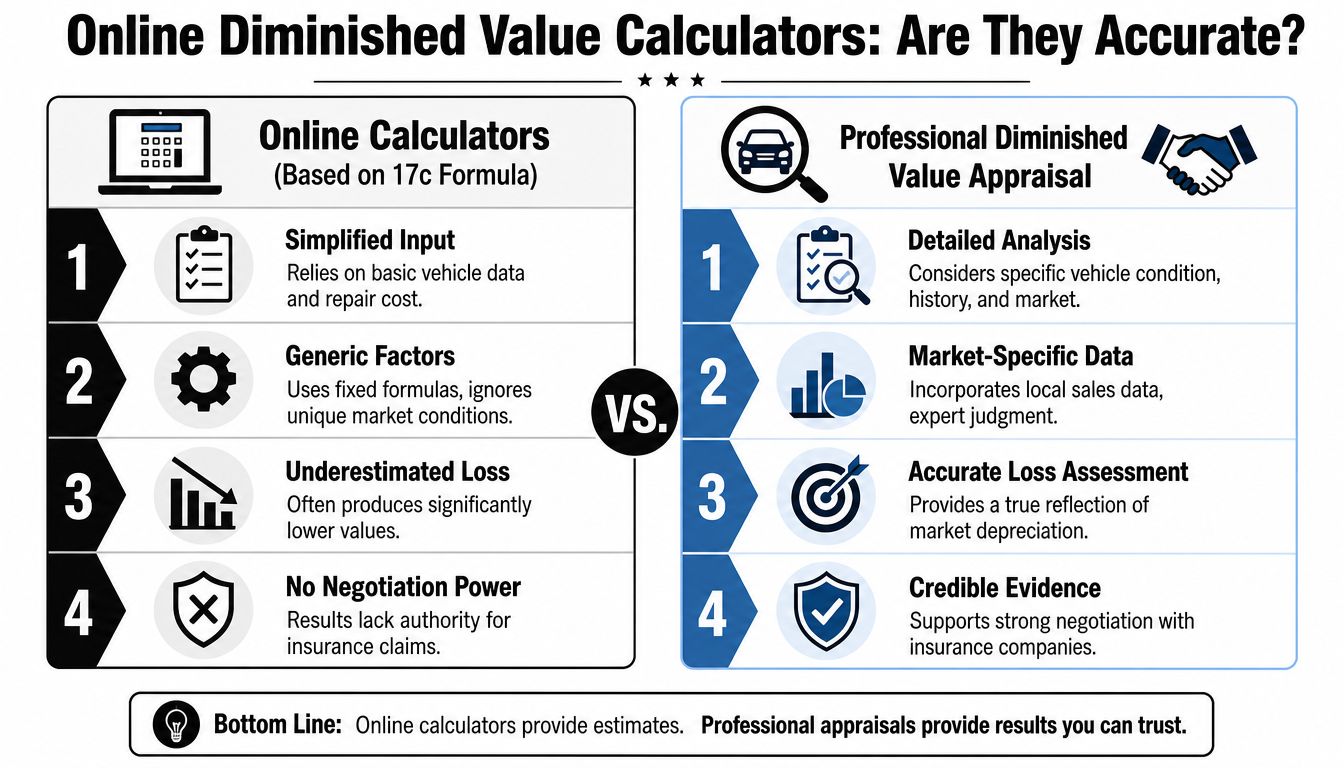
The biggest weakness is simple. Calculators based on 17c don't ask what actual buyers and dealers in your market will pay for your repaired vehicle compared with a comparable clean-history vehicle. They apply a formula and stop there.
Georgia legal sources note that insurers rely on the rigid 17c formula, which caps loss at 10% of pre-accident value and applies arbitrary multipliers, often producing settlements 30% to 50% below actual market loss. Those same sources note that independent appraisers using dealer surveys and comparable sales data consistently recover higher values, as discussed in this Georgia diminished value analysis.
What a calculator misses
A formula-based tool usually ignores several things that affect real resale value:
- Buyer resistance after accident history even when repairs look good
- Dealer trade-in behavior when they know the vehicle history report will show prior damage
- Vehicle desirability in the local market
- Repair narrative, including whether the loss was cosmetic or more serious
- Model-specific sensitivity to damage history
That's why two vehicles with similar repair invoices can suffer different market reactions. The formula doesn't see that difference.
This video gives a useful visual explanation of how valuation disputes often play out in practice.
What a market-based appraisal does differently
A professional appraisal starts with a different question. Not “What does the formula allow?” but “What did the accident do to this vehicle's resale position?”
That approach usually looks at:
- Comparable clean vehicles
- Comparable accident-history vehicles
- Dealer and market reactions
- Vehicle history reporting impact
- Repair quality and damage type
A calculator is useful for forecasting the insurer's move. It is weak evidence of your actual loss.
That distinction matters when an adjuster says your online result proves the case is small. It doesn't. It only proves what the formula spits out after applying insurer-friendly limits.
Gathering Evidence to Prove Your Actual Loss
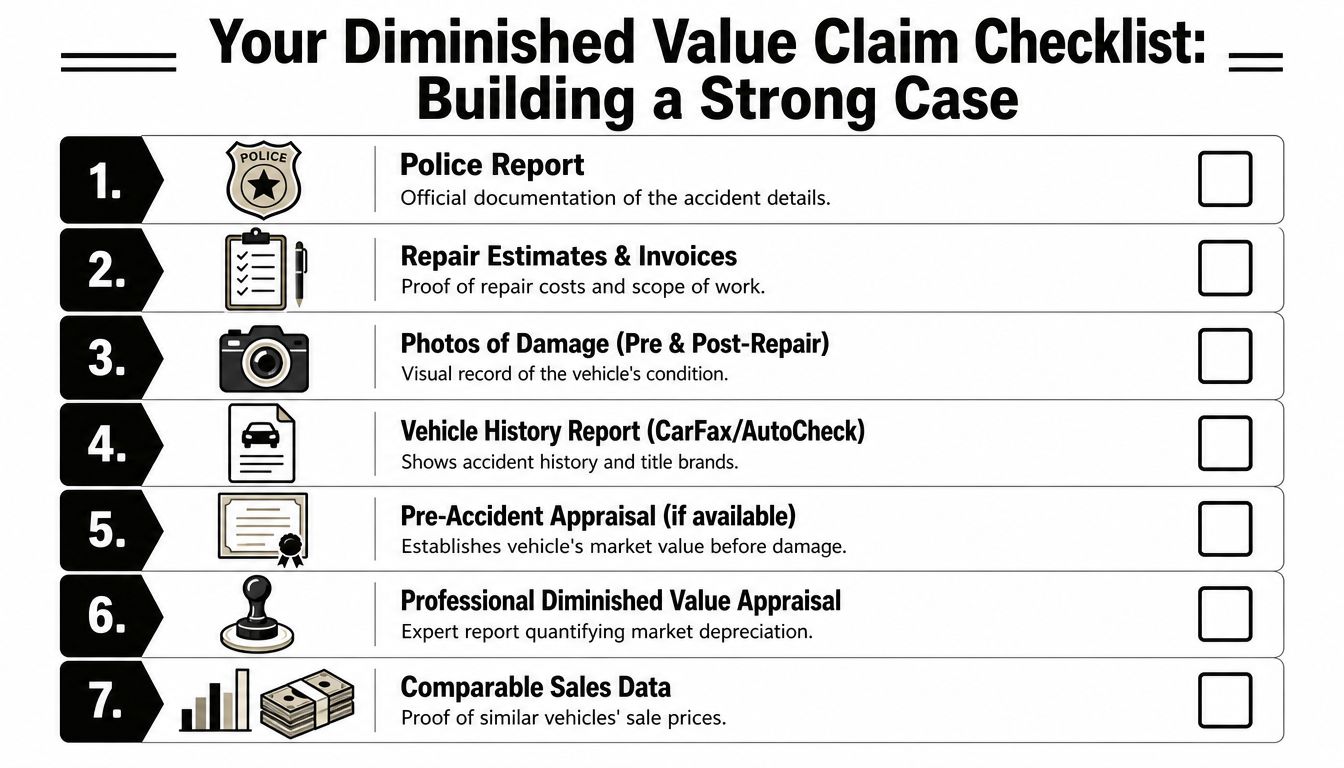
A strong diminished value claim is built with documents, not frustration. If you want to move the discussion away from the insurer's formula, you need evidence that shows what happened, what was repaired, and how the market now views the car.
The core file to assemble
Gather these items before you send a serious demand:
Police report
This anchors the loss event and helps establish fault context.Final repair invoices
Not just estimates. The final invoice shows what work was performed.Photos before and after repair
Photos help an adjuster or appraiser understand visible impact and repair scope.Maintenance records
These support the vehicle's pre-accident condition and help show the car wasn't already suffering from neglect.Vehicle history report
This helps document how accident history will appear to future buyers.
The two documents that often carry the most weight
A certified diminished value appraisal is the document that directly addresses the amount of market loss. It gives the insurer something more serious than a calculator printout.
Comparable market data matters too. If you can show how similar vehicles are priced with and without accident history, you move the claim onto stronger ground. This resource on comparables for appraisal is useful for understanding what makes a comparable persuasive instead of superficial.
Good claims packages don't just show that repairs happened. They show why the repaired car is still worth less.
What weakens a claim
Owners often hurt their own case by sending only a repair bill and a demand amount. That leaves the adjuster free to default back to the insurer's formula.
A better file tells a complete story. Clean pre-loss condition. Documented collision. Completed repairs. Persistent market stigma. Supported value loss.
When to Escalate to a Certified Appraiser
Some claims can be handled with a solid demand package and patient follow-up. Others need professional escalation quickly.
If the vehicle had structural damage, if the insurer's offer feels disconnected from the repair reality, or if the car sits in a value range where accident history matters sharply to buyers, a calculator usually won't get you where you need to go. The same is true when the adjuster keeps repeating formula language but won't engage with market evidence.
Red flags that tell you the calculator phase is over
Watch for these signs:
- The adjuster relies only on the formula and won't discuss actual resale impact.
- Your vehicle is especially market-sensitive, such as a luxury, enthusiast, collector, or unusually clean example.
- The repairs were more than cosmetic, especially when the damage affects buyer confidence.
- The offer arrives fast and low, with little explanation beyond a preset method.
At that point, a certified appraiser adds more than a number. A credible appraisal reframes the claim around market loss instead of software output.
Why professional valuation changes the leverage
An appraiser can evaluate comparable sales, dealer reactions, repair scope, and accident-history impact in a way a generic calculator can't. More important, the report gives you a structured valuation document that can hold up in negotiation.
In some disputes, the next issue isn't just valuation. It's compensation theory more broadly. If you want a plain-language legal overview of how damages are evaluated in civil disputes, Miles Hansford Law Firm on civil compensation is a useful resource.
If the insurer keeps talking about formulas and you keep talking about the market, you need evidence strong enough to force that conversation onto your terms.
For many owners, that's the point where hiring an appraiser stops being an expense and starts becoming a recovery strategy.
Georgia Diminished Value Claim FAQs
Can I still file if I was partly at fault
Yes, potentially. Under Georgia's comparative negligence rule, a diminished value claim can still be valid when the driver was partially at fault, as long as the accident caused significant structural or mechanical damage rather than only minor paint issues, according to this Georgia diminished value FAQ.
The practical issue is proof. Partial fault often makes the claim more contested, so your documentation and valuation support need to be cleaner.
Does minor cosmetic damage qualify
Usually, minor cosmetic-only damage is a weak diminished value case. The stronger claims involve repairs that materially affect how buyers, dealers, or appraisers view the vehicle after the crash.
If the repair was limited to light paint or trim concerns, don't assume the claim is impossible. But do expect more pushback.
Can a total loss vehicle have a diminished value claim
No. A vehicle classified as a total loss cannot pursue a diminished value claim under the Georgia guidance cited above.
That's because diminished value applies to a repairable vehicle that returns to the road with reduced market value. A total loss is handled through a different valuation track.
What if the insurer's number seems too low
That's common. Start by reviewing the insurer's inputs, especially the pre-loss value and how the damage was characterized. Then compare that number to real market evidence.
If the formula result doesn't reflect what similar repaired vehicles face in the market, the next step is usually a market-based appraisal, not another free calculator.
What should I save after the accident
Keep every repair document, photos, communication from the insurer, and any records that show your vehicle's condition before the crash. The cleaner your file, the harder it is for the carrier to reduce the dispute to a generic formula result.
If you're dealing with a low diminished value offer or an insurer that's hiding behind formula-based software, Total Loss Northwest can help you pursue a market-based appraisal instead of accepting a number built to protect the carrier. Their team handles diminished value support in all 50 states and focuses on defensible valuation reports that give owners stronger footing in negotiations.