You got the car repaired. The panels line up, the paint looks close enough, and the insurer acts like the problem is over.
It usually isn't.
A buyer, dealer, or appraiser will still see the accident history. They'll price that history into the vehicle, even when the repair work was competent. That gap between what your car was worth before the wreck and what it's worth after proper repair is the loss most drivers feel immediately, but many never recover.
In Georgia, that loss is often recoverable. The hard part isn't understanding that your car is worth less. The hard part is knowing when you need an appraiser, when you need a lawyer, and when trying to handle everything yourself starts costing you money.
Your Car Is Repaired But Not Whole
A common Georgia claim starts the same way. Another driver hits your vehicle. You report the crash, take it to a body shop, save the repair invoice, and wait for the insurer to do what it's supposed to do.
Then the repair is finished, and the car still doesn't feel financially whole.

The reason is simple. The market treats an accident history as damage to value, not just damage to sheet metal. A dealer may offer less on trade. A private buyer may hesitate. A lender or lessee may scrutinize the history report. None of that disappears because the bumper was replaced and the paint cured properly.
What drivers usually miss
It's frequently believed that the only fight is over repair quality. That matters, but it's not the whole issue. Even a well-repaired vehicle can carry a stigma in the market.
That's what makes diminished value so frustrating. You did everything right, and the loss still lands on you unless you press the claim correctly.
A repaired car can be safe, drivable, and still worth less in the real market.
Where claims start to go sideways
Insurers often treat diminished value as optional until the owner forces the issue with documentation. Drivers also hurt their own claims by moving too fast or by assuming the body shop invoice proves everything.
It doesn't.
A repair bill proves what was fixed. It does not prove what the vehicle lost in market value. That's a different question, and it usually needs separate evidence.
Here's where people tend to lose their advantage:
- They accept the repair payment as the full resolution. Repair compensation and value loss are not the same thing.
- They rely on a generic online valuation. That may help you get oriented, but it usually won't carry a disputed claim.
- They wait too long to organize records. Photos, repair invoices, and accident documents are easier to use when gathered early.
- They hire the wrong professional first. If the amount of loss is unclear, start with valuation evidence. If the legal right to payment is being blocked, bring in counsel.
That distinction matters throughout the rest of the claim.
What Is a Georgia Diminished Value Claim
A Georgia driver gets the car back from the body shop, the repairs look clean, and the next buyer still offers less because the vehicle now shows an accident history. That price gap is the diminished value.
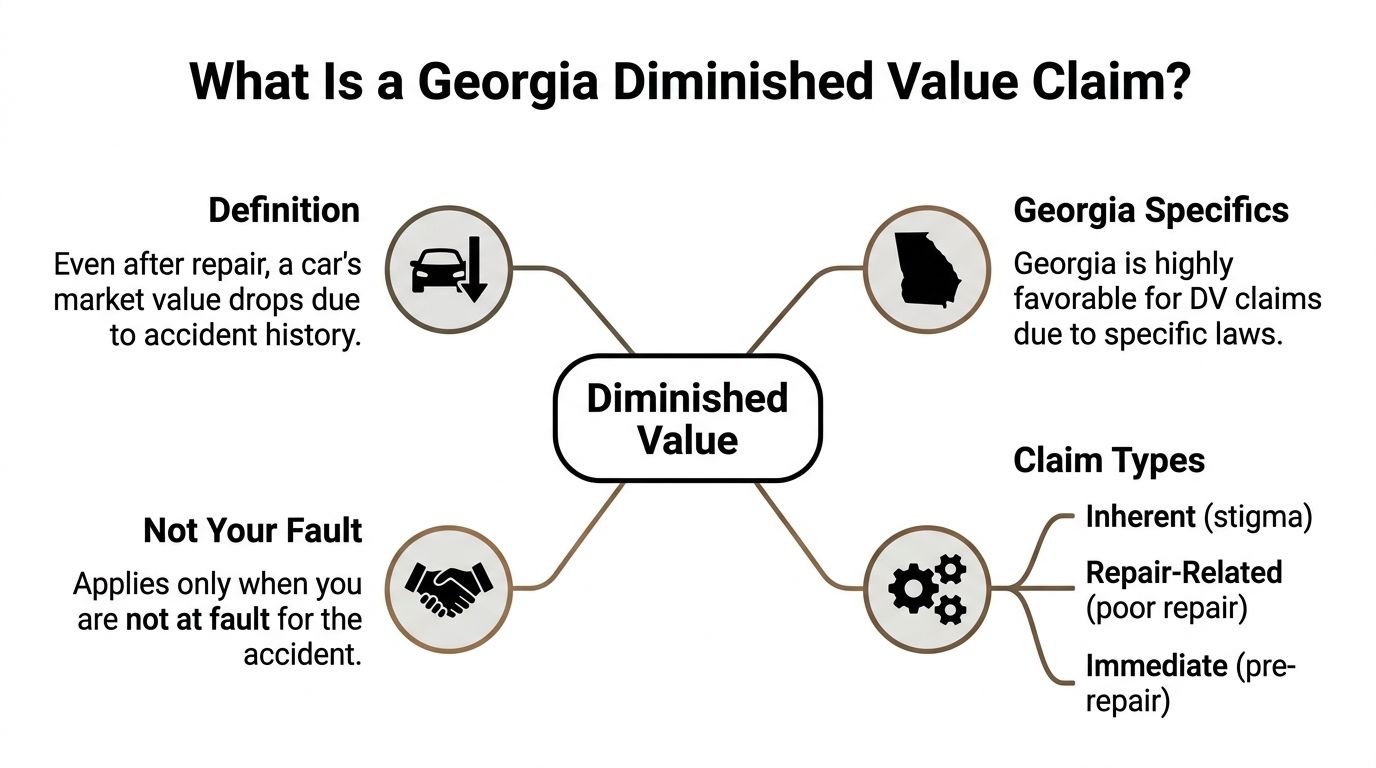
In Georgia, a diminished value claim seeks the difference between the vehicle's pre-loss market value and its post-repair market value, as long as the vehicle was repairable and not a total loss. Repair invoices matter, but they answer a different question. They show what it cost to fix the damage, not what the market now subtracts because the car has a damage record.
A practical example helps. A late-model SUV with no prior damage may be fully repaired after a collision, pass inspection, and drive normally. Yet dealers, private buyers, and appraisal tools often treat that SUV differently from a comparable clean-history vehicle. That remaining loss is the claim.
The legal foundation in Georgia
Georgia recognizes diminished value as part of property damage, which is why these claims come up so often after otherwise routine accidents. Georgia law and case law also give owners a path to recover that loss from the at-fault side in the right case. For a concise overview of how these claims work in practice, see this guide to a Georgia diminished value claim.
Two legal points usually matter first. The claim depends on a repairable vehicle, and fault still matters. Guidance discussing OCGA § 51-1-6 explains the legal basis for recovering property damage, and Georgia claim discussions also note that diminished value recovery generally tracks cases where the owner is less than 50% at fault, as outlined by Chris Hudson Law Group.
Timing matters too. Georgia property damage claims are generally subject to a four-year statute of limitations, and Georgia lawyers frequently point to the 2001 Mabry decision when explaining why diminished value can be owed in addition to repair costs. John Foy & Associates summarizes both points in its discussion of Georgia diminished value deadlines and insurer responsibility.
To make the process easier to visualize, this walkthrough gives a quick overview:
The three types of diminished value
Drivers, appraisers, and lawyers usually sort diminished value into three buckets:
- Inherent diminished value is the loss that remains because the vehicle now has an accident history, even if the repairs were proper.
- Repair-related diminished value comes from poor workmanship, visible defects, incorrect parts, or finish issues.
- Immediate diminished value refers to the drop in value right after the collision, before repairs are completed.
Most Georgia claims center on inherent diminished value. That is the category insurers dispute most often because the car may look fine while the resale market still discounts it.
One more point is practical, not legal. If you expect pushback from an insurer, keep your records organized from the start. Claim files with clear photos, repair documents, and valuation support are easier to present, whether you handle the matter yourself, hire an appraiser, or get legal help. Even basic communication habits matter when you are dealing with adjusters and law offices. This guide on optimizing lawyer phone calls is a useful operational reference.
Practical rule: If the vehicle now carries an accident history and comparable clean-history vehicles sell for more, the owner may have a diminished value claim even after proper repairs.
The Role of an Appraiser Versus a Lawyer
Consequently, many claims stall. Drivers search for a diminished value lawyer in Georgia when what they first need is a credible valuation. Other drivers order an appraisal when the primary problem is that the insurer is disputing fault, coverage, or legal responsibility.
The two roles overlap, but they are not the same.
What the appraiser does
An independent appraiser answers one question: How much value did the vehicle lose?
That work usually involves reviewing the vehicle history, repair documentation, damage severity, market perception, and comparable vehicle conditions. The result should be a written report that supports a specific diminished value amount and explains how that figure was reached.
If you need help understanding how these reports are built, this guide on a diminished value appraiser is a useful starting point.
A good appraiser is often enough when liability is clear and the insurer is still engaging. In straightforward claims, the appraisal becomes the backbone of negotiation.
What the lawyer does
A lawyer answers a different question: How do you force payment when the insurer won't deal fairly?
That can include disputes over fault, policy language, claim denial, release issues, deadlines, or litigation strategy. A lawyer doesn't replace the valuation expert. In most serious diminished value disputes, counsel still needs an appraisal or other solid damage evidence.
This also matters for communication. Once a claim turns adversarial, every phone call matters. If you're trying to tighten intake and communication habits before or during a dispute, this practical guide on optimizing lawyer phone calls can help you avoid the usual back-and-forth that slows claims down.
Who to call first
| Scenario | Recommended Expert |
|---|---|
| Liability is clear, repairs are complete, insurer asks for proof of loss amount | Appraiser |
| Insurer says your vehicle doesn't qualify | Lawyer, often with appraiser support |
| Insurer makes a small offer but doesn't deny the claim outright | Appraiser first |
| Fault is disputed or shared | Lawyer |
| Claim may need small claims court or broader litigation strategy | Lawyer |
| Repair quality is questionable and value loss must be documented | Appraiser first, lawyer if the insurer resists |
What works and what doesn't
What works is sequencing the claim correctly. Establish the amount of loss, then enforce payment if needed.
What doesn't work is skipping proof. A lawyer can argue rights. An appraiser can prove market loss. Most strong claims need both functions at different stages, not one substitute for the other.
When You Absolutely Need a Diminished Value Lawyer
Your car is repaired, the body shop is paid, and the insurer still treats your diminished value claim like a side issue. That is the point where drivers often waste weeks arguing with an adjuster when they should be getting legal help.
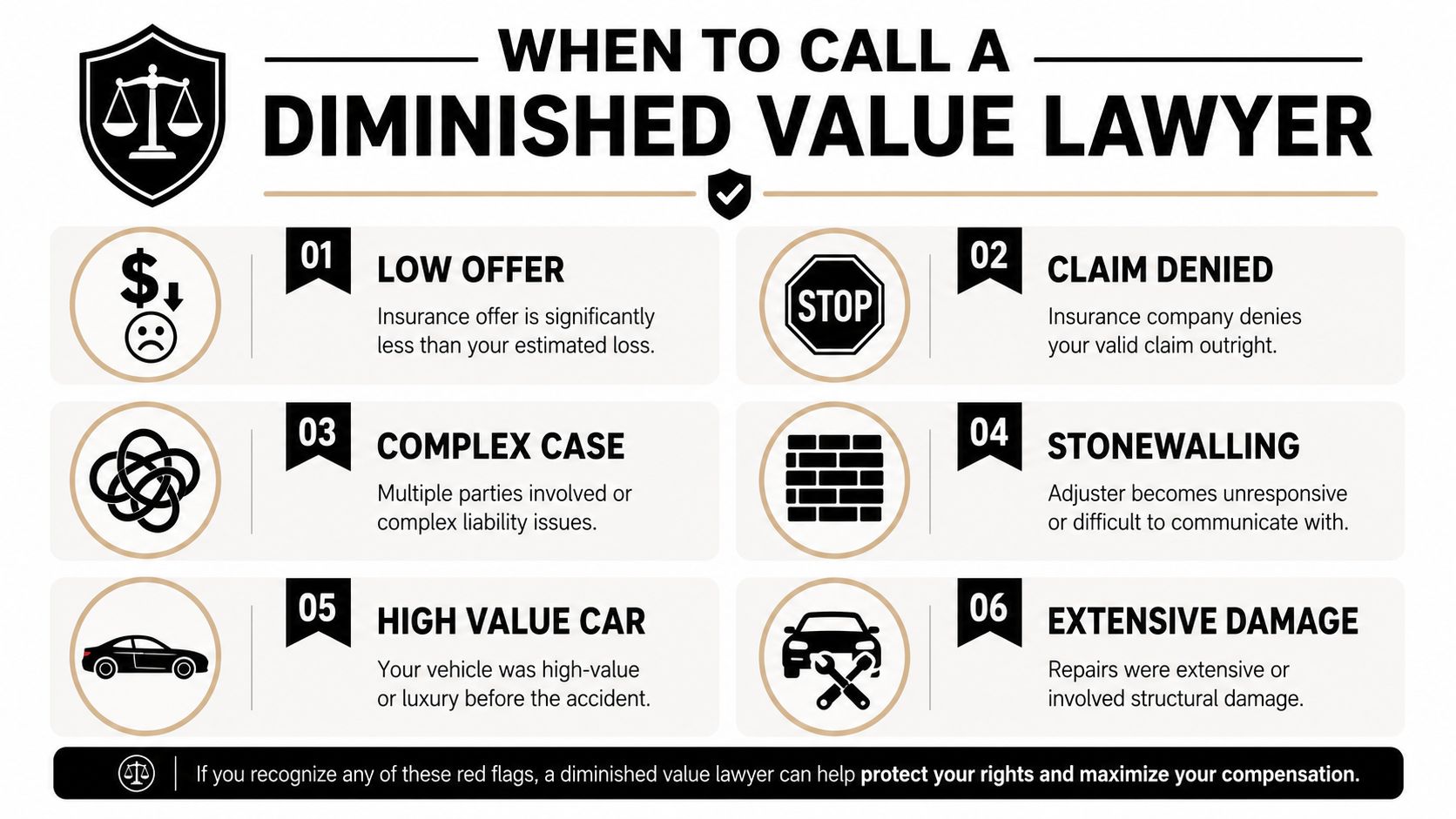
Red flags that call for counsel
A diminished value lawyer in Georgia is usually needed when the dispute has shifted from "What is the loss worth?" to "Do you have any right to collect at all?"
That shift matters. An appraiser can document market loss. A lawyer handles the pressure points that stop payment even when the valuation is sound.
Bring in counsel when these facts show up:
- The insurer denies the claim on eligibility or technical grounds. Carriers often argue the vehicle does not qualify, the damage was not serious enough, or the claim falls outside their internal standards. Georgia claim guidance discussed by Gary Martin Hays & Associates reflects how often valid claims stall on those threshold arguments.
- Fault turns into a real dispute. Once the carrier says you caused the wreck, or shares fault back to you, the claim is no longer a simple property valuation file.
- The adjuster avoids taking a position in writing. If the carrier will talk on the phone but will not confirm its position by email or letter, that usually means the file is headed for a harder dispute.
- You signed paperwork and do not know what you released. Settlement language can waive property damage rights, including diminished value, depending on how the release was written.
- The vehicle falls outside a routine passenger-car claim. High-end vehicles, collector cars, heavily optioned trucks, and commercial units often create disputes about market comparables, use, and repair stigma that become harder to resolve without counsel.
Cases where an appraiser alone usually is not enough
Some files need more than proof of loss. They need someone to force a legal answer.
An appraiser usually cannot fix these problems alone:
- An uninsured or underinsured at-fault driver issue
- A crash involving multiple vehicles or competing versions of fault
- A first-party dispute with your own insurer
- A claim that is close to a filing deadline
- A matter that may need to be filed in court
Georgia law gives property damage claims a filing window, and smaller disputes may fit within magistrate court limits, as noted earlier. Once you are measuring court options, service issues, pleadings, or release language, the claim has moved beyond appraisal work.
If the dispute is about legal rights, deadlines, or who owes what, an appraisal report helps the case but does not finish it.
The practical cutoff
Here is the clean rule I use. Hire a lawyer when being correct about the amount of diminished value is no longer enough to get paid.
That happens earlier than many drivers expect. It is common in moderate-damage claims, unusual-vehicle claims, and any file where the insurer starts arguing qualification instead of amount. At that stage, legal help is not about making the claim look bigger. It is about keeping a valid claim from being shut down on procedure, fault, or release language.
Navigating the Claim Process With Legal Help
Once counsel is involved, the process usually becomes more structured. That helps because diminished value claims often fail from disorder, not from lack of merit. Documents are scattered, the repair timeline is unclear, and nobody has pinned down a supportable amount of loss.
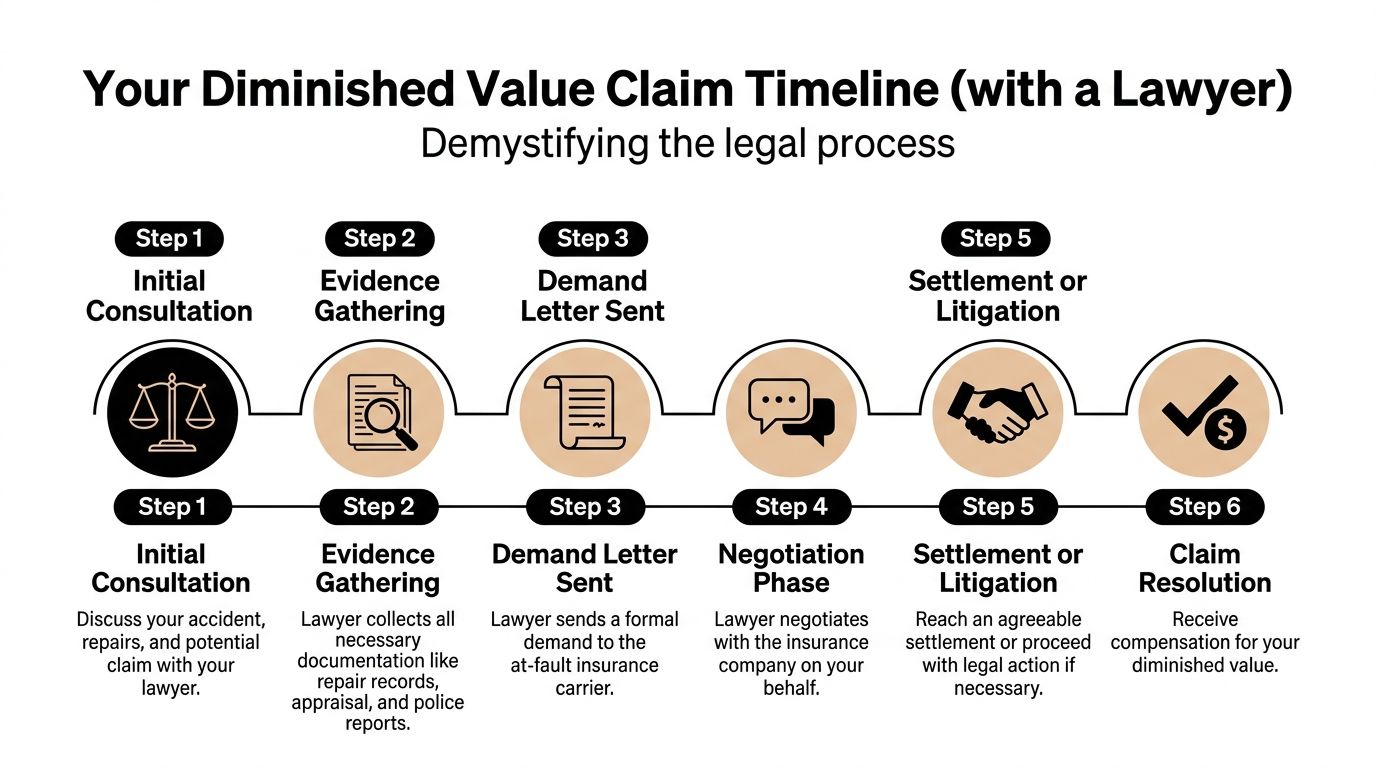
How the file usually gets built
A lawyer typically starts by reviewing the accident facts, repair records, title status, ownership, and any insurer correspondence. If the claim has substance, the next move is usually evidence assembly.
That file often includes:
- Accident documentation such as the crash report, photos, and carrier information.
- Repair proof including estimates, supplements, and final invoices.
- Vehicle background showing mileage, options, condition, and prior history.
- A diminished value appraisal that establishes the claimed loss amount.
Without that last item, many demand letters are just arguments without a damages foundation.
What legal help changes
Once the lawyer has a clean evidence package, the carrier usually receives a formal demand. That matters because a proper demand organizes the theory of the claim, the proof of fault, and the amount sought in one place.
After that, the claim usually moves in one of two directions:
- Negotiation continues. This is common when liability is clear and the dispute is mainly about value.
- Litigation posture develops. This happens when the insurer denies, delays, or takes a legal position that blocks payment.
The appraisal is the number. The demand letter is the pressure.
Third-party versus first-party claims
Most drivers think of diminished value as a claim against the at-fault driver's insurer. That's still the typical route. But Georgia practice has added an important wrinkle.
Georgia legal commentary notes that courts are increasingly recognizing diminished value as recoverable under first-party policies, especially after rulings such as Mabry v. State Farm, which means some drivers may have a path under their own coverage when the insurer accepts fault. That same discussion points out that this area is more complex and often omitted from basic guides, which is why it often requires legal guidance, according to Bayuk Pratt.
That's one reason a lawyer may be essential even when the accident facts seem uncomplicated. The dispute may not be about whether your car lost value. It may be about which insurer has to pay, and under what policy language.
Where an appraisal service fits
This is also where independent appraisal firms can support counsel. For example, Total Loss Northwest provides diminished value appraisal reports and evidence support that can be used in negotiation or claim presentation. That doesn't replace legal advice. It gives the legal claim a valuation foundation.
Understanding Lawyer Fees and Your Settlement
Most drivers hesitate at the same point. They understand the value loss, but they don't want to spend money chasing money.
That concern is reasonable. The answer depends on how the lawyer charges and how difficult the insurer has made the case.
Common fee structures
Diminished value lawyers may use different billing models, depending on the size and complexity of the claim.
The most common structures are:
- Contingency fee where the lawyer gets paid from the recovery if the claim resolves successfully.
- Hourly billing where you pay for time spent on review, negotiation, and litigation work.
- Flat or hybrid arrangements in narrower property-damage matters.
If you want a plain-English comparison of how law firm fee models work, this overview of car accident lawyer price structures is helpful.
The real trade-off
The fee question shouldn't be framed as “Can I avoid paying a lawyer?” It should be framed as “What does the insurer's resistance make necessary?”
If liability is clear and the only missing piece is proof of amount, paying for a strong appraisal may be the smarter first spend. If the insurer has denied the claim, misapplied eligibility rules, or forced the matter toward court, legal fees can become the cost of recovering payment that won't happen otherwise.
Here's the practical way to view this:
- Low-friction claim. Appraisal first. Legal help only if the carrier stalls.
- High-friction claim. Counsel early, because delay and procedural mistakes can weaken your position.
- Unusual vehicle or policy dispute. Expect to need both valuation and legal strategy.
What hurts settlements
Drivers often reduce their own net recovery by making one of these mistakes:
- They hire a lawyer before gathering basic records. That adds time and billable work.
- They skip the appraisal and ask counsel to negotiate a number with no valuation basis.
- They focus only on fee percentage and ignore claim quality. A cheaper lawyer doesn't help if the case is underdeveloped.
- They settle quickly because the process feels annoying. Insurers know that fatigue closes files.
A good fee arrangement should match the posture of the claim. A simple valuation fight doesn't need the same budget as a denied or litigated case.
Georgia Diminished Value FAQs
Can I still file if I was partly at fault
Yes, sometimes.
In Georgia, partial fault can reduce or block recovery depending on how responsibility is assigned. As noted earlier, diminished value may still be recoverable if your share of fault stays below the legal cutoff, but the claim usually stops being just a valuation question. It becomes a liability dispute.
That is a lawyer case more often than an appraiser-only case. An appraiser can measure the loss in market value. A lawyer addresses the harder problem, which is proving why the other driver and insurer still owe part of that loss.
Will a diminished value claim raise my insurance rates
It can, especially if the claim runs through your own policy instead of the at-fault driver's insurer.
The practical move is simple. Before opening a first-party route, ask your carrier how it will code the claim and whether it can affect premiums, renewal, or claim history. Get that answer in writing. Verbal answers from a call center do not help much later if the file is handled differently than you were told.
Can I make a diminished value claim on a leased car
Sometimes, but lease claims require a closer look at who suffered the loss.
With a leased vehicle, the driver, leasing company, and insurer may all have different interests. The key question is who has the legal right to claim the loss in resale value at the end of the lease or after an early payoff. I regularly tell drivers not to guess on this point. Pull the lease agreement, review the loss and ownership language, and determine who can make the claim before sending a demand.
What's the difference between an appraisal clause approach and a lawyer demand letter
They solve different problems.
An appraisal clause is usually a policy-based process for deciding value. A lawyer's demand letter is used to press a legal position, document the basis for payment, and set up the record if the insurer keeps denying or underpaying the claim. If the carrier accepts coverage and only disputes the number, appraisal may be enough. If the carrier disputes fault, policy language, eligibility, or whether diminished value is owed at all, legal help is usually the right next step.
If you are comparing fee structures before hiring counsel, learn pricing for law firms.
If your vehicle lost market value after an accident, Total Loss Northwest can help document that loss with an independent diminished value appraisal and structured evidence support. If the dispute is still about the amount, that may be the right first step. If the insurer has turned it into a legal fight, take that appraisal to qualified Georgia counsel and proceed with proof already in hand.