Your car is in the shop. The other driver caused the crash. You're missing work pickups, rearranging errands, and hearing some version of, “We'll see what the rental situation is.” That's usually the moment drivers start treating transportation as a side issue.
It isn't.
When someone else damages your vehicle, the time you're deprived of it has value. That's what loss of use is about. It's not a favor from the insurance company, and it's not limited to whether you swiped a credit card for a rental. It's part of the property damage claim.
A lot of people lose money here because they focus only on the repair bill. The insurer knows most claimants don't understand the documentation, the formula, or the pressure points. If you do, the conversation changes fast. A strong loss of use rental car claim is built on dates, comparable vehicle proof, and repair records that leave very little room for argument.
Your Accident Was Not Your Fault Now What
The pattern is almost always the same. You report the crash, open the claim, get an estimate, and then the practical problems start stacking up. You still need to get to work. Kids still need rides. Grocery runs don't stop because your SUV is waiting on parts.
Then the adjuster says something vague. Maybe they'll “review rental.” Maybe they'll authorize only a few days. Maybe they act like the issue doesn't exist until the repairs are done. That's where many drivers fall behind, because they start reacting instead of documenting.
What matters in the first few days
Start with a clean file. Save every text, email, estimate, shop update, and claim note. Ask the body shop for intake and expected completion dates in writing. If you need a replacement vehicle, get one that matches how you use your own vehicle, not whatever is cheapest on the board.
Your claim gets stronger when the timeline is simple:
- Date of loss: When the crash happened
- Date vehicle became unavailable: When you reasonably lost use of it
- Date repairs started: When the shop began work
- Date repairs finished: When the vehicle was ready for pickup
Practical rule: If it isn't written down, expect the insurer to question it later.
The mindset shift is important. You're not asking for extra money because the situation is annoying. You're asserting a property damage component caused by the at-fault driver. Handle it that way from day one, and you'll make better decisions about rentals, records, and settlement demands.
Understanding Your Right to Loss of Use Compensation
Think about it this way. If someone damaged your lawnmower and it sat unusable for a while, you lost the use of your property whether you borrowed a neighbor's mower or let the grass grow. A car works the same way, except the disruption is usually much bigger.
Loss of use is compensation for the period when you couldn't use your vehicle. It's separate from the cost to repair the damage. That distinction matters because insurers often try to collapse everything into “Did you spend money on a rental?” That's too narrow.
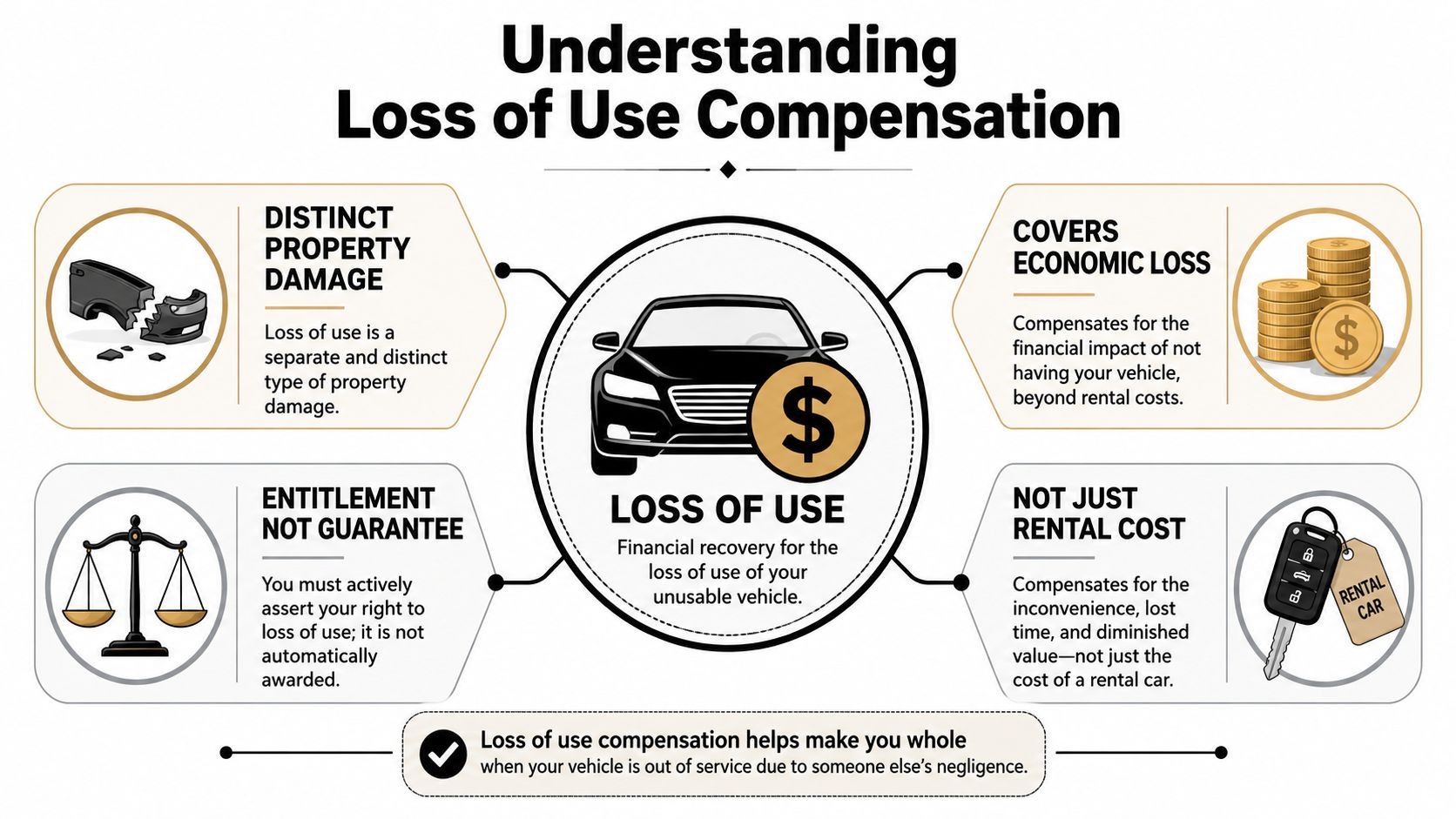
It's about lost use, not just receipts
Courts have recognized that being deprived of a vehicle has inherent value. The principle was reinforced in PurCo v. Koenig on September 10, 2012, where the Colorado Supreme Court held that rental car companies can recover loss-of-use damages regardless of actual lost profits, because loss of the vehicle itself has value. The court also recognized reasonable rental value as the best evidence for those damages, often using the daily rate from the damaged vehicle's actual rental contract, as discussed in this analysis of PurCo v. Koenig and loss-of-use damages.
That case involved rental companies, but the underlying logic is useful for everyday drivers. The point isn't that you had to spend money. The point is that you lost the right to use your property.
What drivers often get wrong
Drivers commonly assume one of these things:
- “I didn't rent a car, so there's no claim.” That's often wrong. Loss of use can exist even without a rental receipt.
- “Any rental counts.” It doesn't. The replacement vehicle should be comparable.
- “The insurer will calculate it fairly on its own.” Sometimes they do. Often they don't.
If you're trying to sort out the difference between coverage that pays for a rental under your own policy and a third-party property damage claim against the at-fault driver, this guide on rental car coverage after an accident helps separate those two issues.
The cleanest way to think about loss of use is this: the law values the time your vehicle was unavailable, not just the cash you spent while it was unavailable.
How Insurers Calculate a Loss of Use Claim
Your car goes into the shop on Monday. The adjuster says they will pay for eight days. The shop finishes two weeks later because teardown revealed hidden damage, the supplement sat waiting for approval, and a needed part arrived late. That gap is where many loss of use claims get cut down.
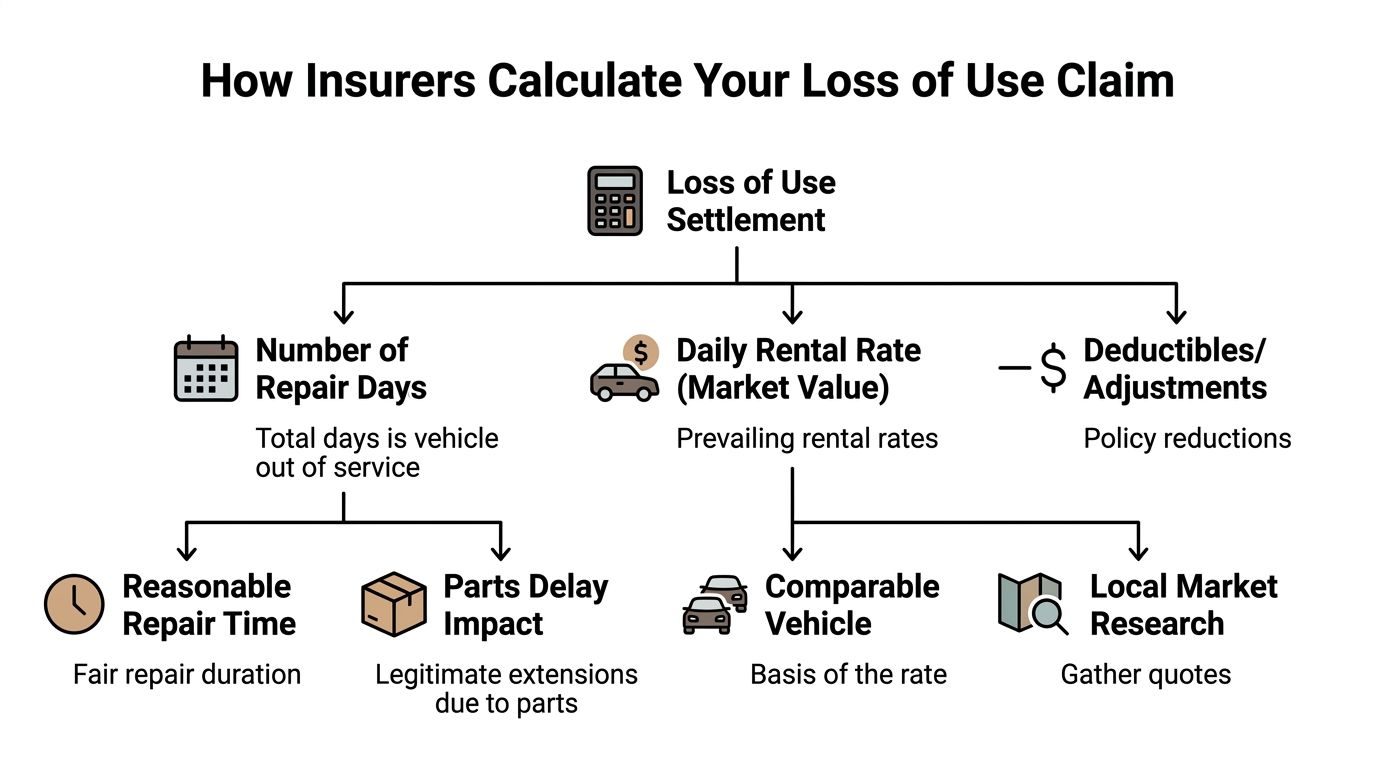
Insurers usually start with two inputs: the reasonable number of days your vehicle was unavailable, and the daily rental value of a comparable replacement. The basic math is straightforward. The arguments are not.
A typical calculation is reasonable out-of-service days × daily rate for a comparable vehicle. The problem is that carriers often try to shorten the time period, downgrade the vehicle class, or both. If you understand those pressure points, you can document the claim in a way that is hard to trim.
The days should match the real out-of-service period
Reasonable repair time is tied to when the vehicle was unavailable for use. It is not whatever number appears in the insurer's internal system.
In practice, adjusters often accept active repair days more readily than delay days. That is why the file needs a clean timeline. If the shop had the vehicle, found additional damage, sent a supplement, and waited on approval or parts, those dates matter. Some delays are legitimate parts of the repair process. Some are not. Your goal is to separate the two with records, not arguments.
Ask the repair shop for dated proof of:
- Drop-off or intake date
- Teardown or disassembly date
- Supplement submission and approval dates
- Parts order and parts arrival dates
- Reassembly and calibration dates
- Completion date
- Date the vehicle was ready for pickup
Those entries let you show exactly why the car was out of service for the period claimed. That same documentation also makes your numbers much stronger if you later send a car accident settlement demand letter.
The daily rate should match a comparable vehicle, not the cheapest car on the lot
This is another common lowball area.
Comparable means comparable in size, function, and use. A family SUV should be matched to a similar SUV or minivan. A work pickup should be matched to a truck with similar utility. If your vehicle had towing capability, wheelchair access, or enough seating for your household, those features are part of the comparison.
| Your vehicle use | Better comparison |
|---|---|
| Family hauler | Similar-size SUV or minivan |
| Work truck | Similar truck class and utility |
| Accessible vehicle | Vehicle with needed accessibility features |
| Towing setup | Vehicle with similar towing capability |
I often see insurers cite an economy-car rate pulled from a discount search. That number may be available somewhere in the market, but it does not answer the right question. The right question is what a reasonable substitute for your vehicle costs in your local area during the loss-of-use period.
Total loss claims use a different time frame
A total loss claim does not have a repair schedule, so the dispute shifts to how long you reasonably needed to secure a replacement vehicle after the crash and valuation process. Courts in some states allow loss-of-use damages on totaled vehicles, and Oregon has recognized that principle, as discussed in this Oregon-focused review of total loss loss-of-use damages.
That does not mean every day until you buy another car will be paid. Carriers usually argue for a shorter window tied to inspection, valuation, payment, and a reasonable replacement period. If you are in Oregon or Washington, state-specific rules and claim handling practices can affect that analysis more than adjusters admit.
A strong loss of use calculation is built from dated shop records and local comparable rental pricing. That is what gives you room to challenge a short pay offer.
Building an Undeniable Claim and Demand Letter
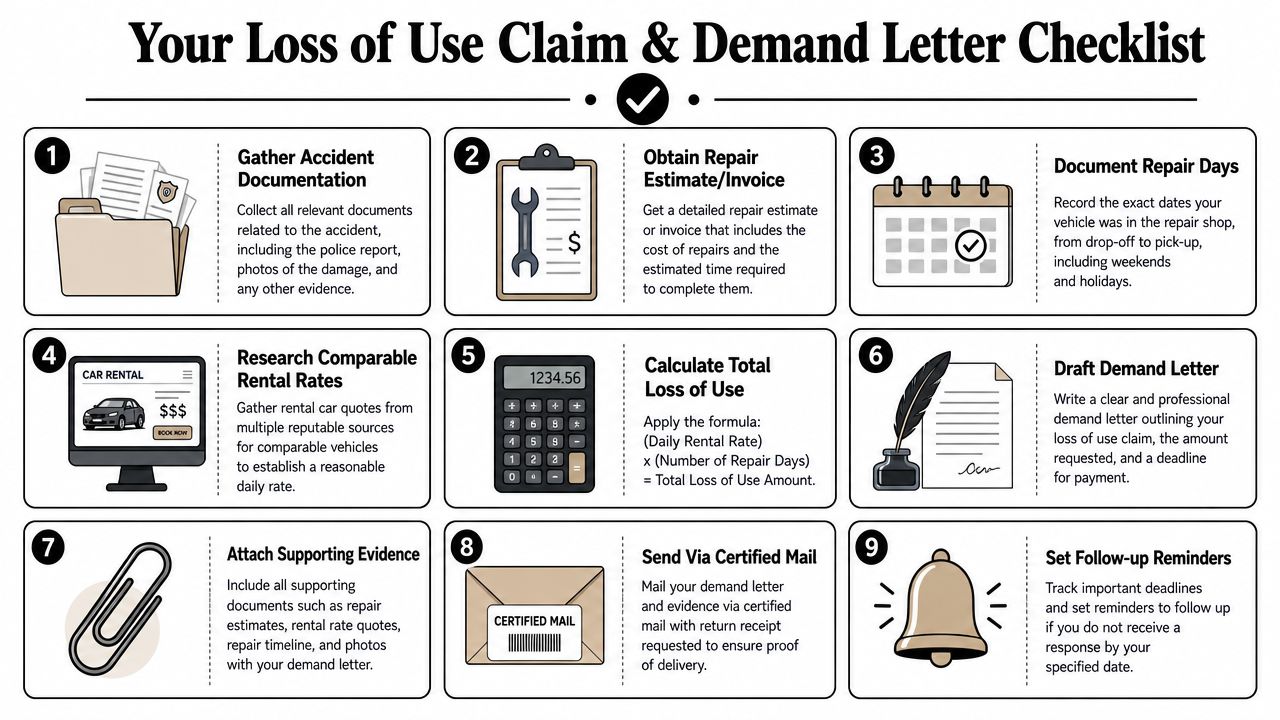
A weak claim says, “I was without my car for a while.” A strong claim shows exactly when the vehicle went out of service, why it stayed out, what a comparable rental costs, and how you calculated the demand.
The documents that move the claim
Start building your package before the repairs are finished. Waiting until the end usually means missing emails, vague shop memory, and incomplete dates.
Gather these items:
- Collision documents. Police exchange information, photos, claim number, and liability confirmation if the carrier has made it.
- Shop estimate and final invoice. You want both. The estimate shows expected scope. The final invoice shows what occurred.
- Repair timeline evidence. Ask for a dated timeline from the shop. Intake, teardown, supplement approval, parts arrival, reassembly, calibration, and completion.
- Comparable rental quotes. Pull quotes for a same-class vehicle from local providers and save screenshots with dates.
- Your written calculation. State the days, the daily rate, and the total demanded.
- Communication log. Keep a one-page chronology of every call and email with the insurer.
A very effective tactic is asking for proof of true repair timing when the insurer or rental company pads the period. Legal standards distinguish loss of use from loss of profits, so you should demand specific repair timeline evidence to expose days when the vehicle wasn't undergoing repair, as outlined in this discussion of repair timeline evidence and disputed downtime.
A demand letter that sounds like you know what you're doing
Before sending your letter, it helps to review a stronger example of a car accident settlement demand letter so your format looks organized and professional.
Use a structure like this:
Sample demand letter
Date: [insert date]
Claim number: [insert claim number]
Insured: [at-fault driver name]
Vehicle: [year, make, model]I am requesting payment for loss of use arising from the collision on [date]. My vehicle was unavailable from [start date] through [end date] due to repair-related deprivation of use.
The vehicle is a [describe class and relevant features]. A comparable rental rate in my market is [daily rate], supported by attached rental quotes.
My loss of use calculation is: [number of days] x [daily rate] = [total amount].
Attached are the repair estimate, final invoice, repair timeline documentation, comparable rental rate support, and related claim correspondence.
Please confirm payment or provide a written explanation for any disagreement with the repair period, comparable vehicle class, or daily rate by [reasonable deadline].
Sincerely,
[your name]
Later in the process, a short explainer can help you keep your paperwork focused.
What makes a file hard to deny
The strongest files don't argue in circles. They show:
- A dated deprivation period
- A same-class rate with proof
- A repair timeline supported by the shop
- A concise written demand
- A deadline for response
That combination gives the adjuster fewer ways to shrink the claim without putting a weak position in writing.
Special Considerations for Oregon and Washington Drivers
Oregon and Washington drivers should treat loss of use as a proof issue first and a negotiation issue second. In both states, “reasonable” is the word that controls most of the fight. Reasonable repair time. Reasonable comparable rate. Reasonable explanation for any delay.
That means your claim shouldn't lean on broad statements about inconvenience. It should lean on records from the body shop, rental market comparisons, and a clean communication trail showing you didn't cause the delay.
What usually matters most locally
In practice, these points carry weight in Oregon and Washington claims:
- Shop-specific timing matters. If the repair facility can explain why the vehicle sat, calibrated, or waited on supplements, the insurer has a harder time dismissing those days.
- Vehicle function matters. A crossover isn't automatically comparable to a pickup. A base sedan isn't automatically comparable to a loaded SUV.
- Delay attribution matters. If the carrier held up approvals, asked for repeated photos, or dragged out supplement review, document it.
Local claims also overlap with total loss and valuation disputes more often than drivers expect. If the property damage side is already becoming a broader fight, Washington drivers can review Washington claim support for vehicle owners for guidance on handling a more contested file.
Don't rely on generic internet advice
A lot of online advice treats every state the same and every car the same. That's how drivers end up accepting economy-car numbers for specialty vehicles or letting the insurer erase days that were supported by the shop's records.
In Oregon and Washington, the practical winner is usually the person with the better timeline, not the louder argument.
For local claims, keep the focus tight. What was the vehicle. When was it unavailable. Why was it unavailable. What would a comparable replacement have cost in your market. That approach travels well with adjusters, supervisors, appraisers, and lawyers.
How to Counter Common Insurance Adjuster Tactics
On Monday, the adjuster says they need more time. On Thursday, they say your SUV should be priced like a compact. The next week, they claim you are owed nothing because you borrowed a family member's car instead of renting one. That pattern is common in loss of use claims. It also gets easier to stop once every response is tied to a document, a date, or a written question they have to answer.
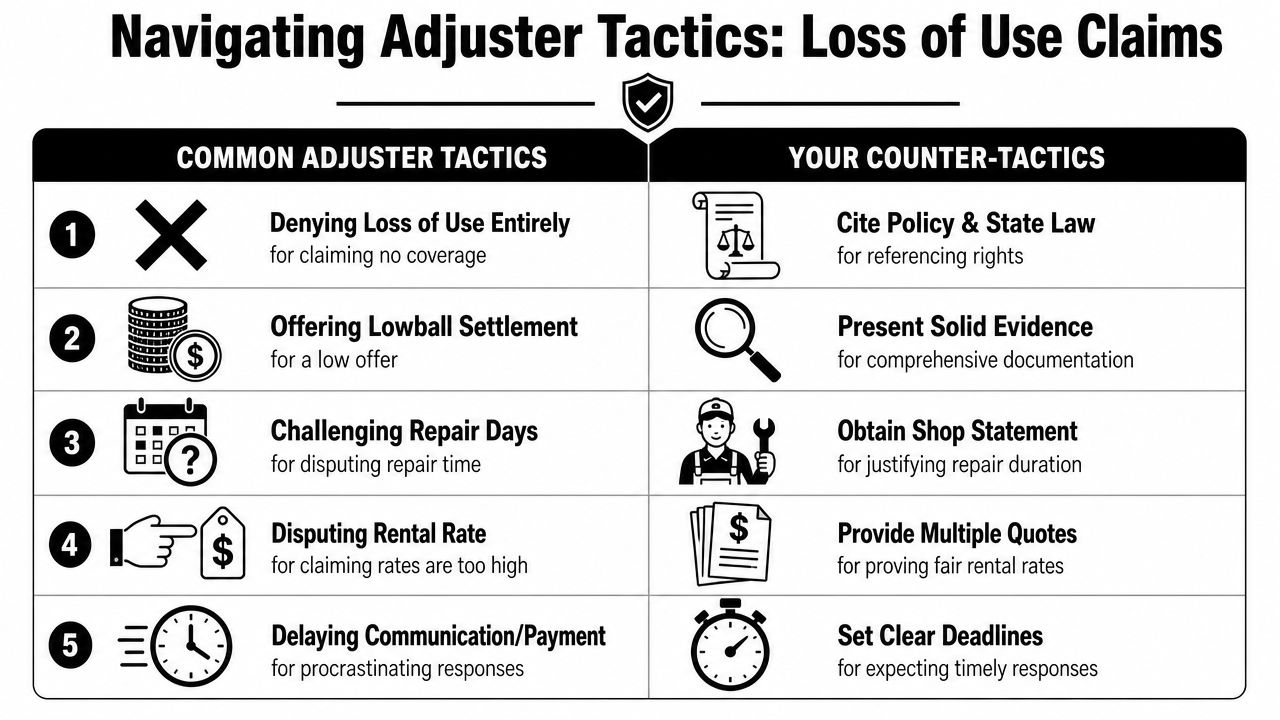
Adjusters usually do not win these disputes with one big argument. They win by trimming the daily rate, cutting repair days, keeping key positions off email, and waiting to see whether the owner gets tired. The fix is to make each point specific enough that a supervisor, Oregon regulator, Washington examiner, appraiser, or lawyer can follow the file without guessing.
Tactic one says no rental means no claim
You may hear, “Since you didn't rent a car, we don't owe loss of use.”
That is a standard low-payment position. Loss of use is generally measured by the reasonable rental value of a comparable replacement vehicle during the period your own vehicle was unavailable. Actual rental expense can support a claim, but the lack of a receipt does not automatically erase it.
Reply in writing and keep it tight:
- State your position clearly. “My claim is for the reasonable rental value of a comparable vehicle during the documented loss-of-use period.”
- Attach your rate evidence. Include local quotes or screenshots for the right vehicle class.
- Force a written answer. Ask, “Please confirm in writing whether your position is that loss of use is unavailable unless I incurred rental charges.”
That last sentence matters. If an adjuster knows the file may be reviewed later, weak verbal positions often change fast.
Tactic two uses the cheapest car on the lot
Another common move is to price your claim as if any vehicle will do. That is how an owner of a pickup, three-row SUV, or higher-trim crossover gets offered a compact-car rate.
Comparability decides this issue. If your vehicle had all-wheel drive, seating needs, cargo capacity, business use, or towing function that affected reasonable replacement cost, say so directly and support it with market quotes from your area. In Oregon and Washington, I have seen carriers back off low rates once the owner shows three local examples for the correct class and asks the adjuster to explain the downgrade in writing.
Use a response like this:
My vehicle is not comparable to the class you used. Please identify the basis for your selected vehicle class and daily rate in writing, and address the attached comparable rental quotes from my local market.
Tactic three attacks the repair period
Many files are often trimmed. The carrier says the shop took too long, parts delay does not count, calibration time should be excluded, or supplement days were excessive.
Sometimes the shop really did cause avoidable delay. Sometimes the insurer caused it by slow approval, repeated photo requests, or a lag on supplements. Do not argue that point in general terms. Build a dated timeline and make them dispute actual entries.
A simple side-by-side works well:
| Adjuster argument | Strong reply |
|---|---|
| “The shop delayed things” | “Attached is the repair timeline showing intake, teardown, supplement submission, approval dates, parts status, calibration, and completion.” |
| “Those days were excessive” | “Please identify the exact dates you dispute and the factual basis for excluding each one.” |
| “We don't pay for waiting time” | “The vehicle remained unavailable during this documented repair-related period. Please specify which days you contend were unrelated to repair or insurer approval.” |
In Oregon and Washington claims, this is often where the file turns. A shop email, supplement log, or parts notice with dates does more work than three angry phone calls.
Tactic four keeps everything verbal
If an adjuster will talk but will not email, that is a claim-handling choice, not an accident. Verbal conversations leave room to change the story later.
Fix that by creating your own record. After every call, send a short email that says what was discussed, what was requested, and what remains disputed. If they do not correct your summary, your email becomes part of the claim history. That matters if the file gets escalated.
Use this pattern:
- Send follow-ups on a schedule. Every few business days is usually enough.
- Confirm every call by email.
- Ask for written positions on rate, days, and comparability.
- Set a response date. A specific date works better than “please respond soon.”
A calm paper trail usually beats a heated conversation.
When to Hire an Independent Appraiser or Attorney
Some loss of use claims are straightforward. Others get tangled with repair delays, total loss valuation, specialty vehicle issues, or an insurer that won't engage fairly. That's the point where doing everything yourself can start costing more than it saves.
You should think seriously about outside help when the dispute stops being about a small difference in days and starts becoming a structural problem in the claim.
Red flags that mean the file is no longer simple
Consider bringing in an independent appraiser or attorney if any of these are happening:
- The insurer won't commit in writing. If every important issue stays verbal, they're preserving flexibility and leaving you with no clean record.
- The offer is obviously disconnected from your evidence. That usually means the adjuster is using an internal shortcut instead of your actual vehicle class and repair timeline.
- Your vehicle is unusual. Collector cars, modified trucks, high-end trims, and specialty-use vehicles often don't fit standard rental comparables.
- The claim overlaps with a total loss dispute. Loss of use can become secondary in the insurer's mind even though it still affects what you're owed.
- Delay is becoming the main issue. If approvals, supplements, or payment timing are driving the deprivation period, the claim may need a more formal push.
What each professional actually does
An independent appraiser is often useful when the core problem is value, comparability, or insurer pricing logic. They can help frame what a proper same-class replacement looks like and support a broader property damage file.
An attorney is usually the better move when liability is being contested, the carrier is denying the claim outright, or the pattern suggests bad-faith handling concerns. Lawyers also help when the insurer knows you have evidence and still refuses to move.
Hiring help isn't admitting defeat. It's recognizing when the other side is no longer treating the claim like a routine property damage matter.
If your file is organized, a professional can step in much faster and do more with it. If your file is a mess, part of what you're paying for is reconstruction. That's another reason to document early, even if you hope you won't need backup.
If you're dealing with a lowballed loss of use, total loss, or diminished value claim in Oregon or Washington, Total Loss Northwest can help you pressure-test the insurer's numbers and build a settlement position backed by real appraisal logic, not carrier shortcuts.