A truck crash claim isn't just an injury claim. It's often a medical case, a liability case, an insurance coverage case, and a vehicle valuation case at the same time. That's why so many people underestimate what's at stake.
The financial scale alone should reset expectations. Data from the Federal Motor Carrier Safety Administration indicates that the average cost of a commercial truck accident in which one person is injured is $148,279, while a fatal trucking accident averages $7.2 million, as summarized in this truck accident settlement analysis. Those figures help explain why trucking companies and insurers move fast, defend hard, and look for every opening to narrow what they pay.
If you're dealing with a truck accident claim, confusion is normal. You may be sorting out medical treatment, a damaged or totaled vehicle, missed work, and calls from adjusters who sound helpful but are building a file. A lot of guides talk only about bodily injury. That leaves out a major part of recovery for drivers in Oregon and Washington, especially when the vehicle was newer, customized, commercial-use, or hard to replace.
For readers trying to understand the bigger picture of auto claim value, this overview of car accident settlement value is also useful context.
Understanding Truck Accident Payouts in 2026
Truck accident settlements and verdicts are larger and more complicated than ordinary car crash claims for a simple reason. The losses are usually broader. The injuries tend to be worse, the evidence is more technical, and the insurance structure is more layered.
A fair payout usually includes more than the emergency room bill and body shop estimate. In serious claims, the core dispute often centers on future medical care, lost earning capacity, pain and suffering, fault allocation, and whether the insurer is undervaluing the vehicle as a total loss or pretending a repaired vehicle suffered no lasting market stigma.
What a payout usually has to cover
Most truck crash recoveries break into a few practical buckets:
- Injury-related losses: medical bills, ongoing treatment, rehabilitation, and income disruption.
- Human losses that don't come with invoices: pain, limitations, distress, and changes in daily life.
- Vehicle losses: repair costs, total loss value, towing, storage, loss of use, and sometimes diminished value after repair.
- Litigation pressure points: evidence disputes, multiple insurers, and arguments over who caused what.
Why drivers get blindsided
People expect the injury side to be complex. They often don't expect the property side to become its own fight. Yet in real claims, the vehicle can represent a major unreimbursed loss if the insurer relies on weak comparables, ignores options and upgrades, or uses formula-driven reports that don't reflect the local market.
Practical rule: Don't measure your case by the first offer. Early numbers are often driven by what the insurer can close the file for, not what the claim is actually worth.
Why Truck Accident Claims Are More Complex
Truck cases operate under a different structure than ordinary auto claims. That structure is why settlement values can be much higher, but it's also why mistakes early in the claim can be expensive.
Federal FMCSA regulations mandate minimum insurance coverage of $750,000 for general freight and up to $5 million for hazardous materials, and truck cases often involve multiple liable defendants such as the driver, trucking company, and cargo loader, which creates a broader recovery pool than a standard car accident, as discussed in this analysis of truck accident settlements in New York.
More money is available, but more defenses appear
A passenger car claim usually centers on one driver and one policy. A truck claim may involve the driver, the motor carrier, a trailer owner, a shipper, a cargo-loading company, a maintenance contractor, or another commercial entity tied to the vehicle and trip.
That shifts the negotiating advantage in two ways. First, there may be more insurance available. Second, every defendant may try to shift blame to someone else.
Federal safety rules create evidence ordinary crashes don't have
Commercial trucking is governed by detailed safety rules. That matters because violations can become powerful proof of negligence. Hours-of-service problems, maintenance failures, inspection gaps, and trip documentation issues can all reshape a case.
When these records exist, the claim stops being a simple dispute over recollection. It becomes a document-driven case.
Trucking insurers rarely treat these claims casually. They know the exposure can be serious, and they build defenses early.
Injury overlap can complicate the claim
Some truck crashes happen while a person is driving for work or traveling between job sites. In those situations, the claim can involve both liability and employment-related issues. People in that position often need a plain-language explanation of how the systems intersect, which is why this guidance for workplace injury patients can help frame the difference between workers' compensation and personal injury claims.
Complexity cuts both ways
The same features that make truck accident settlements and verdicts larger also make them easier to undervalue if the claim is handled too narrowly.
A common example is when a claimant focuses only on the truck driver's conduct. That may miss the company that hired the driver, the company that maintained the equipment, or the business that loaded the trailer. Another example is when the injury claim moves forward but the vehicle claim is treated like an afterthought.
Key Factors That Determine Your Settlement Value
Settlement value comes from two things working together. The first is the scope of loss. The second is the strength of proof.
A serious injury with weak evidence can stall. A moderate injury with excellent proof can move. In truck litigation, clear negligence evidence often changes the tone of the entire claim.
Cases with strong evidence, such as Electronic Logging Device data showing driver fatigue or maintenance records confirming known brake defects, routinely achieve significantly higher settlements, often reaching $15 million to $150 million for catastrophic injuries, according to this guide on how truck accident settlements are determined.
A simple visual helps organize the moving parts.
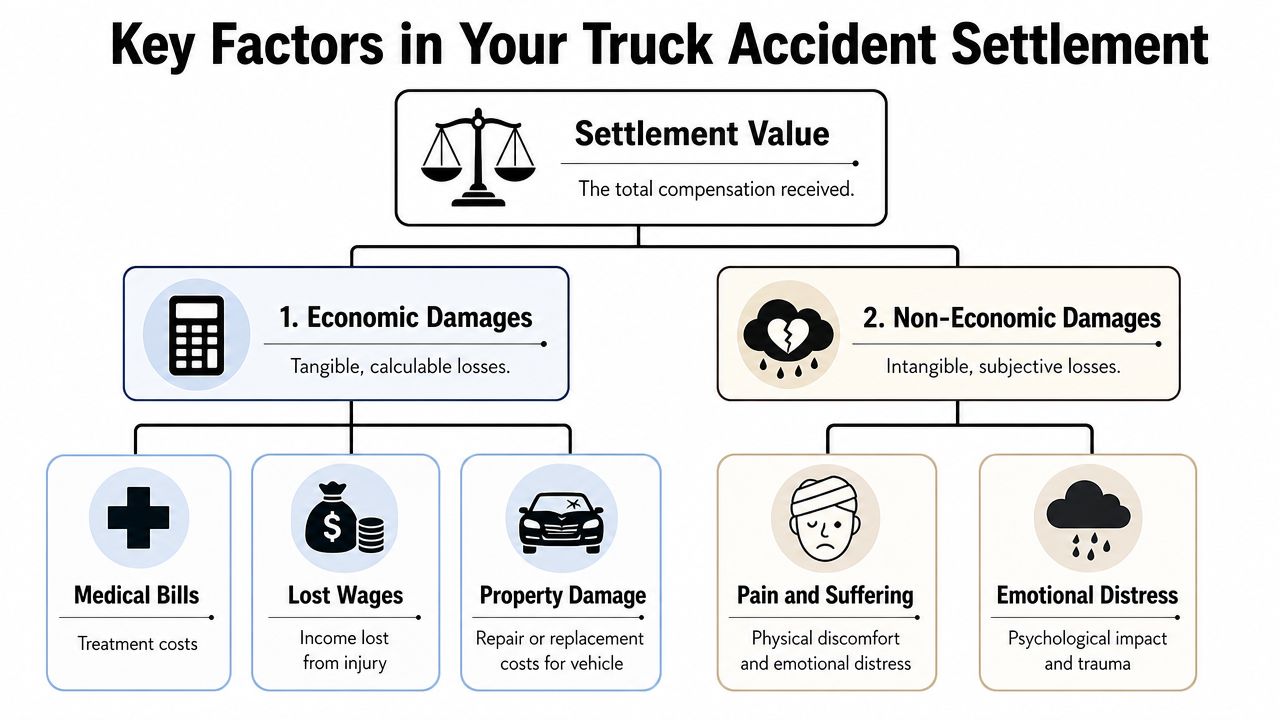
Economic damages are the foundation
Economic damages are the losses you can document in dollars. They usually include medical expenses, lost income, and property damage.
For many drivers, property damage deserves more attention than it gets. If the vehicle is totaled, the central question is pre-loss market value. If it's repaired, the question may shift to diminished value, especially when the vehicle had low mileage, premium trim, custom equipment, or a clean history before the crash.
Other out-of-pocket costs can matter too. In severe injury cases, equipment and home care needs may become part of the damages picture. Anyone trying to understand the cost range of specialized recovery equipment may find this Stryker bed pricing guide from DME Superstore helpful as practical background, even though each case turns on its own records and needs.
Non-economic damages often drive the real negotiation
These are the human losses. Pain. Disruption. Anxiety around driving. Sleep problems. Limits on ordinary activities. The loss of comfort, independence, and routine.
Insurers often resist these damages because they aren't captured by a single invoice. That's why the medical record matters so much. Consistent treatment, specialist notes, imaging, and day-to-day documentation make the claim more credible.
Here's a short breakdown:
| Damage category | What usually matters most |
|---|---|
| Economic damages | Bills, wage records, repair or valuation proof |
| Non-economic damages | Medical consistency, symptom documentation, daily impact |
| Vehicle-specific losses | Market comps, options, condition, repair stigma, appraisal quality |
A practical video overview can help if you want a general explainer before diving deeper into the paperwork.
Evidence moves value more than argument does
Lawyers and adjusters can argue all day. Records decide which side has power.
- ELD data: Can show driving time, rest periods, and whether fatigue may have played a role.
- Maintenance files: Can reveal ignored brake issues, inspection problems, or recurring defects.
- Scene evidence: Photos, skid marks, debris fields, and surveillance footage often matter more than later recollections.
- Vehicle documentation: Pre-loss photos, service records, option lists, and comparable market sales can make a major difference in the property portion of the claim.
The strongest truck claim usually isn't the loudest one. It's the one with the best records.
Truck Accident Settlement And Verdict Examples
Truck accident settlements and verdicts vary widely because injury severity, liability proof, venue, and damages proof all change the result. Still, real verdict data gives useful orientation.
A Jury Verdict Research study found that truck accident victims receive a median compensatory award of $90,000. The same study noted that minor injuries typically range from $20,000 to $100,000, moderate injuries from $100,000 to $500,000, and severe injuries such as paralysis from $500,000 to several million dollars, as summarized in this review of truck accident verdicts.
What those ranges look like in practice
A minor injury case usually involves a shorter treatment course and a cleaner recovery. These claims can still become contentious if the insurer argues the impact was low, the symptoms were temporary, or the treatment was excessive.
Moderate injury cases often involve fractures, disc injuries, or longer disruption to work and daily activity. These are the claims where documentation quality starts to separate a fair result from an undervalued one.
Severe cases are different altogether. Permanent limitations, paralysis, traumatic brain injury, or life-care needs pull the case into a different category. The vehicle damage may be only one part of the loss, but it still shouldn't be ignored, especially when the totaled vehicle was high-value or hard to replace.
Typical truck accident settlement ranges by injury severity
| Injury Severity | Typical Compensation Range |
|---|---|
| Minor injuries | $20,000 to $100,000 |
| Moderate injuries | $100,000 to $500,000 |
| Severe injuries | $500,000 to several million dollars |
Why examples don't equal predictions
Readers often look for one number that tells them what their claim is worth. That's understandable, but it usually leads to bad expectations. Two truck crashes can involve similar visible damage and still have very different outcomes because the records, injuries, and legal posture are different.
A disc injury with strong liability proof may perform differently than a fracture claim with fault disputes. A severe injury claim with disputed causation may settle differently than a moderate injury claim backed by clean records and excellent witnesses.
Use verdict ranges as reference points, not promises. Real value depends on proof, not labels.
The same caution applies to the vehicle side. A total loss figure from an insurer may look precise because it's printed in a valuation report. Precision doesn't mean accuracy. If the comps are weak, the trim level is wrong, the condition rating is inflated against you, or the local market isn't reflected, the report can still be wrong by a meaningful amount.
The Critical Role of Vehicle Value Appraisals
In many truck accident claims, the vehicle is the forgotten loss.
That's a mistake. A driver can resolve the injury claim and still leave serious money behind if the total loss valuation is low or the carrier refuses to recognize diminished value after repairs. This happens constantly with newer vehicles, luxury models, collector cars, trucks with aftermarket upgrades, and vehicles with unusually strong local resale value.
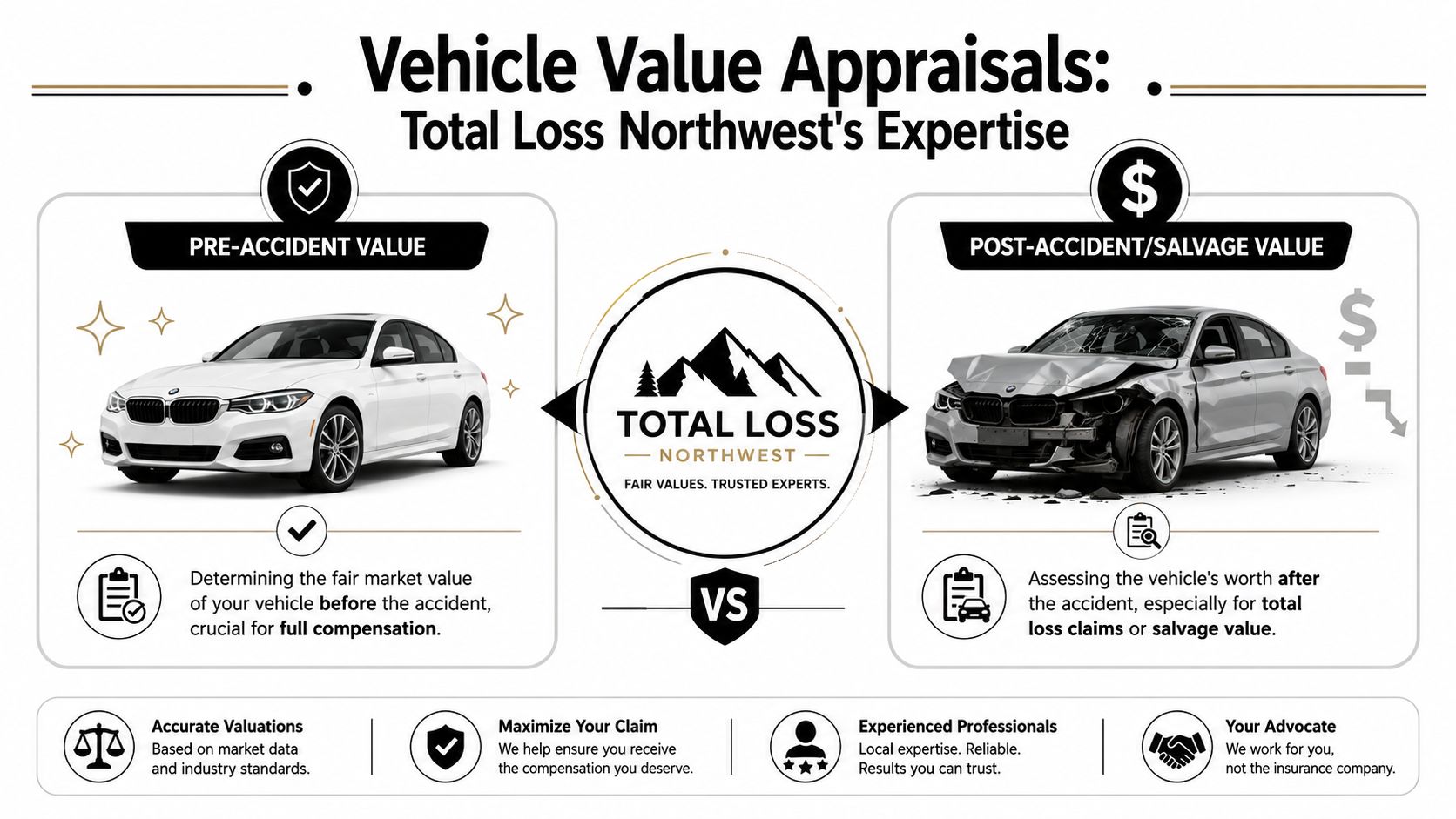
Total loss value and diminished value are different problems
A total loss dispute asks what the vehicle was worth immediately before the crash. Insurers often answer that question with valuation software and selected comparables. Those reports can miss local scarcity, factory options, prior condition, recent service, specialty use, or regional demand.
A diminished value claim applies when the vehicle is repaired but worth less because it now carries an accident history. Even quality repairs don't erase market stigma. Buyers, dealers, and appraisers take prior structural damage and claim history seriously.
Why insurer valuations often fall short
The insurer's process is built for scale and cost control. It isn't built to advocate for your side of the market value question.
Common valuation problems include:
- Bad comparables: wrong trim, wrong mileage band, different condition, or different market area.
- Missing equipment: upgraded wheels, packages, towing gear, tech options, or custom additions omitted from the report.
- Condition downgrades: the carrier rates the pre-loss vehicle as average when it was well-kept or above market.
- Ignoring repair stigma: the claim closes on repair cost alone with no serious analysis of post-repair resale impact.
What works better
A market-based appraisal is usually the cleanest way to challenge a low number. The strongest reports don't rely on broad formulas alone. They document the actual vehicle, the relevant market, and the valuation logic in a way that can survive negotiation.
If you're dealing with a dispute over total loss value or post-repair loss in the Pacific Northwest, a professional vehicle appraisal can help frame the property side of the claim with better evidence than a carrier-generated worksheet.
A vehicle valuation dispute isn't emotional. It's evidentiary. The side with the better market proof usually has the stronger position.
Navigating Oregon and Washington's Legal Landscape
Oregon and Washington drivers face many of the same insurance tactics, but the legal effect of partial fault can differ in ways that directly affect recovery.

Comparative fault changes the math
In plain terms, comparative fault rules determine what happens if the defense says you were partly responsible.
Oregon uses a modified comparative fault system. Washington uses a pure comparative fault system. The practical difference is significant. In one state, crossing the line on fault can bar recovery. In the other, partial fault typically reduces recovery rather than eliminating it.
That matters in truck cases because commercial insurers regularly argue that the passenger vehicle changed lanes unsafely, followed too closely, stopped suddenly, or failed to react. The more room the defense has to assign fault to you, the more pressure they can apply to reduce the claim.
Deadlines matter more than most people think
Filing deadlines also impact the strength of a case. A claim that feels active in conversation can still become legally weak if the formal deadline is approaching and no suit has been filed. Property disputes can drift for months while the injury side develops. That delay can create problems if nobody is tracking the litigation calendar.
Drivers in Washington who are sorting through property valuation problems alongside liability issues may find this Washington claim support resource useful for the vehicle side of the process.
Local rules affect strategy, not just paperwork
The biggest mistake I see in regional claims is treating fault rules and vehicle valuation as separate topics. They're connected.
If the defense pushes comparative fault, every part of the claim is under pressure. That includes bodily injury and property damage. A weak total loss valuation combined with a fault reduction can leave a driver substantially short of a fair result, even when the truck driver plainly caused most of the harm.
Steps to Maximize Your Truck Accident Recovery
The best claims usually start with disciplined early decisions, not dramatic ones.
Pursuing only the driver yields significantly lower settlements than cases where the motor carrier, shipper, or maintenance contractor are also named, and adding those entities can exponentially increase verdicts due to deeper liability and higher policy limits, according to this discussion of truck accident settlements.
A practical checklist after a truck crash
Get medical care promptly. Gaps in treatment create arguments that you weren't seriously hurt or that something else caused the problem.
Preserve the scene record. Keep photos of vehicle damage, roadway position, debris, skid marks, cargo, and the truck's identifying numbers if you have them.
Document the vehicle before it disappears. Save photos, service records, upgrade receipts, purchase paperwork, and screenshots of comparable listings. This becomes critical in a total loss or diminished value dispute.
Be careful with recorded statements. The opposing insurer isn't calling to help you value the claim. They're building defenses.
Identify every possible defendant early. Don't assume the truck driver is the only responsible party. The carrier, maintenance vendor, shipper, or loader may matter just as much.
Challenge weak valuation reports. If the total loss number doesn't match the actual market, push back with evidence. For drivers dealing with lowball property offers, this Leverage Auto Appraisals total loss guide offers a helpful overview of how to approach the dispute.
What usually does not work
Waiting for the insurer to “do the right thing” rarely works. So does assuming the property damage will sort itself out once the injury claim settles.
Truck accident settlements and verdicts improve when the claim is built deliberately. That means stronger liability proof, full defendant identification, and a serious approach to vehicle value.
If you're in Oregon or Washington and the insurer is lowballing your total loss payout or ignoring diminished value, Total Loss Northwest helps drivers challenge weak valuations with certified independent appraisals. Their work focuses on real market value, appraisal clause support, and the vehicle side of the claim that too many accident cases leave underpaid.