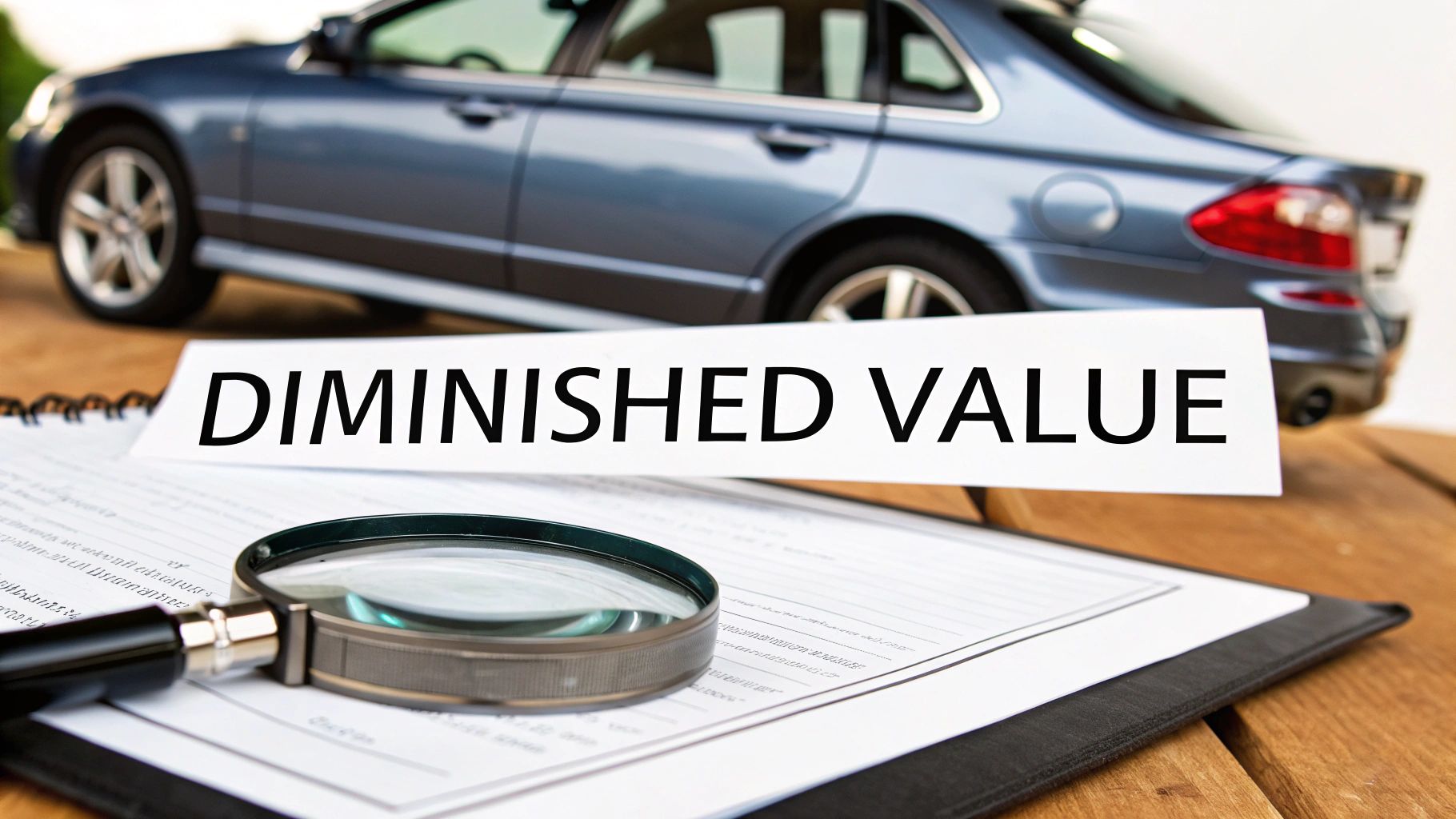
Cars on U.S. roads are older than ever. The average age of vehicles on the road reached 12.8 years in 2025, up from 9.1 years in 1996, and that trend is still climbing according to this vehicle age analysis.
If you've just been in an accident, that number isn't trivia. It's an advantage.
Insurance adjusters still talk about age like it's an automatic discount. They look at a ten, twelve, or fifteen-year-old vehicle and act like the conversation is over. It isn't. The market often sees an older vehicle survive because it was reliable, maintained, and still useful to buyers. That's exactly why blanket depreciation logic breaks down.
A lot of owners make the same mistake after a loss. They hear, "It's an older car," and they start negotiating from a defensive position. Wrong move. Age alone doesn't define market value. Real-world replacement cost, condition, service history, trim, demand, and scarcity do.
If your insurer is treating your vehicle like just another old car, you're already behind. The average age of cars on the road tells you something important: older vehicles are no longer the exception. They're the market.
Why the Average Car Age Matters to You
The phrase average age of cars on the road sounds abstract until an insurer uses your vehicle's age against you.
That's when this statistic becomes personal. You file a total loss claim or a diminished value claim, and the carrier frames your car as "older," "high mileage," or "past peak value." That framing is designed to make a low offer sound reasonable.
Age is not the same as low value
A vehicle's age tells you almost nothing by itself. A well-kept older car with clean condition, documented maintenance, desirable options, and strong local demand can hold far more value than an insurer's software wants to admit.
Insurers like broad assumptions because broad assumptions are cheap. They let a valuation system push older cars down fast, even when the local market says otherwise. That gap is where owners lose money.
Practical rule: If the adjuster keeps repeating your car's age, push the conversation back to market evidence and condition.
Your car may belong to a stronger market segment than the insurer admits
Older vehicles now fill a huge part of the transportation market. Buyers rely on them. Families keep them longer. Owners repair them instead of replacing them. And for certain models, finding a clean replacement isn't easy at all.
That matters after an accident because insurance claims are supposed to reflect what your vehicle was worth before the loss, not what a simplistic age-based curve says it should be worth.
Consider what usually gets missed:
- Condition history: A car with consistent maintenance records should not be lumped in with neglected examples.
- Replacement difficulty: If comparable vehicles in your area are scarce, the value floor rises.
- Owner investment: Tires, major services, and careful upkeep often support stronger market appeal even on older vehicles.
- Survivor status: Cars that stay on the road for years often do so because buyers still want them.
The right mindset after an accident
Stop apologizing for your car's age.
If your vehicle was still dependable, still marketable, and still in demand before the accident, the insurer doesn't get to erase that with one line in a valuation report. Your job is to challenge age-based undervaluation with facts about the market your vehicle lived in.
That's how you move from reacting to the insurer's number to attacking the logic behind it.
Understanding the Record-Breaking Age Trend
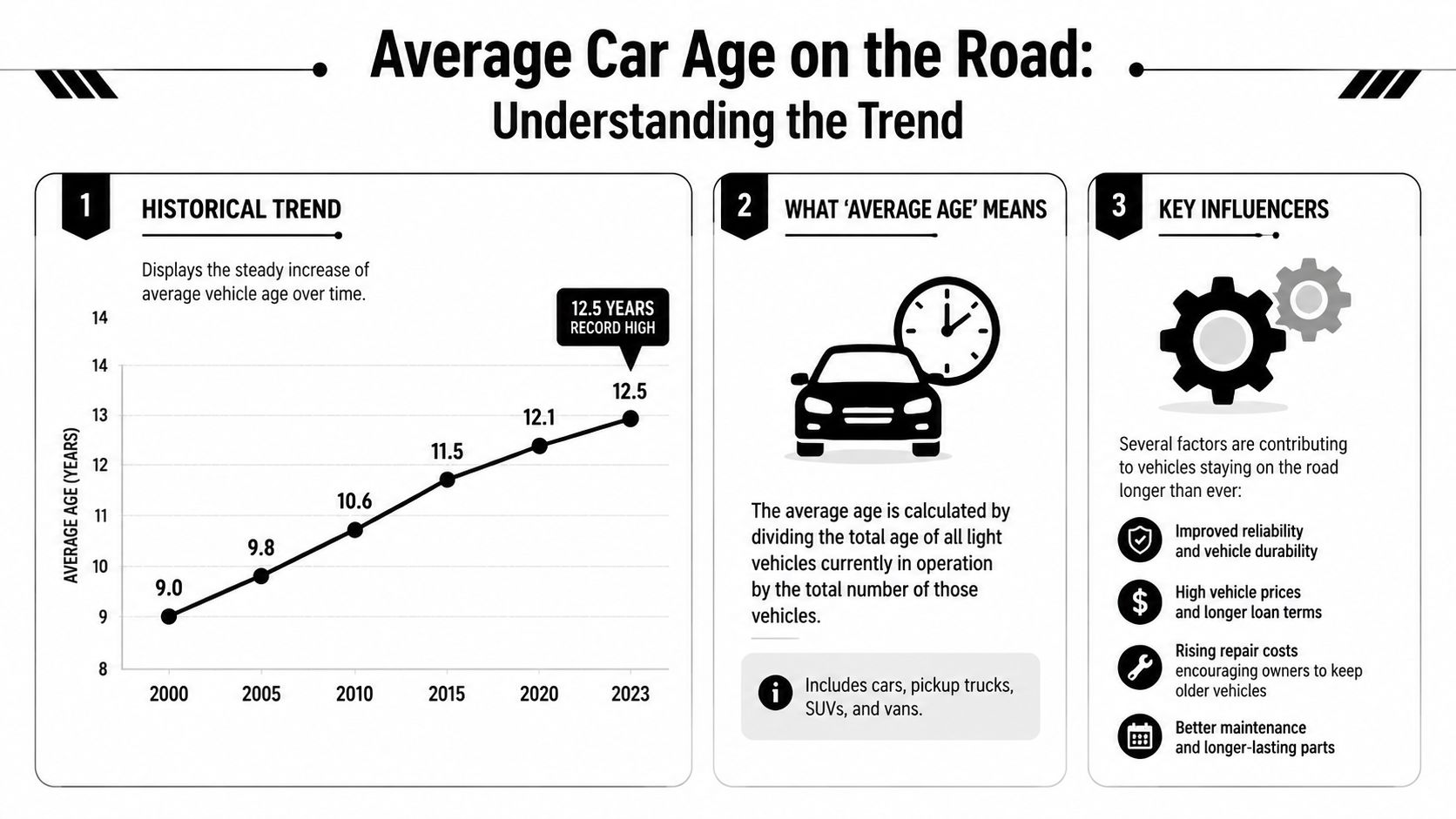
The fleet is older than the valuation models many insurers still use. The average vehicle on U.S. roads is now at a record age, and the trend keeps climbing, as noted earlier in this article. That changes the meaning of "old" in a claim.
What the metric actually means
Average age is a fleet measure. It combines newer vehicles, middle-aged daily drivers, and long-kept survivors that are still licensed, insured, and in regular use.
That matters because insurers often treat a 10-, 12-, or 14-year-old vehicle as if it sits outside the normal market. It does not. A vehicle in that age range now sits much closer to the center of the actual fleet than many claim systems admit.
Here is the practical reading of the number:
| Common insurance assumption | What the age trend actually supports |
|---|---|
| A vehicle near the average is close to the end of its useful life | Many vehicles beyond that age remain serviceable, saleable, and actively traded |
| Older age automatically means weak market value | Older age often reflects durability, owner retention, and continued demand |
| Standard depreciation should control the payout | Actual local comparables and condition should control the payout |
This trend changed the baseline
A rising average vehicle age is not trivia. It is evidence that the market has adjusted. Owners keep vehicles longer, repair them longer, and shop for used replacements in older age bands than they did years ago.
That shift matters after a loss. If the whole market accepts older vehicles as normal transportation, then an insurer cannot fairly value your car as if age alone made it marginal.
A well-kept older vehicle can sit in a healthy replacement market and still get undervalued by an automated report. That is exactly why survivor vehicles get shortchanged. The software sees a date on the title. The market sees a clean, maintained example that would cost real money to replace.
Why this belongs in your claim file
Use this trend to attack weak valuation logic. If an adjuster leans on age as the reason for a low number, force the discussion back to the current market standard.
Focus on four points:
- Your vehicle's age is less unusual than the insurer suggests
- An older fleet means older comparables are part of the mainstream market
- A maintained survivor should be compared to similar maintained vehicles, not rough examples
- Any report that overweights age and underweights condition deserves scrutiny
The baseline has moved. Many insurance valuation systems have not. That gap is where lowball offers happen, especially on older cars that were still dependable, presentable, and hard to replace before the accident.
Key Forces Behind America's Aging Fleet
Passenger cars are aging especially fast. In the U.S. light-duty vehicle parc, passenger cars reached an average age of 14.5 years in 2025, while light trucks averaged 11.9 years, as reported in this analysis of passenger car and truck age differences.
That split matters because it tells you something insurers often ignore. Sedans and traditional passenger cars aren't disappearing because they're worthless. They're staying in service because owners keep them, use them, and replace them less often.
Better vehicles stay alive longer
Modern vehicles generally last longer than people used to expect. Better manufacturing, stronger drivetrains, improved corrosion protection, and more durable components all contribute to longer useful life.
That doesn't mean every old car is valuable. It means age by itself no longer proves decline. If a vehicle has been maintained and remains desirable, the market treats it differently than an outdated depreciation table does.
Owners hold onto cars for practical reasons
A lot of people choose to keep a known, reliable vehicle rather than gamble on a replacement. That's especially true when the existing car is paid off, well serviced, and fits the owner's needs.
Claims professionals need to understand that reality. An older car isn't automatically a disposable asset. For many households, it's a carefully preserved one.
Four forces that keep vehicles on the road
The aging fleet comes from several pressures working together:
- Durability improved: Cars and trucks now remain usable for much longer than older valuation habits assume.
- Replacement got harder: Owners often decide that maintaining a known vehicle is smarter than chasing another one with unknown problems.
- Recent shortages changed behavior: Many drivers learned the value of keeping a dependable vehicle when replacement options tightened.
- Transition hesitation exists: Some buyers delay switching platforms and keep their current gas-powered vehicle longer.
Why passenger cars deserve special attention in claims
Passenger cars aging to 14.5 years tells you something important. A sedan that's still on the road at that age may represent a stable and intentional ownership pattern, not a distressed one.
That affects total loss and diminished value analysis in practical ways:
| Vehicle trait | Why it matters after an accident |
|---|---|
| Long ownership history | Suggests consistent maintenance and known condition |
| Older passenger car status | Places the vehicle in a durable market segment, not necessarily a weak one |
| Clean pre-loss condition | Supports stronger comparable value |
| Hard-to-find replacement examples | Undercuts lowball settlement logic |
When a car survives this long, ask why. The answer is often value, not neglect.
An adjuster may see age and stop there. You shouldn't.
How Rising Vehicle Age Impacts Your Insurance Claim
The most important fact in this entire discussion is this: 68.5 million U.S. vehicles are now 20 years or older, and that group represents 23% of the entire light vehicle parc, according to this report on the 20-plus-year vehicle population.
That destroys the lazy assumption that older vehicles have little market relevance. They clearly do.
The insurer's model often breaks on survivor vehicles
A survivor vehicle is the older car that remains on the road because owners kept it up and buyers still want it. These aren't theoretical vehicles. They're everywhere.
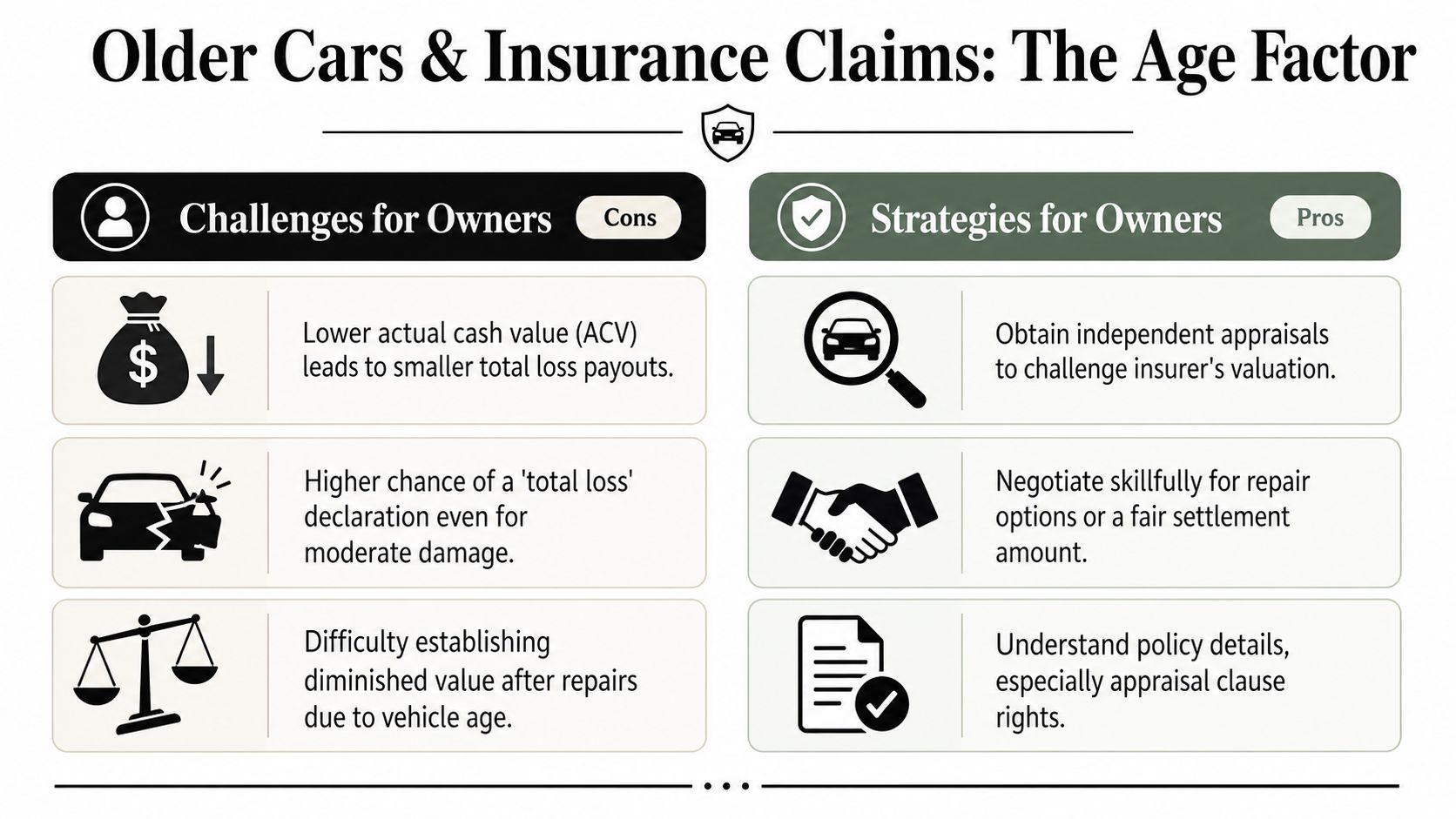
Insurance valuation systems still tend to treat age as a nearly automatic negative. That creates a serious problem in claims involving older Toyotas, Hondas, trucks, wagons, specialty trims, and clean commuter cars that have proven they can keep going. If the system assumes your vehicle should be cheap because it is older, the opening offer will often miss the actual market.
The problem gets worse when the insurer uses poor comparables, weak condition adjustments, or distant listings that don't reflect your local market.
Scarcity changes the claim math
Replacement inventory matters. If there aren't many comparable vehicles nearby with similar condition and history, the value doesn't collapse just because the model year is older.
That's why older cars often get undervalued in two specific claim types:
- Total loss claims: The carrier may call the vehicle a total loss and then understate what it would cost to replace it with a similar one.
- Diminished value claims: The carrier may argue an older vehicle has no meaningful loss in market appeal after repairs, even when buyers would plainly pay less for an accident-repaired example.
If you're dealing with post-repair value loss, review how car depreciation after an accident affects an insurance payout. The key issue isn't age alone. It's whether the accident changed what a buyer would pay now.
What adjusters say and what you should say back
Here is the usual lowball pattern:
| Adjuster position | Better response |
|---|---|
| "It's an older vehicle" | "Older vehicles make up a large, active market. Show me true local comparables." |
| "It had already depreciated" | "Depreciation doesn't erase pre-loss market value or post-repair stigma." |
| "There aren't many comps" | "Scarcity can support value. Lack of inventory isn't proof of low value." |
If the insurer can't replace your vehicle for the amount offered, the offer is weak. That's the test that matters.
The first offer often reflects software logic, not market logic. For survivor vehicles, that gap can be substantial. Owners who challenge it with documentation, comparables, and appraisal rights usually put themselves in a far stronger position than owners who just argue emotionally.
A Practical Guide to Getting a Fair Settlement
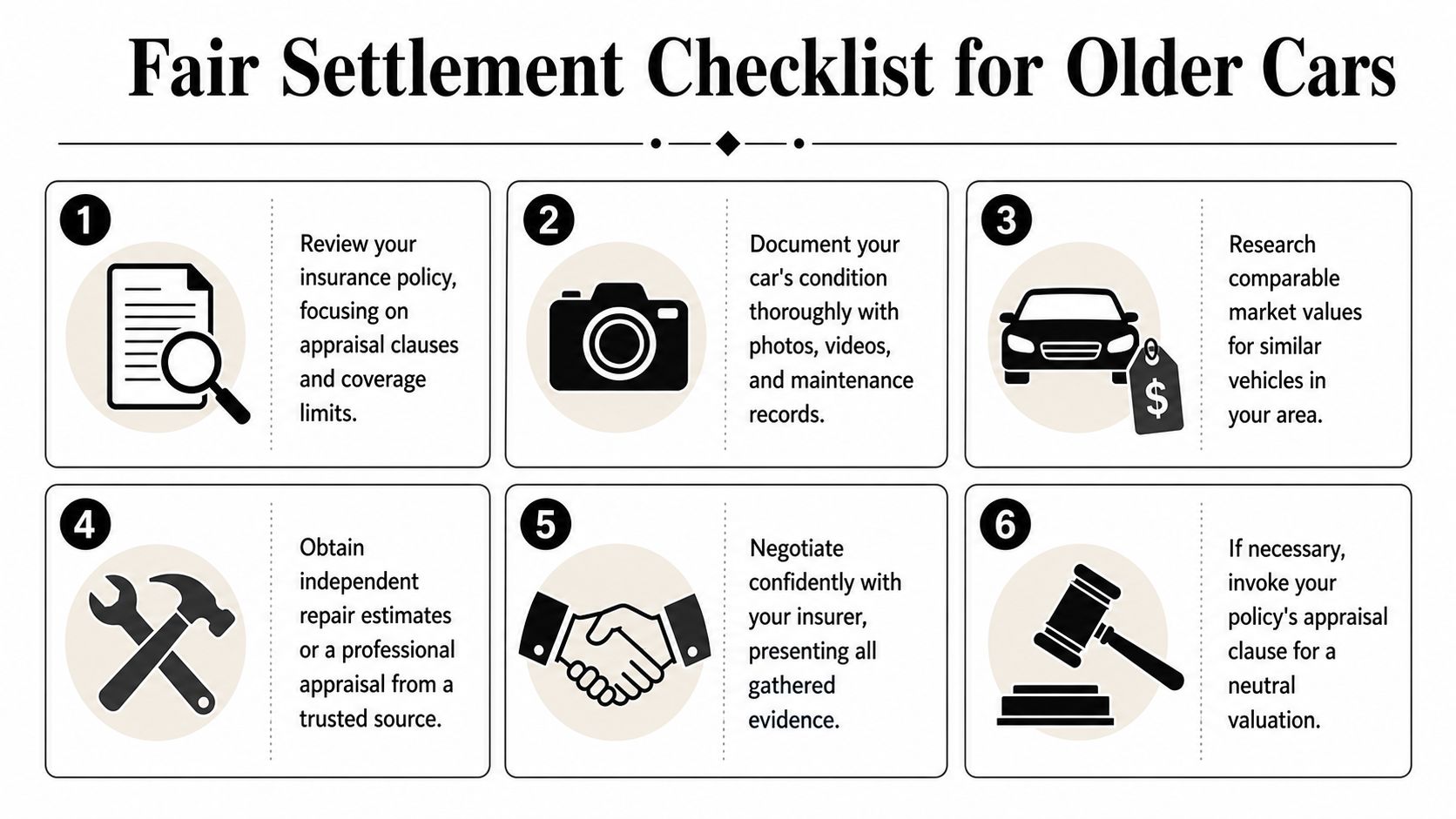
You don't need a speech. You need a file.
The strongest claim files are organized, local, and specific to the vehicle that was damaged or totaled. That's how you push the discussion away from software-generated shortcuts and back toward actual market value.
Start by tearing apart the valuation report
Don't skim the insurer's report. Audit it.
Look for comparable vehicles that are far away, in worse condition, different trims, or missing relevant equipment. Check whether the condition adjustments make any sense. If your car had strong service history, clean interior, recent tires, or major maintenance, those details should not disappear.
Use this checklist:
- Check the comparables: Are they similar in trim, condition, drivetrain, and overall appeal?
- Check geography: A local market matters more than a generic regional spread.
- Check condition notes: If the report assumes average or rough condition and your car was better, challenge it.
- Check omitted features: Packages, accessories, and documented upkeep can matter.
A useful supporting record is a vehicle inspection report and how it helps establish condition.
Use direct language in negotiation
Most owners talk too much and concede too early. Keep it clean.
Say things like:
- "The market for this vehicle is defined by longevity and replacement scarcity."
- "Your valuation doesn't reflect comparable vehicles in my area."
- "Age alone is not a valid reason to discount documented condition."
- "I want the basis for each adjustment in writing."
That changes the tone. You're no longer asking for sympathy. You're demanding support for the number.
Ask the insurer to explain every deduction line by line. Weak reports fall apart when someone has to defend them in plain English.
Know when to stop arguing and invoke appraisal rights
If the carrier keeps circling back to the same weak report, stop trying to win by repetition. Move to the next tool available under the policy.
For many owners, that means using the appraisal clause. This is especially important in states such as Washington and Oregon, where a formal valuation dispute often benefits from a detailed, independent market analysis instead of insurer software.
Here is where people go wrong. They wait too long, or they think invoking appraisal sounds aggressive. It isn't. It's a contract process.
A broader reason this matters is that vehicle markets are local. The EU average vehicle age reached 12.3 years in 2024, while Japan was at 9.2 years in 2023, according to this international vehicle age comparison. Different regions produce different ownership patterns and replacement markets. That is exactly why a state-specific appraisal beats a generic depreciation formula.
If the carrier has gone beyond lowballing and moved into outright resistance, this overview of what to do when an insurance company denied car claim is a useful companion resource.
A quick explainer can also help if you're sorting through your options before pushing back:
Take Control of Your Vehicle's True Value
The rising average age of cars on the road changes the argument after an accident. An older vehicle is no longer evidence of weak value by default. In many cases, it's evidence that the vehicle remained useful, desirable, and difficult to replace.
That matters because insurers still lean on old valuation habits. They treat age as if it settles the issue. It doesn't. Condition matters. Local demand matters. Comparable availability matters. Survivor status matters.
If your offer feels low, trust that instinct and verify it. Pull the valuation apart. Review your policy. Build a condition file. Force the carrier to justify every adjustment. If they can't support the number with real market evidence, don't accept it.
One of the best starting points is understanding how fair market value is calculated after a total loss. Once you understand the method, weak assumptions become easier to spot.
You don't need to accept "it's an old car" as the final answer. You need evidence, influence, and the willingness to use the appraisal process when the insurer won't move.
Older doesn't mean worthless. In this market, it often means the insurer's first number deserves a hard challenge.
If you're in Oregon or Washington and the insurance company is lowballing your total loss or diminished value claim, Total Loss Northwest can help you challenge the number with an independent appraisal built on real market evidence. Their work focuses on Appraisal Clause disputes, total loss valuations, and diminished value claims so you can stop arguing with insurance software and start working from a defensible number.