You open the claim email, see the insurance company's number, and know right away it won't cover what you lost. Maybe your vehicle was repaired but now carries accident history. Maybe it was declared a total loss and the valuation looks nothing like the actual local market. Maybe the adjuster keeps repeating what their software says, as if that settles it.
That's usually the point where people feel stuck. They assume the company has already decided what the claim is worth. It hasn't. It has made an opening position.
A demand letter changes the posture of the claim. Done right, it's not a rant and it's not a casual complaint. It's a formal record that tells the insurer exactly what happened, what documents support your position, what amount you're demanding, and what comes next if they don't resolve it. It forces the conversation onto evidence, policy language, and value.
For vehicle owners in Oregon and Washington, two issues get missed constantly in ordinary claim advice. The first is Diminished Value, which is separate from repair costs. The second is the Appraisal Clause, which can take valuation out of the insurer's software-driven process and put it into an independent appraisal process. If you don't raise those issues correctly, you can leave money on the table without realizing it.
If you're trying to learn how to write demand letter language that gets attention, start before the writing. The letter is the final product. The hard part is building a file that the adjuster can't dismiss with a canned response. Every important sentence in your letter should point to proof you already have in hand.
Introduction
A strong auto insurance demand letter starts with discipline. Most weak letters fail before the first sentence because the owner writes from frustration instead of from the file. I understand the frustration. You paid premiums, cooperated with the claim, sent photos, answered calls, and still got a number that doesn't reflect your vehicle's real value.
That's exactly why the letter has to be strategic.
The insurer is looking for gaps. Missing photos. No clean timeline. No independent valuation. No separation between repair costs and diminished value. No proof that the low total loss offer misses real comparable vehicles. If those gaps exist, the company can keep the discussion vague and keep the offer low.
A demand letter works when each factual statement is tied to a document the insurer can verify.
For auto claims, the writing usually comes last. First, build the claim around three things:
- Facts that don't move. Date of loss, location, involved parties, police report, repair history, vehicle details.
- Liability support. Photos, report language, statements, and insurer correspondence.
- Damages support. Repair invoices, storage bills, towing, rental, appraisal report, and any other loss tied to the accident.
If your dispute involves a repaired vehicle, don't assume the repair invoice proves the whole loss. It doesn't. A vehicle can be fully repaired and still suffer market stigma. That lost resale value is often the center of the dispute.
If your dispute involves a total loss, don't assume the insurer's valuation software used the right comparables or accounted properly for options, condition, mileage, or custom work. In practice, that's where many low offers start.
The best demand letters don't sound dramatic. They sound organized, documented, and ready for the next step.
Preparing Your Case Before You Write
Before you draft anything, gather the file as if someone else will have to review it cold. That “someone else” could be a claims supervisor, an appraiser, a mediator, or a judge. If your documents are scattered, your argument will be too.
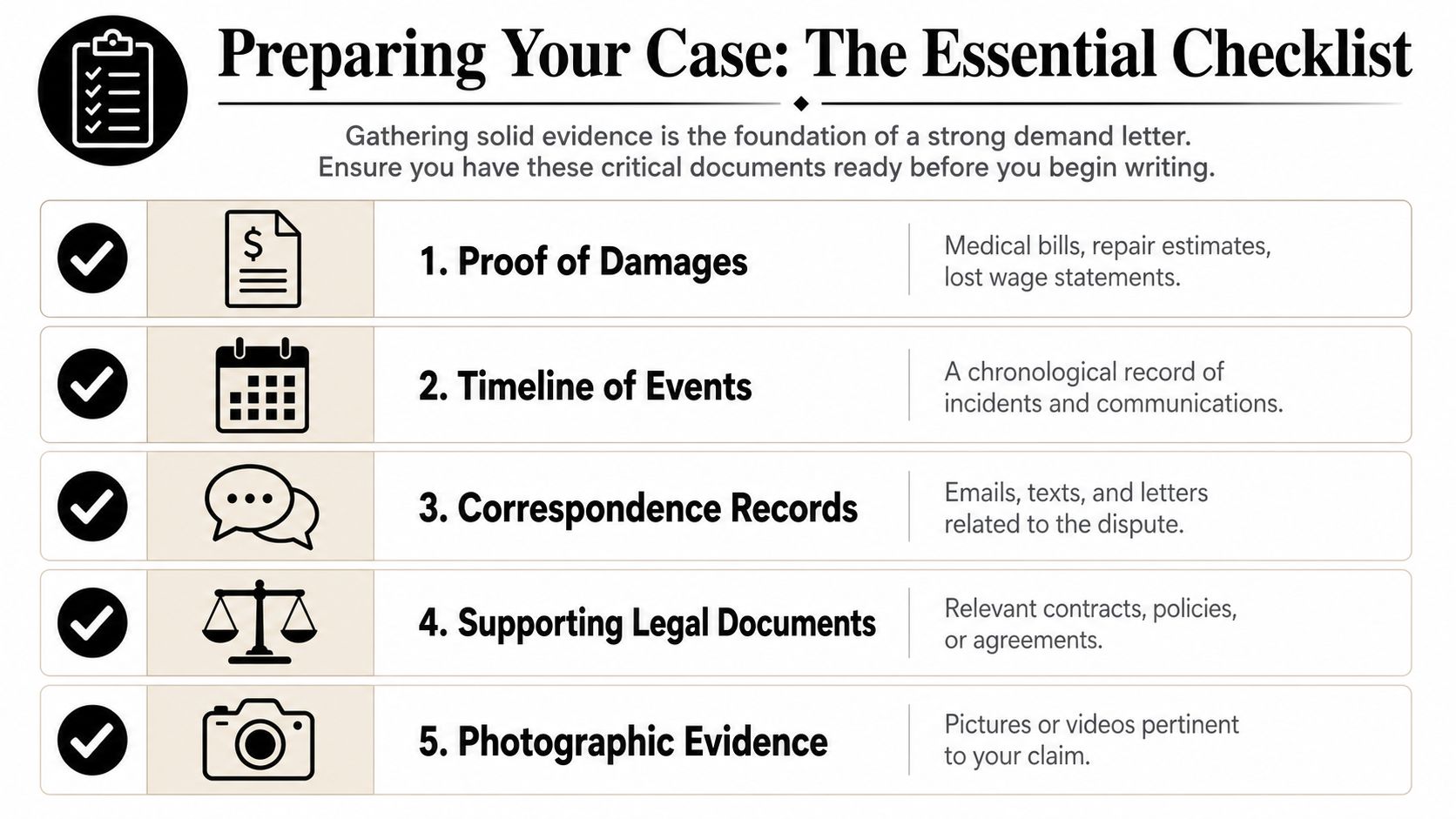
Gather the core records
Start with the documents that establish the claim itself.
- Accident proof. Police report, incident exchange sheet, scene photos, and damage photos.
- Vehicle records. Title, registration, VIN confirmation, prior condition records, maintenance history if relevant.
- Insurance communications. Emails, letters, claim notes you received, valuation reports, repair approval messages, and denial language.
- Cost documents. Repair estimate, final repair invoice, towing, storage, rental, and out-of-pocket receipts.
- Valuation support. Independent appraisal report for diminished value or total loss disputes.
If your evidence includes images or video from the scene, it helps to log where each file came from and when it was created. A simple download evidence documentation form can help you keep that record straight, especially when you're attaching multiple files and want the package to stay organized.
For a practical way to assemble claim records in one place, use an auto claim documentation guide and keep exhibit names consistent from the start. “Exhibit A” should stay “Exhibit A” everywhere.
Build the file around proof, not opinion
The insurer doesn't need your anger to evaluate the claim. It needs a package that removes excuses.
A demand letter that includes five technical elements, a single specific dollar amount, a deadline of 15 to 21 days, at least two relevant statutory citations, a clear statement of next steps, and proof of delivery by USPS certified mail, reached a 74% response rate within 30 days, compared with 41% for letters missing any one of those elements, according to Terms.law's analysis of demand letters.
That finding matters before you write, because each of those elements depends on preparation. You can't demand one precise number unless you've already calculated it. You can't cite law responsibly unless you've checked what applies to your claim. You can't describe next steps if you haven't decided whether you're prepared to invoke appraisal, negotiate further, or file.
Organize by issue, not by date alone
Chronology matters, but claim disputes usually turn on categories. I recommend separating your file into:
| Category | What belongs there | Why it matters |
|---|---|---|
| Liability | Report, photos, statements | Shows fault clearly |
| Repair loss | Estimates, invoices, supplements | Proves physical damage cost |
| Diminished Value | Appraisal, market analysis, before-and-after value support | Establishes post-repair loss |
| Total loss value | Valuation report, comparable vehicles, options, condition evidence | Challenges low ACV offers |
| Correspondence | Emails, letters, adjuster responses | Shows what was said and when |
Practical rule: If a sentence in your future demand letter can't point to a document, rewrite the sentence or get the document first.
Anatomy of an Effective Demand Letter
A demand letter should read like a business document, not a diary entry. Keep it tight. A properly written demand letter should be 1 to 3 pages long, which legal writing standards identify as enough space to present the facts clearly without burying the point, according to MC Law PLLC's guidance on demand letters.
Use the format adjusters expect
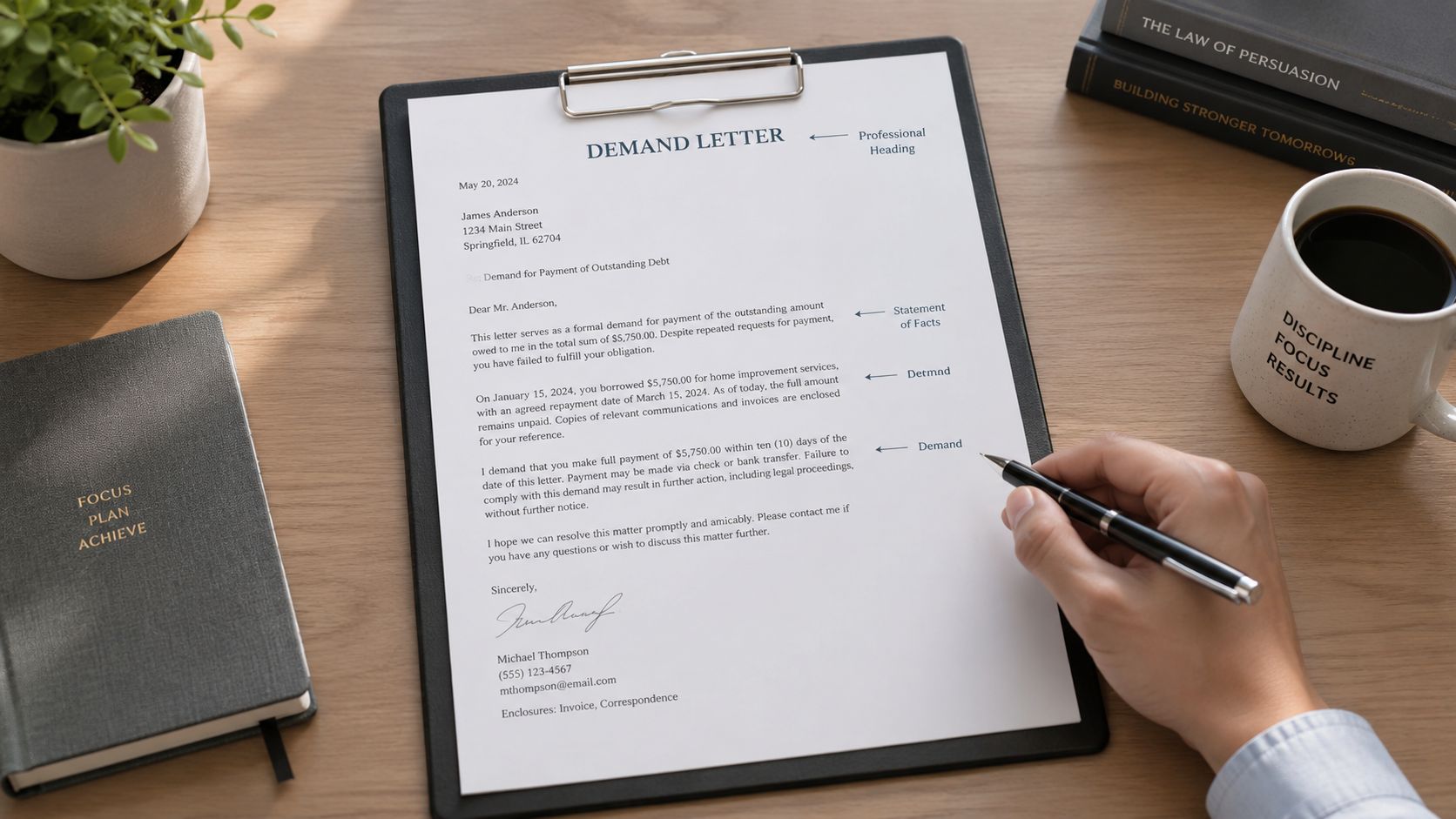
A clean demand letter usually has these parts:
Your heading
Your name, address, phone, email, and the date.Recipient block
Adjuster name, insurance company, mailing address, and claim number.Subject line
Vehicle owner name, date of loss, claim number, insured name if needed.Opening paragraph
State why you're writing and what the letter demands.Statement of facts
A short chronological summary of the collision and resulting damage.Liability section
Explain fault using report facts and evidence, not adjectives.Damages section
Separate repair loss, total loss value dispute, diminished value, rental, towing, and other supported items.Demand section
State one exact amount and a firm response date.
Sample phrasing that works
Re: Claim No. ______ / Date of Loss ______ / Vehicle ______
I am submitting this formal demand for payment arising from the collision on [date]. The evidence attached establishes liability and documents the full measure of my damages, including the vehicle's diminished value [or disputed total loss value].
For the facts section, keep the narration short.
On [date], your insured struck my vehicle at [location]. The collision and resulting damage are documented in the attached photographs, repair records, and claim correspondence. The sequence of events is further reflected in Exhibit A and Exhibit B.
For liability, stay specific.
Liability is supported by the crash documentation and the physical damage pattern shown in the attached exhibits. My vehicle was lawfully operating when the impact occurred, and the record places fault on your insured.
Focus the money section on vehicle value
Many letters fall apart when people list inconvenience, frustration, and general unfairness, then never prove the actual value loss.
If the vehicle was repaired, the central question is usually diminished value. A repaired vehicle can still sell for less because accident history affects market perception. The proper demand doesn't say, “my car isn't worth as much now” and stop there. It points to a before-and-after valuation analysis.
If the vehicle was declared a total loss, the central question is fair market value. The insurer may rely on a valuation product that uses weak comparables, misses option content, or fails to account for custom modifications and actual local asking prices. Your demand has to show where the insurer's number breaks down.
Here's the structure I recommend:
- State the category of loss clearly. Total loss dispute or diminished value claim.
- Identify the supporting exhibit. Appraisal report, comparable vehicle list, repair invoice, photos.
- Tie the exhibit to the demand amount. Don't assume the reader will make the connection for you.
The attached certified appraisal report identifies the vehicle's market value based on relevant comparable vehicles and vehicle-specific condition factors. That report supports the demand amount stated below.
What to leave out
A demand letter gets weaker when it includes any of the following:
- Long emotional narratives that don't add proof
- Ranges instead of a number
- Unlabeled attachments
- Threats you don't intend to follow through on
- Arguments about fairness without valuation support
If you're learning how to write demand letter language for an auto claim, remember this. The strongest letter is easy to scan, hard to rebut, and built around documented value.
Calculating and Justifying Your Financial Demand
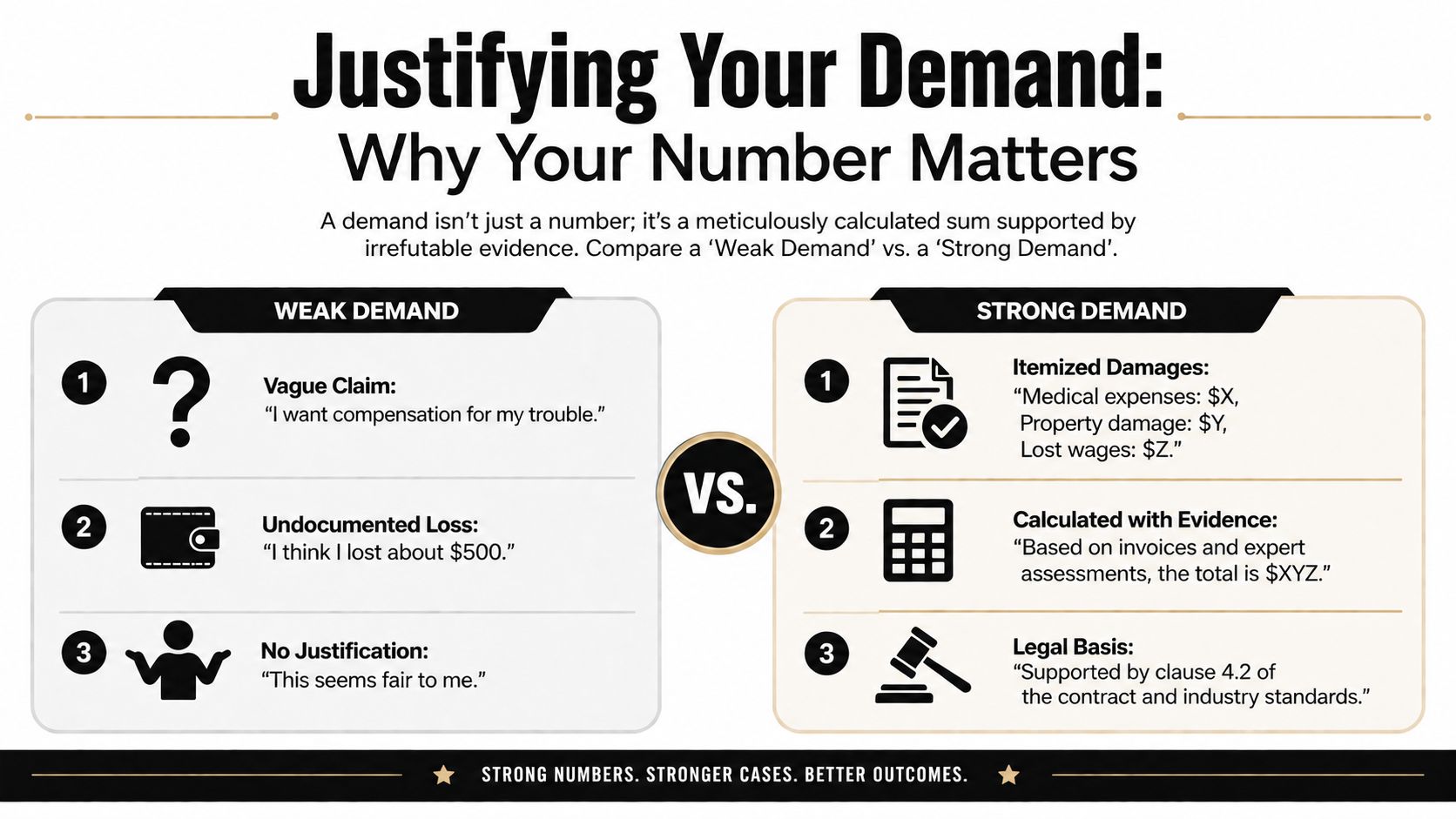
The number in your demand letter has to feel inevitable. Not inflated. Not guessed. Not emotional. I want the adjuster to see the amount and understand exactly how you got there.
Diminished Value needs its own calculation
A lot of owners make one expensive mistake. They demand repair reimbursement and assume that closes the vehicle side of the claim. It doesn't if the car lost market value after the accident.
A 2025 NAIC report indicates that 68% of Diminished Value claims are denied initially because the demand letter lacks a specific before-and-after market value gap analysis backed by a certified appraisal report, as summarized in Nolo's discussion of demand letters and supporting proof.
That's the inside track on why so many valid DV claims stall. The insurer isn't just looking for repair bills. It's looking for a valuation method it can't dismiss as speculation.
Your demand should separate these ideas:
| Item | What it proves |
|---|---|
| Repair invoice | What it cost to fix the vehicle |
| Post-repair photos | Repair completion and condition |
| Certified appraisal report | The market value loss that remains after repair |
| Comparable market data | Why the before-and-after gap is real |
Don't blend repair cost and diminished value into one vague number. They are different categories of damage.
Total loss valuation requires local market discipline
In a total loss claim, the insurer's report may look polished and still be wrong. I see that when comparable vehicles aren't comparable, when condition adjustments are off, or when custom work is ignored.
An independent appraisal is crucial. A credible report addresses the actual vehicle, not a software average. It should account for trim, options, mileage, pre-loss condition, and the actual market for similar vehicles in your area.
If you need context on what goes into a realistic number, this breakdown of car accident settlement value is useful for separating vehicle-related losses from broader claim elements.
A short reference in the letter can look like this:
My demand is based on the attached appraisal report, which analyzes the vehicle's fair market value using relevant comparables and vehicle-specific characteristics. The insurer's current valuation does not reflect that market evidence.
Later in the claim, some owners also ask whether non-vehicle damages belong in the same conversation. If bodily injury is part of the file, this explanation from Lein Law Offices on pain and suffering gives a plain-language overview of when that category enters the case. Keep it separate from your vehicle valuation analysis so the property side stays clean.
Here's a useful explainer on presenting a supported demand:
Tone affects the number more than people think
An angry letter makes the number look negotiable because it suggests the demand came from emotion. A factual letter makes the number look earned because it shows the calculation.
Compare these:
“Your offer is ridiculous and insulting. I know my car is worth way more than that.”
Versus:
“The valuation attached to your offer does not reflect the vehicle's actual market value. My enclosed appraisal identifies the applicable comparables and supports the demand amount stated in this letter.”
The second version is harder to sidestep because it points straight back to evidence.
Mastering the Tone and Professional Phrasing
The adjuster doesn't need to believe you're upset. They already know that. What they need to see is that your file is clean, your position is documented, and your next step is credible.
Expert benchmarks for demand letters emphasize avoiding emotional language, using standard business letter format, organizing content with clear headings, and labeling exhibits consistently so the reader can move straight from assertion to proof, according to Aaron Bruner Law's guidance on effective demand letters.
Phrases that weaken a claim
These usually sound strong to the writer and weak to the reader:
- “You people are trying to cheat me.”
- “I demand justice immediately.”
- “Everyone knows your valuation is fake.”
- “If you don't pay, I'll see you in court.”
The problem isn't just tone. It's that none of those lines proves anything.
Phrases that hold up better
Use wording that identifies facts, documents, and action.
Fault language
“Your insured failed to yield, as reflected in the crash documentation and attached evidence.”Value dispute language
“The current valuation does not reflect the vehicle's market value as supported by the enclosed appraisal.”Diminished Value language
“In addition to repair costs, the vehicle sustained measurable post-repair market value loss documented in the attached report.”Deadline language
“Please provide a written response by [specific calendar date].”
Keep the letter firm, respectful, and boring. Boring letters get paid more often than dramatic ones because they read like records, not arguments.
Presentation matters
Use a standard business format. Choose a normal font such as Arial or Times New Roman. Label your attachments in the letter exactly the way they appear in the exhibit packet. If you write “see Exhibit C,” the reader should find Exhibit C instantly.
A professional tone also helps later if the claim escalates. When someone reviews your letter outside the initial adjustment process, clean phrasing makes you look prepared and reasonable. That matters.
Proper Delivery and Follow-Up Strategy
A well-written letter that you can't prove was delivered quickly loses its effectiveness. Delivery is part of the strategy, not an administrative chore.
Sending a demand letter by certified mail with return receipt requested is the most effective method because it creates legally verifiable proof of delivery. Approximately 90% of successful pre-litigation settlements involve documented delivery proof, according to People's Law guidance on demand letters.
How to send it
Use a methodical process:
- Print the signed letter and the exhibit list.
- Make a complete copy for yourself before mailing.
- Send by USPS Certified Mail with Return Receipt Requested.
- Keep the mailing receipt and returned proof of delivery with your claim file.
- Send a same-day email copy if you have the adjuster's email and note that the hard copy was sent by certified mail.
The response deadline should be a specific calendar date, not something vague like “within ten days of receipt.” Specific dates remove arguments later about when the clock started.
What to do after mailing
Once the letter is sent, stop chasing emotionally and start tracking formally.
- Mark the deadline on your calendar. Don't rely on memory.
- Save every reply in one folder. Email, voicemail transcription, scanned mail, all of it.
- If the date passes without a real response, send a short follow-up email referencing the certified letter and the delivery record.
- If the insurer rejects the valuation without addressing your evidence, that often signals the dispute is moving from routine adjustment to formal valuation conflict.
That's where the claim changes shape. A demand letter isn't always the finish line. In many vehicle value disputes, it's the document that sets up the next and more powerful move.
Your Next Move When Insurers Push Back
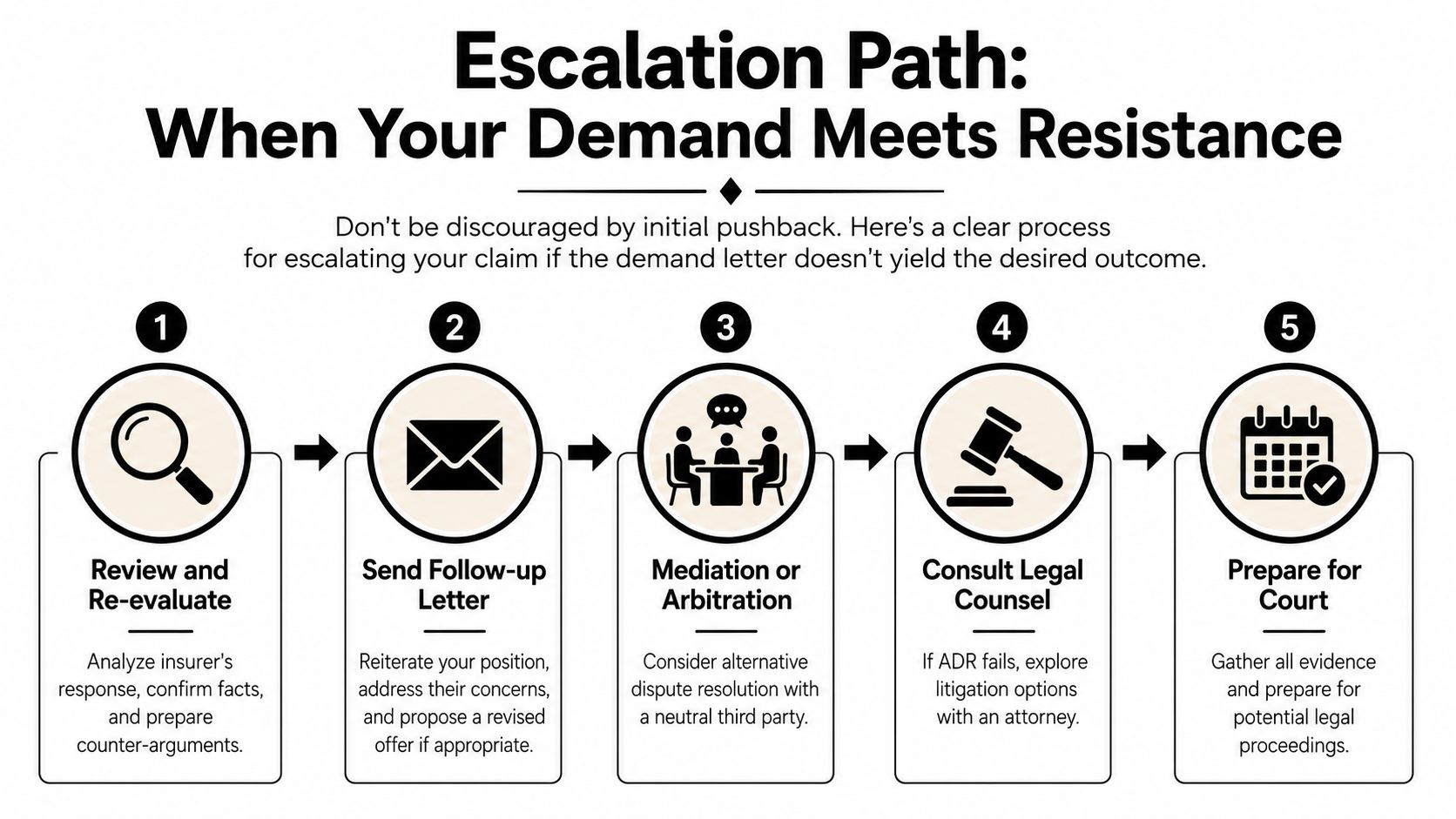
A low counteroffer doesn't always mean the claim failed. Often it means the insurer wants to see whether you'll fold. If the company ignores your valuation support or keeps repeating a software number, move the dispute to the policy mechanism that was built for this exact problem.
Invoke the Appraisal Clause when value is the real dispute
The Appraisal Clause is one of the most underused tools in auto property claims. It matters most when liability isn't the issue and the primary dispute is over value.
That strategy is especially important in custom, collector, and higher-value vehicle claims. 2025 industry data indicates insurers' AI-driven valuation tools undervalue custom modifications by 15% to 30% on average, which is why a formal demand for third-party appraisal can be critical, as described in People's Law School's demand letter discussion.
When you invoke appraisal, you are no longer asking the insurer to voluntarily rethink its own number. You are demanding that the valuation dispute be handled under the contract process. That shifts the advantage.
A practical escalation path looks like this:
- Review the denial or low counter carefully. Is the insurer disputing fault, or only value?
- Respond in writing. State that the valuation remains unsupported by the evidence you provided.
- Invoke the Appraisal Clause if the policy allows it. Do this clearly and formally.
- Retain an independent appraiser. Total Loss Northwest handles appraisal-clause vehicle valuation disputes and diminished value appraisals in Oregon and Washington.
- Prepare for the next forum. That may be appraisal, mediation, small claims, or attorney review depending on the file.
For drivers trying to sort out the escalation process, this guide on how to contest an insurance claim gives a useful overview of the steps after an insurer pushes back.
Know when to bring in legal counsel
If the insurer is disputing liability, misrepresenting policy language, or refusing to engage with documented proof, legal advice may be the right next step. The same is true if deadlines matter, if multiple damage categories are in play, or if the claim has crossed from ordinary negotiation into a broader coverage dispute.
For Oregon and Washington drivers, the practical point is simple. Don't let the insurer collapse everything into one generic property damage number. If your vehicle was repaired and lost value, demand diminished value separately. If the total loss offer doesn't match the actual market, challenge the valuation method. If the company refuses to budge and the policy includes appraisal rights, use them.
The insurer's software is not the final word on what your vehicle was worth.
A demand letter is strongest when it does more than complain. It lays the record, preserves your position, and sets up the next move with purpose.
If your insurer is undervaluing a total loss or ignoring diminished value after repairs, Total Loss Northwest provides certified auto appraisals for Oregon and Washington vehicle owners and can help document fair market value for negotiation or appraisal-clause disputes.