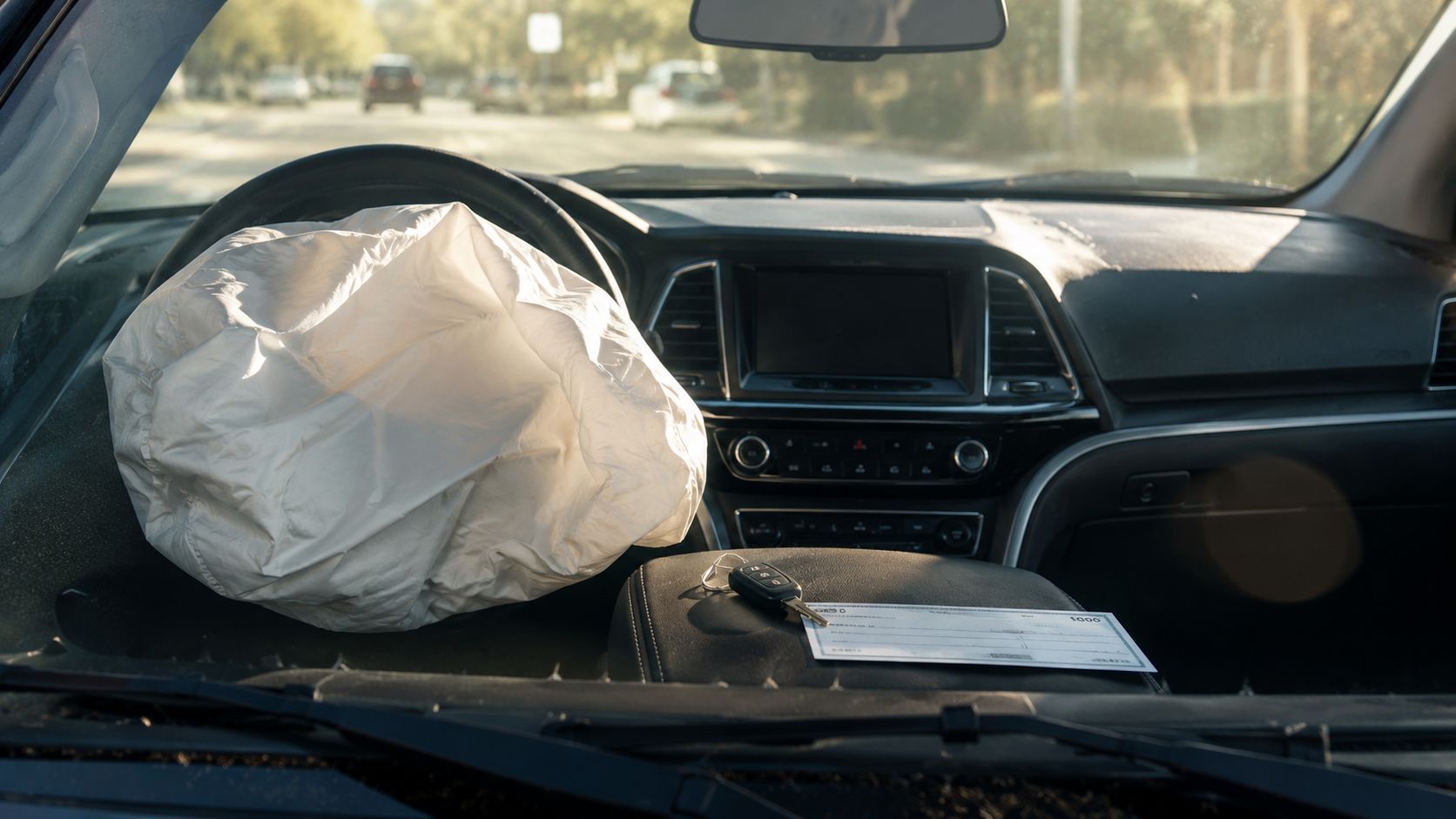
You've had a crash. The front end looks repairable. The doors still open. The car may even start. But the airbags blew, and suddenly the adjuster starts talking like the vehicle is probably done.
That's where many drivers get blindsided.
People often assume airbag deployment means the car is automatically totaled. It doesn't. What happens is more frustrating and more technical. The insurer looks past the bent bumper and cracked grille, then starts adding up all the less visible safety-system costs attached to the airbag event. That's usually where the claim turns.
A cautious driver in Oregon or Washington can get stuck in a bad spot fast. The insurer may frame the decision as simple, when it's really based on a valuation formula, line-item repair choices, and state-specific law. If you don't understand those pieces, it's hard to tell whether the total loss decision is fair, whether the value is too low, or whether the repair estimate overlooked important safety work.
The phrase airbag deployment total loss is significant. It isn't just about whether the bags went off. It's about how insurers value the whole claim after that happened.
Introduction to Airbag Deployment and Total Loss
A common scene goes like this. You're driving home, someone turns in front of you, and you hit the brakes too late to avoid contact. The impact feels moderate, not catastrophic. The hood is crumpled, the bumper is hanging, and both front airbags deploy exactly as they should.
A day later, you start hearing two different messages. The body shop says the visible damage doesn't look terrible. The insurance company says the vehicle may be a total loss. To most drivers, that sounds contradictory.
It isn't.
Airbags are safety devices, not cosmetic parts. Once they deploy, the repair conversation changes. The insurer isn't just pricing a new steering wheel cover or dashboard panel. They're looking at the airbag units, related sensors, diagnostic components, interior trim, and the work needed to restore the safety system properly. A car can look fixable while still being economically impractical to repair.
That gap between what you can see and what the insurer counts is where confusion starts.
Airbag deployment often changes the economics of the claim more than the appearance of the damage.
Drivers in the Northwest run into another layer of confusion. Total loss rules aren't handled the same way everywhere. A claim outcome that makes sense in one state may not be handled the same way in Oregon or Washington. If your adjuster talks in general rules without tying the decision to your state's standard, you should slow the conversation down and ask questions.
Why this catches people off guard
Many assume the key question is, “How bad does the car look?”
The insurer's real question is different: “What will it cost to return this vehicle to a safe, pre-loss condition, and how does that compare with the vehicle's value under the applicable rule?”
That difference matters because it affects:
- Your settlement amount: If the insurer undervalues the vehicle, the total loss payout can come in low.
- The repair estimate: If the estimate skips hidden safety-system items, the claim picture may be inaccurate.
- Your next move: You may need to challenge the value, the total loss decision, or both.
A careful review starts with the formula behind the decision.
Understanding the Total Loss Formula
A Northwest driver gets an estimate after a crash and sees body damage that looks manageable. Then the insurer says the vehicle may be a total loss. The surprise usually comes from one fact: the decision turns on a formula, not on whether the car still looks repairable from the curb.
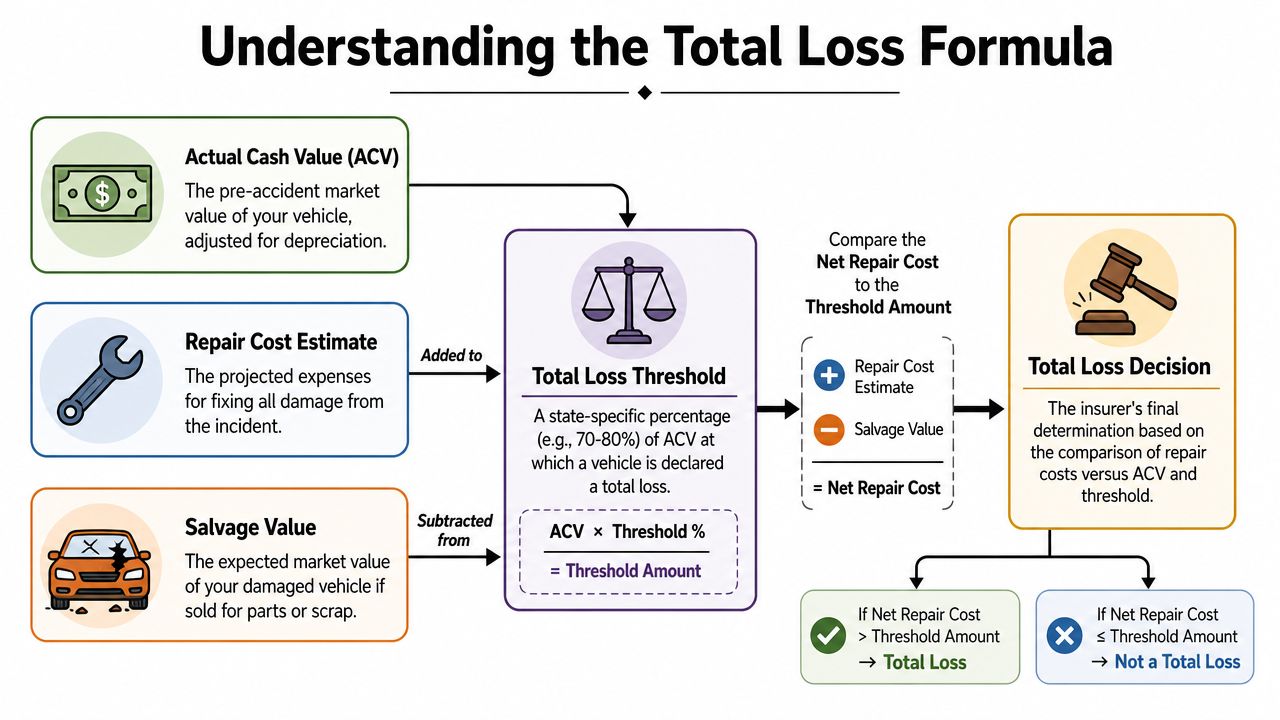
The formula insurers use is usually called the Total Loss Formula, or TLF. The central issue is financial. How much would it cost to repair the vehicle to a safe pre-loss condition, and how does that number compare with the vehicle's Actual Cash Value, or ACV, along with what the damaged vehicle could still bring as salvage? Airbag deployment matters because it can push repair costs up fast, especially once hidden safety-system items are included.
A practical way to read the math
The comparison works like deciding whether to rebuild an older machine or replace it. Once the repair bill gets too close to the machine's real-world value, the numbers stop supporting repair.
Insurers usually compare three parts:
| Component | What it means |
|---|---|
| Actual Cash Value | Your car's pre-crash market value |
| Repair estimate | What the shop says it will cost to restore the vehicle |
| Salvage value | What the damaged vehicle could bring in salvage |
Here is the point drivers often miss. Salvage value is not a side note. It is part of why a car can be declared a total loss even when the repair estimate alone does not seem extreme. A damaged vehicle still has resale value to a salvage buyer, and the insurer counts that in the equation.
That is why two owners with similar-looking damage can get different outcomes. A vehicle with strong salvage demand, expensive airbags, and a modest ACV can cross the line quickly.
What ACV really means
ACV is not the amount you still owe on the loan, and it is not the amount you hoped to sell the car for last month. It is the vehicle's market value immediately before the crash, based on factors such as age, mileage, trim, condition, and comparable sales.
These situations frequently initiate settlement disputes. If the insurer sets ACV too low, the total loss decision becomes easier for the carrier and the payout can shrink at the same time.
Oregon and Washington can reach different results
Northwest drivers need to ask a more precise question than, “Is it totaled?” The better question is, “What legal standard did you apply in my state?”
Oregon and Washington do not use identical wording for total loss decisions. That matters in close cases. If the repair number lands at or near the vehicle's value, the state rule can affect whether the claim is treated as repairable or totaled.
For a driver trying to check the insurer's math, that difference is like measuring with two rulers that mark the cutoff slightly differently. The car has not changed. The rule has.
Where airbags change the outcome
Airbags usually do not create an automatic total loss. They change the repair side of the formula, and often by more than drivers expect.
A deployed airbag can trigger replacement of related electronics, module work, interior components, scanning, and calibration. Those costs are easy to miss if you are only looking at visible body damage. In borderline claims, that hidden safety-system expense is often the piece that tips the numbers.
If you remember one idea from this section, make it this: total loss decisions after airbag deployment are math problems shaped by state rules. To check the insurer's conclusion, you need all three pieces in view. ACV, full repair cost, and salvage value.
Insurer Considerations After Airbag Deployment
Once the airbags deploy, the insurer's estimate usually expands beyond the parts you'd mention in casual conversation. Most drivers think “airbag replacement” means swapping out the bags themselves. Adjusters and repair planners look at a wider system.
The parts list is broader than most people expect
After deployment, the estimate may include more than the obvious module in the steering wheel or dash. It can also involve related components tied to the event and to system restoration.
Common cost drivers include:
- Airbag modules: The deployed unit itself has to be replaced with the correct part.
- Sensors and electronics: The system depends on impact-related components and communication between modules.
- Control units and diagnostics: The vehicle may need additional electronic work before the safety system can be returned to service.
- Trim and interior pieces: Dash panels, steering wheel components, pillar covers, seats, or surrounding materials may need removal or replacement.
- Calibration and verification: Modern vehicles often require post-repair checks to confirm the system is functioning correctly.
This is one reason two crashes that look similar from the curb can price out very differently on paper.
Insurers also evaluate how the estimate was built
The repair total depends not only on what's damaged, but on how the shop and insurer write the estimate.
Questions that matter:
- Were original equipment parts included where required for safety restoration?
- Did the estimate account for labor to access buried components?
- Were diagnostic procedures and post-repair checks added as line items?
- Was the estimate written before teardown, or after hidden damage was exposed?
A pre-teardown estimate can make a claim look cheaper than it will be. Once the shop disassembles trim and front-end components, the cost picture often becomes more complete.
Salvage value affects borderline cases
Many drivers focus only on repair cost, but salvage value can influence the decision in a formula-based analysis. A vehicle with meaningful salvage value can tip into total-loss territory sooner than expected because the insurer includes that number in the economics.
That doesn't mean the decision is wrong. It does mean you should ask to see the basis for it.
When an adjuster says the car is “not worth fixing,” ask whether that conclusion came from repair cost alone or from repair cost plus salvage value.
What to verify before accepting the decision
If you want to pressure-test the insurer's reasoning, review:
- The full repair estimate, not the summary page.
- Whether hidden safety-system work was included.
- Whether the ACV reflects the correct trim, condition, and options.
- Whether the state rule applied matches where the vehicle is titled and handled.
That review often tells you whether the insurer missed costs, undervalued the car, or both.
Typical Airbag Replacement Costs and Repairability
The biggest shock for many drivers is that airbag-related repairs can be expensive even when the crash damage looks manageable.
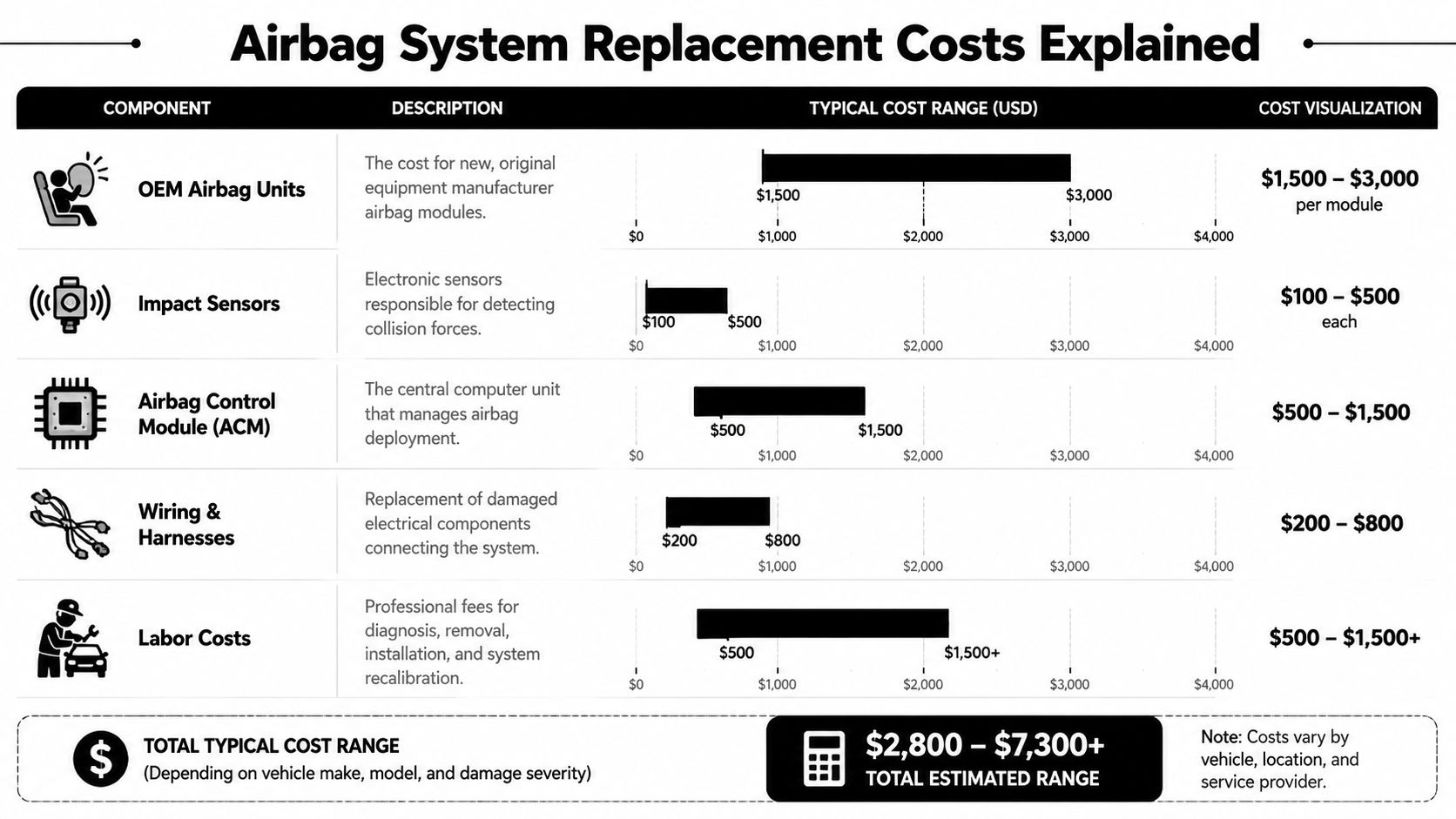
According to GoodCar's breakdown of airbag deployment repair costs, replacing a single deployed airbag system typically costs between $1,500 and $3,000 per unit when OEM airbag, sensor, diagnostic module replacement, and labor are included. That same source notes these costs can push repair totals to 70 to 80% of a mid-range vehicle's ACV.
Why the total rises so fast
Drivers often expect the airbag part itself to be the main expense. In practice, the final bill usually reflects a chain of related work.
A repair order may involve:
- The deployed unit itself
- Associated sensors
- Diagnostic module work
- Labor for removal and reassembly
- Calibration and verification
- Interior part replacement where the bag exited
GoodCar also notes that dual-front deployments with associated sensor recalibration can often exceed $5,000 in restoration cost in some situations, which is a major reason these claims become economically difficult on lower-value vehicles.
Repairable doesn't always mean sensible
A vehicle can be physically repairable and still be a poor repair candidate. That distinction matters.
If the structure is manageable and the drivetrain is fine, a technician may be able to restore the car. But insurers don't decide only on mechanical possibility. They decide on economic feasibility under the applicable rule.
That's why a modestly damaged older car can be totaled while a newer, higher-value vehicle with similar visible damage gets repaired.
For drivers trying to understand the line items, this guide to airbag replacement cost details is useful because it helps separate the visible crash damage from the hidden safety-system bill.
A quick visual can help if you want to see how repair shops approach these systems in practice.
Questions worth asking the shop or adjuster
Instead of asking, “Can it be fixed?” ask sharper questions:
- Which airbag-related parts are being replaced?
- Is this estimate based on OEM components?
- Does the estimate include diagnostics and calibration?
- Was the vehicle fully disassembled before the number was finalized?
Those questions help you tell the difference between a realistic estimate and a thin one.
Salvage Titles and Diminished Value Effects
Once a vehicle is declared a total loss, the conversation usually shifts from repair economics to ownership, title status, and market value after the claim. That shift matters because the financial impact doesn't end with the insurer's first offer.
Why older vehicles get trapped faster
One of the harsh realities in airbag claims is that older vehicles have less room for repair costs before the numbers stop working.
Autvex's discussion of deployed airbags and total loss outcomes states that a single deployed airbag can cost $3,000 to $10,000+ including labor and recalibration, and that older vehicles face an 85%+ probability of total loss because of that hidden repair bill rather than crash severity. That helps explain why a car that still drives, and even looks decent from a distance, can still end up written off.
What salvage status changes
If the insurer totals the vehicle and the title changes to salvage status, the market usually treats that car differently from then on.
Practical effects can include:
- Resale resistance: Buyers often hesitate when a title record shows major prior damage.
- Financing friction: Some lenders don't like collateral with salvage history.
- Insurance complications: Coverage options may narrow after the title changes.
- Value compression: Even after quality repairs, the title history can weigh on what the market will pay.
If you're trying to understand the process side of that shift, this overview of the salvage title process helps clarify what usually follows a total loss designation.
A repaired vehicle and a market-accepted vehicle are not always the same thing.
Diminished value after repair
If the vehicle is repaired instead of totaled, a separate issue may remain. The market may value the car less because it now carries accident history, safety-system replacement history, or both.
That's the core idea behind diminished value. The car may function well. Buyers may still discount it.
Here's a plain-language example. A late-model sedan with clean history before the crash often commands stronger buyer confidence than the same sedan after a collision involving deployed airbags and major repairs. Even if the body work looks excellent, the loss history can follow the vehicle in valuation tools, dealer appraisals, and buyer negotiations.
How to approach the insurer
If you're dealing with a repairable claim and suspect value loss:
- Ask for all repair invoices and final estimate versions.
- Keep records showing the airbag event and related safety work.
- Document the vehicle's pre-loss condition carefully.
- Compare the insurer's position with actual market reaction to accident-history vehicles.
That approach gives you a factual basis for discussing value loss without guessing.
Navigating State Specific Rules in Oregon and Washington
A driver in Portland and a driver in Vancouver can have nearly identical crash damage, similar airbag deployment, and very different claim outcomes. The reason is not just the estimate. It is the rule the insurer must apply in that state.
For airbag cases, that distinction matters because the visible damage is often only the first layer. The hidden layer can include crash sensors, seat belt pretensioners, control modules, steering wheel components, dash trim, calibration work, and post-repair scans. If those costs push the file to the line, Oregon and Washington do not use the same wording to decide whether the vehicle qualifies as a total loss.
Oregon and Washington use similar ideas, but not identical formulas
Here is the practical difference.
| State | Threshold | Formula |
|---|---|---|
| Oregon | Repair costs equal or exceed pre-crash ACV | ORS 819.012 standard |
| Washington | Repair costs exceed fair market value | RCW 46.12.600 standard |
One word can change the result.
If the repair total lands at the same number as the vehicle's actual cash value, Oregon's wording may support a total loss decision. Washington's wording points to a higher bar. The repair cost must go past the vehicle's fair market value, not merely meet it.
That sounds technical. In practice, it can decide whether the insurer writes a repair check or a total loss offer.
Why airbag claims sit on the borderline more often
Airbag losses often work like opening a wall after a pipe leak. The first estimate shows the obvious damage. The larger bill can appear after teardown, diagnostics, and parts research.
A front-end impact may start with bumper, grille, and hood damage. Then the estimate grows. Add deployed airbags, seat belt components, module replacement or reset where allowed, steering column parts, dashboard work, and manufacturer-required calibrations. A claim that looked repairable at first can cross the line later, especially on late-model vehicles with multiple safety systems.
That is why a Northwest driver should not accept a vague statement such as, “it did not meet our threshold,” without asking which state formula was used and what numbers were compared.
The question to ask is simple: what was compared to what?
Insurers often speak in shorthand. You need the full equation.
Ask the adjuster to identify:
- the value figure used for the vehicle before the loss
- the current repair estimate
- whether supplements after teardown are included
- whether airbag system parts and calibrations are fully included
- which state rule controlled the decision
That last point matters more than many drivers expect. If your vehicle is registered in one state, garaged in another, or the loss happened near the border, confusion about the governing rule can creep into the file.
A cautious-driver example
Suppose your SUV has a pre-loss value of $18,000. The first estimate is $15,500, so the insurer talks repair. After teardown, the shop finds additional airbag system work, seat belt pretensioners, and calibration procedures that raise the estimate to $18,000.
In Oregon, equal-or-exceed wording may put that vehicle in total loss territory. In Washington, the same numbers may still prompt an argument unless the repair cost rises above the vehicle's fair market value.
That is why border-state claims deserve a closer reading than generic insurance language.
For drivers sorting out related value disputes, diminished value after an auto loss can overlap with the same valuation records used in a total loss claim.
Put these questions in writing
Email creates a paper trail and slows down fuzzy explanations. Ask:
- Which state statute or rule did you apply to this total loss decision?
- What pre-loss value did you assign to my vehicle?
- Does your repair figure include all airbag and restraint system parts, diagnostics, and calibrations?
- If the estimate increases after teardown, will you recalculate total loss status under the applicable state rule?
Written questions do something useful. They force the adjuster to show the math instead of relying on general phrases.
If the explanation sounds broad, ask for the exact state rule, the exact vehicle value, and the exact repair total used in the comparison.
Drivers in Oregon and Washington do not need to memorize statutes. They do need to know that a one-word difference in state law can change the claim, especially in airbag cases where hidden safety-system costs often appear late.
Step by Step Checklist to Maximize Your Settlement
Once airbags deploy, the best settlement work starts early. You don't need to become an appraiser overnight, but you do need to organize the claim better than is typically done in the first few days.
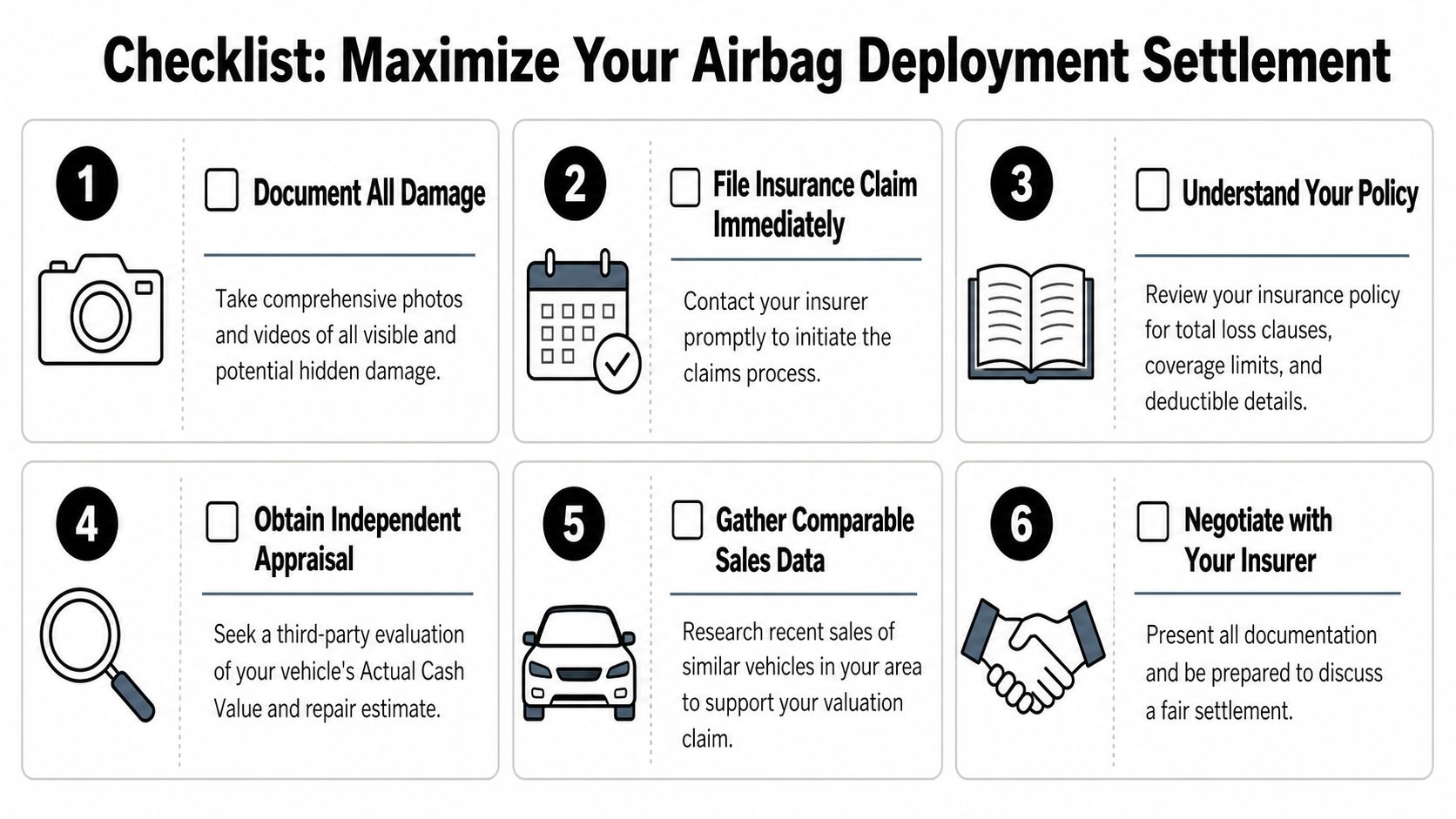
Start with documentation, not assumptions
Photograph everything
Take wide shots, close-ups, interior photos, and photos of every airbag that deployed. Include the dash, steering wheel, seats, and trim areas. If warning lights are on, photograph those too.
Open the claim promptly
Report the loss to the insurer as soon as you can. Delays don't help your position, and they can complicate inspection timing and storage issues.
Review your policy language
Look for the sections dealing with total loss handling, valuation, deductibles, and any appraisal clause. If you don't understand a term, highlight it and ask the adjuster to identify how it applies to your claim.
Get the numbers before you react to the offer
Request the full valuation report
Don't settle from a summary. Ask for the report showing the insurer's ACV calculation, comparable vehicles, condition adjustments, trim level, mileage, and listed options.
Read the repair estimate line by line
You're looking for missing safety-system items, vague labor entries, or a pre-teardown estimate that may not reflect the full damage picture. A short estimate isn't always a favorable one.
Collect comparable local vehicles
If the insurer's value looks low, gather market examples that closely match your vehicle's trim, condition, and equipment. The closer the match, the stronger your challenge.
Use outside help when the file doesn't add up
Consider an independent appraisal
This becomes especially useful when the ACV appears low, the comparables are weak, or the insurer's repair-versus-total-loss reasoning feels inconsistent.
Keep your communications in writing
Phone calls are fine for speed. Email is better for disputes. Written communication gives you a timeline and reduces confusion about what the adjuster said.
Question borderline decisions
If the claim sits close to the line, ask how the insurer handled state law, salvage value, teardown supplements, and airbag-related system costs.
Keep one claim file with photos, emails, estimates, valuation reports, comparable listings, and notes from every conversation. Organized drivers usually negotiate from a stronger position.
Before you accept anything
Use this final short check:
- Is the vehicle description accurate?
- Is the market value believable?
- Does the total loss decision match your state's rule?
- Did the estimate account for hidden airbag-system work?
- Are you being paid for the correct loss scenario?
If any answer feels shaky, pause before signing.
Conclusion and Next Steps
Airbag deployment changes a claim because it expands the repair bill in ways many drivers don't see at first. The core issue usually isn't the dramatic moment of deployment. It's the valuation math that follows.
A fair outcome depends on three things. First, the insurer needs the right vehicle value. Second, the repair estimate needs to reflect the full safety-system work, not just visible damage. Third, the total loss decision needs to match the rule that applies in Oregon or Washington.
That's why drivers should treat an airbag deployment total loss claim as both a repair question and a valuation question. If the estimate is thin, the claim picture is distorted. If the ACV is low, the settlement is distorted. If the state rule is misapplied, the entire decision may be off.
Careful documentation, written questions, and an independent valuation review can make a major difference before you accept the insurer's position.
If you're in Oregon or Washington and your insurer is lowballing a total loss offer or mishandling a post-accident value dispute, Total Loss Northwest provides certified independent appraisals for total loss and diminished value claims. They help drivers challenge biased valuation software, document real market value, and negotiate from a stronger factual position.