Your insurer just sent a number that feels too low, and the conversation suddenly got cold. That's the moment you realize you're not negotiating with a person, you're fighting a valuation system that already decided what your vehicle is worth.
If your car was totaled or damaged badly enough to trigger a diminished-value claim, you don't need more opinions. You need a report that shows the vehicle's real condition, its real market position, and the gaps in the insurer's offer. That's how you strengthen your position.
Your Guide to Challenging a Lowball Insurance Offer
A weak total-loss offer usually arrives with a clean spreadsheet and a bad taste in your mouth. The adjuster points to a number, the software spits out comps, and suddenly you're told that's “market value.” That's not a negotiation, that's a starting position dressed up like a final answer.
Why the first offer often misses the mark
Insurer valuation tools are built to move claims fast, not to understand the full story of your vehicle. They can miss trim, options, condition, recent repairs, or market behavior that matters in your area. That's why an independent appraisal report matters, because it replaces a generic number with a file built from actual records and comparable-market proof SnapClaim vehicle-owner guidance.
Practical rule: don't argue the offer as if it were a bad opinion. Treat it like a bad valuation package and attack the package.
A strong report is more than a second opinion. It's the document that lets you say, in writing, that the insurer's number doesn't reflect the vehicle you owned, the condition it was in, or the market it should be measured against.
What the report does for you
The report gives you a structured way to answer the insurer's valuation with facts. That matters whether the claim is total loss or diminished value, because the dispute is usually about what your vehicle was worth before the loss.
If you want a direct route into the process, start with an independent option such as Total Loss Northwest's independent insurance appraisal. The point isn't to collect paperwork for the sake of paperwork. The point is to build something the insurer has to take seriously.
Deciding If an Independent Appraisal Is Worth It for You
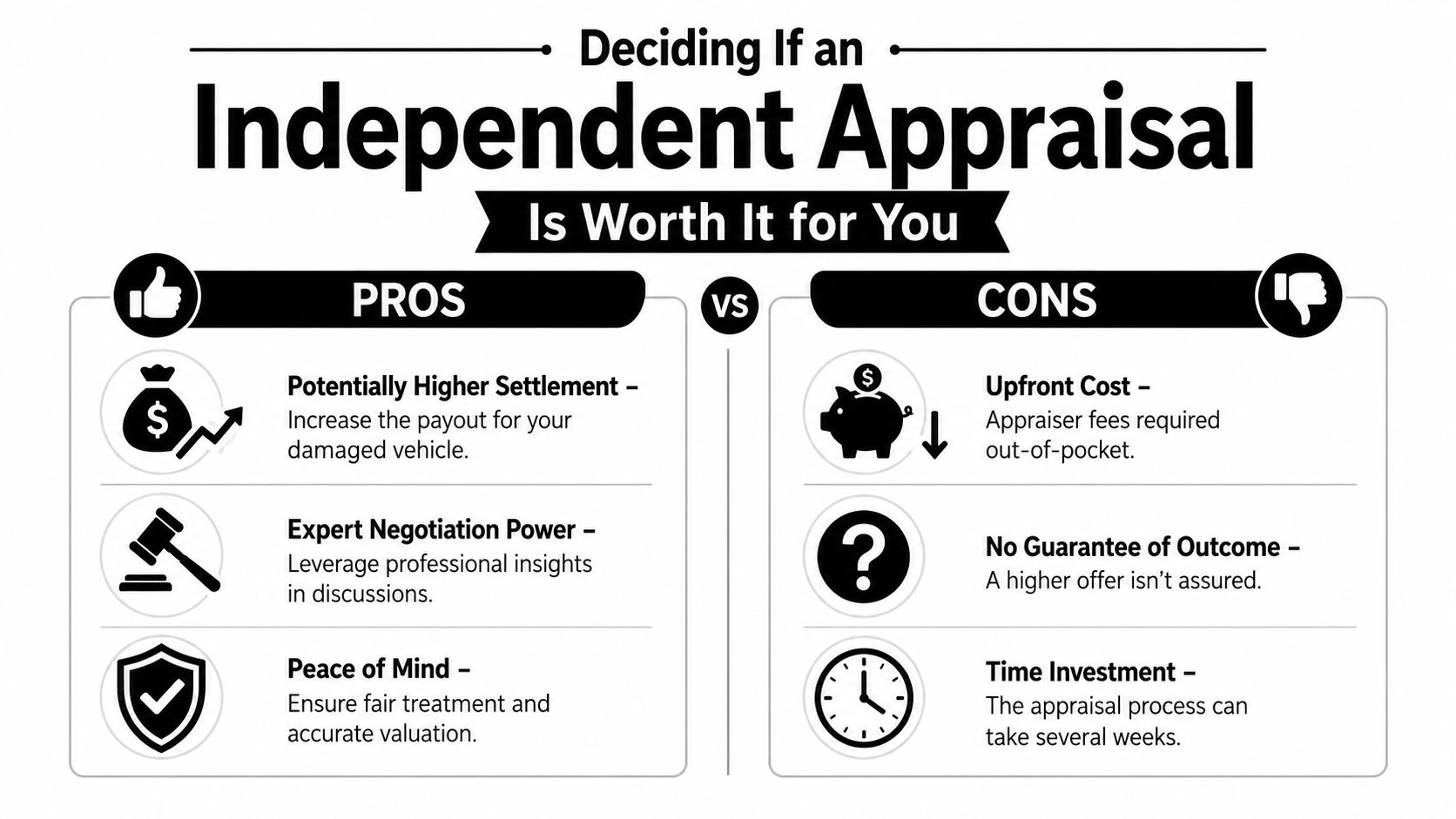
An appraisal is not for every fender-bender. If the loss is small and the insurer's number is already in line with the vehicle's condition, paying for a report can be unnecessary. But if the claim is a total loss, a diminished-value dispute, or a vehicle that's older, customized, rare, or high value, the appraisal is usually the right move auto appraisal guidance.
Think in settlement leverage, not fee anxiety
The mistake people make is treating the appraiser's fee like a sunk cost instead of a negotiation tool. If the report is built correctly, it can expose a weak insurer valuation and create room for a better settlement. That's especially true when the insurer's comparable vehicles are sloppy, mismatched, or missing the details that matter most for a specific car.
My view: if the vehicle has meaningful equity, special equipment, or unusual market behavior, the appraisal is a business decision, not an emotional one.
The key question is whether the likely upside justifies the fee. For a commuter car with ordinary wear and a clean offer, maybe not. For a vehicle with a strong pre-loss story, the appraisal can be the difference between accepting the first number and forcing a real valuation review.
Cases where I'd push hard for one
- Total loss claims: This is the clearest use case, because the entire dispute turns on actual cash value and the insurer's comps can be too generic.
- Diminished value claims: If the car is newer and still had real market value before the crash, a report can help prove the loss in resale value.
- Custom, collector, or modified vehicles: Standard valuation software rarely captures what makes these vehicles different.
- Older vehicles with real condition variance: A well-kept older vehicle can be worth more than a simple database model suggests.
If you're sorting out claim strategy and want a parallel example from another property-loss context, it's worth reading maximize your water damage claim payout. The claim type is different, but the lesson is the same. Documentation wins.
Gathering the Documents for a Bulletproof Valuation
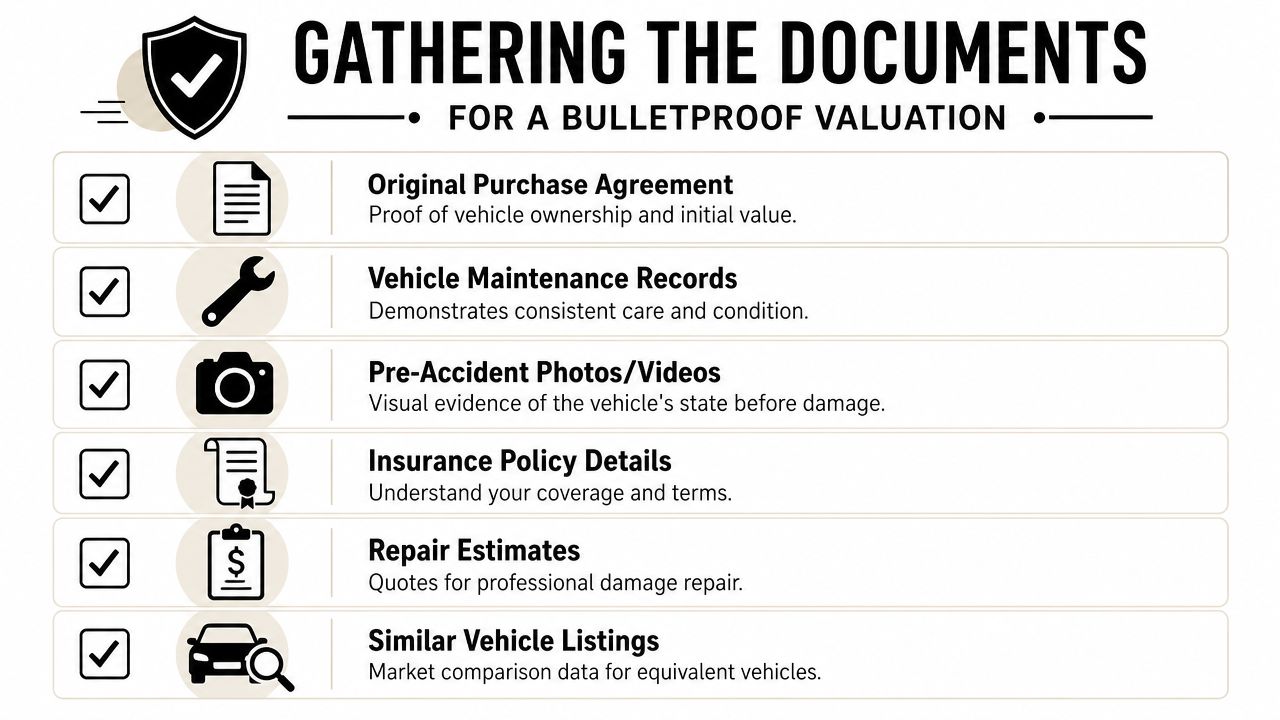
A weak file produces a weak report. That's the whole game. Before an appraiser can defend value, they need proof of identity, condition, mileage, accident details, and the records that show what the vehicle really was before the loss SnapClaim documentation guidance.
The core file you should build
Start with the VIN, mileage, accident details, repair documentation, and photos. Those are the backbone. SnapClaim's vehicle-owner instructions also point to repair invoices, photos, and VIN details, while Total Loss Northwest's appraisal-form guide adds maintenance history, upgrade receipts, ownership records, and comparable listings as supporting evidence SnapClaim vehicle-owner guidance.
Here's the logic behind each item:
- VIN and ownership records: Prove the exact vehicle being valued.
- Mileage: Anchors condition and market position.
- Accident details and repair documentation: Show what happened and what was done.
- Photos: Prove pre-loss and post-loss condition instead of forcing the appraiser to guess.
- Maintenance history and upgrade receipts: Help establish care, equipment, and value that software can miss.
- Comparable listings: Give the report a market basis, not a guess.
Why completeness changes the outcome
An appraiser's report is a documentation package, not a loose estimate. The more complete the file, the harder it is for an insurer to brush it off. That matters most when the company wants to lean on automated valuation tools while you're bringing actual records and market proof to the table.
Useful habit: if you wouldn't want a judge, adjuster, or neutral umpire to see a missing document later, don't leave it out now.
For a clean organizing framework, use this documentation checklist for auto claims. If you're handling a mixed claim with multiple loss components, the same discipline applies to maintain your advantage across the file.
How to Formally Request an Appraisal and Invoke Your Rights
Don't start by begging for a better number. Start by putting the insurer on notice in writing. The appraisal-clause process is a formal dispute mechanism built into many auto policies, and the sequence is simple. You request it in writing, each side names an appraiser, and if they still can't agree, a neutral umpire makes the decision SnapClaim appraisal-clause guide.
The first move is often to ask for the insurer's valuation report and comparable vehicles. That tells you what they used, what they ignored, and where the weak spots are. Then you either push back with your own evidence or invoke the clause if the offer stays low.
What your written request should say
Keep it short, direct, and factual. Don't rant. Don't accuse. Force the process.
Use language like this:
- Identify the claim: Include the claim number, vehicle, and date of loss.
- Request the valuation basis: Ask for the insurer's valuation report and comparable vehicle data.
- State your position: Say you dispute the current value.
- Invoke the clause if needed: If the policy includes an appraisal clause, state that you are formally invoking it.
A clean written notice matters because it shifts the dispute away from a phone call with an adjuster and into a formal resolution track. The report you commission has to be detailed enough to survive that track, not just look persuasive in an email.
The tone that works
Be calm, but firm. You're not asking for a favor, you're preserving a contractual right. The insurer doesn't need to agree with you for the process to start, it only needs to receive a proper request.
Practical rule: when you invoke the clause, stop debating the whole claim verbally and force everything back into writing.
For policyholders who want a practical starting point, this guide to the insurance appraisal clause is worth keeping open while you draft your notice. Use the policy language, document your request, and make the insurer respond to the claim on the record.
Working with an Independent Appraiser to Prove True Market Value
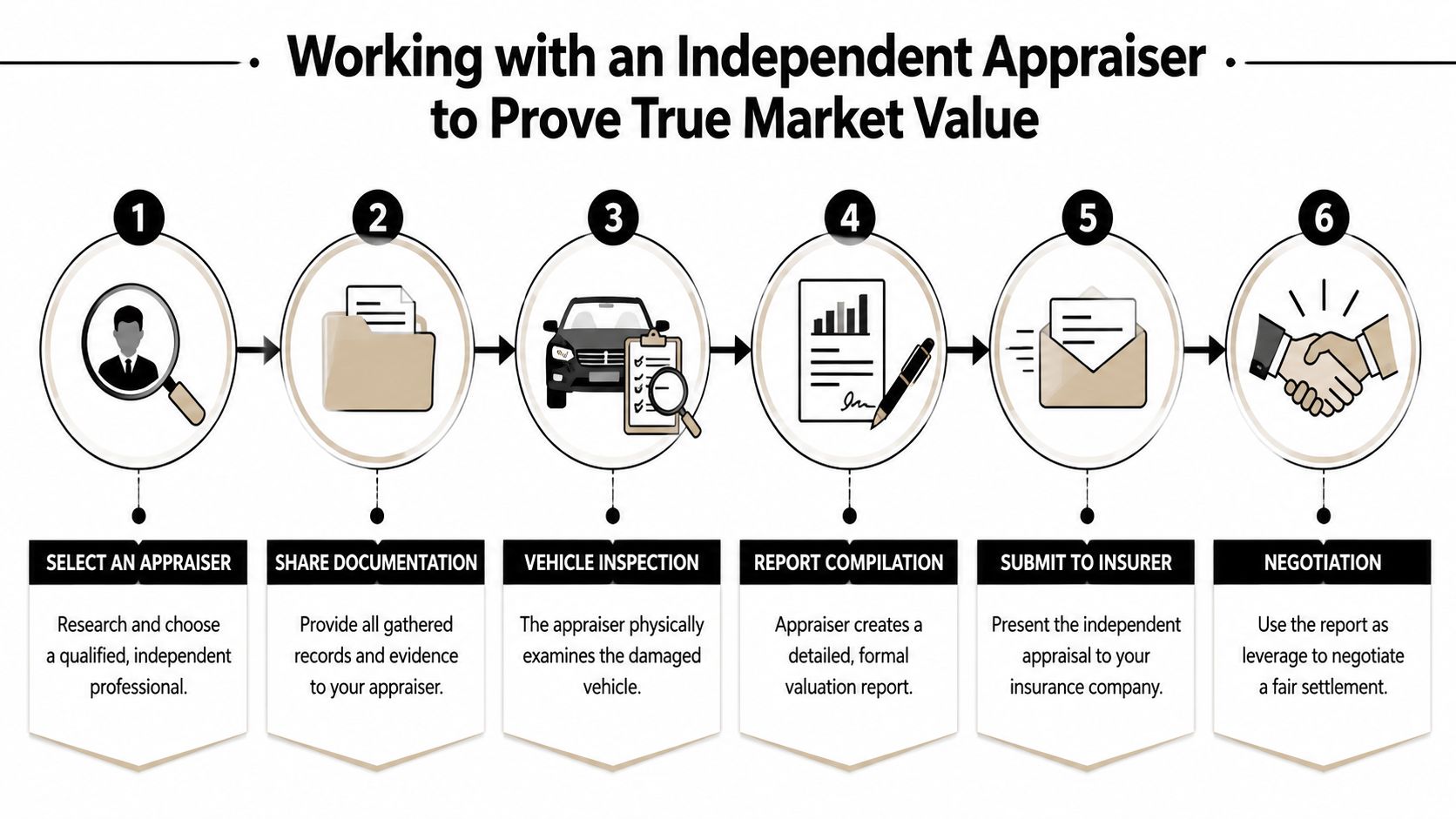
A strong appraiser doesn't just read an estimate and nod. They inspect the vehicle, check the records, and build a market-based valuation that can stand up in a dispute. In disputed total-loss claims, the strongest reports use a comparable-sales methodology, not insurer formula pricing valuation service explanation.
How the appraisal should actually work
The process starts with selection. You choose an independent appraiser who knows total loss or diminished value work, not a general estimator who only writes repair sheets. Then you share the documentation, schedule the inspection, and let the appraiser physically examine the vehicle.
After that, the appraiser studies the local market and selects comparable vehicles, usually about 10 to 20 sold in the last 90 days in the practical workflow described in the verified data from Total Loss Northwest. They then adjust for condition, options, and trim, which is where many insurer valuations get sloppy.
What matters most: the report should explain why this vehicle is worth what it's worth, not just repeat a number from a database.
Why comparable sales beat software shortcuts
Insurers often rely on platforms like CCC, Audatex, or Mitchell. That's fine for speed, but it can miss the market realities that matter in a dispute. One appraisal-engine provider claims independent valuations average 5% to 15% above those platforms, which points to a familiar problem, condition grading, market selection, and option or trim omissions valuation service explanation.
That's why a report has to read like something a real person can audit. It should show the market sources, the comparable selection, and the adjustments, so the conclusion doesn't look like a black box. If the insurer can't see how the number was built, the report isn't defensible enough.
What a good report gives you
A detailed report gives you a number, yet its greater benefit is providing a path to defend that number. That's what changes the conversation from “we disagree” to “here's the evidence that your valuation missed the mark.”
Using Your Report to Negotiate a Fair Settlement
Once the report is in hand, stop treating the claim like a customer service issue. It's a valuation dispute now. A practical total-loss workflow is simple, gather the documents, have the appraiser analyze the market, and use the finished report to challenge the insurer's offer with evidence, not emotion Total Loss Northwest workflow data.
How to present the report
Send the report with a short written summary. Point out the gaps in the insurer's valuation, then identify the specific evidence that corrects them. If the insurer used weak comparables, say so. If the trim, condition, or options were missed, say that too.
A strong email should do three things:
- State the dispute clearly: You do not accept the current valuation.
- Reference the report: Attach the appraisal and identify the key differences.
- Ask for a revised offer: Request a new number based on the independent valuation.
The point is to force the adjuster to answer the report, not the frustration behind it. That keeps the discussion professional and makes it harder for the company to wave you off.
How long this can take
One industry overview reports that independent appraisers win about 85% of total-loss disputes, usually over 30 to 45 days, with average recoveries of $2,000 to $10,000 above the initial offer Total Loss Northwest dispute data. Those numbers don't guarantee anything for your file, but they explain why a solid report changes the economics of the claim.
Bottom line: the report doesn't win by itself. It wins because it gives you a defensible number, a paper trail, and the pressure point the insurer has to answer.
If the adjuster pushes back, stay with the document. Don't drift into personality battles or emotional arguments. Ask them to explain, in writing, which comparable sales they think are more accurate and why your evidence should be ignored.
If you want help turning a weak settlement into a formal dispute package, contact Total Loss Northwest. They review claim documents, issue independent total-loss appraisal reports, and use the appraisal-clause process to push the valuation back toward real market value.