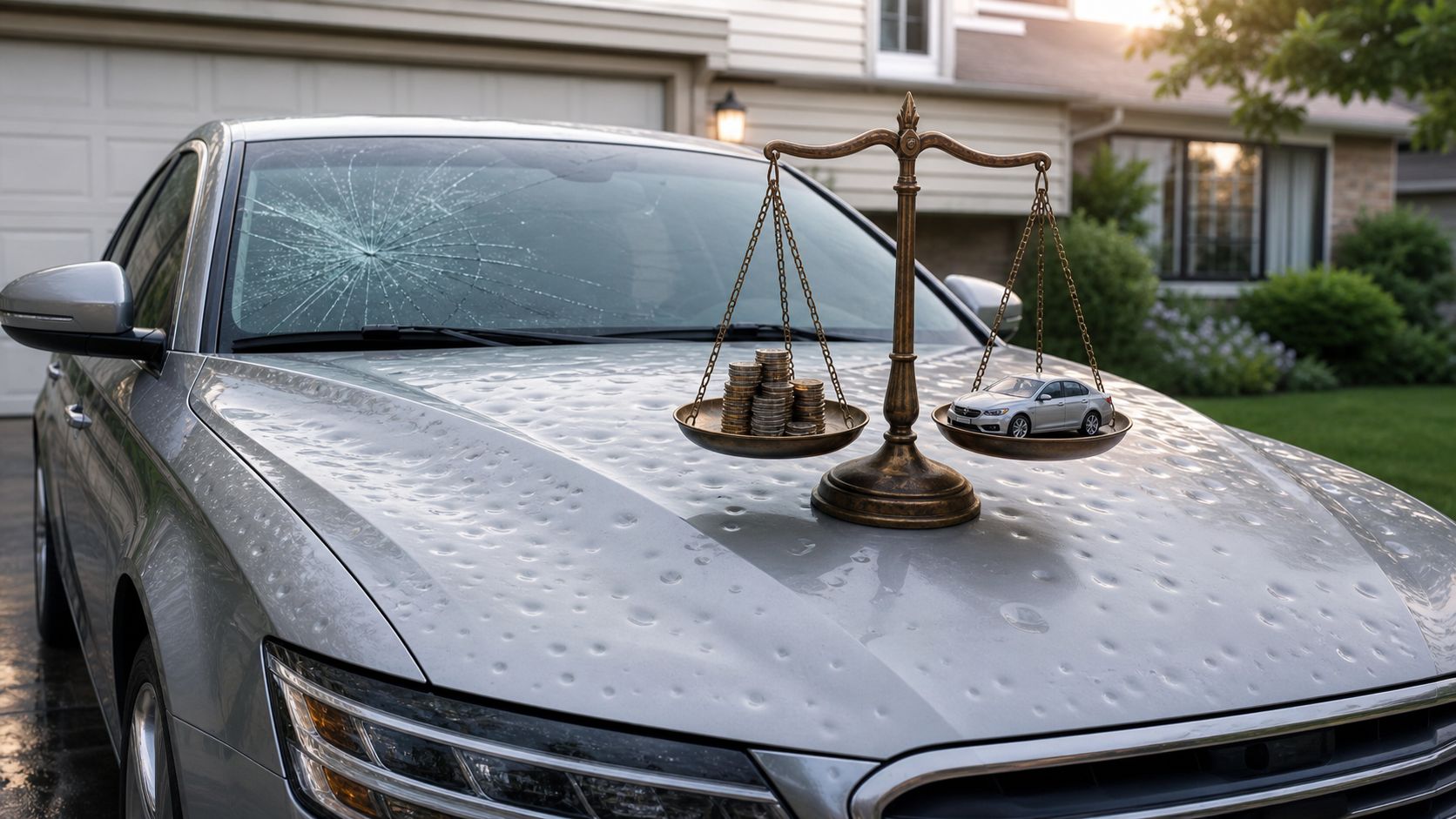
You walk out to the driveway after the storm and see the damage all at once. The hood is peppered, the roof has dimples, the windshield is cracked, and the adjuster's email says your car may be a total loss. That's the part most drivers miss, hail damage total loss is usually not a judgment about whether the car still runs, it's a math problem dressed up as an insurance decision.
If you're in Oregon or Washington, don't let the carrier frame this as a done deal. Hail total-loss disputes are spiking because vehicles are more expensive to repair, storms are hitting harder, and modern cars are loaded with glass, sensors, and calibration-sensitive parts that turn “just hail” into a serious valuation fight. The right move is simple, challenge the valuation, not the fact that hail hit the car.
What Counts as a Hail Damage Total Loss
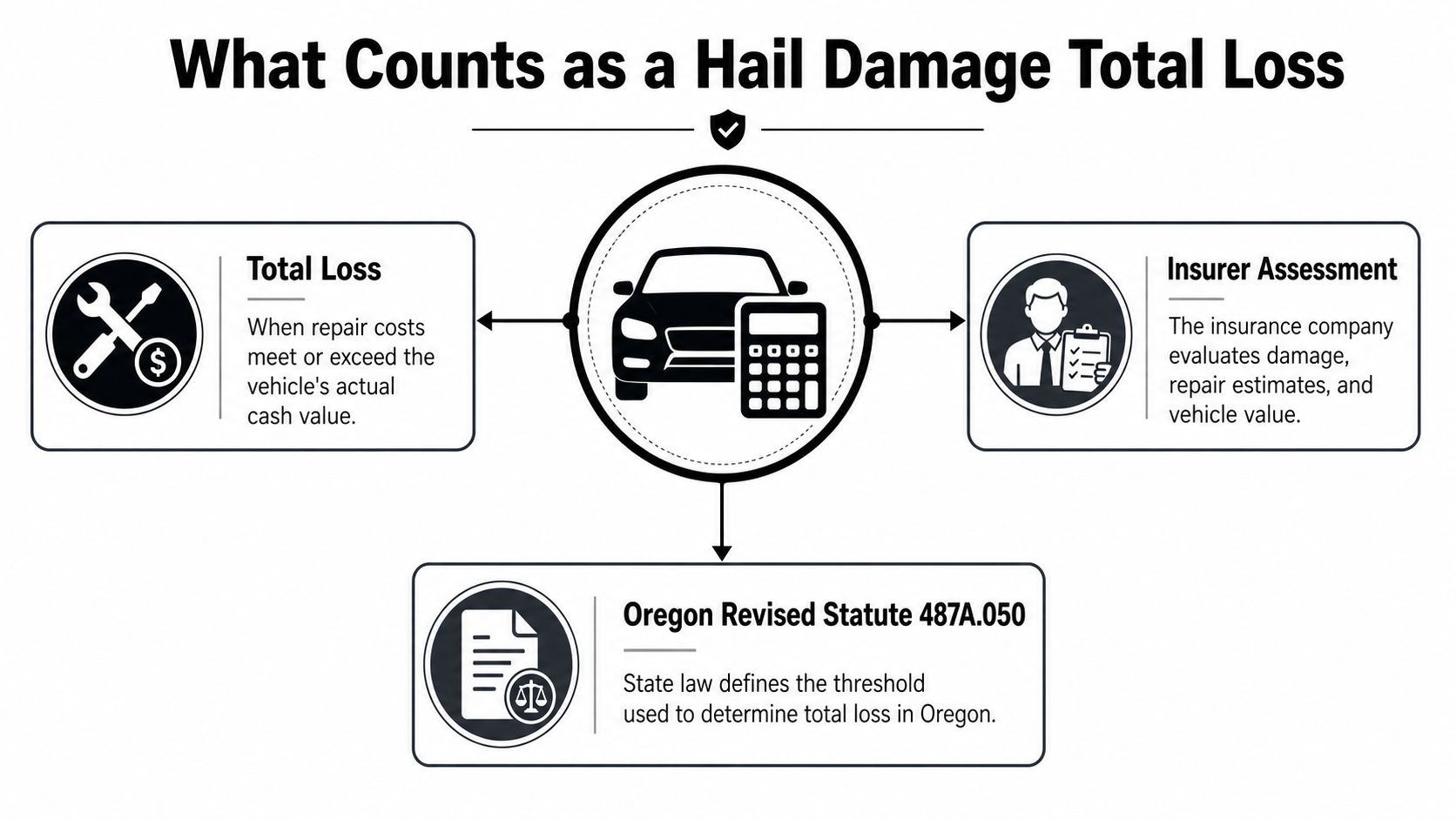
A hail damage total loss starts with one rule, repair math beats dent count. If the carrier's estimate to repair the roof, hood, decklid, glass, trim, and sensor-related pieces gets too close to the car's actual cash value before the loss, the insurer can write it off even if the vehicle still drives. That is why a car can look ugly but stay repairable, or look “mostly okay” and still be totaled.
The insurance term that matters
The cleanest way to say it is this, a hail damage total loss is an economic total loss. The insurer looks at what the car was worth right before the storm, then compares that to the cost of making it whole again. In some places, the carrier also adds salvage value into the formula, which pushes marginal claims over the line faster.
That is different from a wreck where the frame is bent and nobody argues about serious damage. Hail cases are messier because the car may still be drivable, and the dispute is usually over value, not basic operability. If you're reading an email that says the car is totaled, the question is not “Can it move?” The question is, “Does the repair bill make economic sense?” For people dealing with that fight after a severe storm, navigating auto claims with injury lawyers can be a useful reference point for the claims side of a total-loss decision.
Practical rule: if the repair estimate climbs past what the car is worth in the open market, the insurer can total it, even if the car still starts.
Why hail cases go sideways
Hail damage creates scattered losses across panels, glass, and trim. That scattered pattern is exactly why total-loss decisions happen on older cars and lightly equipped models first. A driver sees dents. The carrier sees labor hours, replacement glass, and a repair file that keeps growing.
If you're in the Pacific Northwest and the claim letter feels abrupt, that's normal. What matters is the valuation file behind it, not the tone of the denial or the speed of the decision. Oregon and Washington drivers should treat the first number as an opening position, not a verdict.
How Insurers Calculate Actual Cash Value and Thresholds
Insurers start with actual cash value, or ACV, which is the car's pre-loss market value after depreciation. They don't price the vehicle like a private seller with a polished ad and a full tank of gas, they use year, make, model, mileage, condition, and local comparable sales. That is why the number on the valuation report usually lands below what the owner expected.
The next step is the total-loss threshold. In many states, industry guidance commonly puts that line around 70% to 75% of value. In some markets, carriers use a formula that adds salvage value to repair cost instead. In other words, the carrier isn't asking whether the car can be fixed, it's asking whether fixing it still makes financial sense.
| Sample Hail Total-Loss Thresholds | 70% Threshold | 75% Threshold |
|---|---|---|
| $10,000 ACV | $7,000 | $7,500 |
| $20,000 ACV | $14,000 | $15,000 |
Those numbers show why older vehicles get totaled faster. A low-value sedan doesn't have much room before the repair estimate crosses the line. A newer SUV has more room, but the damage can still get there fast when the hail hits glass, cameras, roof hardware, and trim at the same time.
Where the carrier usually underrates the car
The first valuation fight is usually about what the report leaves out. Tires, brakes, recent paint work, trim upgrades, and aftermarket equipment often get minimized or ignored. If the report misses those items, ACV drops, and the total-loss threshold becomes easier for the insurer to justify.
That's the problem with hail claims, the math looks objective until you inspect the inputs. If the carrier undervalues the car by even a modest amount, the owner ends up carrying the loss on both sides, a lower ACV and a higher chance of total loss. If you want to see how carriers build that number, the valuation breakdown at actual cash value in total-loss claims is worth comparing to your own report.
Bottom line: a total-loss offer is only as fair as the ACV number underneath it.
Why Modern Cars Total Faster from Hail Than Older Models
Hail didn't suddenly become more violent in one magical season. Cars got more fragile from a claims standpoint. The same storm that leaves a 2008 pickup in repair territory can push a newer SUV into total-loss math because the modern vehicle carries more expensive glass, more trim, more hardware, and more things that need calibration after impact.
That's the reason newer vehicles get totaled faster. The roof is no longer just sheet metal; it can be tied to cameras, antennas, sensors, and panoramic glass. The windshield can be part of a driver-assist system. The rear glass and roofline can hold components that turn a simple hail estimate into a layered teardown.
ADAS changes the repair bill
Advanced driver assistance systems, or ADAS, are where hail claims get expensive fast. If the damage affects a camera, sensor mounting point, windshield, or roof assembly, the repair file can expand beyond dent repair into calibration and replacement work. That changes the economics immediately.
Modern vehicle design also makes visible damage less isolated. One storm can strike the hood, roof, decklid, glass, mirrors, and trim all at once. That kind of spread is exactly what pushes a claim toward total loss instead of simple paintless dent repair. Older vehicles could sometimes absorb that hit because the parts were cheaper and the systems were simpler.
NOAA and insurers have both been tracking more severe hail seasons, and that matters because larger hail events hit more panels on more cars. When you combine those storms with today's glass-heavy vehicle design, total-loss disputes become more common, not less. If your car has camera-based safety features, expensive glazing, or a panoramic roof, expect the threshold to come sooner than it did a decade ago.
What to document before you sign anything
Start with the trim package, factory options, recent repairs, and every upgrade that affects value. Then gather photos of the damage from multiple angles before the car gets moved. If the insurer tries to value your vehicle like a stripped base model, you'll need proof that it wasn't one.
Do this first: save the window sticker, service records, and any invoice showing the exact equipment on the car. That paperwork moves money.
Salvage Titles, Payouts, and What Happens to Your Car Next
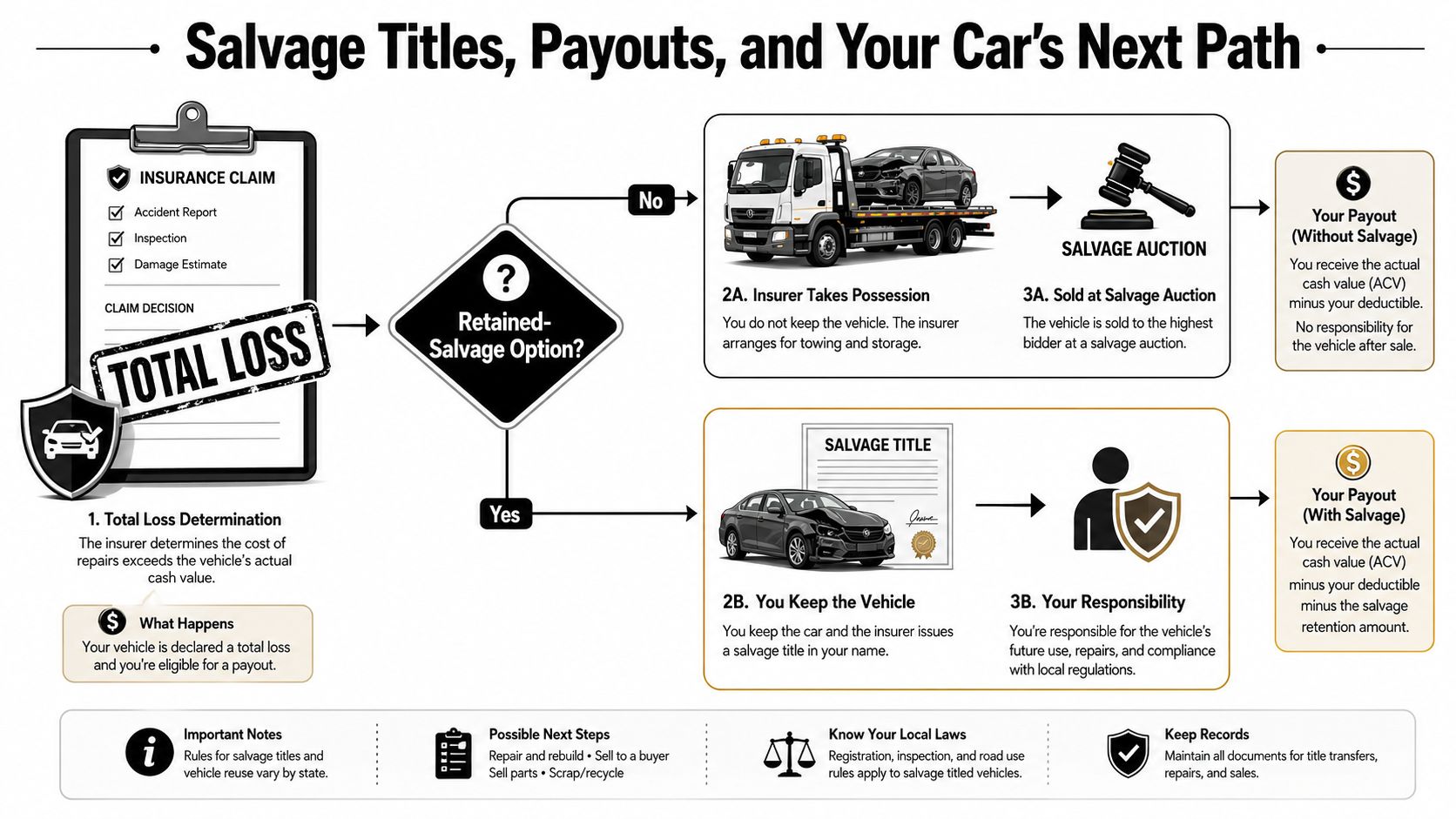
Once the carrier declares a hail damage total loss, the claim usually splits into two paths. The insurer takes the car, pays the ACV less deductible, and sends it to salvage auction, or it offers a retained-salvage option and lets you keep the vehicle with a salvage title. The paper outcome matters just as much as the check.
Three outcomes, three different realities
A low-value sedan usually goes straight to auction because there's no economic reason for the carrier to keep it in inventory. A mid-value SUV may be offered back to the owner if the salvage bid is low enough. A high-end vehicle can become a bigger fight because the gap between the insurer's valuation and the owner's expectation is usually wider.
If you keep the car, you're dealing with a retained salvage arrangement. The insurer pays the ACV minus the salvage value it expects to recover, and the vehicle gets a salvage title record. That can be fine if you only care about keeping an older car on the road, but it's bad if you expect normal resale later.
A salvage title tells future buyers the car was written off. A rebuilt title means it went through the process to return to road use, but the stigma stays. That stigma hits resale hard, and buyers know it. If you're deciding whether to keep the car, read the retained-salvage process in the salvage title process guide before you accept the first offer.
The check is not the whole story
The payout you see on the settlement sheet is only the starting point. If there's a loan or lease, the lender may be paid first. If you owe less than the settlement, you get the remainder. If you owe more, the gap stays with you unless you have separate coverage.
A totaled car doesn't just change your title status, it changes your leverage. Once the vehicle is sold to salvage, the clock is already moving.
How to Dispute a Low Hail Total-Loss Settlement
If the settlement is low, don't argue in circles with the adjuster. Attack the valuation file. Get the comparables, check every option code, and make the carrier show its work. That's where most hail total-loss disputes are won.
Start with your own comparable sales. Use cars in the same trim, similar mileage, and a tight geographic radius. Then request the insurer's full valuation file, including the report from CCC, Mitchell, or whatever vendor they used. The point is simple, you can't dispute a number you haven't seen.
Useful habit: ask for the entire file in writing, not just the summary page. The missing pages are often where the mistakes hide.
Use the appraisal clause when the number is off
The appraisal clause is the cleanest pressure point in a total-loss dispute. You hire a competent appraiser, the insurer hires one, and the two appraisers either agree or bring in an umpire to resolve the gap. That removes the carrier's software valuation from the center of the fight and puts the dispute on market value instead of scripted estimate logic.
Who pays depends on the policy and the jurisdiction, so read the contract before you jump. The primary value of appraisal is speed and influence. It forces the carrier to defend the number with a human process, not hide behind a lowball report. If the insurer is treating your car like a generic unit, the appraisal clause is the right tool to reset the conversation. A practical breakdown of the dispute path is also laid out in the actual cash value dispute guide.
Don't ignore diminished value
Many assume diminished value only matters after a repairable crash. That's incorrect. If the insurer's ACV number ignored recent upgrades, low mileage, or a stronger market position, a diminished value appraisal can help establish what the car was really worth before the loss. In a close total-loss file, that can change the entire settlement posture.
The smarter play is to treat ACV and diminished value as one strategy, not two separate fights. First, challenge the carrier's valuation. Second, preserve the argument that the vehicle's pre-loss market position was stronger than the insurer admitted. Total Loss Northwest does this kind of total-loss and diminished value appraisal work in Oregon and Washington, and that's exactly the sort of service that fits a hard valuation dispute.
Oregon and Washington Specific Notes for Hail Total-Loss Claims
Oregon and Washington don't handle hail total-loss claims the same way in practice, and that difference matters. Washington commonly uses a 100% total-loss formula, where repair cost plus salvage and claim expense can't exceed ACV. Oregon carriers more often use a percentage threshold, which means the same damage can land closer to the edge of total-loss treatment faster or slower depending on the file.
That changes strategy. In Washington, the carrier may have less room to argue around the total-loss line once the repair estimate gets too close to value. In Oregon, the percentage threshold can make the dispute turn more sharply on the ACV number itself. If the valuation is low, the carrier has an easier path to total loss. If the valuation is honest, the claim may stay in repair territory.
What to watch in both states
Salvage title handling is another point to check. If you keep the car, make sure you know how the title will be branded and what inspection steps follow. The title status affects resale, insurance, and whether the car is even worth retaining in the first place.
Timing also matters. After a regional storm, claim volume rises fast, and owners get rushed into bad decisions. That's where adjusters bank on fatigue. Don't let them. Document first, question second, and sign last.
The Pacific Northwest play is simple
If you're in Oregon or Washington, use the state rules to your advantage, but don't rely on them to rescue a weak valuation. The law sets the frame. The appraisal file decides the money. That's why experienced owners treat a hail total loss as a valuation fight, not a paperwork event.
Short version: Oregon and Washington may differ on the threshold, but the owner still wins by proving the car was worth more than the carrier admitted.
Your First 30 Days After a Hail Total Loss
Do not drag your feet after the adjuster's call. Photograph the car before it's towed, save the estimate, and pull your own market comparables right away. If the settlement looks thin, request the valuation report in writing and compare the carrier's options, mileage, and condition notes line by line.
If the number is still off, invoke the appraisal clause before the file gets stale. That keeps the dispute alive and forces a real valuation review. If the vehicle was recent, high-value, or modified, get a diminished value appraisal in the same cycle so you're not chasing the issue later.
Your position is strongest before the salvage process closes. Once the car is gone, the carrier can move faster than you can. A hail damage total loss is a negotiation, not a verdict, and the owner who shows up with records usually gets the better number.
If your hail claim in Oregon or Washington came in low, send the valuation, photos, and estimate to Total Loss Northwest and ask for a total-loss or diminished value review before you accept the carrier's number.