You found the car. Maybe it's an R32 that's been living rent-free in your head for years, maybe it's a kei truck that looked cheap until the math got real, or maybe it's a clean right-hand-drive Honda sitting in a Japanese auction lane with your name already on it. The hard part isn't falling in love with the listing, it's making sure the car can clear U.S. customs, survive the cost stack, and get titled in your state without turning into a paperwork mess.
A lot of first-time buyers start with the wrong question. They ask, “Can I import it?” The better question is, “Can I import it, afford it, and legally register it where I live?” That's the difference between a cool garage find and an expensive port problem.
Why Importing a Japanese Car Goes Wrong Before It Even Ships
A buyer wires money for a dream Skyline, sees the vessel booked, and feels like the hard part is over. Then the exporter sends the build date, and it's two months short of the 25-year exemption. Now the car is sitting in a hold state, the clock was misread, and the buyer is suddenly dealing with delay, extra storage, and a compliance problem that should've been caught before the money left the account.
That's the part enthusiasts always underestimate. japanese car imports to usa fail most often on timing, not enthusiasm. If you count by model year instead of manufacture date, you can be wrong and still feel confident right up until the port says no.
Practical rule: never bid on a car until you've confirmed the actual build month in writing.
The other mistake is treating the ship date like a green light. A car can be perfectly bought, paid for, and loaded, yet still be dead on arrival from a legal standpoint if the eligibility math was sloppy. That's why this guide focuses on sequencing, not hype, because the order you do things in matters more than the badge on the grille.
If you want a broad sense of what kinds of Japanese brands and models are common in the U.S. market, the background on Japanese car brands in America is useful context, but it doesn't replace the import math you need to get right before you bid.
The 25-Year Rule and What It Actually Unlocks
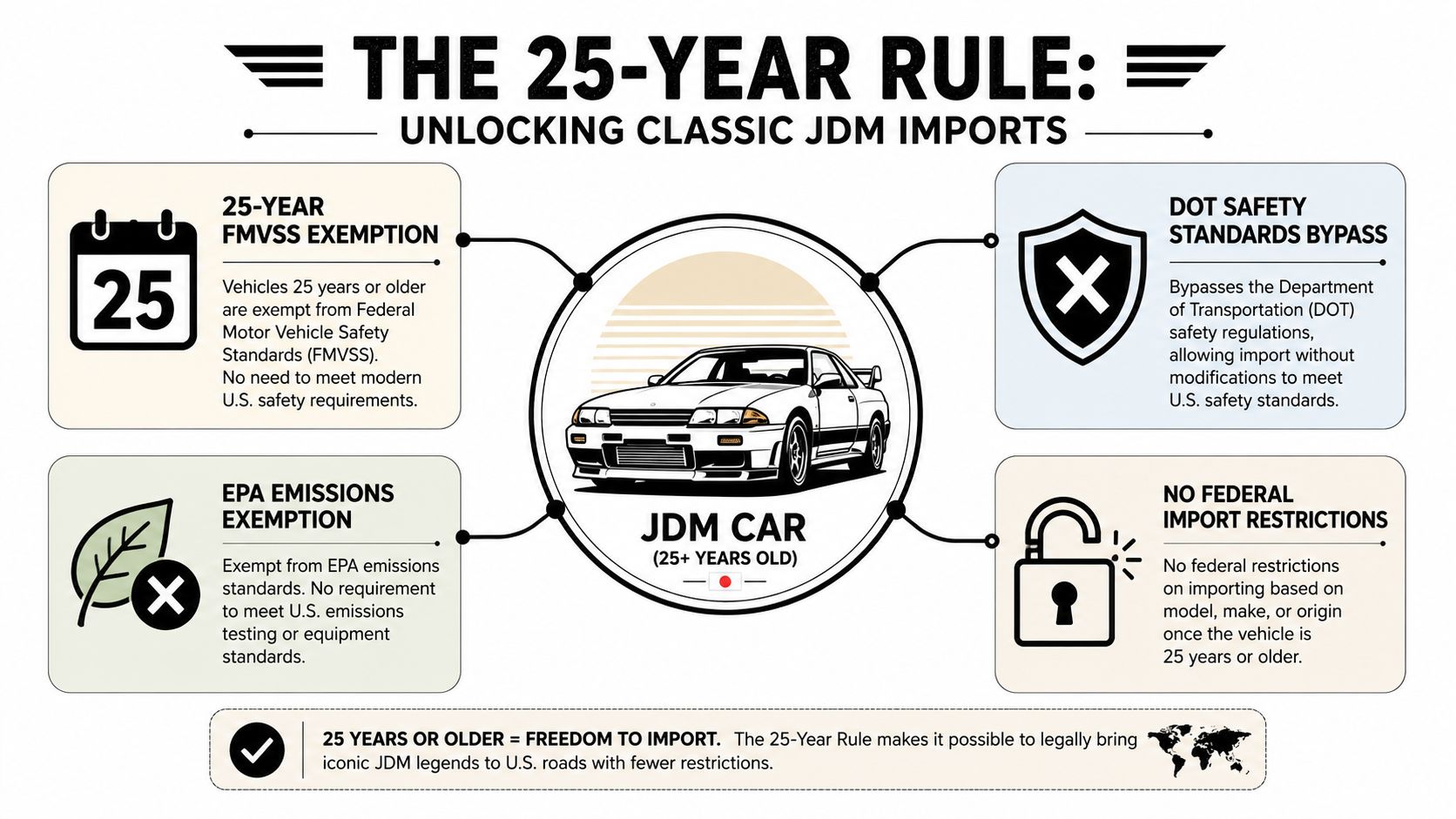
The cleanest legal lane is the 25-year FMVSS exemption. Once a vehicle is at least 25 years old by manufacture date, it's generally exempt from Federal Motor Vehicle Safety Standards, which means you're not paying to crash-test, bumper-test, or re-engineer the car for modern DOT compliance. That's the reason older JDM cars are so much easier to bring in than newer ones, and why serious buyers obsess over the build plate, not the brochure.
The two clocks you have to track
The federal shortcut is split across two systems. For older imports, the FMVSS exemption is the big one, and the EPA emissions exemption is the other key gate. In practice, you need both to line up cleanly, and the vehicle's manufacture date controls the clock, not the model year badge on the trunk.
That's where buyers get burned. A car marketed as a 2001 model isn't automatically legal just because the calendar says 2026. If it was built late in the year, the car might not qualify yet. Check the production month from the exporter before you spend a cent on shipping.
Duty matters too
For passenger cars, the U.S. duty is generally 2.5%, while light trucks face a 25% tariff when imported from Japan to the U.S. Those numbers matter because a kei truck or HiAce can look cheap on the auction sheet and still come out overpriced after duties. The 25% truck tariff is the single biggest reason some “budget” imports stop making sense once the paperwork is done.
Blunt advice: if the seller can't prove the build month, walk away.
Choosing Your Compliance Path
There are really only three lanes worth talking about, and only one of them is normal for private buyers. If the car is old enough, the 25-year exemption is the simplest path. If it's newer, you're in Registered Importer territory, which means more cost, more friction, and more ways to get stuck. The third lane, Show and Display, exists for a narrow slice of historically significant cars and isn't a casual buyer's shortcut.
| Compliance Paths for Japanese Vehicle Imports | Path | Age Range | Paperwork | Typical Cost | Best For |
|---|---|---|---|---|---|
| Compliance Paths for Japanese Vehicle Imports | 25-year exempt | 25 years and older | Standard customs entry, eligibility forms | Lowest of the three | Classic JDM cars, older kei vehicles, straightforward private imports |
| Compliance Paths for Japanese Vehicle Imports | Registered Importer route | Under 25 years | RI process, compliance work, extra federal documentation | Highest and least predictable | Buyers chasing newer cars that can be converted legally |
| Compliance Paths for Japanese Vehicle Imports | Show and Display | Narrow, model-specific exceptions | Special approval and restricted use | High friction, limited availability | Rare historically important cars |
Why right-hand drive isn't the issue
People still think RHD is the problem. It isn't. A right-hand-drive car can be imported and titled if it fits the right federal lane and your state will accept it. The key question is whether the car is old enough to avoid the heavy compliance route, or rare enough to justify it.
Why “1995” is a bad shortcut
Don't use the model year as your decision rule. That's lazy and expensive. A 1995 shell could be legal, could be borderline, or could still be too new depending on when it was built, and the exporter's paperwork is what tells you the truth.
If you're comparing options, the safest bet is still an older car that falls cleanly into the exemption. Newer cars can be brought in, but that's a specialist job, not a first-time buyer gamble.
Paperwork From Auction Sheet to U.S. Title
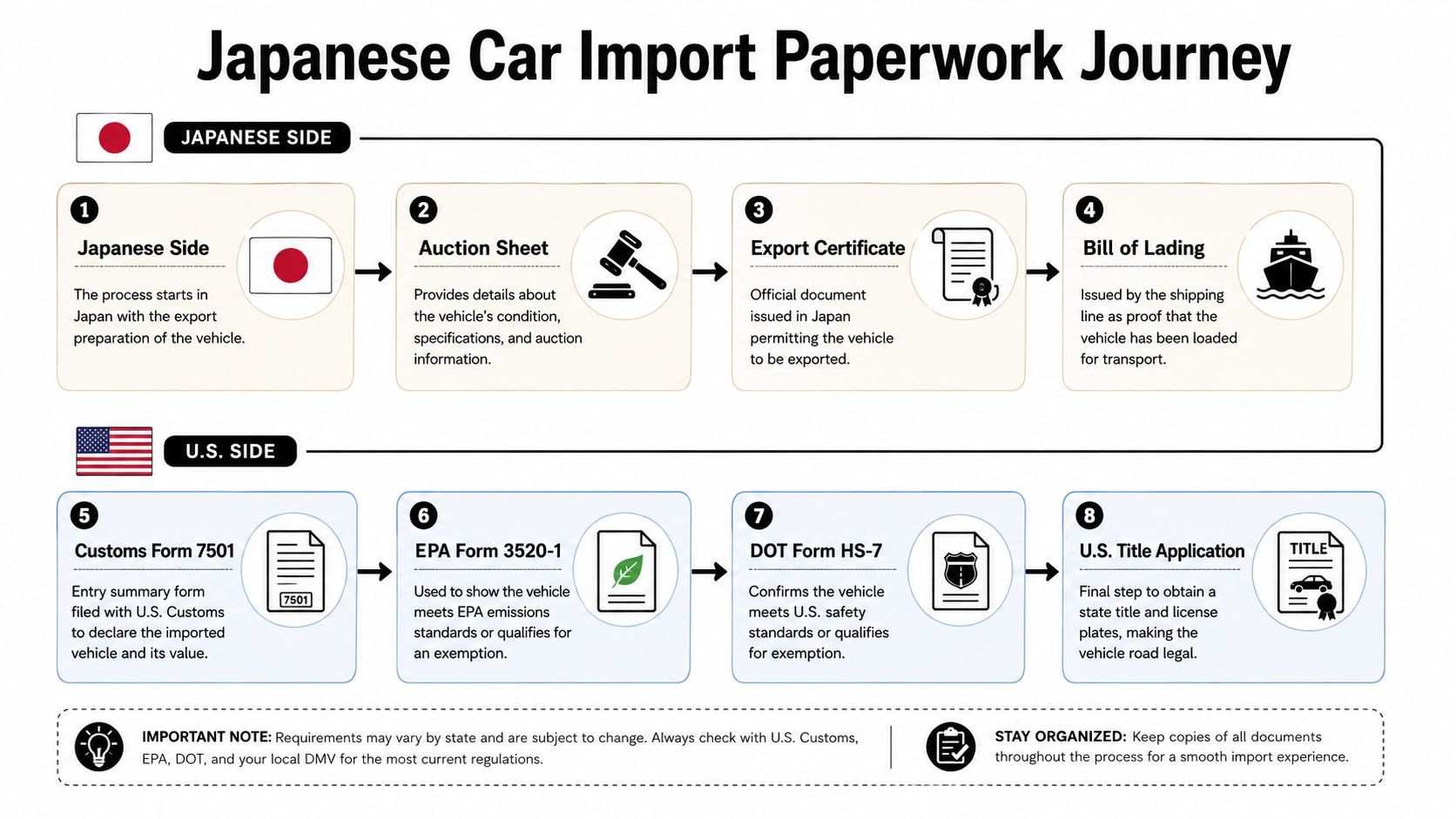
The paper trail starts in Japan, not at the port. You need the auction sheet, the export certificate, and the deregistration paperwork before the car ever gets on a boat. Those documents prove what the vehicle is, who released it, and that it's leaving the Japanese system cleanly.
The U.S. side is more formal, but it's not mysterious. Customs entry runs through CBP Form 7501, the DOT eligibility declaration is HS-7, and emissions compliance is handled on EPA Form 3520-1. Most buyers don't file these themselves. They hand the stack to a customs broker under power of attorney and let the broker process the entry.
The document chain, in plain English
The exporter's job is to get the Japanese side right, then hand off a car that's export-ready. Your broker's job is to clear the U.S. side and keep customs from stalling the shipment. If the paperwork is messy, the port doesn't care how good the car looks.
For buyers who want a practical freight-side reference, navigating customs for freight is a solid primer on how the logistics side works. It won't teach JDM specifics, but it does explain why freight paperwork and customs timing can snowball fast when the documents don't line up.
What stays with the car
The import trail doesn't end at clearance. You'll want every Japanese document saved physically and digitally, because you may need them later for title work, resale, or a DMV question you didn't see coming. That matters even more if the car's history is unusual or the state clerk wants extra proof.
If you're buying something collectible or salvage-adjacent, get the paperwork reviewed before the boat sails. A proper JDM vehicle appraisal won't fix import compliance, but it can help you understand what the car is really worth before you overpay.
The Real Landed Cost Most Buyers Underestimate
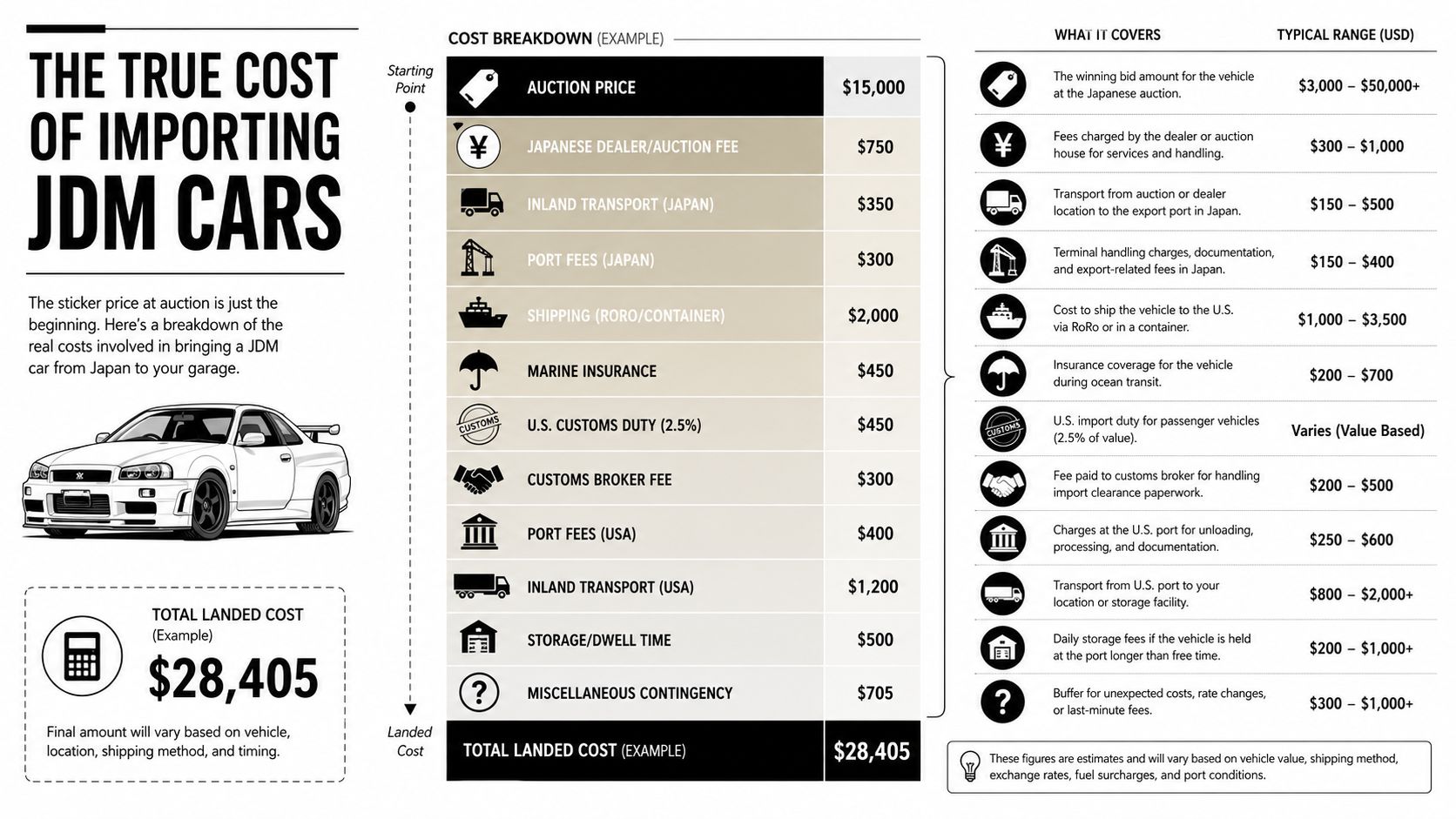
The auction price is the bait. The landed cost is the bill. You're not just paying for the car, you're paying for the export fee, inland transport in Japan, ocean freight, insurance, customs duty, broker handling, port charges, and then another round of transport once the car lands in the U.S.
Where the money disappears
The obvious surprises are shipping and duty. The less obvious ones are the junk costs that show up after the vessel arrives, things like port handling, storage, inland drayage, and customs brokerage. If the vehicle needs a DOT conformance bond, industry guides note it can be 1.5× the vehicle's dutiable value, which is a nasty surprise if you weren't expecting a RI-style process.
The tariff issue is even harsher on trucks. A passenger car can survive the math more easily because the duty is generally 2.5%, but the 25% light-truck tariff can wreck a kei truck deal on its own. That's why so many buyers fall in love with a cheap mini-truck and then discover the final number is nowhere near cheap.
Why location changes the outcome
The same car can land differently depending on where you live. Port choice, inland transport, and state fees all change the total, so a bargain in one part of the country can be a mediocre deal in another. The sticker on the auction sheet doesn't tell you any of that.
Don't pretend the all-in cost is a rounding error. Build a buffer into your budget and assume the port will find something to charge you for. That's not pessimism, that's experience.
Title, Registration, and the State-Level Reality
Customs release is not the finish line. It's just the point where the federal government stops blocking the car and your state DMV starts asking questions. After that, you're dealing with title issuance, VIN verification, and whatever inspection rules your state applies to imported vehicles.
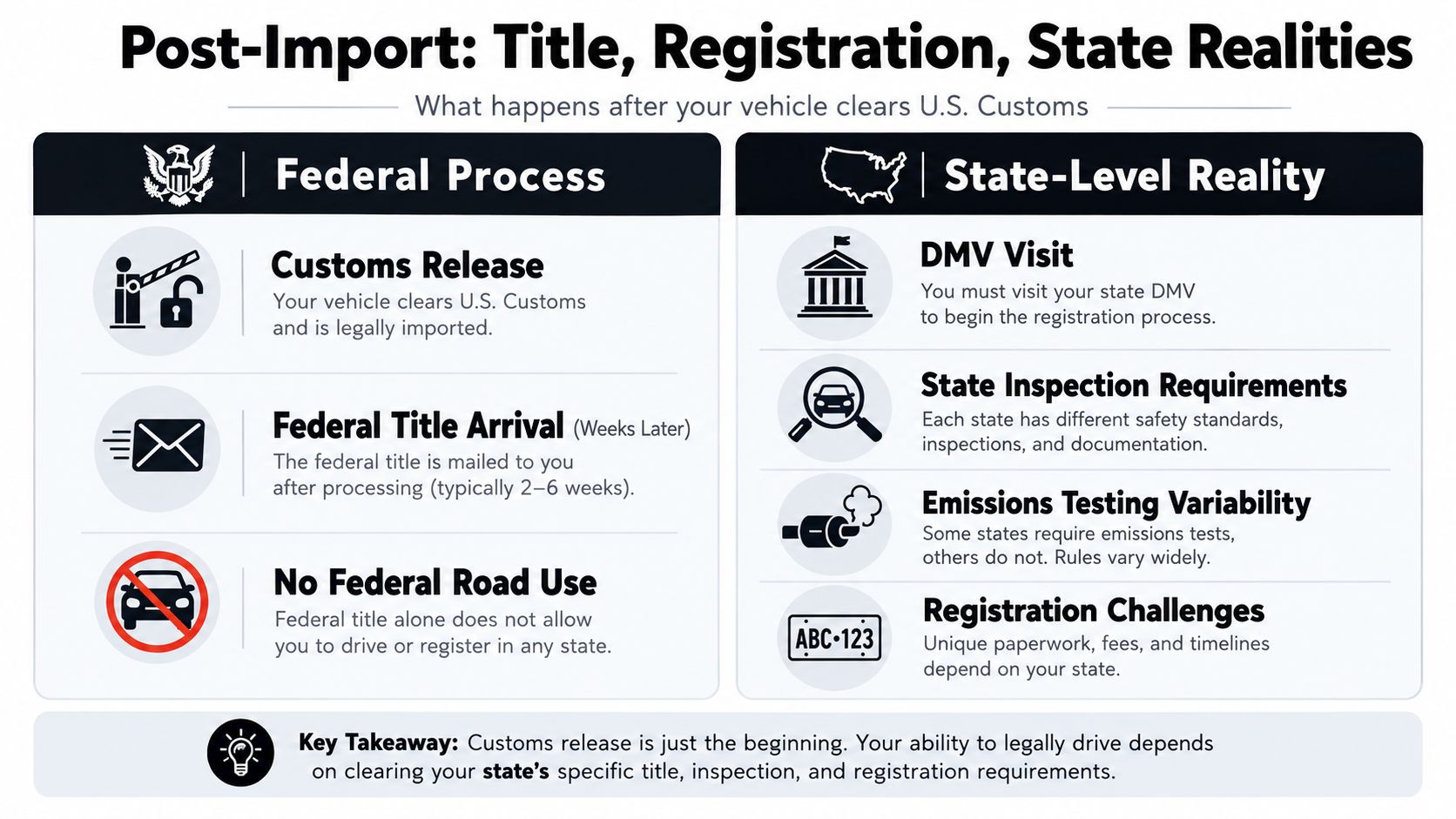
The federal side can be clean while the state side is annoying. That's the part many buyers miss. Even when the car clears customs, your DMV may still want physical inspection, emissions paperwork, and proof that the car fits local road-use rules.
Why states don't all behave the same
Some states are relatively easy on older imports, while others are picky about oddball paperwork, right-hand drive, or commercial-style mini trucks. A car can be federally legal and still be a pain to plate if the clerk doesn't see a familiar title path. That's especially true for gray-market or kei-style vehicles.
The key is to check your home state before you buy. If your DMV has a reputation for being strict, assume it'll be strict for your car too. That isn't paranoia, it's just avoiding a month of dead ends and repeat visits.
For buyers trying to understand how branded salvage, rebuilt, and unusual titles affect registration paths, the breakdown on rebuilt title vs salvage title is worth reading before you get stuck explaining the car twice.
The hard truth on daily use
Federal import legality does not automatically mean easy daily registration. That's where a lot of kei trucks and right-hand-drive builds get stranded in limbo. They're legal in the abstract, but not always convenient in the state where the buyer lives.
If your DMV office has never seen the title format before, show up with more paperwork than you think you need.
Practitioner Tips Before You Wire Any Money
Start with the exporter, not the listing photos. A clean auction sheet, a solid reputation, and a clear paper trail matter more than a polished sales page. If the car is suspiciously cheap, assume something is missing until proven otherwise.
What to confirm before deposit
- Build month in writing: Don't accept a vague model-year claim when the 25-year clock depends on the actual manufacture date.
- Auction grade and mileage consistency: If the numbers don't line up, stop and ask why.
- Deregistration documents: No clean export paperwork, no deal.
- Who files what: Know whether your broker is handling customs entry or leaving you with surprises.
- Your state's registration stance: Check the DMV before the ship leaves Japan, not after.
What to budget for, honestly
Keep a buffer. A 10% to 15% cushion over your all-in estimate is the sane way to buy, because port surprises, storage, repairs, and DMV friction show up when you least want them. That cushion is the difference between a fun project and a car that sits unfinished while the bills pile up.
Rule of thumb: if you can't afford the surprise fee, you can't afford the car yet.
What worth doing in 2026 actually means
Importing is worth it when the car is truly special, the paperwork is clean, and your state won't turn the registration into a fight. It's not worth it when you're chasing a small price gap on a common vehicle or guessing on compliance. The best deals are usually the ones where the legal path is boring.
Keep every document in both physical and digital form. Verify the exporter. Verify the build month. Verify your state rules. If any one of those steps feels shaky, step back and let the car go.
If you want a sharp, local opinion on whether a vehicle is worth the fight after it lands, Total Loss Northwest can help you understand value, paperwork pressure, and the financial reality behind a car that's already been through the system. Visit Total Loss Northwest if you want a serious appraisal-minded review before you commit to the next import, especially when the numbers, title path, or end value don't look right.