You picked up your car from the body shop. The paint looks right. The panel gaps seem close enough. The shop says it's repaired.
But you already know the problem.
If you tried to trade it in tomorrow, or sell it to a private buyer, the accident history would come up and the conversation would change fast. Buyers hesitate. Dealers discount. Insurance companies know this happens, but many still act like repairs alone made you whole.
That loss has a name: car accident depreciation value, also called diminished value. It's the gap between what your car was worth before the crash and what it's worth now, even after proper repairs. That's not a vague annoyance. It's a financial loss tied to the accident.
The numbers are real. CARFAX reports that the average hit to the retail price of a used car with an accident history is about $500, while severe accident damage raises that average hit to about $2,100, with some sources putting the total loss range at 10% to 30% of the car's value according to this diminished value overview.
Insurance adjusters know all of that. What they count on is that most drivers don't know how to prove it, frame it, and push back.
Your Repaired Car Is Worth Less and You Know It
A lot of drivers call only after the same moment. They're standing next to a repaired vehicle that looks fine at first glance, but they can't shake the fact that the vehicle now carries baggage it didn't have before. That instinct is usually correct.
The body shop fixed damage. It didn't erase history.
A dealer appraiser, a private buyer, and a valuation platform don't look at your car the way you do. They look at disclosure, accident reports, repair history, structural concerns, resale risk, and buyer resistance. Once that crash lands on the vehicle record, the car enters a different market category.
What buyers see that owners don't want to hear
A buyer comparing two similar vehicles rarely pays the same money for the one with a crash history. That's true even when the repair work was competent. The concern isn't just whether the car drives straight today. It's whether hidden issues exist, whether future buyers will hesitate, and whether that accident record will keep hurting resale later.
That's why car accident depreciation value becomes its own claim. Repair cost and market loss are not the same thing.
Practical rule: If a vehicle had meaningful damage, especially visible panel damage or structural involvement, assume the resale conversation has changed even if the repairs look clean.
Why insurers push back so hard
Diminished value claims are harder for insurers to contain than repair bills. A repair invoice is a closed document. Market stigma isn't. It depends on vehicle type, buyer behavior, local demand, repair quality, and how the loss gets documented.
That's also why many first offers feel insulting. The carrier isn't just valuing your car. It's testing whether you understand the difference between repaired condition and restored value.
If you're in Oregon or Washington and the other driver caused the crash, don't let the insurer frame this as a “maybe” issue. In the right claim, diminished value is part of the property damage picture. The main fight is usually over amount, not whether the loss exists.
What Is Diminished Value Really?
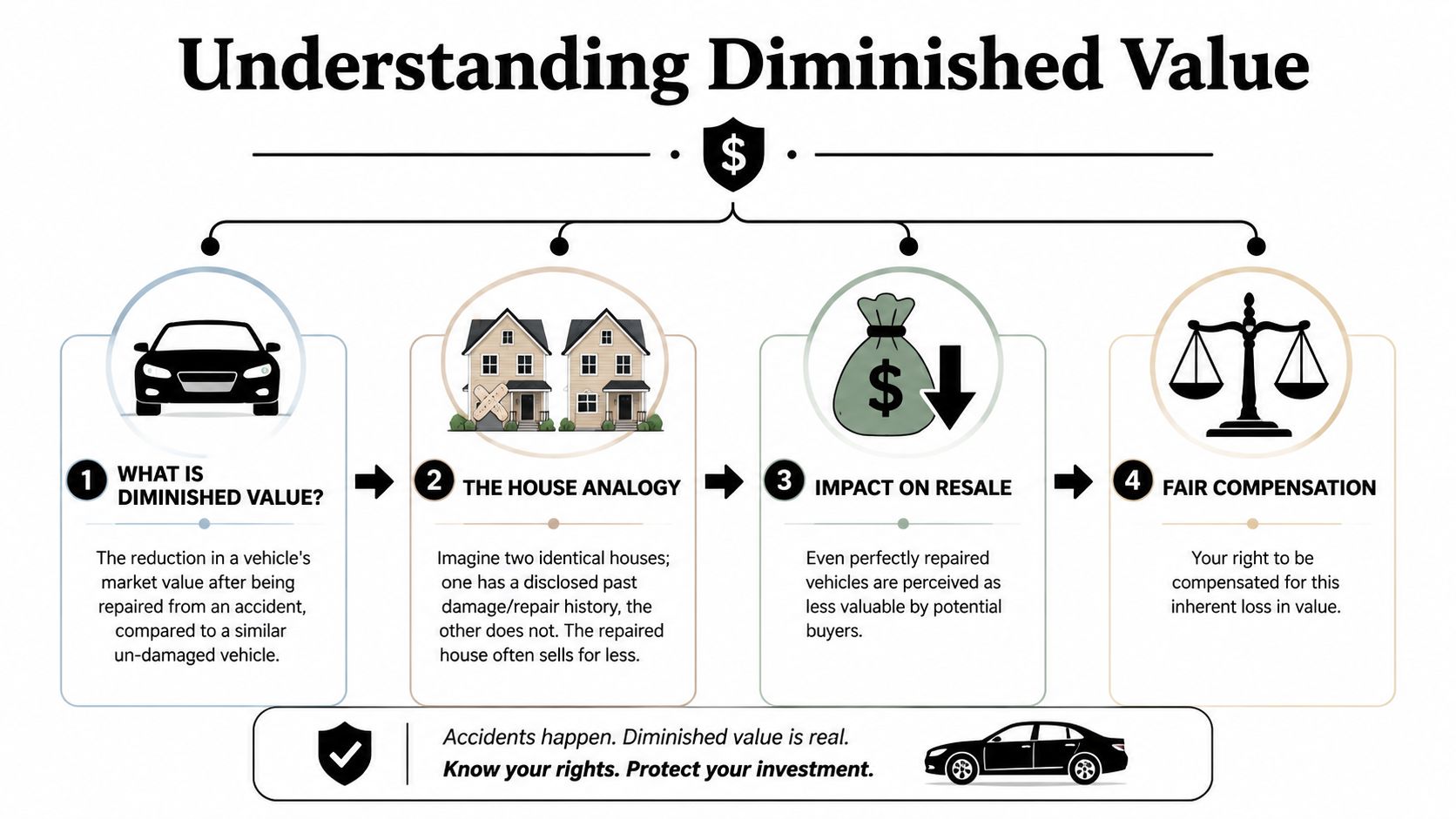
If you want the cleanest explanation, stop thinking about cars for a minute and think about real estate.
Take two identical houses on the same street. Same size, same layout, same neighborhood. One has never had major damage. The other had a serious fire, then got professionally repaired. Most buyers will still pay less for the repaired one because the history changes perception.
That's diminished value.
For a vehicle, the most important category is inherent diminished value. This is the built-in loss in market value that exists because the car now has an accident history. It doesn't require sloppy repairs. It doesn't require current mechanical problems. It exists because the market treats a repaired accident vehicle differently from a clean-history one.
The loss is built into buyer psychology
A buyer may ask:
- What happened in the crash and how severe was it?
- Were airbags involved or was structure affected?
- Who repaired it and how well?
- Will this hurt me again later when I sell or trade it?
Those questions diminish the seller's advantage. That's the heart of inherent diminished value. The car may be safe and functional, but it's no longer a clean comparable to an undamaged one.
Why this matters in a claim
Insurance companies often blur the issue on purpose. They'll say the vehicle was restored to pre-loss condition because the repairs were completed. That answer sounds reasonable until you separate physical condition from market condition.
They are not the same.
A proper repair can restore use. It doesn't automatically restore buyer confidence.
That distinction is why diminished value claims exist at all. If repairs alone solved the whole problem, there would be no resale penalty for accident history. But anyone who has traded in a previously damaged vehicle knows that isn't how the market behaves.
If you want a plain-language legal resource on how these claims fit into broader recovery issues, LA Law Group, APLC has a useful page with expert tips on accident compensation. It's helpful because it frames diminished value as one part of making the owner financially whole after a crash.
The Three Official Types of Diminished Value
When you talk to an adjuster, precision matters. “My car lost value” is true, but it's not specific enough. The industry usually breaks diminished value into three categories, and each one applies in a different way.
Types of diminished value explained
| Type of Diminished Value | Definition | When It Applies |
|---|---|---|
| Inherent Diminished Value | Loss in market value that exists because the vehicle now has an accident history, even if repairs were proper | After repairs are complete and the vehicle still carries stigma in the market |
| Repair-Related Diminished Value | Loss caused by poor or incomplete repairs, such as mismatched paint, visible defects, or other quality issues | When the repair itself lowers value |
| Immediate Diminished Value | The drop in value right after the crash and before repairs are performed | Most relevant near the time of loss or in certain valuation disputes |
Inherent diminished value
This is the claim most drivers are pursuing. The issue isn't that the shop made mistakes. The issue is that a clean-history vehicle and an accident-history vehicle don't command the same money in the open market.
For most non-total-loss claims, this is the category that matters.
Repair-related diminished value
This is a different fight. If the body shop left visible flaws, used lower-grade parts where that matters, or delivered a poor finish, the value problem comes from the quality of the repair. In that situation, you may be dealing with both a repair dispute and a diminished value issue.
The insurer may try to redirect you back to the shop. Sometimes that's appropriate. Sometimes it's a way to avoid discussing broader market loss.
Immediate diminished value
This one gets less attention from ordinary drivers because the vehicle often goes straight into repair. But it's still a real concept. The moment the crash happens, the vehicle's market position changes.
Key point: Adjusters sometimes mix these categories together. Don't let them. If your repairs were competent but the car still won't bring clean-history money, you're talking about inherent diminished value.
Knowing the category helps you aim your evidence. For inherent diminished value, market reaction matters most. For repair-related diminished value, repair defects matter most. If you confuse the two, the insurer gets room to dodge both.
How Insurance Companies Calculate Your Loss
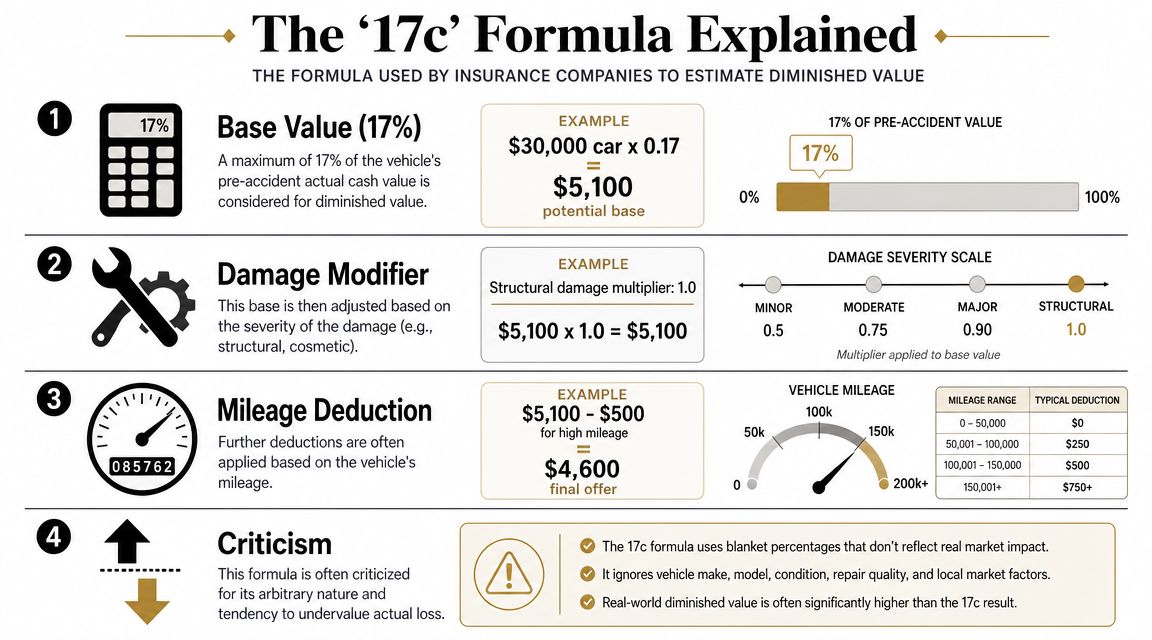
Most insurance companies want a method that is fast, repeatable, and cheap for them. The method you'll hear about most often is the 17c formula.
It's widely cited, and it gives adjusters a simple framework to defend a low number. According to Kelley Blue Book's explanation of diminished value estimates after an accident, the widely cited 17c approach starts with a cap of 10% of the vehicle's pre-accident market value, then reduces that amount again using damage and mileage multipliers. Their example uses a $25,000 vehicle, which produces a $2,500 cap before those additional reductions.
How the 17c method works
The rough logic looks like this:
Start with pre-accident market value
The carrier decides what your car was worth before the crash.Apply the 10% cap
That creates the maximum possible diminished value under this framework.Reduce for damage severity
The formula uses a multiplier that can range from 1.00 for severe structural damage to 0.00 for no structural damage in the KBB explanation.Reduce again for mileage
The mileage multiplier declines as mileage rises and typically reaches 0.00 at 100,000 miles or more under that same framework.
Why this often favors the insurer
The biggest problem is the opening cap. If the market penalty is stronger than the formula allows, the claim is low before the adjuster even starts applying reductions. Then the damage and mileage multipliers can shrink it further.
That's why many owners feel ambushed by the result. A vehicle can have serious stigma in the resale market, yet the insurer points to a neat formula and presents the number like it's objective truth.
It isn't. It's a claims tool.
If the insurer's number came from a formula, ask what market evidence supports it. Many adjusters can explain the math but not the resale reality.
This is also where owners run into valuation software problems more broadly. If you're already dealing with automated claim numbers, it helps to understand how CCC vehicle valuations are challenged in disputed claims, because the same pattern shows up in diminished value negotiations. The system creates a number first. Then the carrier treats that number like the answer instead of the opening position.
Filing Your Claim in Oregon and Washington
Drivers in Oregon and Washington often get generic advice pulled from national articles that never address how these claims get handled in the Northwest. That's a mistake. Local practice matters.
The basic rule is simple. A diminished value claim is usually a third-party property damage claim against the at-fault driver's insurer. You're saying, “Your insured damaged my vehicle, repairs were not the full financial loss, and I want to be paid for the remaining market hit.”
That is very different from asking your own carrier for more repair money.

Why third-party claims are the usual path
In Oregon and Washington, the strongest diminished value claims usually arise when another driver caused the crash and you're pursuing that driver's liability carrier. That gives you a cleaner argument that full property damage includes the vehicle's post-repair loss in market value.
By contrast, first-party claims against your own policy are often more limited because your collision coverage is usually framed around repair or replacement of physical damage. Owners get tripped up here all the time. They assume “my insurer covers my car” means “my insurer covers every category of loss.” That often isn't how the policy is written.
What works in practice
For Northwest claims, documentation beats outrage. The insurer doesn't care that you're offended by the offer. It reacts when the file gets harder to deny.
Use a file that includes:
- The liability decision showing the other driver was at fault
- Final repair invoices with detailed line items
- Damage photos from before repairs
- Vehicle history evidence showing the new accident record
- An independent diminished value opinion when the amount is contested
If you're trying to determine whether your situation supports a claim, a page on diminished value auto appraisal services gives a practical overview of how these claims are evaluated in Oregon and Washington.
What insurers hope you'll do
They want you to accept one of three storylines:
- “Repairs solved it” so there's nothing left to discuss.
- “Your car is too old” so the loss must be minimal or nonexistent.
- “Our internal method says otherwise” so further argument is pointless.
None of those responses ends the discussion by itself. The age, mileage, and severity of damage affect value, but they don't automatically erase a claim. In Oregon and Washington, the better approach is to make the insurer explain why a repaired accident-history vehicle should sell like a clean-history one. Most can't do that convincingly.
Your Step-by-Step Claim and Negotiation Plan
A good diminished value claim isn't built on one angry phone call. It's built like a file you'd be comfortable handing to a judge, arbitrator, or senior claims manager.
Start with order. Then apply pressure.
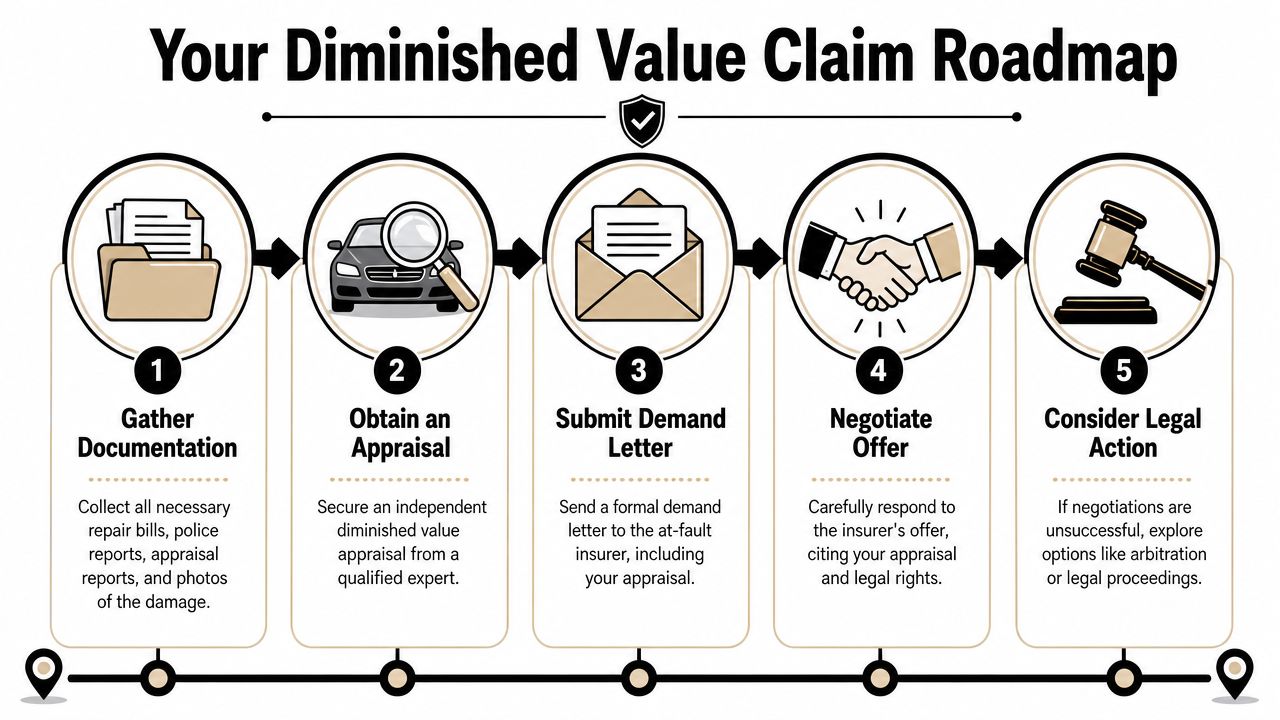
Step 1 Gather the right documents
Before you argue value, collect the records that prove the claim belongs to this accident and this vehicle.
Include:
- Crash paperwork such as the police report or claim assignment documents
- Repair records that show what was damaged and what was replaced or repaired
- Photos from before repair completion
- Ownership and vehicle details including trim, options, mileage, and condition history
If the insurer sees gaps, it will use them.
Step 2 Get an independent appraisal when needed
If the carrier offers a token amount or denies the claim outright, stop debating in circles and get a valuation that is tied to market reality. A qualified appraiser evaluates the pre-loss position, the nature of the damage, the repair outcome, and the resale impact.
This is also where some owners choose a service provider. One option is Total Loss Northwest, which handles diminished value and total loss appraisal disputes and can invoke the appraisal clause in qualifying valuation conflicts. That matters because it moves the dispute away from the insurer's internal number and toward an independent valuation process.
Here's a quick visual guide to the claim flow:
Step 3 Send a formal demand, not a casual complaint
Write a demand letter that is calm, specific, and documented. Identify the vehicle, the date of loss, the liability claim, the repairs completed, and the amount you're seeking if you have an appraisal basis for it.
Attach evidence. Don't send a rant.
“I'm seeking payment for the vehicle's diminished market value after repair. The repair payment did not compensate that separate loss.”
That sentence does more work than three paragraphs of frustration.
Step 4 Negotiate like the adjuster is testing you
Expect the first response to minimize your claim. That's routine. The adjuster may say the offer is based on their formula, that the vehicle doesn't qualify for much loss, or that repaired vehicles don't suffer the kind of penalty you're claiming.
Answer each point with documents, not emotion.
- If they cite a formula, ask what real market support backs it.
- If they question severity, point to the repair scope and affected areas.
- If they imply no buyer cares, remind them the accident history is permanent and directly relevant to resale.
Step 5 Escalate when the file stalls
When negotiation stops moving, don't keep repeating yourself. Escalate. That may mean a supervisor review, a complaint to the appropriate regulator, appraisal involvement where available, or legal action depending on the dispute.
The common mistake is waiting too long while the insurer controls the pace. A disciplined claim gets stronger as it moves upward. A passive claim goes stale.
When You Must Hire a Certified Appraiser
Some claims can be handled with solid paperwork and persistence. Others need expert intervention early because the insurer's formula will never capture the actual loss.
This is especially true for vehicles that trigger stronger buyer sensitivity. According to this discussion of diminished car value for specialty vehicles, for premium, collector, or specialty vehicles, the standard 10% cap used in many formulas can be far too low, with real-world losses reaching 10% to 30%, and potentially as high as 50% in severe cases, because stigma and buyer sensitivity are much stronger.
Hire an appraiser if any of these apply
- Your vehicle is newer or higher value and a low formula-based offer doesn't match what buyers in your market will do.
- The crash involved structural damage or repairs that buyers and dealers will scrutinize closely.
- The vehicle is rare, premium, collector, or specialty and ordinary passenger-car formulas flatten the market's true response.
- The insurer gave you a token offer with no serious market explanation behind it.
- You need a defensible report for negotiation, escalation, or litigation.
What an appraiser changes
A certified appraiser changes the discussion from “the adjuster says” to “the evidence shows.” That matters. Insurers are comfortable denying feelings. They are less comfortable ignoring a documented valuation analysis that can be scrutinized line by line.
If you're not sure what that process involves, this guide on what a car appraisal is used for in an insurance dispute is a useful starting point.
The right time to hire help is usually earlier than people think. Once you see that the carrier is anchored to a weak internal number, you're not negotiating from equal footing anymore.
If your repaired vehicle lost market value after a crash and the insurer is lowballing the claim, Total Loss Northwest provides independent diminished value and total loss appraisals for Oregon and Washington drivers. If you need a documented valuation position instead of another adjuster script, their process is built around real market analysis and appraisal-based dispute support.