So, you’ve been in a car accident. Even after the body shop works its magic and your car looks as good as new, there’s an invisible problem that lingers: its value has taken a permanent hit. This loss is called car accident diminished value, and it's the real, tangible money you lose simply because your vehicle now has an accident on its record.
Insurance companies often gloss over this, but it's a critical piece of the financial recovery you're owed.
What Is Diminished Value and Why It Matters

Let's put this in simple, real-world terms. Imagine you're shopping for a used car. You find two identical models—same year, same mileage, same features. One has a clean history. The other was in an accident but has been fully repaired. Which one do you buy?
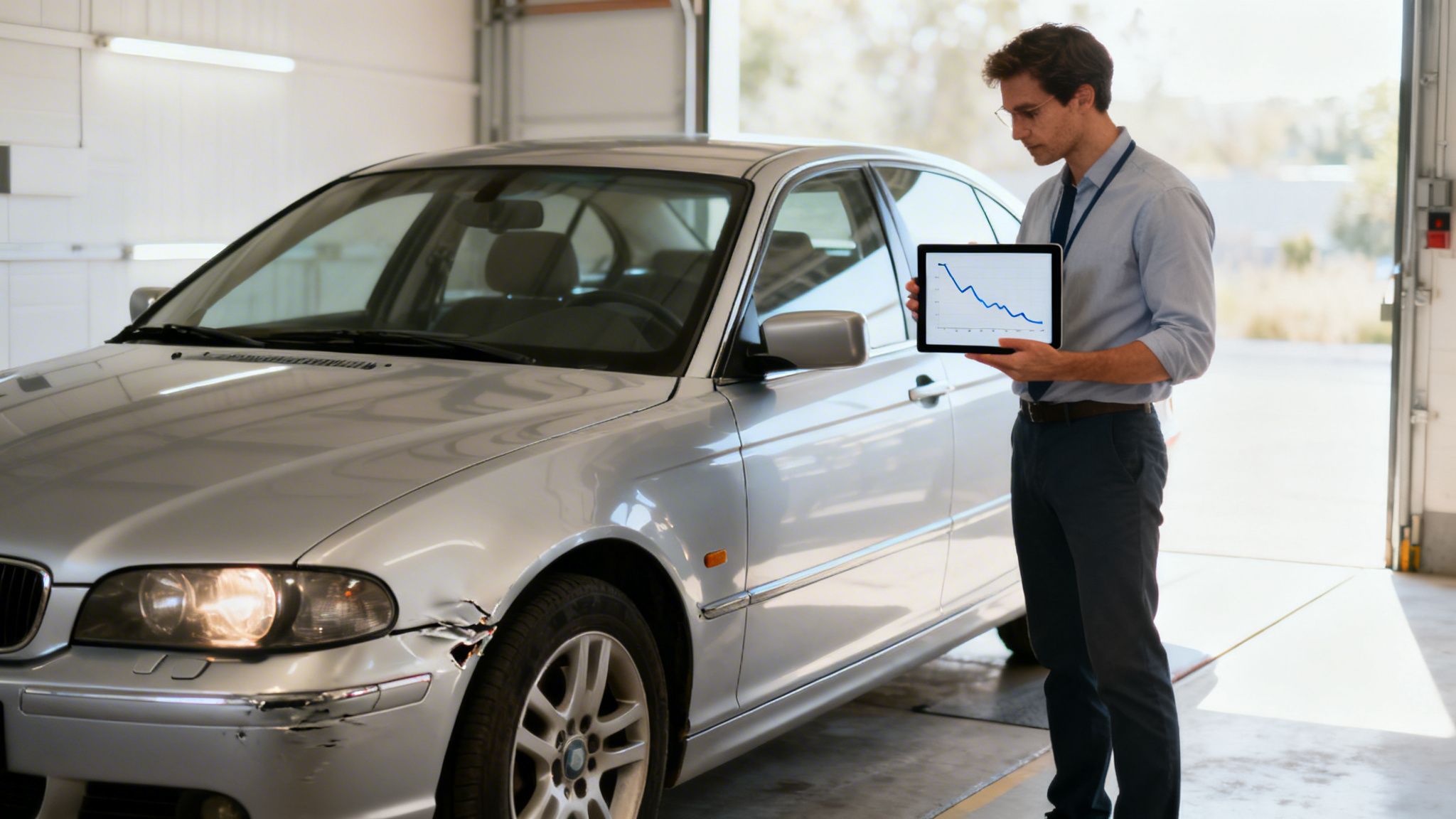
If you’re like most people, you'll either pick the car with no accident history or expect a major discount on the one that was wrecked. That gut feeling, that immediate hesitation, is the very essence of diminished value. It's the stigma that attaches to a vehicle's history report, and no amount of high-quality repair work can ever fully erase it.
The Financial Hit Is Real
This isn't some abstract theory; it's a direct blow to your finances. Let’s say you own a popular mid-size sedan like a Honda Accord or a Toyota Camry. Someone runs a red light and smashes into your side. The repairs are flawless, but fast forward to when you try to sell or trade it in.
That accident history now pops up on every vehicle report. Suddenly, buyers are hesitant, or they're offering you thousands less than you expected. In 2026, market data shows mid-size sedans can lose anywhere from 8% to 14% of their pre-accident value due to this stigma. For a deeper dive, learn more about how a collision impacts your car's resale price.
When another driver is at fault, their insurance company is responsible for making you "whole." That doesn't just mean fixing the dents; it means compensating you for this very real loss in market value.
Diminished Value at a Glance
For anyone navigating the aftermath of an accident, understanding these core concepts is the first step toward a fair recovery. Here's a quick summary of what you need to know.
| Concept | What It Means for You |
|---|---|
| Market Stigma | Your car is now worth less to potential buyers, simply because it has an accident in its history. |
| "Making You Whole" | The at-fault party's insurance owes you for both the cost of repairs and this drop in your car's market value. |
| Inevitable Loss | Even with perfect repairs, a car with a collision history will almost always be worth less than an identical, undamaged one. |
| Proof is Required | You can't just ask for the money; you need a credible, evidence-based report to prove the exact amount of your loss. |
Ultimately, this isn't just about a number on a vehicle history report—it's about protecting the value of one of your most significant assets.
Why Insurance Companies Resist Paying
Despite how clear this concept is in the open market, insurance carriers routinely deny or underpay diminished value claims. Their go-to argument? "We repaired your car, so its value is restored." This completely ignores the reality of how car buyers think and act.
A vehicle with an accident history is worth less than one that has never been in a collision. Car buyers often avoid vehicles with prior damage, which lowers the market value.
Let's be blunt: this is a business tactic. Insurers save millions by counting on car owners not knowing their rights or lacking the professional documentation to fight back. Before you can recover what you're owed, you first need to understand what a diminished value claim is and how the process works.
You are not obligated to accept this financial hit, especially when the accident wasn't your fault. Successfully proving your car accident diminished value claim takes a methodical approach and undeniable evidence. This is where a certified, independent appraiser becomes your most important ally, providing the expert report you need to counter the insurance company's lowball offers and recover the money you're rightfully owed.
Understanding the Three Kinds of Diminished Value

When a car is in an accident, its value doesn't just drop in one simple way. The loss is more nuanced than that. To build a strong claim, you first have to understand exactly how the value was lost.
Think of it like this: not all injuries are the same, and you need a specific diagnosis to get the right treatment. The same goes for your car. The loss it suffers from a car accident diminished value event actually falls into three distinct categories. Pinpointing which ones apply to your situation is the first step toward getting paid what you're rightfully owed.
Inherent Diminished Value
This is the big one—the most common and unavoidable type of loss. Inherent Diminished Value (IDV) is the automatic drop in your car’s resale value just because it now has an accident history. It’s a permanent stigma.
Even with the best repairs in the world, the car's history report will always show it was in a wreck. An educated buyer will simply never pay the same price for a previously damaged car as they would for an identical one with a clean record. This loss is "inherent" because it's baked in, regardless of how perfect the repairs look. It’s a loss based on history, not quality.
Repair-Related Diminished Value
Now we get into the quality of the work itself. Repair-Related Diminished Value happens when the body shop’s work is just not up to par, leaving behind clear evidence of the repair.
This is a separate loss on top of the inherent loss. It’s caused by lingering flaws that any sharp-eyed buyer would spot. I see this all the time. Common examples include:
- Mismatched Paint: The new paint has a slightly different shade or texture that doesn't quite blend with the factory finish.
- Uneven Panel Gaps: The spaces between doors, the hood, or the trunk are wider on one side than the other—a dead giveaway of a past collision.
- Aftermarket Parts: Using cheaper, non-OEM (Original Equipment Manufacturer) parts can compromise the fit, finish, and overall quality of the vehicle.
- Lingering Mechanical Flaws: Maybe there's a new rattle that wasn't there before, or the car pulls slightly to one side.
This type of diminished value is the direct result of a clumsy repair job. It’s tangible proof the car wasn’t truly restored to its pre-accident condition.
Immediate Diminished Value
Finally, there’s Immediate Diminished Value. This one is a bit different. It’s the difference in your car's value right before the crash and its value immediately after—in its wrecked, undrivable state, before any repairs have even started.
Immediate diminished value isn't usually the focus of a standard claim, since we're typically concerned with the value lost after repairs. However, this number becomes critical in total loss negotiations.
When the cost to fix a car gets close to its actual worth, the insurer has to decide: repair it or total it? This is becoming a huge issue for car owners. With the rising cost of parts and higher salvage auction prices, insurers are more motivated than ever to declare a vehicle a total loss. In fact, some analysts predict that by 2026, 30% of all body shop work could result in a total loss.
This shift is largely due to insurers quietly lowering their total loss thresholds, putting more vehicles on the chopping block. You can discover more about the trends impacting total loss declarations and see how it’s changing the game for accident claims.
By understanding these three categories, you can get a complete picture of your car's value loss and build a case that leaves no money on the table.
How Insurance Companies Try to Deny Your Diminished Value Claim
Ever get that sinking feeling when you’re on the phone with an insurance adjuster? You know, for a fact, that your car has lost thousands in value after the accident, but the person on the other end of the line seems to be reading from a completely different script.
That’s not your imagination. It’s their strategy. Insurance carriers are in the business of minimizing payouts to protect their profits, and they have a well-worn playbook to do just that. Knowing their tactics is your first line of defense.
The "Repairs Made It Whole" Argument
This is the oldest trick in the book. The adjuster will confidently tell you that since they paid to fix the physical damage, they’ve met their obligation. They’ll insist the car has been returned to its “pre-loss condition” and that you’ve been made “whole.”
But that logic completely falls apart in the real world. Think about it: no educated car buyer will ever pay the same price for a vehicle with an accident on its record. A clean CARFAX or AutoCheck report is non-negotiable for most people. The insurer’s definition of "whole" conveniently ignores this permanent financial scar.
The Flawed 17c Formula
If the insurer does make an offer, it’s almost guaranteed to be a lowball figure calculated with something called the 17c formula. This method came out of a Georgia court case and has since become a favorite tool for carriers across the country because it reliably churns out insultingly small payouts.
Here’s a look at how this flawed calculation works:
- They start with a pre-accident value from a source like NADA or KBB.
- They immediately apply a 10% cap to that value. That’s their maximum possible payout, regardless of how bad the damage was.
- Next, they hit it with a "damage multiplier," slashing the number based on whether the damage was minor, moderate, or severe.
- Finally, they use a "mileage modifier" to reduce the figure even further for vehicles with more miles on the odometer.
What you're left with is a number that has no connection to your car's actual loss in market value. A proper, independent appraisal doesn't rely on made-up formulas. It uses real-world sales data from comparable vehicles—one with a clean history and one with similar accident damage—to pinpoint the true difference in what a buyer would pay.
When an insurance company brings up the 17c formula, it's a red flag. They are signaling that they aren’t interested in what your car is actually worth. It’s an internal calculation designed to serve them, not to compensate you fairly.
Other Common Denial Tactics
Beyond those two main plays, adjusters have a few other methods they use to stall, confuse, or shut down your claim. Keep an eye out for these.
"You Need to Sell the Car to Prove the Loss"
This is completely false. You don’t have to sell your car to prove it’s worth less. The financial loss happens the instant the accident is documented on its history report. A certified appraiser can prove this loss with market data, no sale required.
"We Don't Pay Diminished Value in Your State"
This is often just a bluff to see if you’ll back down. While laws do vary, most states allow for third-party diminished value claims when the other driver was at fault. Here in Washington and Oregon, your right to claim diminished value is clearly established in case law.
Delay and Discourage
Sometimes, the strategy is simply to wear you out. The adjuster might stop returning your calls, pass you from one department to another, or bury you in endless, pointless paperwork requests. They’re banking on you getting frustrated enough to just give up.
Facing these roadblocks can be intimidating, but it’s crucial to remember that they are just tactics. Your best weapon is an evidence-based claim built on facts. A comprehensive report from a certified, independent appraiser replaces their flawed formulas and flimsy arguments with undeniable proof of your loss.
Filing Diminished Value Claims in Oregon and Washington
Navigating a car accident diminished value claim isn’t a one-size-fits-all process. The rules can change dramatically just by crossing a state line, and for drivers in the Pacific Northwest, understanding the specifics for Oregon and Washington is the key to getting paid what you're owed.
The good news? Both states are what we in the industry call "favorable" for third-party diminished value claims. This simply means that when someone else causes an accident, you have a clear right to file a claim against their insurance company for the drop in your vehicle's resale value. It's a critical protection that keeps you from losing money over someone else’s mistake.
The Legal Landscape in Washington
Washington State gives vehicle owners a very strong foundation for recovering diminished value. Thanks to key court rulings, it's been firmly established that an insurer's duty to "repair or replace" a car also means they have to compensate you for the loss in market value—even if the repairs were perfect.
What this means for you is that insurers can't just dismiss your claim out of hand. But it doesn't mean they'll send you a check automatically. You still have to make a formal demand and, most importantly, prove your loss with solid evidence.
A few key points for Washington drivers:
- Solid Legal Footing: The courts have consistently sided with consumers, which makes it much harder for an insurance company to deny the existence of diminished value.
- Third-Party Claims: Your claim is filed directly with the at-fault driver’s liability insurance.
- Statute of Limitations: You have three years from the date of the accident to file a lawsuit for property damage, which includes your diminished value claim.
How to File a Claim in Oregon
Oregon also recognizes your right to file a third-party diminished value claim. The core principle is the same: if you weren't at fault, you can demand compensation for the market value your car lost simply because it now has an accident history.
Think of it this way: You were not at fault, yet your asset is now worth less. The at-fault party's insurer has a legal responsibility to make you whole, and that includes paying for this documented loss.
Just like in Washington, the burden of proof is entirely on you. You can't just tell the adjuster your car is worth less; you have to show them with a professional, data-backed report. If you want a complete walkthrough, you can learn more about how to handle a diminished value auto claim in our comprehensive guide.
Important details for Oregon drivers:
- Proof is Everything: You are required to quantify your car's loss in value with a formal appraisal.
- The Process: The claim is made against the at-fault driver’s property damage liability coverage.
- Statute of Limitations: The deadline to file a property damage lawsuit in Oregon is much longer, giving you six years from the date of the wreck.
The Burden of Proof Rests on You
In both Oregon and Washington, here’s the reality: the insurance company will not do this work for you. Adjusters aren't going to volunteer a diminished value payment or help you calculate a fair amount. The responsibility to prove how much your car accident diminished value is falls squarely on your shoulders.
This is exactly why a generic online calculator or a simple demand letter almost never gets the job done. You need a detailed, professional appraisal from a certified expert who truly understands the local market. That report becomes your primary piece of evidence, turning a simple request into a powerful, data-driven demand that insurers are legally obligated to take seriously.
Your Step-by-Step Process for a Successful Claim
Knowing you're owed money for diminished value is one thing. Actually getting the insurance company to pay up is a whole different ballgame. Let’s be honest, the at-fault driver's insurer isn't going to hand you a checklist for success. They profit when you get confused and give up.
That's why you need a clear, practical plan. Think of it less like filling out forms and more like building an open-and-shut case. Each step you take adds another piece of solid proof to your file, making it much harder for the adjuster to deny your claim or throw a lowball offer your way. Let's walk through exactly how to build a winning car accident diminished value claim.
Step 1: First, Are You Eligible?
Before you put any time or energy into this, you have to make sure you can actually file a claim. For most people, especially here in Oregon and Washington, this comes down to one simple question: were you the not-at-fault party?
If someone else caused the accident, you can file a diminished value claim against their property damage liability insurance. You generally can't claim diminished value from your own policy if you were the one who caused the crash. Your collision coverage is there to pay for repairs, not to make up for the bad CarFax report that follows.
Step 2: Gather Your Paper Trail
From this moment on, you need to become a meticulous record-keeper. Your claim is only as strong as the evidence you can show the adjuster. Start by creating a file—digital or physical—and put everything related to the accident and repairs into it.
Your evidence file must include:
- The Final Repair Invoice: This is non-negotiable. It’s a detailed list of every part that was replaced and every hour of labor the body shop charged for.
- Photos and Videos: You'll want pictures of the damage before it was fixed and clear photos of the completed repairs. The more angles, the better.
- The Police Report: This is the official record of the accident. Crucially, it documents which driver was cited for being at fault.
- Pre-Accident Records: Any service history or sale documents that help prove your car was in great shape before the wreck will strengthen your case.
This collection of documents tells a story. It establishes the "before" and "after" of your vehicle's condition and provides the factual basis for your financial loss.
The flowchart below gives you a bird's-eye view of how a claim generally proceeds in Oregon and Washington.
As you can see, while the basic steps are the same, the legal time limits are different. Oregon gives you a much longer window to get your claim filed.
Step 3: Get a Professional Appraisal
This is, without a doubt, the most critical part of the entire process. An online calculator or a generic form letter is an invitation for the insurance company to ignore you. To be taken seriously, you need a comprehensive, data-driven report from a certified independent appraiser.
This report isn't just an opinion letter. It's a detailed analysis backed by:
- Real-world sales data from your specific local market.
- Direct comparisons between your repaired vehicle and undamaged ones for sale.
- A physical inspection of the vehicle to assess the quality of the repairs.
A professional appraisal report transforms your claim from a simple request into a formal, evidence-backed demand. It replaces the insurer's flawed formulas with objective, market-driven proof of your loss.
Step 4: Write and Send a Formal Demand Letter
Once you have the certified appraisal in hand, it's time to officially present your claim. You'll draft a formal demand letter and send it directly to the at-fault driver's insurance adjuster. Keep it professional, concise, and to the point.
The letter should clearly state that you are making a claim for your car's inherent diminished value, reference the date of the accident and claim number, and attach the professional appraisal report as your evidence of loss. This letter is what officially puts the insurer on notice and kicks off the negotiation process.
Step 5: Know How to Use the Appraisal Clause
What happens if the insurance company digs in its heels, refuses to negotiate fairly, or sticks to an absurdly low offer? You have a powerful contractual right called the Appraisal Clause. This provision, included in every standard auto policy, outlines a process for resolving disputes when you and the insurer can’t agree on the amount of loss.
When you invoke the clause, both you and the insurer hire your own competent appraisers. Those two appraisers then try to agree on the amount of diminished value. If they can't reach an agreement, they select a neutral third-party umpire to make a final, binding decision. This is your trump card—it takes the decision out of the biased adjuster's hands and forces a resolution based on expert analysis, not the insurance company's internal playbook.
Why a Certified Appraiser Is Your Strongest Ally

Let's be honest. When you're dealing with an insurance company, you're not just talking to a friendly adjuster. You're up against a massive organization with a whole playbook and powerful software all designed for one purpose: to pay you as little as legally possible.
Fighting that battle alone is like showing up to court without a lawyer. You wouldn't do it. The same logic applies here—you shouldn't fight for your car accident diminished value without a true expert in your corner. An independent, certified appraiser is that expert, and they're your most critical ally. Their job is to cut right through the insurer’s self-serving arguments and prove your vehicle's actual, market-based loss with cold, hard facts.
The Power of an Evidence-Based Report
The insurance adjuster's goal is to protect their company’s bottom line. They lean on questionable internal formulas—like the infamous "17c"—to produce a lowball offer that has little to do with your car's real drop in market value. A certified appraiser does the complete opposite.
Instead of plugging numbers into a generic calculator, a professional appraiser meticulously builds a detailed report grounded in objective, verifiable evidence. This isn't just an "opinion"; it's expert testimony on paper.
A truly solid appraisal will always include:
- Real-World Market Analysis: The appraiser digs into your specific local market to see what cars identical to yours—same year, make, model, and trim—are actually selling for.
- Comparable Sales Data: They find examples of similar vehicles that have accident histories to demonstrate the very real price gap that buyers demand.
- USPAP Compliance: The report is written to meet the Uniform Standards of Professional Appraisal Practice (USPAP). These are the same stringent quality standards required for real estate and other high-value appraisals.
This data-first approach completely dismantles the insurance company's position, replacing their weak offer with a number rooted in reality. That difference is often thousands of dollars.
Invoking the Appraisal Clause: Your Secret Weapon
Buried deep in the fine print of nearly every auto policy in Oregon and Washington is a powerful tool called the Appraisal Clause. It’s your contractual right to settle a dispute fairly, and frankly, it's something adjusters hope you never find out about.
The Appraisal Clause is your trump card. It takes the final decision out of the insurance company's hands and gives it to neutral, qualified experts who are legally required to determine a fair value.
When you and the insurer are at a standstill over the amount of loss, you can invoke this clause. The process itself is quite straightforward:
- You hire your own certified appraiser.
- The insurance company then has to hire its own appraiser.
- The two appraisers negotiate to land on an agreed value.
- If they still can't agree, they bring in a neutral "umpire" who makes the final, binding decision.
Invoking the Appraisal Clause is the ultimate check on an insurer’s power. It forces them to drop their internal formulas and engage in a process based purely on evidence and expert analysis. A certified appraiser doesn’t just write your initial report; they can represent you through this entire process to make sure your claim gets the serious attention it deserves. To get a better handle on the mechanics, you can discover more about what an appraisal for a car entails and how it works to secure your settlement.
Frequently Asked Questions About Diminished Value
Even after you get the basics of diminished value, some specific questions almost always pop up. It’s completely normal. Let’s tackle the ones we hear most often from car owners trying to get a fair shake.
Can I Claim Diminished Value if I Was At Fault?
This is a big one, and the short answer is no. Think of a diminished value claim as a way to hold the at-fault driver financially responsible for the full scope of the damage they caused—not just the repairs, but the permanent hit to your car's market value.
Because of this, you can only file a third-party claim against the other driver's insurance. Your own collision policy is only designed to cover the cost of repairs, not the loss in value that happens afterward.
Does the Age or Mileage of My Car Matter?
Absolutely. A nearly new car with only a few thousand miles on the odometer will take a much bigger financial hit from an accident than a ten-year-old vehicle with 150,000 miles.
Buyers expect an older car to have some history and imperfections. But a documented accident on a late-model vehicle is a huge red flag for potential buyers, and its resale price will plummet as a result. By the same token, if your car already had a significant accident in its history, it's much harder to argue for diminished value from a second one—the market stigma was already there.
When assessing diminished value, a certified appraiser will scrutinize the quality of repairs, including the critical choice between OEM vs Aftermarket Parts, as this significantly impacts your vehicle's post-repair market value. Using non-original parts can be a key factor in proving your loss.
How Long Do I Have to File a Claim?
Every state sets a legal deadline, or statute of limitations, for filing a lawsuit over property damage. You must act within this window.
- In Washington, you have three years from the date of the accident.
- In Oregon, the clock is a bit more generous, giving you six years.
While that might seem like plenty of time, our advice is always to start the process as soon as your repairs are finished. The longer you wait, the more difficult it becomes. Evidence gets stale, and it gives the insurance company more opportunities to delay and complicate your claim.
What if My Car Is Leased or I Have a Loan?
You can absolutely file a diminished value claim even if you're still making payments. The key thing to understand is that the financial loss technically belongs to the legal owner of the vehicle. That’s the leasing company or the lienholder (the bank that issued your loan).
Before you start a claim, it's a good idea to check your lease or loan agreement. Some contracts have clauses requiring you to forward any diminished value settlement money directly to them to cover their asset's loss in value. Knowing your obligations upfront is critical.
Don't let an insurance adjuster tell you what your car is worth. At Total Loss Northwest, our certified appraisers dig into the data to prove the true value you're owed, whether for a diminished value or total loss claim. We serve clients across Oregon and Washington, fighting to get you the fair settlement you deserve. Contact us today to get the expert help you need.