Your car is sitting in a tow yard or body shop. The adjuster keeps saying they're “reviewing” the claim. You might be missing work, paying for a rental, arguing over storage fees, and trying to keep up with regular life at the same time. Then an ad pops up promising fast cash against your future settlement.
That pitch lands because the pressure is real. After an accident, people don't go looking for a car accident settlement advance because they want one. They go looking because they feel cornered.
I've spent years around damaged vehicles, lowball valuations, and claim delays. I've seen what happens when financial stress pushes a driver into a bad deal. The cash feels like relief for a minute. Later, when the case settles and the money gets carved up, that relief often turns into regret.
If you're under the gun right now, slow down. A settlement advance is rarely the best move. In many cases, it's the most expensive way to solve a temporary cash problem.
The Financial Pressure Cooker After an Accident
A not-at-fault driver gets rear-ended on the way to work. The vehicle may be unsafe to drive, or it may be declared a total loss. Their neck hurts, their phone won't stop buzzing, and the insurance company wants patience. Meanwhile, rent is due, the deductible is hanging over their head, and missing even a few shifts starts a chain reaction.
That's when the “easy button” shows up.
An ad says you can get cash now and pay it back later from your case. No upfront payment. No monthly bill. No risk if you lose. To someone stressed, tired, and behind, that sounds reasonable.
It's not unreasonable to want breathing room. It is unreasonable how often this industry profits from desperation.
Why these offers hit so hard
Insurance companies move at their pace, not yours. They can delay a valuation, question damage, drag out paperwork, or make an offer that doesn't come close to replacing what you lost. While that happens, your bills don't pause.
A lot of drivers in this spot need triage, not hype. If debt is stacking up, practical resources like LifeBack Law Firm, P.A. solutions can help you think through relief options before you sign away part of your settlement. If you're still trying to stabilize the claim itself, this guide on steps after a car accident is a better starting point than any “cash now” ad.
You're vulnerable after a wreck because the accident creates two losses at once. Physical disruption and financial disruption.
The trap starts with urgency
The companies offering advances understand the moment you're in. They market speed, simplicity, and emotional relief. They don't lead with the downside because the downside kills the sale.
From an appraiser's perspective, this matters because time can improve a claim when the underlying value is documented correctly. But a driver who takes fast money often loses the ability to wait for the right outcome. Once a funding company has a claim on your settlement, every delay feels more expensive. That pressure changes decisions, and not in your favor.
What Is a Car Accident Settlement Advance Really
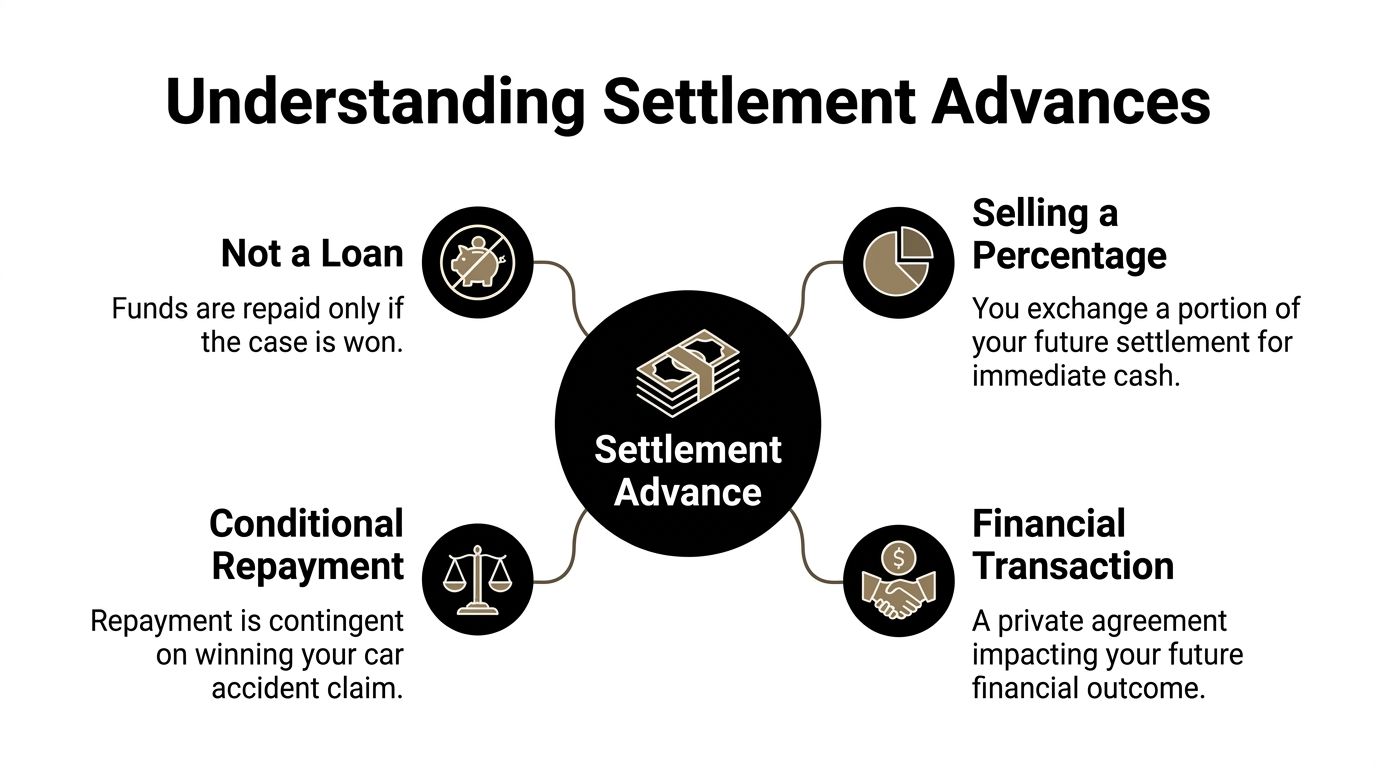
A car accident settlement advance is marketed like a lifeline, but you should think of it as a sale of future proceeds at a discount. You get cash now. In exchange, a funding company gets paid from your settlement later, and they expect a hefty return for taking that risk.
That's why I tell clients not to focus on the “advance” label. Focus on the transaction.
It's not a loan in name, but it acts like expensive debt
A traditional bank loan looks at your credit, income, and ability to repay. A settlement advance company looks at your legal claim. Their decision turns on whether they believe your case is likely to produce money.
The big phrase you'll hear is non-recourse. That means if your case doesn't recover money, you generally don't repay the advance. That feature is real, and it's the main reason these products exist. But it isn't generosity. It's pricing. The company charges heavily because some cases don't pay out.
A simple way to understand it
Consider this scenario: Suppose someone offered to buy part of an inheritance before probate ends. They give you less cash now than that future share is worth because they're buying speed and uncertainty. That's the same basic idea here.
You are not borrowing against your paycheck. You are giving up part of a future recovery that hasn't been finalized yet.
Who's involved
Most of these deals involve three players:
- You as the claimant: You want immediate cash to handle living expenses or claim-related stress.
- Your attorney: The funding company usually wants your lawyer's cooperation because repayment comes from the settlement disbursement.
- The funding company: This isn't a bank. It's a business making a calculated bet on your case.
Practical rule: If you don't understand exactly how the company gets repaid and in what order they get paid, you shouldn't sign anything.
What the company is buying
They're not buying your pain, your inconvenience, or your story. They're buying access to your settlement proceeds. That distinction matters because once the claim resolves, their contract gets enforced before you see your final net amount.
That's why the sales language can mislead people. “No monthly payments” sounds comforting. But the meter may still be running in the background, and the final cost can gut the money that was supposed to help you recover.
The True Cost Behind the Quick Cash
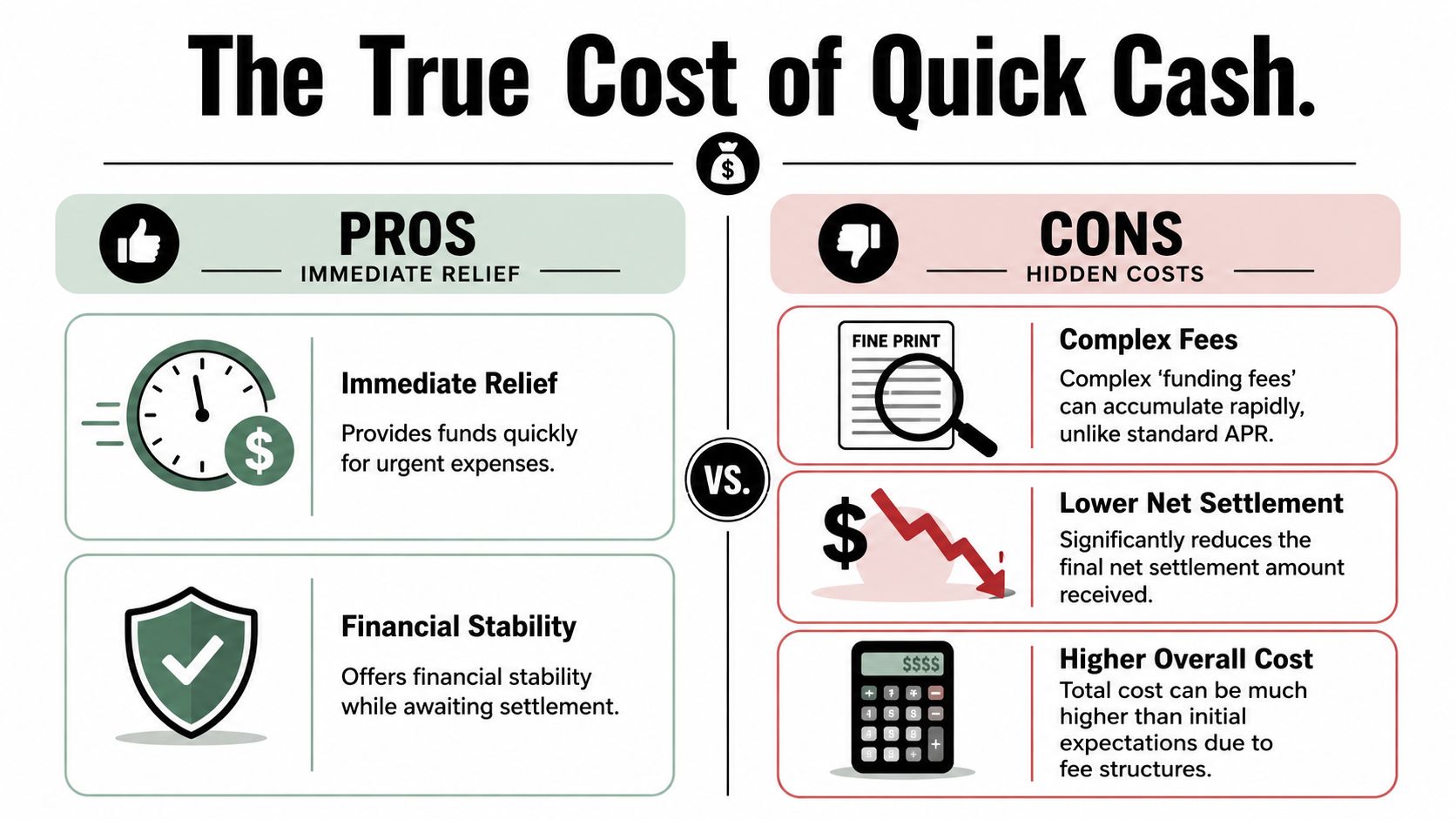
Most drivers often encounter serious financial difficulties. The problem isn't just that a settlement advance is expensive. The problem is that the pricing is often hard to read, easy to underestimate, and brutal once time passes.
You may not see a familiar loan format. Instead, you'll see terms like funding fee, use fee, processing fee, payoff amount, or tiered return. Different labels, same result. The amount owed can grow fast while your case crawls along.
Why the price feels hidden
A lot of people expect to compare borrowing costs the way they would compare a credit card or personal loan. Settlement funding contracts often make that harder. Instead of one clean cost figure, the paperwork may stack fees, schedules, payoff tables, and compounding language that the average person won't catch on a first read.
If you want a plain-language overview of how settlement fees are framed, this 2026 guide to settlement costs is useful background. Read it before you sign anything, not after.
What this does to your net recovery
The money from a claim doesn't all land in your pocket untouched. Depending on the case, the final pot may already have attorney fees, case costs, medical bills, liens, or reimbursement claims attached to it. A funding company adds another hand in the pile.
That changes the math in a bad way.
- You get relief now: That's the appeal, and I won't pretend it's meaningless.
- You give up flexibility later: If your case takes longer than expected, the payoff grows while you wait.
- You shrink the purpose of the settlement: The money that was supposed to replace a vehicle, cover treatment, or offset lost income gets diverted.
What to demand before considering one
Don't accept vague answers. Push for documents.
- A written payoff schedule that shows what you'd owe over time.
- Every fee in writing, including administrative or case review charges.
- Early payoff terms, because some contracts punish people for resolving the advance quickly.
- A cap explanation, if there is one. Many people assume there's a safety limit when there may not be a meaningful one.
If a company sells “fast approval” harder than it explains the payoff structure, walk away.
My blunt view as an appraiser
I've seen too many claims where the driver needed the settlement to make themselves whole, only to watch chunks of that recovery disappear because they grabbed quick cash in a panic. Funding companies know your claim has value. They just want to buy part of it cheap from you before the insurer pays properly.
That's not financial help. It's a high-cost extraction model wearing sympathetic language.
How an Advance Impacts Your Legal and Insurance Claim
The biggest mistake drivers make is treating the advance as separate from the claim. It isn't. The paperwork may be private, but the consequences land right in the middle of your legal strategy and your insurance negotiation.

Your attorney usually has to deal with it
In many cases, the funding company wants your lawyer involved because they expect repayment from the settlement disbursement. That means your attorney may need to review, acknowledge, or coordinate around the contract.
A lot of lawyers dislike these products for a reason. They know what they do to net recovery. They also know that once a client is carrying a growing payoff obligation, patience gets harder.
If you're weighing legal costs generally, this breakdown of car accident lawyer pricing can help you understand the bigger financial picture without confusing attorney compensation with lawsuit funding. They are not the same thing, and they shouldn't be lumped together.
Pressure changes behavior
The insurance company already has one advantage. Time. An advance can make that advantage worse.
Here's how it usually plays out. The claim drags. The driver gets anxious because the settlement advance payoff keeps growing in the background. A lower offer that once seemed insulting starts to look “good enough” because they need the file closed and the debt cleared.
That is exactly the wrong posture for negotiating vehicle value, diminished value, or a disputed total loss number.
Why valuation disputes need patience
A fair insurance payout often depends on documentation, market support, comparable vehicles, repair quality issues, title history, prior condition, and whether the carrier's valuation method holds up under scrutiny. None of that gets stronger because you're financially squeezed.
It gets weaker.
When a funding company is waiting to be paid, your claim stops being only about value. It becomes about speed. That's a problem because insurers can smell pressure. They know when a claimant needs money now.
Here's a helpful explainer on the legal side of these agreements before you keep reading:
What about taxes and disclosure
Tax treatment can be more nuanced than people expect, so don't guess. Ask a qualified tax professional if you have concerns about your specific situation. Don't rely on a salesperson's reassurance.
As for telling the insurance company, your attorney should guide that decision if you have one. What matters most is understanding that even if the insurer never sees the contract itself, the financial pressure behind it can still shape the course of your claim.
A weak offer becomes more dangerous when you're too stressed to reject it.
Red Flags in Settlement Advance Offers
Some settlement advance companies are aggressive to the point of being predatory. If you see these warning signs, don't negotiate harder. Leave.
Sales pressure instead of transparency
A legitimate financial product should survive scrutiny. If the company keeps pushing you to sign quickly, that's a bad sign. Urgency benefits them, not you.
Watch for this language:
- “You need to lock this in today.” They don't want you comparing alternatives.
- “It's standard paperwork.” Standard for them doesn't mean safe for you.
- “Your attorney can review it later.” No. Review comes first.
Fuzzy answers about cost
If you ask what the total payoff could become and the answer gets slippery, stop there. A trustworthy company should explain the contract in plain English and provide written terms that match the verbal pitch.
Bad signs include:
- Missing payoff schedules: They want you focused on the money you receive, not the amount you'll surrender.
- Fee labels that pile up: One charge becomes several once you read the fine print.
- No clear early resolution policy: You should know whether paying it off sooner helps you or barely changes anything.
They don't care whether you have legal counsel
This one matters. If a company doesn't care whether you have an attorney, or acts like attorney involvement is optional when your case is still developing, that should worry you. They may be more interested in the asset than in whether the arrangement is workable.
The offered amount feels generous
That sounds backwards, but it's true. A very large advance can be a danger sign because it ties up more of your future settlement from the start. Drivers think bigger means better. Often it means the company sees room to take more later.
If the offer feels like a rescue package, read it like a repossession notice.
Advertising that sounds too clean
No credit check. Instant approval. No risk. Same-day cash. These slogans are designed to bypass judgment. They target pain, not logic.
Use one simple test. If the ad spends more time promising emotional relief than explaining repayment mechanics, you're looking at marketing built for distressed people. That's exactly the audience these companies want.
Smarter Alternatives That Protect Your Settlement
If you need cash after a wreck, you still have options. The right move depends on whether your problem is short-term bill pressure, medical costs, vehicle replacement, or a low insurance valuation. Don't treat all cash problems like they need the same fix.
Start with the least destructive option
A settlement advance should be the last item on the list, not the first. Before you touch one, look at every ordinary tool available to bridge a gap.
For general borrowing alternatives, this guide to options beyond high-fee payday loans is worth reviewing. The products aren't identical, but the principle is the same. Expensive desperation money usually creates a second problem after the first one.
Settlement Advance vs. Alternatives
| Option | Typical Cost | Risk Level | Impact on Settlement |
|---|---|---|---|
| Settlement advance | High and often hard to predict | High | Reduces what you keep from the claim |
| Personal loan | Usually clearer and easier to compare | Moderate | No direct claim against settlement |
| Credit card | Can be expensive, but terms are familiar | Moderate | No direct claim against settlement |
| Family loan | Often flexible if documented clearly | Low to moderate | No formal lien on the claim in most cases |
| Payment hardship plan | Usually low immediate cost | Low | No claim reduction |
| Stronger appraisal and claim strategy | Upfront effort, sometimes professional fees | Lower than funding in many cases | Aims to protect or improve settlement value |
Don't overlook hardship arrangements
Call the people you owe before you sign away part of your claim. Landlords, utility companies, medical providers, and lenders may offer temporary relief, payment extensions, or adjusted schedules. That conversation may be uncomfortable, but it's often far cheaper than legal funding.
The strongest alternative for vehicle claims
If your fight is really about the insurance company undervaluing your total loss or ignoring diminished value, the better answer often isn't borrowing. It's forcing a proper valuation.
That means stepping away from the insurer's internal numbers and building an independent case for what the vehicle is worth. In many policies, the Appraisal Clause can be a powerful path when there's a dispute over value. It changes the conversation from “take our number or argue with a call center” to a structured valuation process backed by evidence.
If you want to understand how claim value can be improved without giving away part of your proceeds, this guide on how to maximize your car accident settlement lays out the broader strategy.
My recommendation
Here's the order I'd follow if you called me in a panic after an accident:
- First, stabilize expenses: Ask for hardship accommodations before taking on expensive funding.
- Second, separate legal issues from valuation issues: Not every claim problem needs borrowed money.
- Third, challenge a bad vehicle value properly: A weak valuation often creates the cash crunch in the first place.
- Last, if you still consider an advance: Borrow the smallest amount possible and treat the contract like a threat until proven otherwise.
That approach protects the part people forget to defend. Your net recovery.
Frequently Asked Questions About Settlement Advances
Is a car accident settlement advance a loan
Legally, it may be structured as something other than a traditional loan. Functionally, it behaves like very expensive debt tied to your case outcome. Don't let the label calm you down.
Can I get a settlement advance with bad credit
Often, credit matters less than the strength of your claim. The funding company is usually evaluating the case, not just your credit profile. That doesn't make the product safer. It just means they see your claim as collectible.
What happens if I lose my case
With a true non-recourse agreement, you generally don't repay if there's no recovery. Read the contract carefully anyway. Don't rely on a verbal summary from a salesperson.
Should I tell my insurance company about the advance
Let your attorney guide that if you have one. The larger issue is that the advance can still affect your claim even without formal disclosure, because it increases your pressure to settle.
Can an advance hurt my final payout
Yes. That's the central risk. Even when the money helps in the short term, it can take a painful bite out of what you keep when the case closes.
Is there ever a good reason to use one
Only when you've exhausted safer options, understand the full cost in writing, and need the smallest possible amount to avoid immediate harm. Even then, I'd treat it as a last-resort move, not a smart financial strategy.
What should I do before signing
Do these things in order:
- Ask for the full payoff schedule in writing.
- Have your attorney review the agreement.
- Explore hardship plans and conventional credit first.
- Make sure your claim value itself isn't being suppressed by a bad insurance valuation.
If you skip that last step, you may borrow against a claim that was undervalued from the beginning.
If your insurer is lowballing your total loss or diminished value claim, don't patch the problem with a costly advance before you challenge the valuation itself. Total Loss Northwest helps drivers push back with independent appraisals and Appraisal Clause support, so you can fight for a fair settlement without handing a chunk of it to a funding company.