You're probably dealing with three things at once right now. A damaged car, a phone that won't stop ringing, and an insurance adjuster who sounds helpful while pushing you to settle fast.
That's where most Texas drivers get trapped. They assume the claim is simple if the crash seemed minor, or they assume the insurer's first number must be close to fair. In practice, a car accident settlement in Texas usually turns on details the average driver never gets explained clearly. Fault language gets used to shave money off the claim. Vehicle value gets reduced to a software printout. And if there was no injury, many people never realize they may still have a valid argument over the car's lost market value.
I've seen the same pattern over and over in valuation disputes. The insurer talks about repairs, maybe rental, maybe a total loss figure. The driver thinks that's the whole claim. It often isn't. If you also need medical treatment after the crash, get your billing and insurance details in order early. This guide on how to verify health coverage can help you confirm what your health plan will process while the auto claim is still being sorted out.
Your Guide to Navigating a Texas Car Accident Settlement
The hardest part for individuals isn't the paperwork. It's the uncertainty.
You don't know whether the adjuster is being straight with you. You don't know whether the body shop number is enough. You don't know whether that comment in the police report about “contributing factors” is about to cost you money. And if your car is older, custom, or higher-end, you may already suspect the total loss number doesn't reflect the true cost to replace it.
A fair settlement starts with understanding what game is being played. Texas claims usually break into two tracks. One track is the injury claim, where the fight is about medical treatment, lost wages, and pain and suffering. The other is the property claim, where the fight is about repair cost, total loss value, and diminished value after an accident.
Most lowball offers don't arrive labeled as lowball offers. They arrive packaged as “standard procedure.”
The two biggest traps are easy to miss because they sound technical. The first is comparative fault. Even when the other driver clearly caused the crash, insurers may assign you a slice of blame and use that to cut what they pay. The second is diminished value, especially in non-injury crashes. A car can be repaired correctly and still be worth less because it now carries accident history.
If you understand those two pressure points, you can read the insurer's position much more clearly. You'll know when they're negotiating in good faith and when they're trying to close the file cheaply.
Key Texas Laws That Impact Your Settlement Amount
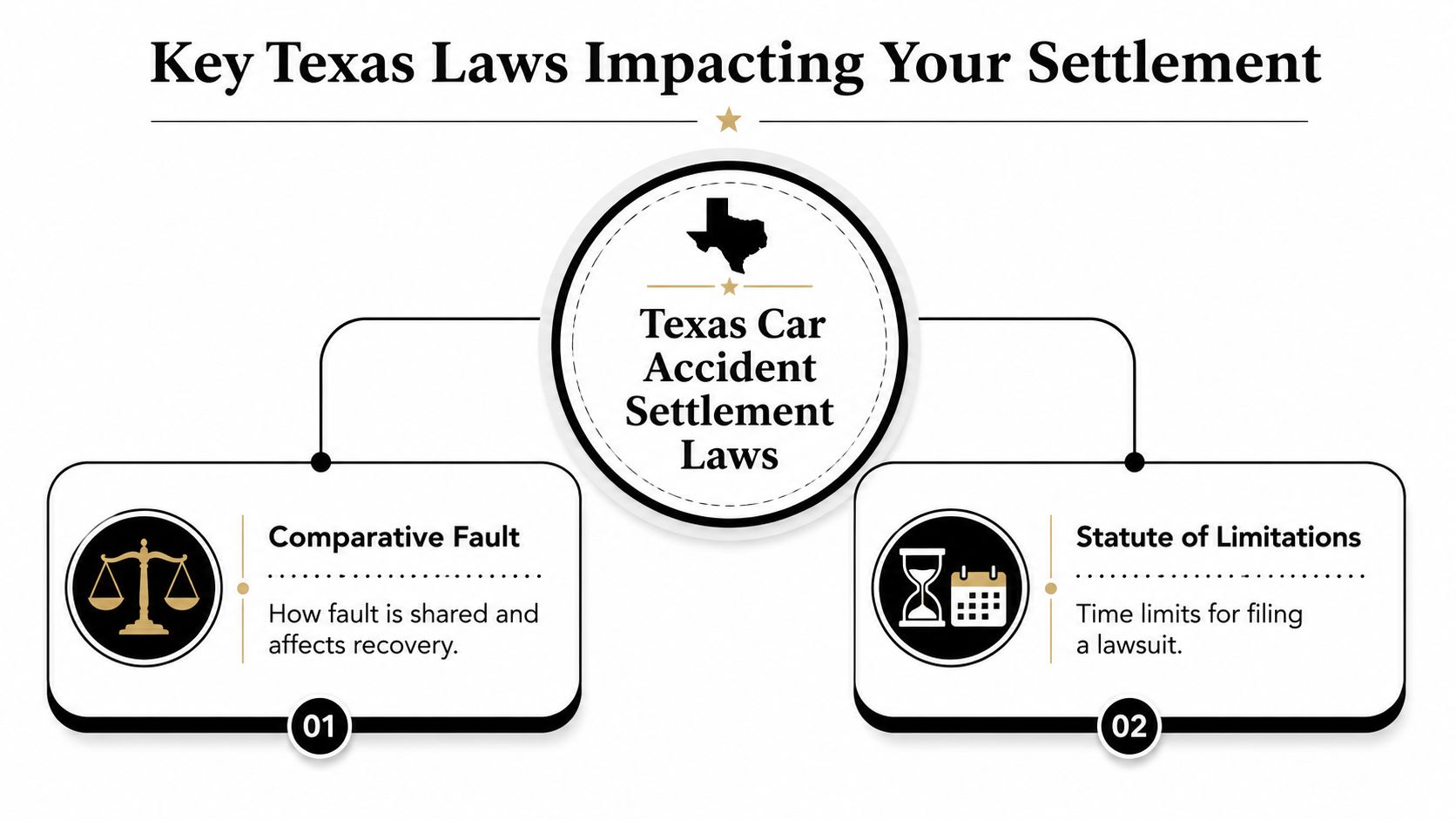
A Texas claim can fall apart for legal reasons long before anyone debates what the case is worth. Two rules matter more than most drivers realize. One is time. The other is fault.
The deadline rule you can't ignore
Texas has a statute of limitations for filing a lawsuit after a car accident. That deadline matters even if you expect the claim to settle. Insurance companies know when the pressure shifts in their favor, and delay can weaken your negotiating position.
If you're dealing with a vehicle that may be totaled, it also helps to understand how Texas handles the threshold question for severe damage. This breakdown of the Texas total loss threshold gives useful context on how that part of the property claim is evaluated.
How modified comparative fault works in real life
Texas uses modified comparative fault. In plain English, if you are more than 50% at fault, your recovery can be cut off. That sounds straightforward until you see how insurers apply it in ordinary crashes.
Think of fault like a scale. If the insurer can push enough blame onto your side, they gain an advantage. They don't always need to prove you caused most of the crash. They often just need enough ambiguity to justify a reduced offer.
According to Crosley Law's discussion of Texas car accident settlements, Texas insurers use this rule aggressively in low-impact cases, sometimes slashing settlements by 20-40% based on minor alleged faults even when the other driver was primarily responsible. The same source notes that AI-driven liability tools can over-penalize minor infractions and contribute to underpayment when fault is disputed.
What insurers use against you
In a close-liability claim, they often focus on details like these:
- Lane position issues: They may say you drifted, hesitated, or failed to maintain your lane.
- Speed framing: Even without a citation, they may argue you were “traveling too fast for conditions.”
- Statement wording: A casual remark like “I never saw him” can get used as an implied admission.
- Impact appearance: Minor visible damage often gets paired with a shared-fault argument to shrink the payout.
Practical rule: Never treat fault as settled just because the adjuster says, “We accept liability.” Watch what they do with the valuation.
The fix is documentation. Photos of vehicle positions, independent witness names, dashcam footage, road markings, and repair estimates that match the mechanics of impact all help. If there's a dispute, don't argue with the adjuster in general terms. Force the discussion back to evidence.
What Is a Fair Car Accident Settlement in Texas
A fair settlement isn't a random number. It's the total value of your losses, supported by records and adjusted for the weaknesses and strengths in the claim.
What a settlement is actually paying for
Most claims involve two categories of damages.
Economic damages are the easier part to document. They usually include medical bills, wage loss, medication, therapy, repair invoices, towing, rental expenses, and other out-of-pocket costs tied to the crash.
Non-economic damages are less mechanical. They cover things like pain, physical limitations, emotional strain, and the ways the injury changed your daily life. These don't come with a simple receipt, so the quality of your medical records and your timeline of symptoms matters.
A fair offer should account for both. If the insurer only discusses your bills and ignores your recovery experience, they're framing the claim too narrowly.
Texas settlement ranges
One verified benchmark comes from Texas settlement figures summarized by Versus Texas. That source reports that the average Texas bodily injury settlement was $24,211 in 2022, while the average property damage claim alone was $5,314. It also notes that minor injuries often settle for $3,000 to $15,000, moderate injuries can range from $15,000 to $50,000, and catastrophic injury cases can exceed $1 million.
| Injury Severity | Typical Settlement Range |
|---|---|
| Minor injuries | $3,000 to $15,000 |
| Moderate injuries | $15,000 to $50,000 |
| Catastrophic injuries | Can exceed $1 million |
Those numbers are useful for orientation, but they don't tell you what your case is worth by themselves.
Why the average can mislead you
An average gets pulled upward by very large cases. That's why drivers sometimes see a headline number and expect more than the facts of their own claim support. Severe trauma cases change the math dramatically.
The same source notes that the median result is lower than the average because large outlier cases skew the mean. That distinction matters. If you had a short course of treatment and no permanent injury, your settlement value won't look like a catastrophic injury file. If you had a complex recovery and strong medical support, a quick low offer probably won't reflect the actual exposure.
A fair settlement is not the first offer that sounds convenient. It's the amount you can defend with records, market evidence, and a coherent damages story.
What raises or lowers value
Here's what tends to move a claim upward or downward in real negotiations:
- Clear medical continuity: Consistent treatment records usually help more than sporadic visits.
- Objective findings: Imaging, specialist notes, and documented restrictions often carry more weight than generalized complaints.
- Work disruption: Verified missed work or reduced capacity strengthens the economic side of the claim.
- Clean liability picture: The less room the insurer has to argue shared fault, the less room they have to discount the number.
- Vehicle evidence: Property damage photos and repair documentation can support injury mechanics and crash severity.
Fairness comes from fit. The settlement has to match the evidence, not the insurer's opening script.
Maximizing Your Property Damage and Total Loss Claim
Property claims get mishandled because drivers are taught to focus on whether the car can be repaired. That's only part of the story.
If the vehicle is repairable, the question isn't just whether the shop can fix it. It's also whether the car is worth less afterward. If the vehicle is totaled, the question isn't just whether the insurer ran a valuation. It's whether the valuation matches the actual market for your vehicle.

Diminished value is real even when there's no injury
Many drivers miss diminished value, usually shortened to DV, because the insurer acts like a non-injury claim is only about repair cost, towing, and rental. That framing leaves money on the table.
According to Daniel Stark's discussion of non-injury crashes in Texas, Texas law allows owners to pursue diminished value even when there was no physical injury. The same source notes that insurers frequently offer zero DV on lightly damaged vehicles, yet independent appraisals show DV can still reach 10-15% of pre-accident value for the right vehicle.
That matters most with:
- High-end vehicles: Buyers and dealers discount them quickly after an accident entry appears.
- Collector or specialty vehicles: Prior damage history can hurt market appeal beyond the repair invoice.
- Late-model daily drivers: Even clean repairs can leave a resale stigma.
- Custom vehicles: Standard insurer databases often miss the effect of modifications on actual market value.
Why insurers resist DV claims
They resist DV because it's not as easy to automate as a body shop estimate. Repair cost can be pulled from software. Market stigma after an accident takes judgment, comparable vehicle analysis, and condition-based reasoning.
That's why many adjusters default to this position: if the repairs are complete, the claim is complete. For some cars, that's wrong.
If a buyer would pay less for your car because it has an accident history, the loss didn't disappear when the paint dried.
The appraisal clause changes the leverage
Total loss claims and DV disputes often turn when the owner invokes the Appraisal Clause. This is a contractual process found in many policies that allows a valuation dispute to be decided outside the insurer's internal pricing system.
Instead of arguing endlessly with the desk adjuster, you bring in an independent appraiser to support the actual market value or diminished value position. That changes the conversation from opinion to documented valuation.
Here's a useful walkthrough on the process:
What works and what doesn't
Drivers usually waste time on arguments that feel reasonable but don't move the file.
What usually doesn't work:
- Saying the offer feels low: Adjusters hear that all day.
- Sending random sale listings with no adjustments: Listings can help, but only if they're comparable and explained.
- Arguing based on what you owe on the loan: Loan balance and market value are different issues.
What works better:
- Correct comparables: Same trim, similar mileage, similar condition, similar market.
- Repair and condition records: These help separate your vehicle from generic database assumptions.
- A written appraisal position: A structured report has more weight than a string of emails.
- Policy-based escalation: Invoking appraisal creates a process the insurer has to address.
An independent valuation service can be useful here. For example, Total Loss Northwest handles diminished value and total loss appraisals and works through the Appraisal Clause process for valuation disputes. That's different from legal representation. It's evidence work focused on what the car was worth before and after the crash.
The Step by Step Settlement Negotiation Process
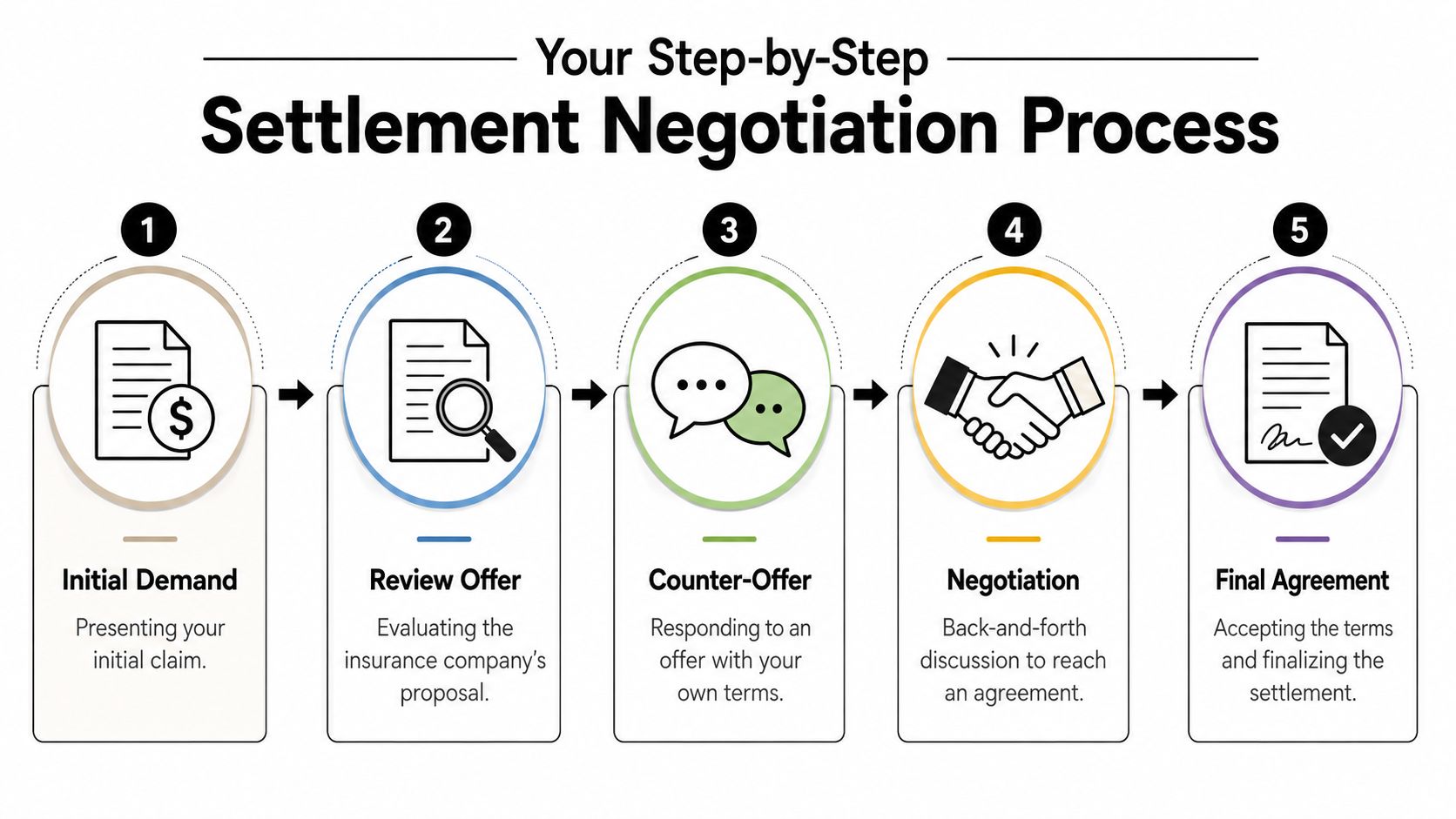
Most claims don't get resolved because the driver “pushes harder.” They get resolved because the driver presents a clean, documented case and responds to the insurer in the right order.
Build the file before you argue value
Before you negotiate, organize the evidence. That means the crash report, scene photos, vehicle photos, repair records, medical bills, treatment notes, wage documentation, and every insurance letter you've received.
If you're sending a formal package, this guide to a car accident settlement demand letter is a solid model for how to structure it.
Make the first demand specific
A strong demand doesn't ramble. It states what happened, why the other driver is responsible, what losses you suffered, and what number you are demanding to resolve the claim.
Use attachments. Don't assume the adjuster has reviewed the full file. Make them look at the proof again in the order that helps you.
A basic demand package should include:
- Liability summary: A short statement of how the crash occurred and why fault is clear.
- Damages summary: Medical costs, lost income, vehicle losses, and any ongoing symptoms or limitations.
- Supporting documents: Bills, records, photos, estimates, and valuation materials.
- A deadline to respond: Reasonable, firm, and in writing.
Handle the first offer correctly
The first offer is often a test. The insurer wants to know whether you understand the file and whether you'll accept a discount just to end the process.
Don't respond emotionally. Respond with gaps.
“I'm not accepting that figure. Your offer doesn't account for the treatment timeline, the documented work loss, and the valuation evidence already provided. Please identify what records you are excluding so I can address that specifically.”
That kind of response does two things. It rejects the number, and it forces the adjuster to explain the discount.
Avoid common negotiation mistakes
These errors cost people money fast:
- Giving a loose recorded statement: If you aren't prepared, you can create contradictions the insurer will use later.
- Negotiating by phone only: Important positions should be confirmed in writing.
- Settling before treatment stabilizes: You can't reopen a signed release just because symptoms lasted longer than expected.
- Skipping your own math: If you can't explain how you reached your demand, the insurer won't take it seriously.
A simple counter can sound like this:
“I've reviewed your offer and I disagree with the valuation. Based on the records already submitted, the claim supports a higher number. If your position is tied to fault allocation or a specific medical discount, put that in writing so I can respond directly.”
That keeps control where it belongs. On the evidence.
When to Hire an Attorney vs an Independent Appraiser
A lot of drivers hire the wrong kind of help because they assume every accident problem is a legal problem. Some are. Some aren't.
Hire an attorney when the fight is about injury or liability
If you have serious injuries, disputed fault, a difficult insurer, or a case that may need litigation, a lawyer is the right tool. Attorneys handle bodily injury claims, legal deadlines, fault arguments, negotiation advantage, and courtroom strategy.
If you're weighing that option, this overview of car accident lawyer pricing helps explain the cost side of that decision.
Hire an independent appraiser when the fight is about the car's value
If the insurer agrees a payment is owed but the dispute is over how much the vehicle is worth, that's where an independent appraiser comes in. The appraiser's job is narrower and more technical. They analyze comparable sales, condition, market data, prior value, post-repair stigma, and total loss methodology.
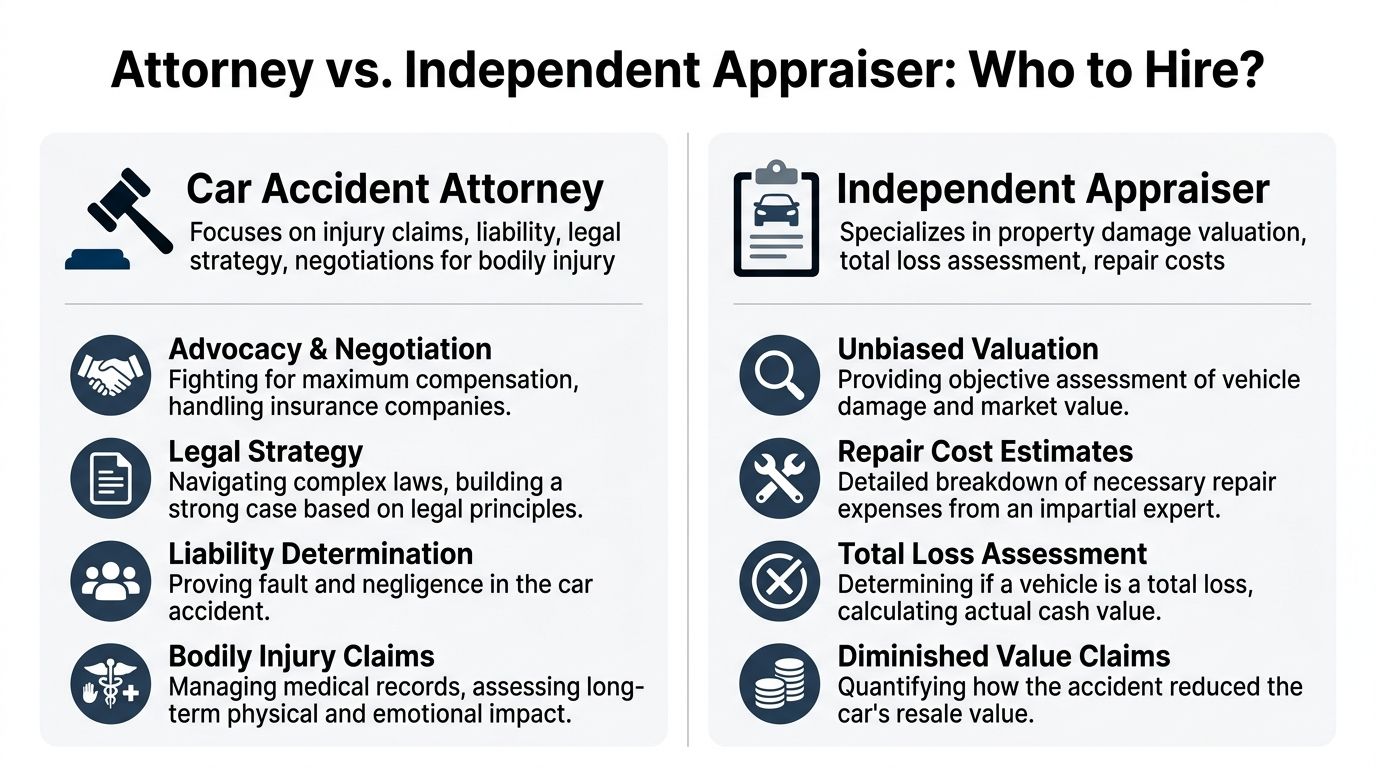
A quick way to separate the two:
- Attorney: Best for injury damages, legal strategy, and fault disputes.
- Independent appraiser: Best for total loss value, diminished value, and market-based vehicle disputes.
- Both: Sometimes you need both professionals if the claim includes major injuries and a serious valuation fight over the car.
The cleanest choice depends on what's being contested. If the adjuster is arguing medicine and fault, call a lawyer. If the adjuster is lowballing the vehicle number, get an appraiser involved.
Texas Car Accident Settlement FAQ
How long does a Texas car accident settlement take
It depends on what's being disputed. Straightforward property damage claims can move relatively quickly. Injury claims usually take longer because you need a clearer picture of treatment, recovery, and future impact before signing a release.
Is settlement money taxable
Tax treatment depends on what the payment is for and how the claim is structured. Because tax rules can turn on the details, ask a qualified tax professional before assuming any part of the settlement is or isn't taxable.
What if the other driver has no insurance or not enough insurance
You may need to look at your own policy for uninsured or underinsured motorist coverage if you carry it. Those claims still require proof of fault and proof of damages, and your own insurer may still negotiate hard.
Should I accept the first offer if I need the money
Needing the money and being fairly compensated are not the same thing. Once you sign a release, the claim is usually over. If the offer doesn't account for the full scope of your injuries or the actual market value of your vehicle, a fast check can become an expensive mistake.
If your dispute is about what the car was worth after a total loss or how much value it lost after repairs, Total Loss Northwest offers independent diminished value and total loss appraisal support, including Appraisal Clause disputes, so you can challenge an insurer's number with market-based evidence.