You just got the call. The car's gone, the adjuster has looked at it, and the number on the phone feels too low to replace anything you drive. That's the moment a car accident total loss settlement is not a math problem, it's a negotiation dressed up like a form letter.
The frustrating part is that insurers know you're tired, shaken, and likely without a vehicle. They count on fast signatures. With total-loss claims now showing up in roughly 1 in 4 crash claims in recent industry reporting based on CCC's 2026 Crash Course, this isn't some rare corner case anymore, it's where a lot of ordinary drivers end up. If the offer feels off, treat that instinct seriously.
The Moment You Realize the Offer Is Wrong
The first red flag is usually the call itself. The adjuster says the car is a total loss, gives you a number, and pushes paperwork like the file is already closed. Stop there. Pull comparable vehicles in your area and check whether the offer would replace the car you lost.
That gap is where these settlements fall apart. The insurer is not paying for what you hoped the car was worth, what you paid for it, or what a dealer will charge you this afternoon. They are paying what they claim it was worth immediately before the crash, and that figure often comes in lower than a real replacement.
Total-loss claims have become much more common, and the carrier knows it. CCC data shows total-loss claims rose from 20% of collision claims in 2019 to 24% in 2021, then 27% in 2022 and 27% again in 2023 Kelley Blue Book's summary of CCC data. More recent reporting tied to CCC's 2026 Crash Course put total-loss frequency at a record 23.1% of all claims in 2025. The result is a lot of drivers getting a payout that looks tidy on paper and short in practice.
Practical rule: if the number feels low, treat the valuation report as suspect until you have checked it line by line.
That is the part many overlook. The settlement is not magic, and it is not fixed just because the adjuster said so. It is a report built from vehicle data, condition adjustments, and comparable sales, and those inputs can be wrong. Once you know how the number is assembled, the dispute stops feeling vague. It turns into a fight over trim, mileage, condition, and comp selection, which is exactly where carriers make mistakes and where you can force a better number.
What a Total Loss Settlement Actually Means
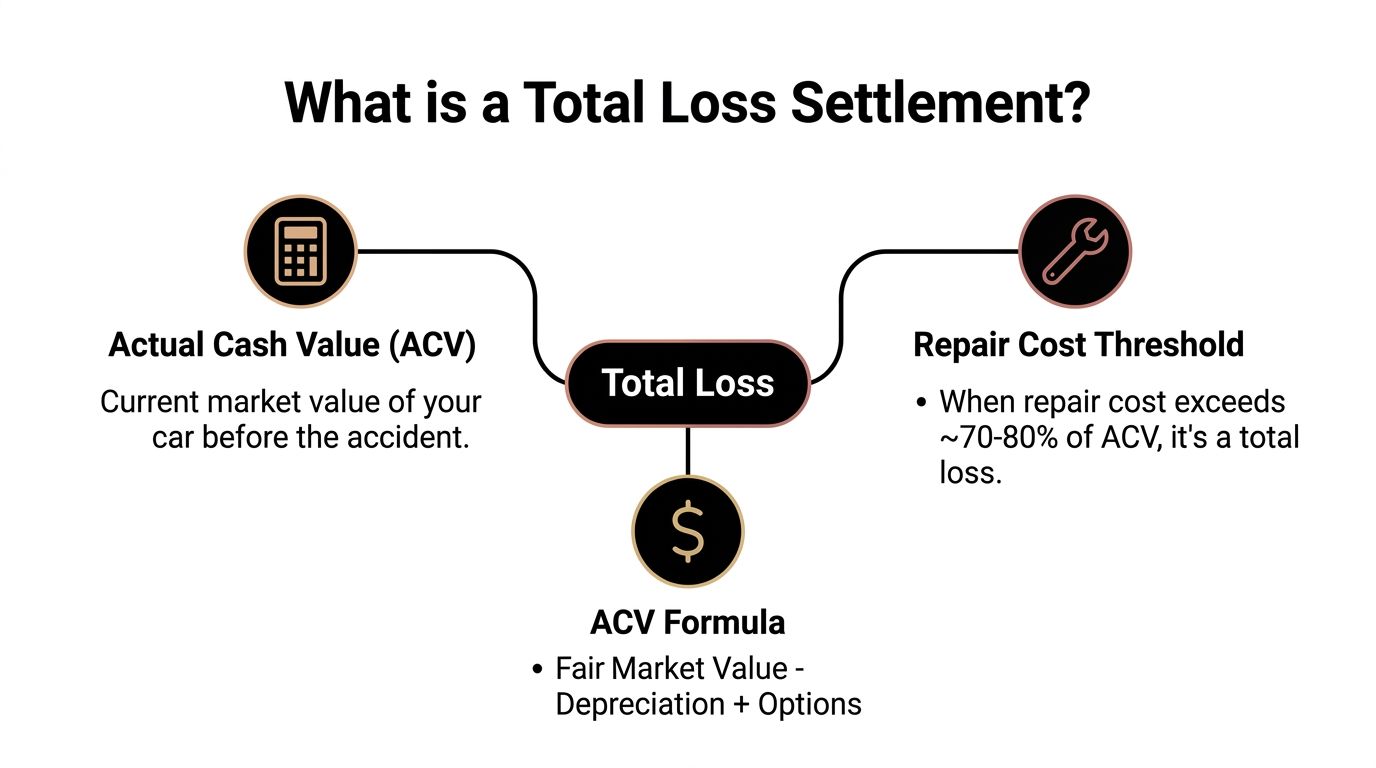
A total loss settlement starts with actual cash value, or ACV. That is the car's market value immediately before the crash, built from comparable vehicles and then adjusted for mileage, trim, options, condition, and prior damage, as described by the National Auto Claims Authority. That number controls the payout. If the ACV is wrong, the settlement is wrong.
Why the repair estimate is not the payout
Insurers total a car when the repair bill gets too close to ACV, because fixing it no longer makes economic sense for them. That threshold matters, but it is only one part of the decision. The estimate tells the carrier whether the car is expensive enough to write off. The settlement amount comes from the valuation report, not the body shop line items.
Repair costs have been climbing, which is why more borderline cars get totaled instead of repaired. CCC's 2026 report put the average repair cost at $4,818, a figure reflected in Kelley Blue Book's summary of CCC data. In practice, that kind of repair expense pushes more vehicles across the total-loss line even when the car is still drivable.
What people confuse with ACV
Drivers mix up ACV with replacement cost and with the original purchase price. Those are different numbers. A car bought new years ago may have lost a lot of paper value, while the same model in your local market may now cost more to replace because supply is tight or the trim level is scarce.
Older vehicles get pushed into write-off territory faster, too. As noted earlier, CCC tied more total losses to vehicle age, with vehicles 7 years or older making up almost 72% of valuations across all loss categories in 2024. That does not mean age alone decides the claim. It does show why lower-value cars are often totaled on paper even when the owner still sees real utility in them.
For a structured record set, use this auto claim documentation guide for 2026.
A total loss settlement is an ACV fight first, and a repair-cost fight second. The repair estimate decides whether the carrier treats the car as repairable. The valuation report decides how much money changes hands.
The Paper Trail You Need Before You Negotiate
The insurer's number is only as good as the records you can force back onto the table. If you show up with vague complaints, the adjuster can wave you off. If you show up with documents, photos, and local comparables, you've turned a casual phone call into a valuation dispute.
Start with the records that define the car
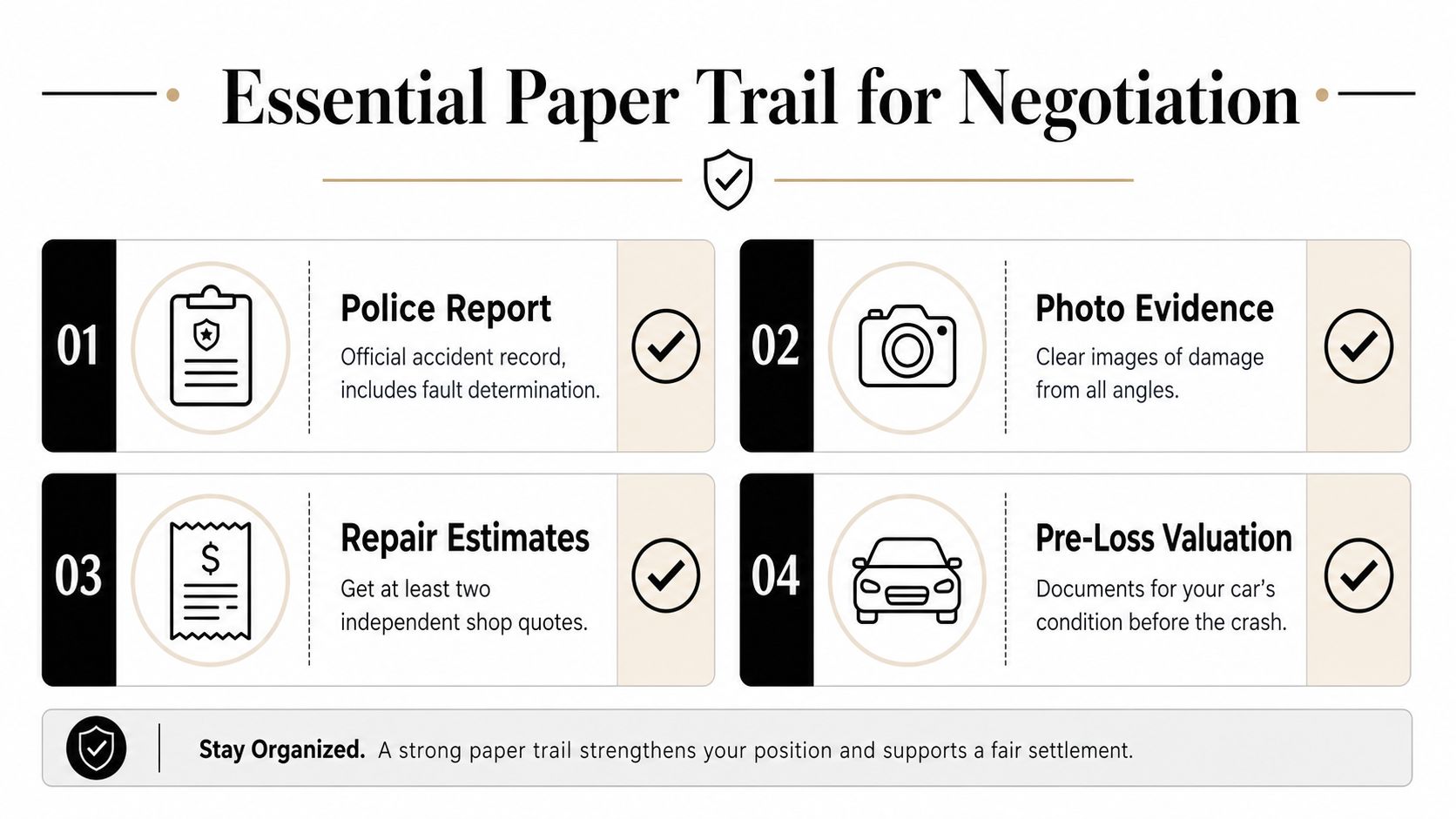
The police report matters because it anchors the accident facts and fault position. The photos matter because insurers love to pretend the car was average condition unless you prove otherwise. Service records matter because maintenance history helps support condition and can help explain why your vehicle was above average compared with the comps they chose.
You also want the original window sticker or build sheet if you still have it. That document is gold when the carrier misses trim, packages, or factory options. If the car had recent repairs, new tires, upgraded wheels, or other equipment, gather receipts now. Once the valuation goes sideways, those receipts are what separate a real adjustment from a hand-wave.
For a more structured checklist, keep a copy of this auto claim documentation guide for 2026 open while you sort your file.
Gather comps the right way
At minimum, pull three to five local comparable listings that resemble your car. Match trim first, then mileage, then condition. Don't grab the cheapest listing from two counties away and act surprised when the insurer ignores it. The point is to mirror the market the insurer claims to be using.
Adjuster reality: if your proof doesn't address trim, mileage, and condition, it usually won't move the number.
Timing matters too. Consumer guidance notes that insurers often use comparables from the past 90 days and tells policyholders to do their own local research and request claim documentation when the insurer's figure doesn't match the market United Policyholders. That's the window where your research has the most impact.
How to Read and Challenge the Insurer's Valuation Report
The valuation report is where the money is made or lost. A CCC or Mitchell-style report looks technical enough to intimidate people, but most of the damage comes from a handful of predictable errors. I've seen the same four problems over and over, and they're usually enough to explain why the offer missed the mark.
Where the report usually breaks
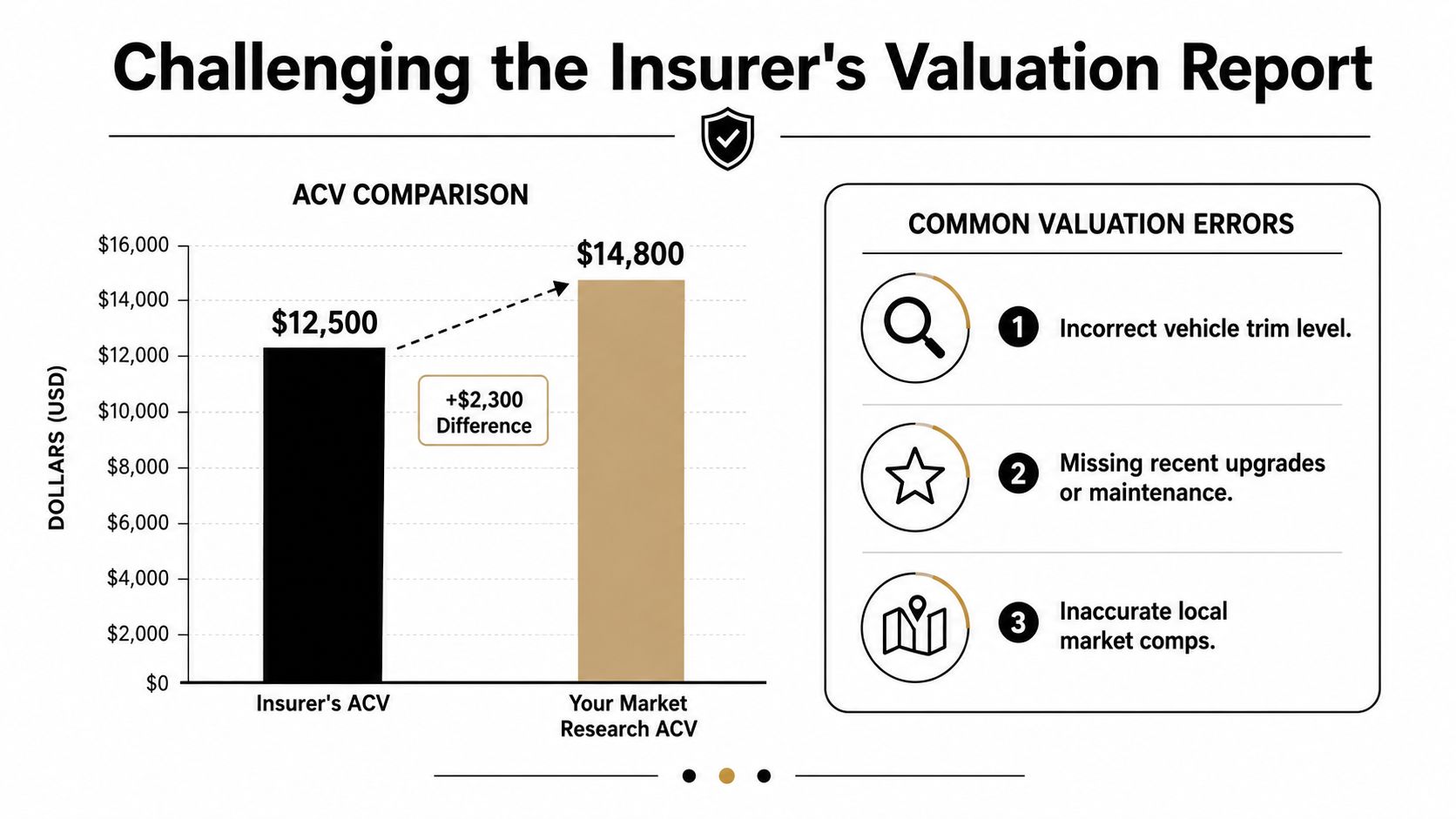
First, trim-level mismatches. A base model and a higher trim can look similar to a database, but the market doesn't price them the same. If the report selected the wrong trim or ignored a package, your ACV is already understated.
Second, condition adjustments. Insurers love “average condition.” That's a convenient default, not a fact. If your car had newer tires, clean interior, recent maintenance, or better-than-average cosmetics, the report should reflect that. A lazy condition rating can shave meaningful money off the number.
Third, mileage handling. Some reports round mileage in a way that ignores recent driving or treats a near-match as close enough. It isn't. Once the mileage delta gets baked into the valuation, it affects the ACV benchmark directly.
Fourth, geography. A report that pulls comparables from the wrong market can miss what your car would sell for locally. The farther the comps drift from your actual area, the less useful the valuation becomes.
How to push the number up without getting lost
Here's the move. Don't argue in broad strokes. Point to each bad input and ask for a correction. If the trim is wrong, show the build data. If the condition is understated, show maintenance and photos. If the comps aren't local, ask why they were selected and whether the insurer can re-run the report with a tighter market set.
Consumer advice often says to “get your own comps,” and that's useful, but it falls flat if you stop there. What works is forcing the carrier to revisit its own comparable set and showing, line by line, where the assumptions fail.
If you need a model for the conversation, think in terms of a short, specific correction rather than a dramatic demand. A report that starts at $18,200 can move much closer to a defensible $21,500 when two major inputs are corrected, such as trim and condition. That's the kind of swing one bad assumption can create.
Use this rule: challenge the cell, not the whole universe. Adjusters answer specific objections faster than general outrage.
Invoking the Appraisal Clause and Hiring an Independent Appraiser
The appraisal clause is the cleanest way to stop circling the same low number. It's a contractual remedy, not a favor, and it changes the game because each side picks an appraiser. If the two appraisers can't agree, an umpire breaks the deadlock. That's the point where the dispute leaves the carrier's software and gets decided by valuation professionals.
When appraisal makes sense
Invoke appraisal when the gap between the offer and the market value is big enough to justify the cost. If the difference is small, you can waste money chasing a technical fight that won't move enough cash to matter. If the difference is meaningful, appraisal can be the most efficient way to force a redo instead of begging for one.
An independent appraiser is especially useful when the insurer won't correct trim, condition, or local market errors even after you've documented them. That's the exact niche where Total Loss Northwest positions its appraisal work, as one option among others for drivers who want a formal valuation challenge rather than another round of phone-tag.
What appraisal does and doesn't do
Appraisal doesn't guarantee a windfall. It does remove the carrier's first-pass valuation from the center of the process. That matters because a clean, independent report gives you a defensible number that can stand up in a real dispute.
If you want a plain-language walkthrough of the procedure, this insurance appraisal process guide lays out how the clause is used in practice. Keep that in mind if the adjuster keeps insisting the original offer is “final.” It usually isn't.
Negotiation Tactics That Move the Number
The best negotiations are boring and specific. You don't need a speech. You need a tight record, a hard copy of your comps, and a willingness to make the adjuster explain every questionable line in the report. That's where the number starts moving.

The tactics that actually work
Anchor with your own market research, but don't frame it as a rant. Ask the adjuster to walk through each comparable one by one. If the trim is off, say so. If the mileage is off, say so. If the condition rating is lazy, say so.
Put the dispute in writing the moment the conversation stalls. Oral arguments disappear fast. Written objections create a record, and records matter when the file gets reviewed again.
Best practice: make the carrier explain its comps before you explain yours.
You should also ask about items that aren't always folded cleanly into the first offer. Public guidance and legal explainers note that some total-loss claims can include taxes, title fees, rental-car costs, and other expenses, and that an appraisal clause can be used when the insurer lowballs the ACV Perrin Law Texas. If you were not at fault, don't assume the ACV check is the end of the story.
A demand paragraph you can actually send
Try this instead of a long, emotional letter:
“I do not agree with the current total-loss valuation because the report uses the wrong trim, understates condition, and misses local market comparables. Please reissue the valuation with corrected options, condition, and geographically relevant comps, and include the supporting documentation for each comparable used. If the file will not be corrected voluntarily, I'm prepared to move the dispute into appraisal.”
If you want more negotiation structure, this resource on negotiating a total loss claim is a useful companion.
The video below is worth watching if you want to see how carriers frame the first offer and how claimants usually respond.
Oregon and Washington Rules That Change the Playbook
State rules matter because total-loss settlement fights do not happen in a vacuum. In Oregon or Washington, the valuation fight and the time you have to push back are shaped by local law, and that changes how hard you should come out of the gate.
Washington gives you a clear valuation standard
Washington is unusually specific about what insurers can use for valuation. They may rely on comparable vehicles, licensed dealer quotes within 150 miles, advertised local comparables, or a computerized source that is statistically valid. That gives you a clean target when the carrier's report is built on the wrong market or a thin data set.
The practical move is simple. If the comps are too far away, the trim is wrong, or the report skips a closer local vehicle, challenge it directly. Do not waste time arguing that the offer feels low. Force the insurer to show that its valuation method matches the one it picked.
Oregon's claim-handling duties provide leverage
Oregon drivers should pay attention to the Unfair Claim Settlement Practices Act and the unreasonable-benefits-denial standard. Those rules do not turn every low offer into bad faith, but they give you stronger ground when the carrier ignores solid comp evidence or refuses to correct obvious valuation mistakes. A file with clean documentation and ignored evidence is a very different problem from a routine price dispute.
For a broader state-by-state comparison of thresholds and settlement context, use this total-loss threshold by state guide to see how repair costs and total-loss triggers are handled in each state. For a wider look at how claims rules shape carrier conduct, the insurance industry regulations guide is a useful reference.
Oregon vs Washington Total Loss Settlement Rules
| Factor | Oregon | Washington |
|---|---|---|
| Valuation approach | Claim-handling rules and documented market evidence matter most | Specific valuation methods are recognized, including local dealer quotes and valid computerized sources |
| Best dispute angle | Show ignored comps, wrong trim, or unfair handling of your evidence | Challenge whether the insurer used a valid local market dataset |
| Deadline pressure | Property damage deadlines can pass before the file feels “finished” | Same practical risk, do not wait for the file to stall |
The order of moves that makes sense
Start with your own comp set and force a direct correction to the report. If the gap survives that step, hire an independent appraiser and consider invoking the appraisal clause. If the carrier still will not move to a fair number, speak with a property damage attorney about breach-of-contract or bad-faith theories. Then file suit before the statute runs, because waiting past the deadline turns a bad offer into a permanent loss.
Accept the settlement only when the number is fair and the add-ons are handled. A clean offer with a real market basis is worth taking. A rushed number that misses the market, the trim, or the paperwork is not.
If you want a valuation fight handled by people who focus on total loss appraisals and appraisal clause support in Oregon and Washington, visit Total Loss Northwest. They work on the same kind of settlement gap covered here, the kind where the insurer's first number is not the last word.