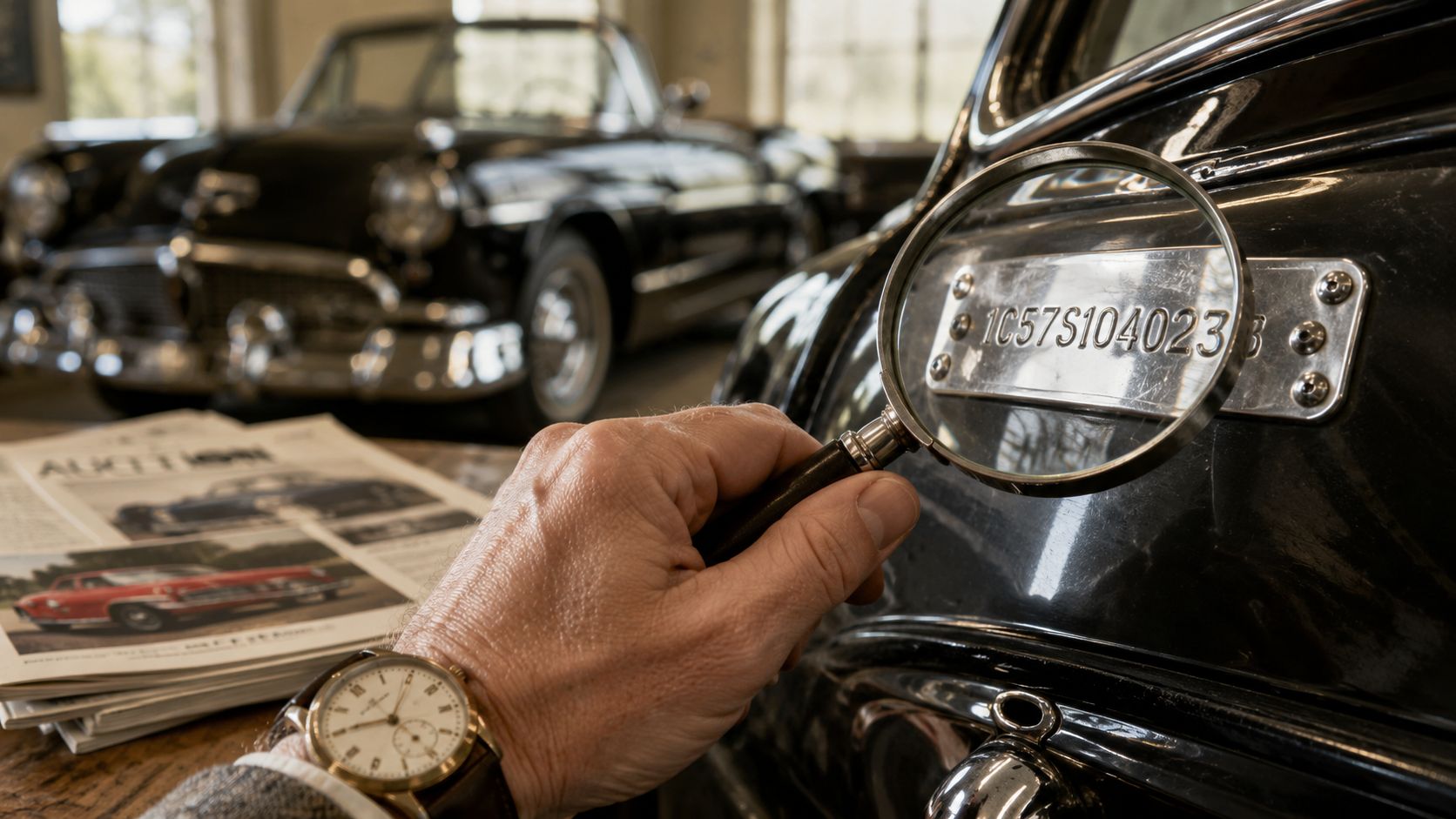
You found a car in a family garage. Or you're staring at an insurance offer that feels detached from reality. In both situations, the first instinct is the same: run the VIN and get a number.
That's a useful start. It's not the job.
A classic car value by VIN search can identify what the car was built as. It can help narrow the field from “old Mustang” or “vintage Corvette” to a specific year, engine, trim, body style, and production details. But no serious appraiser stops there, because collector-car value comes from identity plus condition, originality, documentation, and real market evidence.
Your Classic Car's VIN Is More Than Just a Serial Number
When owners ask for a value, they often expect the VIN to work like a barcode. Scan it, get a price, move on. That's how many online tools market the process, and that's why people get blindsided when the result doesn't hold up in a negotiation, a purchase, or an insurance claim.
The VIN matters because it's the car's baseline identity. For classic vehicles, that identity is often where the biggest differences begin. Two cars with the same badge can have different engines, factory options, body styles, production plants, or trim levels. That's why major market guides and insurers use the VIN as the starting point to identify the exact vehicle before estimating value, and why the final figure still depends on demand, rarity, originality, mileage, special features, and documentation rather than VIN alone, as explained by Progressive's overview of classic car values.
What the VIN actually does
A VIN gives you a factual starting line:
- Confirms identity: year, make, model, and often original configuration.
- Supports title review: the stamped or plated number should align with the paperwork.
- Frames your comp search: once you know the exact vehicle, you can compare it to the right sales.
If you need a quick refresher on how VIN formats work and where people often get confused, carBoost wyjaśnia numery VIN is a useful primer.
Where owners go wrong
The common mistake is treating decoded identity as finished value. It isn't. A VIN can confirm that a car left the factory with a certain engine. It can't tell you whether that engine is still in the car, whether the body has poor prior repairs, or whether the restoration was done to a high standard.
A VIN identifies the car. It does not inspect the car.
That distinction matters most when money is on the line. If you're settling a claim, buying a collector vehicle, or defending an agreed value, the VIN is your first document, not your final answer.
How to Decode Your Classic Car's VIN
Decoding a classic-car VIN is straightforward on paper and messy in practice. The process changes depending on the vehicle's age, and older cars require more make-specific research than people expect.
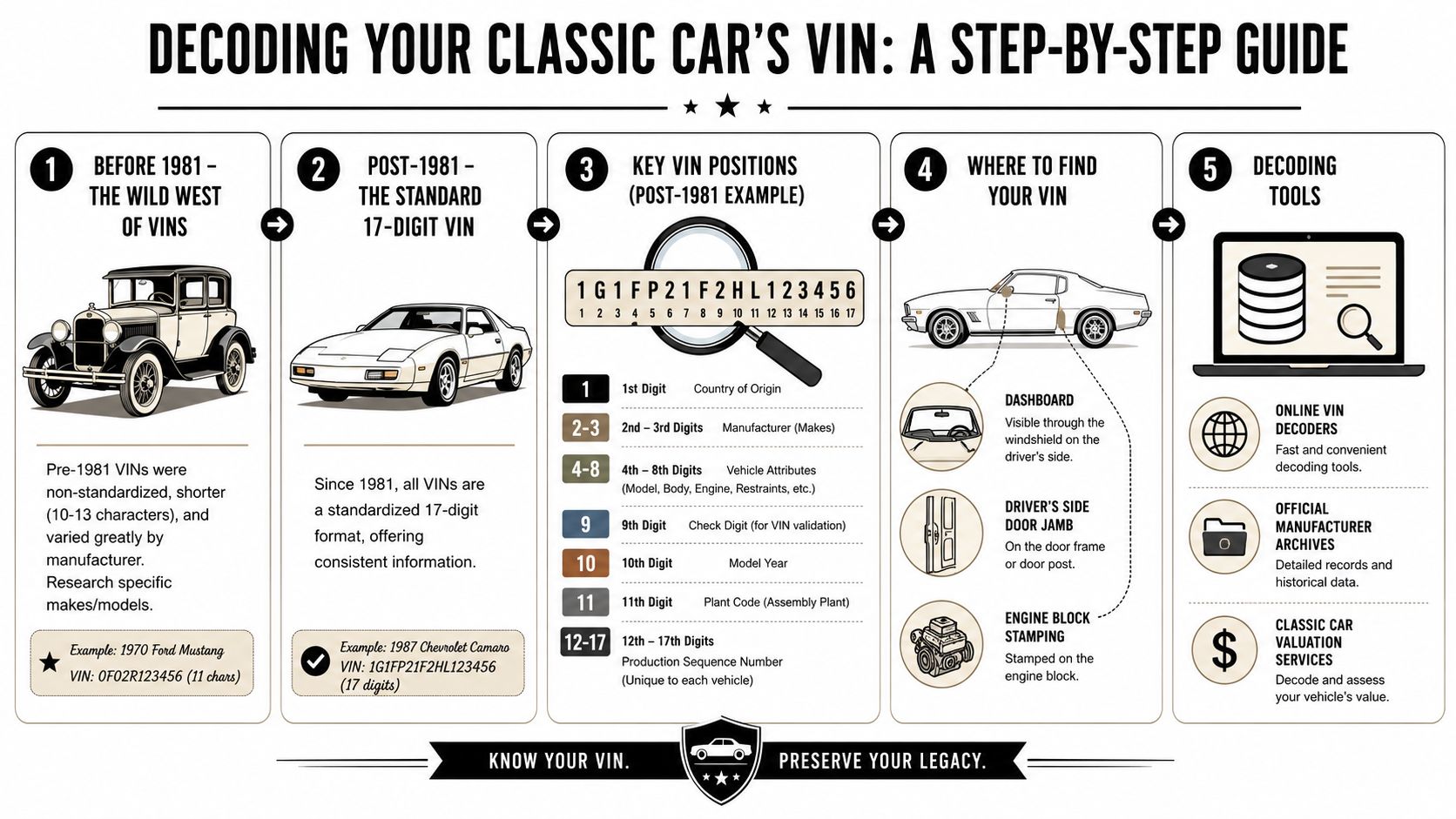
Start with the year split
The first question is simple.
- Before 1981: VINs were not standardized across the industry. Formats were often shorter and varied by manufacturer.
- 1981 and newer: the VIN follows the familiar 17-digit standardized format.
That split changes your research method. On a later vehicle, a decoder can often pull useful factory data quickly. On an earlier classic, the decoder may only give you partial information, and you'll often need factory literature, marque registries, service manuals, or model-year reference guides to verify what each character means.
What the 17-digit VIN tells you
For post-1981 vehicles, the VIN breaks down into recognizable sections:
| VIN position | What it typically identifies |
|---|---|
| 1st digit | Country of origin |
| 2nd to 3rd | Manufacturer |
| 4th to 8th | Vehicle attributes |
| 9th | Check digit |
| 10th | Model year |
| 11th | Assembly plant |
| 12th to 17th | Production sequence number |
That structure is useful even when you're dealing with a car that's only recently become collectible. It helps confirm whether the title, body tags, and visible equipment make sense together.
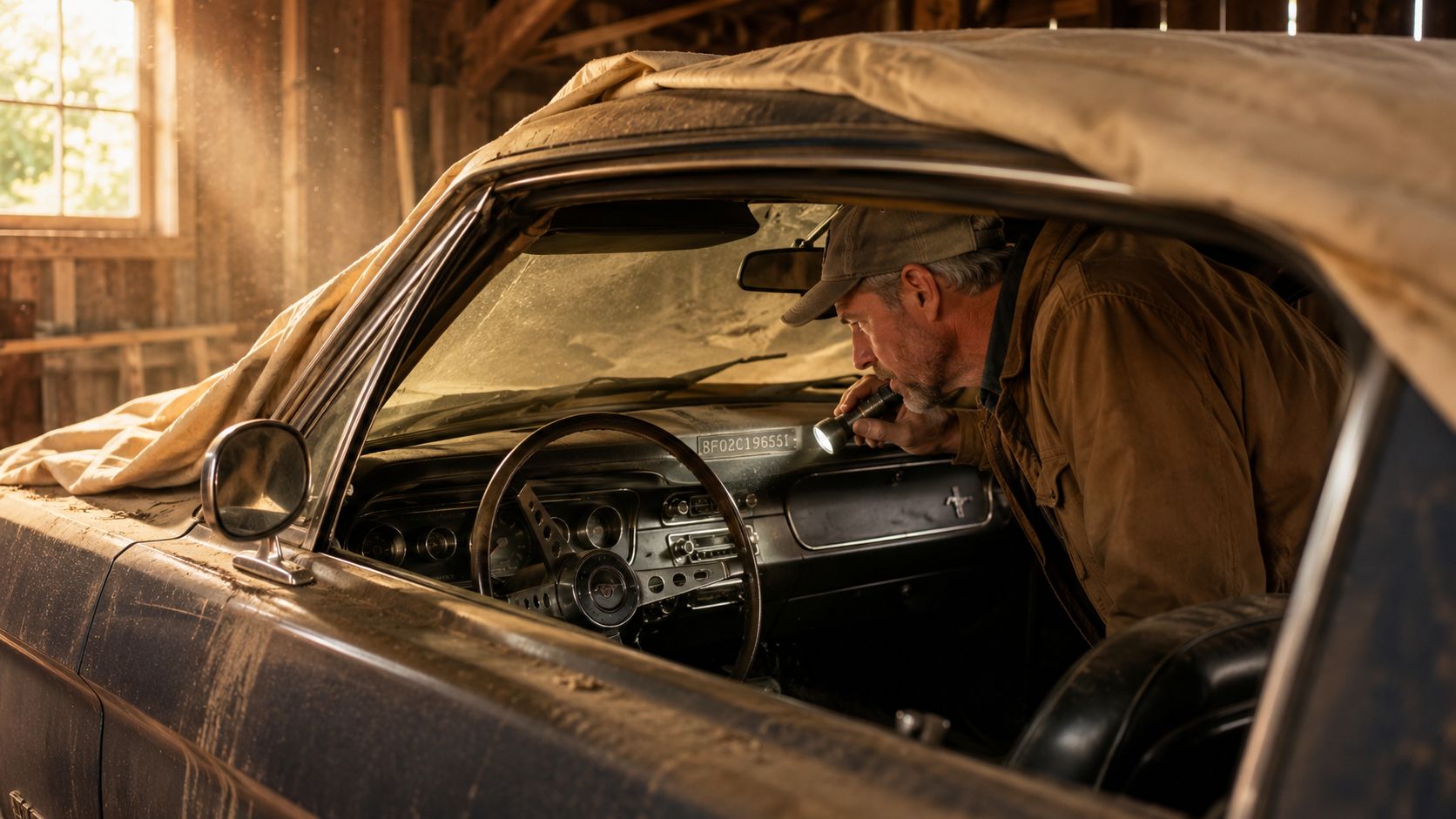
Where to find the VIN on the car
Check more than one location when possible:
- Dashboard plate: visible through the windshield on many vehicles.
- Driver's door jamb: common secondary location.
- Engine or chassis stamping: especially important on older cars and disputed vehicles.
If one area looks altered, damaged, or inconsistent with the rest of the car, slow down and document everything.
Later in your search, this walkthrough video may help if you want a visual reference for locating and understanding VIN details:
Use decoders carefully
Online decoders are useful for a first pass, but they're only as good as the database behind them. They tend to work better on standardized VINs and more common production vehicles. They struggle with older builds, unusual trim combinations, gray-market imports, and low-volume collector cars.
Practical rule: Decode the VIN, then verify the car in front of you. Never do those in the opposite order.
The best workflow is simple. Pull the VIN data. Compare it to title records. Cross-check engine, trim, body style, and visible equipment yourself. Then move to market research with a clearer idea of what you have.
From VIN to Value Using Market Comparables
Once the VIN identifies the car, thorough valuation work begins. Many owners err at this stage. They pull one guide number, assume it applies to their car, and stop. For collector vehicles, that shortcut is weak.
The strongest benchmark data comes from auction and price-guide aggregation rather than generic blue-book pricing. Market-facing guides rely on historical sale prices, current asking prices, and auction results, and overreliance on a single guide value can miss regional price variation and restoration quality, as summarized by Alex Manos on classic-car pricing sources.
Build an apples-to-apples comp set
A usable comparable should match the subject car as closely as possible in the areas that matter most:
- Same year and model
- Same body style
- Same engine family or factory-correct setup
- Same transmission type if that materially affects demand
- Similar condition and originality
- Comparable documentation and provenance
A shiny listing photo isn't enough. Asking prices can be informative, but sold results usually carry more weight because they show where a buyer and seller met.
Where to look for real market evidence
Start with sources that specialize in collector vehicles, not everyday used-car pricing. Auction archives, enthusiast marketplaces, and marque-specific communities can all help if you filter carefully.
A clean research routine often looks like this:
- Pull recent auction sales for the same model and configuration.
- Review current asking prices to see where sellers are testing the market.
- Sort by condition level so restored cars aren't compared to driver-grade cars.
- Adjust for originality if one car retains factory-correct features and another does not.
- Document your sources so the conclusion is defensible later.
If you want a practical walkthrough of that process, how to value a classic car gives a useful framework for turning raw comps into a reasoned value range.
What works and what doesn't
Here's the trade-off in plain terms.
| Approach | What it's good for | Where it fails |
|---|---|---|
| Single online estimate | Fast baseline curiosity | Misses condition, originality, and market nuance |
| Guide-only valuation | General orientation | Weak support in disputes if the car is unusual |
| Auction and listing comps | Stronger market context | Requires judgment to compare cars correctly |
| Appraisal-supported comp analysis | Settlement, negotiation, documentation | Takes more time and inspection effort |
Good classic valuation isn't about finding one magic number. It's about building a value opinion you can defend.
That matters most when someone else has an incentive to value the car low.
The Critical Details a VIN Alone Cannot Reveal
The reason online VIN tools disappoint people is simple. They decode a string. They don't evaluate a car.
That gap matters because the collector market is large and financially significant. Hagerty reports that the U.S. collector vehicle market includes around 43 million cars with an estimated $1 trillion in combined insurable value, which is exactly why small identification or condition errors can have serious consequences in a sale or insurance settlement, as noted in Hagerty's collector-car market data.

The physical car still decides the number
A VIN can tell me what the car was born as. It can't tell me whether the underside is clean, patched, corroded, bent, or poorly repaired. It can't judge paint depth, panel fit, interior correctness, trim quality, or whether the restoration was cosmetic rather than structural.
These details move value more than people think:
- Condition grade: concours-ready, strong driver, project, or parts-level.
- Originality: factory-correct finishes and components usually matter.
- Restoration quality: fresh paint can hide bad metalwork.
- Modifications: some help drivability, some narrow the buyer pool.
- Documentation: build records, receipts, photos, ownership history, and awards can support value.
A numbers-matching VIN on a car with a compromised frame doesn't add value. It confirms the identity of a problem.
Provenance, rarity, and taste aren't in the VIN
Some value drivers live outside the car itself. Documented ownership, known history, restoration records, and period-correct paperwork can support a stronger conclusion. The absence of records doesn't always kill value, but it lowers confidence.
Collectors in other markets deal with the same issue. A serious watch buyer doesn't rely only on a reference number either. They look at originality, replacement parts, documentation, and condition. That's why this guide for luxury watch collectors is a useful parallel. The identifier matters, but the object and its history decide the premium.
Restoration cost is not the same as value
Owners often point to receipts and assume the market will reimburse every dollar spent. It won't. Restoration cost and market value are related, but they aren't interchangeable.
That's especially important if you've poured money into bodywork, paint, interior, chrome, and mechanical sorting. Before using restoration spending as a valuation shortcut, review classic car restoration costs and compare those expenses against actual demand for your specific car. Some work preserves value. Some work exceeds what the market will pay back.
When to Hire a Certified Appraiser for Your Classic
There's a point where DIY valuation stops being smart and starts being risky. If you're dealing with a title issue, a high-stakes purchase, a total loss, or a settlement dispute, a casual VIN-based estimate won't protect you.
American Collectors notes that valuation databases struggle with rare, low-volume, or newly collectible cars when comparable sales are thin, and that an expert appraisal using detailed market comparisons is the most reliable way to determine an accurate, defensible value, as described in American Collectors' classic car values guidance.

Red flags that should stop a DIY valuation
Some situations call for immediate scrutiny.
- VIN mismatch: the dash plate, title, door tag, or stamped numbers don't line up.
- Tampering signs: rivets, plates, stampings, or surrounding metal look disturbed.
- Thin comps: few relevant sales exist for the exact car.
- Heavy restoration or modifications: value depends on workmanship and buyer demand.
- Insurance dispute: the carrier's number doesn't reflect the actual vehicle.
If any of those apply, you don't need more guesswork. You need documentation.
When an appraisal earns its keep
A certified appraiser does more than provide a number. The report ties together identity, inspection findings, market comparables, and reasoning in a format that can be used in negotiation, underwriting, estate handling, and claims work.
Common situations include:
| Situation | Why an appraiser matters |
|---|---|
| Total loss claim | Supports a market-based value instead of a weak software output |
| Diminished value claim | Documents loss in value after damage and repair |
| Estate or divorce matter | Creates an independent value opinion |
| High-dollar purchase | Reduces the risk of overpaying for misrepresented condition |
| Agreed-value coverage | Helps establish a supportable insured amount |
When the number has to survive scrutiny, inspection plus comps beats automation every time.
For owners in a dispute, one option is classic auto appraisers, where Total Loss Northwest handles market-based appraisal work for claim and valuation situations. In insurance cases, a certified independent appraiser can also help invoke the appraisal clause when the carrier's valuation process doesn't reflect the actual vehicle.
Why insurance changes everything
Insurance settlements are adversarial by design. The carrier is evaluating a payout. You're trying to protect an asset. That's not the moment to rely on a generic collector-car lookup.
An appraisal report matters because it creates a documented, supportable position. If the vehicle is rare, highly restored, unusually original, or difficult to compare, that support becomes even more important. The stronger the documentation, the harder it is for a low-end estimate to stand unchallenged.
Securing Your Car's True Market Value
The practical process is straightforward. Start with the VIN. Confirm what the car is. Then compare it to the right market evidence. After that, evaluate the things a database can't see: condition, originality, quality of work, and documentation.
That's the only reliable path to a serious classic car value by VIN conclusion.
For early research, online tools are fine. They help identify the vehicle and narrow your comp search. They do not replace inspection judgment, and they do not create a defensible value on their own. That matters even more with enthusiast cars that have unusual histories, desirable option combinations, older restorations, or changing collector demand.
Collectors understand this in every niche. Whether someone is comparing vintage Volkswagens or sorting period-correct memorabilia, the details behind the item often matter more than the label. For air-cooled enthusiasts, this Collector's guide for Aussie VW fans is a good reminder that history, configuration, and authenticity shape collector interest in ways a simple lookup never captures.
If you're curious, do the homework yourself. Decode the VIN. Pull the comps. Review the paperwork.
If you're negotiating with an insurer, settling a total loss, or trying to defend the value of a rare or highly restored classic, get an independent appraisal. That isn't overkill. It's how you protect the number before someone else defines it for you.
If you're dealing with a classic-car total loss or a value dispute after an accident, Total Loss Northwest provides certified independent appraisals that focus on real market evidence, not insurer-friendly software shortcuts. When the settlement offer doesn't match the vehicle you owned, that kind of documentation can make the difference.