You get the call, or the email. Your classic is a total loss. You already know the car wasn't ordinary, and then the adjuster says the number that's supposed to settle everything: “That's the NADA value.”
That's usually the moment owners feel two things at once. First, relief that the claim is moving. Second, a hard suspicion that the offer doesn't come close to what it would take to buy the same car again in the same condition, with the same originality, paperwork, and options.
That suspicion is often justified.
In total-loss claims, classic car value nada gets treated like a final answer when it's only a starting point. A guide can be useful. A guide used badly becomes a weapon. Insurers know that many owners won't ask for the valuation report, won't challenge the condition rating, and won't force the carrier to defend the missing details. That's where lowball offers happen.
The Problem with the "NADA Value" for Your Totaled Classic
A classic car claim doesn't feel like a normal car claim. You're not arguing over transportation alone. You're arguing over originality, restoration quality, rare trim, records, and what it would cost to replace something that may not come up for sale very often.
That's why it's a mistake when an insurer acts like your dispute is just an emotional owner overstating a hobby car. It isn't. Heritage's 2025 report says the UK classic car insurance market was valued at £757.6 million in 2024, with 415,257 historic classic cars registered that year, which shows classics are routinely insured, tracked, and priced with market evidence rather than guesswork (Heritage classic car report 2025).
Why the first offer feels wrong
Most owners notice the same pattern. The insurer names a value quickly. The report sounds technical. The number looks tidy. But the offer doesn't reflect the car you lost.
A generic valuation process works tolerably for common daily drivers. It breaks down fast with collector vehicles because collector value lives in the details. If the report misses factory options, originality, paperwork, restoration quality, or a desirable drivetrain, the number can be low before the negotiation even starts.
A total-loss settlement is not supposed to pay for a generic version of your car. It's supposed to pay for your car's market value, as equipped and as conditioned.
That's also why it helps to think like someone who has to evaluate complex financial problems rather than accept a canned number. The strongest claim disputes are built the same way. You identify assumptions, test inputs, and challenge anything the other side treated as fixed.
What insurers want you to believe
They want “NADA value” to sound final.
It isn't final. It's a guide output that depends on what data went in, what condition was assumed, and what the adjuster chose to ignore. If those inputs are wrong, the result is wrong.
That's the core issue. Not that NADA exists, but that people use it as if it overrides the actual collector market.
How NADA Guides Calculate Classic Car Values
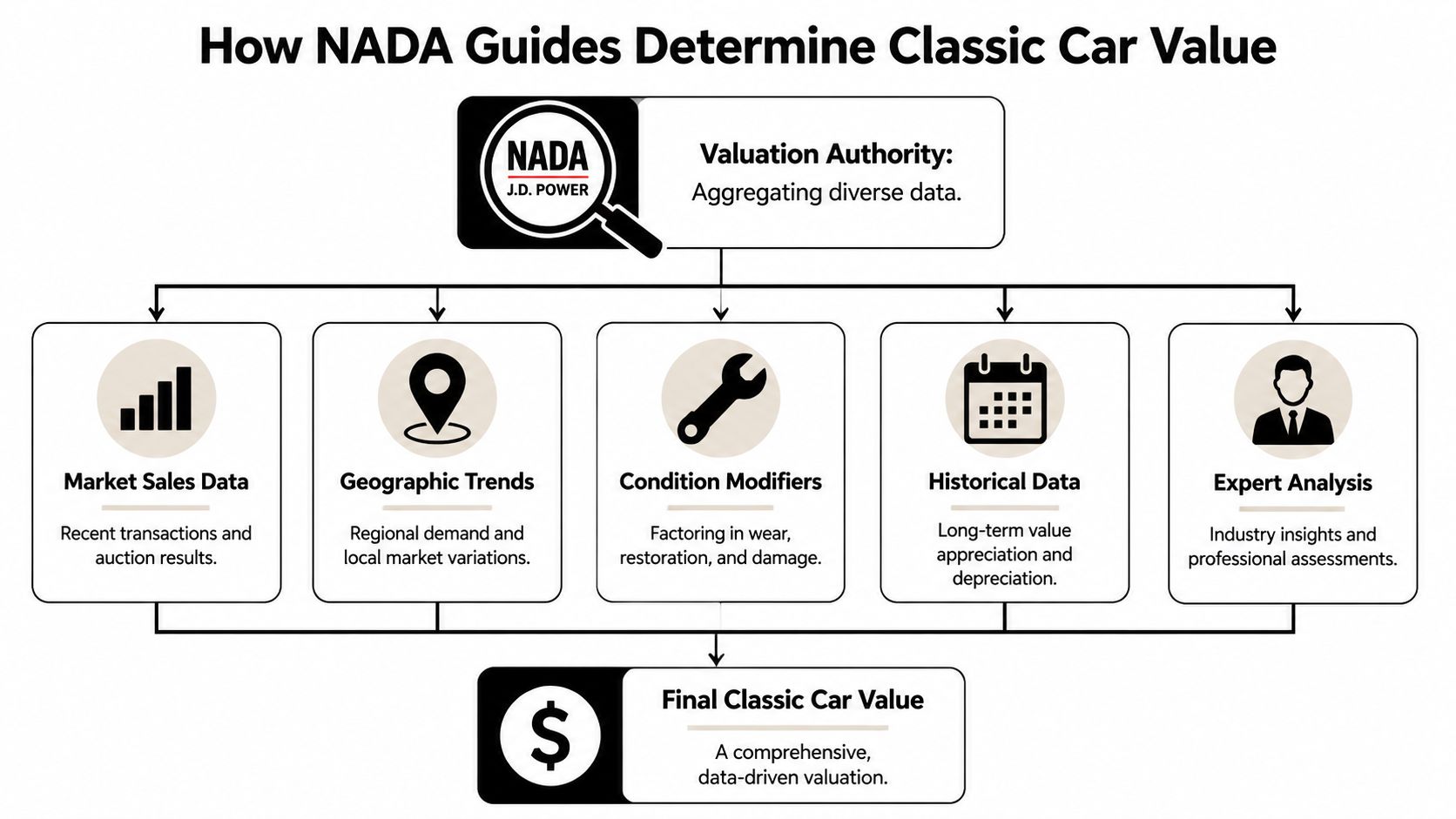
NADA-based valuation is often misunderstood. Owners hear one number and assume there must be a single master list behind it. That's not how it works.
For classics, the number is better understood as a market-model estimate. It relies on a vehicle being identified correctly and then adjusted according to the characteristics that move collector value. If those characteristics aren't entered correctly, the estimate can drift away from reality very quickly.
It's a model, not a magic number
Think of NADA like a recipe. The output depends on the ingredients.
American Collectors makes the important point clearly: NADA-based classic vehicle valuation is not a single-number lookup. It depends on the exact year, make, model, trim, factory options, and condition, and two similar classics can separate sharply in value based on original equipment, documented options, restoration quality, rarity, mileage, and demand (American Collectors classic car values).
That's why a 2-door hardtop and a convertible from the same year may not track together. It's why an original drivetrain can matter. It's why a documented factory option package can matter. It's also why a sloppy repaint and a correct restoration shouldn't land in the same value conversation.
What has to be right for the number to help you
A useful guide output depends on accurate inputs. In practice, these are the pressure points:
- Exact vehicle identity. Year, make, model, trim, engine, transmission, and body style must be correct.
- Factory options. Not aftermarket guesswork. Real options that affect what buyers pay.
- Condition. Paint, body, interior, mechanical state, chrome, glass, undercarriage, and overall presentation.
- Originality and restoration quality. A car with correct components and documented work is not the same as a car that merely looks clean in photos.
- Market context. Some cars trade in a thin market where generalized averages don't keep up.
Practical rule: If the insurer's report identifies your car correctly but describes it generically, you still have a valuation problem.
Where owners get misled
Owners often assume the number itself is the issue. Sometimes the actual issue is the path used to reach it.
If the system starts with the wrong trim, ignores a factory performance package, or rates the car as merely average when it was well above that, the final number may look official while still being weak. The guide didn't fail on its own. The user failed to feed it the right facts.
That's why I tell clients to stop arguing with the label and start auditing the inputs. “NADA says” is not the end of the discussion. It's the beginning of document review.
How Insurance Companies Misuse NADA Valuations
Most insurers don't misuse NADA by citing it. They misuse it by stripping away the context that makes it meaningful.
That usually happens in quiet ways. The report gets built from broad vehicle data. The car is assigned a middle-of-the-road condition. Desirable details are omitted unless the owner forces them into the file. Then the offer is delivered as if the number came from a neutral machine and therefore must be fair.
The common lowball pattern
Here's what I see most often in disputed classic claims:
- Average condition becomes the default. Even when the car was clearly better than average, the report lands in the middle unless someone challenges it.
- Rare or valuable details disappear. Original equipment, uncommon trim, special drivetrains, and documented restoration work get left out.
- The adjuster frames the number as fixed. The language sounds final even though the valuation depends on assumptions.
- Replacement reality is ignored. The offer may have little connection to what it would cost to buy a comparable collector car in the current market.
NADA is a guide, not a law.
That sentence changes the posture of the negotiation. Once you understand that, you stop treating the first offer like a verdict.
Why this tactic works so often
It works because the report looks technical.
Most owners haven't had to read a valuation report line by line before. They see a recognized valuation name and assume the analysis behind it must be thorough. But a recognized guide doesn't protect you from a thin file, a lazy condition call, or a missing option list.
The insurer also knows many policyholders will focus on their own attachment to the car instead of building a market-based rebuttal. Emotional arguments are easy to dismiss. Documentation is harder to ignore.
What doesn't work in response
Saying “I know what I have” doesn't move a claim very far by itself.
What works is more disciplined. Ask for the valuation report. Compare every listed feature to the actual car. Mark what's missing. Challenge condition calls with photos, records, and market comparables. Force the insurer to defend the assumptions, not just repeat the total.
NADA vs Other Valuation Guides and Real Market Data
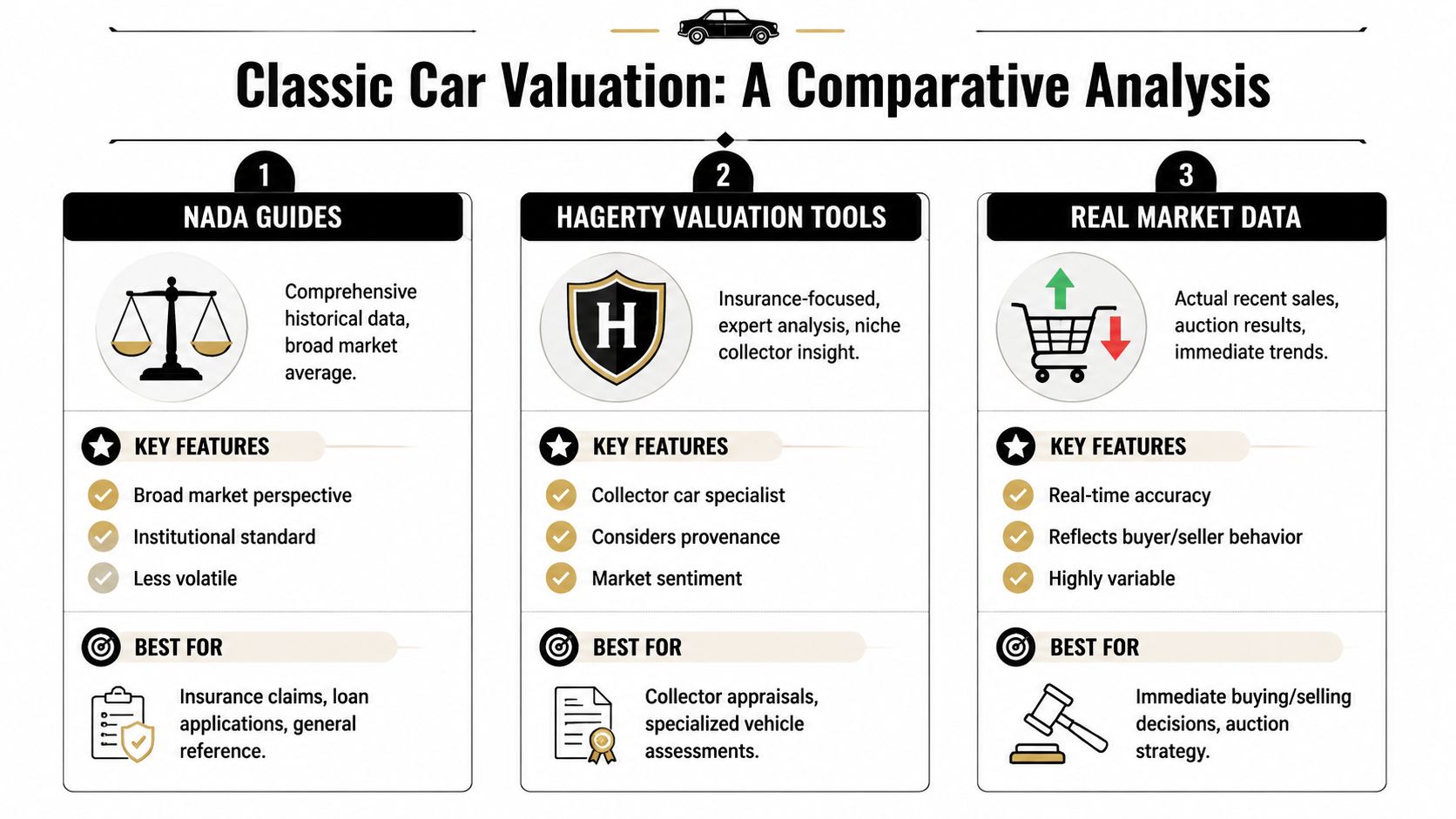
NADA is one tool. That's all. If the insurer presents it as the only legitimate way to value a classic, they're narrowing the field to a format that often favors them.
For collector vehicles, you need to look at more than a single guide output. Some sources are better at broad market framing. Others are better at capturing collector sentiment, current demand, and real buyer behavior. If you want a useful primer on the evidence that drives a proper collector valuation, this guide on how to value a classic car is a good practical reference.
Why one guide can miss the market
Hagerty's 2025 Bull Market List is a good reminder that the collector market is uneven. Hagerty listed a 2005-2008 Dodge Magnum SRT-8 at $32,600 and said it had risen 39% over the prior 5 years, while DeLorean DMC-12 prices had jumped more than 73% since 2019. The same release noted examples such as a 2003-2013 Lamborghini Gallardo 6-speed at $157,700, and Oracle's 2025 classic-car market report, cited in that release, said only 8% of models in Hagerty's UK price guide appreciated over 2024, while 46% fell and 46% stayed flat (Hagerty 2025 Bull Market List).
That matters because it shows how badly a flat, generalized view can miss a specific car. Some segments rise. Some stall. Some split by body style, transmission, or originality. A single guide can lag those shifts.
Classic car valuation source comparison
| Valuation Source | Primary Data Source | Best For | Insurance Claim Weakness |
|---|---|---|---|
| NADA Guides | Broad valuation modeling based on vehicle identification and market inputs | Baseline reference, institutional use, structured starting point | Can flatten collector-specific details if the inputs are generic or incomplete |
| Hagerty Valuation Tools | Collector-focused market analysis and enthusiast-oriented pricing trends | Cars with active collector followings, especially where market sentiment matters | Still a guide, not a direct substitute for your exact vehicle's documented condition |
| Real market data | Recent auction results, dealer listings, and comparable sale evidence | Replacement-cost reality and claim rebuttals | Requires filtering for condition, originality, and true comparability |
| Kelley Blue Book | Mainstream vehicle pricing reference | Later-model vehicles with stronger mainstream market data | Often less useful for true classics and niche collector segments |
What each source does well
NADA helps establish a structured baseline. That can be useful if the vehicle is common enough and the trim and condition are accurately captured.
Hagerty tends to be more responsive to collector-car behavior, especially where enthusiasm, era shifts, and model-specific demand matter. That makes it helpful for modern classics and enthusiast vehicles that don't fit neatly into generalized book logic.
Real market data is where many claim disputes get won. If three comparable cars are listed or sold at numbers above the insurer's offer, that evidence is difficult to brush off. The key is discipline. Don't use fantasy asking prices. Use close comps and explain why they are close.
Good comparables beat a weak guide printout every time, as long as the comparables are actually comparable.
Pros and Cons of Citing NADA in Your Claim
A lot of owners make the same mistake. They think they must either fully embrace NADA or fully reject it.
That's too simplistic. The better approach is strategic. Use NADA when it helps your position. Limit its role when it waters down the facts of your specific car.
When NADA helps
NADA can support your claim if your car fits the guide well and the valuation inputs are accurate.
That usually means the vehicle is identifiable without much ambiguity, the trim and equipment are clearly captured, and the guide output isn't ignoring the exact features buyers care about. In that setting, a favorable NADA figure can serve as one more piece of evidence in your package.
It can also be useful when the insurer is already relying on it. If they've chosen that framework, you may be able to beat their own offer by showing their report used the wrong condition level, omitted options, or selected the wrong model variant.
When NADA becomes a trap
NADA becomes dangerous when the car's value sits in details that a broad guide doesn't handle well.
That includes cars with unusual provenance, highly original examples, excellent documentation, special sub-models, significant restoration quality differences, or rare factory equipment. In those cases, leaning too heavily on NADA can shrink your own argument.
Here's a practical scorecard:
- Use it actively if the guide recognizes the correct version of the car and the number supports your replacement argument.
- Use it cautiously if your car is above average but not especially rare.
- Push it to the background if originality, rarity, custom work, or documentation are the main value drivers.
- Challenge it directly if the insurer used generic year/make/model treatment for a car that clearly deserves more precise analysis.
The strongest claim file doesn't ask, “What does NADA say?” It asks, “What evidence best shows what this exact car was worth on the loss date?”
That change in mindset matters. You stop defending against their framework and start building your own.
How to Document and Challenge a Low Settlement Offer
If the offer is low, don't start with outrage. Start with paper.
A good challenge package is organized, specific, and boring in the best possible way. It reads like a file built for review by someone who wasn't in the original conversation. If you need a grounding point for the numbers side of the dispute, this article on how to calculate fair market value lays out the logic behind a supportable valuation.
Start with the insurer's own report
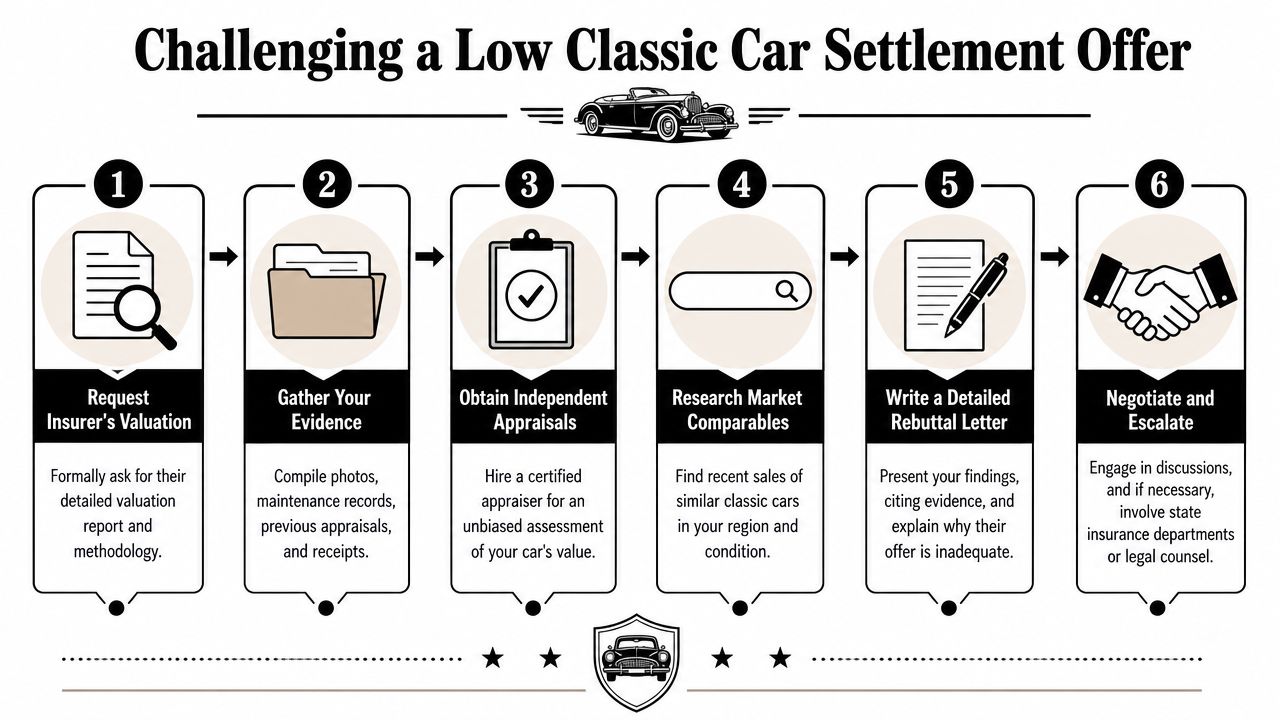
Request the full valuation report in writing. Don't settle for a summary screen or a verbal explanation.
You need to see what they identified as the year, make, model, trim, body style, engine, transmission, options, mileage, and condition. You also need to know whether they used actual comparables, guide values, software, or some mix of all three.
Build your rebuttal file
The best rebuttal packages usually include:
Photos that show actual condition
Use pre-loss photos if possible. Show exterior, interior, engine bay, trunk, wheels, glass, trim, and undercarriage if available.Records and receipts
Service invoices, restoration receipts, parts invoices, prior appraisals, and ownership documentation all help.Factory equipment proof
Build sheets, decoding information, window stickers, option tags, and marque-specific documentation matter when equipment affects value.Comparable vehicles
Use comparables that match the car closely in configuration, condition, and market segment. Explain why each comp is relevant.A written rebuttal letter
This should be clean, direct, and evidence-based. Point out errors line by line.
What to say in the rebuttal letter
Keep the letter factual.
State the claim number, the loss date, the insurer's offer, and the amount you dispute. Then identify the errors. Wrong trim. Missing options. Condition understated. Inadequate comps. Unsupported deductions. Follow each point with evidence.
A simple structure works well:
- Opening position. You dispute the settlement amount because it doesn't reflect the vehicle as equipped and conditioned.
- Report errors. List each in separate paragraphs or bullets.
- Supporting evidence. Attach records, photos, and comps.
- Counter-value. State the number you believe is supported and why.
- Request for review. Ask for a revised settlement in writing.
Owners lose leverage when they send a long emotional email. They gain leverage when they submit a short, documented rebuttal that an evaluator can't easily dismiss.
What to avoid
Don't flood the file with weak comparables.
Don't use unrelated auction headlines, distant listings with major differences, or asking prices that bear no relationship to your car. A small set of strong comps beats a pile of noisy screenshots.
Also, don't let the dispute stay verbal. Phone calls disappear. Written disputes force a paper trail.
When to Hire a Certified Independent Appraiser
Some claims can be handled by the owner with a disciplined rebuttal. Others hit a wall.
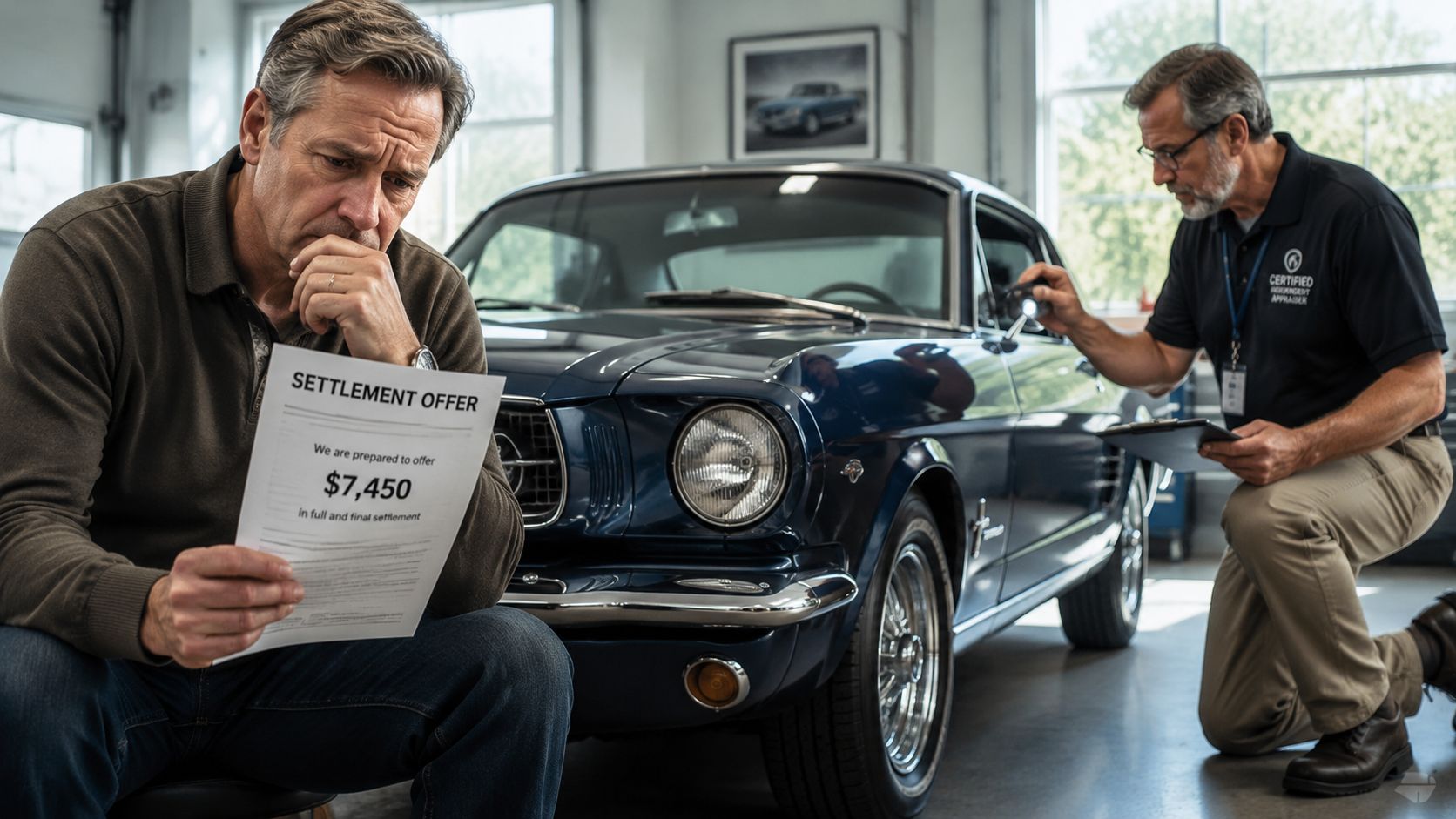
If the insurer refuses to adjust obvious errors, dismisses your comparables without meaningful explanation, or keeps repeating the same software-driven number, it may be time to bring in a certified independent appraiser.
The right time to escalate
You should seriously consider outside help when:
- The car is rare or hard to comp. Thin markets create room for bad insurer assumptions.
- The value depends on expertise. Originality, restoration quality, or collector significance may need specialist analysis.
- The insurer won't engage your evidence. If every response sounds canned, informal negotiation may be finished.
- The gap is substantial. At some point, the amount in dispute justifies professional support.
- You have an appraisal clause option. Many policies contain one, and it can move the dispute out of the insurer's preferred lane.
An independent appraiser's job is not to inflate the number. It's to document a supportable market value that can survive scrutiny. That usually means inspecting the vehicle record, reviewing the insurer's methodology, selecting proper comparables, and preparing a report built for negotiation or appraisal-clause use.
For owners in Oregon and Washington dealing with total-loss or diminished-value disputes, classic auto appraisers can also help invoke the appraisal clause and replace biased valuation software with a market-based analysis.
A short overview of the process helps if you've never seen the appraisal clause in action:
Why this step changes the negotiation
The minute a qualified appraiser gets involved, the discussion usually becomes more disciplined.
The insurer can no longer rely on a vague “NADA value” statement and expect that to end the dispute. They have to confront competing valuation logic, documented comparables, and a record that can be used beyond the adjuster's desk. That pressure matters.
If your classic was totaled and the settlement doesn't reflect the actual market, don't assume the first number is the last number.
If you need help challenging a low classic-car total loss offer, Total Loss Northwest provides certified independent appraisals for total loss and diminished value claims. They work with market comparables, documented vehicle specifics, and appraisal-clause disputes so owners have a defensible valuation instead of a software-driven number.