You walk into the garage expecting to think about repair shops, parts availability, and whether the paint can be matched. Instead, you end up staring at an insurance valuation that treats your collector car like a tired commuter with extra birthdays.
That's the moment most owners realize they're not just dealing with body damage. They're dealing with a pricing fight.
Collector car valuation matters most when the stakes are worst. After an accident, the insurer's first number often comes from software built for ordinary used vehicles. That approach breaks down fast when the car's value depends on originality, documentation, provenance, restoration quality, and a market that doesn't behave like the late-model market. If you don't know how value is built and defended, you can lose money even if the car gets repaired, and even more if it's declared a total loss.
The Lowball Offer That Changes Everything
The call usually sounds routine. The adjuster is polite. The process seems simple. Then the offer arrives, and the number tells you everything you need to know. They didn't value your car as a collector vehicle. They valued it as transportation.
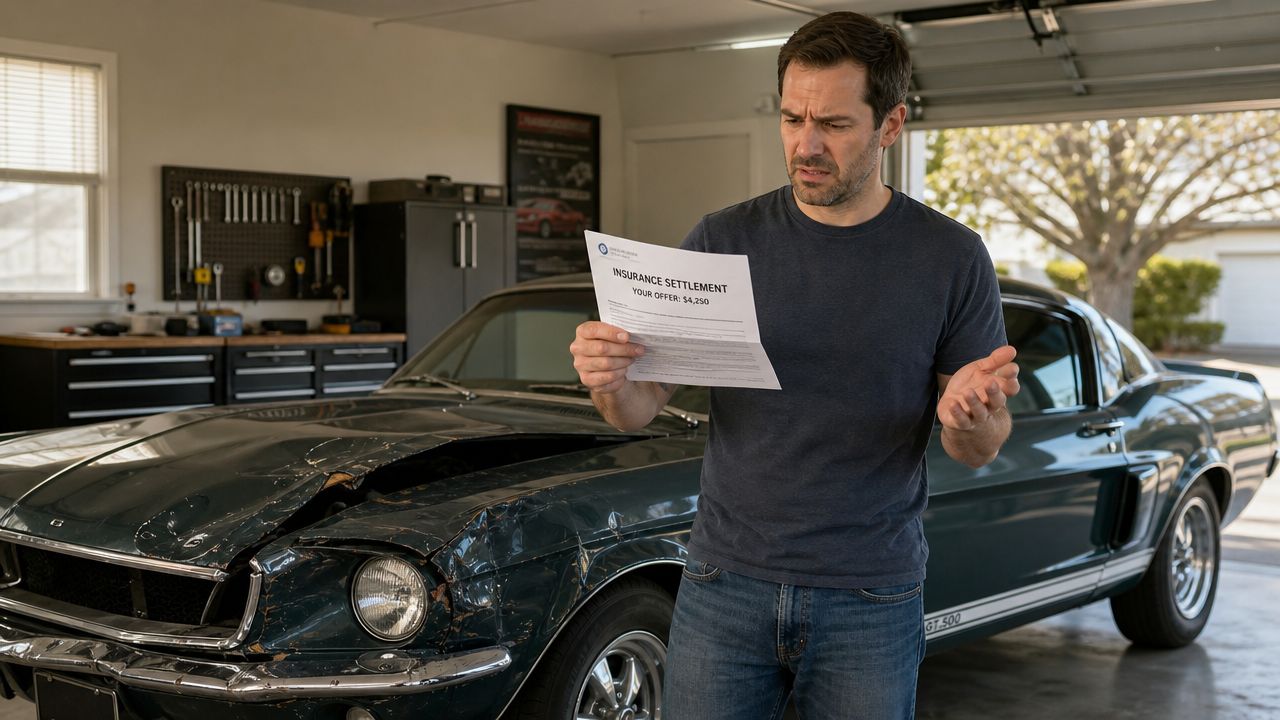
A collector owner often knows the car better than anyone on the claim. You know the engine is numbers-matching. You know the trim was sourced carefully. You know the repaint was done to factory-correct standards, not as a quick resale job. The insurer's valuation often ignores all of that and substitutes a generic model-year view that compresses meaningful differences.
That isn't a fringe problem. Hagerty estimates there are about 43 million collector vehicles in the United States, representing roughly 16% of the country's 275 million registered vehicles, with a combined insurable value of about $1 trillion. Hagerty also notes North American collector-car auctions produced about $2.2 billion in sales in 2021, which shows how active and consequential this market is for pricing and settlement disputes in practical situations, as outlined in Hagerty's collector-car market overview.
What the first offer usually gets wrong
- It treats age like depreciation: That logic works for ordinary used cars. It often fails for collector vehicles.
- It ignores buyer behavior: Collectors don't pay based on mileage alone. They pay for authenticity, documentation, and the right configuration.
- It misses market context: A sale at auction, a recognized condition grade, and a documented restoration can matter more than the insurer's canned comparable list.
The first insurance number is often a negotiating position, not a reliable statement of collector car value.
If you're holding a low offer right now, the important thing is this. Your frustration is reasonable, and your instinct to question the number is probably correct. A proper collector car valuation gives you the language, evidence, and structure to challenge a settlement that doesn't reflect what the car was before the loss.
Why Your Classic Is Not Just an Old Car
You hand the adjuster photos, receipts, and years of records. A week later, the offer comes back built on ordinary used-car logic, as if your car were just a worn-out vehicle with an old VIN. That is the mistake that drives many bad collector-car settlements.
A 2015 Ford Mustang and a 1965 Ford Mustang may share a badge, but they do not trade in the same market. The newer car is usually valued by depreciation, mileage, options, and local used-car sales. The older car is valued by how collectors judge that specific example, including originality, correctness, documentation, and buyer demand for the exact configuration.
Insurance carriers know this. Their software often does not handle it well.
The wrong lens and the right lens
| Lens | Ordinary used car | Collector car |
|---|---|---|
| Primary driver | Depreciation | Desirability and authenticity |
| Mileage role | Major | Often secondary |
| Repair history | Usually a deduction | Depends on quality, originality, and documentation |
| Parts | Replacement is expected | Factory-correct parts can matter a lot |
| Market behavior | Broad and predictable | Narrower, more segmented, more emotional |
In a collector-car claim, owners lose ground when they argue from attachment alone. Insurance companies are not paying for memories. They are paying for market value, and they will usually start from the narrowest reading of that value unless someone forces a more accurate analysis.
That is why a collector car has to be presented as a specific asset, not a sentimental possession and not a generic used car. A proper classic car valuation process after an accident documents what the software misses, including factory-correct features, provenance, restoration quality, and the sales data that reflects collector demand.
The valuation standard is also far more detailed than a year-make-model lookup. J.D. Power explains that its collector vehicle methodology reviews vehicles across six major categories and roughly twenty condition factors, then assigns a condition level based on that closer inspection, which is a very different exercise from standard used-car pricing, as described in the J.D. Power classic car values overview.
Presentation matters too, especially when condition is disputed after a loss. Clear pre-loss photos, service records, and evidence of cosmetic care can support your position when the carrier tries to grade the car down. Even appearance-related upkeep can help frame condition credibly. Mobile Buff tips for pre-sale detailing offer a useful reminder that presentation affects how others judge a vehicle, even before the appraisal file gets built.
What owners should stop saying
Some arguments feel true but do not move a claim file very far:
- “I've owned it forever.” Length of ownership does not prove market value.
- “I know what I have.” Knowledge helps, but insurers respond to records, photos, and comparable sales.
- “It's worth what I spent.” Restoration cost can exceed market value, or fall short of it.
The stronger position is specific and documented. Show what the car was, why collectors pay more for examples like it, and where the insurance valuation cut corners. That is how bad reports get challenged, and it is often the point where a low initial offer starts to change.
The Five Pillars of Collector Car Value
The market doesn't reward collector cars evenly. Two examples can look similar in photos and still land far apart in value because one has better authenticity, better paper, or better history. That's why collector car valuation is largely condition- and originality-driven, with value shaped by condition grade, originality, rarity, provenance, and documentation. Industry guidance notes that this is why similar cars can differ by tens of thousands of dollars, as explained in this guide to classic car value factors.
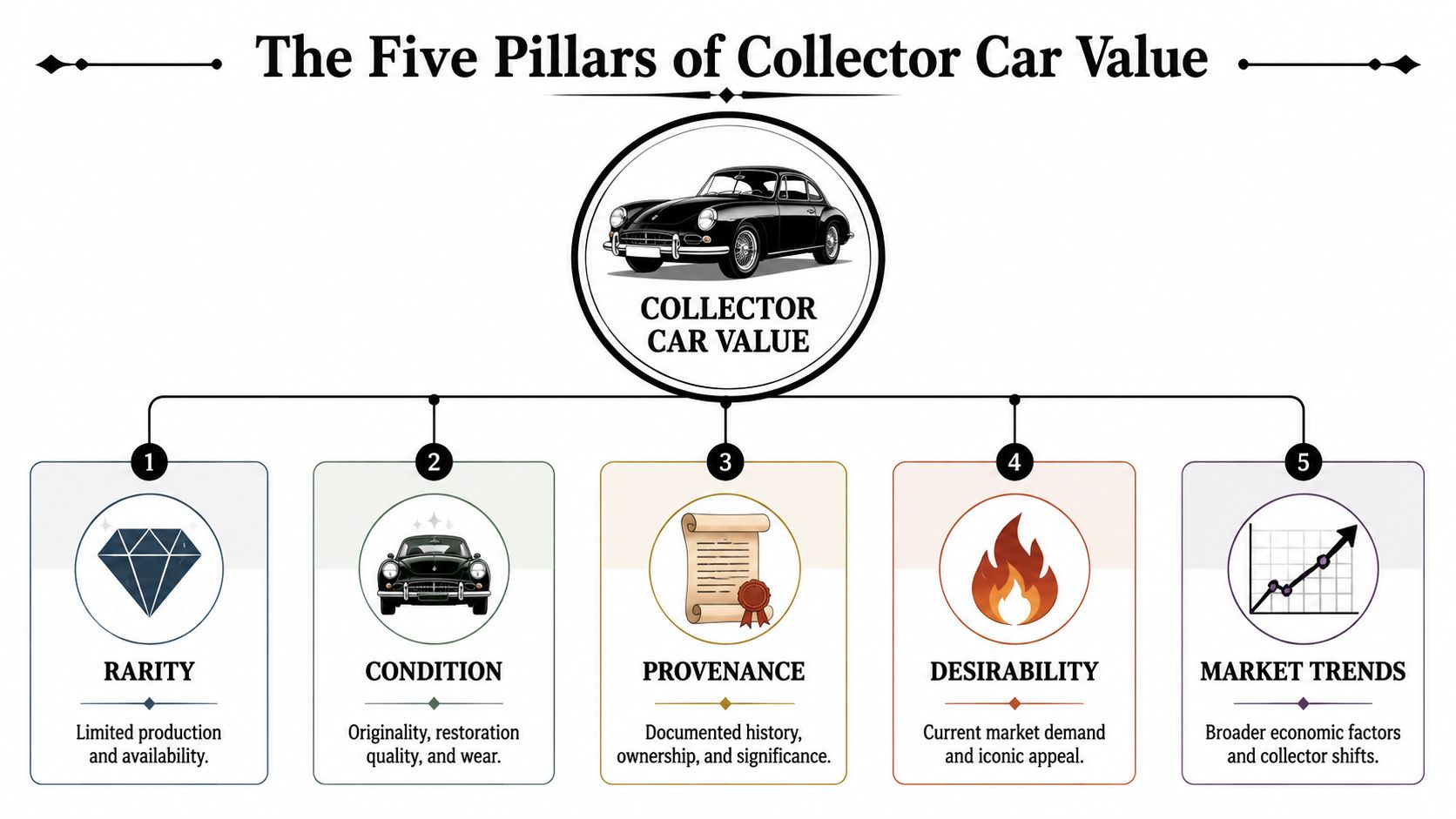
Originality
Originality answers a hard question. How much of the car is still what the factory built?
A numbers-matching engine and transmission usually matter because they anchor authenticity. Factory-correct trim, finishes, and components matter for the same reason. When a car has replacement tags, substituted driveline parts, or later-era modifications, the market may still like the car, but it often prices that car differently.
Condition
Condition is not just “nice” or “rough.” It includes paint quality, body integrity, mechanical presentation, interior correctness, chrome, glass, undercarriage, and signs of age or shortcuts. A clean-looking car with mediocre fit, weak materials, or inconsistent restoration work can fall below a car that presents less dramatically but is more honest and correct.
Practical rule: Never assume a glossy repaint adds value. On a collector claim, finish quality only helps if it supports the car's overall grade and authenticity.
Provenance
Provenance is the story you can prove. Prior ownership history, period photos, restoration chronology, marque recognition, event history, and known significance all matter. A car with documented continuity is easier to defend than one that relies on oral history and guesswork.
Rarity
Rarity isn't only about low production. It can come from a desirable trim, drivetrain, body style, color combination, or surviving availability in the current market. Some cars are common in name but scarce in the exact specification buyers want.
Documentation
Documentation turns claims into evidence. Build sheets, window stickers, service records, restoration invoices, ownership records, and appraisal reports all help. Even presentation matters. If the car is repaired and you may later sell it, resources like Mobile Buff tips for pre-sale detailing can help you preserve how the car is perceived after work is completed.
For a deeper walkthrough of how these pieces come together in practice, this guide on how to value a classic car is useful because it frames value the way an appraisal dispute unfolds.
Decoding the Data Valuation Methods Explained
A collector claim gets stronger when the valuation isn't built on one source. Single-source pricing is where bad settlements hide. One guide can lag. One auction result can be an outlier. One listing can be wishful thinking.
The more reliable workflow uses multiple market benchmarks, specifically condition-based price guides, completed auction results, and current asking prices. Hagerty states its valuation tools combine price-guide data with real-world sales across 40,000+ collector vehicles, and the broader takeaway is that appraisal accuracy improves when the number is triangulated across these datasets, as described in Hagerty Valuation Tools.
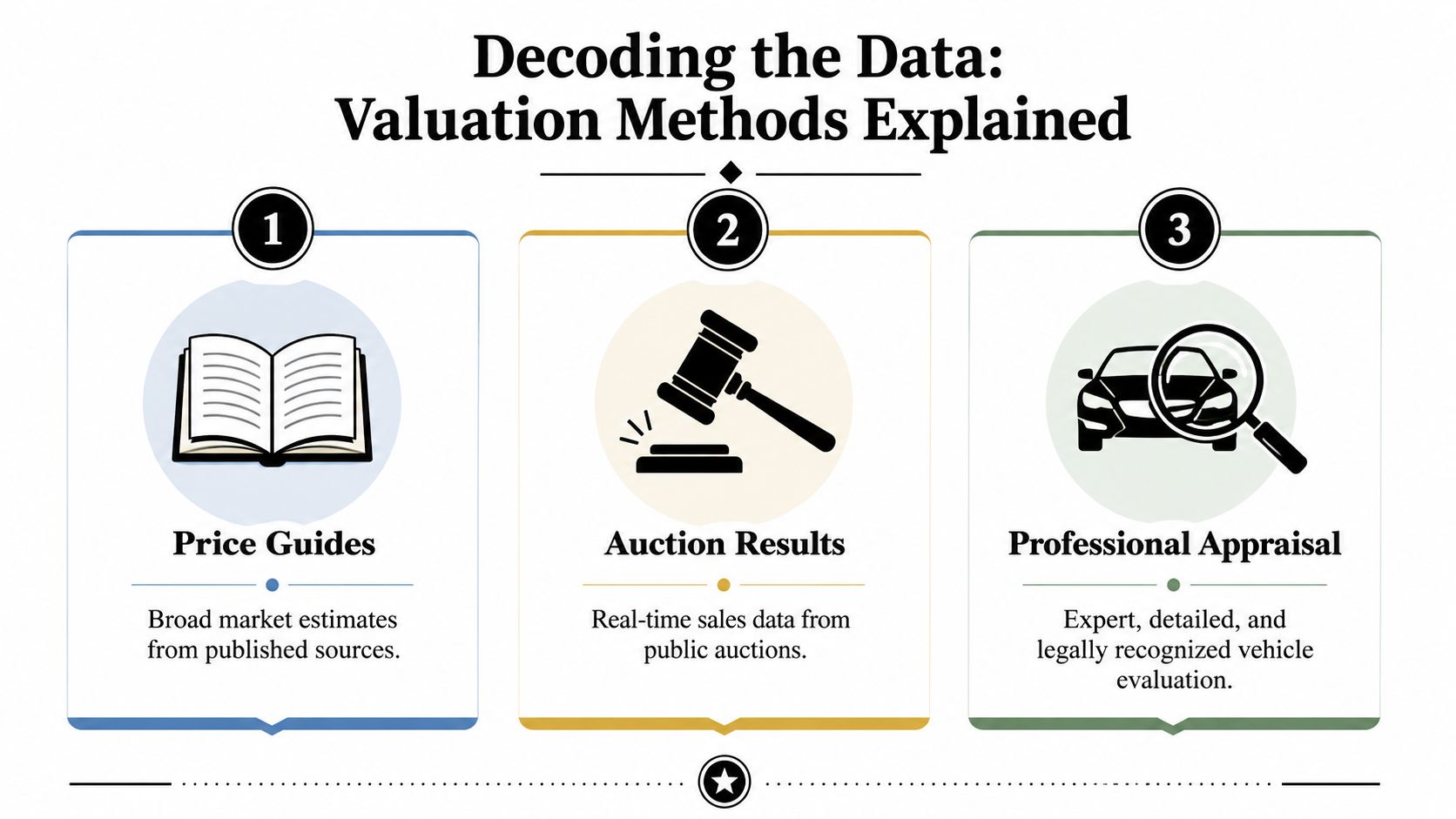
How each method helps and where it fails
| Method | What it does well | Where it falls short |
|---|---|---|
| Price guides | Establishes a structured baseline by condition tier | Can lag fast market changes or miss unusual configurations |
| Auction results | Shows what buyers actually paid | Can be skewed by venue, presentation, bidder mix, or one exceptional car |
| Asking prices | Shows seller expectations and current inventory | An asking price is not a closed deal |
| Professional appraisal | Connects the car's actual features to market evidence | Quality depends on the appraiser's method and documentation |
What insurers often do
They pick the source that supports the lowest result. That might mean leaning on a broad guide without adjusting for originality, or selecting weak comparables while ignoring stronger cars with better documentation and similar specification.
A sound valuation does the opposite:
- It starts with condition: The car must be placed in the right grade first.
- It adjusts for authenticity: Matching numbers, factory options, and documentation need specific treatment.
- It checks live market behavior: Guides, sold results, and current listings should point in roughly the same direction.
- It explains differences: If one comp sold lower, the report should say why.
If a valuation number appears precise but the report doesn't show how the car was graded, what comps were used, and why those comps fit, the precision is mostly cosmetic.
The practical advantage of a multi-source approach is simple. It gives you a basis to challenge cherry-picked evidence. You're no longer arguing that the insurer feels wrong. You're showing where the valuation method itself broke down.
How to Spot and Dispute a Bad Valuation
A bad valuation rarely announces itself. It usually arrives wrapped in confidence, line items, and software formatting. Owners assume the adjuster's report must be objective because it looks technical. That's a mistake.
The collector market doesn't move uniformly. Recent commentary shows some segments have dropped sharply while others behave differently, which means static pricing tools can miss fast market moves and become a poor basis for settlement, as discussed in this review of classic car value volatility. That cuts both ways. If your segment has softened, it matters. If your segment has held firm or strengthened, that matters too.
Red flags in the insurer's report
Look for these problems before you argue about the final number:
- Wrong comparables: The report uses the same model but the wrong engine, body style, trim, or restoration level.
- Missing originality analysis: It mentions age and mileage but says little about numbers-matching status, tags, paperwork, or factory-correct equipment.
- No market timing discussion: It relies on stale data without explaining whether the segment has changed since those sales.
- Repair-cost logic in a value dispute: The adjuster acts as if the cost to repair dictates pre-loss value. It doesn't.
- Generic condition grading: The car gets labeled with a broad condition bucket and no explanation of why.
How to push back effectively
Don't call the offer “ridiculous” and stop there. Ask direct, documented questions.
- Ask for the full valuation report. You need the comparables, adjustments, condition assessment, and source dates.
- Challenge comp selection. If they used modified cars against your documented original example, say so clearly.
- Question stale data windows. Ask why the report ignored newer market evidence.
- Address non-originality carefully. Not every replacement part deserves the same deduction. A restoration-era substitution is not the same as a missing VIN-related identifier or undocumented major component swap.
- Request explanation in writing. Claims improve when the insurer has to defend methodology, not just repeat a number.
A useful starting point is understanding how insurer valuation systems work and where they fail. This breakdown of CCC auto valuation issues helps owners recognize when software-driven pricing has drifted away from the actual market.
Ask the adjuster to identify which features of your specific car moved the number up or down. If they can't answer, they probably didn't value the specific car at all.
The non-originality trap
Many claims go sideways. Insurers often treat any non-originality as a broad penalty because it simplifies the file. Actual market behavior is more nuanced. Some deviations are serious and value-limiting. Others are expected in older restorations and may matter less than overall condition, especially when authenticity is difficult to verify cleanly.
That nuance matters in a dispute. You don't want to deny a flaw that exists. You want to force the insurer to price the flaw correctly.
When to Call in a Certified Appraiser
The call usually comes after the adjuster gives you a number that does not match the car sitting in your garage, or the car that was sitting there before the loss. At that point, receipts and a few auction printouts stop carrying the file. If the claim involves a total loss, diminished value after repair, estate division, divorce, or agreed-value policy planning, a certified appraisal often becomes the document that sets the dispute on solid ground.
Collector car valuation is detailed by design. Serious appraisal work breaks the vehicle into multiple condition and authenticity factors, then weighs how those factors affect market appeal for that exact model and configuration. Small differences in paint quality, drivability, provenance, trim correctness, or restoration quality can separate one car from another by a wide margin. An insurer's software tends to flatten those differences because speed matters to the carrier more than precision matters to the owner.
A real appraisal needs to do more than announce a number. It should:
- Identify the specific car: VIN-related identifiers, body style, engine and transmission configuration, options, modifications, and restoration history.
- Document condition closely: Exterior, interior, glass, chrome, undercarriage, engine bay, mechanical function, and overall presentation.
- Support the opinion with market evidence: Comparable sales, guide references, and active market checks that resemble the subject car.
- Explain every adjustment: Why one comparable deserves more weight, and why another should be discounted or rejected.
- Hold up under scrutiny: The report should be usable in negotiations, appraisal clause disputes, or attorney review.
Owners can and should organize photos, invoices, prior appraisals, and ownership history. That groundwork matters. The problem starts when the claim shifts from facts to procedure.
Insurance companies handle claims every day. They have approved vendors, canned explanations, and valuation formats built to defend the first number. To answer that effectively, you need a report written in the same language of evidence, condition analysis, and market support. That is the point where an independent appraiser stops being optional and starts being practical.
For owners facing a serious value dispute, classic auto appraisers can prepare a documented opinion that insurers, attorneys, and umpires can evaluate line by line. Total Loss Northwest is one example of a firm that works in that dispute setting for classic, diminished value, and total loss claims.
A certified appraisal gives you something better than an opinion. It gives you a defensible record of what the insurer missed, ignored, or priced incorrectly.
If the gap is small and the errors are obvious, you may resolve the claim yourself. If the insurer keeps repeating the same unsupported figure, the report is technical, or the dollars at stake are meaningful, paying for an appraisal is often cheaper than absorbing a weak settlement.
Your Action Plan for a Fair Settlement
Right after an accident, owners often move too fast on the wrong tasks. They argue emotionally, accept incomplete explanations, or let the insurer define the car before they've assembled their evidence. A better approach is methodical.
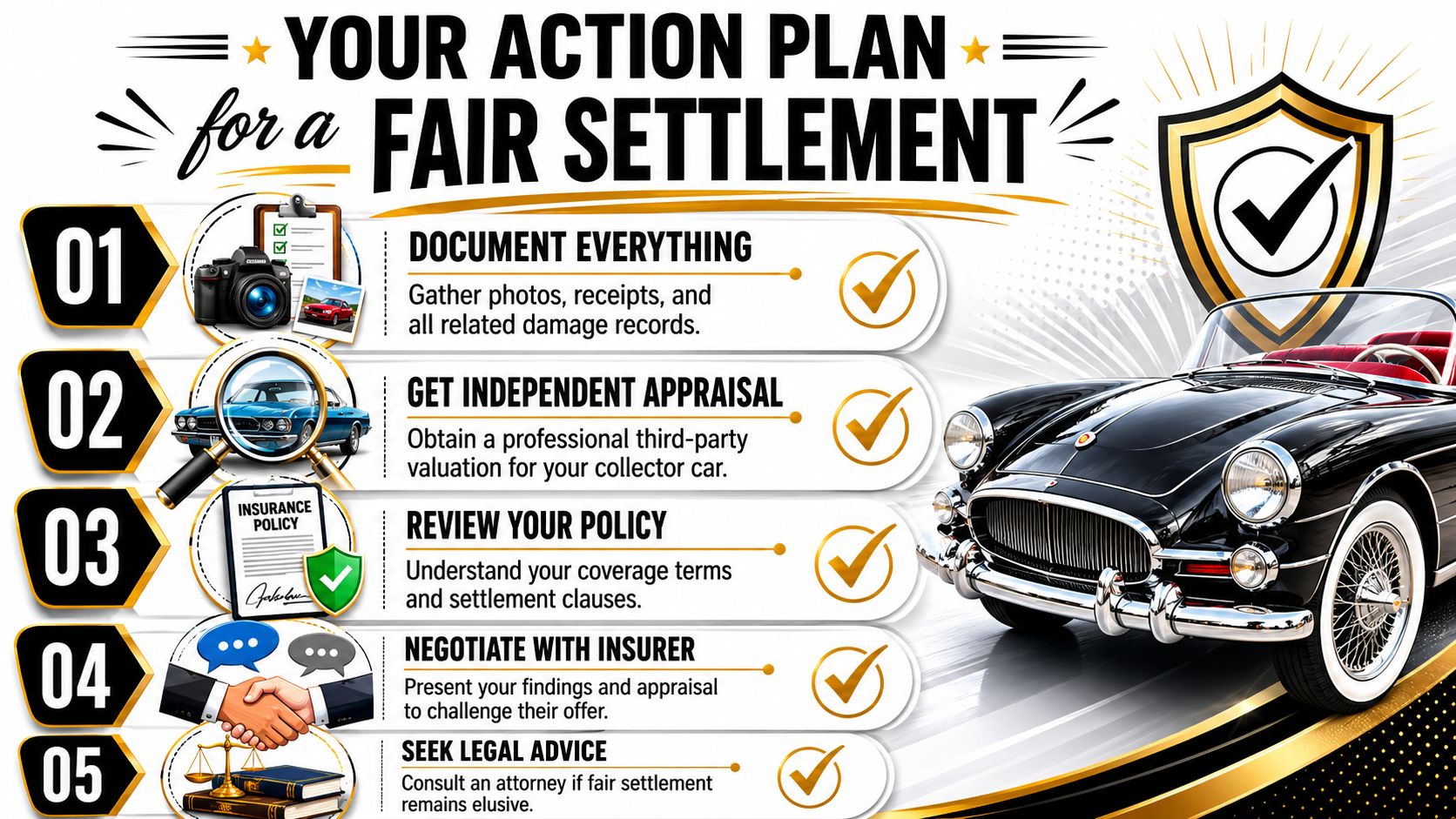
Follow this checklist
Document everything
Photograph the damage, the whole car, the interior, the engine bay, identifying tags, and the parts that show originality. Gather receipts, restoration records, title history, old photos, event materials, and prior appraisals.Build your market file
Pull condition-based guide context, sold auction examples, and current listings for cars that resemble yours in equipment and presentation. Reject weak comps early.Don't accept the first offer blindly
Ask for the full valuation packet. Read the comp list and adjustments. If the report doesn't explain condition, originality, or market timing, you have a basis to dispute it.Read the policy language
Find the appraisal clause and any wording on stated value, agreed value, actual cash value, and dispute procedures. The policy often tells you how to force the claim out of a one-sided software process.Bring in independent help when needed
If the file is complex, the number gap is serious, or the insurer won't correct obvious errors, get an appraiser who works from market evidence and detailed vehicle-specific analysis.
Keep your communication sharp
Use written, specific language with the insurer:
- Identify the error: “Comparable two is modified and not equivalent to my documented original example.”
- Request support: “Please provide the source dates and condition basis for each comparable.”
- Tie evidence to value: “The report does not account for documented provenance and factory-correct equipment.”
- Stay focused: You're disputing methodology, not venting frustration.
A fair settlement usually goes to the owner who stays organized longer. The insurer handles claims every day. You only need to handle this one properly.
If your collector car was totaled or undervalued after an accident, Total Loss Northwest can help you challenge the insurer's number with an independent appraisal built for negotiation, appraisal-clause disputes, and diminished value claims.