You've already done the hard part. The bumper is fixed, the paint looks right, and the shop says the car is ready, but the number that matters can still be lower when you try to sell or trade it in. In Arizona, that surprise often shows up only after the repair bill is closed and the vehicle history report starts doing the talking.
A diminished value appraisal Arizona drivers rely on is about that hidden loss, not the repair itself. The rest of this guide walks through the claim path in plain English, from what the appraisal measures to how Arizona's deadline and claim rules shape your next move. If you want a quick outside reference while you compare options, the Nares Law Group diminished value guide is a helpful starting point, and a separate history-report explainer on insurance loss reporting helps show why a repaired car can still be worth less.
Arizona's Hidden Diminished Value Loss
A driver on Loop 101 gets rear-ended, the body shop replaces the damaged panels, and everything looks clean when the keys come back. Then the owner checks trade-in offers and learns the market still sees the crash, not just the repair. That gap is the whole problem with diminished value, because a car can look fine in person and still carry a stigma on paper.
That stigma matters because buyers and dealers price risk. If a vehicle history report shows an accident, many shoppers assume there may be hidden wear, future repair concerns, or a tougher resale path later. The loss can show up even when the workmanship is good, which is why repair completion is not the same thing as financial recovery.
The practical question is whether the loss is large enough to justify the effort of a claim. Some cars are easy to replace and don't lose much market trust. Others, especially newer or higher-value vehicles, can see a resale hit that is hard to ignore.
If you've only seen generic advice that says “file a claim,” that's not enough. Arizona drivers need a decision framework, because the value loss, the evidence burden, and the forum you choose all affect whether the claim is worth it. A clear appraisal can turn that vague feeling of “my car feels worth less now” into a number an insurer has to address.
Practical rule: if the accident history will follow the car into a sale, the repair bill alone probably won't make you whole.
What a Diminished Value Appraisal Means
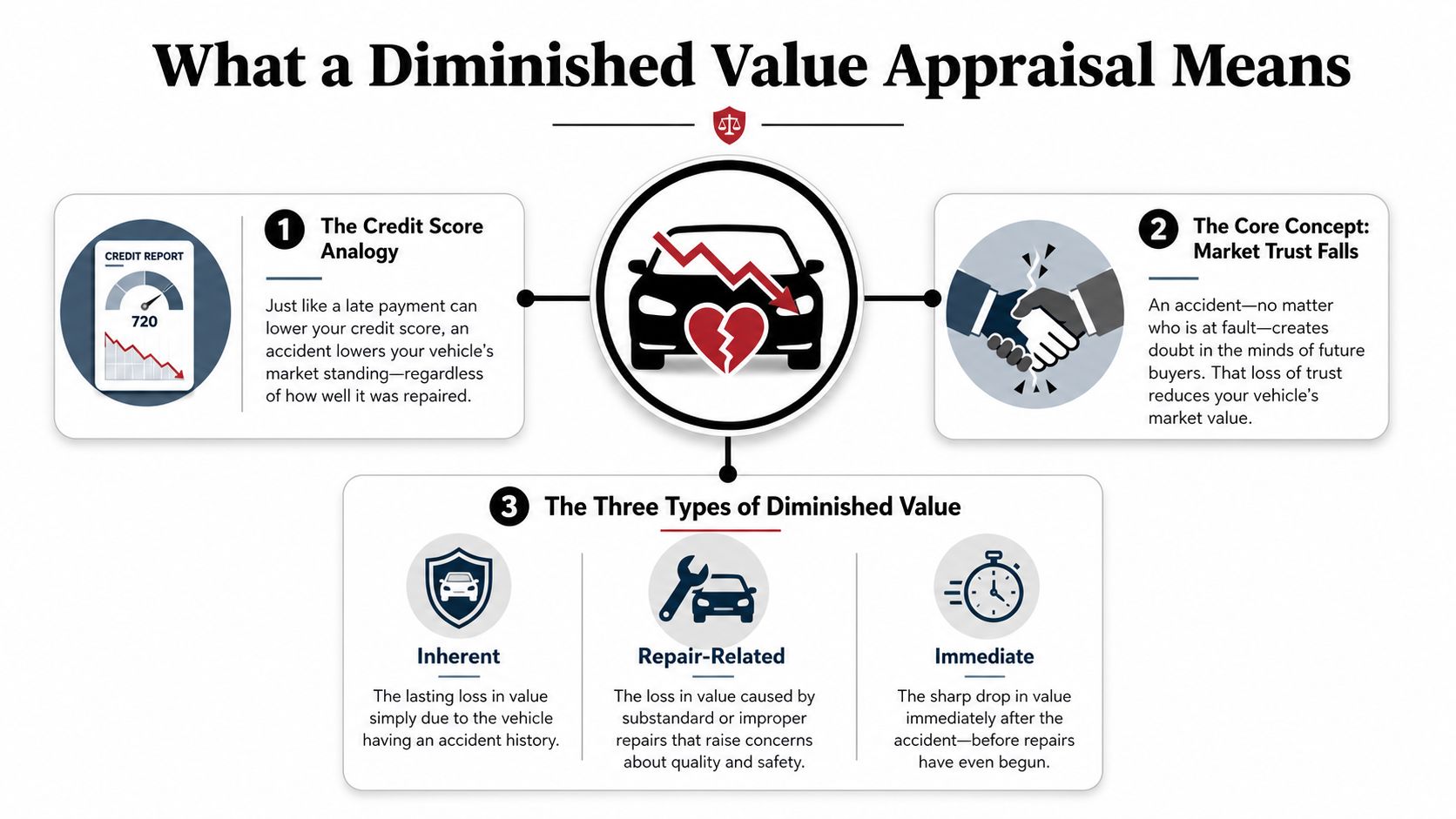
A good way to think about a diminished value appraisal is like a credit score after one missed payment. The account may be current again, but the record of the miss can still change how lenders view you. A repaired car works the same way, because the damage may be gone while buyer trust stays lower.
The basic idea
The appraisal measures the gap between a car's value before the crash and its value after the repair. That gap is separate from the repair invoice. In plain terms, the shop fixed the metal, but the market may still discount the car because the accident now lives in its history.
There are three common forms of diminished value. Immediate diminished value is the drop right after the accident. Repair-related diminished value comes from poor or incomplete repairs. Inherent diminished value, often called stigma loss, is the one that matters most in Arizona claims because it can exist even after a proper repair.
That's why a repaired sedan can still bring less at resale than a similar sedan with a clean history. The market isn't rewarding the bodywork alone. It's pricing the fact that the car was once damaged.
For a simple comparison, think about ACV and agreed value policies on a specialty car. A resource from PTL Insurance Associates on actual cash value versus agreed value helps show how a car's valuation basis can change the result. Diminished value works differently, but the same lesson applies, the method used to value the vehicle changes the outcome.
A diminished value appraisal is not a repair estimate. It is a market-value opinion about what the accident permanently changed.
Arizona Diminished Value Legal Rules
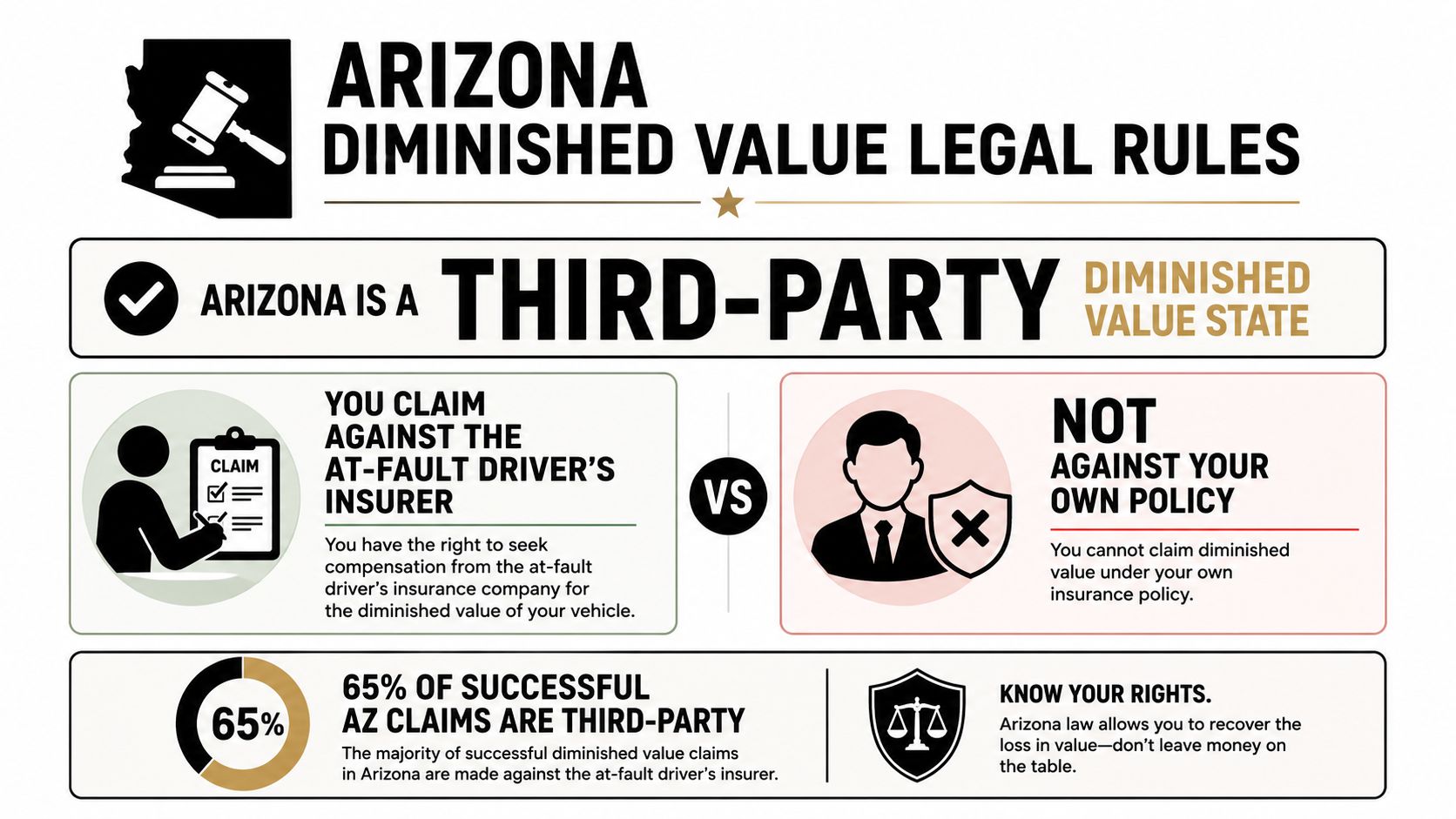
An Arizona diminished value claim usually starts with a simple question, who caused the crash, and what kind of car was affected? Arizona treats third-party diminished value as a claim against the at-fault driver's insurer, so the loss is normally pursued outside your own policy. Arizona guidance also says uninsured motorist coverage does not cover diminished value, and the filing window is 2 years from the accident date My DV AC Arizona guide. For a smaller loss, Arizona's small-claims limit of $3,500 can shape whether the claim belongs in court or at the negotiating table My DV AC Arizona guide.
Those rules matter because the size of the vehicle loss should match the size of the effort. A daily driver with modest market value may not justify a long fight if the likely recovery is close to the cost of proving it. A late-model commuter, luxury sedan, or enthusiast car often tells a different story, because even a clean repair can leave a larger residue in resale value. The threshold is practical, not emotional. If the likely claim is small, the time, appraisal fee, and follow-up work can eat into the benefit. If the vehicle sits in a higher-value segment, the same accident can justify a much stronger claim.
Arizona does not use a statutory diminished value formula. You have to prove liability and the remaining loss with valuation evidence, and Arizona law allows recovery for repair costs plus proven residual reduction in fair market value MyFairClaim Arizona guidance. That makes the appraisal do real work. A vague statement that the car “lost value” is usually too thin to carry the claim. The proof has to show why a buyer would pay less after the accident, even if the repair itself looks good.
The paperwork matters because it gives the insurer something concrete to evaluate. A file built around repair records, photos, and market support usually does more than a general complaint about stigma. If you are gathering the claim file, a useful starting point is Total Loss Northwest's auto-claim documentation page, since the same kind of records help show what was damaged and what was restored.
Collecting Evidence and Negotiating Your Claim
Start with the basics, then build outward. You need the police report, repair invoices, repair estimates, before-accident photos or listings, post-repair photos, and any vehicle history report that shows the accident entry. A documentation checklist for auto claims on Total Loss Northwest's auto-claim documentation page lines up well with that approach.
A calm file beats a heated phone call. When an adjuster sees organized paperwork, the conversation stops being about whether damage happened and starts being about how much value was lost. That's the goal, because the appraisal should be the anchor, not your frustration.
Here's a simple way to talk about it:
“I'm not asking you to re-litigate the repair bill. I'm asking you to review the independent appraisal and the market comps that show the post-repair loss.”
If the offer comes in low, ask the adjuster which part of the valuation they dispute. Then respond to that point only. If they question the repair quality, point to the invoices and photos. If they question the market comps, show the specific listings or sale examples your appraiser used.
A polite letter works better than a long emotional explanation. Keep it focused on the facts, the appraisal, and the amount you're requesting. If the insurer still pushes back, preserve your records and ask what additional documentation they want before the file is closed.
How Independent Appraisers Value Arizona Cars
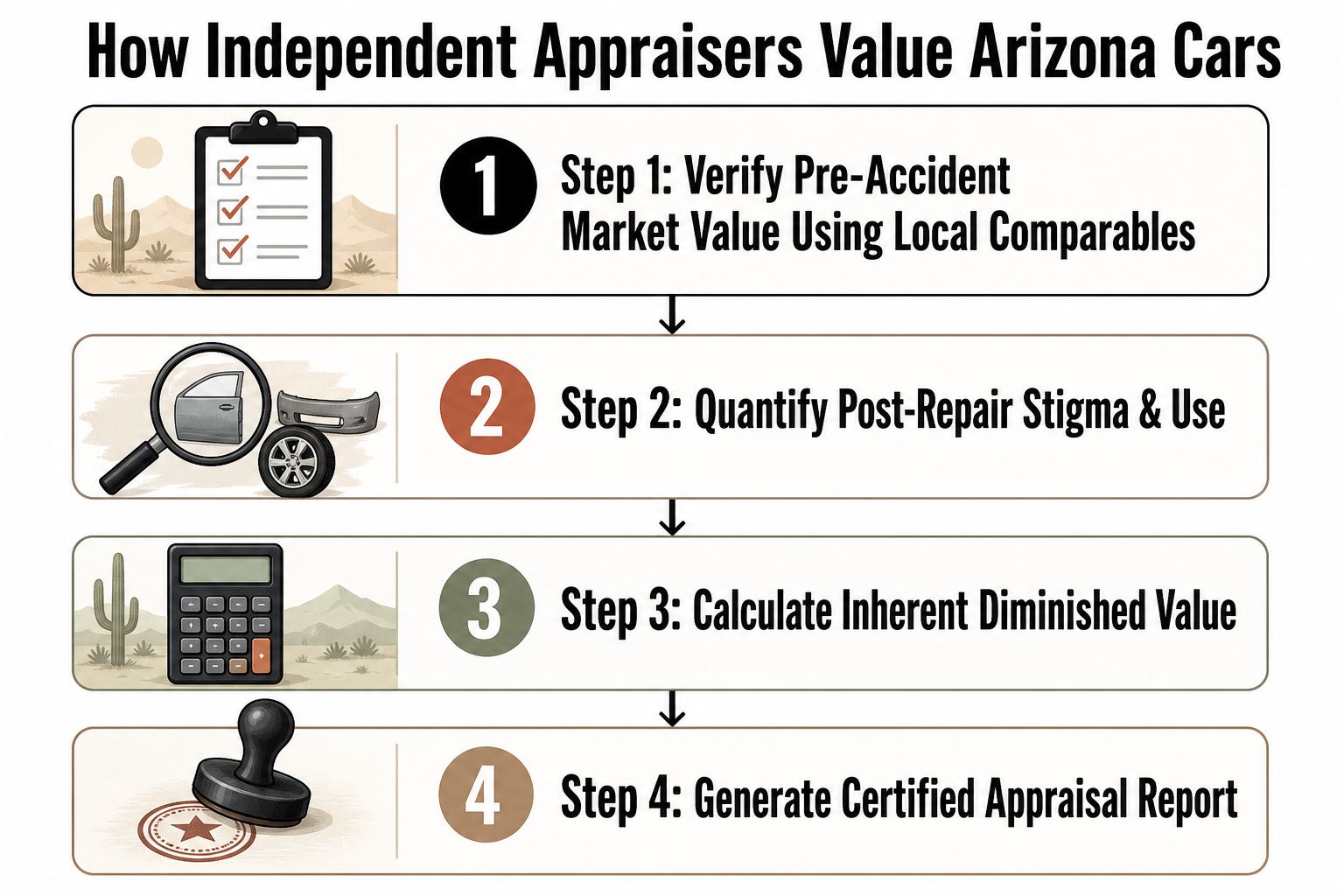
A driver can get the repair bill paid and still be left with a smaller resale number. Independent appraisers start by estimating the car's pre-accident market value with local comparables, then they compare that baseline with the car's post-repair condition, mileage, repair quality, and the stigma tied to an accident history. That market-based approach is the part Arizona claim reviews tend to focus on, because the state does not hand out a fixed formula.
The appraiser's job is part math, part market judgment. A simple estimate can be brushed aside like a handwritten note, while a USPAP-style report with calculations, comparable selection, and adjustment reasoning gives the claim a structure the insurer has to address. That kind of report is especially useful when the vehicle type changes the value question, because a daily commuter, a late-model SUV, a luxury sedan, and an enthusiast car do not lose buyer trust in the same way.
A daily driver with older miles may still have a claim, but the resale hit is often softer because the market already expects wear. A late-model vehicle usually gets closer scrutiny, since buyers expect a cleaner history and have more to lose if the title story changes. Luxury and enthusiast vehicles can face the sharpest reaction, since the people shopping those cars often care more about originality, accident history, and future resale than a basic transportation buyer does.
What to look for in an appraiser
- Certification and appraisal training: The report should come from someone who can explain the math and the method, not just the conclusion.
- Arizona market familiarity: Local resale behavior matters, especially when comparable vehicles are hard to find.
- Willingness to stand behind the report: If the insurer pushes back, the appraiser should be able to explain the reasoning in plain language.
- Repair awareness: For bodywork context, the Pete Nelson Automotive service guide can help you connect repair quality with valuation questions.
- Independent report quality: A specialized independent car appraiser should show the work behind the number, not just hand over a final figure.
That decision point matters because not every claim is worth the effort. A modest diminished value claim on an older daily driver may not justify much appraisal cost or back-and-forth with the insurer. A late-model SUV, a luxury car, or a well-kept enthusiast vehicle is more likely to clear that threshold, because the resale loss can be large enough to make a documented claim worth pursuing.
Arizona Diminished Value Settlement Examples
Settlement examples make more sense if you sort them by vehicle class, because a fender bender does not affect every car the same way. A daily commuter usually gets viewed like a reliable tool, while a late-model SUV, a luxury sedan, or an enthusiast car can be judged more like a collectible with a history report. That difference changes the size of the loss and also changes whether the claim is worth the effort of appraisal and negotiation.
One Arizona claims source says diminished value settlements commonly fall between $1,500 and $8,000, with representative outcomes of $1,500-$3,500 for a 5- to 10-year-old sedan with moderate damage, $3,500-$6,000 for a 1- to 5-year-old SUV with structural damage, and $6,000-$12,000+ for luxury vehicles with frame, airbag, or major body damage Orlando Auto Body AZ diminished value overview. A separate NAIC report noted in that source says diminished value often lands at about 10% to 20% of the direct physical damage loss, so a $10,000 repair bill may correspond to roughly $1,000-$2,000 in diminished value. Those figures give drivers a rough starting point, not a promise of what any single claim will produce.
A small claim can still matter, but only if the numbers justify the work. If the vehicle is older, already heavily depreciated, and used mainly for everyday driving, the resale hit may be modest enough that appraisal fees and insurer back-and-forth eat up much of the gain. A newer vehicle with clean history expectations tells a different story, especially when buyers in that segment compare accident records as closely as mileage and trim.
Here is how the settlement picture often shifts by segment.
| Arizona Diminished Value by Vehicle Segment | Damage Type | Typical DV Settlement |
|---|---|---|
| Daily driver sedan | Moderate damage | $1,500-$3,500 Orlando Auto Body AZ diminished value overview |
| Late-model SUV | Structural damage | $3,500-$6,000 Orlando Auto Body AZ diminished value overview |
| Luxury vehicle | Frame, airbag, or major body damage | $6,000-$12,000+ Orlando Auto Body AZ diminished value overview |
The table shows why segment matters so much. A daily driver sedan may have a real claim, yet the market often treats it like a worn pair of work boots, useful even after repairs. A late-model SUV can draw more concern because buyers expect cleaner condition and stronger resale. Luxury and enthusiast vehicles face the hardest scrutiny, since originality, accident history, and future resale tend to weigh more heavily in that buyer pool.
A demand letter does not need theatrical language. It needs a clear structure that points the insurer to the evidence. A simple opening works: “Enclosed is an independent appraisal supporting my diminished value claim for the post-repair loss caused by the collision. Please review the report and respond with your valuation basis.” That keeps the conversation anchored to the numbers, which is what matters when a claim has to justify the cost of proving it.
Your Next Step After an Arizona Appraisal
A fender bender is one thing. A newer vehicle with clean lines, strong resale, and a buyer who checks history reports is another. Arizona diminished value claims usually make the most sense in the second situation, because the market reacts more sharply when the car is harder to replace, more expensive to shop for, or likely to draw questions after repairs. A late-model SUV, a luxury car, or a collectible often feels the hit more than a high-mileage daily driver, just as a clean used laptop loses more value after visible damage than an older one that was already worn.
The next question is whether the claim is worth the effort. Arizona rules point the claim toward the at-fault insurer, require proof of fault and loss, and tie the filing window to the accident date, as noted earlier in the Arizona guidance from My DV AC Arizona guide and MyFairClaim Arizona guidance. That matters because a certified appraisal only pays off when it can do more than confirm damage, it has to show that the post-repair market value drop is large enough to justify the time spent proving it.
A simple test helps. If the car is ordinary, older, and already depreciated hard, the claim may cost more to pursue than it is likely to return. If the vehicle is newer, premium, or difficult to replace, the appraisal can give you a clearer picture of whether the loss is real enough to press the insurer.
So the next move is practical. Gather the repair records, title and mileage information, and photos, then match the vehicle against its segment and expected resale behavior. If the appraisal shows a measurable loss on a car that buyers care about, the claim is worth a careful push. If it does not, you have avoided spending time and money on a number that will not move far.
If you're comparing an accident-history loss against the cost of proving it, Total Loss Northwest can help with certified independent auto appraisals and valuation support for diminished value disputes. Visit Total Loss Northwest to see whether your Arizona claim needs a report that's built around market data instead of insurer shortcuts.