You're standing at the counter with a repaired car that looks fine, drives fine, and still feels wrong. The bumper lines up, the paint matches, and the repair shop says the job's done. The problem is the market doesn't forget the crash, and neither do insurers.
That gap between a repaired vehicle and a buyer's trust is where a diminished value claim lives. In plain English, it's the loss in market value your car suffers because it now has an accident history, even when the repairs were done correctly. In Ohio, that loss can be recoverable, but only if you know which insurer owes it, what proof carries weight, and how to push the claim past the adjuster's first objection.
What Is a Diminished Value Claim
A driver usually notices diminished value at the worst possible moment, after the repair estimate has already been approved and the car is back in the driveway. The body shop may have done solid work, but the vehicle now has a collision record that follows it through trade-in conversations, used-car searches, and history reports. That's the issue the claim is meant to address.
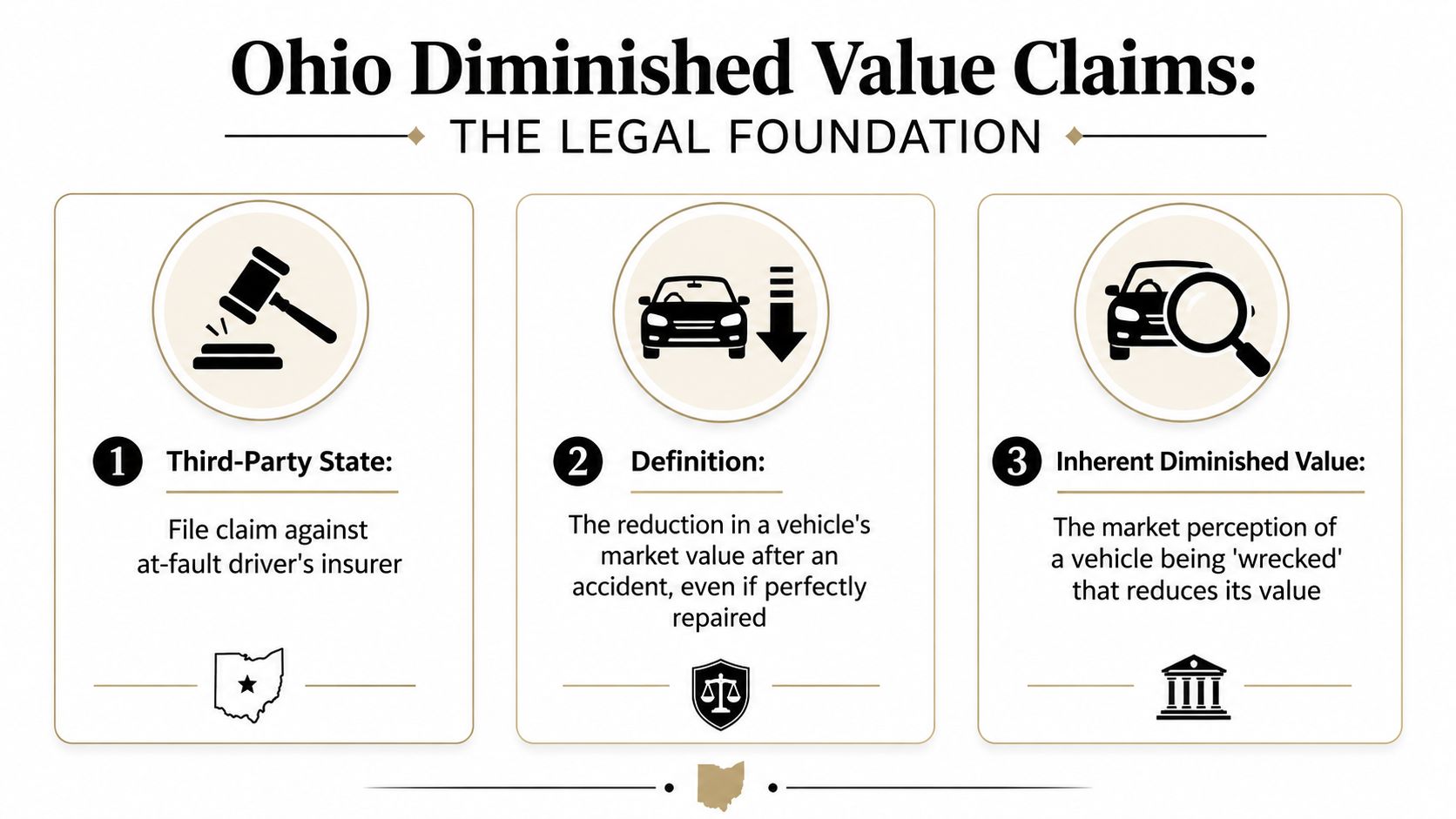
Diminished value is the drop in what a vehicle would sell for after an accident, compared with what it was worth before the crash. It's not the repair bill. It's the market discount that exists because the car is now a “wrecked” vehicle in the eyes of future buyers, even if it looks clean again.
Why insurers don't mention it first
Insurers usually focus on repair cost because repairs are easy to measure and easier to close. Diminished value takes more work, because it requires proof of pre-loss value, post-loss value, and post-repair value. That means the owner has to bring the evidence, not just the complaint.
Practical rule: if the only number in the file is the repair invoice, the insurer will usually treat the claim as a body-shop issue, not a market-value issue.
For a quick plain-English overview of the concept, the guide to diminished value claims is a useful starting point. The important part is this, your car can be repaired and still be worth less, and that difference is the actual loss you're trying to recover.
Understanding Ohio's Diminished Value Laws
Ohio doesn't treat this as a standalone mystery claim. It's generally handled as a third-party property damage claim, which means the loss is pursued against the at-fault driver's insurance rather than your own insurer, as explained in Ohio claim guidance from LegalClarity. That distinction matters because the claims process changes depending on which policy is on the hook.
Fault rules control whether you can recover
Ohio follows modified comparative negligence. If you are 50% or less at fault, you may recover damages. If you are more than 50% at fault, recovery is typically barred, according to the same Ohio claim guidance from LegalClarity. That means fault isn't a side issue, it's the gatekeeper.
The practical takeaway is simple. If liability is still disputed, don't spend your energy arguing value first. Lock down fault evidence first, because an insurer that can shift enough blame can cut off the claim before it ever gets to the appraisal conversation.
The deadline is part of the claim
Ohio sources also describe a 2-year statute of limitations from the date of the accident for property-damage actions under R.C. 2305.10(A), again discussed in LegalClarity's Ohio summary. That's not a paper-shuffling detail. It's the clock that decides whether you have a claim at all.
If the vehicle was totaled or the title is headed toward a salvage designation, the practical route changes, and the document trail matters even more. A separate Ohio resource on how salvage titles work in Ohio can help you understand how title status affects value, especially when the insurer tries to blur repair loss with title-brand loss.
The insurer's first question is usually not, “How much value did you lose?” It's, “Can this claim survive our fault review and deadline check?”
Gathering Evidence to Prove Your Loss
A strong Ohio diminished value file starts with evidence an adjuster can't wave away. If you bring only a complaint and an opinion, the insurer will treat the number as negotiable. If you bring a record that shows what the car was worth before the crash, what happened to it, and what it's worth after repairs, the claim starts to look like a business issue instead of a debate.
Build the file in the order an adjuster will review it
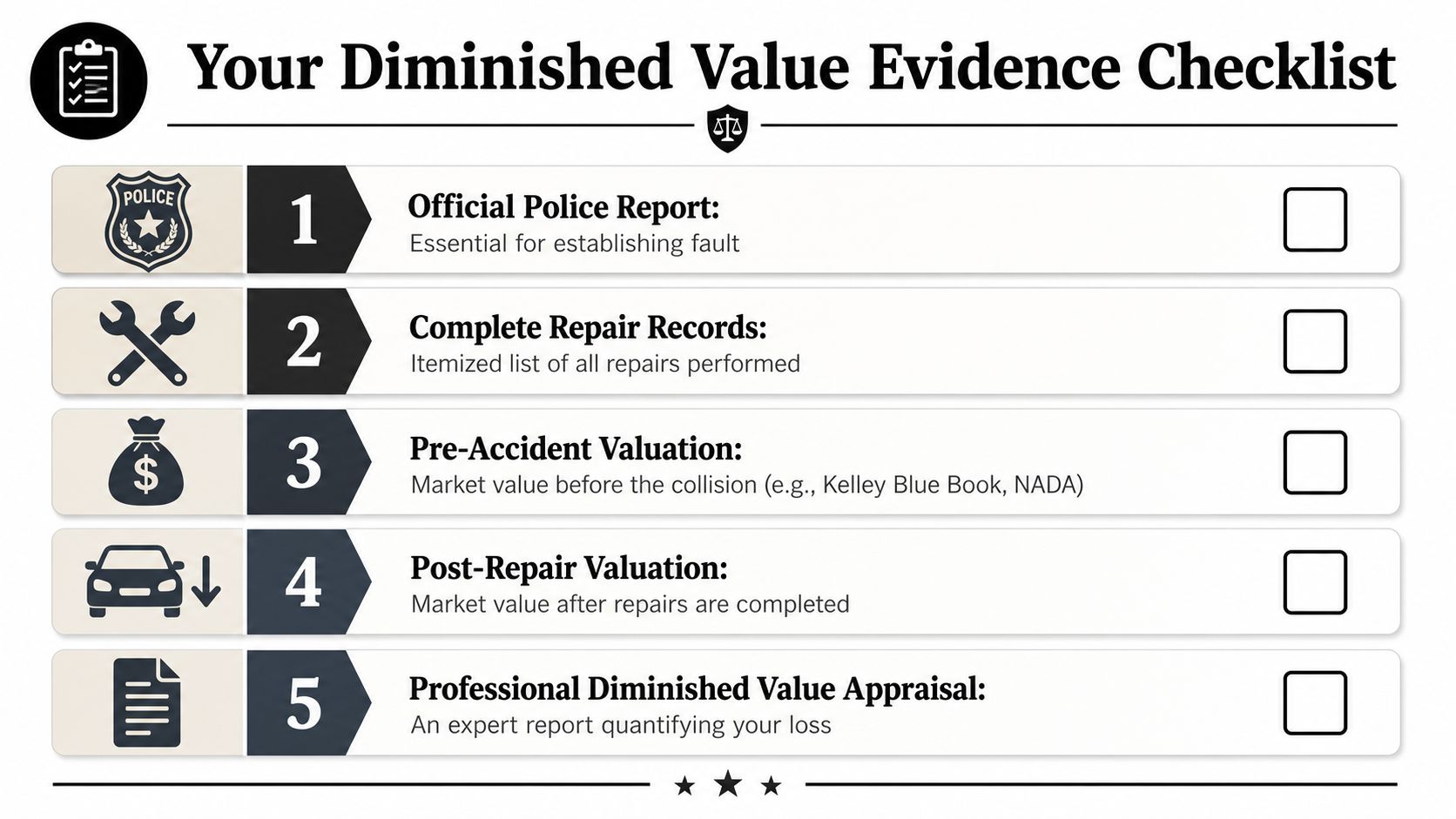
Start with the official police report, because it helps anchor fault and gives the claim a neutral event record. Add the complete repair file, not just the estimate, because insurers look for what was replaced, blended, straightened, painted, or refinished. A repair estimate alone can understate the full scope, while a final invoice shows what was done.
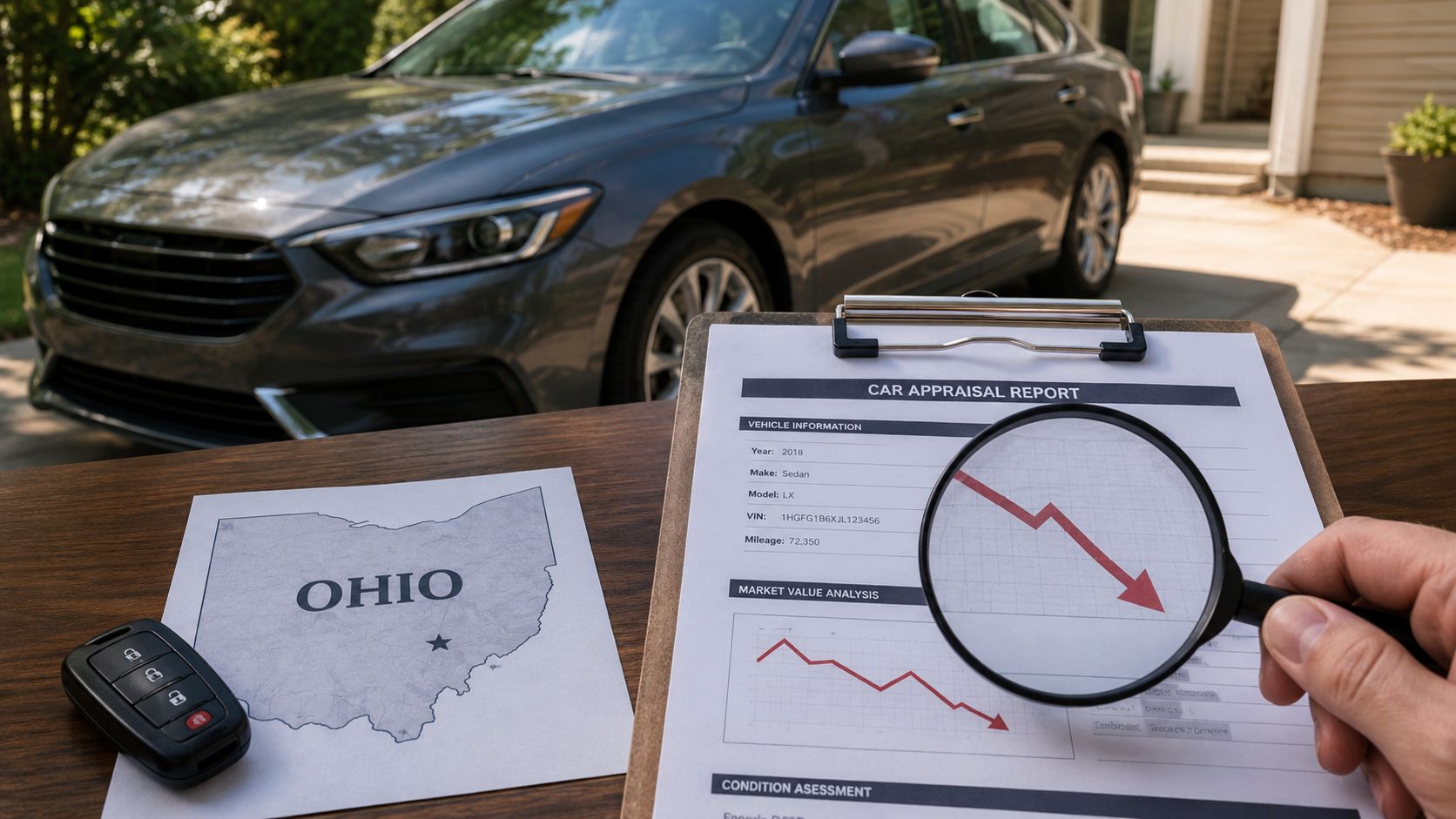
Then gather the pre-accident valuation. Kelley Blue Book and NADA are familiar reference points, but they're only part of the picture. Use them as support, not as the entire argument. Add the post-repair valuation too, because Ohio litigation guidance expects fair market value immediately before the collision, immediately after the collision in damaged condition, and after repairs so the actual diminution can be measured, as noted in Ohio practitioner guidance.
Photos and history reports do the quiet work
Pre- and post-accident photos matter more than most drivers think. They help separate pre-existing wear from collision damage, and they give the appraiser a cleaner basis for comparing condition. Vehicle history reports such as CarFax or AutoCheck add another layer, because the accident entry is exactly the kind of record a buyer reacts to later.
Newer vehicles, higher-value vehicles, and structurally damaged vehicles often have the strongest claims because the market gap can be documented more clearly, as the same Ohio guidance notes in this analysis of diminished value proof. That doesn't mean older cars never qualify. It means the proof has to be tighter when the market value is thinner.
A solid Ohio file usually includes:
- Police report: to support liability and sequence of events.
- Itemized repair invoices: to show the actual work completed.
- Before-and-after photos: to document condition and impact.
- Title and history report: to show status and accident branding.
- Independent appraisal: to quantify the lost market value.
If you want to see how a demand package is organized in another market, the guide for Austin accident victims is a useful comparison point for how insurers respond when documentation is structured clearly. The format differs by state, but the insurance logic is the same, concrete proof gets treated more seriously than a bare request.
Calculating and Submitting Your Claim
Insurance companies often start with a formula that looks objective and behaves like a ceiling. The well-known Rule 17c approach is one example people run into, and it's usually a starting point for the insurer, not a neutral market analysis. The problem is simple, a formula can be tidy and still miss what your specific car lost in the local market.
| Method | How It Works | Who Uses It | Primary Flaw |
|---|---|---|---|
| Rule 17c | Applies a formula-based reduction to the claim | Insurers and claims handlers | Can understate the real market loss |
| Dealer-style market comparison | Compares similar vehicles with and without accident history | Appraisers and claimants | Needs careful local data |
| Independent diminished value appraisal | Calculates loss based on condition, repair scope, and market perception | Certified appraisers | Takes more documentation and analysis |
Build the number around the market, not the formula
A better approach uses actual market evidence. That means looking at comparable vehicles, accident history effects, repair scope, and title status, then tying the conclusion back to the car's pre-loss value. If the insurer wants to argue the car is “as good as new,” the file has to show why the market still discounts it.
Ohio also allows claims through your own uninsured motorist coverage when the other driver is uninsured or in a hit-and-run, according to Ohio coverage guidance. That path depends on policy language, so it's not automatic. Read the policy carefully, because first-party payment usually rises or falls on wording, exclusions, and how the carrier interprets the covered loss.
Write the demand letter like a claim file, not a speech
A strong demand letter usually has four parts. First, a short accident summary. Second, a direct statement of the diminished value amount being claimed. Third, a list of the enclosed evidence. Fourth, a deadline for response. That structure keeps the insurer focused on the record rather than on back-and-forth storytelling.
If you need a clean drafting model, the demand letter guide is a helpful reference for tone and organization. Keep the language factual. Don't oversell. Don't guess. Let the appraisal, photos, and repair file do the heavy lifting.
Best practice: submit the demand only after the repair file is complete. An incomplete package invites a delay response, and delay is one of the easiest ways an insurer avoids paying value loss.
Negotiating Your Settlement and Escalation Options
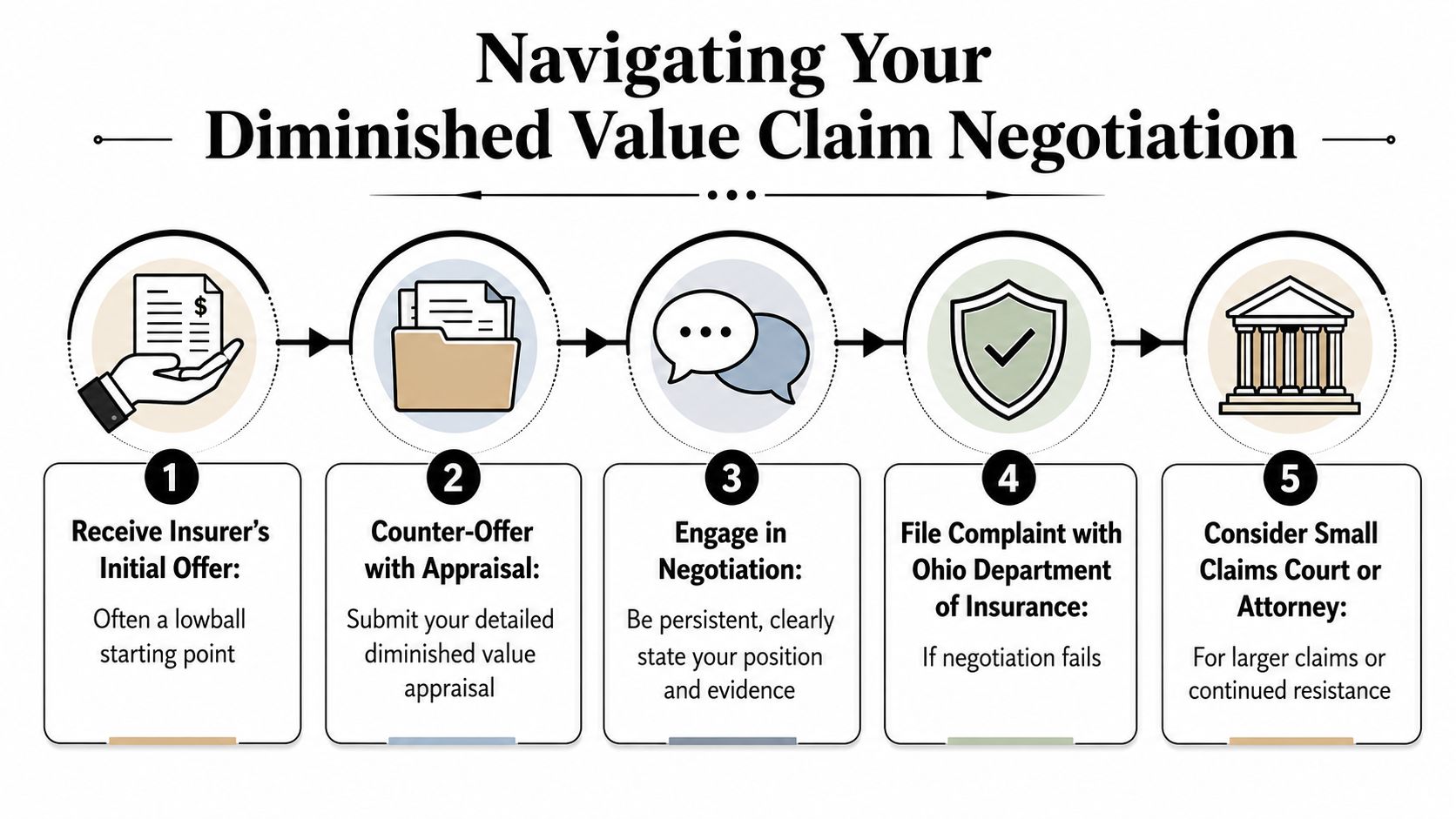
The first offer is usually a test, not a final answer. Adjusters know most owners want to move on, so the opening number is often designed to close the file cheaply before the carrier has to review a real appraisal. That's why the response has to stay calm and evidence-based.
What to say when the adjuster lowballs the claim
Don't argue emotionally. Anchor every counterpoint to the file. If the adjuster says the repairs fixed everything, point back to the accident history, the valuation gap, and the fact that Ohio claims still center on proof of pre-loss value, post-loss value, and post-repair value, as described in Ohio coverage and dispute guidance.
A practical response sounds like this in substance, not as a script. The repair invoice shows the car was restored mechanically, but the market still discounts an accident-branded vehicle. The appraisal quantifies that discount. The insurer can disagree, but it needs a competing valuation, not just a denial phrase.
Independent appraisal changes the tone
A certified independent appraiser is useful because it moves the dispute from opinion to methodology. The insurer may still push back, but it now has to rebut a report instead of a customer complaint. That matters in negotiation, because adjusters are trained to discount vague assertions and document-driven claims differently.
Ohio allows claims through your own uninsured motorist coverage in some uninsured or hit-and-run situations, but that path depends on the policy language, as noted in Ohio coverage guidance. When that's the only available route, policy wording becomes the battleground. Read the exclusions closely, because some claims fail not on value, but on coverage interpretation.
Escalation options when the file stalls
If negotiation goes nowhere, the next steps depend on the size of the claim and the resistance you're getting. A complaint to the Ohio Department of Insurance can help create pressure when an insurer is ignoring documentation or dragging its feet. If the claim is still unresolved, small claims court can be a workable option for a limited property-damage dispute, especially when the file is clean and the insurer just won't move.
In larger or more stubborn cases, an independent appraiser plus legal help is often the better combination. The point isn't to threaten litigation first. The point is to show the insurer that the claim is documented, timed correctly, and ready to be tested.
When to Hire a Professional for Your Ohio Claim
A DIY claim can work when the damage was mild, the car is older, and the market loss is clearly small enough that a simple demand letter might resolve it. In that situation, the file still needs the same basics, fault proof, repair records, and a clean valuation trail. The difference is that the owner can often carry the claim without spending much on outside help.
When the numbers and the resistance justify outside help
Hire a certified independent appraiser when the vehicle is newer, higher-value, specialty, or structurally damaged. Those cars tend to create a more meaningful market discount, and insurers know it. The same is true when the carrier keeps leaning on formulas instead of real-market comparison, or when the adjuster refuses to engage after you've submitted strong evidence.
Practical rule: if the insurer's answer never changes and your file keeps getting stronger, the claim probably needs a professional valuation, not more arguing.
An attorney becomes more useful when there's more than property damage in play, especially when personal injuries are involved alongside the vehicle claim. At that point, the diminished value issue can get lost unless someone is actively protecting the property-damage side of the case. If you're deciding between a solo claim, an appraisal, or counsel, match the help to the resistance, not just to the size of the damage.
For some claimants, a service such as Total Loss Northwest can provide diminished value support and appraisal documentation that helps organize the evidence before settlement talks get stuck. The right help is the one that turns the insurer's objections into questions it has to answer with facts.
If your Ohio insurer is dragging its feet on diminished value, gather the repair packet, the title records, and your valuation evidence now, then send a clean written demand before the deadline pressure gets worse. If you want help building the file or challenging a low offer, contact Total Loss Northwest and ask for support on your diminished value claim.