You've got the lowball total-loss offer in hand, the insurer's number is lower than the market reality, and now someone tells you to “get an expert.” That advice is only half right. The wrong expert gets pushed out before trial, and the jury never hears the opinion. The right one survives the admissibility fight because expert witness qualifications are built for court, not just for a business card.
That gap matters more than most claimants realize. A certification can look impressive and still collapse under a Daubert challenge if the witness can't show the court a reliable method, sufficient facts, and a real fit with the issue being disputed. In auto claims, that difference decides whether your valuation evidence becomes an advantage or gets tossed aside.
Why Expert Witness Qualifications Decide Your Case Before Trial
A driver gets a total-loss offer that barely covers the loan payoff, much less the replacement cost. Their lawyer hires a certified appraiser, assumes the credentials will carry the day, and files the report. Then opposing counsel attacks the foundation, asks for the exact method, the data used, the recent practice history, and the court starts looking at whether the witness is qualified for this claim type.
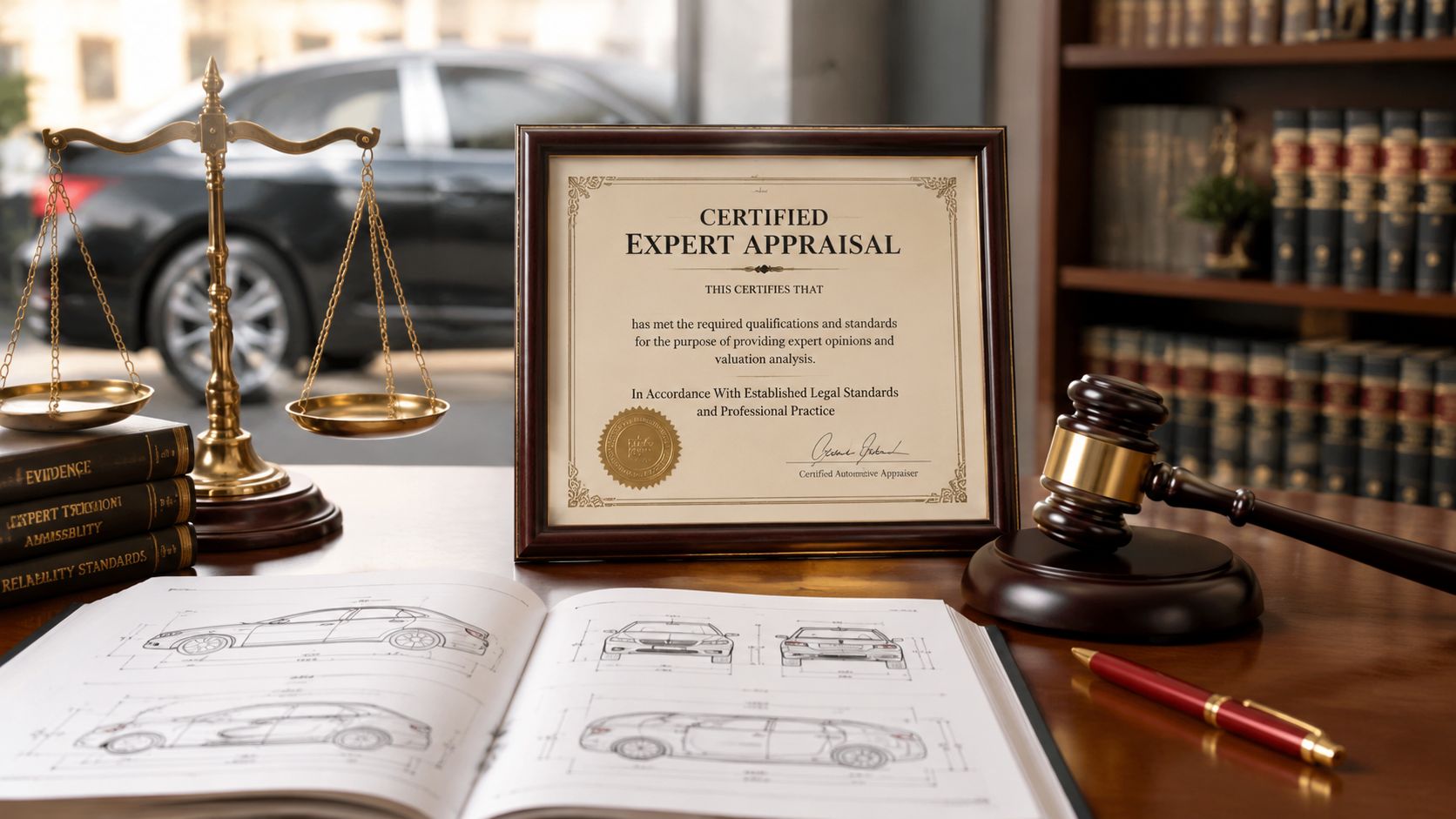
That's where cases get won or lost before a jury hears a word. A polished résumé doesn't matter if the testimony can't get through the gatekeeping function the judge performs under Federal Rule of Evidence 702. The rule requires the witness to be qualified by knowledge, skill, experience, training, or education, and it also requires the court to find that the testimony will help the factfinder, rests on sufficient facts or data, uses reliable methods, and is reliably applied to the case Rule 702.
What opposing counsel attacks first
Counsel on the other side rarely starts by attacking the conclusion. They attack the path to the conclusion. If the expert is relying on old experience, generic certification, or a report that looks assembled from templates, the challenge is easy.
Practical rule: the witness has to look like someone who knows this exact valuation problem, not just someone who has worked around cars for years.
That's why an auto appraiser with real courtroom value needs more than confidence and a credential. The witness needs a clean record of relevant practice, a method the judge can trust, and documentation that ties the opinion to the actual vehicle, the market, and the dispute. If that foundation is weak, the fight ends early.
For a good overview of how a vehicle valuation expert is used in claims work, see this auto expert witness resource. It's the kind of practical reference that makes the gap between “qualified on paper” and “usable in court” easier to spot.
Legal Admissibility Standards That Govern Expert Testimony
Courts do not admit expert testimony because a witness holds a certificate. The judge admits it only when the witness satisfies the governing admissibility rule in that jurisdiction. In federal court, and in many states that follow federal practice, that filter centers on Rule 702. It requires qualification, reliability, and a connection between the opinion and the facts of the case Rule 702.
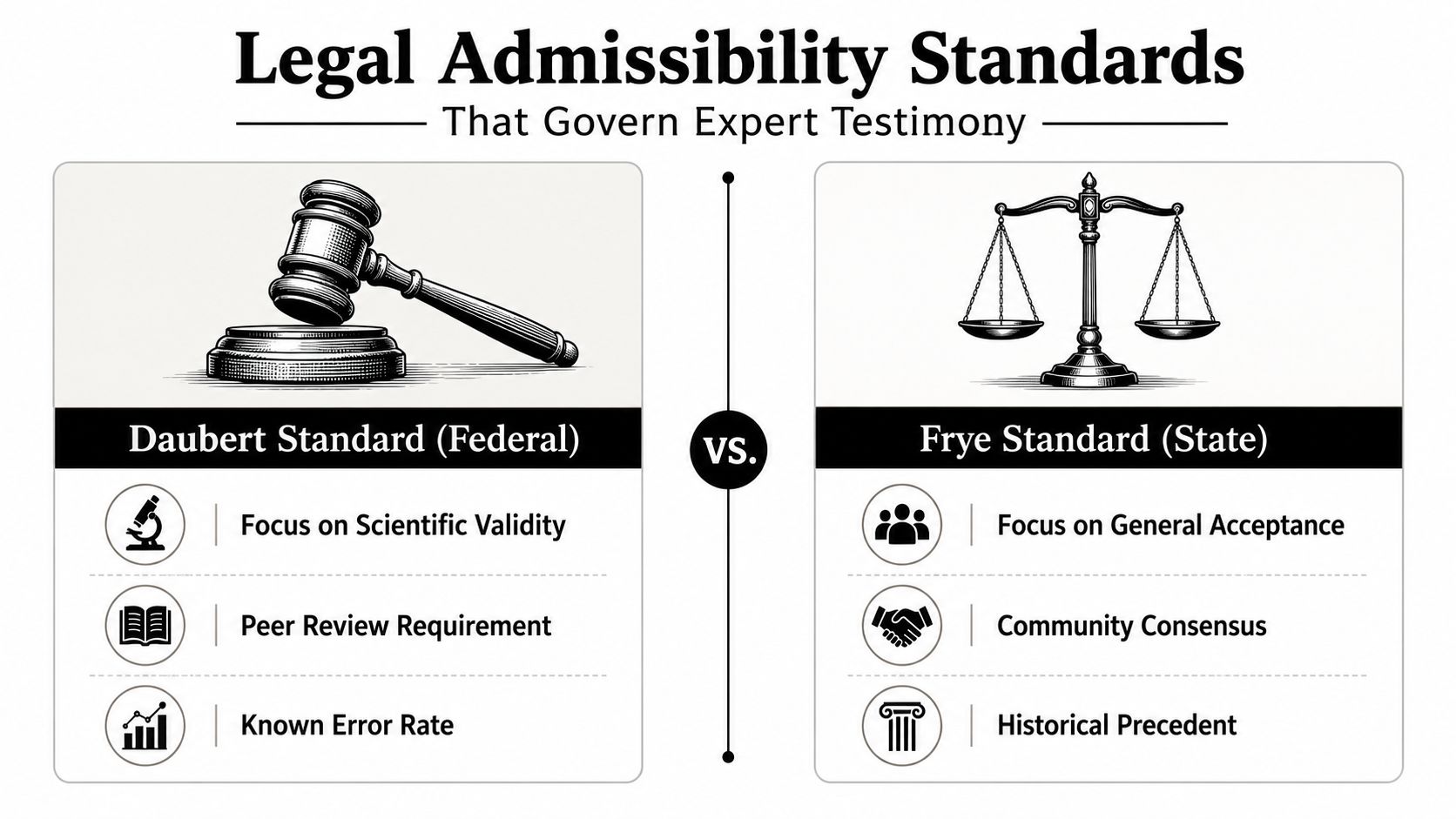
Daubert and Frye are not the same fight
Under the Daubert framework, the judge focuses on reliability and fit. The witness needs a method that can hold up in court, not a credential that sounds impressive on a CV. Under the older Frye framework, the question is whether the method has general acceptance in the relevant community. An appraiser can know the subject well and still lose the admissibility fight if the forum uses a different standard or the method does not match the dispute.
The practical move is simple. Check the jurisdiction first. A report that looks solid in one court can get attacked hard in another if the judge applies a different admissibility test or a state-specific rule.
For readers who want a broader primer on how courts handle technical proof, this guide to understanding forensic evidence helps frame the same reliability questions in plain language. The same logic shows up in auto valuation disputes, even though the subject matter is different.
What the court scrutinizes
The judge is not grading the witness on charisma. The judge is looking at whether the testimony is based on sufficient facts or data, whether the methods are reliable, and whether they are reliably applied to the specific case Rule 702. That is the test for an auto appraiser.
The 2023 revision to Rule 702 matters because it makes the burden clearer. Courts assess whether the witness is more likely than not qualified and whether the opinion meets all four reliability requirements. The structure also means there are five qualification pathways, and the court does not need all five credential types at once. In the right case, experience alone can qualify a witness Rule 702.
The title “expert” is not enough. The opinion has to survive the judge's reliability review first.
Education and Certifications That Build a Defensible Expert Profile
A strong expert profile starts with the right foundation, but not every credential carries the same weight in court. Opposing counsel will list every certificate on the CV, then press on the same point, does any of it relate to the vehicle, the valuation dispute, or the opinion being offered? If the answer is no, the paper trail becomes clutter, not credibility.
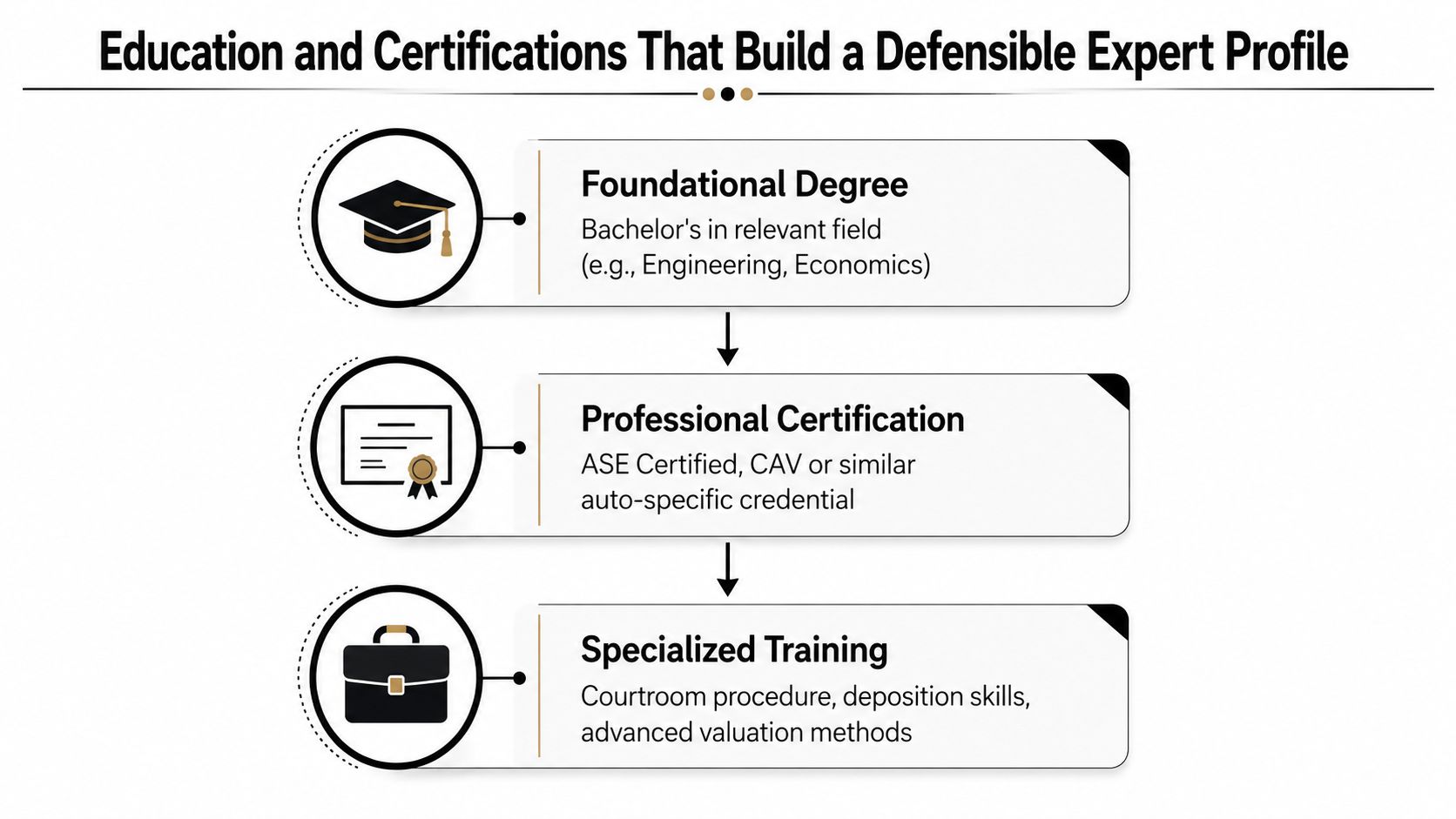
Relevant credentials beat decorative ones
The strongest expert profiles usually combine relevant education, hands-on experience, and specialized training that matches the claim type. In auto appraisal work, that means the witness should be able to explain how they value vehicles, what data they use, and why that method fits the dispute. A generic business credential does not do that.
For medical expert witnesses, the qualification model is especially strict. The American College of Surgeons' revised statement and related specialty guidance require a current, valid, unrestricted medical license, specialty-board certification, and active clinical involvement in the relevant field ACS statement. That standard is a useful reminder for auto cases too. Courts care less about prestige and more about whether the witness is actively and verifiably competent in the exact subject at issue.
Match the credential to the claim
If the dispute is a diminished value claim, the witness should know pre-loss and post-loss market behavior, comparable-vehicle analysis, and how collision history affects resale. If the dispute is a total-loss claim, the witness needs to be fluent in valuation methods, salvage considerations, and fair market value reasoning. A shiny certificate that does not map onto the actual theory of loss will not save the testimony.
Choose a total-loss appraiser who can defend the file in court rather than one who only looks polished on paper. That is the point opposing counsel will attack. They will ask whether the person has the right training for the exact dispute, not whether the résumé looks impressive.
StatPearls' discussion of expert witness medical qualifications also reflects a broader point that applies outside medicine. Current licensure, recognized certification, and active practice in the specialty carry more weight than old prestige alone, and in emergency medicine the text notes at least three years of active clinical practice immediately before the event at issue in many jurisdictions StatPearls. The same court logic rewards recent, verifiable, discipline-specific experience over stale résumé padding.
Bottom line: choose the credential that proves competence in the dispute you have, not the credential that looks nicest on a marketing flyer.
Diminished Value Versus Total Loss Appraisal Expertise
These are related jobs, not interchangeable ones. A witness can be sharp on total-loss valuation and still be the wrong person for a diminished value dispute. The reverse is true too. Courts and opposing counsel care about that distinction because the question isn't whether the appraiser knows cars, it's whether the appraiser knows this kind of loss.
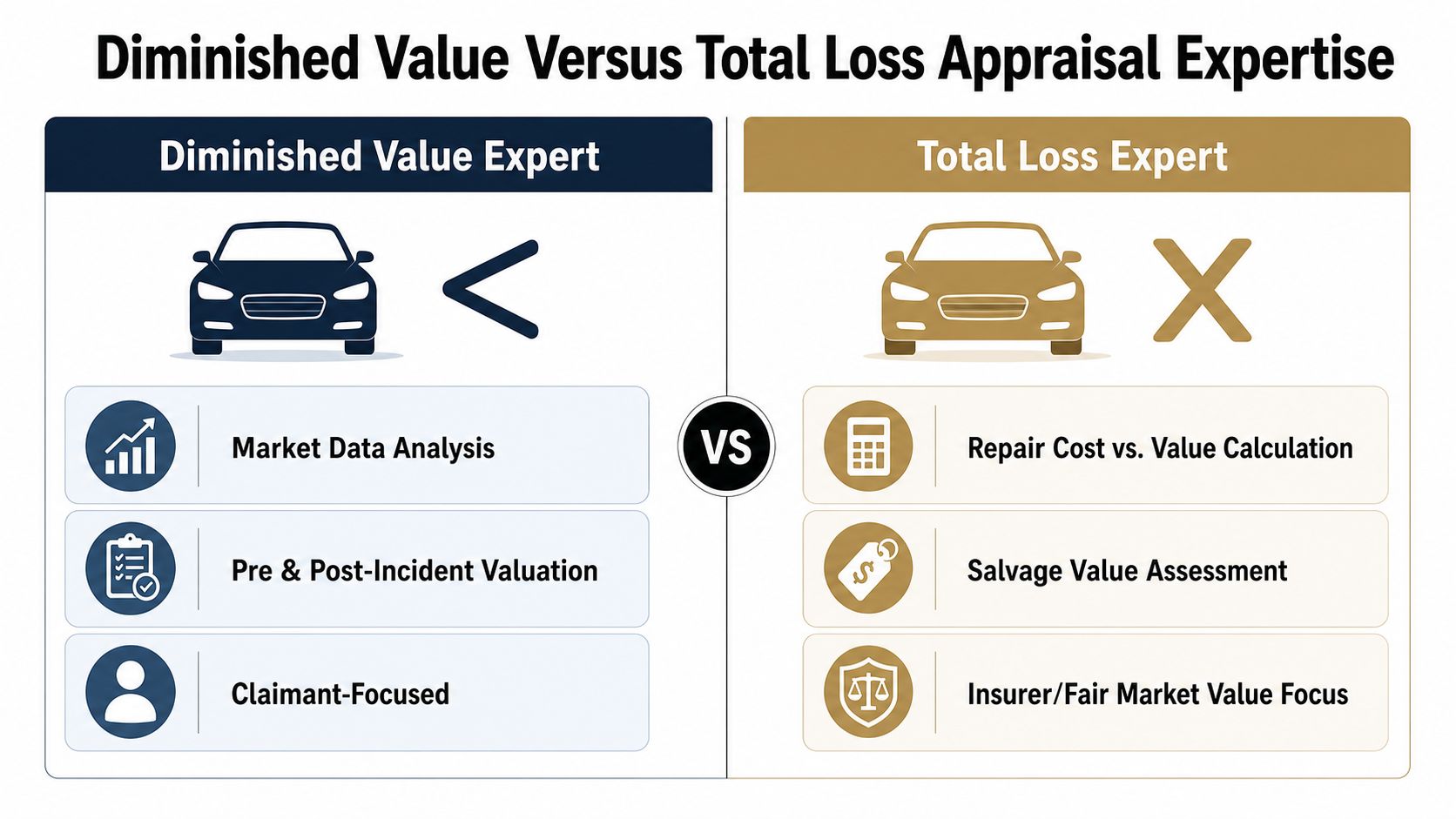
Where the specialties overlap
Both types of experts need disciplined valuation habits, strong documentation, and the ability to explain market reasoning clearly. Both have to compare facts, identify relevant vehicle condition issues, and defend their conclusion without hand-waving. Both can get destroyed on cross-examination if they don't know their sources.
The overlap, though, stops where the dispute diverges. A total-loss case turns on whether the valuation process correctly measures replacement value, repair economics, and salvage-related issues. A diminished value case turns on market stigma, loss in resale value, and the relationship between pre-loss condition and post-loss market reaction.
Why the distinction matters in court
A judge doesn't care that an appraiser is good at “car stuff.” The judge wants the witness to fit the issue in front of the court. That's why recent, discipline-specific practice matters so much. A witness who has been doing the same kind of valuation work on current vehicles is easier to defend than someone leaning on broad experience from years ago.
For attorneys comparing candidates, the right question is simple. Has this person handled the exact dispute type before, and can they explain the valuation path without stepping outside their lane? If the answer is fuzzy, the other side will exploit it.
A practical place to start when vetting a total-loss expert is this guide to what to look for in a total loss appraiser. It helps separate a general appraiser from someone whose experience fits a courtroom valuation fight.
In a courtroom, specialization beats vague familiarity every time.
Documentation and Report Standards That Survive Cross-Examination
Credentials get the expert in the room. The report decides whether they stay standing once cross-examination starts. If the file is thin, the math is unexplained, or the valuation jumps from raw data to conclusion without showing the path, opposing counsel will tear it apart in minutes.
A defensible report shows its work
A court-ready appraisal report should identify the vehicle, the condition, the relevant market information, the comparable units considered, and the reason each piece of information matters. It should show how the final value was reached, not just announce the number. That means the witness has to be able to explain the methodology in plain English and tie each step to the underlying facts.
The same discipline appears in forensic documentation standards generally. A useful technical report should describe the collection method, source condition, artifacts reviewed, limitations, and alternative explanations. In appraisal work, that translates into clear vehicle records, photo documentation, source materials, and a line of reasoning that doesn't depend on guesswork. If the report can't be audited, it's vulnerable.
Sloppy documentation gives the other side an easy opening
Opposing counsel will attack missing comparable data, stale screenshots, vague condition notes, and undocumented adjustments. They will also press on whether the witness kept the underlying notes, not just the final report. If the expert can't explain where a number came from, the court has a reason to doubt the number itself.
For claim files, organized forms matter more than people think. This auto appraisal forms resource is useful because the forms side of the process often reveals whether the expert built a case file or just assembled a conclusion after the fact.
Rule of thumb: if the report reads like an answer key, not a working file, it's a problem.
How Qualifications Are Presented and Challenged in Court
An expert can have the right background and still lose the credibility fight if they present it badly. In court, the first goal is to establish the foundation cleanly. The second goal is to keep the judge focused on the right question, which is whether the witness is qualified to give the specific opinion the case needs.
Voir dire is where the fight starts
During voir dire of an expert, the lawyer asking the questions walks through education, certification, practice history, prior testimony, and the exact subject matter the witness handles. That's not a formality. It's the moment the court decides whether the witness belongs on the stand as an expert at all.
Opposing counsel usually works from a short list of attacks. They will challenge stale experience, generic training, lack of recent practice, overbroad claims of expertise, and any mismatch between the witness's background and the actual dispute. They may also probe demeanor, because a witness who sounds defensive or evasive can lose credibility fast.
Qualification is not the same as admissibility of the opinion
A witness can be qualified in a general sense and still have particular opinions excluded. That distinction matters in auto claims. A court may accept that the appraiser knows valuation work, but still reject a conclusion if the method is unsupported, the data is thin, or the reasoning skips steps.
Practical rule: make the witness answer in a way that a judge can follow without translation.
That means short, direct explanations. No jargon unless it's defined. No overclaiming. No pretending that experience covers gaps in the file. Jurors notice confidence, but judges notice discipline. The witness who admits limits and stays inside the lane often looks more trustworthy than the one trying to sound bigger than the record.
Practical Checklist for Vetting and Preparing Your Expert Witness
Start with the hard question. Can this witness explain the valuation in a way that survives a Daubert challenge, or are they only qualified on paper? A strong résumé does not save a weak opinion. In auto claims, opposing counsel attacks the gap between credentials and courtroom reliability first.
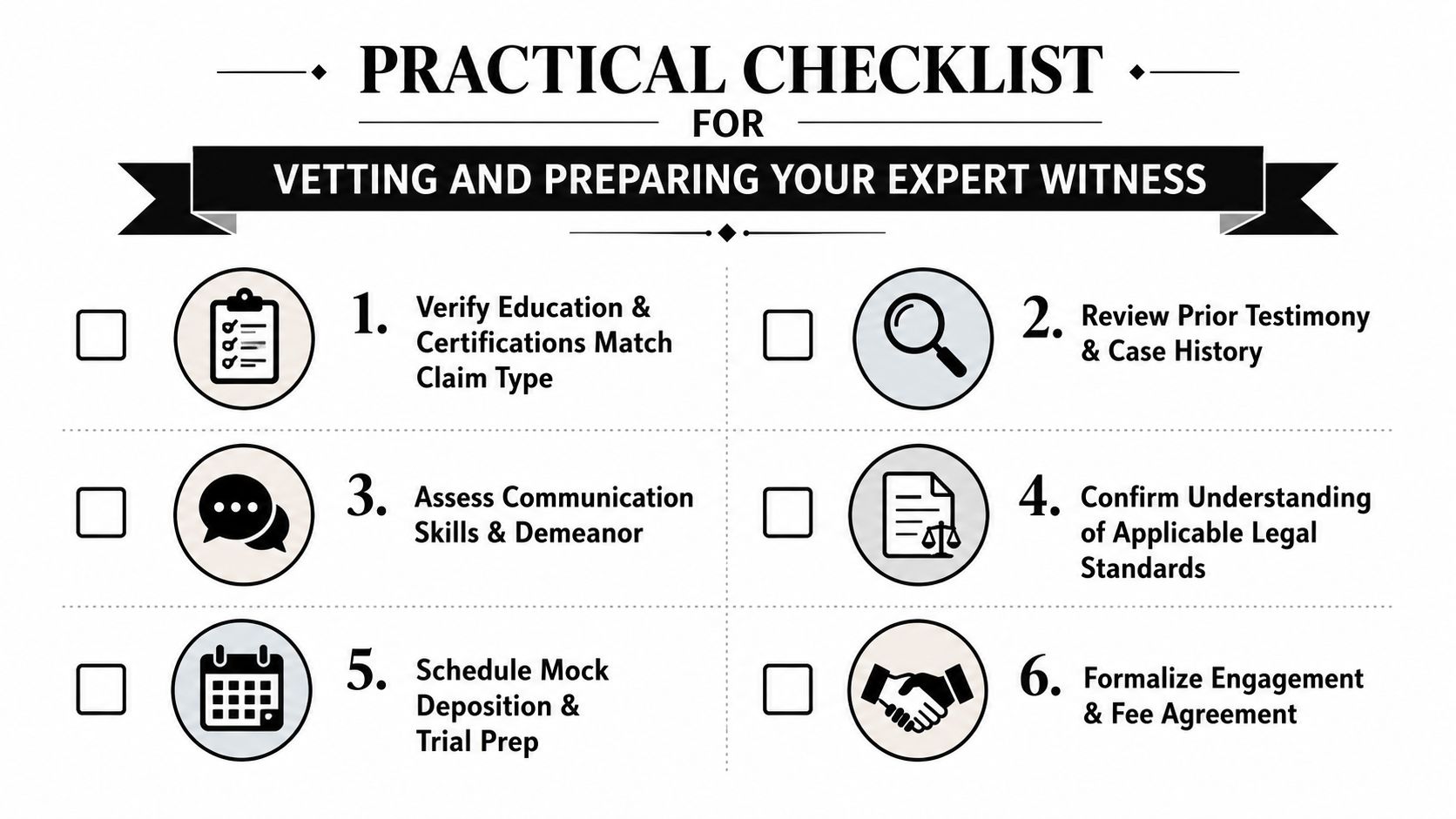
Use this vetting sequence
- Verify the exact match: Check whether the expert's education, certification, and recent work line up with the specific claim, not just the general field of auto appraisal.
- Review prior testimony: Ask how often they have testified, where they testified, and whether any court or opposing lawyer has challenged their methods.
- Test communication: Have them explain the valuation in plain language. If they cannot do that calmly, a jury will not follow it.
- Confirm legal awareness: Make sure they understand the court's admissibility standard and can explain the basis for the opinion without drifting into legal conclusions.
- Run a mock deposition: Pressure exposes weak spots fast. A clean answer in rehearsal can turn into a mess under questioning if the expert has not prepared.
- Lock down the engagement: Put scope, records access, deadlines, and compensation in writing before the work starts.
A quick screen from another compliance setting makes the point. A criminal background check for volunteers exists to verify trust before someone gets the assignment. Expert vetting works the same way. You verify before the witness gets in front of a judge.
For auto claimants who need valuation support, Total Loss Northwest provides diminished value and total-loss appraisal work for disputed auto claims. Use that kind of provider as a benchmark. Ask whether the report, method, and recent experience can hold up in deposition and court before you commit.
If you are facing a low total-loss offer or a disputed diminished value claim, do not settle for a polished résumé. Bring in a valuation expert whose method, documentation, and courtroom foundation can survive attack. Visit Total Loss Northwest to review appraisal support built for contested auto claims and to see how a defensible expert opinion is put together.