You're probably in the part nobody prepares you for.
The crash happened. You dealt with the shock, the tow truck, the calls, the repair shop, maybe a doctor visit. Now the insurer is acting like the hard part is just paperwork. It isn't. This is the stage where people lose money because they trust the process instead of managing it.
A fair settlement for car accident damage doesn't arrive because the adjuster is reasonable. It arrives when you document the loss, value it correctly, and push back with evidence the insurer can't ignore. If your car was totaled, the fight is over pre-loss market value. If it was repaired, the fight may not be over at all, because many drivers never claim diminished value. That mistake costs real money.
The Battle for a Fair Settlement Begins Now
The first real settlement conversation often starts with a polite phone call and a number that sounds workable. You're tired, your routine is wrecked, and you want the file closed. That's exactly when insurers have the advantage.
I've seen the same pattern over and over. A driver gets an offer, assumes it must be based on some objective formula, and signs too early. Then they learn the repair quality doesn't erase the vehicle's accident history, or the total loss valuation ignored options, condition, recent work, and actual local market comps.
This is a negotiation, not a ceremony.
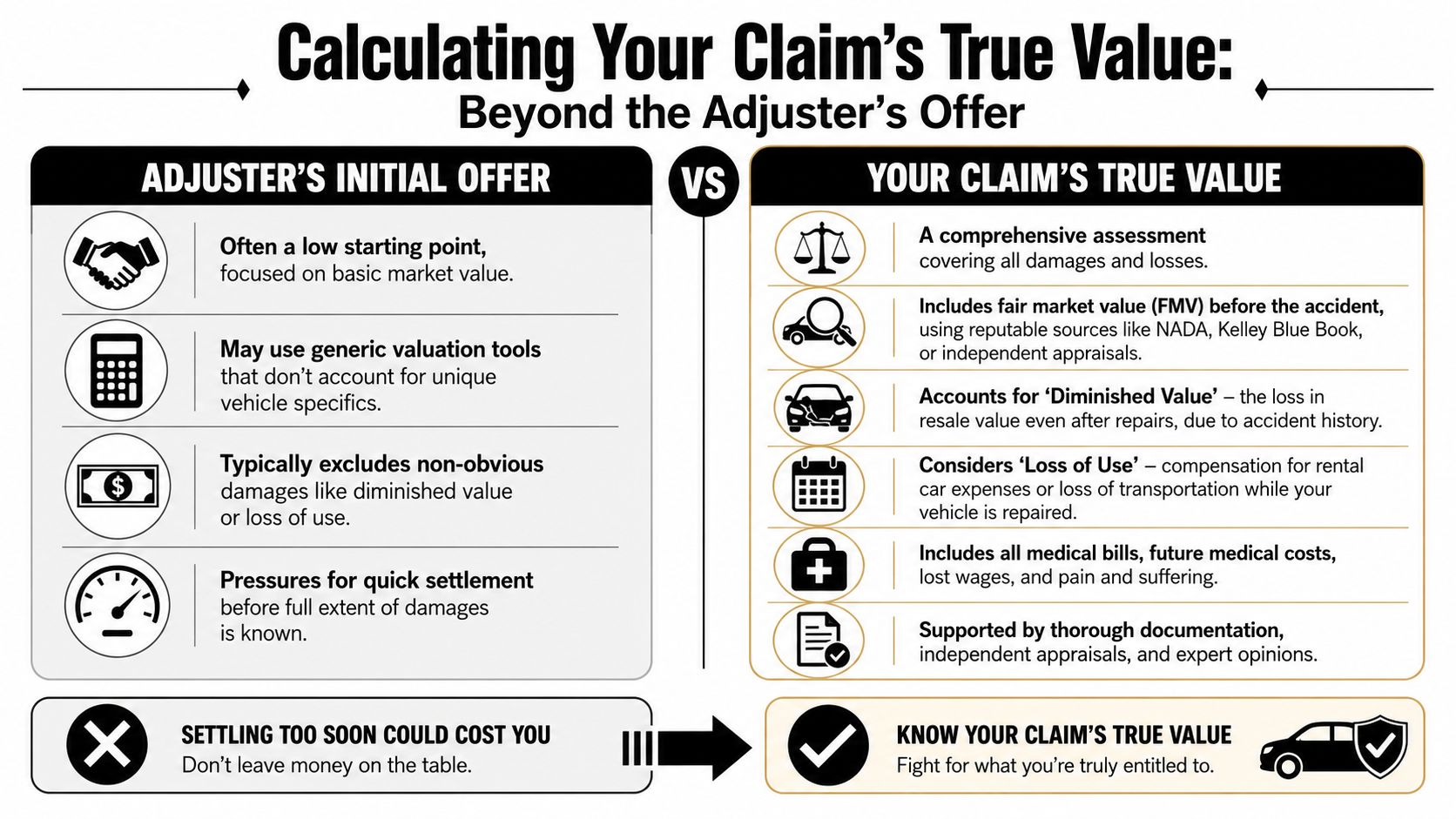
Insurance companies' initial settlement offers are, on average, 40 to 60 percent below the final amount claimants receive after negotiation, according to fair settlement statistics. That tells you everything you need to know about the opening move. The first number is usually a test. They want to learn whether you'll push back.
Practical rule: Treat the first offer as the beginning of the discussion, not the answer.
Your job now is simple. Slow the process down. Get organized. Build your file. If you haven't already, follow a solid post-accident checklist so you don't miss evidence you'll need later.
The insurer's job is also simple. Close the claim for as little as they can justify.
Once you understand that conflict, you stop asking, “Is this what they'll pay?” and start asking, “What can I prove my loss is worth?” That shift changes everything.
Your Post-Crash Playbook for Documenting Everything
Evidence wins claims. Not frustration, not assumptions, not long phone calls.
If you want a fair settlement for car accident damage, build a file that tells the story better than the adjuster can. Under-documenting the claim in the first few days is a common error. That mistake follows them all the way to the settlement number.
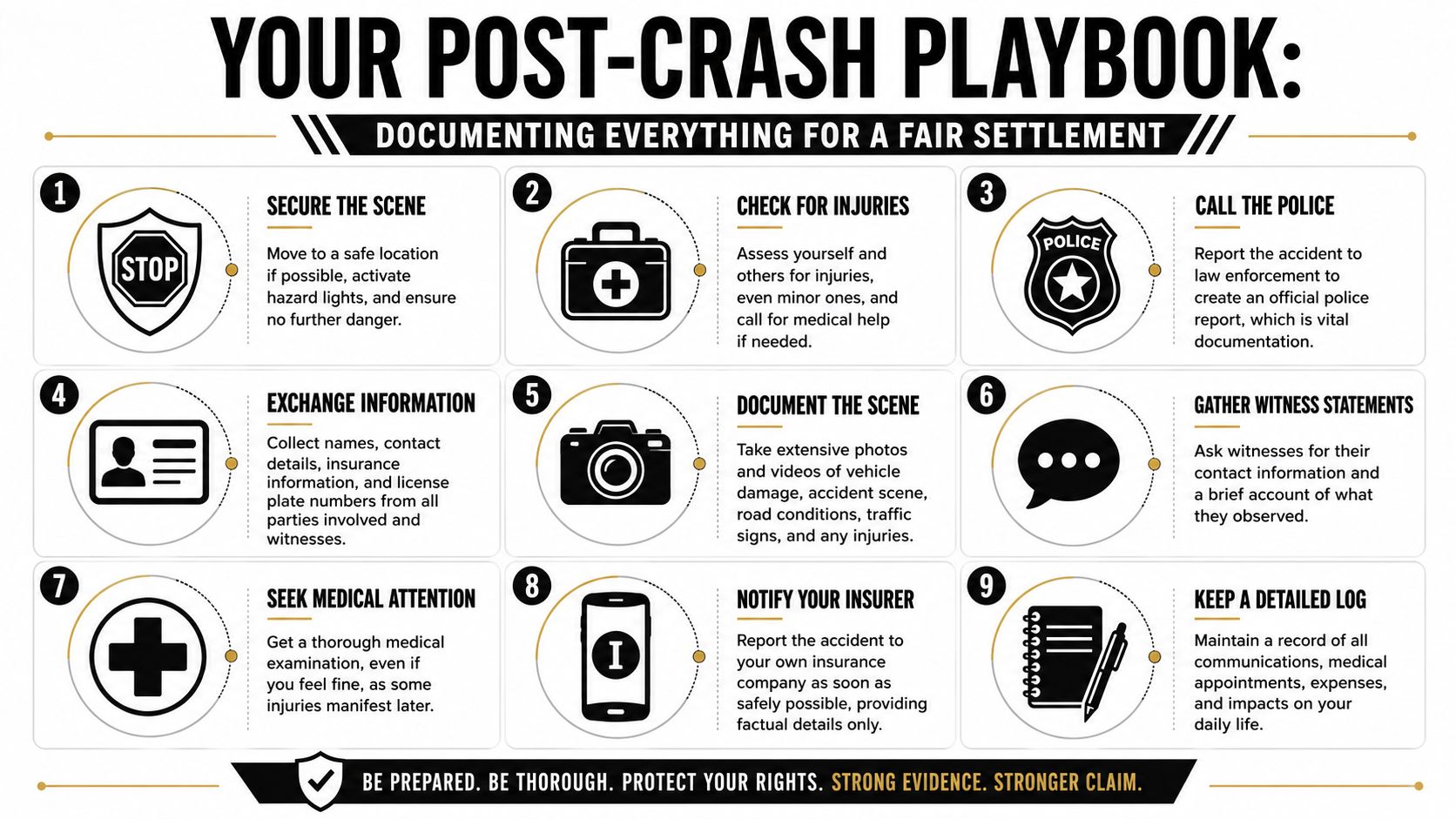
What to capture at the scene
Start broad, then get specific.
- Wide shots first: Photograph the whole scene from multiple angles. Include lane position, intersections, traffic lights, signs, debris, skid marks, and road conditions.
- Then move tight: Get close-up photos of every damaged panel, wheel, light, glass area, and the interior if anything shifted or deployed.
- Show vehicle identity: Photograph your VIN label, license plate, odometer, and the other vehicle's plate.
- Document the other driver: Insurance card, driver's license, and company markings on the vehicle if it was a business car or truck.
- Record visible injuries: Bruising, cuts, swelling, airbag burns, seat belt marks. Do it early and repeat over the next few days if symptoms develop.
Video helps too. A slow walkaround with narration can preserve details still photos miss.
Build a paper trail immediately
After the scene, start a claim log. Use the notes app on your phone, a spreadsheet, or a notebook. Just keep it consistent.
Write down:
- Every call with the insurer, body shop, tow yard, rental company, and medical provider.
- Every cost you paid out of pocket.
- Every symptom you felt, when it started, and how it affected driving, sleep, work, or daily tasks.
- Every deadline the insurer gave you.
If medical treatment is part of the claim, organize those records the same way you'd manage family health information, with one place for visit summaries, imaging, bills, prescriptions, and follow-up instructions. Messy records create easy openings for adjusters.
The best claim files are boring. They're chronological, complete, and hard to argue with.
Don't rely on the insurer to preserve your evidence
Ask for the police report. Save repair estimates. Keep towing and storage invoices. If the vehicle may be totaled, save maintenance receipts, recent upgrades, tire purchases, and photos from before the crash. Those details support condition adjustments later.
Create a single digital folder for the whole claim. If you need a structure, use an auto claim documentation checklist so nothing gets lost between the body shop, insurer, and your inbox.
A documented claim has influence. An undocumented claim has opinions.
Calculating Your Claim's True Value for Total Loss and Diminished Value
Most adjusters present value as if it came down from a mountain on stone tablets. It didn't. It came from a process, and that process can be wrong.
There are two main property-damage paths after a crash. Your vehicle is either a total loss, or it's repaired but worth less afterward. A lot of drivers understand the first path. Very few pursue the second.
Total loss means pre-loss market value is the fight
If the insurer totals your car, the question is not what they feel like paying. The question is what your vehicle was worth in the actual market one second before impact.
That means you need to review the valuation line by line.
Check for:
- Wrong trim level
- Missing options
- Bad condition adjustments
- Comparable vehicles from the wrong market
- Mileage errors
- Ignored recent maintenance or upgrades
Insurers often lean on valuation software. Software is only as good as the inputs. If the trim is wrong, the condition is underrated, or the comps are weak, the output is weak too.
Build your own number using real-world comparable sales. Look for vehicles with matching year, make, model, trim, mileage range, drivetrain, and major options. Then compare asking prices, dealer listings, and local availability. If you need a framework, review a fair market value method for total loss claims.
Repaired doesn't mean fully restored in the market
A properly repaired car still carries accident history. Buyers know it. Dealers know it. Appraisers know it. That market stigma is diminished value.
This is the claim category insurers count on you missing.
A 2025 study by the Insurance Research Council found that only 12% of settlement negotiations include diminished value claims, despite average diminished value payouts ranging from $3,000 to $15,000 depending on vehicle age and pre-accident condition, according to this discussion of car accident settlement values in California.
That doesn't mean every vehicle qualifies for the same result. It means the category exists, it matters, and it's regularly overlooked.
How to tell if you have a diminished value claim
You likely have a stronger DV claim if the car had solid pre-loss condition and one or more of these factors apply:
| Factor | Why it matters |
|---|---|
| Newer vehicle | Buyers react more strongly to accident history on newer cars |
| Luxury or performance model | Market sensitivity is usually higher |
| Structural or major panel damage | Serious repair history hurts resale appeal |
| Clean title and no prior accident history | The value drop is easier to isolate |
| Lower mileage | The accident becomes a more visible negative in the market |
A weaker DV claim doesn't mean no claim. It means the support has to be tighter.
The practical way to value both paths
For total loss, prove what the car was worth before the wreck.
For diminished value, prove what the car would have sold for before the wreck versus after quality repairs with an accident history.
That requires documentation, comparable vehicles, repair records, photos, and a market-based opinion. An independent appraiser can help with that analysis. In Oregon and Washington, some owners use services such as Total Loss Northwest for diminished value reports, total loss valuations, and appraisal-clause disputes when the insurer's number doesn't hold up.
A repair invoice shows what it cost to fix the damage. It does not prove the vehicle kept the same market value after the accident.
Those are different questions. Treat them that way.
How to Negotiate with an Insurance Adjuster
Most claimants negotiate backwards. They respond to the adjuster's number, answer too many questions, and hope the insurer “comes up a little.” That approach loses ground fast.
You need to set the frame. Your file, your valuation, your written demand.
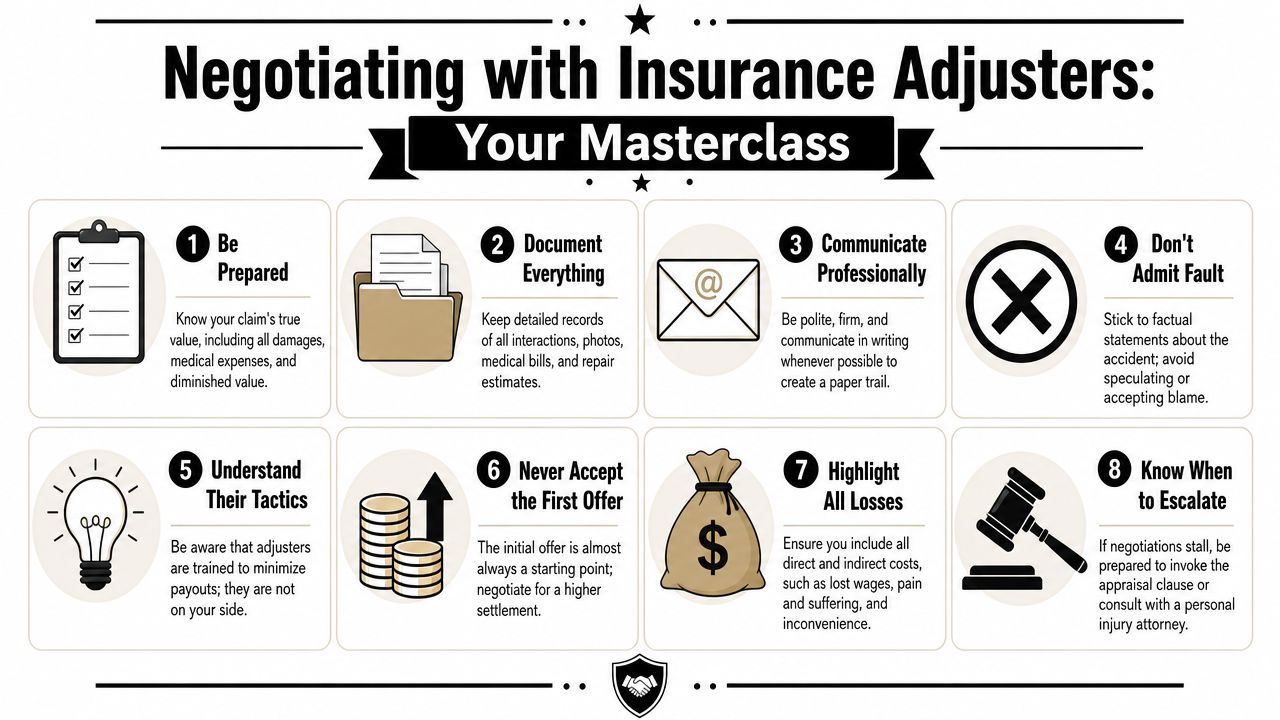
The first phone call
Keep it short. Be polite. Don't perform your case on the phone.
Use language like this:
“I'm reviewing the damage, documentation, and valuation. I'm not accepting any offer until I've completed that review. Please send your valuation and supporting documents in writing.”
That statement does three things. It slows the process, forces paper, and signals that you're not easy to close.
Do not speculate about injuries, prior condition, speed, visibility, or what you “might have done.” Stick to facts.
Your demand should look like a file, not a complaint
A strong demand package has structure. It doesn't rant.
Include:
- A short summary of the loss: date, parties, claim number, vehicle details
- Liability position: brief and factual
- Damage documentation: photos, repair estimate, total loss report, repair invoice, supplemental repairs
- Your valuation support: comparable vehicles, correction of trim or options, condition evidence, market analysis
- Diminished value support if repaired: repair records, accident history effect, post-repair market impact
- Your number: specific, supported, and stated clearly
- A deadline for response: reasonable and in writing
Common adjuster tactics and the right counter
Here's the playbook they use, and the move that answers it:
| Adjuster tactic | What it means | Your counter |
|---|---|---|
| “This is our market valuation” | They want you to treat software as neutral fact | Ask for every comparable, adjustment, and condition basis in writing |
| “The repairs restore the vehicle” | They want to erase diminished value | Separate repair cost from post-repair market stigma |
| “We need to close this quickly” | Pressure tactic | Refuse urgency and insist on full review |
| “Those comps aren't acceptable” | They don't like your market evidence | Ask why each comp is excluded and answer point by point |
After you've laid the groundwork, this video gives a useful visual overview of handling insurer negotiations:
When representation changes the outcome
Some claims can be handled directly if the dispute is limited and the documentation is strong. Others need escalation.
For claimants with attorney representation, the average settlement rises to $77,600, which is 340% higher than the $17,600 average for unrepresented claimants. I'm stating that qualitatively here because the source was already cited earlier, and the point is simple: advocacy changes results.
That doesn't mean every property-damage dispute requires a personal injury lawyer. It does mean you should stop acting like the adjuster is the decision-maker. They are one participant in a contested valuation.
If your written support gets ignored, stop repeating yourself. Escalate.
Invoking the Appraisal Clause to Break a Stalemate
This is the policy provision insurers hope you never read.
If you and the insurer disagree on the amount of loss, the appraisal clause can move the valuation dispute out of the adjuster's hands and into a structured process with appraisers. For vehicle owners in Oregon and Washington, this can be the cleanest way to break a deadlock on total loss value, repair-related valuation disputes, or diminished value issues tied to the policy language.
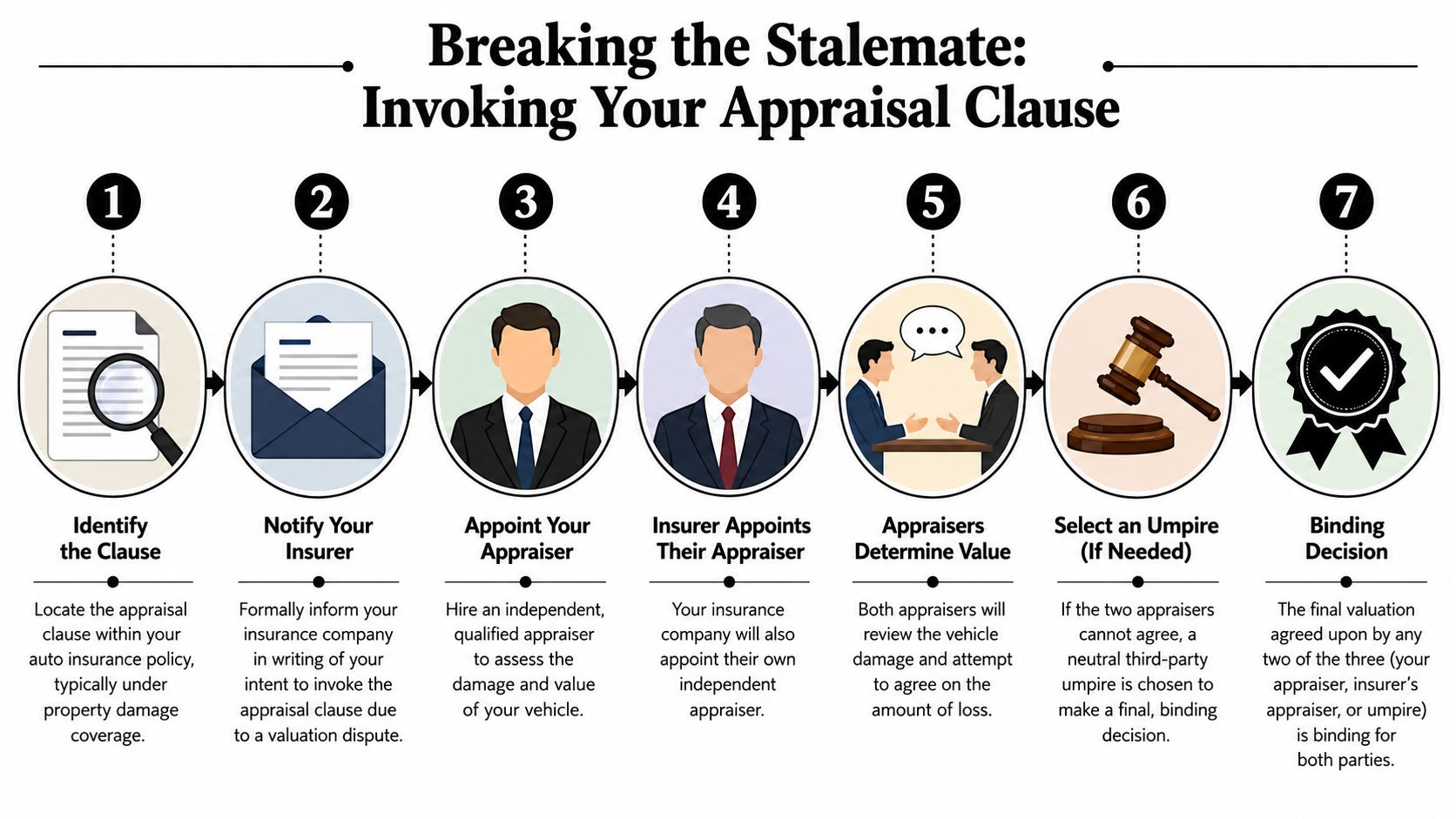
What the clause actually does
It does not decide fault. It does not resolve every legal issue in the claim. It addresses the amount of loss.
Typically, you select an appraiser. The insurer selects an appraiser. If those two can't agree, an umpire is selected. A decision agreed to by the required participants becomes binding under the policy terms for the valuation issue.
That matters because it changes the battlefield. You're no longer arguing with a desk adjuster who can hide behind software and internal guidelines. You're in a process built around competing valuation opinions.
When an insurer stops negotiating and starts repeating itself, you're usually at the point where appraisal makes more sense than another email.
When to invoke it
Appraisal makes sense when the dispute is mature. That means:
- The insurer has made its position clear.
- You've reviewed their valuation support.
- You've assembled your own evidence.
- The disagreement is about value, not who caused the accident.
If the carrier is still investigating basic facts, appraisal may be premature. If the issue is plainly the dollar amount, it's often the right next move.
How to do it correctly
Send a written notice invoking the appraisal clause under your policy. Be direct. Identify the claim, the vehicle, the date of loss, and the disputed valuation issue. Ask the insurer to confirm its appraiser.
Then choose your own appraiser carefully.
Look for:
- Independence: not a shop manager guessing at market value
- Auto valuation experience: especially total loss and diminished value work
- Knowledge of local markets: Oregon and Washington values can diverge from national assumptions
- Report quality: the work should be detailed enough to survive scrutiny
What to expect from the process
A good appraisal dispute feels less emotional because it is. The work revolves around documents, comparables, condition, repair quality, vehicle history, and market reaction.
Your appraiser should inspect the file closely, challenge bad comparables, and support a defensible number. If the insurer's side brings weak analysis, that weakness gets exposed faster in appraisal than in routine claim handling.
Appraisal is not magic. It is a powerful tool backed by contract language. Used at the right time, it can force movement when ordinary negotiation has gone stale.
Key Settlement Rules for Oregon and Washington Drivers
Generic internet advice is where drivers get sloppy. Oregon and Washington claims turn on local rules, policy language, and how insurers handle valuation disputes in practice.
Diminished value matters in both states
If the other driver caused the wreck and your vehicle was repaired, don't assume the claim ends with the body shop invoice. In both Oregon and Washington, diminished value is a live issue for many not-at-fault owners. The practical problem isn't whether the concept exists. The practical problem is that drivers often never ask for it, or they ask without proof.
Your move is straightforward. Preserve the final repair records, pre-loss photos if you have them, and enough market evidence to show the vehicle's post-repair resale hit.
Read your policy for appraisal rights
For first-party property claims, your own policy may contain the appraisal clause discussed above. Don't rely on the adjuster to point it out. Read the section on physical damage coverage and dispute resolution. If you see appraisal language, use it strategically when the dispute is about value.
That is especially useful in total loss cases where the insurer's market report doesn't reflect actual local pricing, or in repair disputes where the value impact remains contested.
Local action steps that help immediately
- Check the policy language: Oregon and Washington policies aren't all identical. Read the actual contract before you argue process.
- Separate claim categories: Repair cost, loss of use, total loss value, and diminished value are not the same issue.
- Keep Oregon and Washington market comps local: A valuation built from the wrong region is easy to attack.
- Watch claim timing carefully: Property damage and injury timelines can differ, and delay weakens evidence even before any legal deadline becomes the issue.
If you drive a high-value, collector, or heavily optioned vehicle, local nuance matters even more. Those cars get misread by generic valuation systems all the time.
Answering Your Top Car Accident Settlement Questions
Do I have to use the insurance company's repair shop
No. You can choose your own repair shop. The insurer may recommend one, but recommendation is not control. Pick a shop that documents repairs thoroughly and will explain what was replaced, repaired, calibrated, and refinished.
What if the other driver was uninsured
You may still have options through your own policy, depending on your coverages. That can include uninsured motorist protections for injuries and first-party coverages for vehicle damage. Pull the declarations page and read the policy before assuming you're stuck.
Can I claim diminished value on a leased vehicle
Potentially, yes, but the ownership and contract issues are more complicated. The key question is who holds the legal interest in the vehicle's post-repair loss in value. Review the lease terms and don't assume the answer without checking the paperwork.
Will my rates go up if I wasn't at fault
Maybe, maybe not. Insurers handle underwriting differently, and policy, claim history, and carrier rules all matter. Don't let fear about rates stop you from pursuing a valid claim. The bigger mistake is leaving a loss unpaid because you're guessing.
Should I accept the first offer if it seems close enough
Usually not. If the insurer's number is unsupported, “close enough” is how underpayment happens. Review the valuation, challenge the weak parts, and make them show their work before you sign anything.
If the insurer is lowballing your total loss or ignoring diminished value, get a second opinion before you settle. Total Loss Northwest provides independent auto appraisals for Oregon and Washington drivers, including total loss valuations, diminished value analysis, and appraisal clause support when negotiations stall.