GAP insurance covers the difference between what your insurer pays for a stolen or totaled car and what you still owe on the loan or lease. If you owe $25,000 and the car is worth $20,000, GAP is designed to address the $5,000 shortfall.
That gap is exactly what catches a lot of first-time buyers off guard. You've made your payments, you've kept the car insured, and then a total loss claim leaves you staring at a payoff that's bigger than the insurer's check.
What Gap Insurance Actually Does
GAP, short for guaranteed asset protection, is optional coverage built for one narrow problem, negative equity after a theft or total loss. The Consumer Financial Protection Bureau says it is meant for the situation where the loan balance is higher than the insurer's payout, and Progressive and the Insurance Information Institute describe the same basic function, it bridges the difference between what the car is worth and what is still owed. Consumer Financial Protection Bureau guidance on GAP insurance
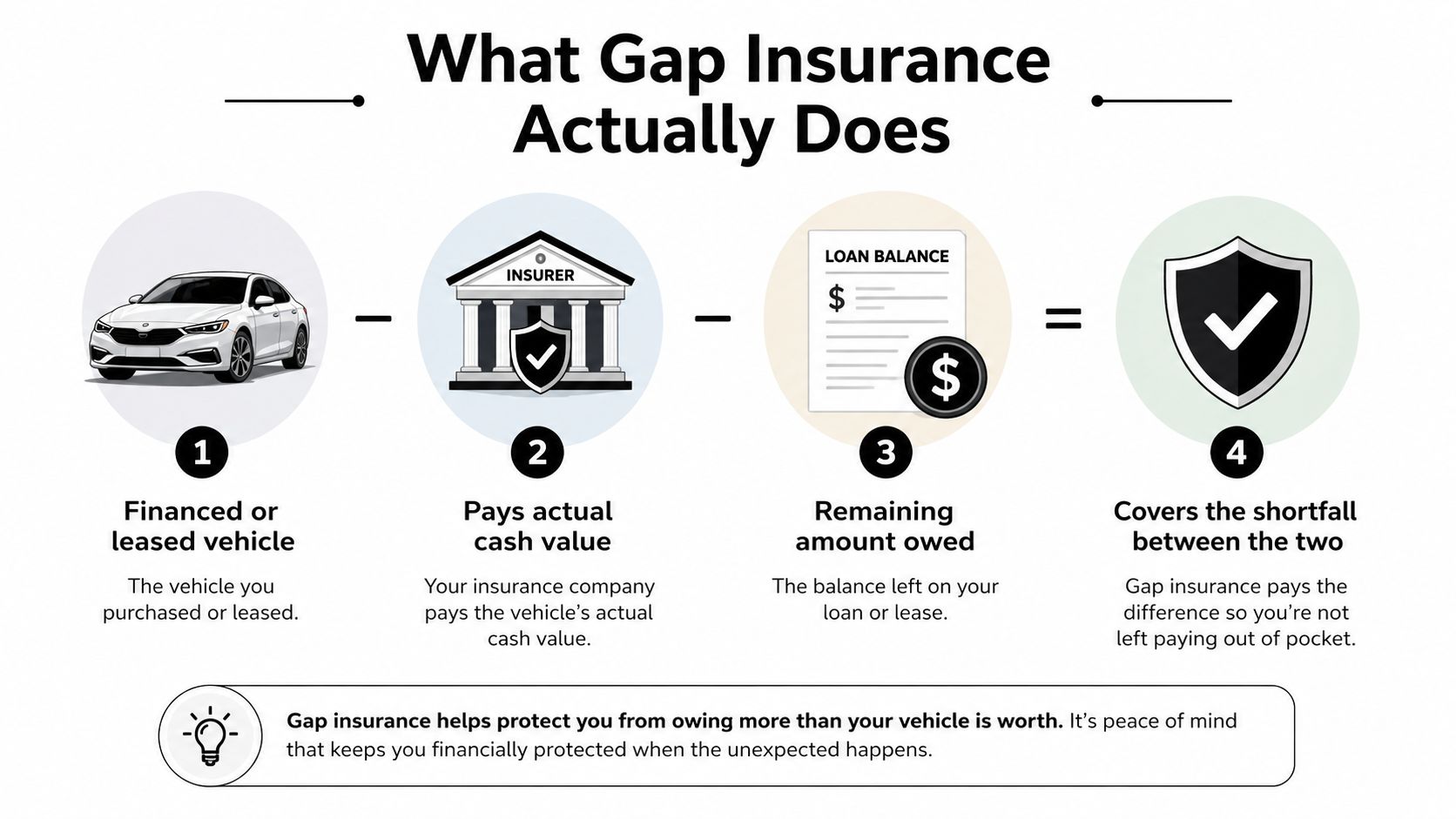
Here's the cleanest way to think about it. Standard auto insurance pays the car's actual cash value, not the amount you financed or the amount you wish it were worth. If the settlement comes in below your payoff, GAP can step in and cover the shortfall, subject to the contract terms and any deductible structure your policy uses.
Why the timing matters
This coverage tends to matter most early in ownership. New vehicles can lose value quickly while the loan balance falls more slowly, so the risk window is strongest when the car is still fresh and the debt is still heavy. Progressive notes that once you owe less than the car is worth, the coverage can usually be dropped. Progressive's overview of GAP insurance
That's why a first-time buyer should ask one simple question: if this car were totaled tomorrow, would the insurer's value likely be lower than the payoff? If the answer is yes, GAP is solving a real balance-sheet problem, not an abstract one.
Practical rule: GAP is for the debt gap after a total loss, not for everyday damage, maintenance, or repairs.
The Main Types of Gap Coverage Drivers Should Know
Not every GAP product behaves the same way, and that's where buyers get tripped up. Some policies only cover the remaining loan or lease balance, while others are structured differently, such as return-to-invoice, return-to-value, vehicle-replacement, finance GAP, negative-equity GAP, or lease GAP. RAC's guide to GAP insurance types
Same label, different payout shape
A loan or lease GAP policy usually focuses on the payoff gap itself. A return-to-invoice product is built around the original invoice amount, while return-to-value and vehicle-replacement products are aimed more at restoring the buyer to a comparable vehicle position, depending on the contract wording. That difference matters because two people can both say they have GAP, yet end up with very different claim outcomes.
For leased vehicles, lease GAP deserves special attention because lease contracts can include early-termination charges. If the lease paperwork includes extra charges, you need to know whether the GAP product is written to address them or only the base payoff. The question isn't just whether you have GAP, it's which version of GAP you have.
Ask the seller to be specific
A dealer or insurer should be able to answer the contract question plainly. If the sales pitch stays vague, that's a warning sign. The useful question is, “Which GAP type is this, and what charges are excluded from the payoff calculation?”
Some buyers assume all GAP products are interchangeable. They're not, and the payout shape can change the result more than the label suggests.
What Gap Insurance Covers and What It Does Not
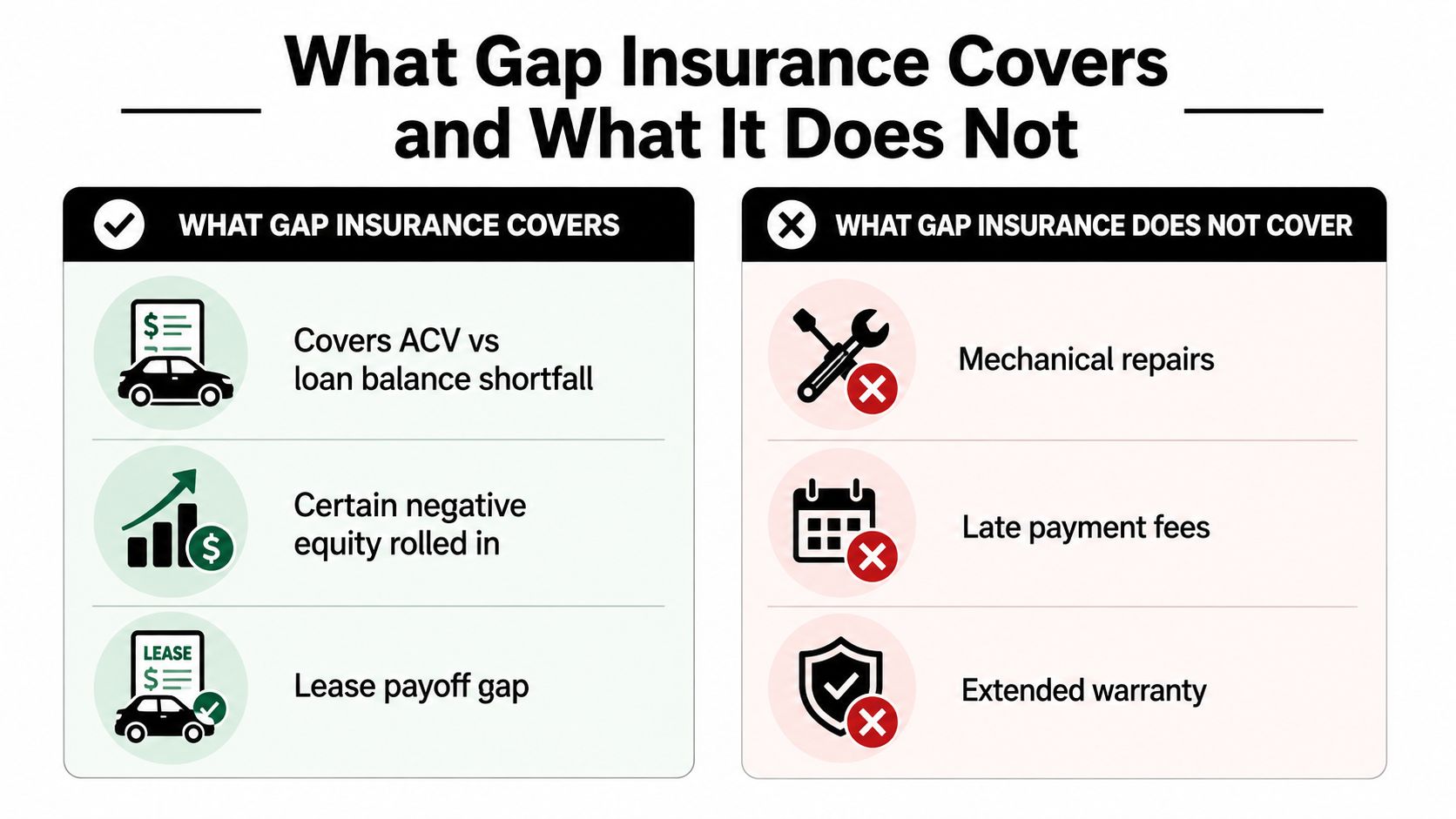
GAP coverage is narrow, but within that narrow lane it can be very useful. It generally covers the shortfall between ACV and the loan or lease payoff, and in some contracts it may also address negative equity rolled into the financing or certain early-termination lease charges. It does not become a general financial safety net just because a vehicle was involved in a claim.
What is usually in bounds
- ACV versus payoff shortfall: If the insurer's settlement is lower than the amount owed, GAP can bridge the difference.
- Certain rolled-in negative equity: If the contract allows it, some policies account for debt carried into the new loan.
- Lease payoff gap: Some lease products help with remaining lease obligations after a total loss.
What is usually out of bounds
- Collision or comprehensive deductible: Many buyers assume GAP wipes out the deductible. That's often untrue, and the policy language controls.
- Medical bills or third-party damage: Those belong to other parts of auto insurance, not GAP.
- Mechanical failure: GAP is not a warranty.
- Add-on fees in the loan: Extended warranties, service plans, mileage charges, and similar extras are often excluded.
- Late payments or penalties: Past-due amounts usually don't disappear just because the car was totaled.
For a plain-English checklist of common exclusions, the internal guide on what gap insurance does not cover is useful before you sign anything.
Most missed exclusion: GAP often does not erase the deductible, and many drivers only learn that after the total-loss paperwork arrives.
If a borrower is dealing with debt issues tied to a vehicle loan, Miles Hansford's Chapter 13 car loan guidance can help put the loan side of the conversation in context, especially when the payoff amount, missed payments, and plan treatment all matter together.
Two Total-Loss Scenarios Drivers Should Walk Through
A total-loss claim feels abstract until you follow the paper trail. The order matters, because the primary insurer, the lender, and the GAP administrator each look at a different number before money moves.
Financed car with a deductible
Start with a driver who owes $28,000 on a financed daily driver. The insurer says the car's ACV is $22,000, and the policy has a $1,000 deductible. The primary insurer pays the ACV amount under the policy terms, the lender then gets paid from the settlement stream, and the remaining difference becomes the GAP question.
That's where the math can surprise people. If the contract handles the deductible separately, the deductible can still sit with the driver even after GAP pays the covered shortfall. That's why the exact policy wording matters more than the sales summary.
Leased car with an early termination charge
Now look at a lessee in a similar total-loss situation. The lease payoff may include an early-termination fee, and some lease GAP policies address part of that amount while others do not. A lessee should read the contract as closely as a borrower does, because the lease balance and the fee structure can change the final result.
For a deeper look at leased vehicle totals, the page on leased vehicle total loss handling is a practical reference point. It helps drivers see how the lease company, insurer, and GAP administrator each fit into the payment order.
The sequence is simple, but the numbers aren't. The insurer's valuation starts the settlement, and GAP only works on what's left after that figure is applied.
How Insurer Valuations and Independent Appraisals Affect the Gap
GAP doesn't pay a fixed amount. It pays what's left after the insurer sets the vehicle's actual cash value, so the valuation itself controls how big the gap is. If the insurer's number is low, the shortfall gets bigger. If the number rises, the gap can shrink or disappear.
Why the first ACV number isn't always the last one
Insurers often use valuation software and comparable sales data to set ACV, but that process can miss local market strength, rare trim packages, or vehicle-specific options. On a standard commuter car, that may not change the conversation much. On a high-value, collector, or custom vehicle, the missing details can be the difference between a fair settlement and a thin one.
That's where the Appraisal Clause can matter. In plain English, it lets a policyholder challenge the insurer's value with an independent appraisal process instead of accepting the first figure as final. If the ACV goes up, the portion GAP has to cover goes down because the shortfall is smaller.
Why this matters to GAP buyers
GAP is often discussed like it sits on top of a fixed insurer payment. It doesn't. It sits on top of whatever ACV is ultimately accepted. That means a buyer who pushes back on an undervalued total loss may reduce the role GAP needs to play.
Important note: A better ACV can help you more than a bigger GAP payout, because GAP only fills the gap that remains after the insurer's value is settled.
This is especially relevant if the car has factory packages, aftermarket modifications, or trim details that standard valuation tools overlook. In those cases, the goal isn't to “use GAP better,” it's to make sure the starting number is fair before anyone calculates the shortfall.
Filing a Gap Claim Step by Step
The claim process is calmer when you treat it like a checklist. GAP administrators usually want the same core documents, and they expect the primary auto insurer to handle the ACV side first.
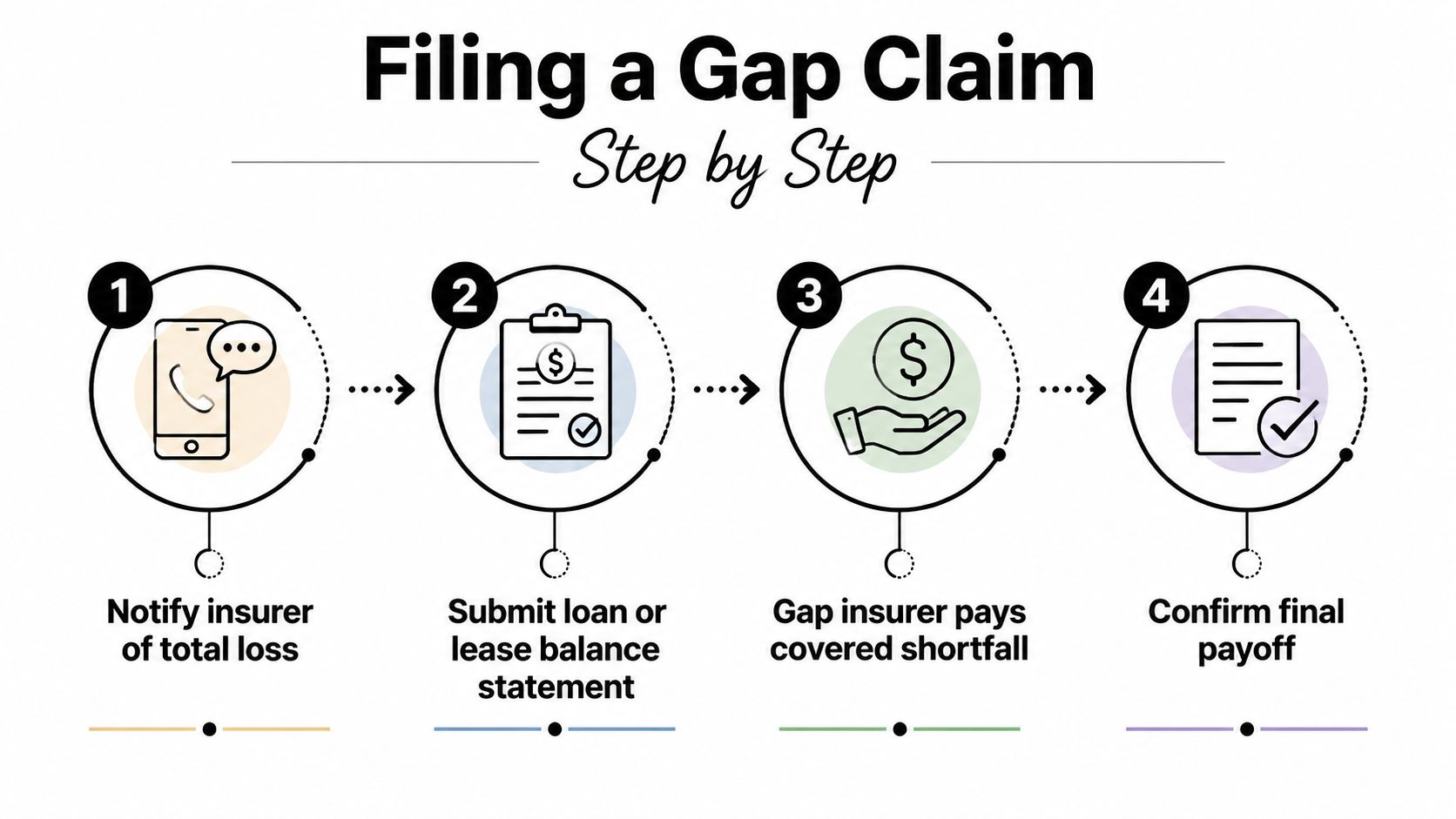
The usual order
- Notify the auto insurer that the vehicle is a total loss or stolen and not recovered.
- Review the ACV offer and decide whether to accept it or dispute it through the available valuation process.
- Send the payoff statement to the GAP administrator so the remaining balance can be reviewed.
- Confirm the final payoff with the lender once the insurer and GAP payments are applied.
The paperwork usually matters more than the emotion. The GAP administrator will want the loan or lease balance statement, the insurer's settlement details, and often proof of the policy itself. If the loan contains excluded add-ons, those amounts can be the reason a claim is reduced.
What slows claims down
Missing documents, unpaid fees not covered by the contract, and disagreements about the insurer's total-loss value can all delay the finish line. That's one reason a deductible choice deserves attention before a claim ever happens. If you want a clear framework for weighing that tradeoff, choose the right car insurance deductible is a useful place to compare how out-of-pocket risk changes with the policy structure.
The cleanest file is a simple one, insurance settlement, payoff statement, and GAP terms all lined up with no surprises.
Alternatives Worth Comparing Before You Buy
GAP is one way to handle negative-equity risk, but it's not the only way. A bigger down payment, a shorter loan term, or waiting until the balance falls below ACV can all reduce the need for it. Some drivers also prefer to self-insure the difference through savings instead of buying an extra policy.
| Option | What it covers | Best for | Trade-off |
|---|---|---|---|
| GAP insurance | Shortfall between ACV and payoff after a total loss | Drivers who owe more than the car is worth | Extra premium or fee |
| Larger down payment | Lowers the chance of negative equity | Buyers with cash up front | More money tied up at purchase |
| Shorter loan term | Helps equity build faster | Drivers who can afford higher monthly payments | Higher monthly payment |
| Refinancing later | Can improve the payoff position over time | Borrowers who qualify for better terms later | Not guaranteed |
| Wait and cancel GAP | No need once payoff drops below ACV | Owners whose equity improves quickly | Requires monitoring the balance |
The most practical comparison is whether you're buying protection for a real gap or paying for peace of mind you may not need. That's why the internal guide on whether gap insurance is worth it can help drivers think through the cost in relation to their loan shape.
If your payoff is already below the car's value, GAP has little left to do.
Buying Gap Coverage in Oregon and Washington
Drivers in Oregon and Washington usually see GAP sold through dealerships, lenders, and standalone insurance providers. The important part isn't where it's sold, it's what the contract says about the type of GAP, the excluded fees, and whether cancellation is allowed if the balance drops below ACV.
A good contract review starts with the valuation piece. If the insurer's ACV is weak, GAP has more work to do. If the valuation is fair, the coverage may only need to address a small remainder, or nothing at all.
Questions worth asking before you sign
- Which GAP type is this? Loan payoff, lease GAP, return-to-invoice, or another structure.
- Which charges are excluded? Look for fees, add-ons, or penalties that won't be covered.
- Is there a refund path? Some policies can be cancelled when the loan balance falls below the vehicle's value.
- Does the contract require full coverage first? GAP usually depends on collision and comprehensive being in place.
Oregon and Washington buyers should also confirm how refunds are handled if the policy is cancelled early and whether the GAP was sold as part of the loan or as a separate policy. The contract language controls, not the finance office summary.
If you're comparing a dealer product against an insurer product, keep the appraisal issue in mind too. A fair ACV is the starting point for any GAP payout, and a low settlement can make a decent policy look less useful than it really is.
If you want a careful review of a total-loss number before GAP enters the picture, Total Loss Northwest handles independent total loss and diminished value appraisals in Oregon and Washington. Visit Total Loss Northwest if you want help checking whether the insurer's valuation is fair before you decide what GAP needs to cover.