It's the gut-wrenching moment no one wants to face: your financed car is a wreck, and the insurance company has just declared it a total loss. The most important thing to understand right away is a simple, hard truth: your insurer pays your lender first, not you.
If that insurance check isn't enough to cover what you still owe, you are on the hook for the rest—on a car that's now just a memory.
What Happens When Your Financed Car is Totaled?

Let’s put this into a real-world context. Say you were driving your financed 2022 Toyota Camry when another driver runs a red light, leaving your car completely mangled. The call from the adjuster confirms it: it's a "total loss."
This isn't an uncommon scenario. In fact, it's becoming more and more typical. Projections for 2025 estimate that nearly one in four crashed vehicles in the U.S. will be totaled—a jump to 22.8% from 22.1% in 2024. Why? The complex technology in modern cars, especially advanced driver-assistance systems (ADAS), makes repairs incredibly expensive. A simple fender bender can now involve recalibrating a dozen sensors, pushing repair costs past the vehicle's value.
The key to getting through this is realizing you're dealing with two separate agreements: your auto loan with a lender and your insurance policy with an insurer. The crash may have destroyed your car, but it didn't wipe out your debt.
A helpful way to think about it is to compare it to a house mortgage. If your house burns down, the insurance company doesn't just hand you a check to go shopping. They pay the bank first to clear the mortgage. Whatever is left over (or still owed) is your responsibility. It's the exact same principle with your car.
Key Players in a Total Loss Claim on a Financed Car
The process can feel like being caught in the middle of a frustrating tug-of-war. Understanding who is involved and what they're after is the first step to taking back control. Our guide on what to do when your car is totaled goes into even more detail.
Essentially, there are three main parties at the table, each with a different priority.
Here’s a quick summary of who is involved and what their primary role is during the total loss process.
| Player | Role | What They Want |
|---|---|---|
| You (The Borrower) | To satisfy the loan obligation, secure a fair settlement, and figure out your next steps. | To minimize your out-of-pocket loss and get back on the road as soon as possible. |
| Your Lender | As the lienholder, they are the legal owner of the car until you pay off the loan. | To get their outstanding loan balance paid back in full. |
| Your Insurer | To assess the vehicle's pre-accident value, process the claim, and pay out according to the policy. | To settle the claim fairly but efficiently, based on the terms of your coverage. |
Knowing these roles helps you understand the motivations behind the phone calls and paperwork, which is crucial for navigating the weeks ahead.
How Insurance Companies Calculate Your Car's Value
When your financed car is totaled, one number suddenly becomes more important than any other: the Actual Cash Value (ACV). This isn't the price you paid for the car, and it's certainly not what you still owe the bank. Simply put, ACV is what your car was worth the second before the crash.
Think of it this way: if you were to sell a used couch online, you wouldn't ask for the price you paid new. You'd look at its current condition, how old it is, and what similar couches are selling for. Insurers do the same thing with your car, just with a lot more data.
They don't just guess a number. Insurance companies use sophisticated software that crunches several key data points to come up with that initial ACV offer.
Breaking Down the ACV Calculation
At its heart, an insurer's valuation report is all about figuring out your car's fair market price in your local area. They get to that number by looking at a few specific things.
- Core Vehicle Details: This is the easy stuff—the year, make, model, trim package, and any options that came from the factory.
- Condition and Mileage: The adjuster will document the car's pre-accident condition. Was there any old damage, rust, or heavy wear and tear? High mileage pulls the value down, while a well-maintained, low-mileage car is worth more.
- Local Market Analysis: This is the big one. The insurer searches for recent sales of "comparable vehicles" (or "comps") near you. This is also where most disagreements start, because what they consider "comparable" might be very different from reality.
The final valuation report often feels surprisingly low, and there's a reason for that. The software insurers use is programmed to find the cheapest comps available, which naturally works in their favor, not yours. You can dive deeper into this process by calculating a total loss vehicle's value in our guide.
The insurer’s first offer is just that—an offer. It is not the final, unchangeable value of your vehicle. You have every right to see their report, challenge their comps, and provide your own research to push for a higher, more accurate settlement.
Why Their Comps Might Be Flawed
Your best defense against a lowball offer is to pick apart the "comparable" vehicles the insurer used. It’s common for an insurance company to use a base model as a comp for your top-tier trim package, or compare your dealer-certified vehicle to one from a private sale with a questionable history.
These little "mistakes" can cost you thousands of dollars. Your goal is to understand exactly how they got their number so you can come back with better data. This is where you start taking back control and fighting for the money you're rightfully owed.
The Money Trail: Who Gets Paid First?
So, your insurance company has crunched the numbers and determined your car's Actual Cash Value (ACV). The big question now is, where does that settlement check actually go?
It’s a common misconception, but the check doesn't come to you. Instead, it’s sent directly to the bank or credit union that financed your vehicle.
Think of it this way: until you make that final car payment, your lender is technically the legal owner. They hold a lien on the title, which gives them first dibs on any insurance payout to protect their investment. You only get a check if there's money left over after the entire loan is paid off.
This flowchart gives you a good look at how an insurer lands on that ACV number, which is the starting point for this whole process.
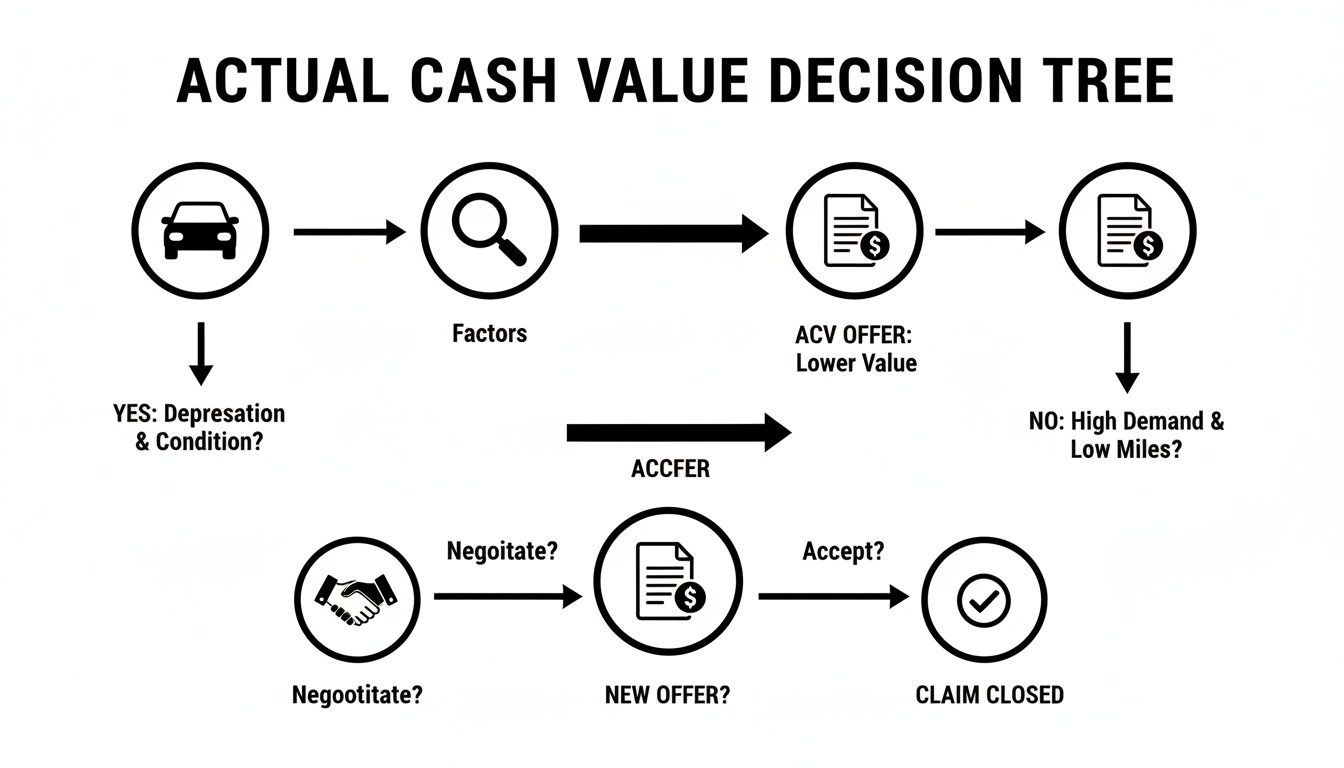
As you can see, the value is based on the car's real-world condition and local market data—not what you owe on your loan. This is exactly why a gap between the payout and your loan balance can happen so easily.
Three Possible Financial Outcomes
Once the insurance payout and your auto loan meet, it can go one of three ways. Let's walk through an example. Imagine you financed a Ford F-150 and you still owe $45,000 on it.
Positive Equity: This is the best-case scenario. The insurer values your truck at $48,000. They send $45,000 to your lender to close out the loan, and the extra $3,000 comes directly to you.
Break-Even: The ACV comes in at exactly $45,000. The lender gets paid in full, the loan is closed, and you walk away with no debt but no extra cash in your pocket, either.
Negative Equity (Upside Down): This is the most common—and painful—outcome. The insurer's valuation is only $38,000. The full amount goes to the lender, but you’re still on the hook for the remaining $7,000 loan balance for a truck that's now a memory.
That shortfall is called a deficiency balance, and you are legally responsible for paying it out of pocket.
Don't ignore a deficiency balance. Your lender can send it to a collections agency, which will hammer your credit score. They could even take legal action to recover the money you owe.
This isn't just a hypothetical problem; it's becoming more and more common. With total loss claims in the U.S. now making up over 30% of all collision claims—thanks in part to rising repair costs from parts tariffs—the odds of facing a shortfall are higher than ever. That $7,000 gap in our F-150 example is a very real possibility for many drivers today. You can learn more about these market trends and how they're affecting insurance payouts.
Your Financial Safety Net: Understanding GAP Insurance

The biggest financial headache after totaling a financed car is the risk of that dreaded deficiency balance. So, what happens when you find yourself "upside down" on your loan? This is precisely the scenario where Guaranteed Asset Protection (GAP) insurance becomes your best friend.
Think of GAP coverage as a financial bridge. It's a separate, optional policy built to cover the "gap" between what your car is worth (its ACV) and the larger amount you still owe the bank. Its entire purpose is to pay off that remaining balance so you don't have to.
How GAP Insurance Saves the Day
Let’s go back to our Ford F-150 example to see this in action.
- Loan Balance: You still owe $45,000.
- ACV Payout: Your primary insurer cuts a check for $38,000.
- The Gap: This leaves a painful $7,000 deficiency balance.
Without GAP insurance, that $7,000 bill is all yours. With it, the process is simple. You file a separate GAP claim, and the provider pays the $7,000 directly to your lender, completely clearing the loan. You get to walk away without any lingering debt from a car that's now just a memory.
GAP insurance is your primary defense against owing money on a car you can no longer drive. It turns a potential financial disaster into a clean slate, allowing you to focus on finding a new vehicle without old debt hanging over you.
The Consequences of Not Having GAP Coverage
Skipping GAP insurance can be an expensive mistake, especially if you fit a certain profile. If you total your financed vehicle without it, your lender is going to come knocking for that deficiency balance, and they'll want it paid right away.
What happens next is never fun. Your lender may demand a lump-sum payment. If you're lucky, they might agree to a short-term payment plan, but there are no guarantees. If you can't pay up, the debt will almost certainly be sent to a collections agency, which will do serious damage to your credit score for years to come.
When a deficiency balance is in play, you might find yourself dealing with persistent debt collectors. It's crucial to understand your rights against debt collectors in this situation. This coverage is especially important if you made a small down payment, have a loan term longer than 60 months, or rolled negative equity from a previous trade-in into your current loan.
How to Challenge a Low Insurance Offer
That first settlement offer from the insurance company can be a real gut punch, especially when it lands thousands of dollars below what you know your car was worth. It feels final, but it's not.
Here’s the single most important thing to remember: you do not have to accept their first offer. Buried in the fine print of every auto policy in Oregon and Washington is a powerful tool designed for this exact situation. It's called the Appraisal Clause, and it's your right to use it.
Invoking this clause takes the decision out of the insurance company's internal system and puts it into a neutral, fact-finding process. It’s your legal right to dispute their valuation and demand a fair settlement based on real-world evidence.
Invoking the Appraisal Clause
Think of the Appraisal Clause as the official dispute-resolution mechanism built right into your policy. When you and your insurer are at a standstill over your car's value, this clause lets both sides bring in qualified experts to settle the matter.
It’s a surprisingly straightforward process designed to be fair:
- You Hire Your Expert: First, you find and hire a certified, independent auto appraiser. This person works for you, not the insurance company, and their only job is to determine the true market value of your vehicle before the accident.
- The Insurer Hires Theirs: Once you've formally invoked the clause, your insurance company will hire its own appraiser to do the same thing.
- An Umpire Makes the Final Call: The two appraisers present their research and try to agree on a settlement value. If they can’t reach an agreement, they select a neutral, third-party umpire to review both reports and make a final, legally binding decision.
The moment you invoke the Appraisal Clause, the insurer's internal valuation software becomes irrelevant. The conversation shifts from their proprietary algorithms to actual market data, comparable vehicle sales, and expert analysis. When you have a loan to pay off, that shift is critical.
Want a deeper dive into the process? You can learn more about the specifics in our detailed guide on how auto insurance appraisals work.
By invoking the Appraisal Clause, you change the game. Instead of playing by their rules, you move the settlement to a structured, impartial process where evidence—not algorithms—determines the outcome.
Why an Independent Appraiser Is Your Best Advocate
An independent appraiser does more than just give you a second opinion. They act as your expert advocate in what is essentially a complex financial negotiation.
Their job is to build a detailed, evidence-based case for your vehicle's true pre-accident value. They dig into local market data, find genuinely comparable vehicles for sale in your area, and document every single feature, upgrade, and even the exceptional condition of your car that adds to its worth.
This kind of expert support is more crucial than ever. With advanced driver-assistance systems (ADAS) now found in 88% of appraisals, correctly valuing modern vehicles has become more complex. On top of that, market forecasts predict total loss rates will keep climbing into 2026, partially because tariffs are expected to slash North American vehicle production by over 944,000 units. This puts a real squeeze on the market, making every dollar of your settlement count.
Let's compare the two approaches side-by-side.
Insurer's Valuation vs Independent Appraisal
| Factor | Insurer's Method | Independent Appraisal Method |
|---|---|---|
| Data Source | Proprietary software (e.g., CCC, Mitchell) using broad regional data. | Hyper-local market research, including private and dealer listings. |
| Comparables | Often uses "comps" that are a poor match for your vehicle’s trim, mileage, or condition. | Hand-selects truly comparable vehicles to build a realistic value. |
| Objectivity | An inherent conflict of interest exists; their goal is to minimize the payout. | Works exclusively for you with a fiduciary duty to determine the highest accurate value. |
| Adjustments | Condition and feature adjustments are often standardized and minimal. | Details like recent maintenance, upgrades, and superior condition are documented and factored in. |
| Outcome | Tends to produce a lower initial offer to protect the insurer's bottom line. | Aims for a fair, evidence-based settlement that reflects the true cost of replacement. |
Hiring a professional ensures your settlement isn't just a number spit out by a computer. It's a reflection of reality—one that helps you pay off your loan and get back on your feet.
A Few More Questions People Often Ask
Even when you have a good handle on the big picture, a few practical questions almost always come up when a financed car is totaled. The whole situation can feel like a tangled mess of rules and responsibilities between you, your insurance company, and your bank.
Let's clear up some of the most common points of confusion so you can move forward with confidence.
Do I Still Have to Make Car Payments on a Totaled Car?
Yes, you absolutely do. This is a non-negotiable, and it catches a lot of people by surprise.
Think of it this way: your car loan and your insurance policy are two completely separate contracts. The accident may have destroyed your car, but it didn't touch the loan agreement you signed with the lender. You're still on the hook for that payment every month until the lender has the insurance check in hand and officially closes your account.
If you stop paying, even if you know a settlement is coming, your lender will report the missed payments to the credit bureaus. That can do serious damage to your credit score. The best thing to do is call your lender, let them know what happened, but keep making those payments on time.
Can I Keep My Totaled Car If It Is Financed?
For most people, the answer is a hard no. Your lender holds the title and has a lien on the car, which means they have the final word. Their one and only goal is to get their money back, and that means taking the insurance settlement and letting the insurance company have the wrecked vehicle.
Once the insurance company pays the lender, they take possession of the car. The title gets rebranded as "salvage," and the car is typically hauled off to be sold for parts at an auction.
There is a roundabout way to keep it, but it's rarely a good idea. You would have to pay off your entire loan balance out of your own pocket first. After that, you'd have to negotiate with your insurer to buy the car back from them at its salvage value. It's a complicated and expensive process that almost never makes financial sense.
What Happens to My Down Payment When My Financed Car Is Totaled?
This is a common source of heartache—your down payment isn't refunded to you. Instead, think of that money as instant equity you had in the car the moment you drove it off the lot. It was your head start on paying down the loan.
That equity plays a big part in how things shake out financially. If the insurance payout (the ACV) is more than what you still owe, that leftover cash you get back is essentially a return of the equity you built up, which includes your down payment.
- Here’s an example: You put $5,000 down. A year later, you owe $20,000, and the insurance company determines the ACV is $22,000. The insurer sends $20,000 to your lender to close the loan, and they send the remaining $2,000 to you. That $2,000 is what's left of your equity.
Making a larger down payment is the best way to guard against being "upside down" and increases the odds you'll get some cash back.
How Long Does the Total Loss Process Take?
You'll need to be patient here, because this isn't a quick process. From the day of the crash to getting the final letter from your lender, you can expect the whole ordeal to take anywhere from a few weeks to over a month.
There's a sequence of events that has to happen, and each step takes time:
- Damage Assessment: An adjuster inspects the car and officially declares it a total loss.
- Valuation: The insurer crunches the numbers to come up with the ACV and makes you an initial settlement offer.
- Negotiation: This is your window to push back if the offer is too low. Providing your own evidence or invoking the Appraisal Clause can add time, but it can also add thousands to your settlement.
- Lender Payoff: The insurer has to contact your lender to get an official 10-day payoff amount.
- Payment & Title Transfer: The check goes to the lender, and arrangements are made for the insurer to take the car.
- Loan Closure: Your lender processes the payment and closes your account. Only then will you settle any leftover balance or receive a check for any overpayment.
With so many different parties involved, delays are common, so try to be prepared for the wait.
Dealing with a lowball total loss offer is frustrating enough without a loan hanging over your head. At Total Loss Northwest, we're experts at using the Appraisal Clause to force insurance companies to pay what your vehicle was actually worth. If you're in Oregon or Washington and feel your settlement is unfair, reach out to us. We'll help you get the true value you’re owed. Learn more at https://totallossnw.com.