Receiving a denial letter from your insurance company can feel like hitting a brick wall. But don't panic. Most of the time, that denial isn't the final word—it's just the start of a negotiation.
In my experience, almost every auto and total loss denial boils down to one of three things: simple administrative mistakes, a dispute over your car's value, or a specific policy exclusion. Figuring out which category your denial falls into is the first step to turning things around.
Understanding Why Your Insurance Claim Was Denied

Your denial letter is the roadmap. Read it carefully, line by line, and look for clues that point to one of these common reasons:
Administrative Errors: This is the best-case scenario. It could be something as simple as a missing signature, a typo in the VIN, or a miscoded repair invoice from the shop. These are usually the easiest to fix.
Valuation Disputes: This happens when your insurer's software spits out a market value that just doesn't line up with reality, especially for classic cars, custom builds, or meticulously maintained vehicles. They're valuing a generic model, not your specific car.
Policy Exclusions: The letter will cite a specific clause in your policy, arguing that what happened isn't covered. This often involves things like track day damage, certain aftermarket modifications, or issues they classify as normal wear and tear.
Let’s break down what these look like in the real world.
| Denial Type | What the Letter Might Say | Your Immediate Fix |
|---|---|---|
| Administrative | “Insufficient documentation provided” or incorrect dates listed. | Find the missing document or correct the info and resubmit it immediately. |
| Valuation | A low settlement offer or a dispute over the "actual cash value" (ACV). | Gather proof of your car's real value: sales listings for comparable vehicles and an independent appraisal. |
| Exclusion | "Per section C, subsection 4, this loss is not covered." | Scour your policy for any language or exceptions that contradict their claim. |
Keep in mind that a ridiculously low settlement offer is essentially a denial in disguise. The insurance company isn't technically saying "no," but they are implicitly rejecting your vehicle's true value. Treat a lowball offer just like a formal denial: never sign a release and be prepared to appeal.
Expert Tip: From the moment you receive a denial, start a folder. Keep the denial letter, all explanation of benefits (EOB) forms, photos, repair estimates, and a log of every phone call and email. This paper trail is your best weapon for proving timelines and catching contradictions.
For instance, we worked with a driver in Portland whose heavily modified F-150 was declared a total loss. The insurer’s initial offer was based on a stock, base-model truck. We helped him gather receipts for all the custom parts and a certified appraisal, which forced the carrier to come back with a revised settlement that was thousands higher.
Once you’ve identified the reason for the denial, your next move is to gather targeted evidence that directly refutes their claim. A focused appeal that cites their own policy language and your supporting documents will always be more effective than an angry, vague complaint.
Immediate Actions To Protect Your Claim Rights
Start photographing everything the moment you can safely do so. Every angle of the vehicle, the odometer reading, the VIN plate, and especially any aftermarket upgrades that add real value. Time-stamped, high-resolution photos are your best defense against an insurer trying to pass off preexisting damage as part of the current claim.
Save every single piece of correspondence. Emails, text messages, voicemails, denial letters, repair estimates—all of it. You're building a chronological paper trail that backs up your version of what happened, and you'll be surprised how often the story changes on the other side.
The same day you get a denial, put your request for the complete claim file in writing. Insurers are required to hand over adjuster notes and valuation reports, and these documents frequently expose calculation errors or the use of incorrect comparable vehicles. I've seen cases where the "comparable" car was a different trim level entirely.
Keep a call log. Write down dates, times, names, and exact quotes when you can. One Seattle driver I know recorded an adjuster saying "we used base model pricing" during a phone call. That single note completely contradicted the carrier's later position and gave them serious ground to stand on in negotiations.
If you're dealing with a custom build or collector car, get an independent appraisal sooner rather than later. Insurer software tends to flatten unique features into generic values, and a certified appraisal forces the conversation back toward actual fair market value.
And this one catches people every time: don't sign any release forms or deposit a check marked "full settlement" until you fully understand what you're giving up. Once you sign away future claims, that's it. Insurers know this and use it to close out disputes for far less than they're worth.
Quick Checklist To Strengthen Your Appeal
- Photograph damage and identifiers with timestamps
- Archive all letters, emails, and repair estimates
- Send a written request for your full claim file and note the response deadline
- Maintain a chronological call and contact log
- Order a certified independent appraisal if valuation is disputed
Key Takeaway Getting and preserving evidence in the first 72 hours is the most protective action a claimant can take
If you want a practical walkthrough of organizing documentation, Learn more about auto claim documentation in our guide How To Build An Effective Auto Claim File.
Navigating The Appeals Process Effectively
Read that denial letter like a roadmap. Circle the exact dates, note the specific reason they gave, and find the appeal deadline — most auto policies allow 30 to 60 days for a first-level review.
This timeframe dictates everything you do next and frames the evidence you need to pull together.
Now, gather valuation evidence that directly pushes back against their numbers. You want at least two independent repair estimates and three market comparables matching your vehicle’s trim, mileage, and options.
Take the case of one Portland custom truck owner who successfully reversed a denial. They did it by submitting a diminished value report alongside receipts for $12,000 in aftermarket parts.
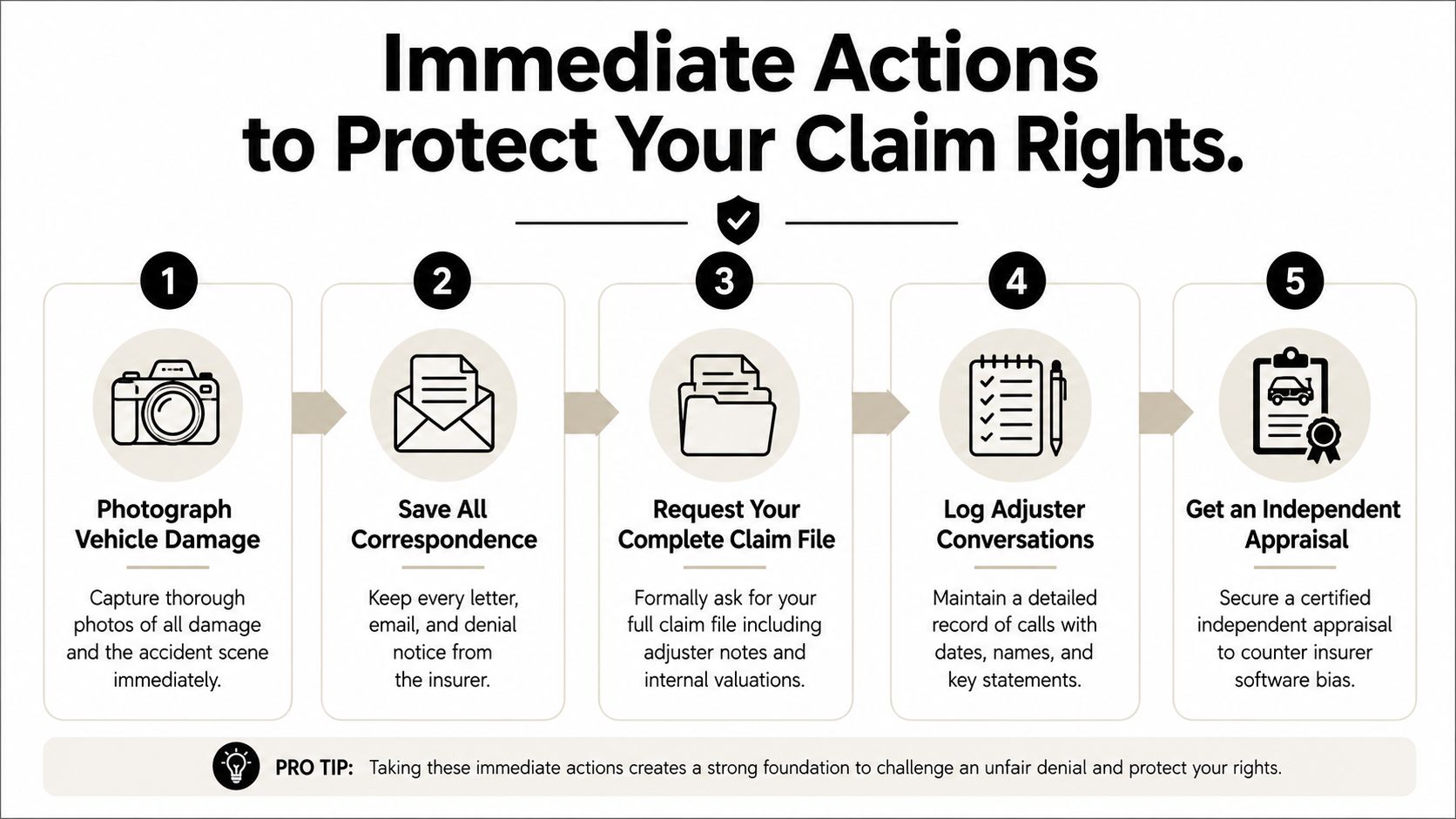
This graphic breaks down five immediate actions to protect your rights right after a denial, ranging from photographing the damage to securing an independent appraisal.
The biggest takeaway here? Evidence collected within 72 hours plus a complete claim file request materially increases your chances of success. It stops insurers from claiming preexisting conditions or blaming missing paperwork.
How To Draft A Persuasive Appeal Letter
Start your letter by quoting the denial date and their exact wording. Then, counter each point with a numbered piece of evidence. Keep your paragraphs short and attach documents in the exact order you reference them.
Always send it via certified mail and request a written decision within the timeframe your policy allows. Make sure your package includes:
- Documents that match the policy language
- Repair estimates, comparables, receipts, and the independent appraisal
- A concise cover sheet listing your attachments
Timeline And Escalation Expectations
Internal appeals typically take 30 to 60 days to review. If you get denied again, you have options. You can escalate the issue to your state insurance department or invoke the Appraisal Clause for an independent valuation.
Small claims court works well for modest disputes. For higher-value or complex losses, a civil suit or hiring a specialist makes more sense.
Key Takeaway: Use direct policy citations and tightly ordered evidence to make the reviewer’s job easy. That is exactly how denials become approvals.
If you want a reusable sample letter and more detail on demand letters, read also: How To Write A Demand Letter.
So your internal appeal hit a dead end. Now what? Picking the right escalation path comes down to three things: cost, speed, and how much impact it'll actually have. Generally, you're looking at three options: filing a regulator complaint, invoking the Appraisal Clause for an independent valuation, or taking it to small claims or civil court.
Filing a complaint with your state insurance department triggers a third-party review. It often forces the insurer to reveal exactly how they calculated their lowball valuation. The best part? It’s low-cost, and while it depends on their backlog, you’re typically looking at a resolution in weeks or months.
Filing a regulator complaint often exposes calculation errors insurers hide in internal notes
If the actual valuation is where you and the insurer disagree, the Appraisal Clause is your best friend. It legally binds both parties to hire independent appraisers, bringing in an umpire if they can't agree. I've seen this completely turn the tables. Take a Spokane driver we worked with—their payout jumped by thousands once a certified appraisal replaced the insurer's biased software numbers with real market data.
Practical Steps for the Appraisal Clause
- Hire a certified appraiser who knows your specific vehicle type and local market
- Exchange appraiser names according to your policy and lock in a written timeline
- If the two appraisers can't see eye to eye, bring in an umpire and split the fees as your policy dictates
When your total loss falls under your state's small claims limit, heading to small claims court makes sense. It’s way faster and cheaper than a full-blown lawsuit. Judges there appreciate a crisp, well-organized evidence file.
Small Claims Tactics
- Put together a tight evidence packet featuring your comparables and the appraisal summary
- Rehearse a clear, two- to three-minute opening statement for the judge
- Bring printed repair estimates and photos—physical copies go a long way in the courtroom
High-value or overly complex cases usually call in a specialist. That's where a team like Total Loss Northwest comes in. We step in when insurers stubbornly cling to software-derived lowball offers, swapping those figures out for certified, market-based reports across Oregon and Washington.
For a step-by-step breakdown of this process, check out our guide on how to file an insurance commissioner complaint.
Ultimately, weigh the expected recovery against your out-of-pocket costs and the timeline. Escalate strategically so you don't end up accepting an unfair settlement just to make it go away.
Recognizing When to Hiring a Total Loss Specialist
Most denied claims don't actually require outside help. But certain situations leave you fighting with one hand tied behind your back. High-value collector cars, extensive custom modifications, or a massive gap between your research and the insurer's actual cash value calculation—these are the moments where professional help makes sense. These cases often depend on niche market data that the insurer's software simply doesn't account for.
Real examples make this clearer. A restored 1967 Mustang received a lowball ACV because the carrier compared it to base trim models. An independent, certified appraisal that included recent restoration receipts and relevant sales comps pushed the offer up by thousands. That's the tangible difference a specialist brings to the table.
Quick Indicators You Should Call a Pro
- Your vehicle has rare options or documented upgrades worth $5,000+
- The insurer refuses to negotiate or hides behind opaque valuation software
- Multiple comparables contradict the insurer's ACV by 10% or more
- The claim involves out-of-state market effects or legal nuances
What a Total Loss Specialist Does Differently
Rather than just arguing with adjusters, a good specialist builds a defensible valuation report using recent local sales and option-adjusted comps. They compile a chronological evidence folder organized specifically for appeals or regulator reviews. And they invoke the Appraisal Clause, managing the entire appraiser exchange process so you're not stuck doing the heavy lifting.
Hiring a certified appraiser often converts a technical denial into a negotiable settlement
DIY Versus Professional Representation
| Factor | DIY | Professional |
|---|---|---|
| Time investment | High | Low |
| Likely recovery | Variable | Typically higher |
| Evidence quality | Inconsistent | Forensic and market-backed |
When the settlement gap exceeds your available time or technical knowledge, bringing in a specialist like Total Loss Northwest becomes worthwhile. Their multi-state diminished value support proves especially valuable when local markets vary significantly or carriers rely on generic valuation tools that miss the mark.
Proactive Habits To Prevent Future Claim Denials
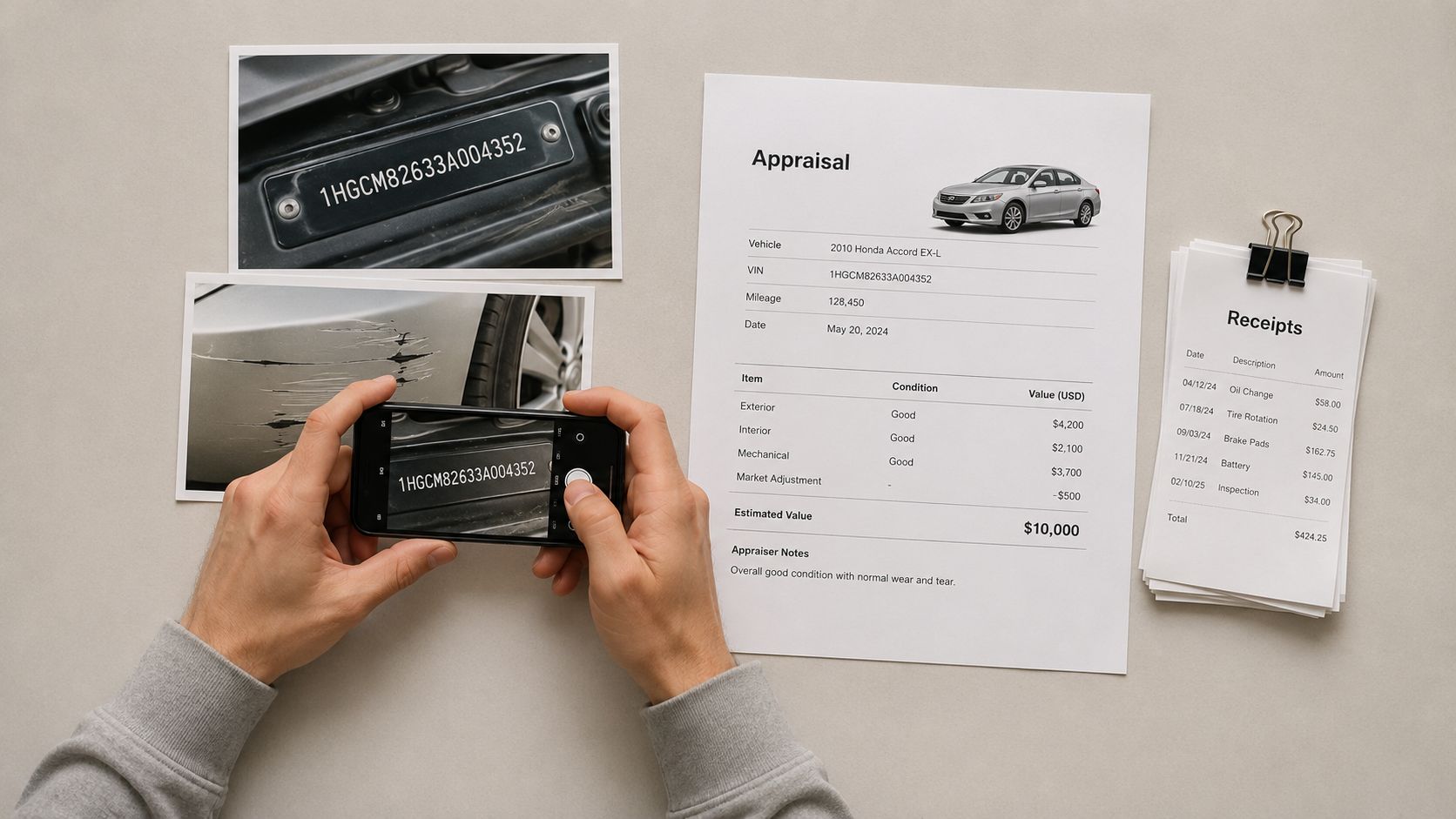
Start documenting your vehicle long before anything goes wrong. Snap high-res photos every year, keep an eye on your mileage, and scan receipts for any upgrades or restoration work. This kind of baseline record-keeping makes a huge difference when you need to prove your car's true condition, and it cuts down on the valuation disputes that frequently lead to an insurance claim denial.
Put together an evidence binder you can pull up fast. Digital copies of restoration invoices, aftermarket part receipts, and past appraisals all go into a single dated folder. When an adjuster asks for documentation, you won't be digging through shoeboxes or searching your email. You'll have everything matched to your policy language and ready to go.
Independent records matter
Certified appraisals and dated receipts create a paper trail that insurers take seriously. It reduces their ability to push a lowball offer and gives you solid ground to stand on during an appeal.
Annual Documentation Checklist
- Annual high-resolution photos with the odometer and VIN clearly visible
- Scanned receipts for parts and labor, including dates and shop contact info
- A one-page vehicle history summary tracking major changes and maintenance
Staying current on these items means you won't lose precious days scrambling for paperwork after a crash. It also makes market comparisons far more convincing.
Quick Actions After an Incident
- Photograph the damage and the surrounding scene right away.
- Pull your organized binder and pull copies of the relevant receipts.
- Order an independent appraisal if you suspect the valuation will be contested.
I've seen this play out in real situations. One classic Mustang owner I worked with had a pre-loss appraisal on file before any damage occurred. When the carrier's software tried to undervalue the aftermarket restoration work, that documented appraisal held up and the claim denial fell apart. Without it, they'd have been stuck fighting a losing battle.
Practical Tips From the Field
- Timestamp everything using your phone's metadata or send documents through certified mail.
- Keep every interaction brief and always note the adjuster's name along with what they said.
- Re-run your documentation checklist once a year or right after any major modification.
Build these habits into your routine now. Denial prevention stops being a frantic emergency response and starts being just another part of how you manage your vehicle.
Frequently Asked Questions About Insurance Claim Denial
What Should I Do Immediately After a Denial to Preserve Evidence
The moment that denial letter hits your hands, the clock starts ticking. Photograph everything – the damage, your VIN plate, odometer reading, and any aftermarket upgrades. Make sure those photos have timestamps turned on.
Save the denial letter and send a written request for your complete claim file the same day. Don't wait on this.
Keep a running log of every call – who you spoke with, what they said, and when. This builds your rebuttal packet and protects your timeline for appeals.
How Do I Challenge a Low Total Loss Valuation Effectively
Check your policy for the Appraisal Clause – it's your right to demand an independent evaluation when you and the insurer can't agree on value.
Get a certified appraisal that lists comparable sales and accounts for your vehicle's specific options. Then package it up clean:
- Repair estimates from a reputable shop
- Receipts for modifications or upgrades
- Market comps from your area
- A numbered summary of why their valuation misses the mark
A tight, documented package forces a re-evaluation. A disorganized appeal gets dismissed.
What Are Common Appeal Deadlines and Variations
Most auto policies give you 30 to 60 days for a first-level appeal, but rules vary by state and insurer. Some states have regulations that override your policy terms.
If your denial letter lacks a deadline, get it in writing immediately. I've seen people lose appeal rights just by waiting too long on a vague letter.
When Should I Hire Total Loss Northwest Instead of DIY
Call in a specialist when:
- Valuations differ by 10% or more
- Aftermarket parts exceed $5,000
- The insurer refuses to negotiate
- You're facing a technical denial that's hard to parse
Total Loss Northwest provides certified reports that work across multiple states. They translate technical denials into language that gets results – I've seen their involvement turn lowball offers into fair settlements repeatedly.
Keep exact, dated evidence and act fast to keep appeal options open.
For help visit Total Loss Northwest https://totallossnw.com