You're shopping a used SUV in the gray light of a rainy lot, and the dealer keeps waving off your questions with, “It passed inspection.” Then you pull the title history and see the brand nobody wanted to explain, lemon law buyback. Or maybe you're the owner with the car that's been back to the shop so many times you've started keeping a second key in your coat pocket because you don't trust the thing to start when you need it.
That's the moment this term stops being legal jargon and becomes a money problem. A lemon law buyback vehicle can be a legitimate manufacturer repurchase, but it can also be a headache that keeps costing the next owner after the first claim is closed. The smart move is to treat it like a disclosure, valuation, and documentation problem all at once, because that's what it really is.
Why Lemon Law Buyback Vehicles Catch Drivers Off Guard
A driver usually doesn't go looking for a lemon law buyback vehicle. The term shows up after the car has already turned into a liability, or after a bargain listing has been sitting long enough to look suspiciously cheap. That's why people get blindsided, they're reacting to the brand, not the history behind it.
One owner I'd trust to tell the truth about a bad vehicle is the one who's already got three repair orders in a folder and still can't get a straight answer from the service writer. Another is the shopper who thought they found a clean deal, then noticed the disclosure packet mentioned a lemon sticker on the door. Those are two very different situations, but they point to the same problem, the car's past is now part of its price.
A lot of people assume the repurchase process ends the story. It doesn't. The core issue is what happens after the manufacturer takes the vehicle back, repairs it, and sends it back into the market with a permanent brand. That brand changes how buyers, dealers, and lenders see the car, even when it drives fine on the test loop.
Practical rule: if the title history makes you uneasy, don't argue with your gut. Start asking for repair records, disclosure documents, and an independent opinion before anyone asks you to sign.
For owners, the fight is different. You're not just proving the defect was real, you're trying to document why the remedy should be a repurchase instead of more empty shop time. For buyers, the job is to decide whether the discount adequately compensates for the risk. If you skip that analysis, you're gambling with someone else's old problem.
What a Lemon Law Buyback Vehicle Actually Is
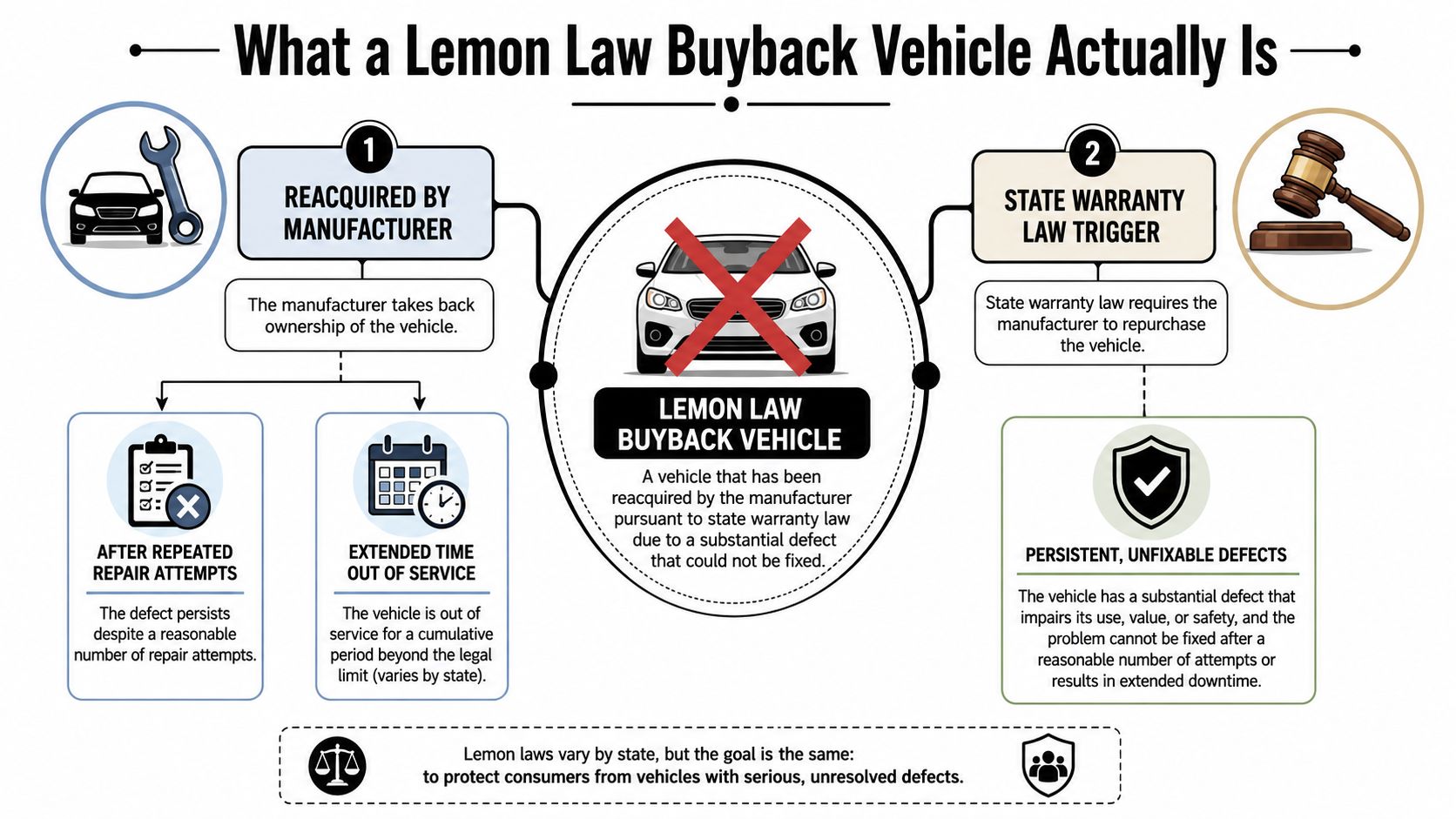
A lemon law buyback vehicle is a car the manufacturer had to take back because state warranty law forced the issue. It is not a salvage vehicle, and it is not the same thing as a collision write-off. The brand reflects a warranty-based nonconformity history, not flood, frame, or crash damage.
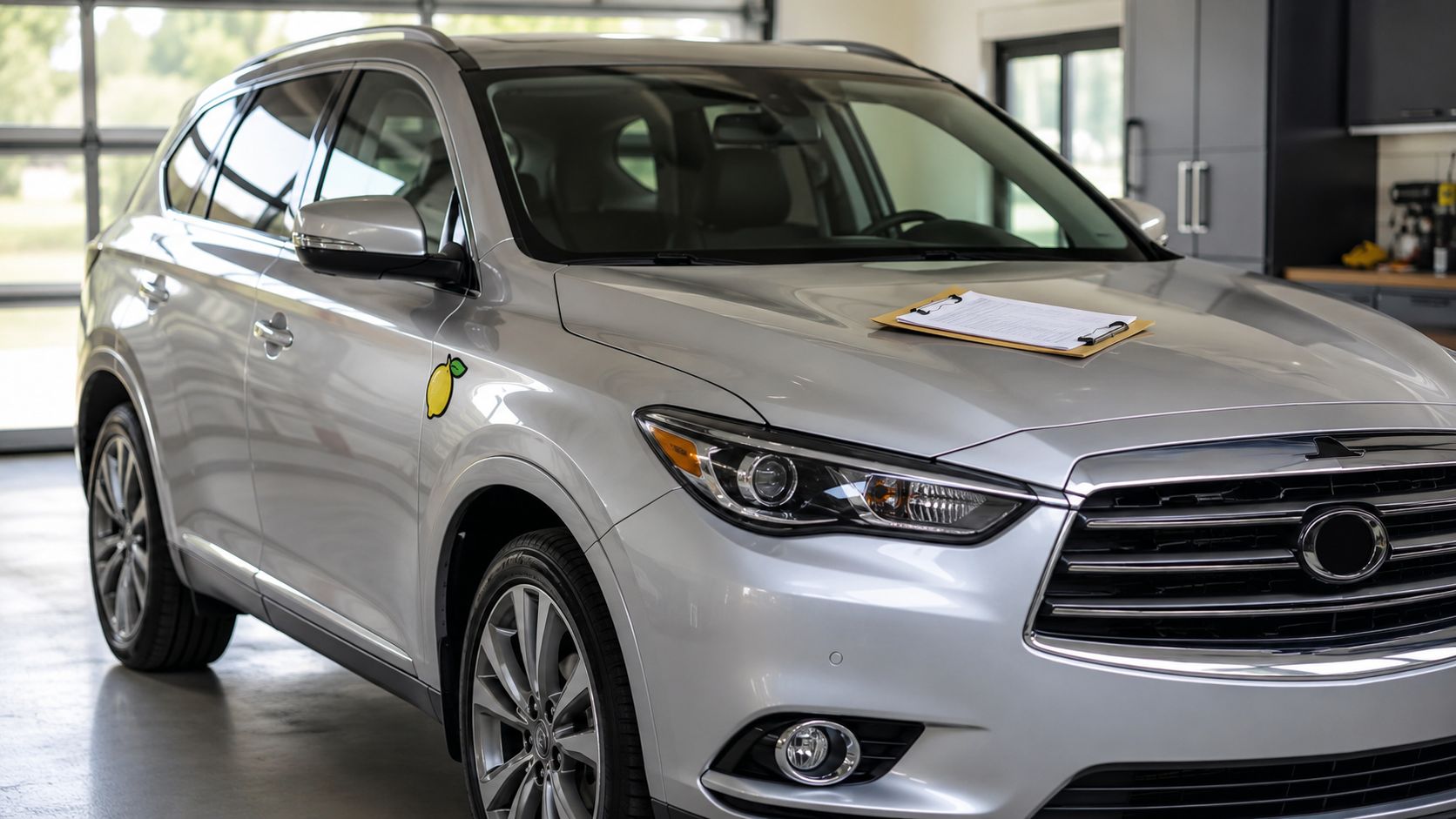
That distinction matters. California's vehicle industry manual says dealer-resold buybacks have to be labeled with a lemon law buyback designation and carry a lemon sticker on the door, so buyers are not left guessing about the vehicle's past California DMV manual on lemon law buybacks. The label is a warning about defect history and disclosure compliance, not structural-loss status.
The three categories buyers mix up
Lemon law buyback. The manufacturer reacquired the vehicle because the defect history met the state's legal trigger.
Salvage title. The car was declared a total loss because of damage, usually from a collision, flood, theft recovery, or similar structural event.
Manufacturer warranty return. This is another branded path where the paperwork can look similar, but the legal basis and resale labeling can differ by state.
The reason lenders and insurers care is simple. They are not pricing just whether the car runs today, they're pricing what the title says will follow it for the rest of its life. A clean-driving buyback can still be a harder car to finance, insure, or resell, because the permanent brand never disappears.
If you want to compare how branded paperwork changes a vehicle's market story more broadly, the salvage-title process is worth understanding too, especially when you're sorting through a mixed history at the negotiation table. A useful reference is this master the salvage title process in 2026.
How a Buyback Gets Triggered in the First Place
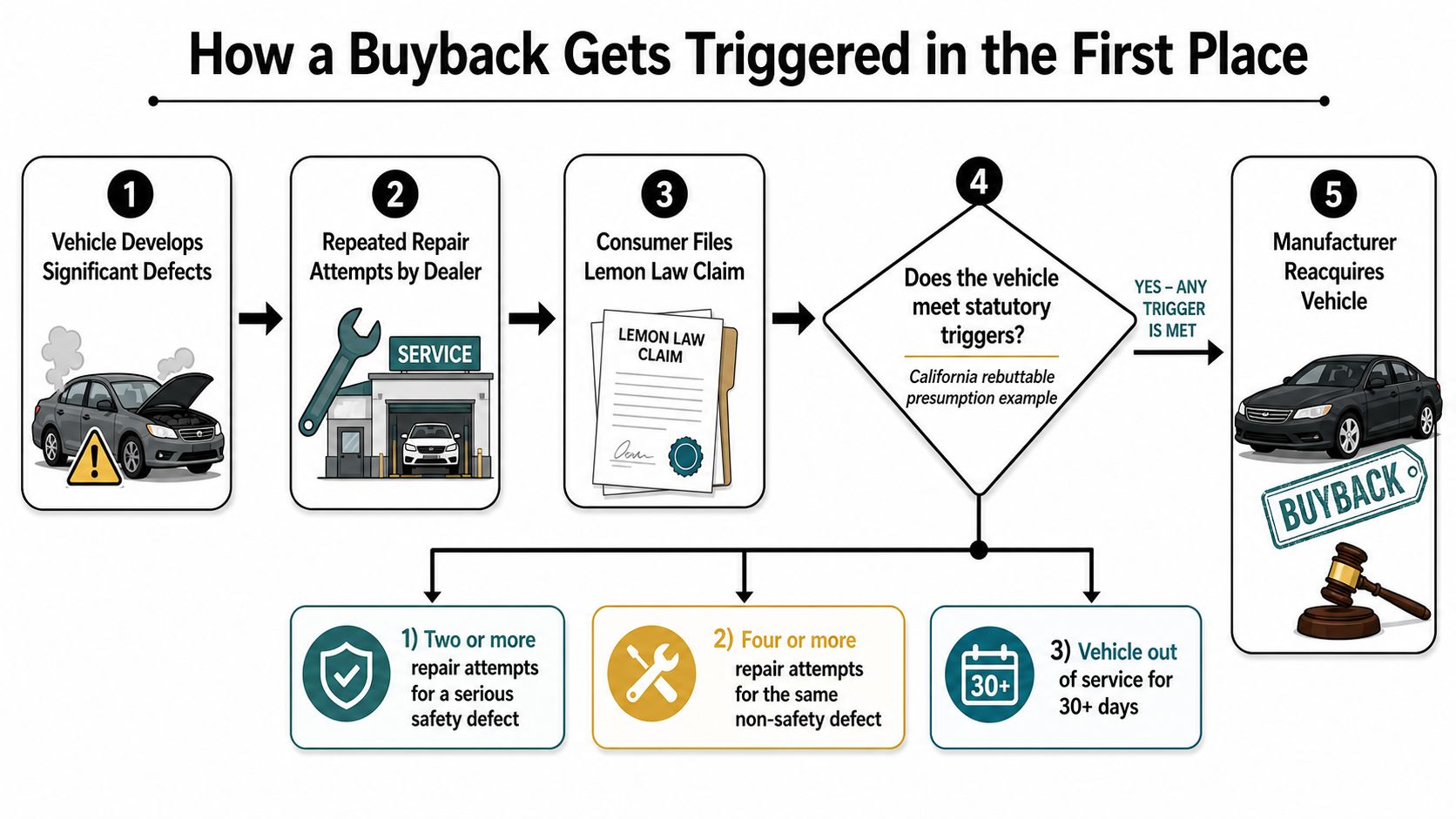
A buyback doesn't happen because a customer is annoyed. It happens because the defect is substantial and the repair trail shows the manufacturer or dealer got repeated chances to fix it. California's consumer guidance lays out the common trigger pattern, four repair attempts, two attempts for a serious safety defect, or 30 or more cumulative days out of service within 18 months or 18,000 miles California Attorney General consumer cars guidance.
The defect class tells you a lot
The bad actors here are usually not cosmetic. They're systems that control whether the car can be trusted at all, powertrain, steering, braking, or electrical faults. When those parts fail, the mileage and time of first failure start to matter because they shape both the legal claim and the resale problem later.
Repair-order chronology is the backbone of the dispute. If the paperwork shows the same complaint, the same mileage band, and the same unresolved symptom coming back over and over, that's the paper trail that pushes a claim forward. If the shop notes are sloppy or missing, the manufacturer gets room to argue the defect never met the statutory trigger.
The strongest claims are built from boring paperwork, not emotional frustration.
The date stamps matter, the odometer entries matter, and the number of days the vehicle sat unusable matters. That's why owners should keep every repair order, even the ones that feel insignificant at the time. A buyback case can turn on the difference between “it was in the shop a lot” and “here's the exact record of when, why, and how long.”
For buyers, this trigger history is also the best clue to the car's future. A vehicle with a documented electrical defect that was repurchased and repaired may be manageable. A vehicle with a recurring safety defect and a thin repair file deserves a hard pass unless the price and warranty terms are unusually strong.
How Buyback Status Reshapes Market Value
A lemon law buyback vehicle can look like a value play on paper, but the market does not forgive the brand. Industry guidance summarized by resale-focused sources puts these vehicles about 15% to 40% below comparable clean-title cars, and branded-title discounts are often cited in the 20% to 40% range depending on the defect, repair quality, and demand buyback resale guidance. That spread is big enough to change the math fast, especially on a higher-priced truck or low-mileage SUV.
The rough logic is easy to see. A vehicle with a permanent defect history narrows the buyer pool, and a narrower buyer pool drags on price. The brand itself isn't the only thing that drives the discount, the defect class and the completeness of the disclosures matter just as much. Buyers pay more when they can see exactly what failed, what was repaired, and what warranty coverage remains.
Many people get distracted by the percentage and miss the actual result. On a more expensive vehicle, even a discount at the lower end can mean serious money left on the table. That's why sellers often resist early, and buyers should resist paying “almost clean-title” money for a car that will always carry a branded history.
The market reality behind the discount
Only a minority of lemon-law claims end in a buyback. A 2023 NHTSA-referenced report cited by WorldMetrics says 62% of claims end in a refund, 28% in a replacement vehicle, and 10% in a buyback WorldMetrics lemon law statistics. That skew matters because it means true buyback inventory is relatively limited, and limited inventory can make pricing messy and uneven from one dealer to the next.
If you're storing a vehicle while a claim plays out, or you're waiting on paperwork before the next step, secure storage can keep the car and documents together without cluttering your driveway. For owners in that position, it's worth looking at a practical option to browse vehicle storage units so the file doesn't get separated from the vehicle.
Dealers, lenders, and insurers don't all react the same way. Dealers usually want enough margin to cover the risk, lenders want comfort that the collateral will hold, and insurers care about how the title brand will affect repair and recovery economics. The cleanest negotiation anchor is not the sticker price, it's the documented defect history plus the title brand plus a realistic appraisal of comparable sales.
Documents Owners Should Request and Preserve
Owners who are pushing for a buyback need paperwork, not memory. The claim lives or dies on the dates, mileage, and repair notes, so every repair order should show exactly when the vehicle came in, what complaint was reported, and what the shop said it found. If the paperwork is thin, the manufacturer can stall the claim by saying the defect was never clearly documented.
Keep the written repair summary from each visit, not just the invoice. The summary is where the service department often admits what it inspected, what it could not duplicate, and whether any parts were replaced. That detail can matter more than the bill itself.
Build the file like you expect to be challenged
Request and save the following:
- Every repair order. Keep the full version with dates, mileage, and the customer complaint.
- The final settlement letter. This is the paper that shows what the manufacturer agreed to do.
- Any arbitration outcome. If the dispute went before a board or arbitrator, that decision is part of the record.
- The odometer reading at repurchase. That number helps establish the vehicle's condition at the handoff.
If the buyback closes, don't toss the file. Keep the warranty on any replaced components, the dealer's disclosure packet for the next buyer, and any later repair records if the same defect comes back. The reappearance question is a real one, and it becomes much easier to answer when the original paper trail is still intact.
For a broader records checklist, this guide to auto claim documentation for 2026 is a useful reference point. It lines up with the same principle here, bad records weaken good claims.
If a seller, manufacturer, or dealer says the file is “complete,” verify that yourself. Half-complete paperwork is where disputes go to die.
A Practical Checklist for Prospective Buyers
A branded buyback can be a decent purchase only when the documentation is solid and the price reflects the risk. Start with the VIN, because the VIN tells you whether the title history, buyback brand, or disclosure trail matches what the dealer is saying. If the seller gets defensive about the VIN, that's already useful information.
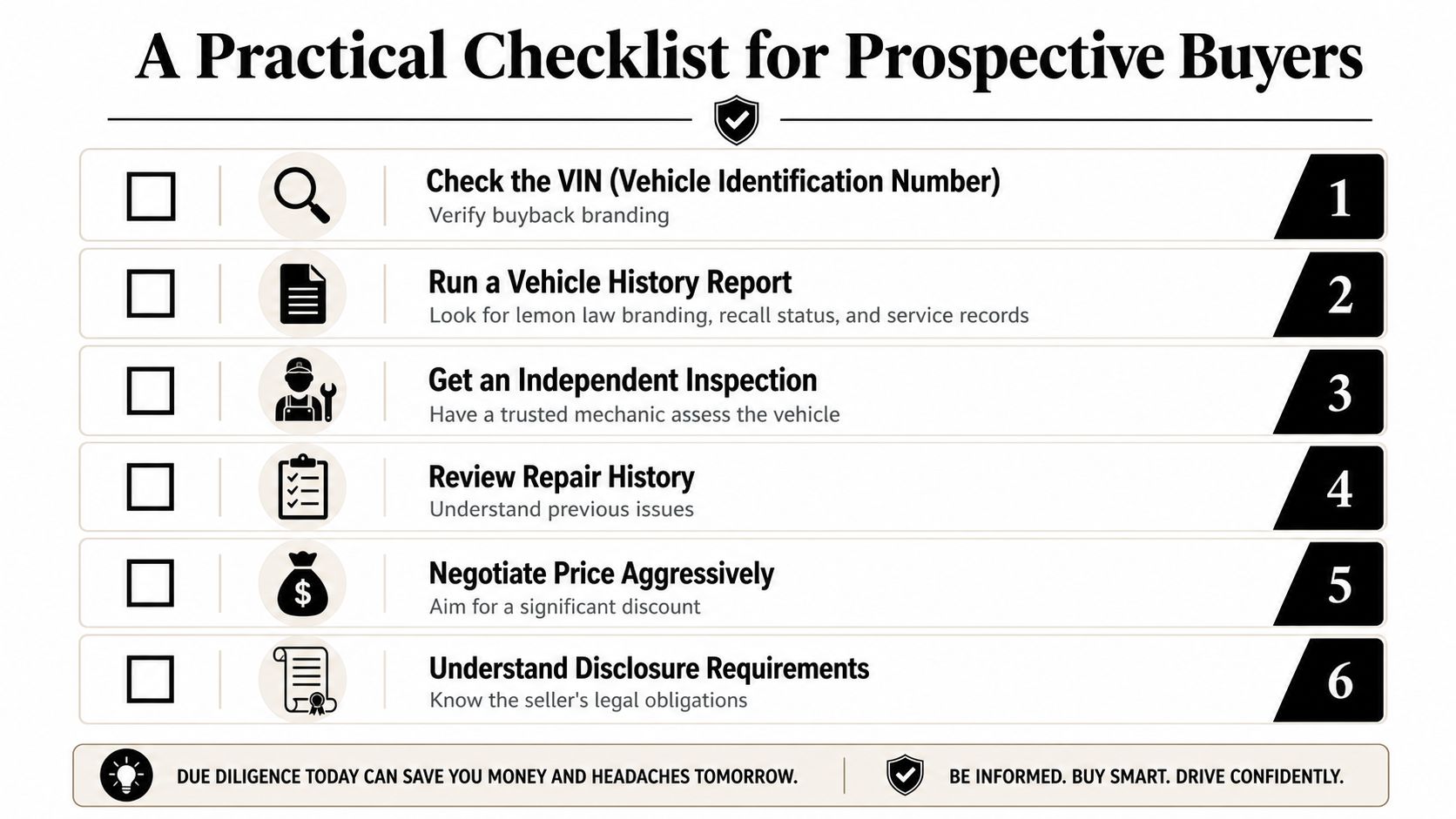
Run the history report and compare it against the door sticker, title brand, and dealer disclosure. Then ask for the repair history, not a summary of it. You want the actual service records that show what failed, what parts were replaced, and whether the manufacturer repaired the same complaint more than once.
The questions that move a dealer
- What defect triggered the buyback? Get the answer in writing, not just verbally.
- What repairs were completed? Ask for the exact work order numbers and the dates.
- What warranty remains? If the seller won't show it, assume the protection is weak.
- Has the problem returned? If the answer is vague, assume it deserves more inspection.
An independent inspection is not optional on a buyback candidate. A mechanic who knows where to look can often spot whether the original fault area still shows signs of trouble, and that's the kind of detail a quick test-drive won't reveal. Check the systems most often involved in buybacks, then verify the recall status through NHTSA before you think about price.
The negotiation should be blunt. Use the documented discount range, the defect class, and the resale penalty to justify the number you're offering. If the dealer is asking near clean-title money, walk.
For another layer of confidence, demand a written warranty or short-term return policy before you sign. If the seller is serious about the repair history, they should be willing to put some risk back on their side of the table. A buyback without a usable warranty is just a discounted problem with nicer lighting.
When a Certified Independent Appraisal Changes the Math
A manufacturer offer or dealer offer is not the truth; it's the opening number. A certified independent appraisal changes the conversation because it replaces the seller's preferred valuation logic with a signed, market-based report that can be used in negotiation. That's the same advantage principle behind the Appraisal Clause work used in total loss and diminished-value disputes.
The advantage is simple. Internal software tends to flatten nuance, while a competent independent appraisal can account for the brand, the defect history, comparable sales, condition, and real market appetite. When a buyback vehicle or branded-title car is being undervalued, the report gives you a clean position to push from instead of arguing from frustration.
When it's worth bringing in an appraiser
Use one when the number feels off and the stakes justify the fight. That usually means the vehicle has stronger-than-average market value, the defect history is documented but poorly understood by the other side, or the seller is refusing to recognize the title-brand penalty in a realistic way. A formal appraisal also makes sense when the same defect history is being used to justify a low offer that doesn't match the actual market evidence.
There's a reason this matters in practice. On these deals, the fight is rarely about whether the vehicle had a problem. It's about how that problem affects value now, and who has the paper to prove it.
If you want a closer look at how a certified report is built and why it matters in a dispute, this certified auto appraiser resource is the right place to start. It's especially useful when the offer on the table looks like it was built to end the conversation, not solve the valuation problem.
A good appraisal doesn't create value out of thin air. It exposes value the other side is trying to ignore.
State-Specific Considerations and Next Legal Resources
Oregon and Washington handle vehicle consumer issues through separate state frameworks, so don't assume a California-style paper trail maps perfectly onto your case. The smart move is to check the state consumer pages, then cross-check the title brand, repair file, and any arbitration options before you accept a settlement. If you're dealing with warranty or contract language in Washington, a practical guide for Washington founders can also help you think clearly about dispute resolution steps and documented influence.
The resources worth bookmarking are the state attorney general consumer pages, the NHTSA lemon-law complaint portal, and any manufacturer-sponsored arbitration program tied to your vehicle. If the paperwork is thin, the brand is confusing, or the number feels low, bring in an independent appraisal before you sign away your bargaining power. Know the brand, know the defect, know the documents, and don't let a shiny discount hide a weak deal.
If you're dealing with a buyback, a branded title, or a settlement offer that feels thin, Total Loss Northwest can help you document value with an independent appraisal and push back with facts. Visit Total Loss Northwest if you want a team that knows how to challenge low numbers and stand up for the market value of your vehicle.