You hear tires lock up, then one impact, then another. Your car stops. The traffic around you doesn't.
Now you're standing on the shoulder or sitting in a disabled vehicle, looking at a line of crushed bumpers, arguing drivers, flashing lights, and a police officer trying to sort out a scene nobody fully saw. That's the reality of a multi vehicle accident. It isn't just one crash. It's a sequence of impacts, separate decisions, and competing insurance stories.
If your car was caught in the middle and you didn't cause it, your biggest risk isn't only the damage. It's getting pushed into a vague, slow-moving claims process where fault gets diluted, insurers point at each other, and you leave money on the table after repairs or a total loss.
The Aftermath of a Multi Vehicle Accident
A multi vehicle accident usually means three or more vehicles are involved. That matters because the claim stops being simple the moment more than two drivers, two policies, and two versions of events enter the picture. In major pileups, the stakes rise fast. Between 2005 and 2021, there were 138 fatal crashes in the United States that involved at least ten vehicles, according to the documented record of multiple-vehicle collisions.
In this situation, the initial focus is often on the body shop, the tow yard, and whether the car still runs. That's understandable, but it's incomplete. In a pile-up, you need to think like a claims file before the insurers do. You need photos, witness names, impact sequence, police report details, and a clean timeline of what happened to your vehicle from first contact to final stop.
Practical rule: In a chain-reaction crash, confusion helps insurers more than drivers.
If you manage work vehicles or your crash involved a commercial truck, these important tips for fleet managers are worth reviewing because fleet claims add another layer of reporting and documentation problems.
For private drivers, the first hours still shape the financial result months later. If you need a grounded checklist right away, review these steps to take after a car accident and follow them while the details are still fresh.
What usually goes wrong first
People talk too much at the scene. They guess. They apologize. They say “I'm fine” before the adrenaline wears off. Then they accept the first insurance framing of the crash as if it's final.
That's a mistake. In a multi vehicle accident, the first story is often wrong, incomplete, or convenient for someone else's insurer. Your job is to protect the facts and protect the value of your vehicle.
Untangling the Chain Reaction Who Is at Fault
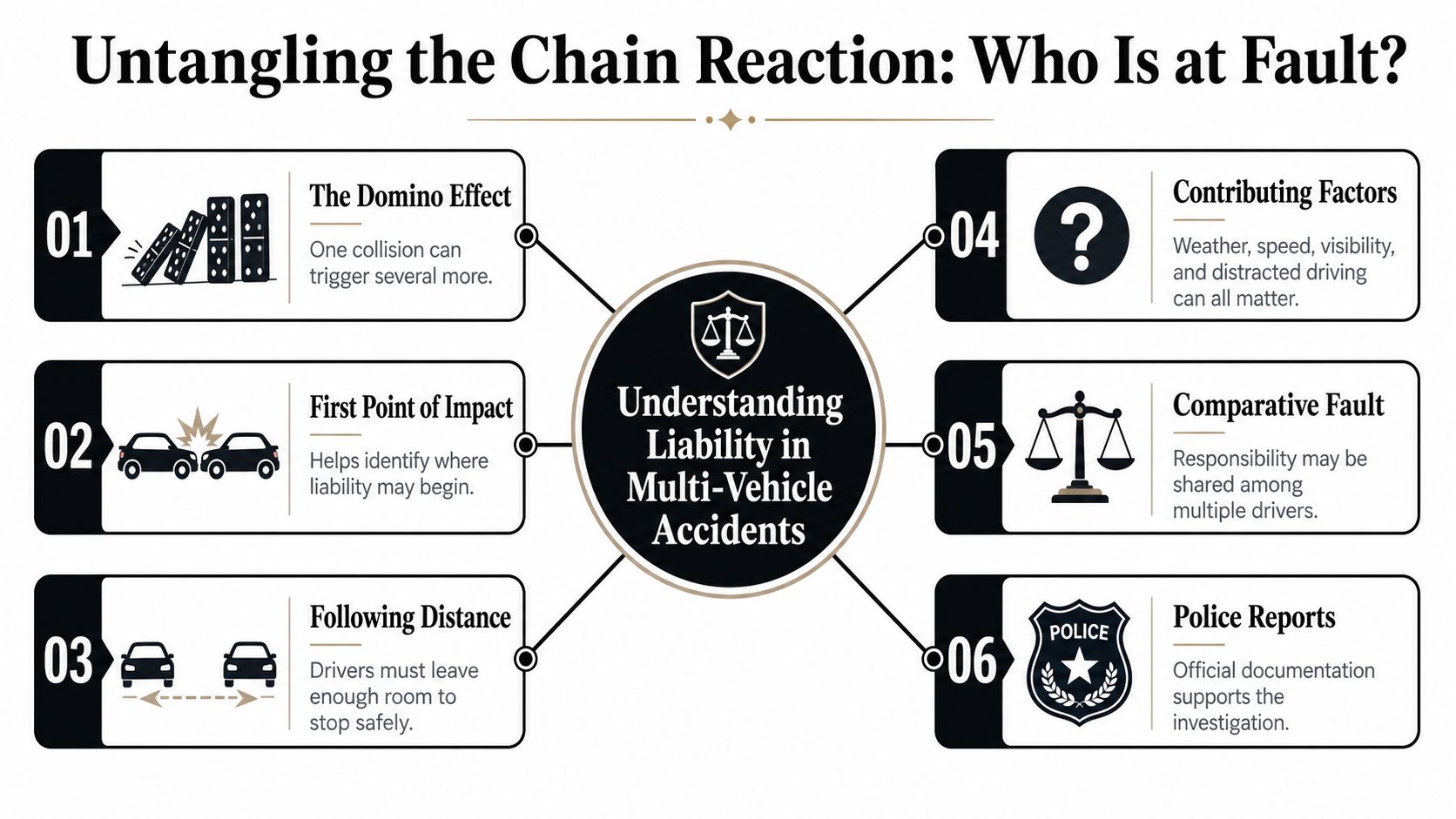
Think of a pile-up like falling dominos. One driver may tip the first piece, but several impacts can follow, and each one has its own legal and factual consequences. The driver who made the first mistake isn't always responsible for every later hit. Sometimes a trailing driver was following too closely. Sometimes a middle vehicle had no realistic chance to avoid a second impact. Sometimes road design, speed, and visibility shaped the entire sequence.
What investigators look for
In fatal crashes involving three or more vehicles, the primary causal factors are road characteristics, vehicle speed, and road type, according to federal crash research on multi-vehicle fatal collisions. That matters because it pushes the analysis beyond the lazy version of fault, which is “somebody hit somebody from behind.”
Crash investigators and insurers usually work from a few hard points:
- First point of impact: Which vehicle started the sequence, and was that contact avoidable?
- Damage pattern: Rear damage, front damage, corner damage, and underride patterns help place vehicles in order.
- Final resting positions: Where each vehicle ended up can support or contradict a driver's story.
- Road context: Interstate traffic, lane merges, limited visibility, slick pavement, and median design all matter.
- Driver behavior: Following distance, lane changes, braking, distraction, and speed relative to conditions.
A police report helps, but it doesn't end the argument. Officers work with a messy scene and limited time. They document observations, statements, citations, and a basic diagram. Useful, yes. Final, no.
Oregon and Washington don't handle shared fault the same way
If your crash happened in Oregon or Washington, comparative negligence changes the money.
Here's the short version:
| State | Fault system | What it means for your claim |
|---|---|---|
| Oregon | Modified comparative negligence | Your recovery can be reduced if you share fault, and your percentage matters a lot |
| Washington | Pure comparative negligence | Fault can be split across drivers, and recovery is adjusted to that share |
If you want a plain-English breakdown of how comparative negligence impacts claims, that overview is useful because shared-fault rules drive how insurers argue over percentages.
Don't confuse blame with proof
The loudest driver at the scene is often the least useful source of information. Focus on what can be verified.
In a chain-reaction crash, liability often turns on sequence, spacing, and road conditions, not on who sounds most confident afterward.
If you were pushed into another vehicle after being hit, say exactly that. If you stopped before impact, say exactly that. If you don't know whether a third vehicle hit you before or after your car moved forward, say you don't know. Precision beats speculation every time.
Navigating Multiple Insurance Claims and Adjusters
A multi vehicle accident can put you in contact with several adjusters at once. One carrier handles the driver behind you. Another handles the lead vehicle. Your own insurer may open a parallel claim. If injuries are involved, separate bodily injury adjusters may start calling too. Each adjuster has a file to close and a theory of the crash that serves that file.
That doesn't mean they're acting in your interest.
Why these claims get messy fast
In a simple rear-end crash, one insurer usually accepts or denies liability and the property damage claim moves forward. In a pile-up, carriers compare statements, wait on the police report, reserve rights, and sometimes delay while they argue over contribution between policies. Meanwhile, your tow bill grows, storage charges stack up, and you still need transportation.
The insurance issue that gets missed most often is inadequate coverage. Emerging data from 2024–2025 shows that 38% of multi-vehicle pileups involve underinsured or uninsured at-fault drivers, as discussed in Bankrate's explanation of stacked vs. unstacked car insurance. That doesn't mean your own policy automatically fills every gap.
What UM and UIM can and can't do
Drivers hear “uninsured” or “underinsured” and assume their own coverage solves the whole loss. It often doesn't.
Use this as your working rule set:
- Bodily injury claims may be different from property damage claims: Coverage that helps with medical losses doesn't always extend the same way to your vehicle's reduced market value.
- Stacking is state-specific and policy-specific: Some drivers can combine limits in some situations. Others can't.
- Property damage is the trap: A lot of drivers assume they can stack coverage for diminished value. In many situations, that assumption falls apart once the policy language gets read closely.
If an adjuster starts speaking in shorthand, slow the conversation down. Ask them to identify the exact coverage they're applying, whether the claim is first-party or third-party, and whether they're discussing repair cost, actual cash value, or a post-repair loss like diminished value.
How to deal with adjusters without hurting your claim
The best approach is calm, brief, and documented. You don't need to argue. You need a paper trail.
Use this approach:
- Confirm everything in writing. After a phone call, send an email summarizing what was discussed.
- Don't guess about impact sequence. If you're unsure, say you're still reviewing the facts.
- Separate vehicle damage from injury discussions. Keep the files clean.
- Track every contact. Name, date, claim number, phone, and what was promised.
- Ask for valuation support. If they make an offer, ask what comparables, condition adjustments, or market sources they used.
If you need a practical script for these conversations, this guide on how to deal with insurance adjusters is a solid reference.
The adjuster's first goal is file control. Yours is claim accuracy.
How to Collect Evidence at the Accident Scene
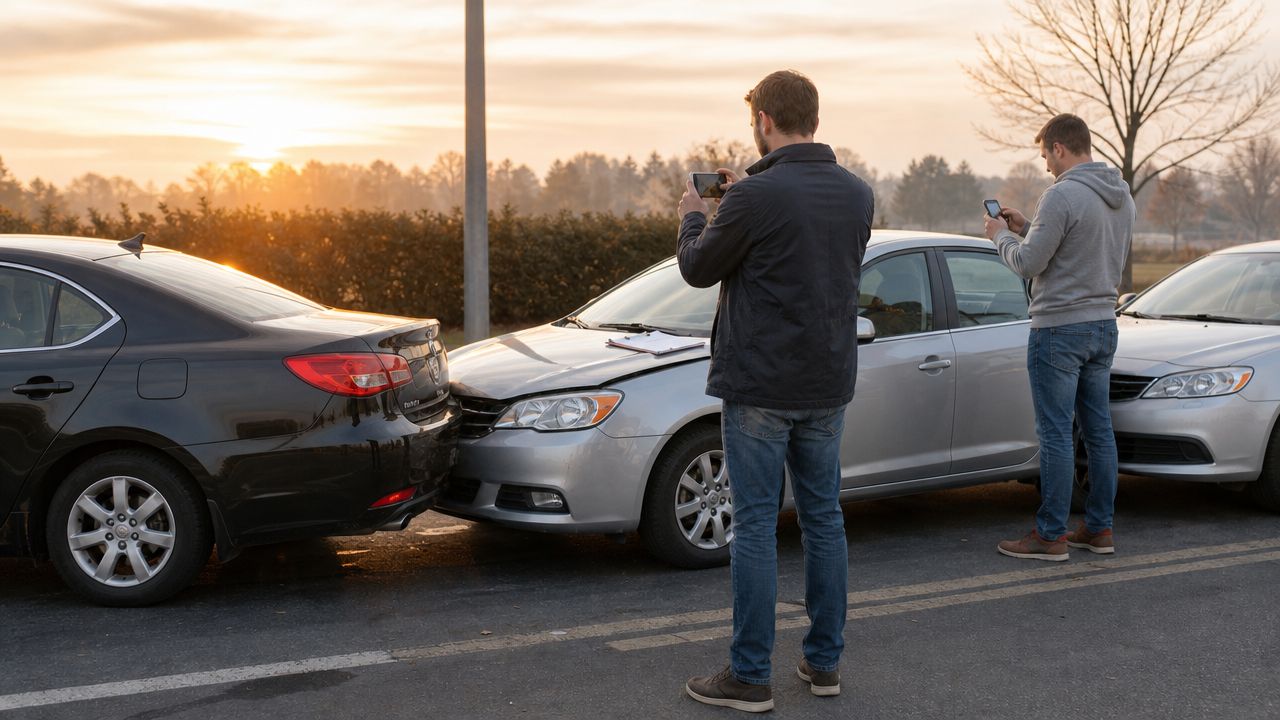
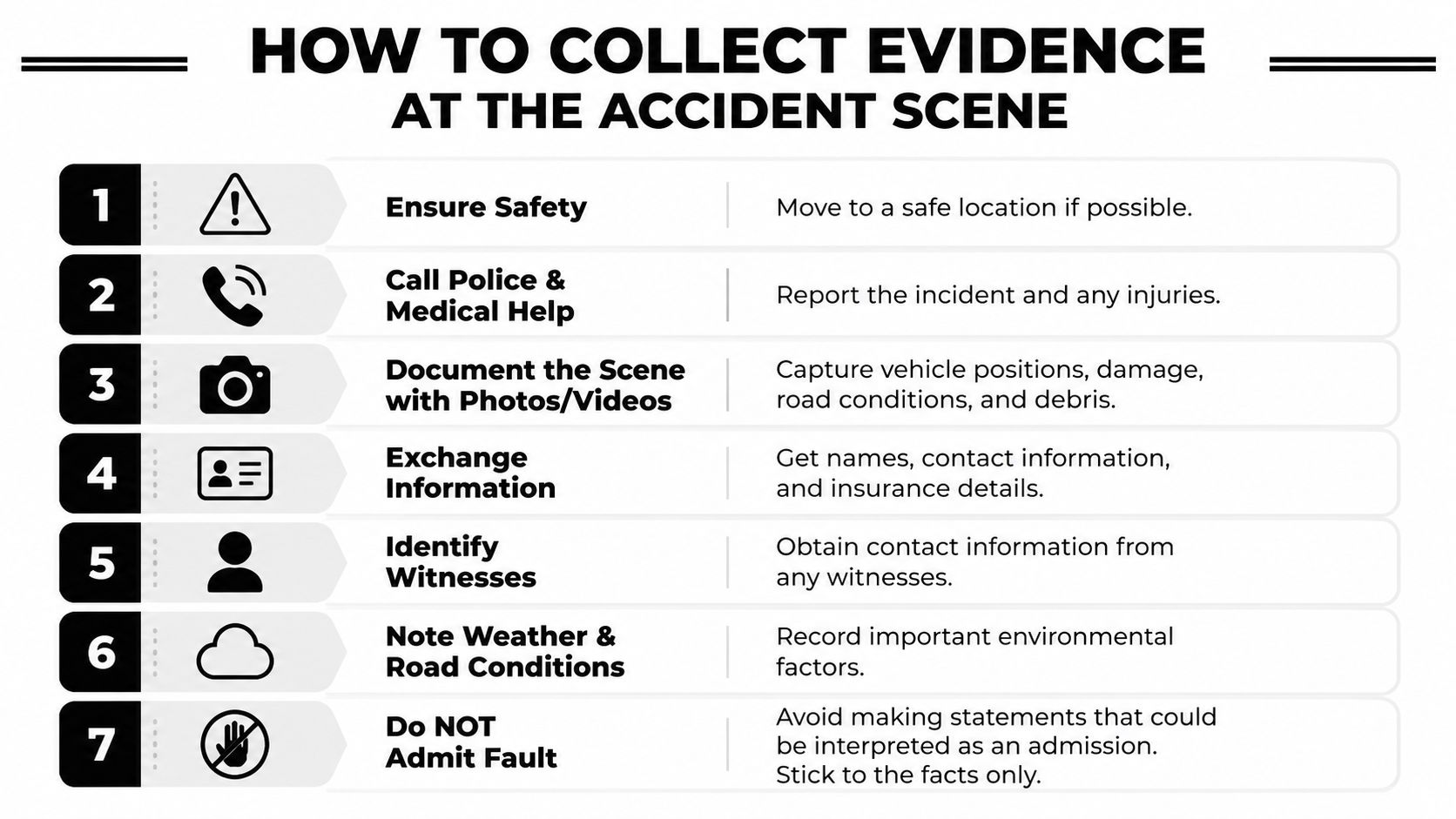
Your evidence starts disappearing the minute vehicles get moved, debris gets cleared, and people drive away. If you can safely use your phone, do it early and do it methodically.
What to capture before the scene changes
Start wide, then move tight.
- Wide shots first: Photograph all vehicles in relation to lanes, shoulders, intersections, barriers, and traffic signals.
- Then the roadway: Capture skid marks, gouges, glass, plastic, fluid trails, and debris fields.
- Then each vehicle: Front, rear, both sides, wheel area, airbags, interior impact points, and license plates.
- Then the environment: Weather, glare, fog, standing water, road construction, and signs.
Video helps too. A slow walkaround with spoken observations can preserve details you'll forget later.
What to collect from people
You don't need a courtroom interview. You need clean identifiers.
Write down or photograph:
- Driver information: Name, phone, plate, insurer, and policy number
- Vehicle details: Make, model, color, and position in the crash sequence if known
- Witness contacts: Name and best phone number
- Police details: Agency, officer name, badge if visible, and report number
Don't coach witnesses. Don't ask leading questions. Just ask what they saw and whether they're willing to be contacted later.
What not to say
This part matters more than people think.
- Don't admit fault: Even casual statements can be repeated as admissions.
- Don't minimize pain: If you're sore, dizzy, or shaken, say so plainly.
- Don't fill gaps with guesses: “I think” and “maybe” become problems later.
- Don't argue with other drivers: You're collecting evidence, not winning a roadside debate.
“State facts. Save conclusions for later.”
Medical documentation protects more than your injury claim
Even if your main concern is the car, get checked if you feel off. A documented evaluation anchors your timeline and supports your credibility. People who wait too long often end up fighting over whether the crash caused the symptoms at all.
The same rule applies to your vehicle. If a tow operator, storage yard, or body shop takes possession, keep every receipt, intake photo, and repair communication. In a multi vehicle accident, those records can help prove whether damage came from the crash, storage handling, or later movement.
Recovering the Hidden Loss of Diminished Value
Most drivers understand repair costs. Fewer understand diminished value. That's the loss in market value your vehicle carries after an accident, even if the repair work looks excellent. Buyers pay less for a vehicle with collision history. Dealers account for it. Appraisers account for it. Insurers often hope you won't.
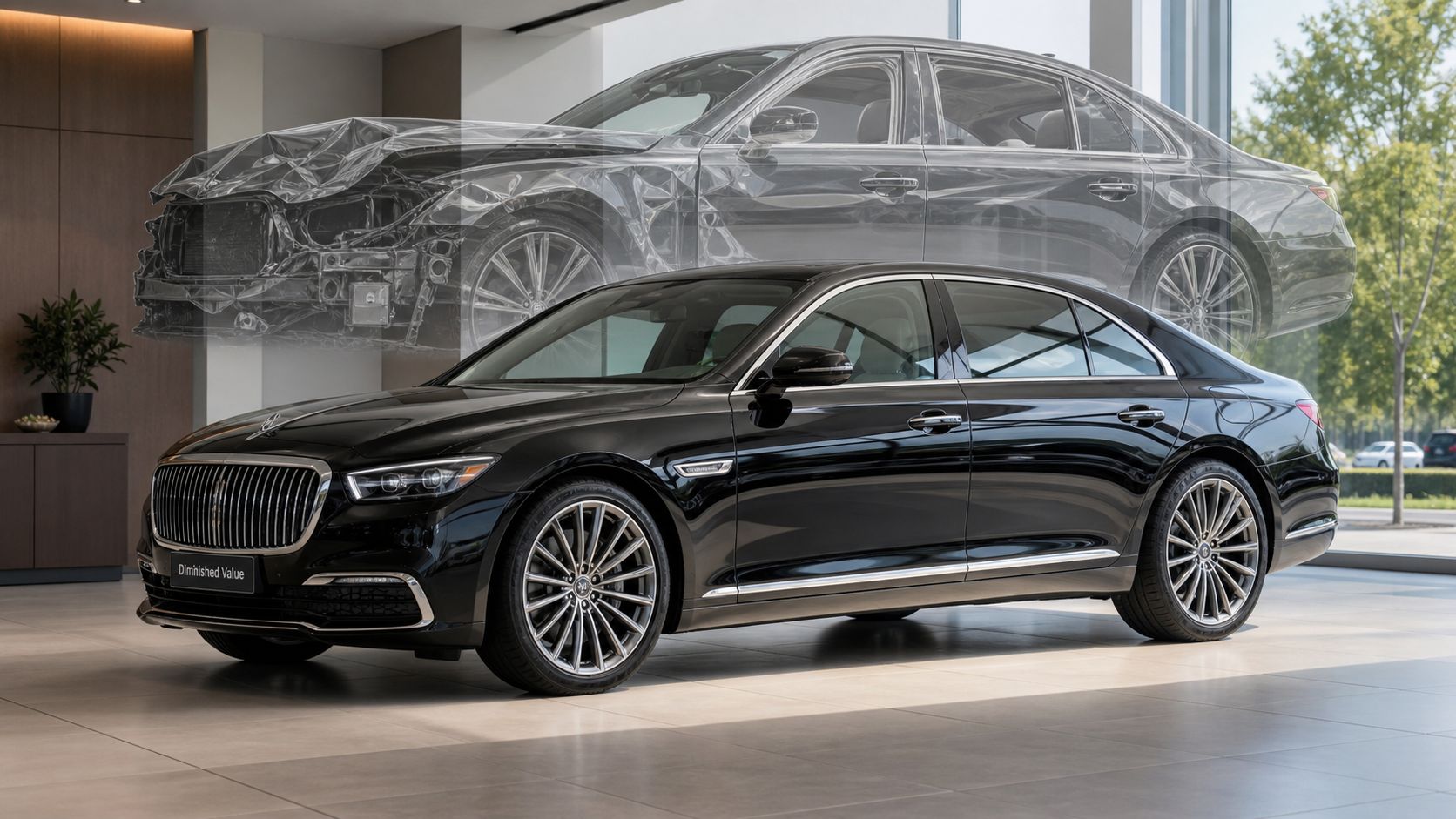
That loss becomes more important after a multi vehicle accident because these crashes often involve multiple impacts, side damage, suspension damage, structural concerns, or a long repair history. Even when the car returns to service, the stigma stays with it.
Why insurers sidestep this claim
Most claim conversations stop at “your car has been repaired.” That's convenient for the carrier. It ignores the fact that the car's resale profile changed the day the accident entered its history.
There's another layer most drivers never get told about. Most content on multi-vehicle accidents fails to explain how diminished value is calculated across multiple at-fault drivers, leaving non-fault drivers unsure whether they can pursue the claim against one insurer or several, as noted in this discussion of multiple-vehicle claims in California. The state law in that article is California-specific, but the underlying problem is broader: pile-ups complicate who pays for the loss in value.
What makes a stronger diminished value file
A weak DV claim is just a complaint. A strong one is documented market evidence.
Build it around:
- Vehicle identity: Year, make, model, trim, mileage, options, and pre-loss condition
- Repair scope: Parts replaced, structural work, paintwork, calibration, and whether OEM or aftermarket parts were used
- Damage severity: One impact or multiple impacts, and which areas were hit
- Market effect: Comparable vehicle sales and listings, adjusted for accident history and condition
If your vehicle is high-value, custom, collectible, or in excellent pre-loss condition, the need for a disciplined appraisal gets even sharper. Generic formulas often flatten real market differences and undervalue the loss.
Here's a straightforward video that helps frame the issue:
Don't wait until the claim is closed
Insurers count on delay. Once the repair file is wrapped and you've mentally moved on, it gets harder to reopen the discussion with bargaining power.
A repaired car can still be a financially damaged car.
If you believe your vehicle lost market value, raise diminished value early, keep the repair documents organized, and insist that the discussion include the accident history's effect on resale, not just the shop invoice.
Fighting Lowball Offers When Your Car Is a Total Loss
When the damage is severe enough, the insurer may declare the car a total loss instead of repairing it. Drivers often hear that decision and assume the valuation that follows is fixed. It isn't.
The offer is just the insurer's number. It is not the market's final word on your vehicle.
Why the first valuation is often too low
Insurers usually build total loss offers from valuation reports that rely on comparable vehicles, condition adjustments, option data, and local market assumptions. That process sounds objective. It often isn't. Bad comparable choices, weak condition grading, missed options, and thin market matching can drag the number down fast.
Road crashes create enormous financial fallout. The World Health Organization reports that between 20 and 50 million people suffer non-fatal injuries from road traffic crashes each year, creating a major economic burden for victims and families, as outlined in the WHO fact sheet on road traffic injuries. When your vehicle is declared a total loss, that burden becomes immediate.
What insurers commonly miss
A short list of trouble spots shows up again and again:
| Valuation issue | Why it hurts you |
|---|---|
| Wrong trim or package | The offer reflects a cheaper vehicle than the one you owned |
| Poor condition grading | Clean, well-kept vehicles get valued like average ones |
| Weak comparables | Listings or sales from the wrong market distort actual local value |
| Missed upgrades | Recent tires, accessories, or premium equipment may be ignored |
| Incomplete history | Service records and pre-loss condition don't make it into the report |
If your car was unusually clean, carefully maintained, or hard to replace in your area, a generic valuation model can miss the point entirely. That's especially common with enthusiast vehicles, luxury trims, trucks with meaningful equipment differences, and older vehicles in exceptional condition.
Treat the offer as a draft
Read the report line by line. Check the trim, mileage, options, condition notes, and comparable vehicles. If anything is off, challenge it in writing. Don't settle just because the number arrived on official letterhead.
Using the Appraisal Clause to Secure Your Fair Settlement
If you're stuck on a low total loss offer or a disputed value loss, the appraisal clause is often the cleanest way to force a real valuation fight instead of a circular debate with an adjuster. Many drivers have this right in their own auto policy and never use it.
That's a mistake.
What the clause actually does
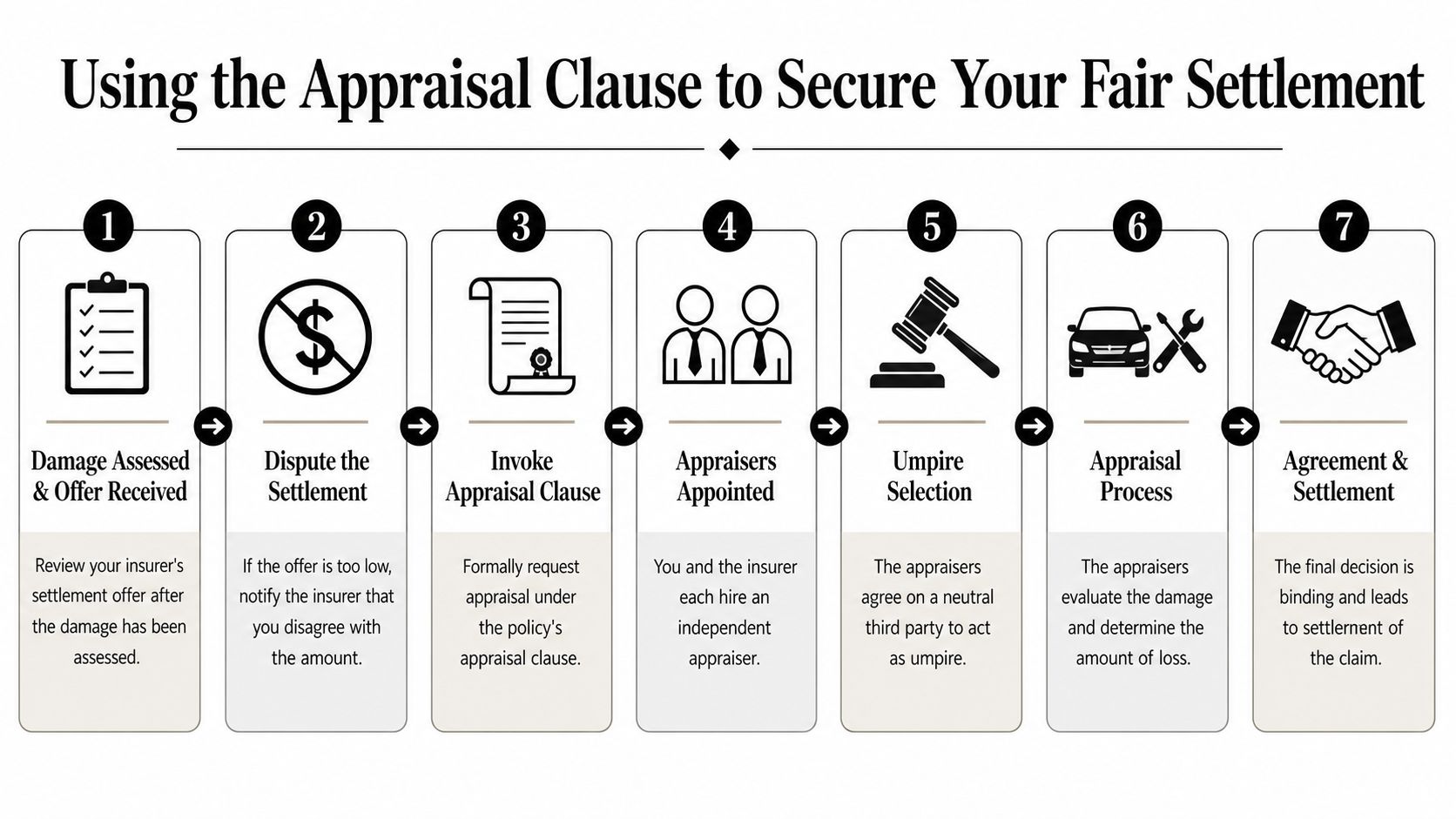
The appraisal clause is a contractual process for resolving disputes over value. Not liability. Not injury. Value.
That distinction matters. If the carrier agrees your car is totaled but undervalues it, or acknowledges a loss but downplays the amount, appraisal can move the dispute out of ordinary adjuster back-and-forth and into a structured process.
How to use it effectively
The basic path usually looks like this:
- Review your policy language. Confirm the clause exists and note any notice requirements.
- Dispute the insurer's valuation in writing. Be direct. State that you disagree with the amount.
- Invoke the appraisal clause formally. Use the policy terms, not a casual phone request.
- Select your appraiser. Choose someone who works from real market support and detailed inspection data.
- Let the appraisers compare positions. If they can't agree, an umpire may be brought in under the policy process.
- Resolve the amount of loss. That result usually carries far more weight than another adjuster conversation.
If you want to understand the mechanics before sending the letter, review this overview of the insurance appraisal process.
Why this works better than arguing with software
Valuation software is only as good as the inputs. If the insurer's report starts from weak comparables or bad condition assumptions, every conclusion after that is distorted. The appraisal clause gives you a path to challenge those inputs with evidence, not frustration.
Bottom line: If the insurer and the market don't agree, the policy may already give you the tool to force a fairer answer.
For drivers in Oregon and Washington, that can be the difference between accepting a convenient number and securing a supportable one. In a multi vehicle accident, where fault disputes and claim delays already drain your energy, appraisal restores advantage. It turns the conversation back to the actual value of what you lost.
If your vehicle was totaled or lost value after a multi vehicle accident in Oregon or Washington, Total Loss Northwest can help you challenge low valuations with certified independent appraisals and appraisal clause support. If an insurer is leaning on weak software or ignoring real market value, get the claim reviewed before you accept the offer.