The call from the insurance company usually sounds calm and final. They've reviewed the file, they have a valuation, and they're ready to settle. If your vehicle was uncommon, modified, exceptionally clean, or better than the generic examples in their system, that offer can feel disconnected from reality.
That's where most owners get stuck. They assume the carrier's number is the number.
It isn't.
A Specialty Vehicle Appraisal is how you move the discussion from software output to documented market evidence. If you're in Oregon or Washington and the claim involves a total loss or post-repair loss in value, the appraisal isn't just a valuation tool. It's the document that can put you in position to invoke the Appraisal Clause and force a fairer process.
Your Guide to Fair Vehicle Value After an Accident
If you've just been handed a low settlement offer, your first problem usually isn't damage. It's the advantage. The insurer has a number on paper, adjusters speak in confident terms, and the owner is left trying to explain why a modified truck, collector car, or unusually well-kept daily driver isn't the same as the generic comparables their system found.
That's why “book value” causes so many bad settlements. It treats unlike vehicles as if they're interchangeable. It overlooks upgrades, prior restoration work, exceptional maintenance, regional demand, and the details that separate your vehicle from an average example.
A proper appraisal changes the conversation because it documents value the way a dispute needs to be documented. It ties condition to evidence. It ties features to market impact. It ties the final number to comparable sales instead of an insurer's internal valuation shortcut.
Practical rule: If the offer doesn't reflect your vehicle's actual market position, stop arguing from memory and start arguing from documentation.
Owners in Oregon and Washington often need that shift quickly. After an accident, carriers move fast. Storage charges start. Rental deadlines close in. Pressure builds to accept the first number and move on. That's exactly when you need a report that can stand up in negotiation, appraisal, arbitration, or court.
What works is simple, even if the process isn't. Get an independent appraisal. Build a clean evidence file. Use the report strategically. If necessary, invoke the Appraisal Clause so the dispute leaves the insurer's software and enters a formal valuation process.
What doesn't work is sending angry emails, forwarding random online listings, or insisting your vehicle was “worth more” without records to back it up.
The strongest claims are rarely the loudest. They're the best documented.
What Is a Specialty Vehicle Appraisal and Who Needs One
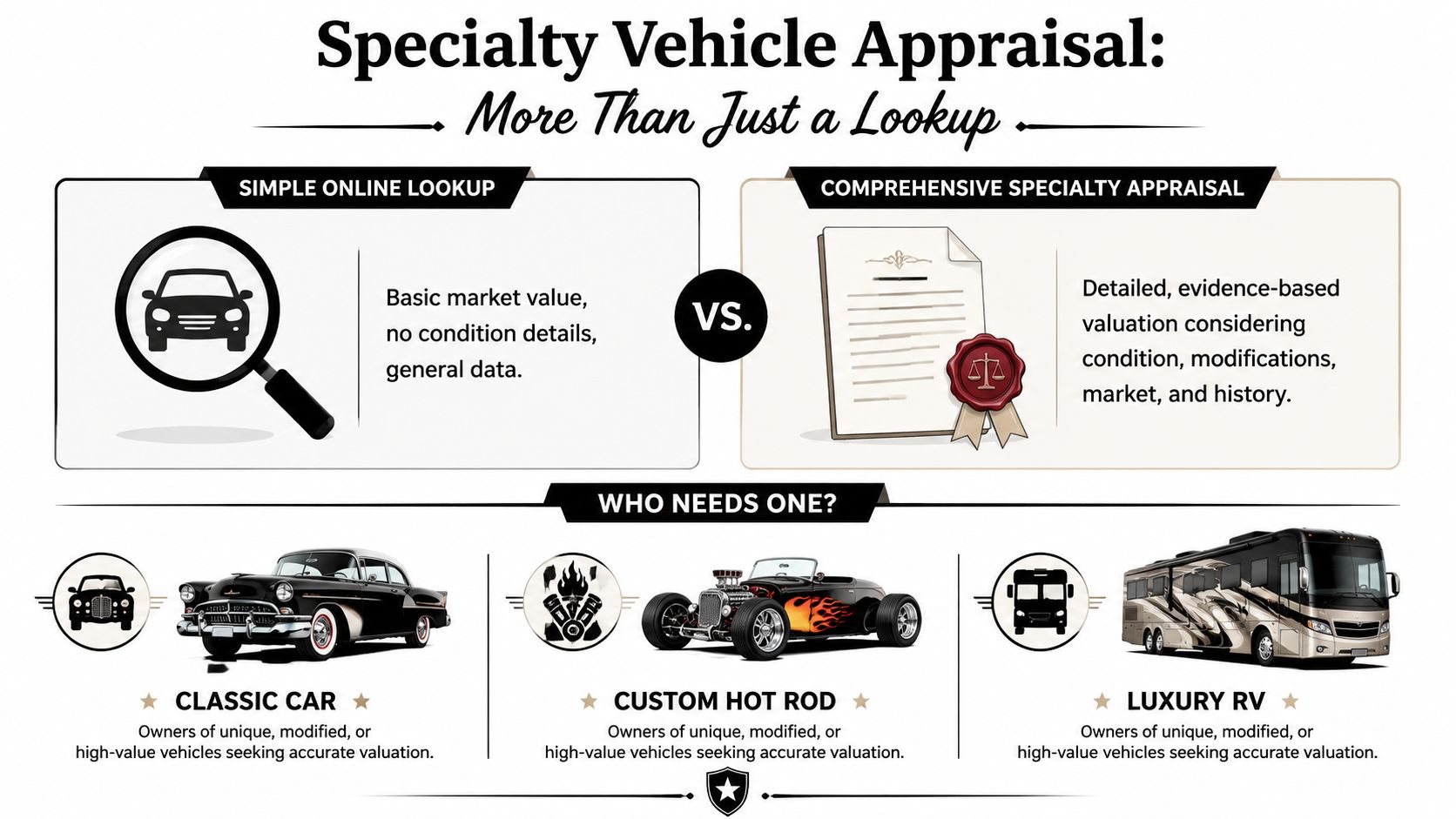
A Specialty Vehicle Appraisal is not a price guess, a trade-in quote, or a value pulled from a consumer website. It's a documented opinion of value built from inspection, market research, comparable sales, and written support for every important adjustment.
Off-the-rack value versus tailored value
The easiest way to understand the difference is this. An insurer's automated valuation is like an off-the-rack suit. It fits broadly, quickly, and cheaply. A specialty appraisal is customized to the actual vehicle in front of you.
That distinction matters because the legal definition of fair market value is narrower than many owners realize. Under the IRS market definition discussed here, fair market value is what a member of the general public would pay, not a dealer's trade-in figure, and dealer trade-in values are often 15 to 20% lower than public retail values. For specialty vehicles, that means the appraiser should work from the most common market, using consumer-to-consumer sales data rather than defaulting to dealer numbers.
Who actually needs one
Many people hear “specialty” and think only of vintage Ferraris or restored muscle cars. In claims work, the category is broader.
You likely need a specialty appraisal if your vehicle falls into one of these groups:
- Classic or collector vehicles that don't trade like ordinary commuter cars.
- Modified vehicles such as lifted trucks, performance builds, custom paint vehicles, or cars with significant aftermarket parts.
- High-condition daily drivers where maintenance, recent work, or trim level materially affects value.
- Total loss claims where the insurer's offer doesn't match the actual replacement market.
- Diminished value claims when a repaired vehicle now carries an accident history that lowers what buyers will pay.
Some owners also need one because their vehicle sits in an awkward middle ground. It isn't rare enough for the insurer to treat it carefully, but it isn't standard enough for valuation software to get it right.
If that's your position, a specialist matters more than a generalist. The appraiser needs to know where to find relevant sales, how to adjust for the right factors, and how to write a report that can withstand challenge. That's especially important for classics and niche vehicles, where classic auto appraisers often work from market channels ordinary valuation tools ignore.
The right appraisal doesn't just answer, “What is it worth?” It answers, “How do we prove it?”
The Certified Appraisal Process from Start to Finish
A professional appraisal should feel structured, not mysterious. If the process sounds vague, the report usually is too.
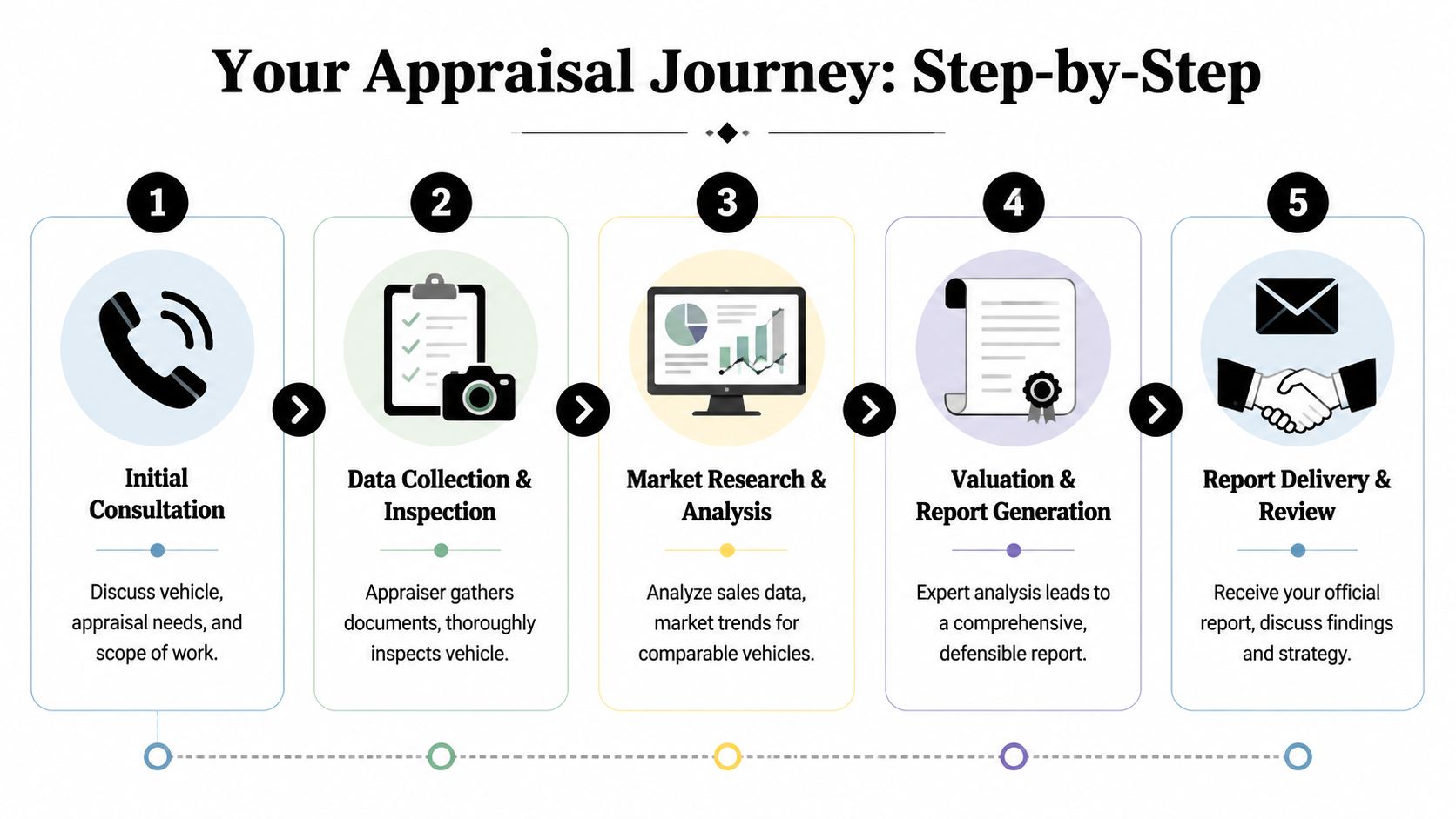
Step one through inspection
The process starts with the claim context. The appraiser needs to know whether the dispute involves total loss, diminished value, estate, donation, or another use. That changes the scope of work and the reporting standard.
Then comes the inspection. The appraiser documents the vehicle's identity, condition, equipment, damage profile, prior repairs if visible, and any features that move value up or down. Age, mileage, and overall condition are foundational inputs. They aren't the whole story, but they set the baseline.
For owners who've never ordered one before, this overview of what a car appraisal involves gives a useful picture of the assignment from first contact to finished report.
Market research and report writing
After the inspection, the hard work usually begins. The appraiser researches comparable sales, filters out weak comps, adjusts for relevant differences, and documents why each adjustment was made. A strong report doesn't just list similar vehicles. It explains why they are similar enough to matter.
According to this explanation of the workflow and reporting standard, the full process from physical inspection to a final USPAP-compliant report typically takes 48 hours, and that timeline supports the inclusion of three to five verified comparable sales plus written rationale for the value adjustments.
What USPAP compliance means in practice
USPAP stands for Uniform Standards of Professional Appraisal Practice. Clients don't need to memorize the acronym, but they should care what it means. A USPAP-compliant report is built to be auditable. The appraiser has to show the scope of work, identify the data used, and explain the reasoning behind the conclusion.
That matters because claims disputes are won by documentation, not by confidence. If your report reaches a value but doesn't show how, it gives the insurer an easy target.
A usable report typically includes:
- Vehicle identification with VIN, trim, mileage, and relevant equipment.
- Condition documentation with photographs and notes about interior, exterior, body, paint, and mechanical condition.
- Comparable sales analysis showing the vehicles considered and the adjustments applied.
- Final opinion of value stated clearly for the claim purpose.
A good report lets another professional follow the logic from raw market data to final number without guessing what happened in between.
Gathering Evidence for a Watertight Valuation
The strongest appraisal starts before the appraiser sees the vehicle. Owners who build a clean file almost always make the process easier and the result more defensible.
Build the file before memories fade
After an accident, details disappear fast. Receipts get lost. Photos stay buried in an old phone. Service history becomes “I know I had work done” instead of a dated invoice.
Start collecting documents immediately. Don't wait until the insurer rejects your position.
Bring together these records first:
- Repair invoices for recent mechanical, body, suspension, or restoration work.
- Modification receipts for wheels, tires, lift kits, exhaust, stereo work, paint protection, tuning, or custom fabrication.
- Maintenance history including oil services, timing components, brakes, cooling system work, and major preventive maintenance.
- Purchase records such as the bill of sale, financing paperwork, or original listing if it captured condition accurately.
- Pre-accident photos from sales listings, club events, social media posts, or your own phone.
What helps and what hurts
Not every document carries equal weight. A receipt with part descriptions, labor notes, and dates helps. A vague handwritten note usually doesn't. Clear, pre-loss photographs help. Dirty, low-light photos taken after impact don't establish pre-loss condition.
A short owner summary can also be useful if it stays factual. List what was done, when it was done, and which documents support it. Don't inflate. Don't editorialize. If a modification added market appeal, the appraiser can address that. If it narrowed buyer demand, that should be reflected accurately too.
Think like you're preparing for challenge
Insurers often test weak points. If they can't dispute the whole valuation, they'll dispute the assumptions behind it. That's why your file should answer obvious questions before they're asked.
Use this checklist:
- Dates matter. Organize records by timeline so recent value-adding work is easy to identify.
- Match parts to vehicle. If you upgraded components, make sure invoices clearly connect them to your car or truck.
- Label photos. Note whether each image is pre-accident, post-accident, or post-repair.
- Keep communications. Save insurer emails, valuation reports, and settlement letters in the same folder.
The goal isn't to overwhelm the appraiser with paper. It's to make sure no real value gets left out because it wasn't documented.
How to Win Total Loss and Diminished Value Claims
The call usually goes the same way. Your insurer has made an offer, the number is too low, and the adjuster sounds finished with the discussion. That is the point where a specialty appraisal stops being paperwork and starts becoming a claim tool. Used correctly, it gives you a documented basis to dispute the carrier's number and, if needed, invoke the Appraisal Clause to force a fairer value process.
Total loss versus diminished value
A total loss claim is a fight over what the vehicle was worth immediately before the accident. The insurer may rely on a market report, dealer comps, or valuation software. If the vehicle is modified, rare, unusually clean, or hard to match with local comparables, those systems often miss real value.
A diminished value claim is a fight over what the vehicle lost after repair. The car or truck is back on the road, but the market now discounts it because the VIN shows damage history, repair history, or both. That discount can be modest on a late-model commuter car and much more serious on a specialty vehicle where originality, condition, and buyer confidence drive price.
For Oregon and Washington owners, the hard part is usually not feeling underpaid. It is proving, in a form the insurer has to answer, what the vehicle was worth before the loss or how much market stigma remains after repair. As explained in this discussion of specialty appraisal disputes, a certified total loss appraisal can be the document that supports a formal value dispute under the policy.
How the Appraisal Clause Shifts the Balance
The Appraisal Clause matters because it changes the setting of the dispute. You are no longer asking the insurer to reconsider out of goodwill. You are invoking a contract procedure that requires both sides to address value through appraisers.
That distinction matters in real claims. Internal reconsideration often stays tied to the same database, the same adjuster notes, and the same narrow comp set that produced the low offer in the first place. Once the clause is invoked correctly, the carrier has to respond within the appraisal framework set by the policy.
The usual path looks like this:
- Get a certified independent appraisal that addresses the exact dispute, total loss value or diminished value.
- Send a written dispute letter identifying the insurer's figure and the value you are contesting.
- Invoke the Appraisal Clause under the policy language if the carrier does not correct the number.
- Require the dispute to be decided through competing appraisals instead of informal back-and-forth with the adjuster.
I tell clients the same thing after an accident. If the insurer used a valuation system, your response needs to be a defensible report, not screenshots and frustration.
Modified vehicles require a claim-specific approach
Modified vehicles are where weak insurer valuations show up fast. A base-model pricing formula does not reliably measure a truck with suspension work, a collector vehicle with documented restoration, or a performance car with quality aftermarket parts.
That does not mean every modification adds dollar-for-dollar value. Some upgrades increase market appeal. Some only matter to a narrow buyer group. Some hurt value because the workmanship is poor or the changes make the vehicle harder to finance, insure, or resell. A credible diminished value analysis has to sort through those trade-offs item by item.
If your claim involves repaired custom work, aftermarket parts, or a vehicle that appeals to a specialty market, this guide to automobile diminished value for specialty and modified vehicles gives useful background on why generic formulas often miss the actual post-repair loss.
Here's a practical explainer that gives the process more context:
What a persuasive claim package looks like
A strong appraisal can still fall flat if it is submitted poorly. Send a clean claim package that makes the dispute easy to follow and hard to sidestep.
Include:
- The signed appraisal report in final form.
- A short dispute letter stating the insurer's amount, your disagreement, and your request for revision or appraisal under the policy.
- Key supporting records such as build receipts, major repair invoices, prior listings, or pre-loss photos.
- The insurer's valuation report or settlement letter so the disagreement is tied to a specific number.
Keep the tone factual. Clear writing and organized records do more for a claim than anger ever will.
If the insurer still stands on an unsupported number, that is usually the point to stop debating and invoke the Appraisal Clause.
Choosing an Appraiser and What to Expect for Costs
Not all appraisers do the same work, and that matters a lot in a dispute. The person valuing a dealer-trade sedan for a sale price discussion is not automatically the right person to handle a modified truck total loss, a collector car, or a diminished value fight.
What to look for first
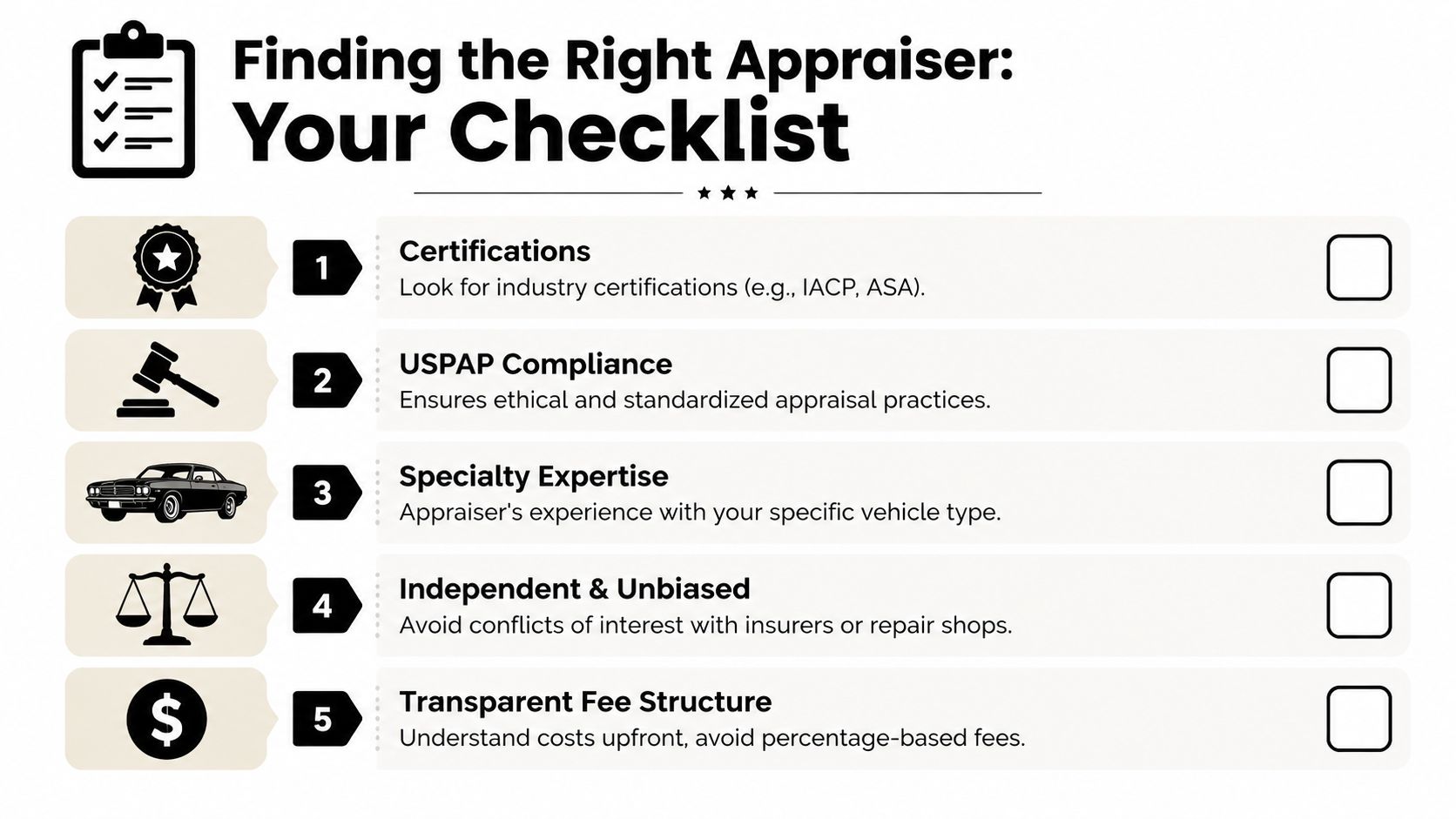
Start with independence. If the appraiser works primarily for insurers or shops that depend on insurer referrals, ask hard questions about conflict and assignment type. In disputed value work, independence isn't a marketing phrase. It's the whole point.
Then look for these signs of competence:
- USPAP-compliant reporting so the work product is structured for scrutiny.
- Relevant specialty experience with your kind of vehicle, not just cars in general.
- Claim-specific familiarity with total loss or diminished value, depending on your issue.
- A defensible comp process that uses relevant market channels and written adjustments.
- Willingness to explain methodology without becoming evasive or theatrical.
A quick screening table
| What to ask | Good answer | Weak answer |
|---|---|---|
| Have you handled vehicles like mine? | Specific examples by type and claim context | “A car is a car” |
| Is the report USPAP compliant? | Clear yes, with explanation | Vague reference to “industry standard” |
| How do you select comps? | Relevant sales with explained adjustments | “We use market averages” |
| Who do you usually work for? | Mixed or owner-focused independent work | Mostly insurer-driven assignments |
The right appraiser should be able to explain their method in plain English. If they hide behind jargon, expect problems later.
What the cost usually looks like
Pricing depends on the vehicle and the depth of work required. According to this breakdown of vehicle appraisal pricing, a professional vehicle appraisal typically costs $150 to $600. The same source notes that a standard certified appraisal with in-person inspection and a USPAP-compliant report often falls in the $250 to $750 range, while specialty valuations for classic or highly modified vehicles can cost $750 or more because the research is more intensive.
That pricing makes sense in practice. A common vehicle with a straightforward claim usually requires less research. A rare, custom, or high-value vehicle takes more time to inspect properly, more effort to source meaningful comps, and more writing to support the conclusion.
Cost versus recovery
Clients often ask whether the appraisal is “worth it.” The better question is whether the insurer's number can be trusted without challenge.
If the carrier undervalued a unique vehicle, the appraisal is often the only document that gives you a realistic path to a better result. Cheap reports can be expensive if they collapse under scrutiny. Strong reports cost more because they require more work.
Specialty Vehicle Appraisal FAQ
Can the insurance company reimburse the appraisal cost
Sometimes, yes. Sometimes, no.
Reimbursement depends on the policy wording, the type of claim, and how the dispute ends. In an Appraisal Clause dispute, each side often pays its own appraiser, while other costs may be handled differently. Do not treat reimbursement as automatic.
Keep your invoice. Ask for reimbursement in writing if the facts support it. If the carrier refuses, that issue can still matter later during settlement discussions or with counsel.
What if my vehicle has a salvaged or rebuilt title
A salvaged or rebuilt title does not block an appraisal. It changes how the value is supported.
The report needs to address the title brand, the quality of prior repairs, current condition, and how buyers in your market treat that history. For some vehicles, insurer software applies broad deductions that do not fit the actual unit. I see this often with rebuilt specialty vehicles that have strong documentation and clean post-repair ownership history. They still take a hit, but the right question is how much, not whether value exists at all.
Can undesirable modifications lower the appraised value
Yes. They can.
Owners are often surprised by this, especially if they spent real money on parts. Cost does not equal market value. A well-documented suspension, wheel, tuning, or cosmetic package may help if it matches buyer demand and the workmanship is good. Poorly chosen parts, incomplete installs, or highly personal styling can shrink the buyer pool and lower the number.
That is why modified-vehicle appraisals need line-item analysis. The goal is to separate what adds value, what adds little, and what may hurt market appeal.
Can I get an appraisal before I buy a vehicle
Yes, and it is often money well spent.
A pre-purchase appraisal can catch condition problems, weak prior repairs, unsupported seller claims, or pricing that does not match the market. That is especially useful with classics, exotics, swaps, and heavily modified vehicles where online listings can be misleading.
For an accident claim, though, the assignment has to fit the dispute. A pre-purchase report is different from a total loss appraisal or a diminished value appraisal. If you are preparing to challenge a low settlement, make sure the appraiser is writing a report that can hold up when the carrier reviews it and, if needed, when the Appraisal Clause is invoked.
What if the insurer says their valuation is final?
That statement usually means the adjuster does not plan to move voluntarily. It does not end the dispute.
If your policy includes an Appraisal Clause and the disagreement is about value, you may have a formal way to force the issue out of the adjuster's hands. That changes the posture of the claim. The carrier now has to defend its number against a supported appraisal instead of repeating it.
Owners in Oregon and Washington frequently gain traction through this method. A certified appraisal gives you a documented market value position, and the Appraisal Clause gives that position procedural weight. The details still matter. Policy wording matters. Deadlines matter. The report has to be written for a value dispute, not as a casual opinion. But many “final” offers stop looking final once the clause is invoked correctly and the insurer sees you are prepared to press the valuation dispute through the process.
If you're in Oregon or Washington and the insurer's number doesn't reflect the market value of your vehicle, Total Loss Northwest helps owners challenge low settlements with certified diminished value and total loss appraisals. Their work is built for negotiation and for invoking the Appraisal Clause when the carrier won't move voluntarily.