The call usually comes fast. Your adjuster says the vehicle is a total loss, then a settlement number lands in your inbox that doesn't come close to what you expected. You're still dealing with the crash, rental issues, storage pressure, and maybe a lender. Now the insurer wants you to decide whether to accept a value that feels wrong.
That's where most drivers lose their advantage. They assume the carrier already ran the numbers correctly, or that the first offer is fixed. In a California total loss claim, that's often a mistake.
A proper total loss settlement in California isn't just about arguing that your car was “worth more.” It's about knowing where the insurer's math can break down, what California rules require, and how to force a re-evaluation when the offer won't buy a real replacement. If your car was clean, well-maintained, upgraded, rare, or hard to match locally, those details matter. But they only help if you present them the right way.
This is the practical version of the process. No fluff. No recycled “save your receipts” advice without context. Just the pressure points that move a claim.
Your Car Was Totaled What Happens Next
A lot of claims follow the same pattern. The body shop says the repair bill is too high. The insurer declares a total loss. Then the adjuster sends a valuation report filled with comparable vehicles, condition adjustments, and a settlement amount that feels detached from current market value.

The next steps taken are understandable, but ineffective. They call the adjuster and say the offer is too low. They mention the car was “in excellent shape.” They point to what they still owe on the loan. None of that carries much weight unless it connects to the insurer's valuation method.
The first settlement offer is usually a negotiation position, not the end of the claim.
What matters now is getting organized before deadlines, title paperwork, and storage charges start to box you in. You need to know three things quickly:
- How the insurer decided the car was a total loss
- How the insurer calculated the vehicle's pre-loss value
- What evidence can force a revision instead of a polite denial
There's also a timing issue. Once people sign settlement paperwork without reviewing the underlying valuation, it becomes much harder to fix a bad outcome. The same goes for owners who hand over the vehicle before asking for the documents behind the offer.
What works right away
Start by requesting the full valuation material, not just the settlement summary. You want the comparable vehicles, the options list, the condition adjustments, and any deductions the insurer applied. Review each line like you would a repair invoice.
Then separate the claim into two distinct fights. One is whether the vehicle should have been totaled at all. The other is whether the value offered is enough to replace it. Those are related, but they aren't the same dispute.
What doesn't work
These approaches rarely move a claim:
- Arguing from emotion: Being upset is justified. It won't change the valuation by itself.
- Using asking prices without matching equipment or condition: Bad comps won't beat bad comps.
- Accepting verbal explanations: If the adjuster can't support a deduction or comparison in writing, press for the written basis.
If you handle this strategically, you usually have more room to push back than the first call suggests.
Understanding California's Total Loss Rules
California drivers often hear a shortcut version of the law. They're told a car is totaled once repairs reach some fixed percentage of the vehicle's value. That's a common insurance talking point. It is not the legal standard.
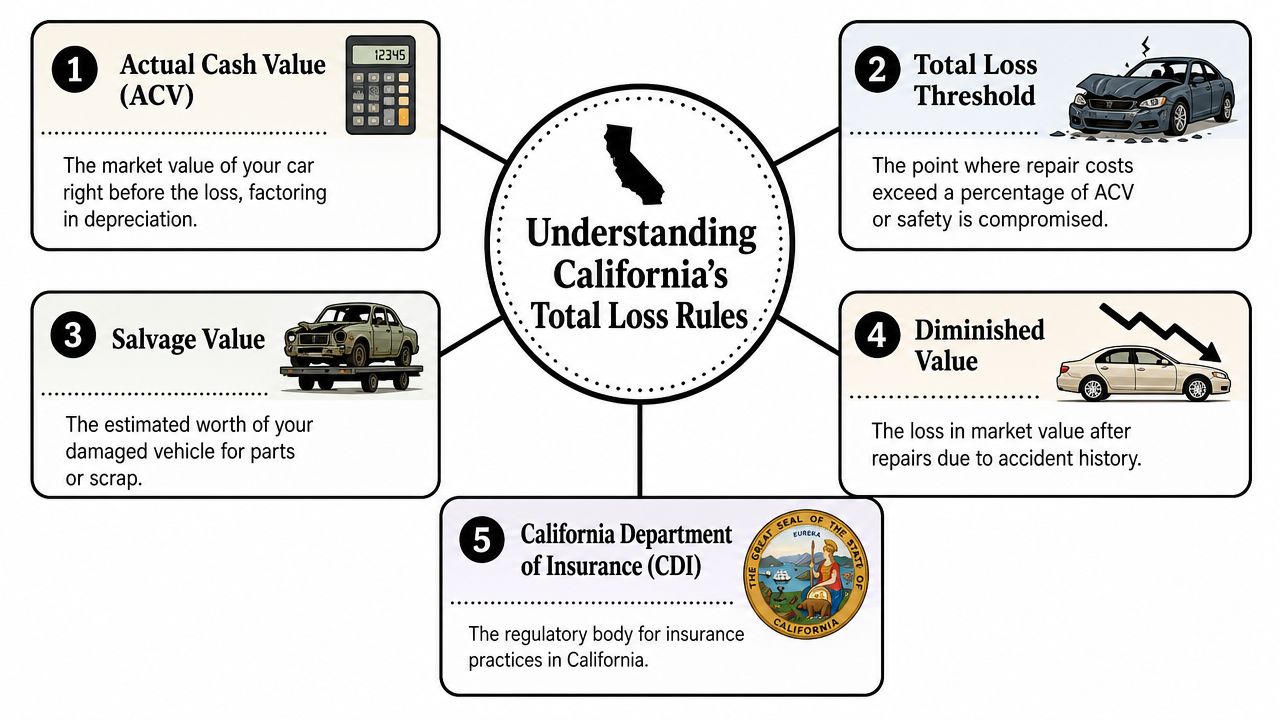
Under California rules, there is no statutory fixed percentage threshold for declaring a vehicle a total loss. The legal standard is whether repairs are uneconomical under California Vehicle Code §544, and the working calculation is the Total Loss Formula: Repair Cost + Salvage Value ≥ Actual Cash Value. That summary is explained in this California total loss law overview. If you want a plain-language comparison of how drivers often misunderstand the state rule, this breakdown of the California total loss threshold is useful.
The three numbers that control the decision
Actual Cash Value is the pre-accident market value of your vehicle. Think of it as what your specific car was worth immediately before the loss, not what you paid for it and not what you still owe.
Repair Cost is the estimate to bring the vehicle back. That number can change if hidden damage appears after teardown, which is one reason early insurer decisions can feel rushed.
Salvage Value is what the damaged vehicle is worth in its current state. Many drivers focus only on repair cost and miss this part entirely.
Here's the formula in simple terms:
| Part of the formula | What it means |
|---|---|
| ACV | What your car was worth before the accident |
| Repair Cost | What it would cost to fix it |
| Salvage Value | What the wrecked vehicle could still sell for |
If repair cost plus salvage value meets or exceeds ACV, the vehicle qualifies as a total loss under the formula.
Why the percentage myth causes problems
Some insurers commonly use internal thresholds in practice, but California doesn't codify a fixed percentage test. That's why drivers get blindsided when a car is totaled even though the repair bill alone didn't seem high enough.
Practical rule: If you only ask, “Are repairs over some percentage of value?” you may miss the salvage figure that actually tipped the car into total-loss status.
That distinction matters because it changes how you challenge the claim. If the issue is not just repair cost but also salvage value, your dispute has to address both. A lot of generic online advice misses that and sends drivers into the wrong argument.
What this means for your settlement
The total-loss decision and the settlement amount are connected, but they're not interchangeable. A vehicle can be properly declared a total loss and still be undervalued. That's where the claim often turns. The legal formula may justify totaling the car, while the valuation report still underprices what it takes to replace it.
How Insurers Determine Your Vehicle's Value
The insurer's value usually starts with a market report. In many claims, that report is built from comparable vehicles the carrier or its vendor says match yours. On paper, that sounds fair. In practice, the report often turns on small choices that shave value in ways most owners won't catch on a first read.
Where low valuations usually begin
Comparable vehicles are only useful when they are actually comparable. Same make and model isn't enough. Trim, mileage, options, prior condition, and local market relevance all matter. If your vehicle had premium packages, new tires, recent mechanical work, or unusually clean pre-loss condition, a weak comp set can bury those details.
Common trouble spots include:
- Out-of-market listings: Vehicles from the wrong region can distort what it would cost to replace your car locally.
- Mismatched equipment: A base trim used against a better-equipped vehicle lowers the starting point.
- Condition deductions: Some reports apply downward adjustments without a clear factual basis.
- Unsupported mileage treatment: If the report mishandles mileage, the final number can drift quickly.
The key is not to argue in broad terms. Find the exact line item that's wrong and challenge that.
The hidden number drivers overlook
Most California content gets this wrong by reducing the total-loss decision to repair cost alone. The more important nuance is that the state's total loss formula includes salvage value, not just repairs. As explained in this discussion of what insurers often leave out, a vehicle can qualify as totaled even when repairs alone are under the rough percentage drivers often hear about, because the formula is Repair Cost + Salvage Value ≥ Actual Cash Value.
That has two consequences.
First, a high salvage estimate can push a borderline vehicle into total-loss territory faster than the owner expects.
Second, if the salvage number is inflated, the insurer may be using a figure the owner never thought to question.
When a driver tells me, “The repairs didn't seem high enough to total it,” I immediately want to see the salvage figure. That's often where the surprise came from.
What to ask for in writing
Don't settle for a verbal explanation that the system “calculated it.” Ask for the documents and the assumptions behind them. At minimum, review:
- The valuation report: You need the actual comparable-vehicle pages, not just the final offer.
- The options and trim data: One missing package can matter.
- Condition adjustments: The insurer should be able to explain why any downward adjustment applies to your vehicle.
- The salvage valuation basis: If salvage value helped trigger the total loss, ask how it was estimated.
What usually works better than arguing
A focused rebuttal beats a general complaint. If the carrier used poor comparables, replace them with stronger local ones. If the report missed equipment, prove the equipment. If the condition adjustment is unfair, counter it with dated service records, pre-loss photos, and recent invoices.
What doesn't work is telling the adjuster your car was “special” without documentation. Every owner feels that way. Only some can prove it in a way the file can't ignore.
How to Document and Prove Your Car's True Value
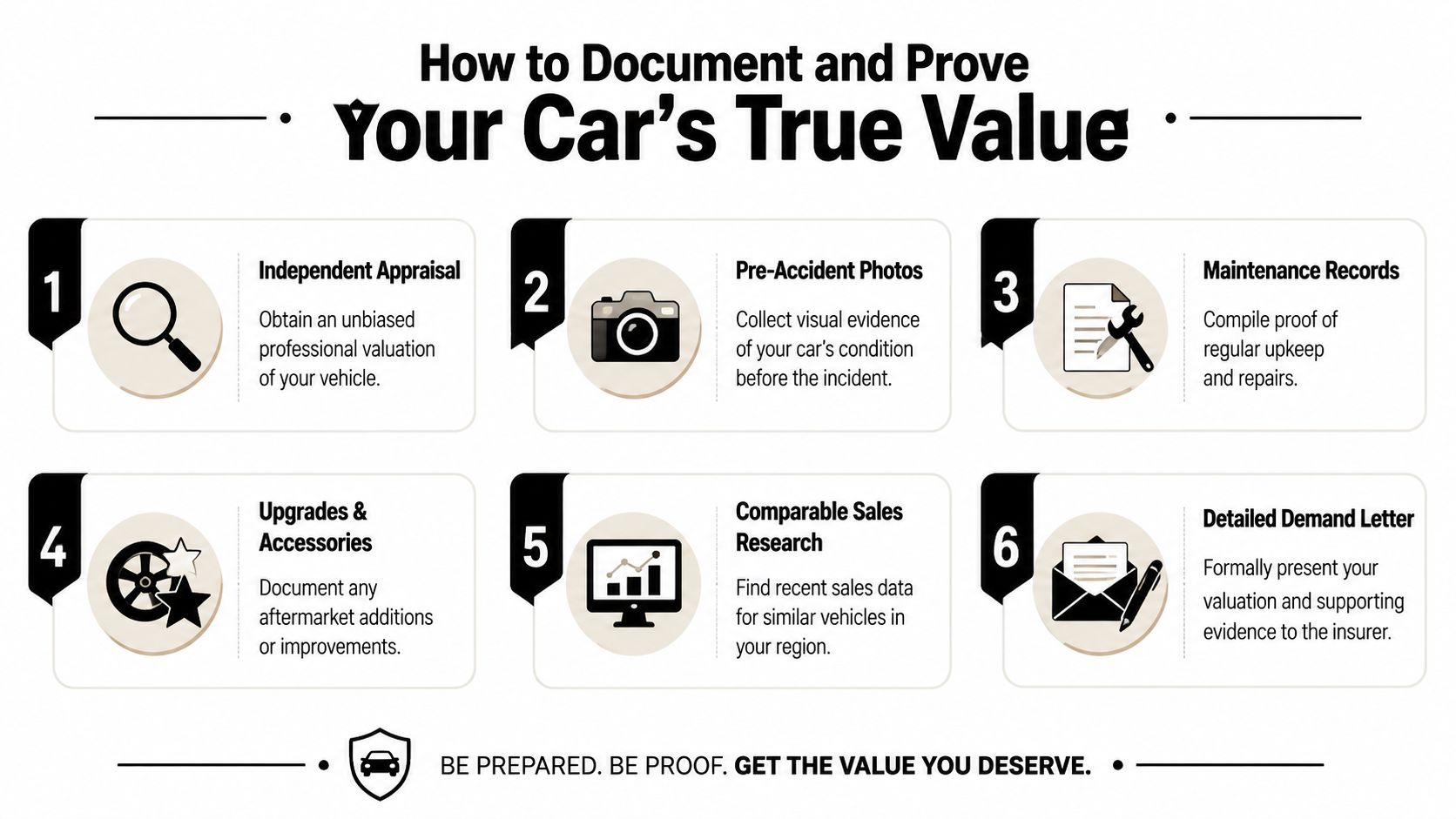
A strong dispute file looks less like a complaint and more like a counter-report. You are showing the insurer, line by line, why its valuation doesn't reflect your actual vehicle or your actual local market.
If you need a practical checklist for assembling the claim file itself, this guide to auto claim documentation for 2026 gives a clean starting structure.
Build your evidence file in layers
Start with the vehicle itself.
- Pre-loss photos: Use anything that shows the car before the crash. Exterior, interior, wheels, seats, dash, cargo area.
- Service and maintenance records: Oil service alone won't move value much. Major repairs, timing components, brakes, suspension work, and recent tires can help support condition.
- Upgrade proof: Window sticker, build sheet, accessory invoices, and dealer records help confirm trim and options.
- Ownership documents: Registration, title records, payoff information, and prior purchase documents can help identify exact configuration.
Then build the market side.
- Local comparable listings: Match year, make, model, trim, mileage band, drivetrain, and major options as closely as possible.
- Seller details: Save the full listing, dealer name, location, stock number, and screenshots in case the ad disappears.
- Written notes: Briefly explain why each comp is stronger than the insurer's comp.
Present it in a form the adjuster can use
Don't send twenty unorganized screenshots and hope someone pieces it together. Create one PDF with sections, labels, and a short cover note. Adjusters are more likely to re-open a valuation when the file is easy to review.
If your supporting packet gets too large to email, a practical tool like PDFWix's PDF compression guide can help you reduce file size without turning your documents into unreadable images.
A short video explanation can also help if you're trying to understand the dispute flow before sending your package.
What your demand should say
Keep it professional. Keep it specific. Don't write a long emotional narrative.
Include:
- The offer you are disputing
- The report errors you identified
- Your supporting comparables
- Your proof of options, condition, and recent work
- A direct request for revised valuation
A good demand letter doesn't say the offer is unfair. It shows exactly why the math, comparables, or deductions are wrong.
The cleaner your package is, the harder it is for the carrier to dismiss it as a generic complaint.
Your Legal Options for Disputing a Low Offer
Sometimes a clean rebuttal moves the claim. Sometimes it doesn't. When the insurer won't correct the valuation voluntarily, you need to stop treating the dispute like an informal conversation and start exercising the power California law and your policy give you.
Use the local-market rule to your advantage
California regulation 10 CCR 2695.8 requires total loss settlements to reflect the actual cost of a comparable vehicle in the local market. It also gives drivers an underused pressure point. If you cannot purchase a comparable vehicle for the settlement amount, you have the right to demand a re-evaluation. That requirement is described in this summary of California total loss laws and the re-evaluation rule.
That matters because insurers often talk about “market value” in the abstract. The rule is more concrete than that. If the settlement won't buy a true local comparable, the problem isn't theoretical.
Make the objection formal
A formal written objection should be short, documented, and direct. State that the offered amount does not reflect the actual cost of a comparable vehicle in the local market. Attach your local comparables and identify why the insurer's comparables fail.
Useful points to raise include:
- Local availability: The listed vehicles you found are what a buyer can pursue nearby.
- Equipment match: Same trim and options matter.
- Mileage and condition: A cheaper vehicle with materially worse condition isn't comparable.
- Market reality: If the insurer's amount won't buy the vehicle described, the settlement is vulnerable.
Consider the appraisal clause
Many auto policies contain an appraisal clause. When available, it can be one of the most effective tools in a total-loss value dispute. It shifts the matter from back-and-forth adjuster negotiation into a more formal valuation process.
Often, owners hesitate because they assume invoking appraisal is aggressive or lawyer-only territory. It isn't. It's a contract mechanism. The policy gives both sides a path to resolve a valuation disagreement with appraisers rather than leaving the issue entirely to the carrier's internal process.
File a complaint when the process breaks down
If the insurer won't explain deductions, won't address flawed comparables, or ignores a written re-evaluation demand tied to local market availability, a complaint to the California Department of Insurance can add pressure. It won't replace a valuation strategy, but it can force attention to handling issues the file has been skating past.
What usually works best is layering these options:
- First layer: Submit a documented written dispute.
- Second layer: Demand re-evaluation when the amount won't buy a true local comparable.
- Third layer: Invoke appraisal if the policy allows it.
- Fourth layer: File a regulatory complaint if the insurer's handling itself becomes the issue.
A low offer doesn't become reasonable just because it came from a valuation vendor. If it won't replace the vehicle the policy owes for, challenge it formally.
Why an Independent Appraiser Is Your Best Advocate
At a certain point, the dispute stops being about whether you can gather records and starts being about whether you can present a valuation that carries equal or greater weight than the insurer's report. That's where an independent appraiser changes the balance.
What an independent appraiser actually does
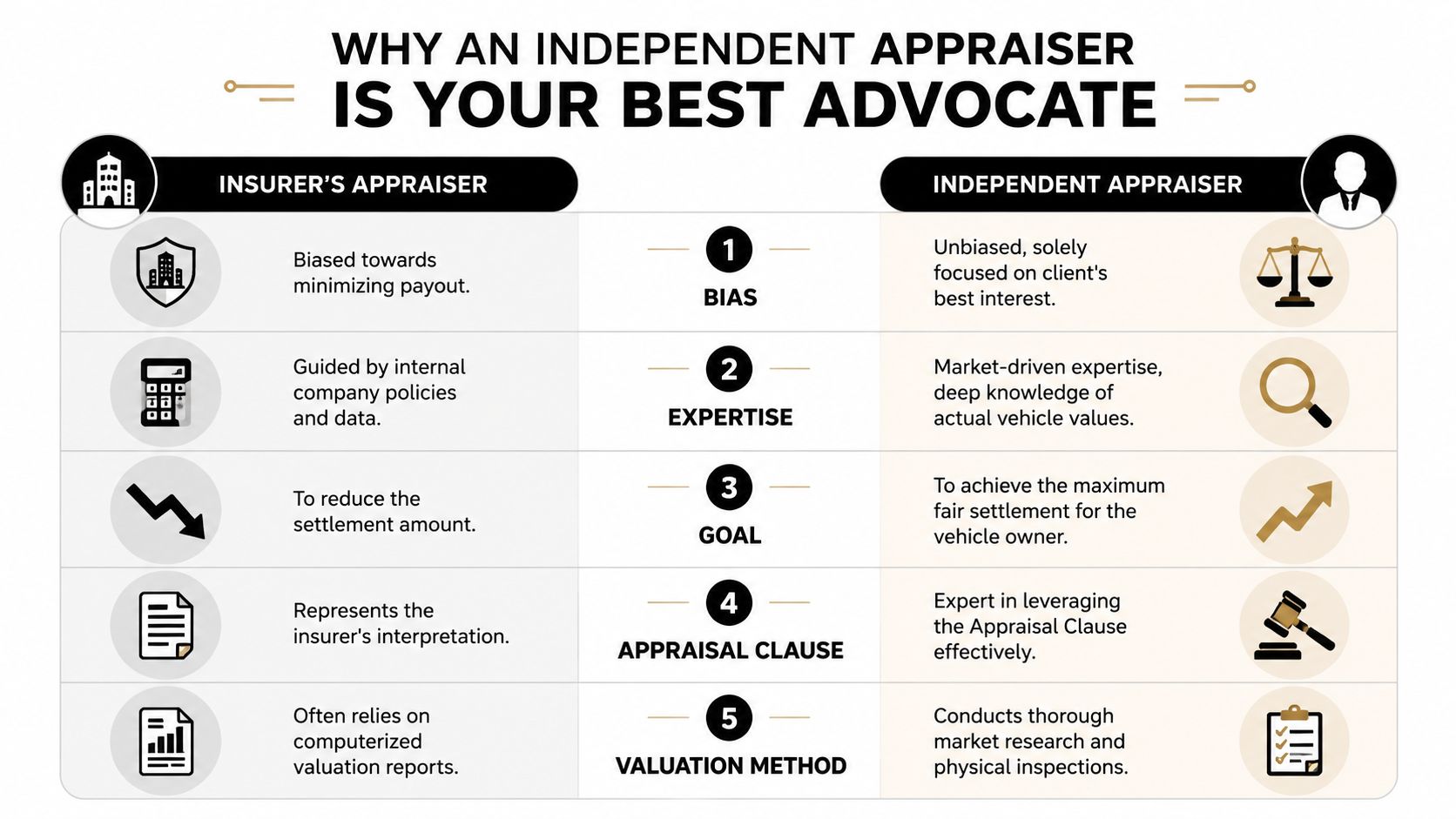
A competent independent appraiser doesn't just “give another opinion.” The work should include market research, vehicle-specific analysis, option verification, condition review, and scrutiny of the insurer's comp selection and adjustments.
That matters because insurer reports often rely heavily on standardized valuation systems. Those systems aren't useless, but they can miss the exact features that separate one used vehicle from another in the actual market.
An appraiser also helps frame the argument correctly. If the carrier's problem is bad comps, the response should center on comps. If the problem is unsupported deductions, the response should attack those deductions. If the claim has moved into appraisal, the appraiser knows how to build a file that fits that process instead of just repeating owner frustration in a nicer format.
Independence is not just a buzzword
If your policy's appraisal clause is in play, independence matters. You want someone who understands valuation and can defend it, not someone who merely confirms what you hoped the car was worth.
When owners are comparing providers, this checklist on what to look for in a total loss appraiser is a practical way to separate real appraisal work from generic claims assistance.
One option in this space is Total Loss Northwest, which provides independent total loss appraisal support and works through appraisal-clause disputes using market-based valuation reports. That kind of service is most useful when the insurer's vendor report doesn't reflect the actual replacement market for the vehicle.
The strongest appraiser is not the one who promises the highest number. It's the one who can support the number under scrutiny.
When hiring one makes the most sense
Independent appraisal is especially useful when:
- The car is hard to match: Collector, luxury, specialty, or uncommon trim vehicles often get flattened by generic comp reports.
- The insurer's comps are weak: Bad market selection usually needs a professional rebuttal.
- Condition is a real value factor: Exceptionally clean vehicles need proof, not adjectives.
- The claim is headed to appraisal: At that point, expertise matters more than persistence.
For many owners, that's the point where the claim stops feeling one-sided.
Taking Control of Your California Total Loss Claim
A California total loss claim can feel final long before it concludes. The insurer declares the vehicle totaled, sends a valuation, and speaks with enough confidence that drivers assume they have no real choice. You do.
Your advantage stems from understanding where the claim can be challenged. The total-loss decision depends on the proper formula. The settlement amount has to reflect a real comparable vehicle in the local market. And if the carrier's number won't put you back into a true replacement vehicle, you can dispute it with evidence and escalate when needed.
Start with the file. Get the valuation report. Check the comparables. Prove your trim, condition, maintenance, and upgrades. If the offer still doesn't track the market, object in writing and push the claim into a more formal process.
If the dispute has stalled, bring in an independent appraiser who can evaluate the vehicle on equal footing with the insurer's report and help you use the appraisal clause correctly. That's often the difference between arguing and moving the number.
If you need help challenging a low total loss offer, Total Loss Northwest provides independent appraisal support for owners dealing with disputed vehicle valuations. If the insurer's numbers don't reflect the actual market, get the file reviewed before you sign anything.