You get the call. The adjuster says your car is a total loss, your rental clock is ticking, and an offer is already on the way.
Most drivers hear that and assume two things. First, the insurer must have used a fixed rule to total the car. Second, the first number is probably close enough. In California, both assumptions can cost you money.
A total loss settlement in California is negotiable when the valuation is wrong, the comparables are weak, or the deductions don't hold up. The key is knowing what the insurer is required to show, what they can and can't deduct, and how to push back with evidence instead of frustration.
Your Car Is Totaled Now What
The first hard moment usually isn't the crash. It's the phone call after.
Your car may still look repairable to you. The shop may even say the damage is concentrated in one area. Then the insurer says it's totaled and immediately shifts the conversation to paperwork, payoff amounts, and how soon you can sign.
That pace works in the carrier's favor. It doesn't help you evaluate whether the offer reflects your vehicle's real pre-accident value.
This is what I tell owners when that first offer lands:
- Treat the first number as an opening position. It's an offer, not a verdict.
- Slow the process down enough to review the valuation. You need the report, not just the payout figure.
- Separate two issues in your mind. One issue is whether the car is a total loss. The other is whether the value assigned to it is accurate.
Many people mix those together and argue the wrong point. If the insurer has already decided the vehicle is uneconomical to repair under its analysis, the bigger money question is often the Actual Cash Value, not whether the body shop could physically fix the car.
A totaled vehicle can still be repairable. Total loss is a financial decision first.
That matters because a low valuation creates a smaller settlement, a bigger gap to replace your vehicle, and more pressure if you still have a loan balance.
What to do before you say yes
Before you accept anything, gather the basics:
- Ask for the full valuation report in writing.
- Check whether the listed vehicle details are correct. Trim, options, mileage, drivetrain, packages, and prior condition all affect value.
- Pull your own records. Maintenance receipts, recent tires, documented upgrades, and clean pre-loss photos help frame condition and equipment.
- Hold off on arguing emotionally. A better strategy is to challenge the data.
If you're feeling rushed, that's normal. But this is the point where good claims get underpaid. Once you understand how California handles total loss claims, the process starts to make a lot more sense.
The 75% Myth and California's Real Total Loss Formula
A lot of bad advice starts with the so-called 75% rule. People repeat it constantly. Shops mention it. Friends mention it. Even some online guides treat it like California law.
It isn't.
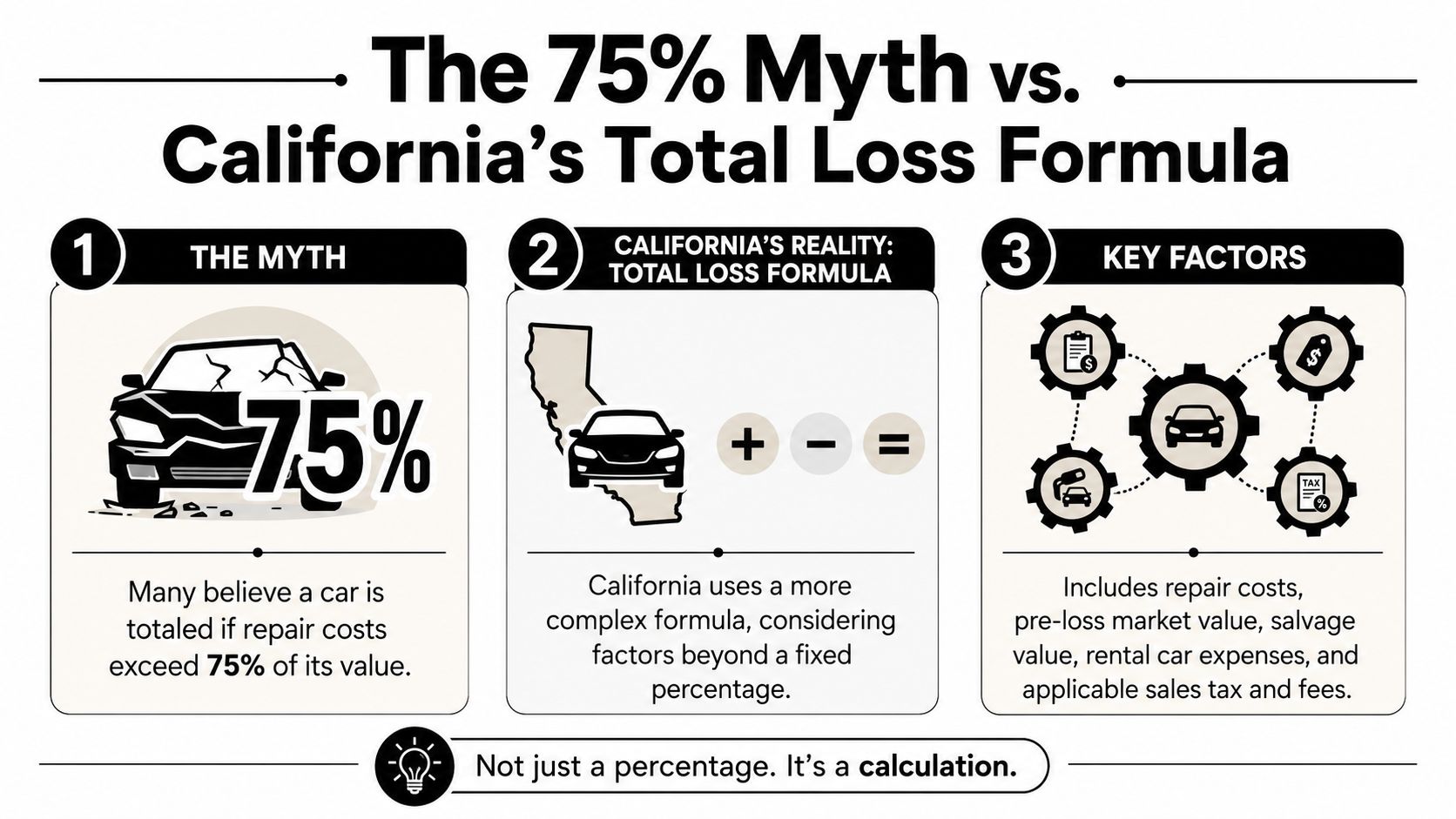
California does not use a fixed statutory percentage threshold for total loss. Instead, the state uses the Total Loss Formula, meaning repair cost + salvage value ≥ actual cash value, with no statutory percentage cap, as explained in this California total loss threshold overview and in this discussion of the California total loss formula.
Why the myth survives
The myth survives because many insurers use internal guidelines that may resemble a percentage range in practice. That's easy to summarize, and easy to misunderstand. People hear a percentage and assume it's a legal trigger.
In California, the legal issue is broader. The insurer looks at:
| Factor | Why it matters |
|---|---|
| Repair cost | What it would cost to restore the vehicle |
| Salvage value | What the damaged vehicle is worth after the loss |
| Actual Cash Value | The vehicle's pre-accident market value |
If repair cost plus salvage value meets or exceeds actual cash value, the insurer can classify it as a total loss.
Salvage value is the overlooked lever
At this point, many owners get blindsided.
A vehicle can be totaled even when the repair bill doesn't look extreme on its own. If the damaged vehicle still has strong salvage value, the math changes. That's especially relevant with vehicles that have parts or systems that retain value after a collision.
Examples include:
- Newer vehicles with strong parts demand
- Luxury models with valuable components
- EVs and hybrids where battery-related salvage value can affect the equation
- Custom or specialty vehicles where certain parts are worth more than people expect
Practical rule: If your car has unusually strong salvage value, don't assume "repairs under the usual percentage" means it can't be totaled.
That's the inside game most consumers never get told. The insurer isn't just asking, "Can this be fixed?" They're asking whether paying to fix it makes economic sense once salvage is part of the equation.
What works and what doesn't
What works is asking for the valuation and understanding the math behind the decision.
What doesn't work is telling the adjuster, "But I thought California used 75%." That argument goes nowhere because it starts from a false rule.
A better question is this: What numbers did you use for repairs, salvage, and actual cash value, and can you support each one? Once you shift the conversation to the accurate formula, you stop arguing myth and start analyzing evidence.
Decoding the Insurer's Offer What Is Actual Cash Value
Once the insurer declares a total loss, the next fight is usually over Actual Cash Value, or ACV. This is the number that drives the settlement.
ACV is often thought of as just a pricing guide printout. In California, it isn't that simple. The valuation process has specific rules, and those rules give you something solid to challenge when the report is weak.

California regulation 10 CCR § 2695.8(b)(2) requires every comparable vehicle used in an ACV calculation to be VIN-identified, from the local market, and within 90 days. It also requires adjustments for things like mileage, condition, or options to be itemized and supported in writing, and condition deductions aren't allowed unless the insurer documents that your vehicle was below average for its specific year, make, and model, as summarized in this breakdown of California ACV rules and discussed in this explanation of auto insurance actual cash value.
What a valid ACV report should contain
When I review a total loss file, I look for four things first:
- Comparable vehicles with VINs. If the report lists vague dealership inventory without clear vehicle identification, that's a problem.
- Local market support. California doesn't let insurers drift into a broad national average when local pricing is what matters.
- Written adjustments. Mileage, options, prior condition, and trim differences should be shown, not assumed.
- Defensible condition treatment. Generic condition downgrades are one of the easiest places for valuations to go wrong.
Where low offers usually come from
The weak spots tend to be repetitive.
| Common issue | Why it hurts your payout |
|---|---|
| Bad trim match | A lower trim can drag down the base value |
| Wrong equipment | Missing packages or features reduce the comparison |
| Distance from your market | Pricing may not reflect your replacement reality |
| Unsupported condition deductions | The insurer shaves value without proof |
| Mileage adjustments that don't track | The number changes, but the support doesn't |
If the insurer can't show exactly how it adjusted the comparables, you don't have to accept the adjustment as accurate.
How to read the report like an appraiser
Start with the basics. Make sure the report identifies your exact vehicle correctly. Then check every comparable against your car, not against the insurer's conclusion.
Look closely at trim level, drivetrain, options, branded title history, and mileage. If your vehicle had documented upgrades or unusually strong condition, that needs to show up somewhere in the analysis.
The biggest mistake consumers make here is arguing from memory. The stronger move is to mark the report line by line and identify where the data fails. A clean, factual challenge usually carries more weight than a long complaint about fairness.
Your Rights and the Insurer's Duties in California
California gives drivers more advantage in a total loss claim than many people realize. The problem isn't always the law. It's that most claimants don't know what the insurer has to provide unless they ask the right way.
The first important point is this: California doesn't impose a fixed percentage threshold for total loss. It relies on the total loss formula, and the valuation side of that process is governed by 10 CCR 2695.8. California also requires insurers to provide the valuation basis, including comparables and itemized deductions, without you having to prompt them, as described in this explanation of California totaled vehicle rules.
What the insurer owes you
When the carrier makes a total loss offer, you should expect more than a settlement number.
You should receive the written basis for valuation, including:
- Comparable vehicle data used to support ACV
- Database outputs or source material behind the figure
- Itemized deductions instead of bundled, unexplained reductions
- Written support for any downward condition claim
If that material isn't in the file you received, don't guess. Demand it.
What your side of the claim should focus on
A strong response isn't about saying the adjuster is wrong in general. It's about forcing the claim onto documented ground.
Use this checklist:
- Request the complete valuation packet if anything is missing.
- Ask the adjuster to identify every deduction in writing.
- Flag any comparable that isn't local, recent, or properly matched.
- Object to unsupported condition deductions.
- Keep all communication in writing when possible.
The insurer's software doesn't decide your claim by itself. The insurer still has to support the valuation under California rules.
The practical trade-off
Some claimants want to resolve the file quickly and move on. That's understandable. But speed often means accepting a report you haven't audited.
On the other hand, fighting every line item without focusing on the biggest valuation defects can waste time. The best approach is selective pressure. Challenge the errors that materially change value. Leave the minor points alone unless they add up.
That approach keeps the discussion professional, and it tells the adjuster you're not guessing. You're reviewing the claim the way it should've been reviewed before the offer went out.
How to Fight a Lowball Offer and Maximize Your Payout
Once you know where the insurer's number comes from, the next move is simple in theory and demanding in practice. You build a better valuation than the one they used.
This part of a total loss settlement in California is where owners either recover real money or leave it behind by arguing loosely.
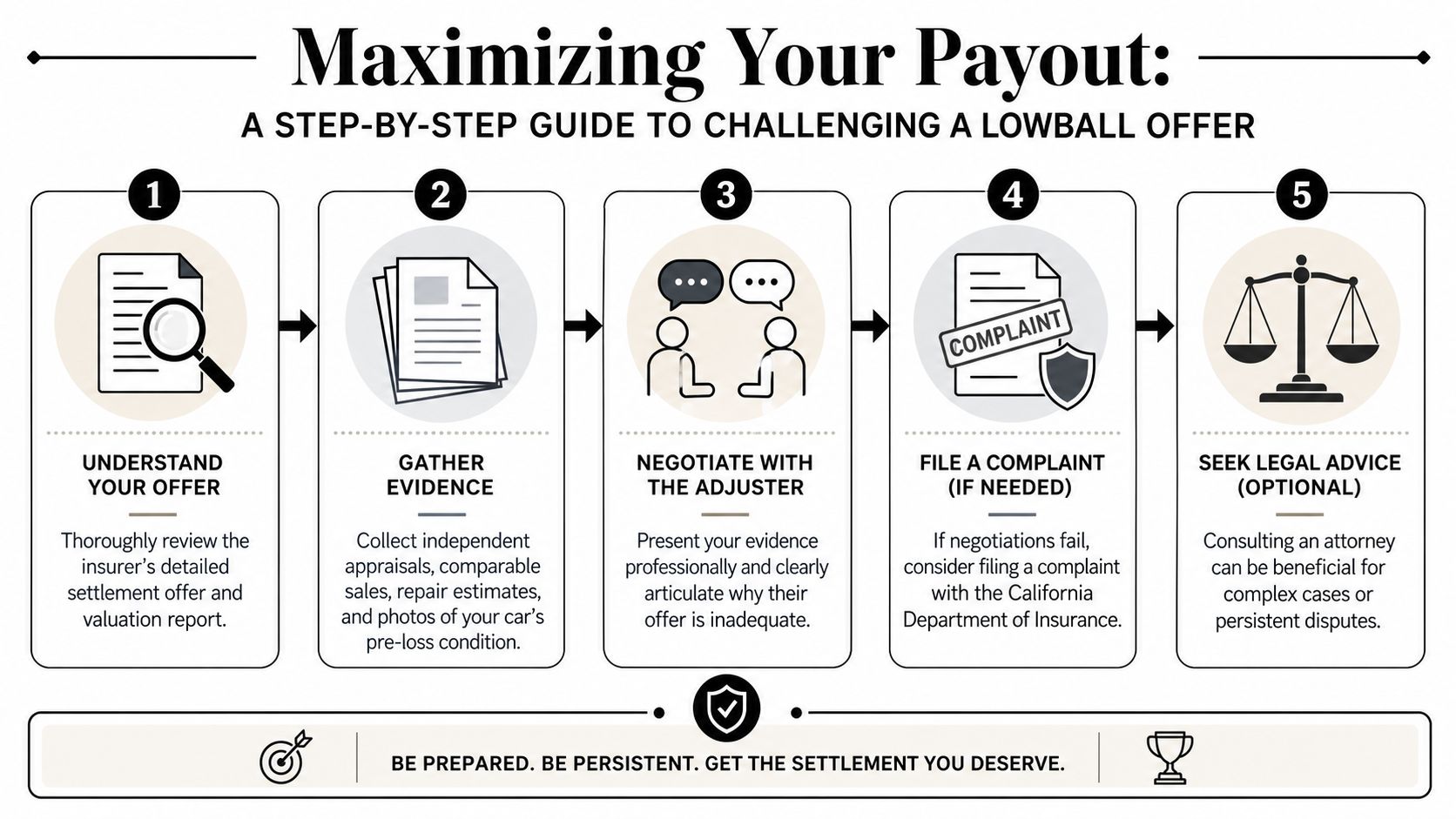
Start with the file in front of you. Don't launch into a demand letter until you've marked every flaw in the insurer's report.
Build your countervaluation
Use evidence the insurer has to take seriously:
- Better comparables pulled from your local retail market, matched as closely as possible to year, make, model, trim, mileage, and options
- Ownership records that support condition, service history, and recent work
- Photos showing pre-loss condition, wheel condition, interior quality, paint, and options
- Corrections to the insurer's report if trim, packages, mileage, or equipment are wrong
What works is precision. If one comparable is the wrong drivetrain, say that. If one condition deduction lacks support, point to that. If one listed comp has equipment your car didn't have, or lacks equipment your car did have, identify it specifically.
What doesn't work is sending random listings with no explanation.
Use a short, direct challenge letter
A good dispute letter doesn't need to sound legalistic. It needs to be organized.
A practical structure looks like this:
- State that you dispute the ACV.
- Identify the defects in the insurer's valuation.
- Attach your supporting comparables and records.
- Request a revised valuation by a specific date.
- Reserve your right to use the appraisal clause if the gap remains material.
"I dispute the current valuation because the comparable vehicles and deductions used do not accurately reflect my vehicle's pre-loss market value. Please review the attached local comparables, equipment corrections, and supporting records, and issue a revised valuation."
That kind of language keeps the file moving without turning the exchange into a rant.
A video walkthrough can also help if you want a visual overview of the dispute process:
When to invoke appraisal
If the gap between your valuation and the insurer's number is meaningful, the appraisal clause can become the most effective tool in the file. The California framework supports invoking appraisal when there's a material dispute over value, and this is especially important for high-value or custom vehicles, as noted in this California total loss law guide.
That same source also notes that California's minimum auto liability requirements increased to $15,000 for property damage per accident as of January 1, 2025 under Senate Bill 1107.
Appraisal changes the dynamic because it moves the valuation dispute away from the insurer's internal number and toward an independent process. That's often the right move when the adjuster keeps defending software outputs instead of addressing the actual flaws in the report.
For owners who want professional help with that step, one option is an independent appraisal service such as Total Loss Northwest, which works on total loss and appraisal clause disputes.
What usually gets results
The strongest disputes usually share the same traits:
| Approach | Result |
|---|---|
| Specific report corrections | Harder for the adjuster to ignore |
| Local, well-matched comparables | Stronger replacement value argument |
| Documented condition evidence | Limits unsupported deductions |
| Timely, written follow-up | Keeps pressure on the file |
| Appraisal when talks stall | Moves the dispute into a different lane |
Negotiation works best when your evidence is cleaner than theirs. That's the standard to aim for.
Keeping Your Car The Salvage Title Explained
You settle the total loss claim, keep the car, and expect to use the money for repairs. Then the insurer deducts salvage value, the title status changes, and the car cannot go back on the road after a body shop visit. That is the part many owners do not see coming.
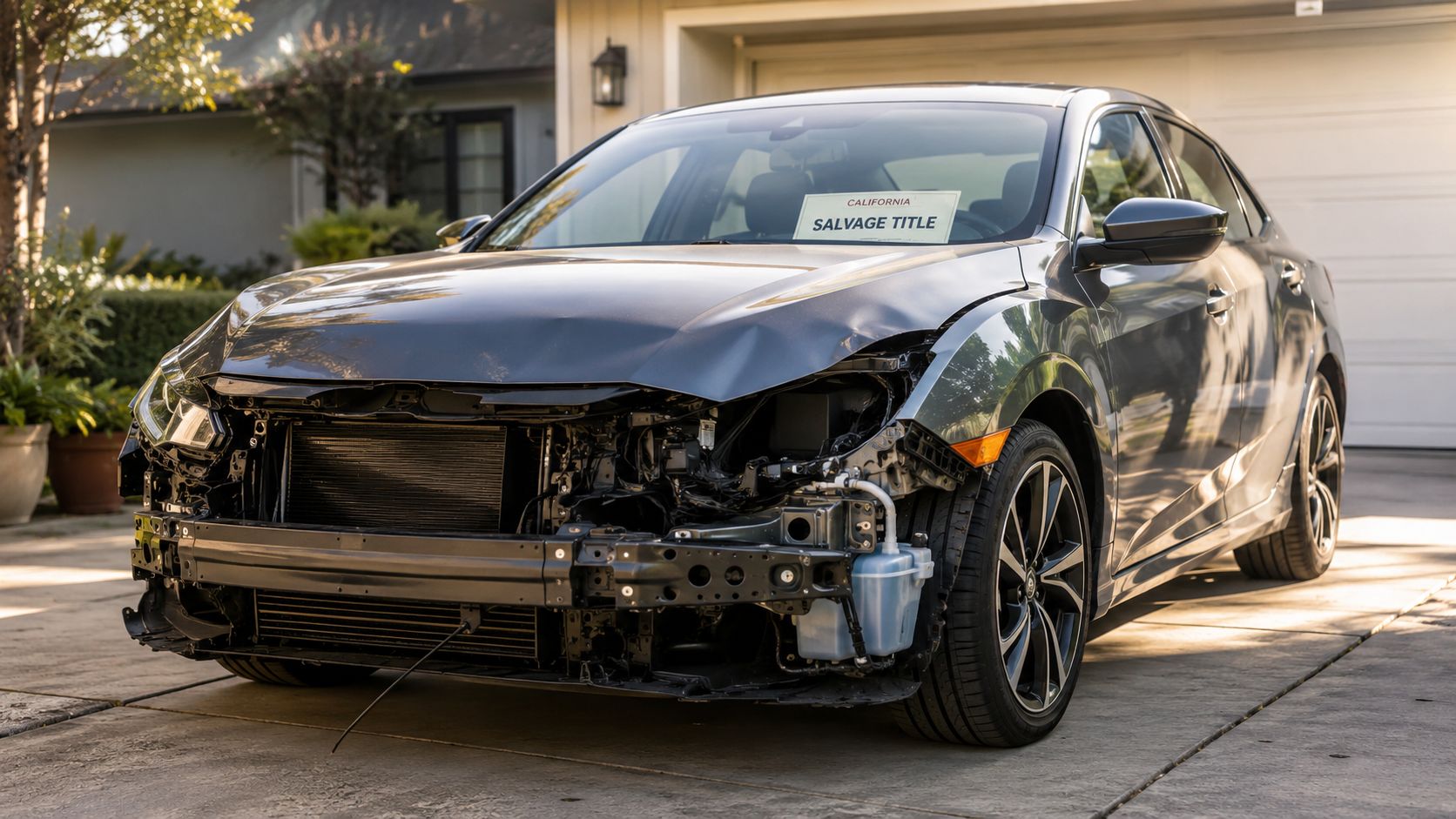
In California, owner retention usually means two things. Your settlement is reduced by the vehicle's salvage value, and the car will go through title and inspection steps before it can lawfully return to the road. The California DMV explains the state process for revived salvage vehicles, and this overview of the salvage title process lays out the claim side in plain English.
Salvage value matters here more than many drivers realize. It is the same number that can affect whether the insurer treats the vehicle as a total loss under California's Total Loss Formula, and it also affects how much cash you receive if you keep the car. If the carrier inflates salvage value, your owner-retained payout drops.
The financial trade-off
Keeping a totaled car can work, but only if the math works after the deduction.
Look at the full picture:
- Lower net settlement because the insurer keeps back the salvage value
- Repair costs that often rise after teardown once hidden damage is found
- DMV, brake, light, and inspection requirements before legal road use is restored
- Lower resale value and fewer buyers once the vehicle carries a salvage history
If you want a practical look at how salvage titles impact value, that reference is useful.
I usually tell owners to make this decision on paper, not emotion. Compare the reduced payout, realistic repair estimate, likely supplemental damage, towing, storage, inspection costs, and the vehicle's post-repair market value with a salvage history. Sentimental value is real, but it should be a conscious choice.
When retaining the vehicle makes sense
Owner retention tends to make sense in a smaller set of cases than people expect.
| Situation | Why it may make sense |
|---|---|
| You have a clear repair plan | You know who will fix it, what parts will be used, and what the probable total cost looks like |
| Damage is mostly cosmetic or limited | The car may be repairable without destroying the economics |
| You plan to keep the car for years | The title brand hurts resale, but that matters less if you are not selling soon |
| The vehicle has unusual personal or practical value | A well-kept older car, specialty setup, or family vehicle may be hard to replace like-for-like |
| You have checked the title and inspection steps first | You are less likely to get stuck with a repaired car you cannot easily register |
What I would not do is keep the car just because the first offer feels low. Fix the valuation problem first. Then run the salvage-retention math with corrected numbers. Those are two separate decisions, and insurers benefit when owners blur them.
Frequently Asked Questions About California Total Loss
What if I still owe money on the car
If there is a loan or lease, the lender is paid first from the total loss settlement. If the payoff is higher than the settlement, you owe the shortfall unless GAP coverage applies.
This is why a low ACV figure hits financed owners harder. A bad valuation does not just shrink the money available for a replacement car. It can leave you paying off a vehicle that is already gone.
Do I have to accept bad comparables
No. Ask for the valuation report, line up the comparable vehicles against your own car, and challenge any mismatch in trim, mileage, options, condition, or local market area. If the insurer used substitutes that do not adequately compare, say so in writing and ask for a revised valuation based on compliant California comparables.
California also gives owners more room than many adjusters suggest. If no true comparable vehicle existed for the insurer's ACV figure, a settled claim may still be reopened, as discussed in this California total loss law summary.
That matters in real claims. I have seen owners accept a payment because they needed the money fast, then later discover the report was built on weaker substitute vehicles. Payment does not always end the dispute if the underlying valuation failed California's standards.
If the insurer priced your vehicle with substitutes instead of true comparables, the claim may still be open even after payment.
How long does settlement take
Some total loss claims wrap up quickly. Others drag because the title is delayed, the lienholder is slow, the valuation report is weak, or the owner disputes the ACV.
Insurers often push for speed once they decide the car is a total loss. That pressure is practical for them, not a reason for you to accept an unsupported number. Review the valuation first, especially in California where salvage value and the Total Loss Formula affect how the claim gets framed behind the scenes.
Does the settlement include taxes and fees
Often yes, but do not assume the insurer calculated every item correctly. Read the written offer carefully and compare it to the valuation packet, settlement breakdown, and any payoff documents.
Ask the adjuster to list each part of the payment in writing, including the vehicle value, tax, fees, and any deductions. That request usually clears up whether something was left out or buried in a vague summary.
If you need help reviewing a low offer, challenging weak comparables, or moving a stalled appraisal dispute forward, Total Loss Northwest provides independent total loss appraisal support and appraisal clause assistance for owners who want a market-based valuation instead of relying only on the insurer's internal report.