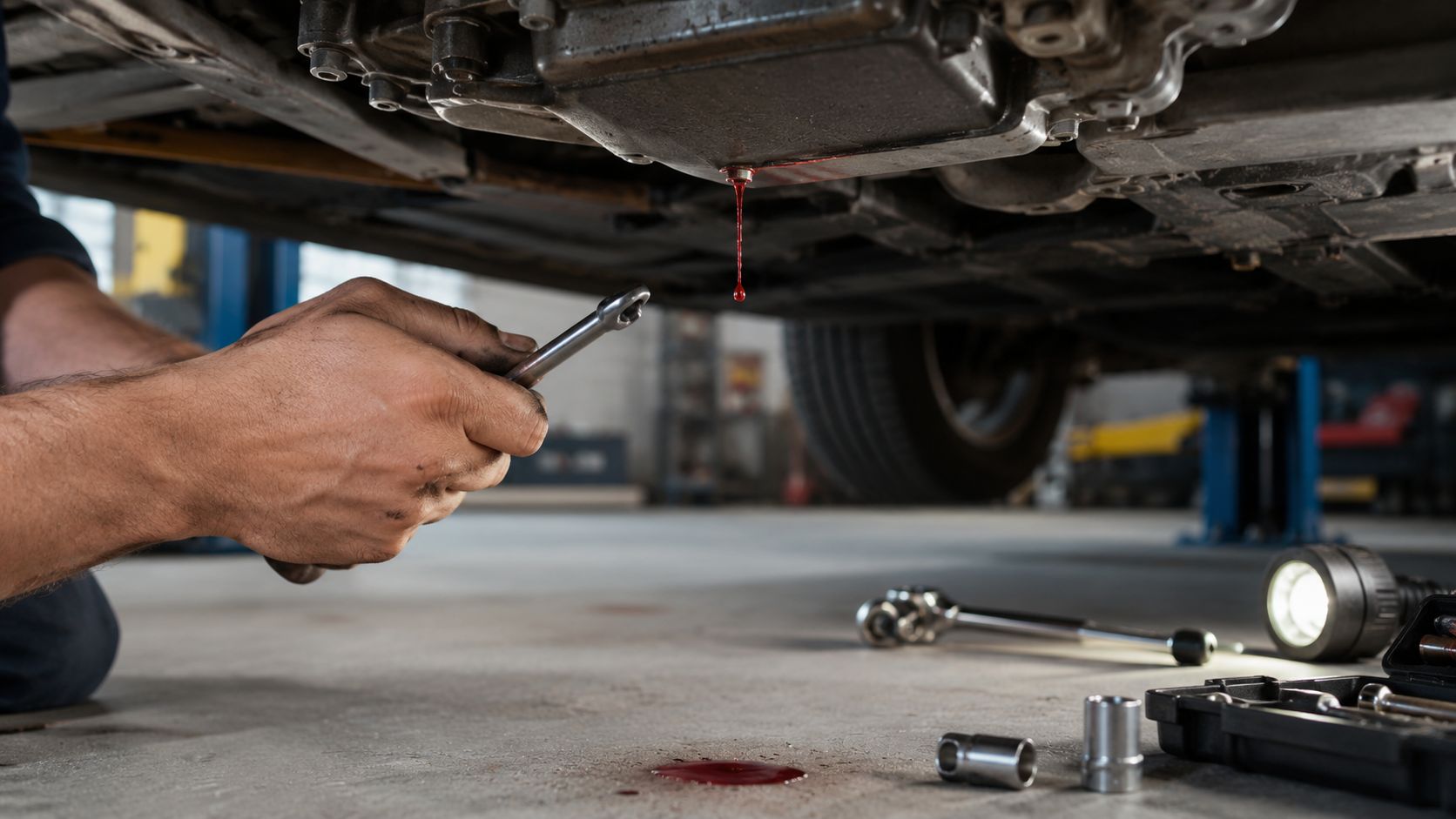
You walk out to the driveway, coffee in hand, and see a red or brown spot under the middle of the car. Most drivers hope it's old residue, a spill, or something harmless. It usually isn't.
A transmission fluid leak has two consequences at once. The first is mechanical. If the fluid drops too far, the transmission can overheat, slip, or fail. The second is financial. Even after a proper fix, a documented leak can affect how buyers, adjusters, and appraisers view the vehicle later.
That's why transmission fluid leak repair isn't just about stopping a drip. It's about making the right first decision, confirming the actual source, avoiding bad repairs, and protecting the vehicle's value if you end up in a diminished value or total loss dispute.
That Red Puddle Under Your Car What It Means
Transmission fluid usually gets your attention because of its color. Many drivers notice a reddish-pink spot first. Older fluid can look darker, even brownish, which is why leaks sometimes get mistaken for engine oil until someone gets closer and checks where the fluid is coming from.
The location matters too. A spot under the center section of the vehicle often raises transmission concerns. A spot farther forward can still be transmission-related, but it needs a careful look from underneath before anyone should guess.
Don't treat it like a cosmetic problem
A small drip can come from something relatively simple, such as a pan gasket, a drain plug area, or a cooler line connection. It can also come from a seal that requires much deeper labor. The leak itself is the symptom. The repair bill depends on what part failed and whether the transmission has to come out to reach it.
That's the mechanical side.
The financial implications begin earlier than one might expect. A transmission leak, even when repaired, can signal possible internal wear or future risk to a buyer or insurer. That matters if the car was recently in an accident, if you're facing a total loss evaluation, or if you plan to sell the vehicle later.
Practical rule: If you see fresh red or brown fluid under the car, assume it deserves immediate diagnosis. Waiting turns a contained repair into a much bigger decision.
What drivers usually get wrong
The most common mistake at this stage is deciding the source before the car is inspected. People see a drip near the pan and buy a gasket. They see wet fluid near an axle and assume it's the seal. Transmission fluid travels. It runs down castings, along brackets, and off the lowest edge before it hits the ground.
The second mistake is focusing only on whether the car still moves. A vehicle can still drive while the transmission is losing fluid. That doesn't mean it's safe to keep driving, and it definitely doesn't mean the leak is minor.
First Steps When You Spot a Transmission Fluid Leak
The first job is simple. Protect the transmission before you think about cost.

If your vehicle has a transmission dipstick, check the level with the engine and gear selector in the condition specified by the owner's manual. If your vehicle doesn't have a dipstick, you're more limited. In that case, the visible leak and the way the vehicle behaves matter even more.
According to guidance on serious transmission fluid leaks, low transmission fluid levels are extremely damaging; driving with insufficient fluid can cause overheating, gear slippage, and complete transmission breakdown. That same guidance says that if fluid levels are critically low, drivers should shut off the engine immediately and call for a tow truck because continuing to drive risks irreversible damage.
When you can drive and when you shouldn't
Use a simple decision standard:
- Fluid is critically low or absent: Shut it off. Don't “just make it home.” Don't test-drive it around the block.
- The transmission is slipping, shuddering, or delaying engagement: Stop driving. Those are warning signs the leak may already be affecting hydraulic operation.
- There's still fluid present and the transmission is behaving normally: You may be able to make a cautious trip to a nearby repair facility, but only after confirming the correct fluid type in the owner's manual and topping up if appropriate.
- You don't know the fluid type: Don't guess. Mixing transmission fluids is a bad shortcut, especially on newer units.
A lot of expensive damage starts with optimism. The car still moves, so the owner keeps using it. Then the repair is no longer about a leak. It becomes an internal transmission problem.
What to do in your driveway
Start with these steps:
- Check the ground pattern. Put cardboard under the vehicle and note where fresh drips land.
- Look under the car with a flashlight. Don't diagnose yet. Just identify whether the leak seems concentrated near the pan, lines, or a higher point.
- Confirm fluid level if the vehicle allows it.
- Avoid additives. They don't belong in your first-response plan.
- Choose the trip or tow decision based on fluid level and symptoms, not convenience.
If you need a reputable place to inspect it, this list of certified repair shops is a practical starting point.
A visual walkaround helps, but a proper leak diagnosis needs a controlled process. This video shows the approach technicians use when they don't want to replace the wrong seal or gasket.
How to Accurately Pinpoint the Leak Source
Bad leak diagnosis wastes money. The drip on the floor is often the end of the trail, not the beginning.
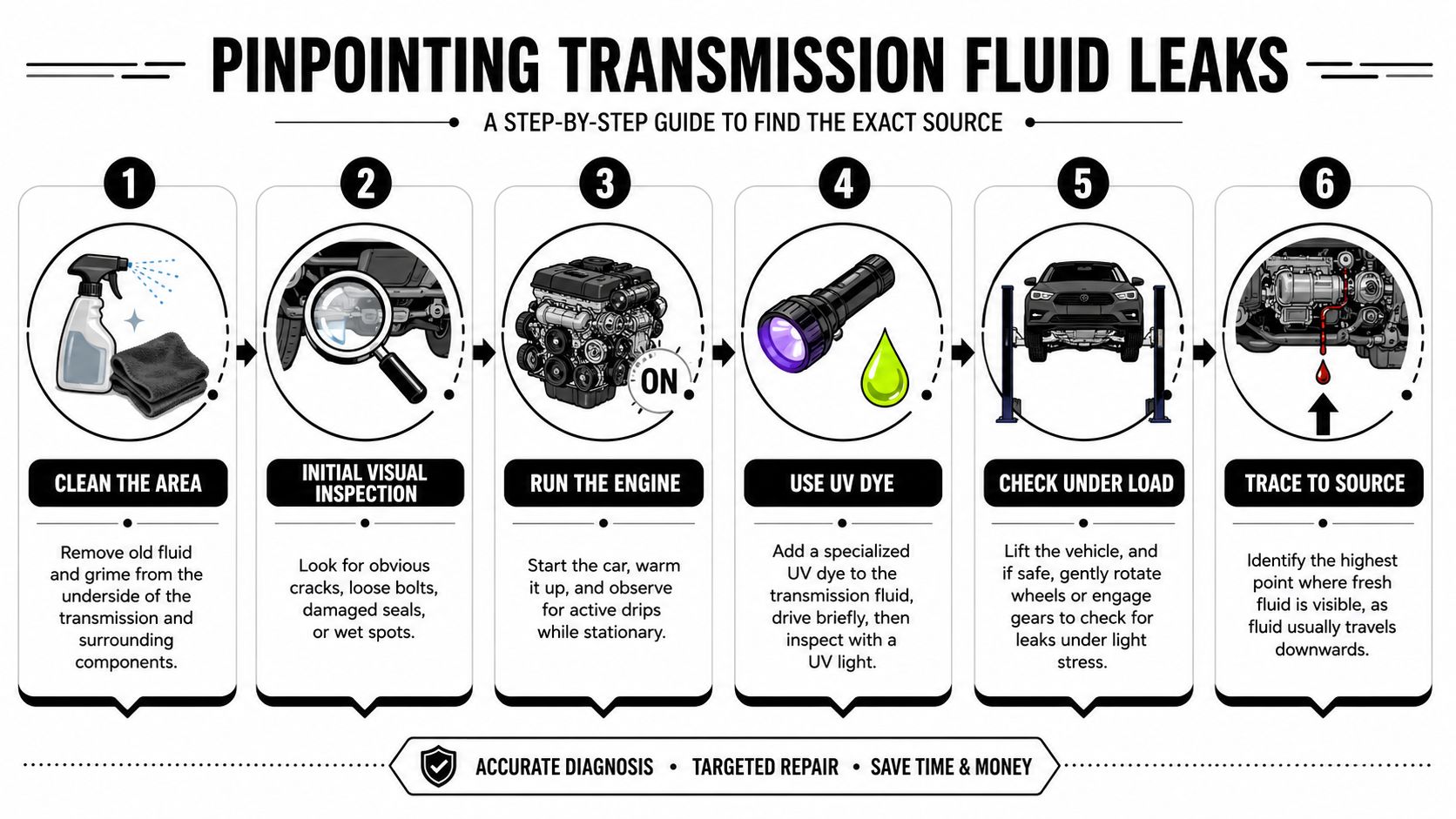
The most reliable method is to inspect from the highest wet point downward. That matters because transmission fluid runs along surfaces before it falls. The actual failure point may be several inches, or more, above the spot you first notice.
Use the clean-and-track method
The clean-and-track routine for transmission leak diagnosis is the standard I trust because it reduces guesswork. The process involves degreasing the transmission exterior, drying it thoroughly, parking over clean cardboard overnight to map drips, doing a brief warm test, and using UV dye if the source is still unclear.
That sequence matters. If you skip the cleaning, old residue will send you chasing ghosts.
Check components in a logical order
Once the outside is clean, inspect the likely failure points from top to bottom.
- Cooler lines and connections: Follow the metal and rubber lines and look for wet fittings, corrosion, or damp sections.
- Pan rail and gasket area: Look for a wet edge around the pan perimeter, especially after cleaning.
- Case seams and plugs: Any fresh fluid tracking down the case deserves a close look.
- Axle or output areas: Leaks here can sling fluid outward and make the underside messy fast.
- Bellhousing area: If fresh fluid appears here, the repair may be much deeper than a pan or line issue.
Fluid lies. It spreads, catches dust, and drips from the lowest edge. Find the highest fresh wet spot first.
Cardboard gives you useful clues
A plain sheet of cardboard under the car overnight can tell you a lot after the transmission has been cleaned.
A drip pattern near one side can support what you see on the case. A centered drip after a warm drive may point you toward a different area than a cold overnight seep. Cardboard doesn't replace inspection, but it helps confirm whether the leak is active and where to begin looking.
When UV dye earns its keep
Some leaks only show up hot, under pressure, or after a short drive. That's where UV dye becomes worth the extra step. Add the dye, run the vehicle briefly, then inspect with a UV light. The fresh trail usually stands out clearly, especially around crowded areas where fluid has been spreading.
Professionals separate a real diagnosis from a parts-guessing exercise. If the source remains uncertain, dye is cheaper than replacing the wrong part.
Your Repair Options and Estimated Costs
Once the leak source is identified, the next question is whether the repair is simple, moderate, or invasive. That's where cost and judgment meet.
The verified market range for transmission fluid leak repair is broad. The repair cost breakdown for transmission leaks puts minor fixes at about $150 to $400, with pan gasket replacement typically at $150 to $400, input or output shaft seals at $250 to $700, cooler lines at $200 to $600, front seals at $800 to $1,200 when transmission removal is required, and major leak-related repairs or rebuilds at over $3,000, with some severe jobs reaching $2,000 to $4,000 or more.
What you can reasonably handle yourself
Some leaks are within reach for an experienced DIY owner. A pan gasket job is the classic example, but only if you can support the vehicle safely, clean mating surfaces correctly, refill with the exact specified fluid, and torque fasteners properly.
A cooler line replacement may also be manageable on certain vehicles if access is straightforward. On others, routing and connection access make it more tedious than expected.
DIY stops making sense when the repair depends on specialty tools, tight packaging, or transmission removal. That includes front seals, torque converter seal work, and many deeper seal jobs.
Cost comparison at a glance
| Repair Type | Estimated Cost Range | Typical Complexity |
|---|---|---|
| Minor plug or gasket fix | $50 to $250 | Low |
| Pan gasket replacement | $150 to $400 | Low to moderate |
| Minor seal replacement | $150 and up | Moderate |
| Input or output shaft seal | $250 to $700 | Moderate to high |
| Transmission cooler lines | $200 to $600 | Moderate |
| Torque converter seal | $600 to $1,200 | High |
| Front seal with transmission removal | $800 to $1,200 | High |
| Cracked transmission case | Over $1,000 | High |
| Rebuild or replacement after major damage | Over $3,000 | Very high |
The real trade-off isn't just labor cost
Drivers often compare shop pricing to parts-store pricing and stop there. That's too narrow.
A proper transmission fluid leak repair also includes cleaning, fluid replacement, leak confirmation after the repair, and checking whether the failed seal was the actual problem or just the visible symptom. If a shaft is worn, replacing only the seal may buy very little time.
Shop-floor reality: The cheapest invoice isn't the cheapest repair if the leak returns and you pay for fluid, labor, and downtime twice.
There's also the practical side of being without your car. If the vehicle will be in the shop for more than a day, it helps to understand rental car insurance insights before you assume your policy will cover transportation.
If you're comparing estimates and trying to separate a fair repair quote from a padded one, reviewing examples of repair shop estimates can help you read line items more critically.
When repair starts approaching a valuation problem
Not every leak should automatically lead to a major repair bill. If the source is minor and the vehicle is otherwise healthy, fixing it usually makes sense. If the leak points to internal damage, repeated failed repairs, or a transmission that must come out on a lower-value vehicle, the conversation changes.
That's where an owner needs to look beyond the invoice and think about actual cash value, resale stigma, and whether the repair cost is starting to collide with what the vehicle is worth in the market.
Critical Repair Mistakes and Hidden Dangers
A driver notices a small red spot in the driveway, tops off the fluid, and keeps using the car for another week. That decision often does more financial damage than the original leak.
A transmission usually survives the first sign of seepage. What hurts owners is delay, guesswork, and repairs that solve the stain but not the cause.
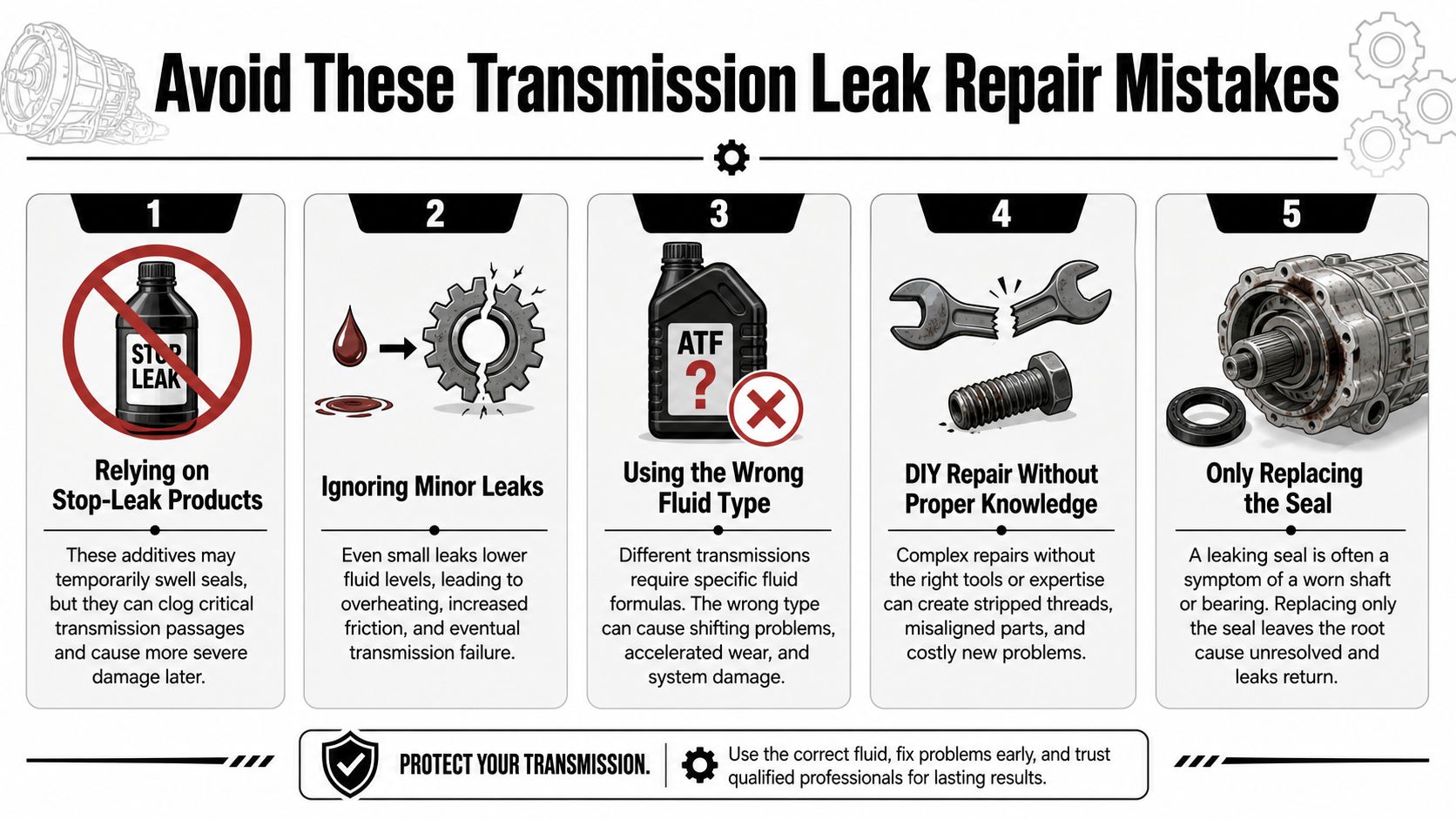
Stop-leak products are rarely the bargain they appear to be
The warning on transmission stop-leak additives covers the mechanical risk, but owners should also understand the paper trail it creates. Once additives are in the unit, a later inspector, buyer, or insurer may treat that as evidence that the transmission was patched rather than properly repaired.
That matters in real valuation disputes. A contaminated fluid system can raise questions about maintenance decisions, warranty compliance, and whether later transmission symptoms came from wear or from the additive itself. A cheap bottle can turn into a credibility problem when the vehicle is appraised or a claim is reviewed.
Overtightening causes fresh leaks
Pan gasket jobs get botched this way all the time. Someone sees wetness around the pan rail and keeps tightening bolts, assuming more force means a better seal.
It often means the opposite. The pan flange can bend, sealing pressure becomes uneven, and the leak returns around the spots that were "fixed." Proper service is slower. Clean the mating surfaces, remove old gasket material, confirm the pan is still flat, install the correct gasket material, and torque bolts in sequence to spec.
Wrong fluid can trigger expensive follow-on damage
Fluid choice is where a basic leak repair can turn into a transmission complaint. CVT, DCT, and many late-model automatics are sensitive to friction characteristics, additive package, and viscosity. Universal fluid claims are not a substitute for the manufacturer specification.
Owners also miss the repair history angle. If the car later develops shift flare, shudder, delayed engagement, or fault codes after a leak repair, the invoice matters. A shop that documented the exact fluid used, the fill procedure, and the final level check leaves far less room for dispute than a vague line that says "top off transmission fluid."
As noted earlier, CarSymp's repair data ties wrong-fluid use and poor leak repair practices to repeat failures and added repair cost. The pattern is familiar in the field. The first invoice looks manageable. The second one is the one that hurts.
Cooler line leaks can escalate faster than owners expect
Cooler lines do not always drip politely for weeks. A cracked rubber section or rusted steel line can go from seepage to active loss once pressure and heat rise.
That is why a car can drive acceptably on one trip and come back with slipping, harsh shifts, or no engagement on the next. If the transmission was run low long enough to damage clutches or overheat internal parts, the conversation shifts from leak repair to major replacement. For owners comparing estimates after that kind of escalation, these examples of dealership transmission and repair costs show how quickly labor, fluid, diagnosis, and follow-on damage stack up.
The hidden danger is poor documentation
A bad repair creates two problems. The leak may still be there, and the service record may now be muddy.
From an appraiser's standpoint, a clear invoice has value. It should identify the leak source, the parts replaced, the fluid specification, and whether the repair was verified after the system reached operating temperature. If that record is missing, the vehicle carries more uncertainty. Uncertainty lowers buyer confidence, weakens claim arguments, and makes it harder to separate a minor external leak from the early stages of transmission failure.
How a Leak Repair Impacts Your Car's Value
A successful repair stops fluid loss. It doesn't erase history.
A transmission leak, even if repaired, can permanently affect market value because it signals possible internal failure or future leak risk to the next buyer, dealer, or insurer. The guidance on transmission leaks and diminished value also points out why this matters in claim disputes. If a vehicle is totaled or evaluated after a leak-related event, owners can face low settlement offers and may need to invoke the Appraisal Clause with a certified appraiser to pursue fair market value.

Why a repaired leak still matters to buyers and insurers
Transmission problems carry stigma because they're expensive and because a leak can be either minor or a sign of deeper wear. A clean invoice helps, but it doesn't remove that concern from the file.
If the vehicle later changes hands, the buyer may wonder:
- Was it just a gasket, or was the unit run low on fluid?
- Did the repair address the cause, or only the symptom?
- Was the correct fluid used and documented?
- Did the leak happen after collision damage or poor prior repair work?
Insurers ask a similar set of questions, just in a different format. They're deciding how much risk sits behind the repaired condition.
Documentation is part of the repair
Owners often save the final invoice and throw away everything else. That's not enough when value is on the line.
Keep a file that includes:
- Initial evidence: Photos of the leak on the ground and on the transmission before work begins.
- Diagnostic notes: Any written statement identifying the source of the leak.
- Repair order details: Part names, fluid type, and labor description.
- Fluid documentation: The exact manufacturer-specified fluid used.
- Follow-up proof: A post-repair note showing the leak was cleaned, tested, and checked for recurrence.
A buyer can live with a repair history. What scares buyers is an unclear repair history.
That same principle applies in insurance negotiations. The more complete your record, the harder it is for someone to reduce the vehicle to a generic software value with no context.
When a leak issue intersects with total loss or diminished value
This becomes especially important after an accident. If impact damage, cooler damage, undercarriage damage, or repair delays contributed to a transmission leak, the insurer may try to separate the leak from the claim or undervalue its consequences.
From an appraiser's perspective, that's where owners lose money. They focus only on whether the repair got approved. They don't focus on what the repair history did to market perception.
A well-documented file gives you an advantage if:
- The insurer calls it a routine wear issue when the timeline says otherwise.
- The carrier totals the vehicle and undervalues it despite the transmission history affecting marketability.
- You pursue diminished value after repair and need to show why the vehicle no longer commands the same market confidence.
If you're facing that kind of dispute, don't rely on the insurer's internal valuation alone. Total loss and diminished value cases often turn on documentation quality, repair context, and whether someone independent is willing to challenge the number.
If your vehicle has a transmission leak in its history and the insurance company is undervaluing your total loss or diminished value claim, Total Loss Northwest can help you challenge that number with a certified independent appraisal. They work with Oregon and Washington vehicle owners to invoke the Appraisal Clause and pursue fair market value based on the actual condition and actual market impact of the damage and repair history.